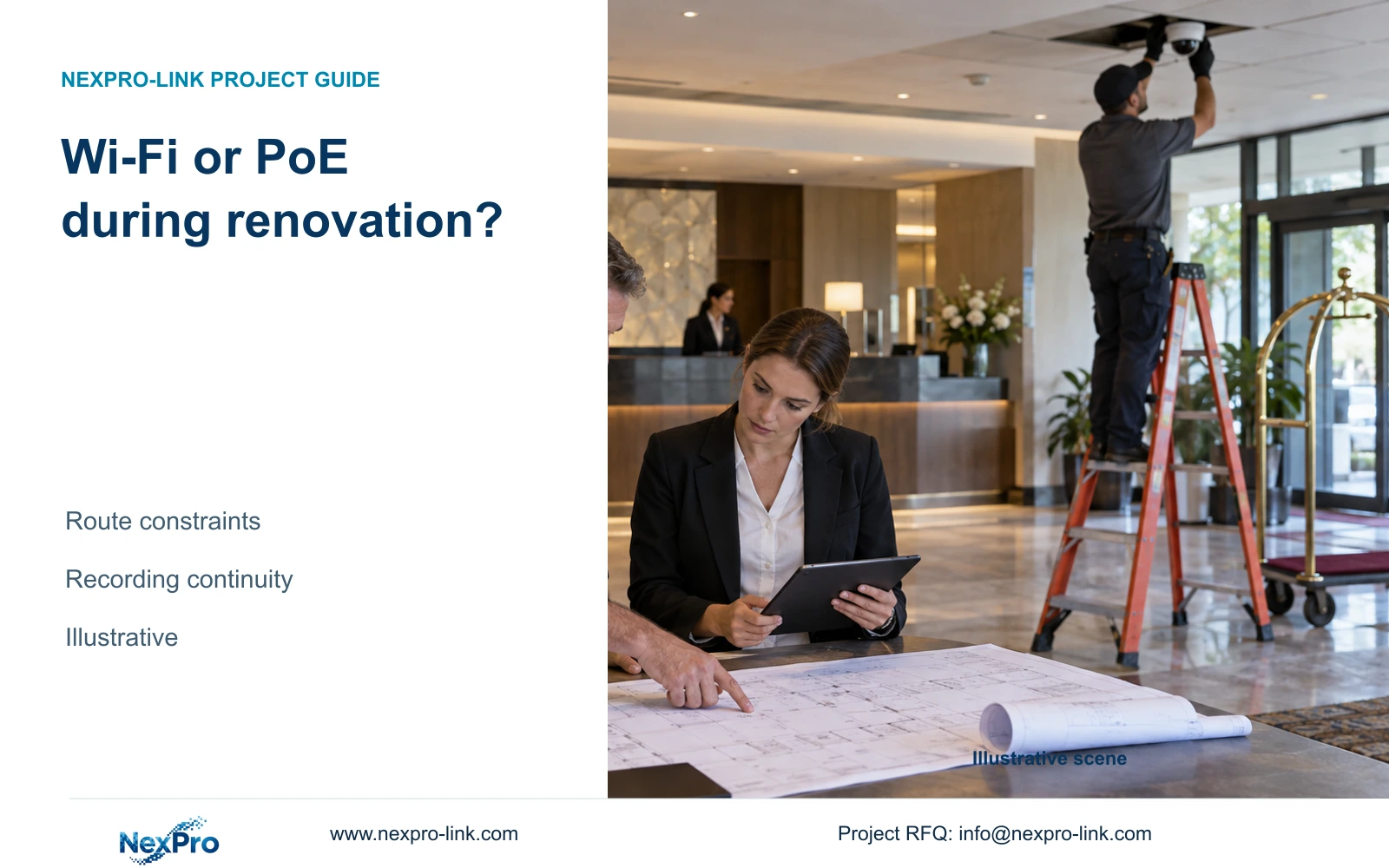
Keep wired PoE where a practical route exists. Consider wireless for documented renovation constraints only after checking capacity, camera power and recording behavior during link loss.
Section 01
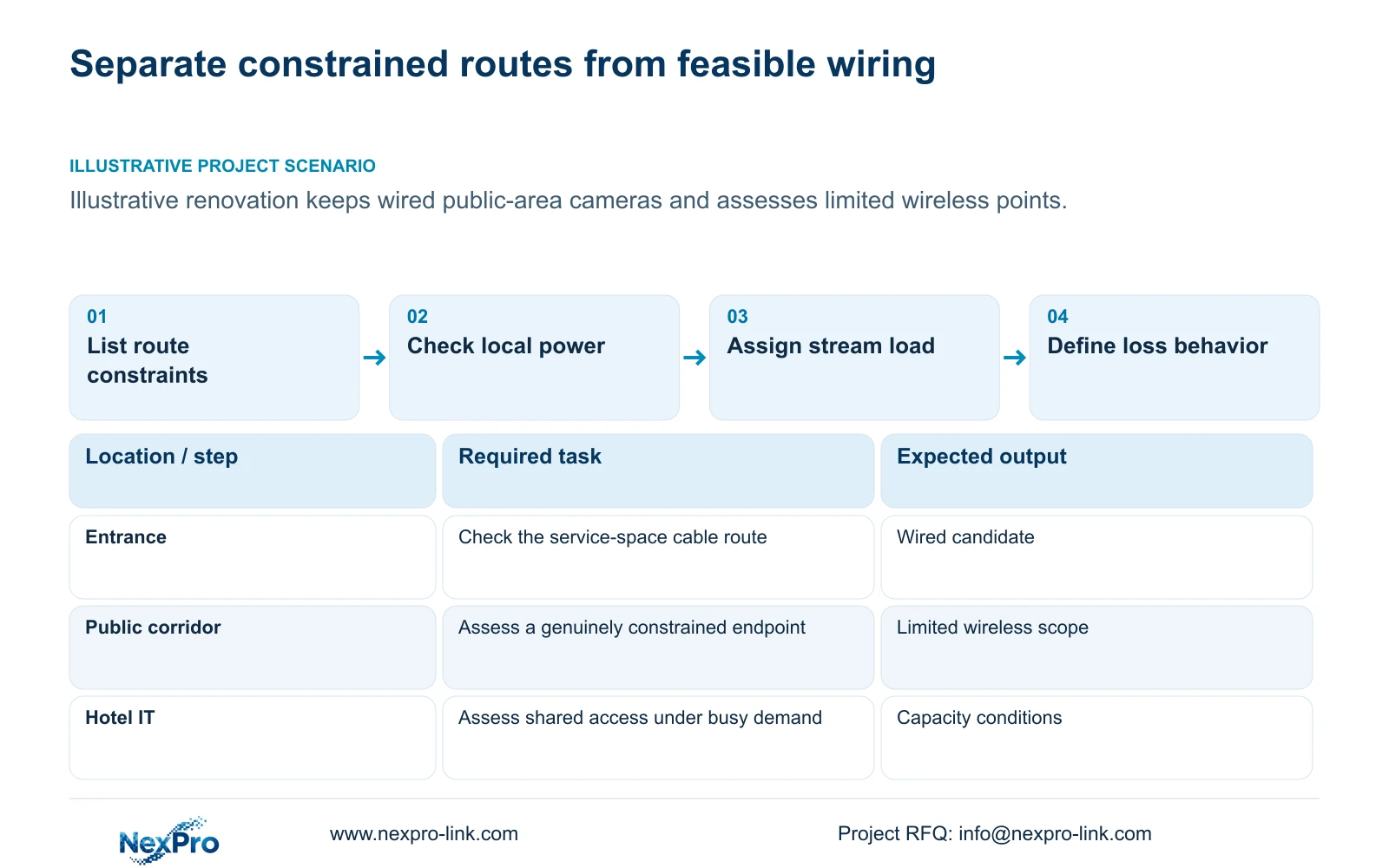
Identify the camera routes that genuinely need wireless
Retain wired PoE where an approved, practical cable route exists. Consider wireless for specific renovation points only after the hotel verifies capacity, local camera power and acceptable recording behavior during connection loss. Existing guest Wi-Fi coverage is insufficient evidence for moving CCTV onto that network.
Create a route schedule for individual public-area cameras. Distinguish a route that cannot be installed from one that is merely inconvenient or requires a different work window. Finished ceilings, restricted access and building boundaries should appear as actual constraints attached to named endpoints. Do not replace this schedule with one average cable length.
Review alternate routes with the installer before declaring a point wireless-only. Keep permanent-link length and patch cords separate, and specify the cable category and installation environment where copper remains feasible. The result can be a mixed system: wired recording paths for accessible areas and a limited wireless proposal for the constrained locations.
| Required task | Given information | Decision still needed |
|---|---|---|
| Record an entrance view | Possible route through a service space | Can the route be approved and installed? |
| Record a constrained public corridor | Proposed cable path crosses a closed finish | Is wireless capacity and local power suitable? |
Section 02
Identify the power wiring that remains
A wireless data connection leaves the camera's power requirement unresolved. Identify the exact camera supply and the approved installation point, then decide whether that supply must remain available during an outage. Include adapters or other supported power equipment in the installed scope, without assuming that they come with an unspecified camera.
Draw the recording dependency chain through the wireless access equipment, its network uplink and the recorder. Each necessary active node needs power. Moving the camera connection away from PoE may change which supplies require protection, even if the central NVR remains on the same UPS.
The supplied BL2812M and DM2812M camera PDFs establish PoE fields, not a Wi-Fi capability. They also omit verified maximum watts. A wireless-capable camera or a separate supported wireless arrangement needs its own specifications. CASE01's camera watt assumptions and aggregate UPS totals do not establish the power budget for this renovation alternative.
Section 03
Estimate streams before assessing wireless capacity
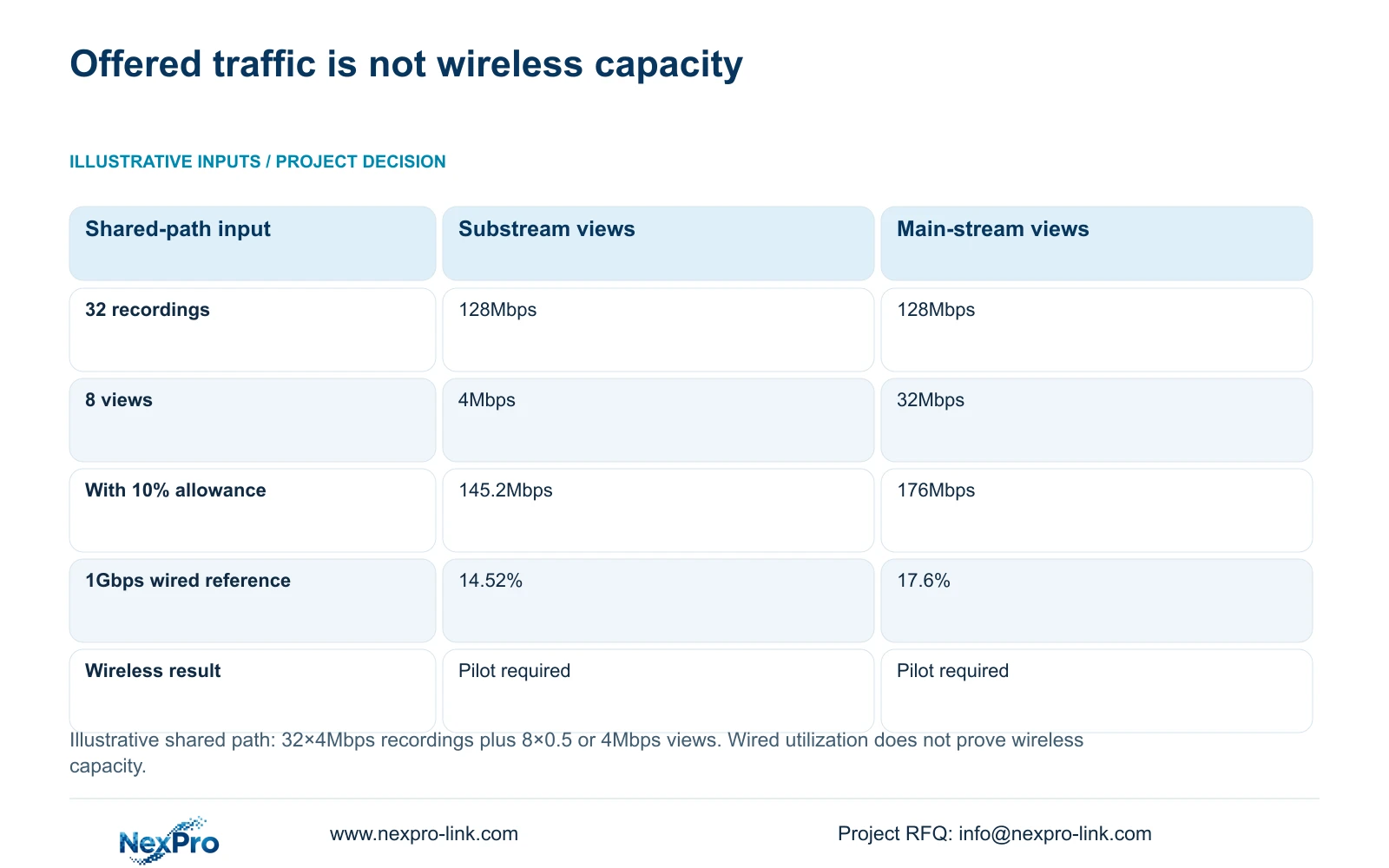
Assign recording streams to the actual wireless connections and access groups. Then identify whether viewing traffic crosses the same segment or is served elsewhere. The supplied example deliberately places 32 recordings and eight viewing streams on one shared path; it is a traffic accounting exercise, not a claim that one wireless access point can support that workload.
At an assumed 4Mbps per recording stream, recording contributes 128Mbps. Eight views at 0.5Mbps contribute 4Mbps; eight views at 4Mbps contribute 32Mbps. Applying the stated 10% allowance gives planned demand = (recording + viewing) × 1.10, producing 145.2Mbps and 176Mbps.
These figures describe offered traffic under the stated conditions. They do not measure wireless airtime, congestion, coverage or sustained useful throughput. The 1Gbps utilization row is a wired nominal-capacity reference only. Wireless acceptance needs an assessment of the proposed location and operating state, with other users' demand included where the infrastructure is shared.
| Metric / condition | Eight substream views | Eight main-stream views |
|---|---|---|
| Recording traffic | 128Mbps | 128Mbps |
| Viewing traffic | 4Mbps | 32Mbps |
| Planned traffic with 10% allowance | 145.2Mbps | 176Mbps |
| 1Gbps nominal utilization | 14.52% | 17.6% |
| Other links | Calculate their own flows | Do not copy this sum to every segment |
Section 05
Define the recording outcome during link loss
Write down what the hotel expects when the wireless link disappears while the camera still has power. Separate live-view loss from loss of new recordings at the central NVR. The proposed equipment must identify its supported behavior; local storage, automatic recovery and later transfer of footage cannot be assumed from the word wireless.
If camera-side recording is proposed, request the exact supported storage and retrieval workflow, including what an authorized operator can recover after reconnection. If that workflow is unavailable, describe the resulting gap openly. A longer NVR retention period cannot recover footage that never reached any recording destination.
Test the relevant exception paths within the limited pilot: wireless loss, unavailable WAN where remote access is used, and loss of a required power supply. Record which local tasks remain possible and how staff recognize the fault. ONVIF support is a function-checking starting point, not proof of every recovery, event or application-binding feature.
Section 06
Approve a limited pilot before extending the scope
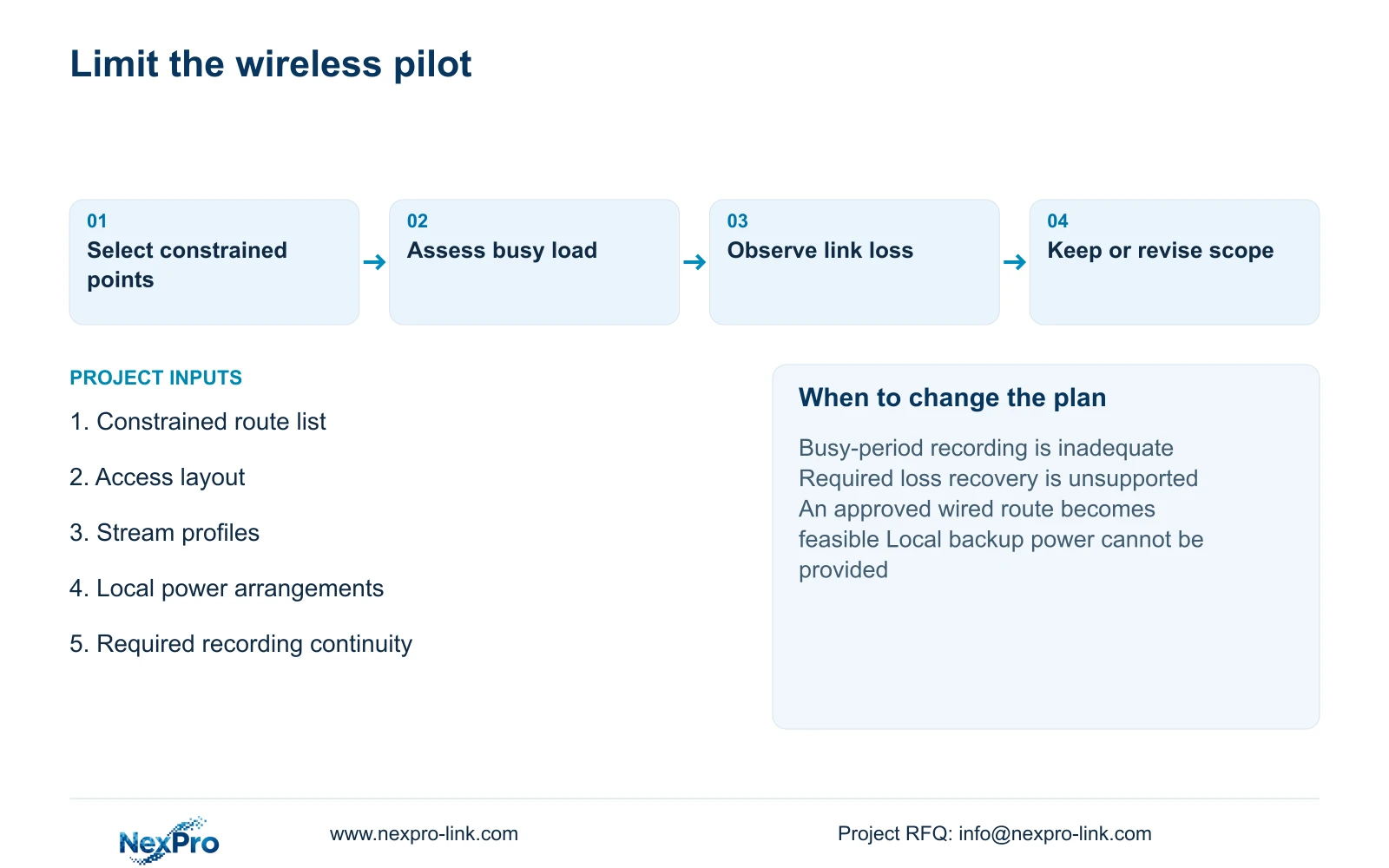
Use wireless only for the documented constrained points whose pilot demonstrates the required recording and retrieval tasks under representative conditions. Keep wired PoE for feasible routes. Change the proposal to a revised wired route or a different supported access arrangement if busy-period capacity or link-loss behavior fails the agreed requirement.
Define the pilot equipment, software versions and camera locations before observing results. Include moving activity in the intended public route, concurrent viewing and the agreed interruption conditions. A successful sample supports the observed configuration and conditions; it does not establish a hotel-wide failure rate or prove every future location.
Compare complete installation costs after assigning shared devices and services once. Include remaining power work, network configuration, testing and operator instructions. SP5648 and DT968MX identify patching components for retained copper links, not an entire cable specification. Send info@nexpro-link.com the constrained-route list, current access layout, stream profiles and required link-loss outcome for a scoped hotel proposal.
Section 07
Buyer questions
Does a separate Wi-Fi name make the camera network suitable? It does not establish available capacity or the recording outcome. Ask IT to identify the actual infrastructure, shared resources and authorized access arrangement, then assess the camera workload in the busy operating state.
Are the supplied PoE camera models also Wi-Fi models? The supplied BL2812M and DM2812M PDFs do not establish Wi-Fi capability. Retain their documented PoE facts and obtain specifications for the exact wireless camera or supported connection arrangement being offered.
What should the pilot prove beyond a live image? An authorized operator should retrieve the required recorded period and verify the agreed behavior during link and power interruption. Record the conditions and limitations. Do not fill in successful results before testing.
Can NexPro-Link price a mixed wired and wireless proposal? NexPro-Link can discuss model matching and coordinated supply against a defined scope. Identify constrained locations and mandatory interfaces first. Wireless hardware, local installation and third-party integration must be explicitly included or excluded.
Engineering references
These sources support the general planning principles. Always use the selected product's current datasheet and applicable project standards for final design.
- BL2812M supplied camera modes and power-field boundaries
- DM2812M supplied camera modes and power-field boundaries
- N01: NexPro-Link Hotel & Hospitality Project Supply
- N02: NexPro-Link BOQ & Tender Support
- O01: ONVIF Profiles and function-matching boundaries
- N05: NexPro SW-POE1618G product record
- N07: NexPro-Link Structured Cabling