List every proposed extender location with access permission, power dependence and supported replacement method. Compare a failed-device visit with service at a new closet, using the hotel's actual access restrictions.
Section 01
Measure the installed route before selecting an extender
List every proposed extender location with access permission, power dependence and supported replacement method. Compare a failed-device visit with service at a new closet, using the hotel's actual access restrictions. Keep unreachable devices unresolved. An advertised distance is not a service-cost saving when the intermediary cannot be maintained as required.
Choose a supported extension arrangement for a few distant cameras only when its documented speed, delivered power and maintenance location meet the required task. Choose a new accessible switch node or fiber access when extension cannot preserve those conditions. The economical option is the complete installed route that remains serviceable, not the device advertising the longest distance.
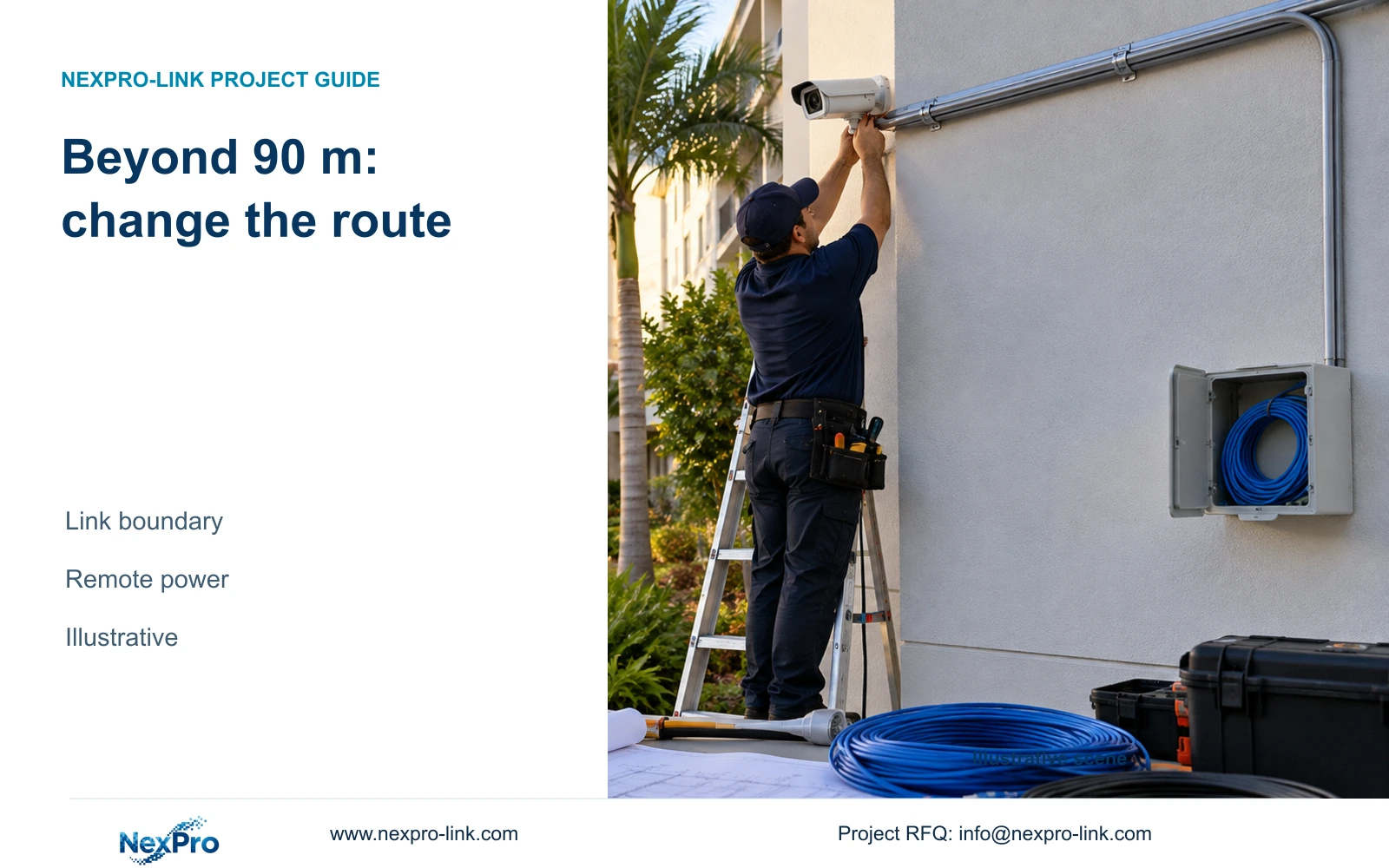
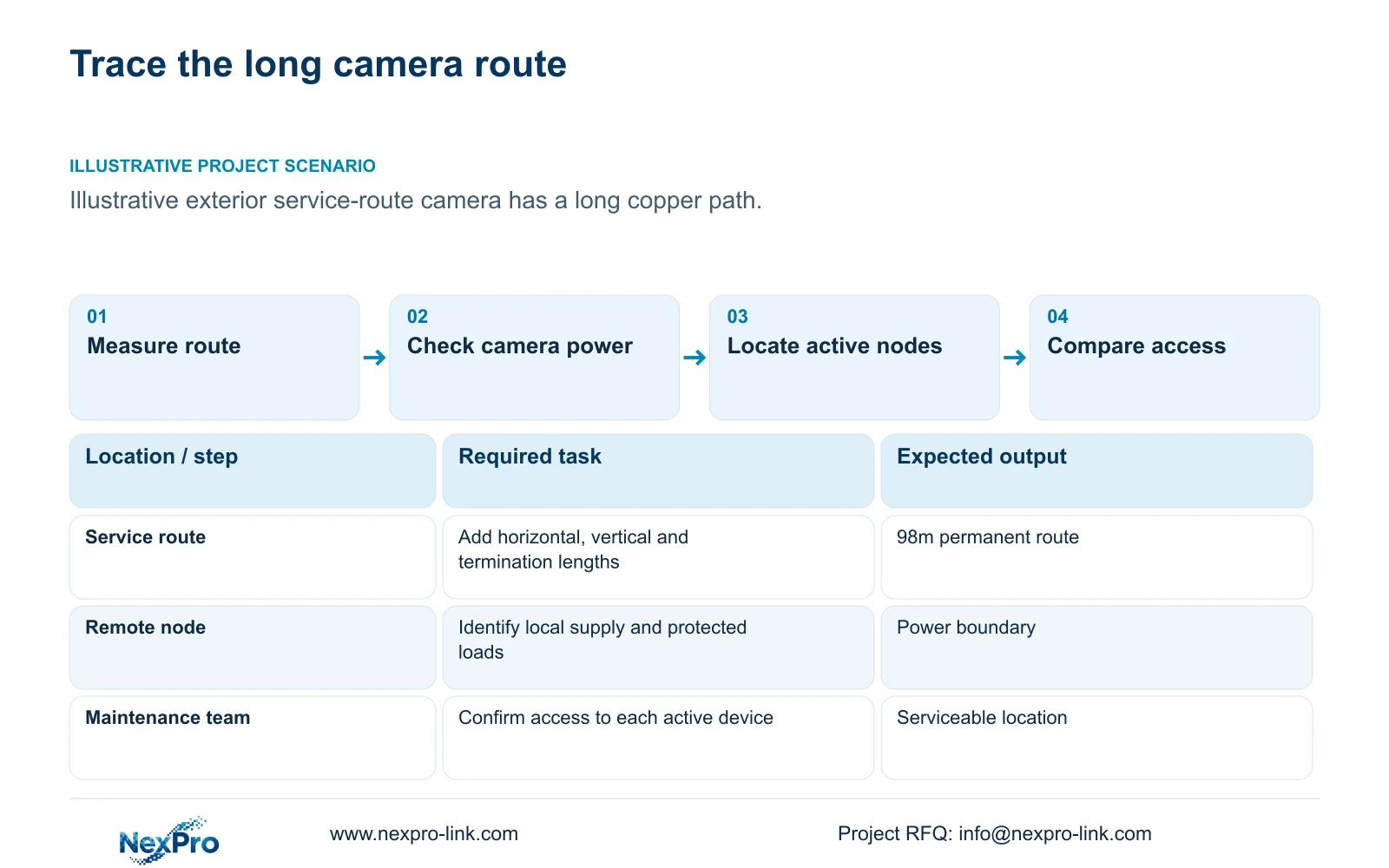
Measure from the actual network endpoint to the camera along the installable path. Include risers, detours around closed areas and termination allowances. A straight line across a floor plan can miss the route that contractors are permitted to use. Record the permanent route separately from patch cords so the comparison uses a consistent length basis.
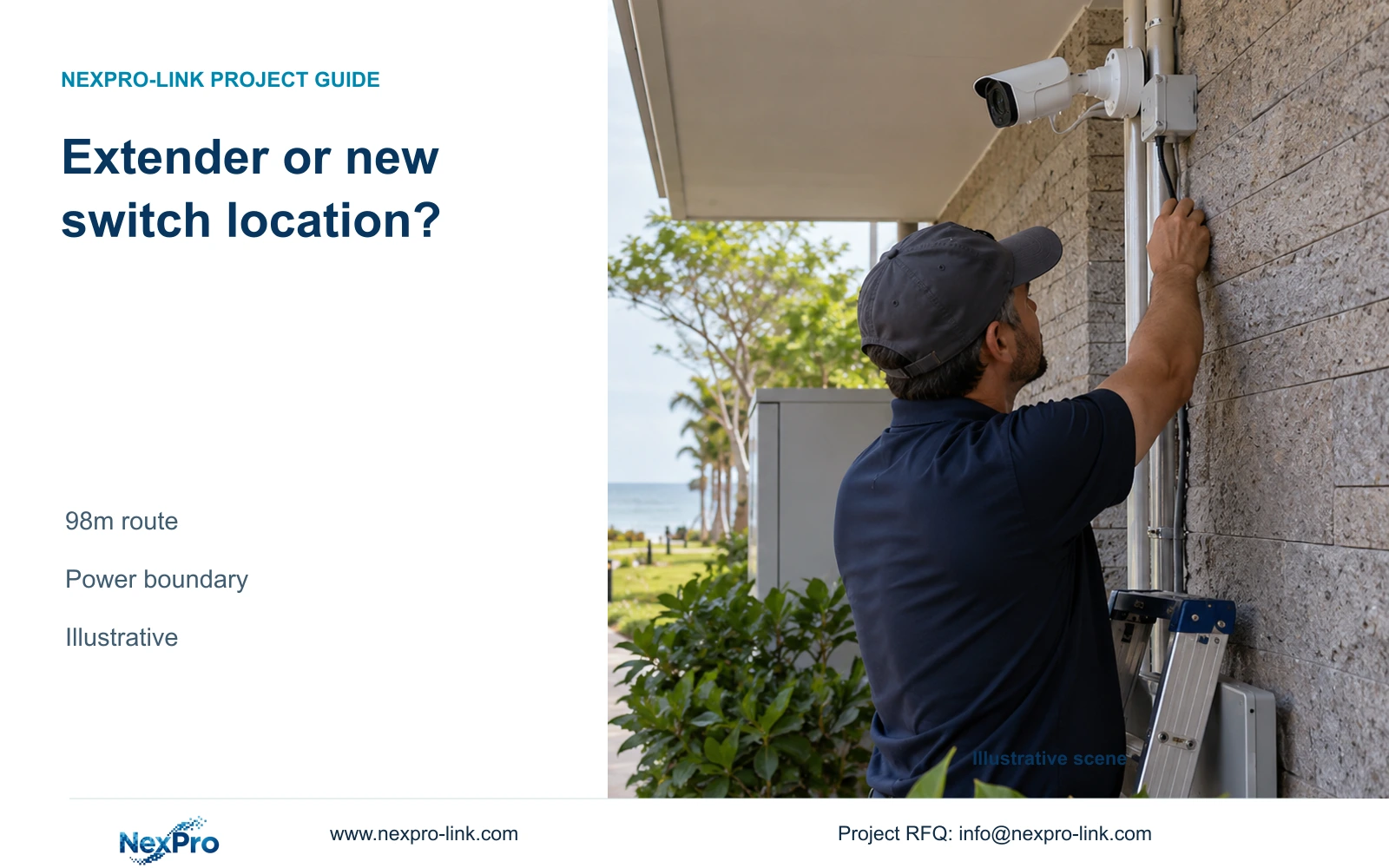
For an illustrative exterior service-route camera, the proposed permanent copper path contains 82m horizontally, 12m vertically and 4m of termination allowance. The total is 98m. The supplied Fluke guidance uses a typical 90m permanent-link basis and a 100m channel basis including patch cords. These different boundaries must not be interchanged.
| Required task | Given information | Decision still needed |
|---|---|---|
| Connect the exterior service view | Permanent route totals 98m | Shorter route, supported extension or remote node? |
| Retain recording during an outage | Remote-node option is available | Which local supply and active devices need protection? |
Section 02
Define the power that must reach the camera
Request the camera's peak powered-device load for the intended operating state, including any selected illumination or other supported loads. Compare that requirement with the extension equipment's documented output at the proposed arrangement. A distance claim does not establish the watts available at the last camera.
Draw the power path independently from the data path. Direct PoE copper carries data and power from its supplying equipment. A fiber backbone carries the data connection to a remote node, which then needs an appropriate supply for itself and its PoE camera outputs. Identify that supply before describing the alternative as complete.
Keep camera-side watts, upstream PoE output and complete switch AC input in separate fields. The supplied BL2812M and DM2812M PDFs do not provide verified maximum watts. CASE01's 12W per camera is a teaching assumption and cannot qualify a real extender or establish this distant camera's consumption.
Section 03
Compare methods within their supported conditions
Evaluate rerouting or relocating the serving connection before adding active equipment. If an approved shorter route meets the selected copper-link basis, it may preserve a simpler power boundary. Where that is unavailable, compare a documented extension arrangement with a remote fiber node and local copper.
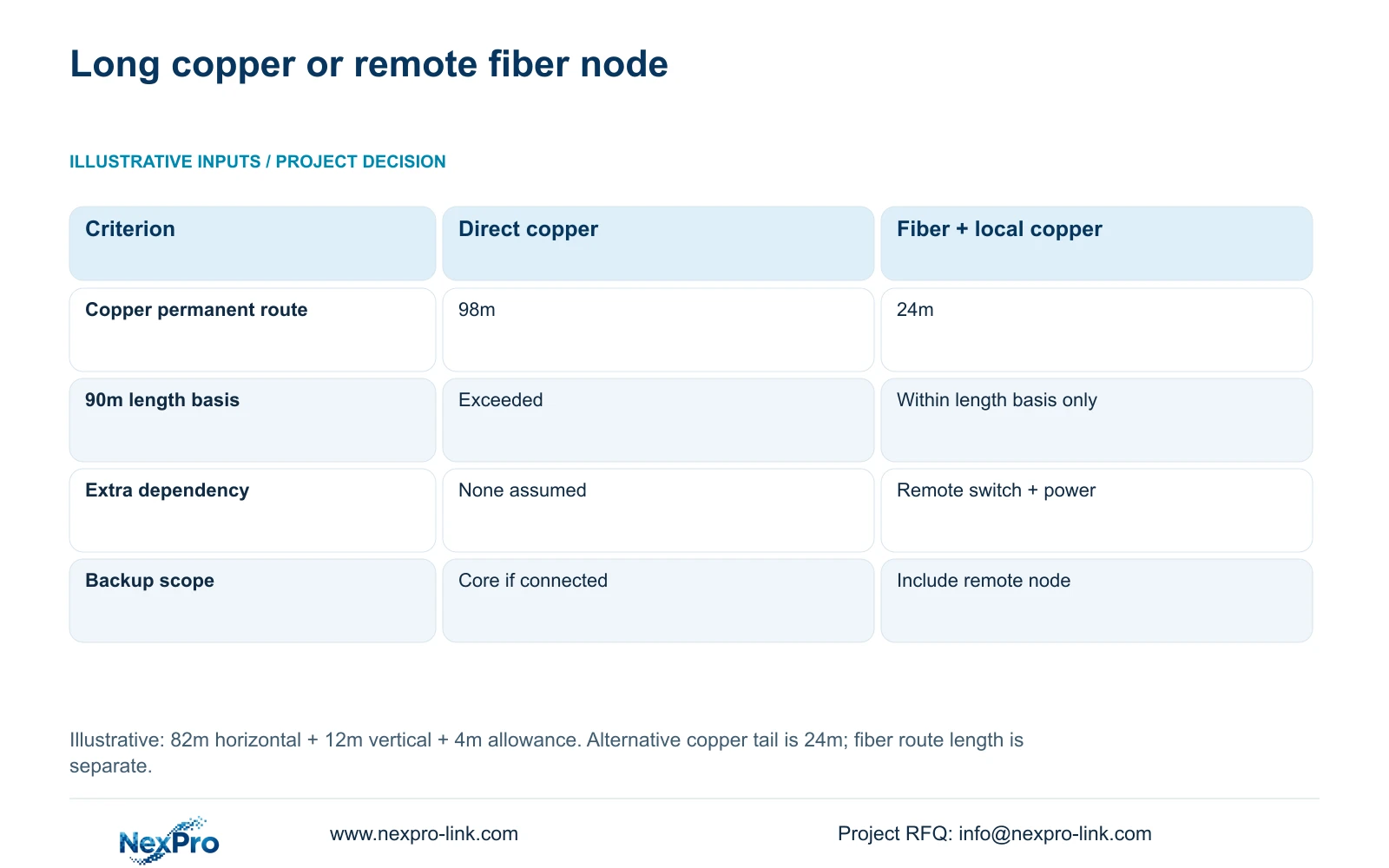
The illustrative route calculation is permanent length = horizontal length + vertical length + termination allowance: 82 + 12 + 4 = 98m. The alternative has a 24m local copper tail. Its fiber backbone is a separate route and is not included in that 24m figure. The table therefore compares the copper segments and their dependencies, not total installed cable quantities.
No named extender specification is supplied. A candidate must identify supported input/output power, link speed and any cascading conditions before selection. Acceptance should include the required recorded view and retrieval workflow under the intended load. A planned demonstration has no pass result until the observations are recorded.
| Metric / condition | Direct copper route | Qualified fiber node + local copper |
|---|---|---|
| Planned copper permanent route | 98m | 24m |
| Typical 90m permanent-link basis | Exceeds this basis | Within length basis only |
| Extra active dependency | None assumed | Remote switch and local power |
| Backup boundary | Core supply if fully connected | Remote node must also be protected |
Section 04
Count every extra active dependency
The 24m tail removes the stated copper-length problem, but it adds a remote switch and local power dependency. Include the node's enclosure, environment and maintenance access. If it serves several cameras, record the views affected by its loss; the device count alone does not describe the operational consequence.
An extender also becomes an intermediate dependency even when it draws power through the upstream route. Document where it sits, how technicians reach it and how its failure is isolated. A device hidden above a sealed public-area ceiling can create a repair task that extends beyond replacing a small interface.
For outage continuity, trace the camera through every required network node to the recorder. Protect the relevant remote supply or explicitly state the views that stop recording. A protected NVR cannot receive footage from an unpowered intermediate switch. CASE01's aggregate power budget illustrates system accounting, but does not provide a central power design for this independent route.
Section 05
Compare the full installation and service scope
Prepare comparable quotations with the same camera task, recording requirement and outage behavior. Include route work, termination and testing, then add the active devices and their power arrangements. For a new closet, include the usable enclosure or cabinet location and the work required to make it accessible. Keep optional future capacity separate.
Compare a small extension purchase against the cost of servicing its chosen location. A remote node can be worthwhile when several approved endpoints share it or when fiber resolves the documented route boundary. Its counter-condition is unavailable local power or an unsuitable service location. No supplied prices establish which alternative is cheaper.
Use product identities accurately in the schedule. SP5648 is a Cat6 48-port patch panel and DT968MX is a Cat6 module; neither identifies the entire cable. NexPro SW-POE1618G has 16 PoE ports and two uplinks, but its access-speed fields conflict and total PoE watts are unstated. Keep it as an inquiry candidate until the relevant fields are resolved.
Section 06
Select a route that technicians can maintain
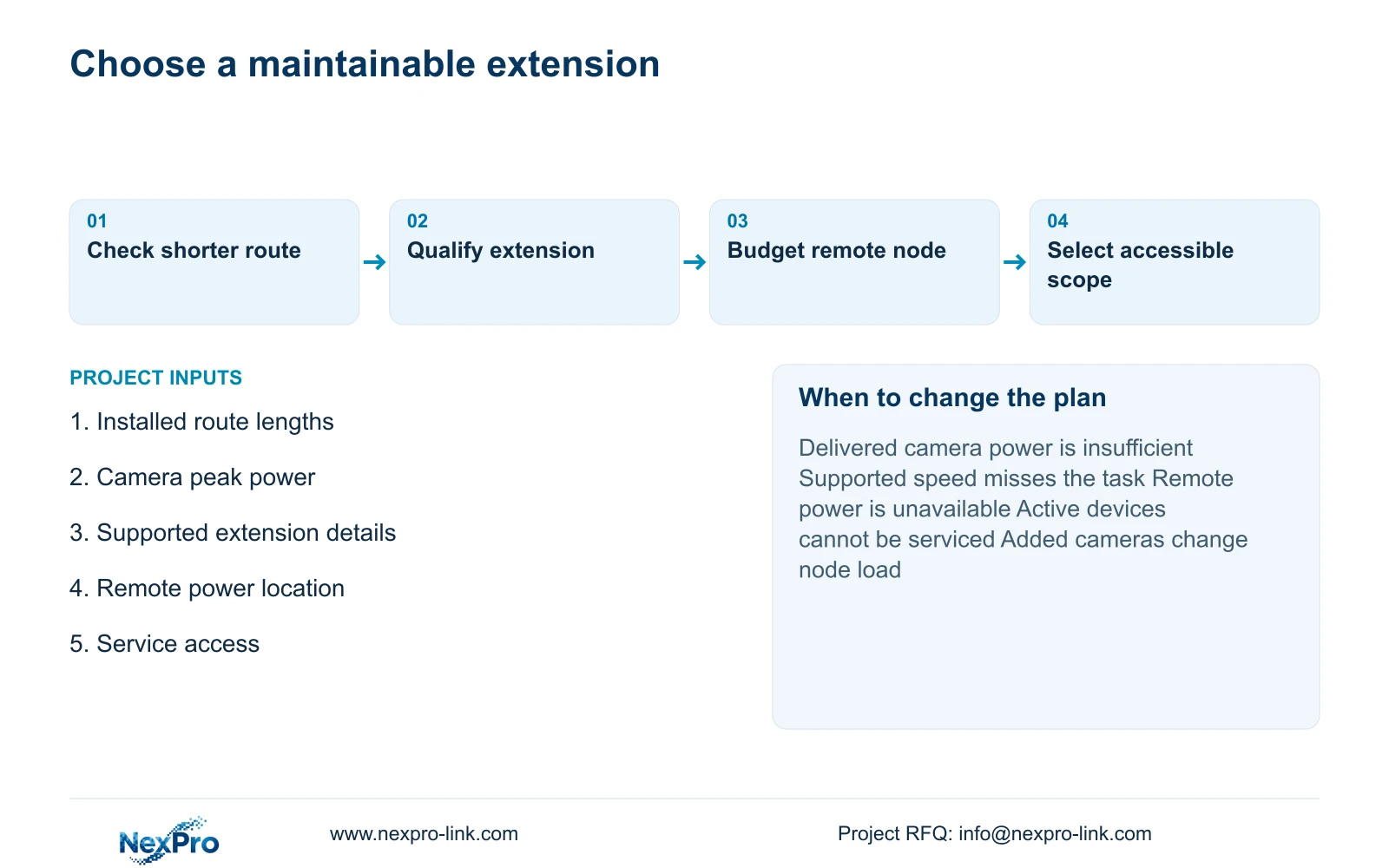
For the 98m example, do not accept direct copper solely because it is near a different channel-length figure. First examine an approved shorter route. If shortening is unavailable, select a supported extension only after its speed and final delivered power are documented; use an accessible fiber node when that arrangement better meets the task and protected-power requirement.
Change the proposal if additional cameras alter the node load, if the route crosses a different building boundary, or if the planned service location cannot remain accessible. Confirm the physical route and local electrical requirements with the responsible specialists. This comparison is a design method, not an installation wiring instruction.
Send info@nexpro-link.com the long-route schedule, camera power requirements, proposed remote-node locations and available local power, plus the required outage state. NexPro-Link can help match equipment and coordinate a BOQ. Its CCTV manufacturing core and supporting equipment supply should be identified separately, with local route work and commissioning responsibilities explicit.
| Situation | Required record | Decision boundary |
|---|---|---|
| Hidden intermediary proposed | Access permission and replacement route | Retain only maintainable locations |
| New closet offered instead | Equivalent task and local work scope | Compare complete service arrangements |
| Access remains unavailable | Unresolved location and responsible owner | Do not count distance as a closed design |
Section 07
Buyer questions
Is a 98m permanent route acceptable because the channel limit is 100m? That substitutes a different boundary. The supplied typical permanent-link basis is 90m, while the 100m channel includes patch cords. Assess the installed arrangement against its specified test basis and any explicitly supported alternative.
Can fiber power the distant camera? The fiber data connection does not automatically supply camera power. A remote PoE node needs an appropriate local supply and, when required, backup protection. Include those items in the comparison.
What evidence should accompany an extender offer? Request the exact device and arrangement, supported speed, output power at the proposed load, cascading limits and installation conditions. Also identify the maintenance location and the tasks to demonstrate before accepting the route.
Engineering references
These sources support the general planning principles. Always use the selected product's current datasheet and applicable project standards for final design.
- BL2812M supplied camera modes and power-field boundaries
- DM2812M supplied camera modes and power-field boundaries
- O02: Fluke Networks cable-testing guidance
- N05: NexPro SW-POE1618G product record
- N07: NexPro-Link Structured Cabling
- N02: NexPro-Link BOQ & Tender Support
- N01: NexPro-Link Hotel & Hospitality Project Supply