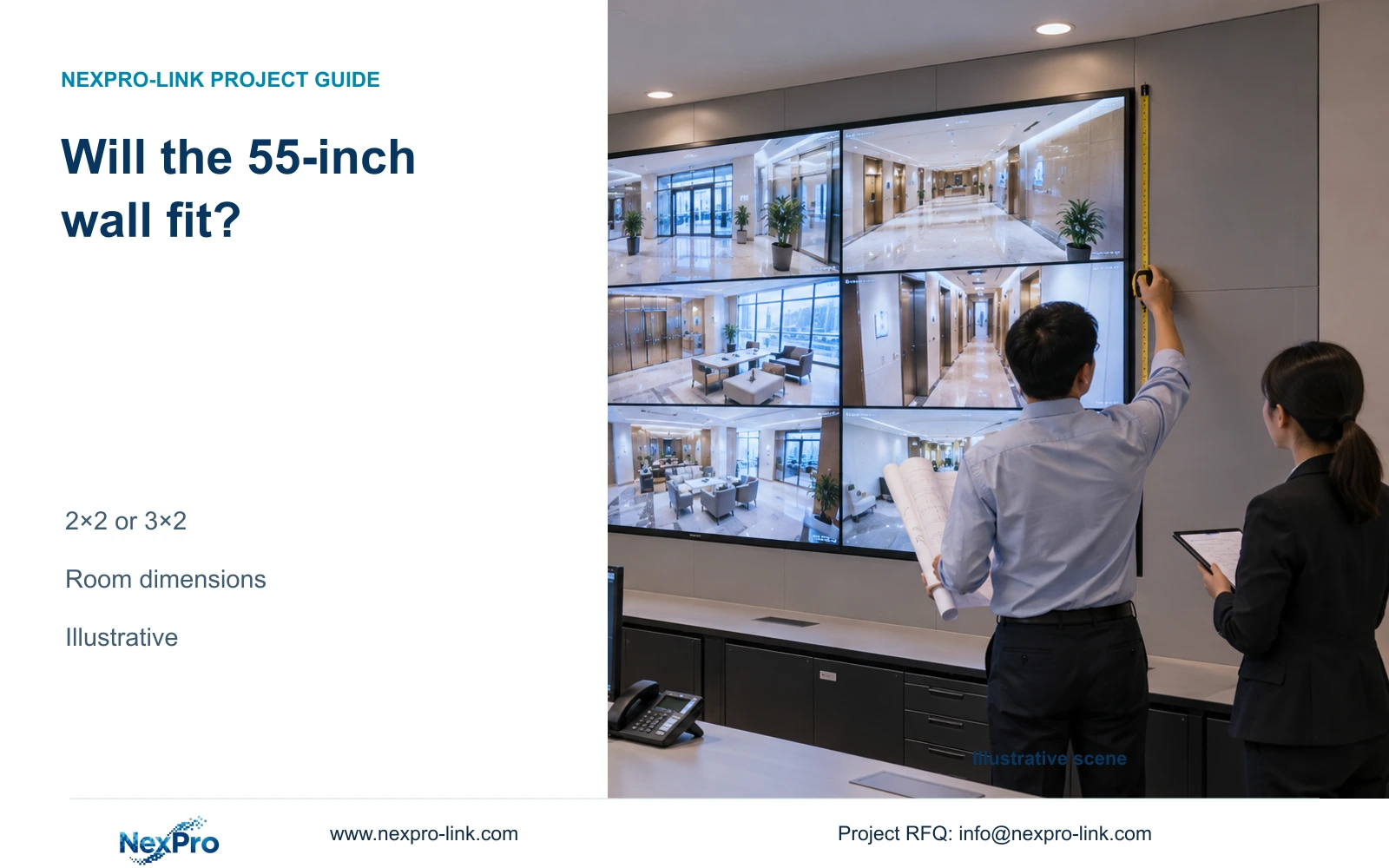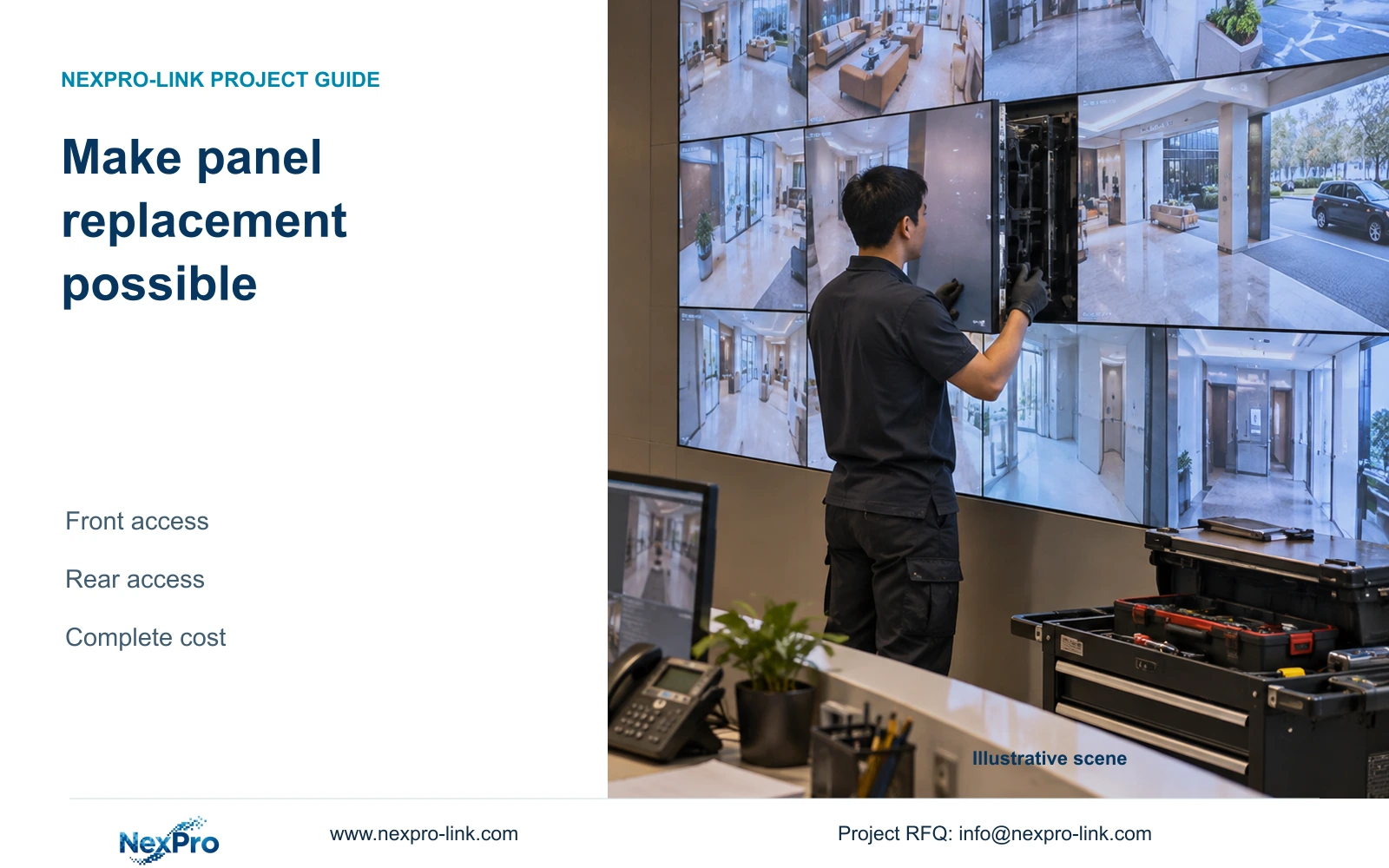
Choose the maintenance method with the panel and mounting assembly, then price the space and replacement process. Front or rear access is a buildability decision, not a label on a screen quote.
Section 01
Choose the service method for the complete wall assembly
Choose front access when the selected panel and mounting assembly support the required service work and the room has usable working space in front. Choose rear access when an accessible service area and the actual equipment arrangement make that method workable. Price either option with its structure and replacement process before comparing commercial totals.
Define maintenance in practical terms: reaching connections, inspecting the mounting arrangement, removing a panel and restoring the operating layout. A front-access description must identify which operations it permits. A rear-access proposal must show how technicians enter and work behind the wall. Neither description establishes the necessary clearance without the selected assembly's information.
NX-VP-5535 is a published 55-inch Full-HD LCD candidate, but the supplied record does not establish its maintenance access, mounting travel, weight or service clearances. Those details belong in the equipment submission. Keep the intended viewing task and panel quantity consistent between alternatives so a lower quotation does not conceal a reduced scope.
| Required task | Given information | Decision still needed |
|---|---|---|
| Reach connections | Panel and mounting assembly not fully defined | Supported access route and working clearance |
| Replace a panel | Wall must return to its operating layout | Removal sequence, handling route and reinstatement |
Section 02
Measure the space used during a service intervention
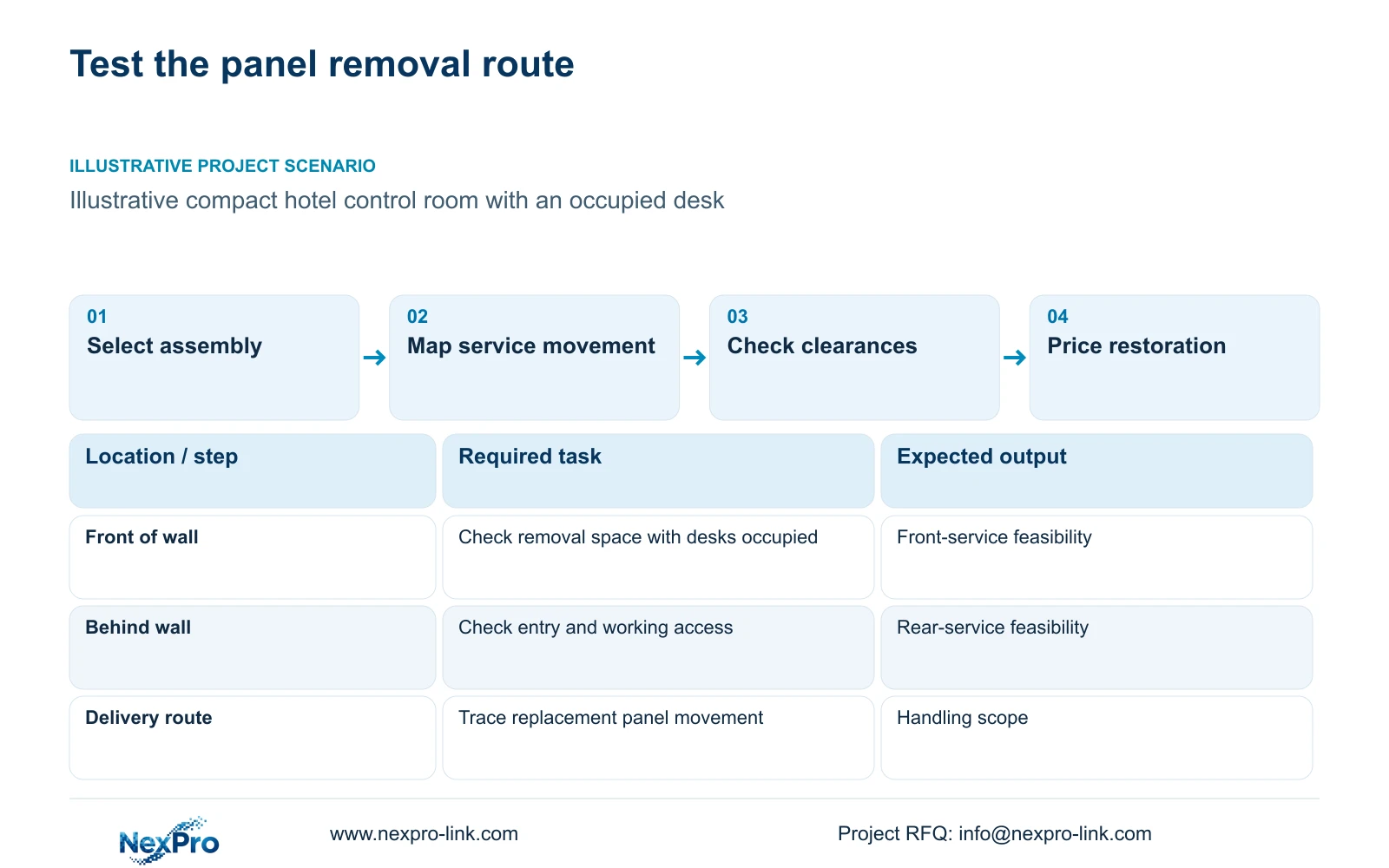
Measure the room in its operating condition and its maintenance condition. Include occupied desks, door swings and routes used to bring equipment into the room. Front service may require temporary working space where staff normally sit. Rear service depends on access to the back of the assembly, including the path to that space.
Use the actual panel and bracket information to establish removal movement and cable access. Do not assign a universal clearance to every hotel wall. A drawing that shows the installed panel footprint can still omit the space needed to release or carry it. Identify whether furniture must move and who can authorize that disruption.
Record unresolved dimensions as pricing qualifications. An unknown mounting depth or service route should not become a zero-cost assumption. Compare alternatives on the same room and required outcome, while stating the additional space or temporary relocation each uses. If neither method fits safely within the approved room arrangement, revise the display size or location before selecting a commercial winner.
| Item | Front-access proposal | Rear-access proposal |
|---|---|---|
| Working space | Confirm space in front during removal | Confirm usable space behind the assembly |
| Operator disruption | Assess desk and seating relocation | Assess access to the rear service route |
| Missing dimensions | Keep bracket movement unresolved | Keep rear depth and access unresolved |
Section 03
Compare mounting structures over a stated cost period
Obtain comparable quotations for panels, mounting assemblies and supporting work. Separate equipment from installation, freight, taxes and later services. A more expensive mounting option may change intervention effort, but that benefit needs an actual service scope. Front access must not automatically be assigned lower maintenance cost, and rear access must not automatically be assigned lower initial cost.
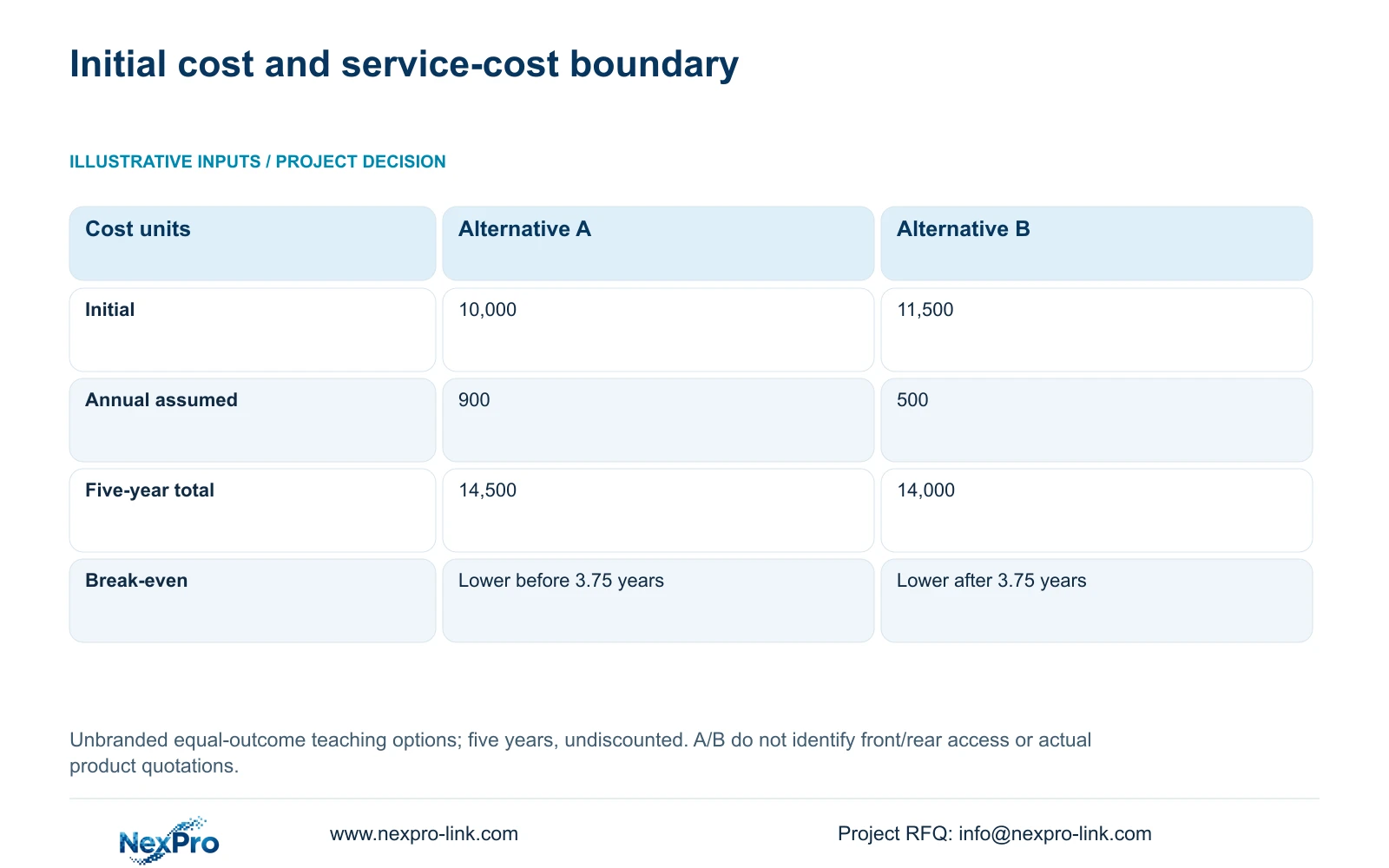
The illustrative alternatives below are deliberately unbranded and are not assigned to either access method. A has an initial cost of 10,000 cost units and an assumed annual cost of 900. B starts at 11,500 with an assumed annual cost of 500. Both are assumed to deliver equal required outcomes over five years, without discounting.
Calculate the five-year total as initial cost + 5 × annual cost. Calculate break-even time as (11,500 − 10,000) ÷ (900 − 500) = 3.75 years. B is 500 cost units lower at five years. This supports investigating recurring intervention costs when the evaluation period exceeds 3.75 years; it does not prove that any particular wall assembly will achieve those costs.
| Metric / condition | A: lower initial cost | B: lower recurring cost |
|---|---|---|
| Initial teaching cost | 10,000 | 11,500 |
| Annual assumed cost | 900 | 500 |
| 5-year undiscounted total | 14,500 | 14,000 |
| Break-even time | Before 3.75 years: A lower | After 3.75 years: B lower |
| Actual tender ranking | Requires scope-matched quotations | Not established by this example |
Section 04
Estimate the work needed to remove and restore a panel
Break an intervention into the work actually required by the selected assembly. Include approved isolation, access preparation, handling, connection work and restoration of the display arrangement. Ask the responsible installer to identify labor and access equipment from that sequence. Without a documented intervention basis, an annual maintenance allowance remains a commercial assumption.
Keep one-time installation and recurring service allowances separate. Check whether the mounting quotation already includes setup or alignment so the same work is not added again elsewhere. Where an option requires temporary furniture relocation or a different access arrangement, price that consequence explicitly instead of hiding it within a panel rate.
Use the 3.75-year example as a sensitivity boundary. A shorter evaluation period favors A under the stated inputs; a longer one favors B. Actual intervention costs can reverse that result. The example contains no brand failure rates and cannot be added to the complete hotel's equipment totals. Rebuild the comparison from qualified quotations before recommending an access method on cost grounds.
Section 05
Plan the replacement route and service responsibility
Trace the replacement route from the delivery point to the wall, including storage and movement through the building. Confirm the selected assembly's handling requirements and the destination's practical access conditions. A panel that fits the finished wall may still require a different route or handling arrangement for removal.
Keep spare availability separate from warranty entitlement. The supplied public policy states a 24-month limited hardware baseline from receipt for applicable main equipment, subject to controlling written order terms. It does not automatically include site labor, travel, return freight or every accessory. Agree those boundaries before using a warranty term as the maintenance budget.
A limited spare arrangement may help an agreed restoration task when the replacement scope is verified. It does not eliminate local handling or configuration work. Retain model and version records, review compatibility after system changes, and confirm RMA authorization and symptoms before return shipment. Equipment containing credentials or guest recordings needs an approved data-handling process rather than an unsolicited return.
Section 06
Approve a wall detail that includes the service operation
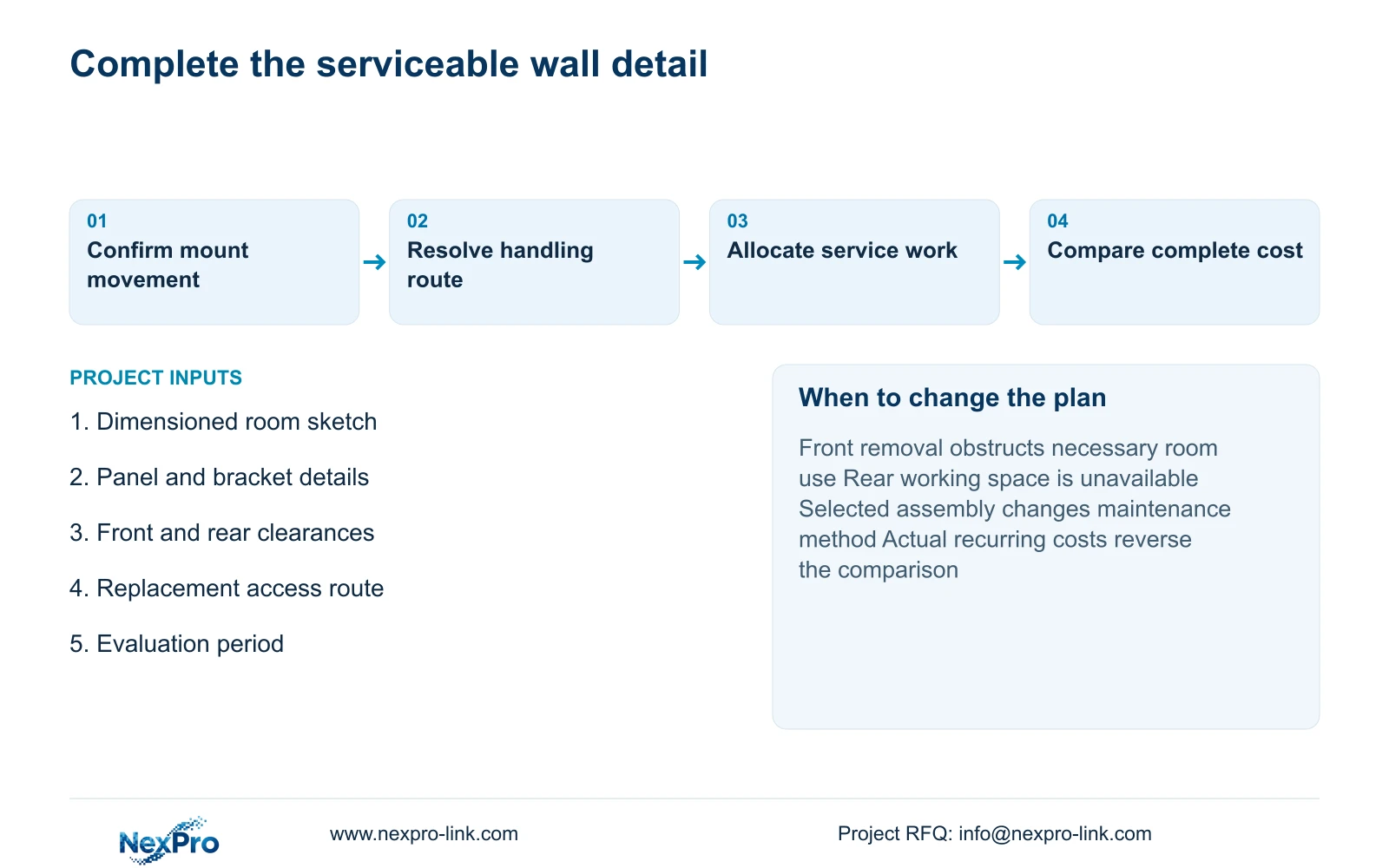
The buildable detail should identify the selected panel and mounting assembly, installed arrangement, service movement, cable route and replacement access. Allocate structural and local installation responsibilities explicitly. A rendering of the finished wall cannot substitute for these inputs, and a screen-only quotation leaves the access decision unresolved.
Recommend the simplest assembly that supports both operator viewing and the agreed maintenance operation. Change the front-access preference if removal obstructs necessary room use or the selected assembly cannot provide the required access. Change the rear-access preference if the rear space or replacement route is unavailable. Where both are buildable, compare complete costs over the buyer's stated period.
Send a dimensioned room sketch, wall section, proposed panel and bracket information, replacement route constraints and evaluation period to info@nexpro-link.com. NexPro-Link can discuss coordinated equipment and BOQ support; local structural design and installation should remain separately assigned. A smaller display is a valid alternative if the required viewing task can be retained and neither wall access method is practical.
Section 07
Buyer questions
Does a front-access bracket guarantee complete front maintenance? No. Confirm which connections and components can be reached and how the selected panel is removed. The access method belongs to the complete assembly and service sequence, not the bracket description alone.
Is the lower annual-cost alternative always worth its higher initial cost? Under the teaching inputs it becomes less expensive after 3.75 years. Actual quotations, intervention scope and the evaluation period may reverse the result. The example does not assign those costs to front or rear access.
What information is needed before a replacement allowance can be priced? Provide the exact panel and mount, removal route, handling requirements, local service responsibility and delivery basis. Identify what the equipment warranty includes separately from site labor and restoration work.
Engineering references
These sources support the general planning principles. Always use the selected product's current datasheet and applicable project standards for final design.