A seamless LED surface is useful only when its native canvas and service arrangement suit the room. Compare equal physical areas and the same operator tasks before buying.
Section 01
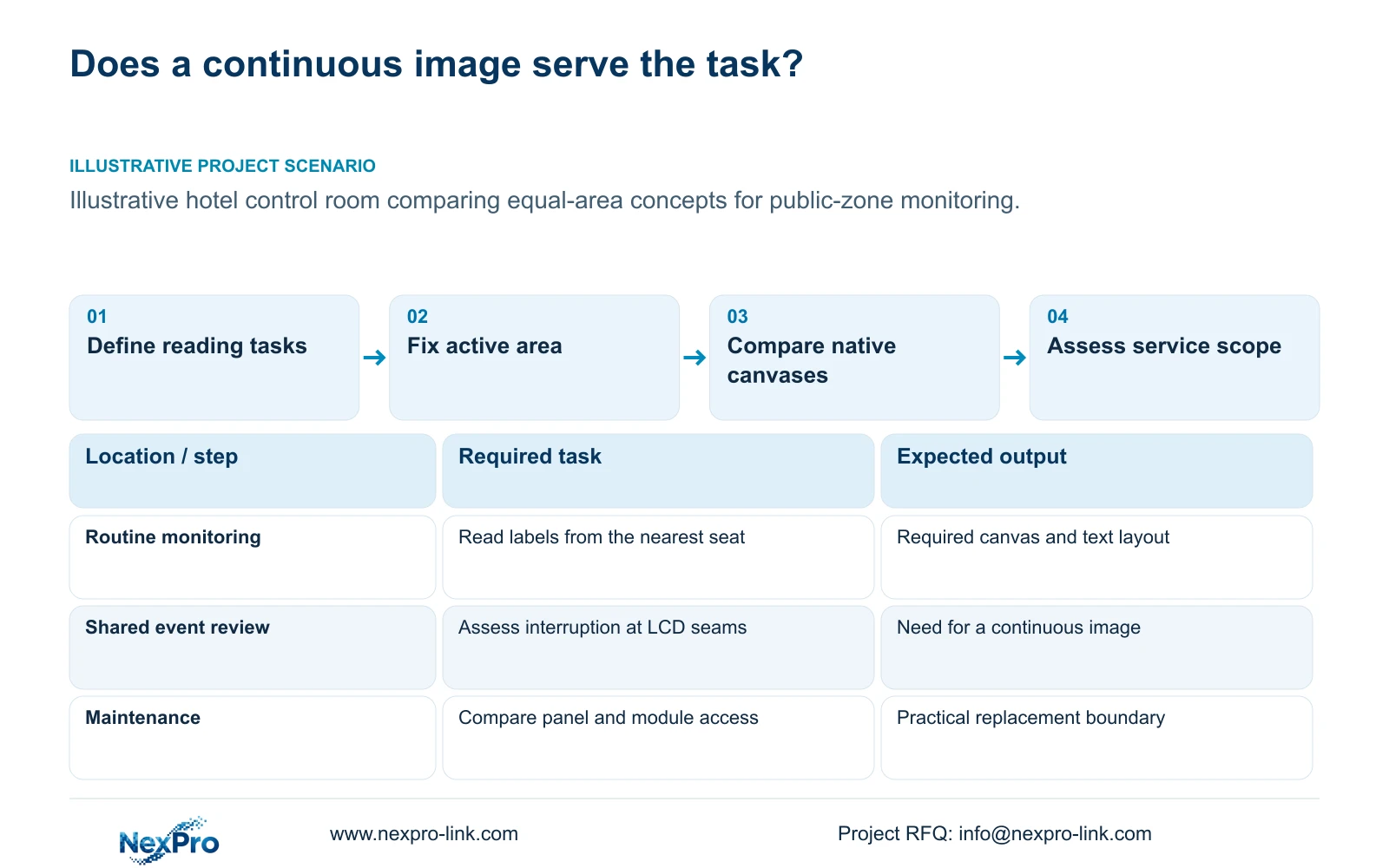
Choose the reading task before the display technology
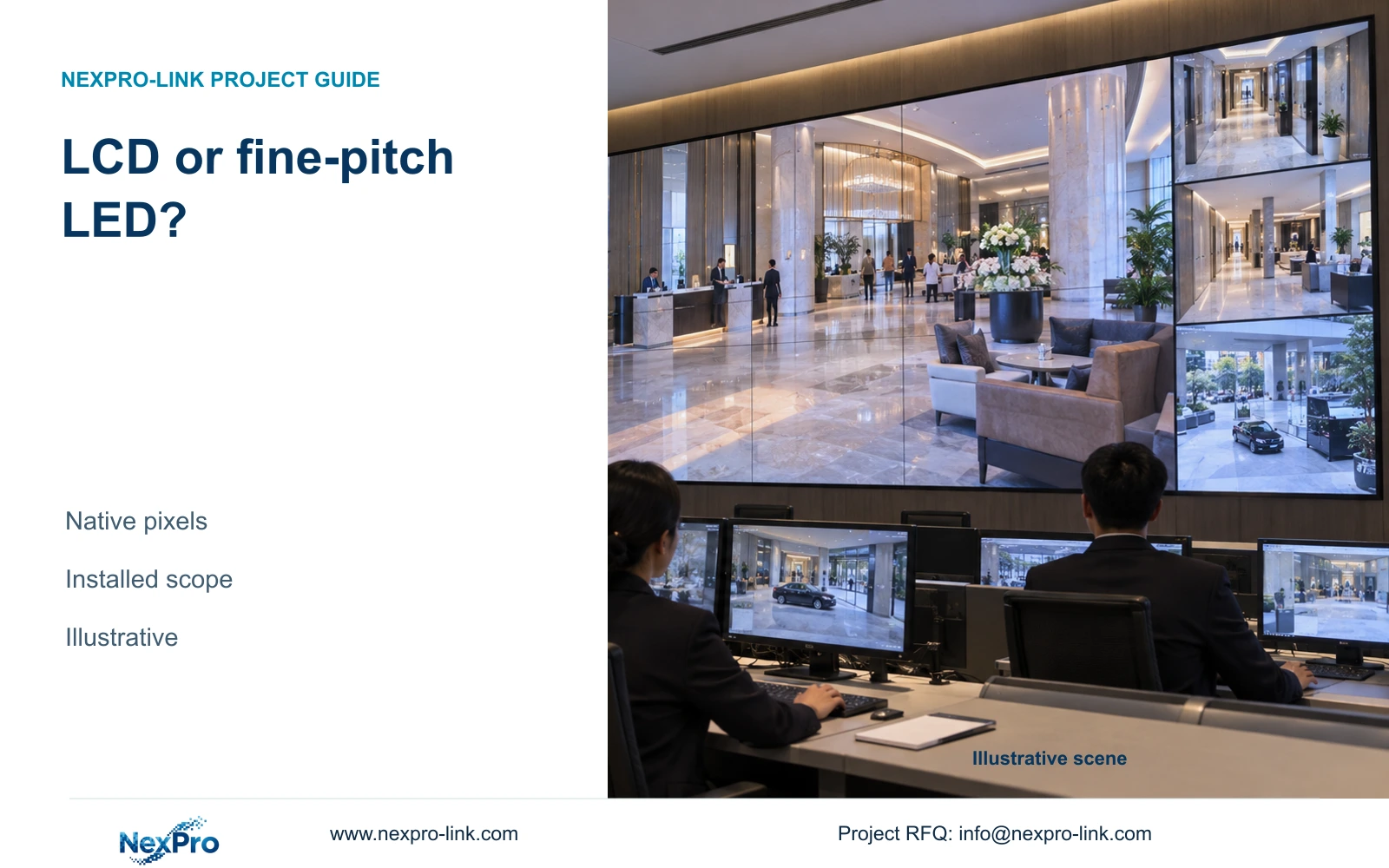
Choose LCD when it satisfies the hotel's required reading tasks and its seams can be accommodated in the layout. Consider fine-pitch LED when a continuous image surface has a defined operational benefit and the proposed native pixels, seat readability and maintenance arrangement meet the same requirements. A seamless appearance alone does not justify changing a small security room to LED.
List the information that must remain visible during routine observation: entrance views, public circulation views and any required labels or alerts. Then define the investigation state, including event enlargement and playback. A display that suits a large overview may still be unsuitable for small interface text from the nearest operating seat.
Use the room drawing to establish the available active width and height, nearest observer and farthest observer. Compare technologies at the same intended physical area and content layout. If one proposal changes the wall size or viewing task, identify that change explicitly so its apparent advantage is not attributed entirely to the display technology.
| Required task | Defined input | Decision still needed |
|---|---|---|
| Read public-zone labels | Nearest seat and normal layout | Required native canvas and text size |
| Review enlarged events | Shared image crosses panel boundaries | Whether LCD seams obstruct the task |
Section 02
Calculate the LED canvas at a fixed physical size
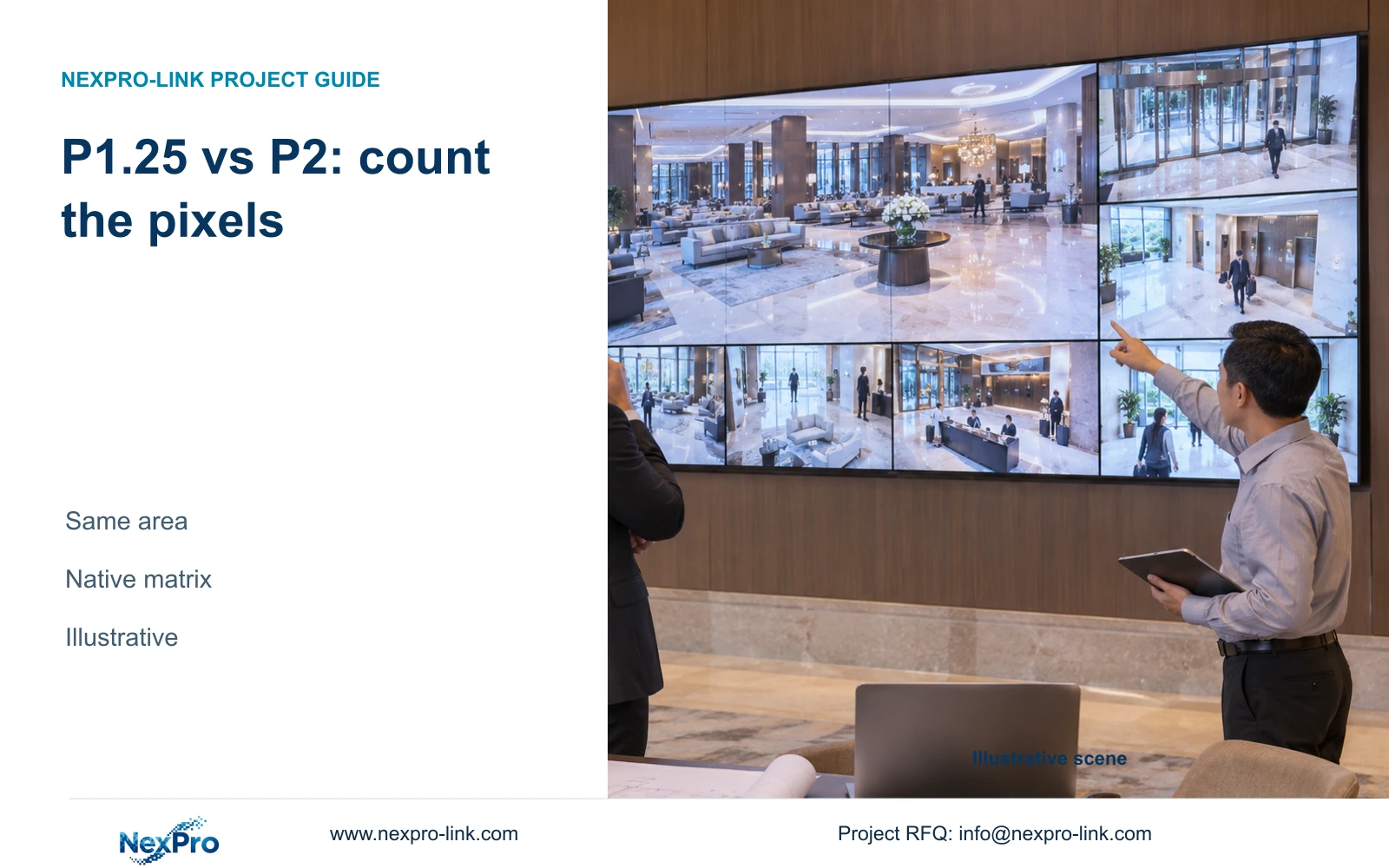
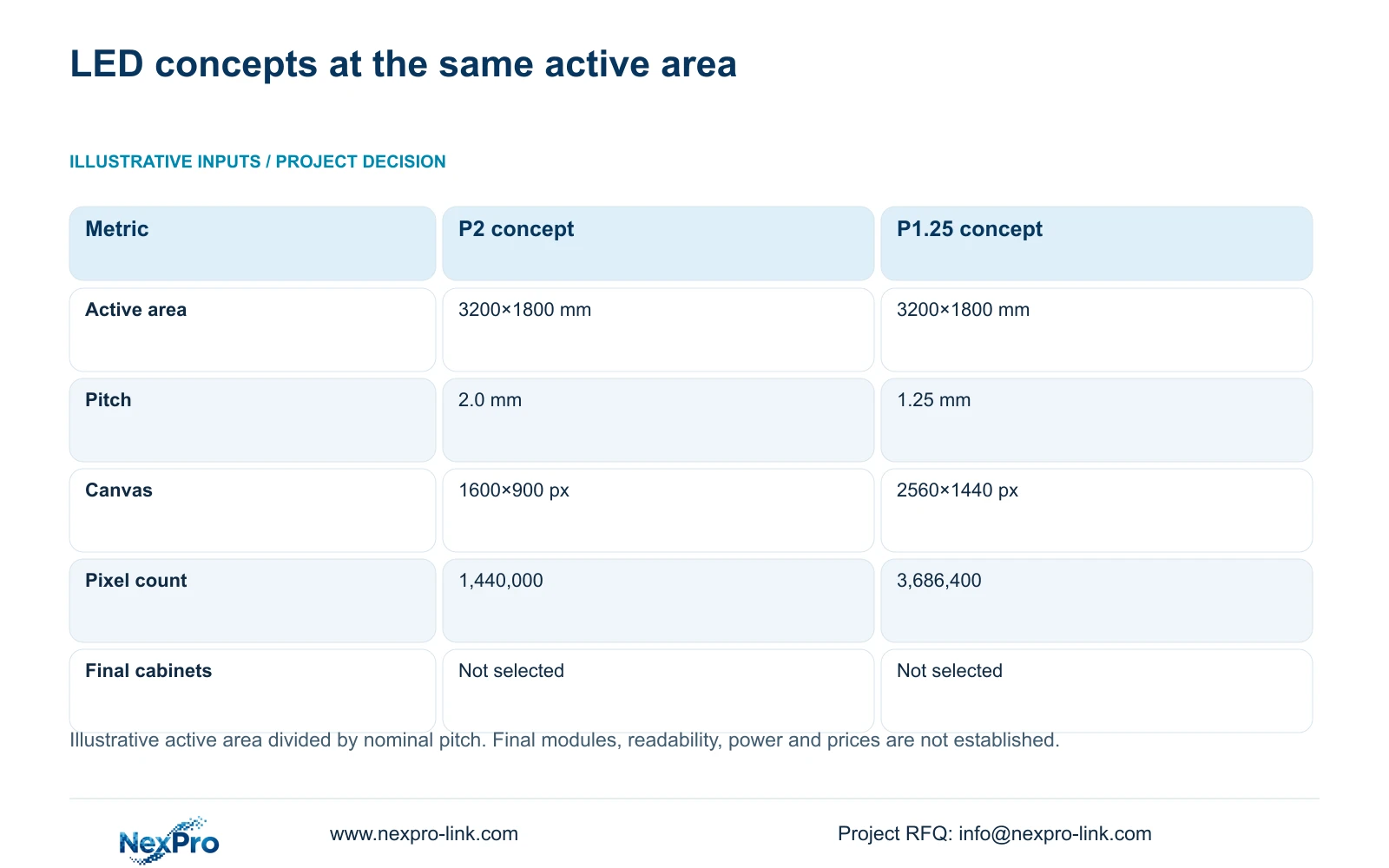
The illustrative LED concept occupies an active area of 3200×1800 mm. Divide each physical dimension by nominal pixel pitch in millimeters. At 2.0 mm pitch, the planning canvas is 1600×900 pixels. At 1.25 mm pitch, it is 2560×1440 pixels. Both estimates refer to the same physical rectangle.
The resulting pixel counts are 1,440,000 and 3,686,400. The finer concept provides more native display positions within that area, which can matter for text and camera tiles. It still does not establish readable content from a particular seat. The final arrangement must fit actual modules, cabinets and the selected control system.
Do not turn a pitch value into a mandatory viewing-distance rule. Content size and the operator's reading task remain necessary inputs. Request a proposed layout at the actual native resolution, then assess the required overview and enlarged-event content under relevant room conditions. Neither concept in this table is a selected or supplied NexPro-Link LED model.
| Metric / condition | 2.0 mm pitch concept | 1.25 mm pitch concept |
|---|---|---|
| Nominal pitch (mm) | 2 | 1.25 |
| Concept canvas (px) | 1600 × 900 | 2560 × 1440 |
| Nominal pixel count | 1,440,000 | 3,686,400 |
| Final model / cabinet grid | Not selected | Not selected |
Section 03
Compare LCD pixels and seams without changing the task
NX-VP-5535 is a 55-inch 1920×1080 LCD panel. Its supplied product fields include a 3.5 mm seam and 400 nit typical brightness. Four panels arranged 2×2 form a theoretical 3840×2160 canvas when a suitable signal path addresses the whole wall. This model must not be described as direct-view LED.
That LCD canvas has more nominal pixels than either LED concept above, but it occupies a different physical arrangement. An equal-area purchasing comparison therefore needs a room-fit LCD layout as well as the proposed LED cabinet grid. Comparing four LCD panels against an arbitrarily larger LED surface would mix area and technology effects.
Plot seams against the intended windows. In an overview grid, panel boundaries can often be considered when assigning views; an enlarged event may cross those boundaries. The hotel should decide whether that interruption affects its actual task. A continuous LED surface removes the LCD panel seam issue, while its native canvas still limits the detail that can be displayed.
Section 04
Review brightness, replacement access and power
Assess brightness in the context of the room's lighting and reflections. A published typical brightness value is a specification field, not a completed readability assessment. Ask for the intended operating setting and show how normal and event layouts will be viewed from the relevant seats. The comparison should avoid choosing the brightest headline without a reading requirement.
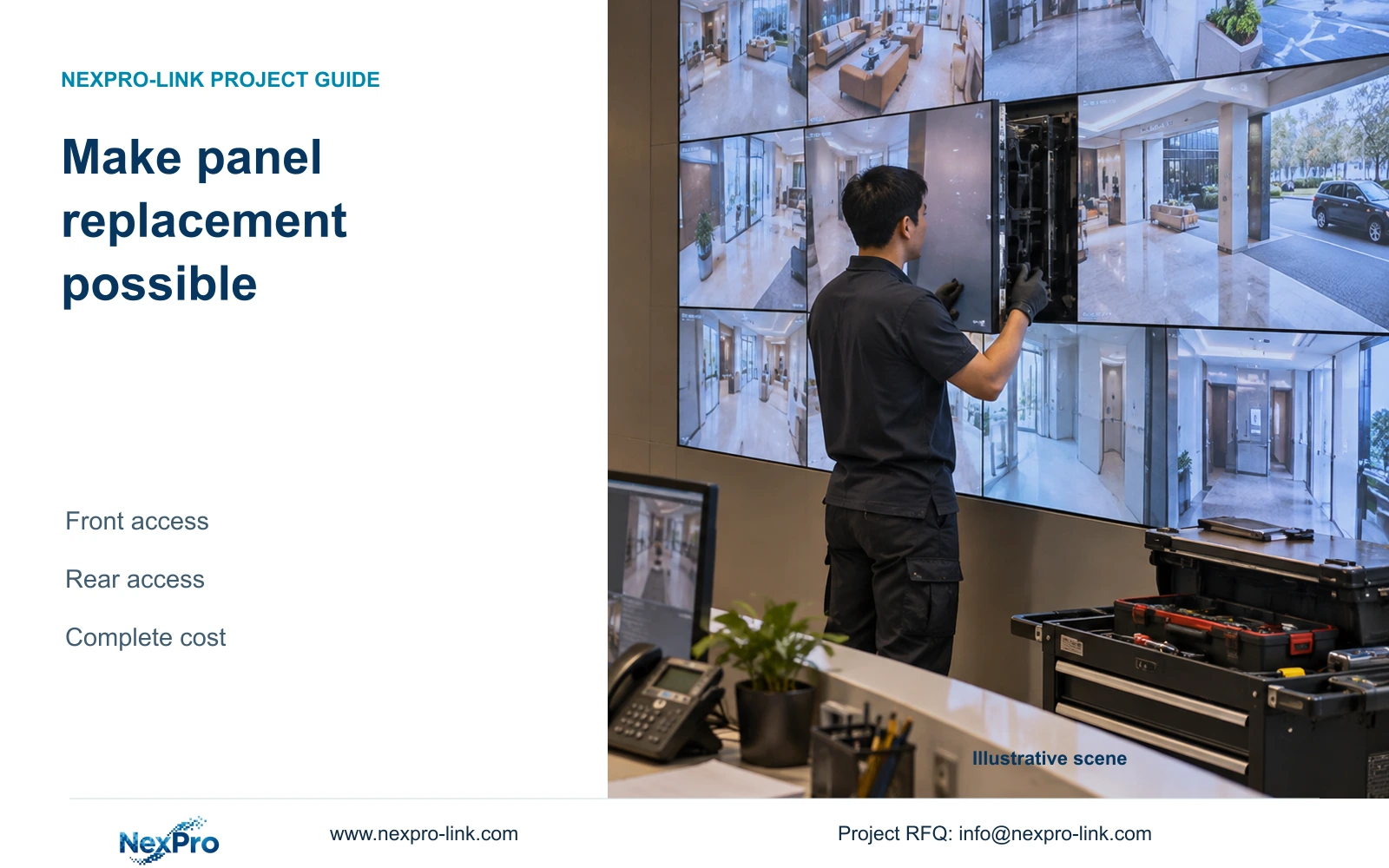
Service access can change the technology decision. Define how an LCD panel or LED unit would be reached and removed, and whether that work obstructs desks or requires rear access. Identify the replacement scope and the responsible party. Similar visible areas can have different practical maintenance envelopes and replacement arrangements.
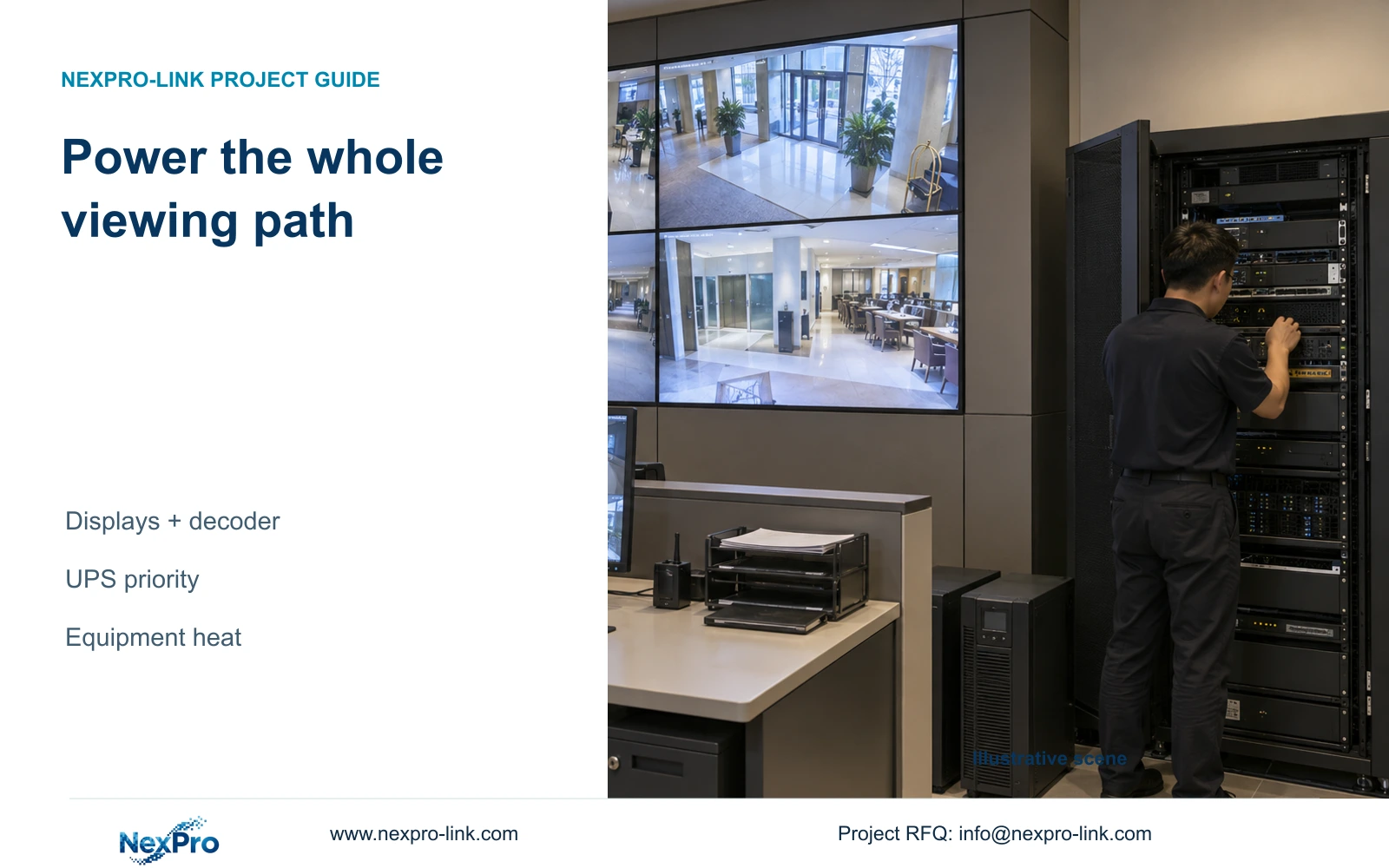
Obtain average and peak electrical inputs for each configured option and provide them to the electrical and cooling teams. The 3200×1800 mm geometry contains no power rating. CASE01's separate assumed LCD and decoder loads cannot be transferred to the LED concepts. Recording must continue through its required camera, network and recorder path even when the optional wall is off.
Section 05
Compare complete installed scope at equal outcomes
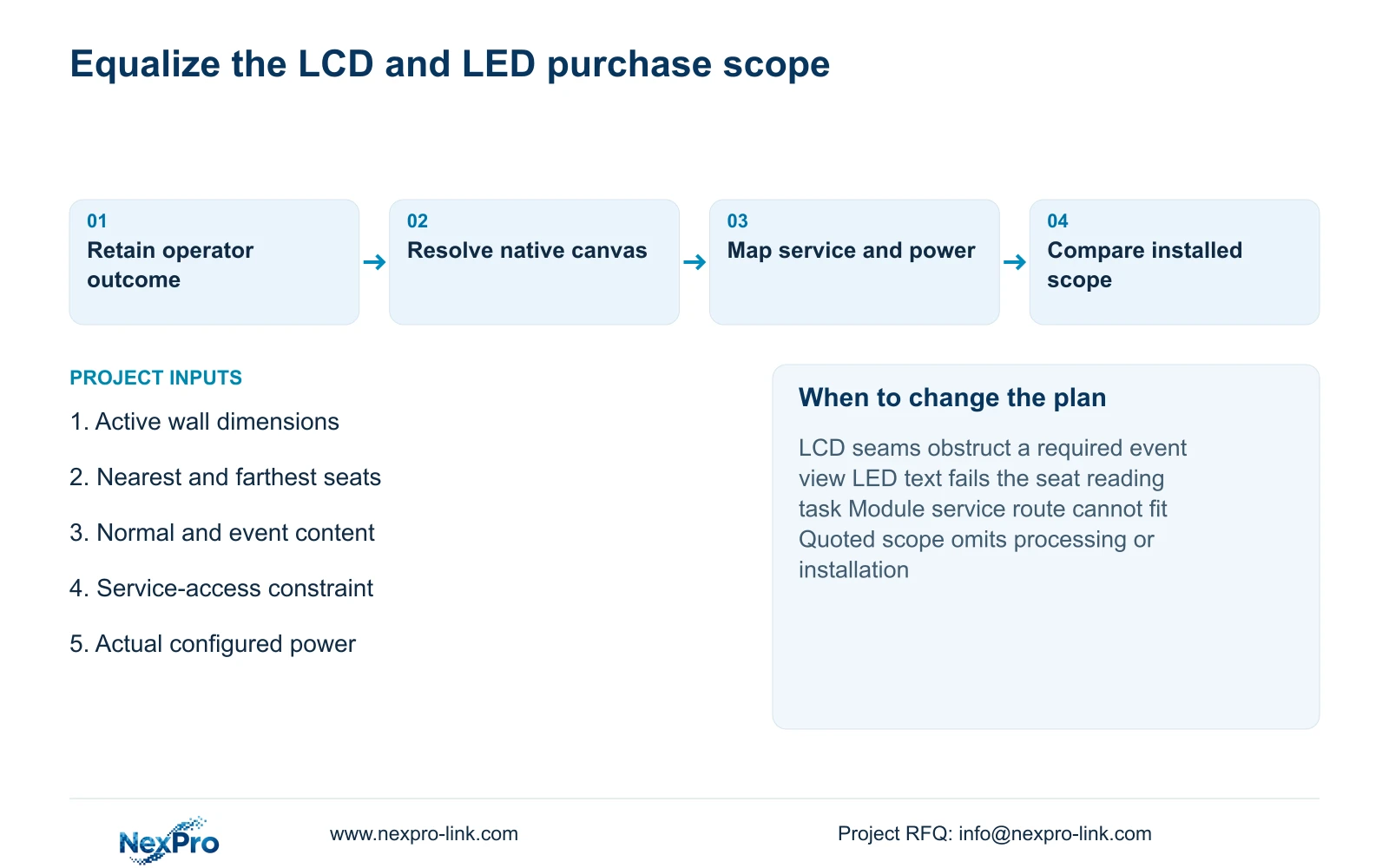
Normalize quotations around the same room tasks and acceptance conditions. Include display equipment, decoding or processing, output interfaces and mounting. Add the relevant electrical work, service provision and local installation responsibilities. A price per panel or per square meter leaves too much scope outside the comparison to support a purchase decision.
Specify what the operator must retain when an event opens. If one option includes a dedicated investigation screen and another does not, either equalize that scope or explain the different workflow. Software and control capability can determine whether the wall is useful, even when the pixel arithmetic is favorable.
There are no supplied scope-matched LCD and LED prices, so no technology cost winner is established here. Warranty should also be compared by covered scope. The supplied current policy record gives applicable main equipment a 24-month limited hardware baseline from receipt, subject to controlling written terms. It does not establish identical coverage for every coordinated display component or include unrestricted local labor.
| Retained outcome | Additional scope to price | Condition that supports the purchase |
|---|---|---|
| Readable shared overview | Selected native canvas and controls | Required labels and views readable from assigned seats |
| Continuous enlarged event | LED processing, cabinets and service arrangement | Panel seams materially obstruct the approved task |
| Outage viewing | Actual protected display load and battery provision | Hotel requires viewing throughout the defined outage |
Section 06
Select a room-fit option with a clear change condition
Retain LCD, or a simpler single-screen arrangement, when its layout completes the reading and event tasks and its service scope is acceptable. Change to LED when the hotel needs a continuous common image and a specific module arrangement demonstrates adequate native detail from the assigned seats. If the finer LED pitch still leaves required text unreadable, revise the content layout or physical design before approving it.
Request the actual module and cabinet schedule after defining the target canvas. No verified direct-view LED SKU is supplied in this article, so the proposal should name its equipment only when selected. NX-VD-4K16 remains a decoder candidate with configuration-dependent input, output and concurrent decoding limits; its name cannot resolve the complete signal design.
Send info@nexpro-link.com the active wall dimensions, nearest and farthest seats, representative content layout and maintenance-access constraint. Include the project destination and whether a continuous image is mandatory. NexPro-Link can discuss equipment matching and coordinated BOQ scope, with CCTV manufacturing and supporting equipment supply responsibilities stated separately.
Section 07
Buyer questions
Is the finer LED concept automatically the better purchase? It provides a larger planning canvas at the same active size, but purchase value depends on whether the additional pixels support a required reading task. Compare complete processing, service and installed scope before choosing it.
Can we use the same decoder specification for LCD and LED? Only after checking the actual input formats, concurrent streams, output canvas and downstream interfaces. A matching display resolution does not establish that both signal paths use the same hardware or configuration.
What evidence should a supplier provide for seat readability? A proposed native-resolution layout and a representative task demonstration under relevant room conditions. Record the actual observations when assessed. Marketing pitch or brightness figures alone do not demonstrate the hotel's reading outcome.
Engineering references
These sources support the general planning principles. Always use the selected product's current datasheet and applicable project standards for final design.