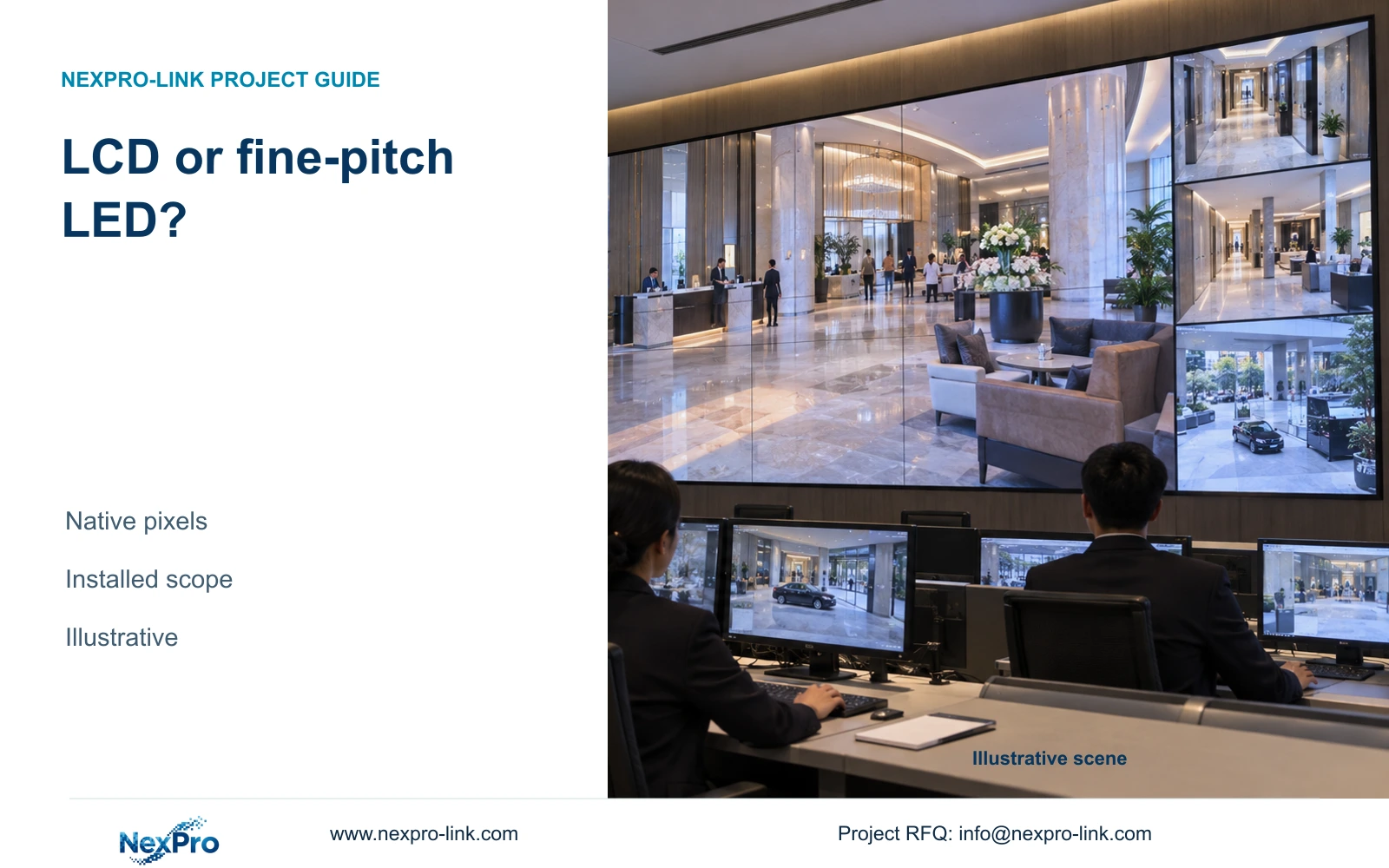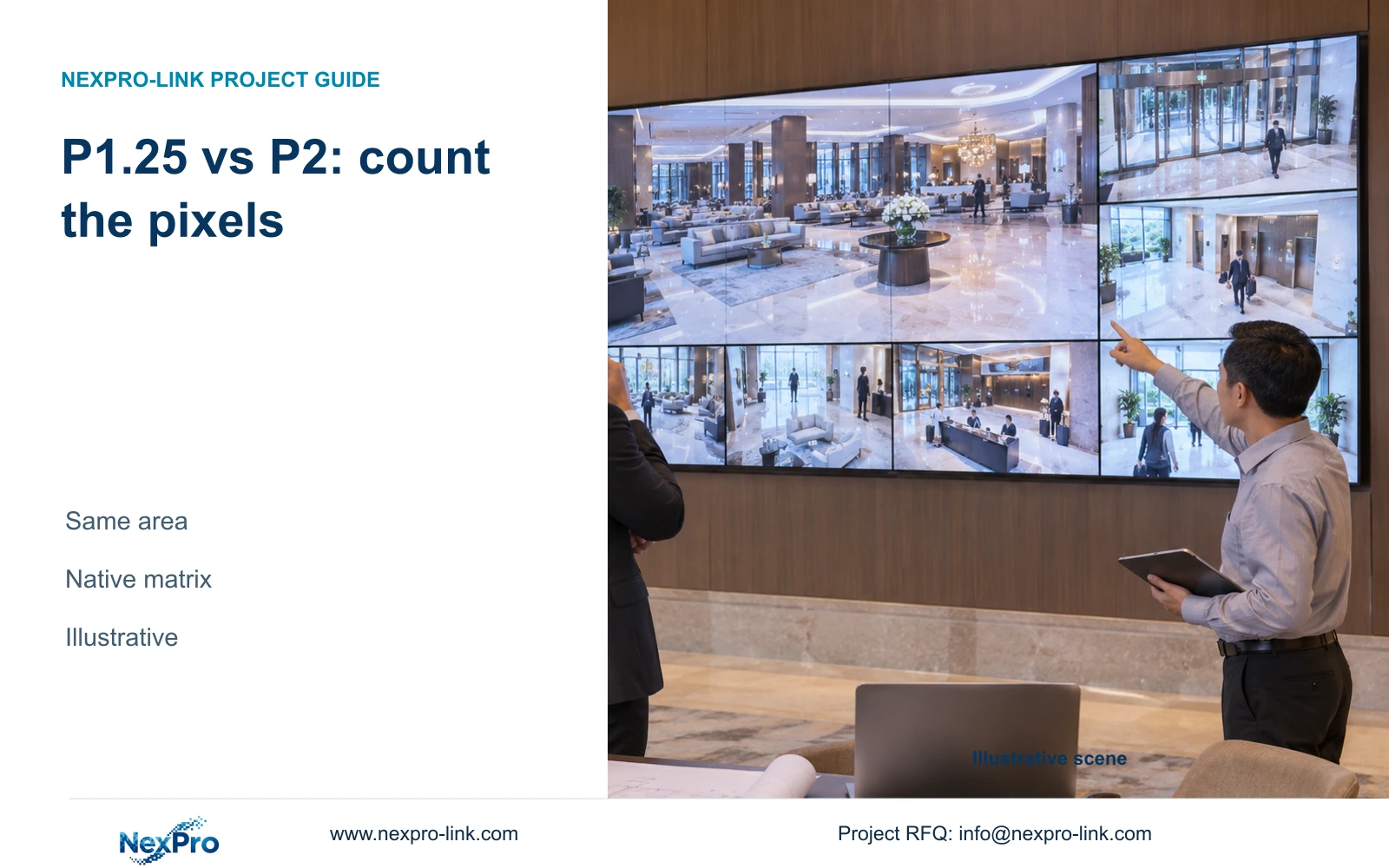
At an illustrative 3200×1800 mm active size, P2 gives 1600×900 planning pixels and P1.25 gives 2560×1440. Actual modules and operator tasks determine the purchase.
Section 01
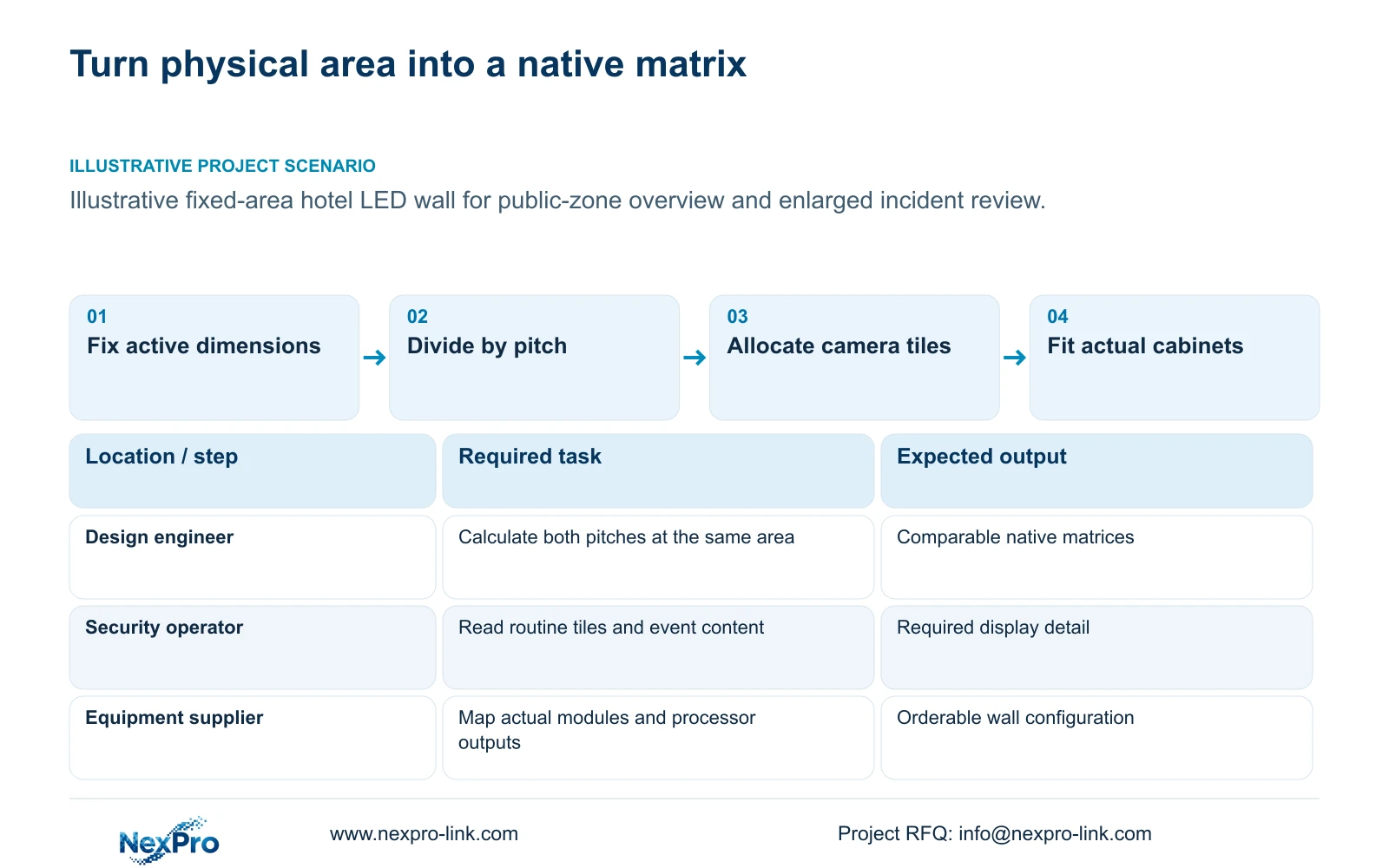
Fix the active display area before comparing pitch
Choose the coarser pitch when its actual cabinet layout and displayed content satisfy the hotel's reading task. Move to finer pitch when the additional native pixels address a demonstrated detail or text requirement within the same available area. Calculate both concepts first, then replace the theoretical matrices with actual module configurations before approving equipment.
The worked example uses a 3200×1800 mm active image area. This is a teaching input, not a surveyed hotel wall or selected product dimension. Mark active width and height separately from the mounting and maintenance envelope. A processor or cabinet arrangement that changes the active area requires a new calculation.
Record the nearest operator seat, the shared viewing positions and the normal camera layout before comparing P1.25 and P2. The same physical rectangle can support very different content demands. An overview of public routes and a screen containing small incident controls should not be judged through one generic viewing-distance shortcut.
| Required task | Defined input | Decision still needed |
|---|---|---|
| Fit the image area | 3200×1800 mm teaching rectangle | Actual cabinet grid and installation envelope |
| Read camera tiles and labels | Seat positions and intended window layout | Whether the native matrix completes the task |
Section 02
Calculate the two native pixel matrices
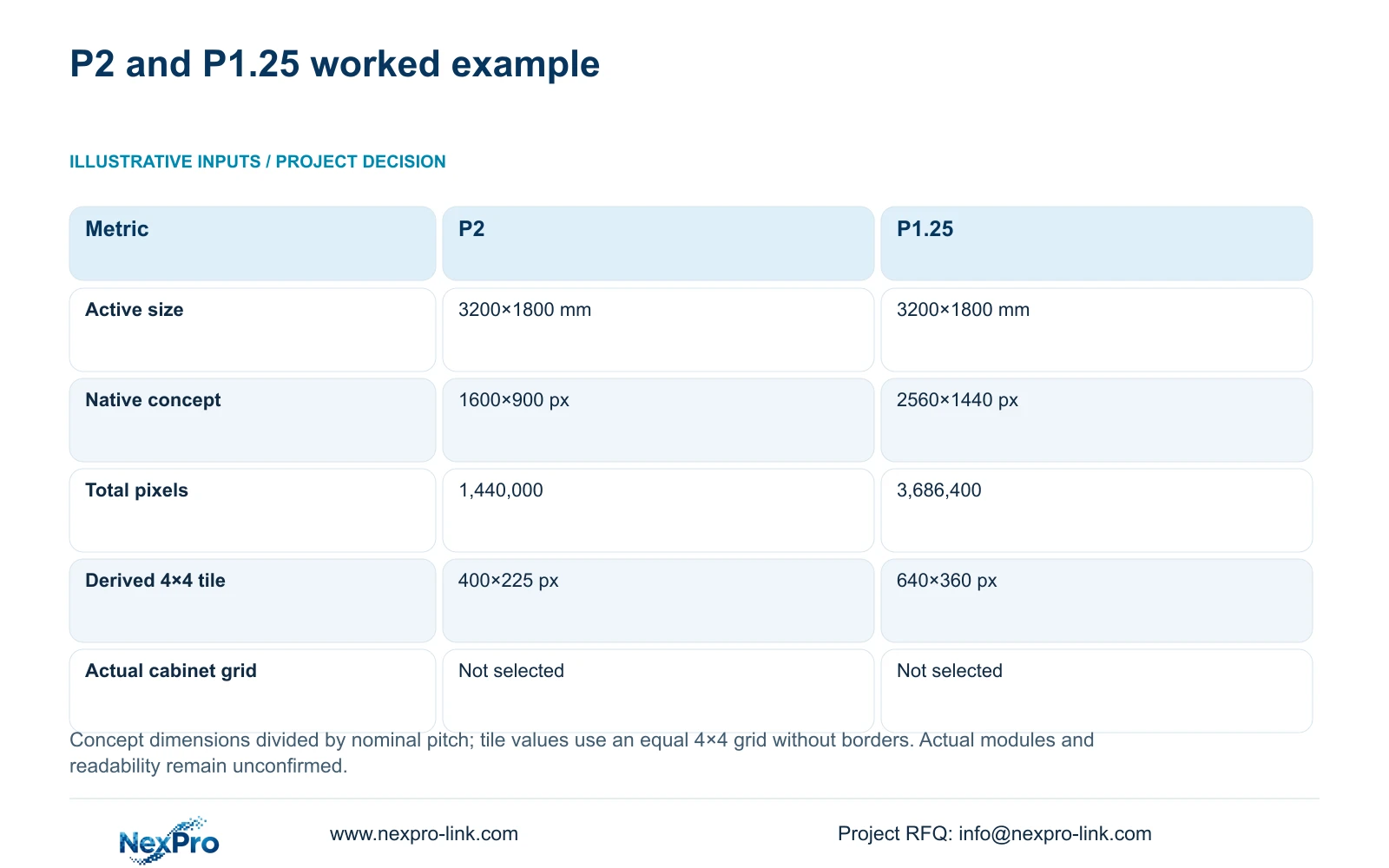
Use millimeters for both physical dimensions and pitch so the units cancel correctly. Planning horizontal pixels equal active width divided by pitch; vertical pixels equal active height divided by pitch. For P2, 3200/2 = 1600 and 1800/2 = 900. Multiplying gives 1,440,000 nominal pixels.
For P1.25, 3200/1.25 = 2560 and 1800/1.25 = 1440. The resulting 3,686,400 pixels occupy the same conceptual active area. Horizontal and vertical counts are each 1.6 times the P2 values, so total pixel count is 2.56 times as large. These are geometric results, not a performance benchmark.
The larger matrix makes finer pitch relevant when the layout requires additional display samples within a fixed area. It does not prove that the operator can read a particular font or identify a moving subject. The final decision needs actual content at native resolution and the correct source/control configuration.
| Metric / condition | 2.0 mm pitch concept | 1.25 mm pitch concept |
|---|---|---|
| Nominal pitch (mm) | 2 | 1.25 |
| Concept canvas (px) | 1600 × 900 | 2560 × 1440 |
| Nominal pixel count | 1,440,000 | 3,686,400 |
| Final model / cabinet grid | Not selected | Not selected |
Section 03
Translate the canvas into CCTV window detail
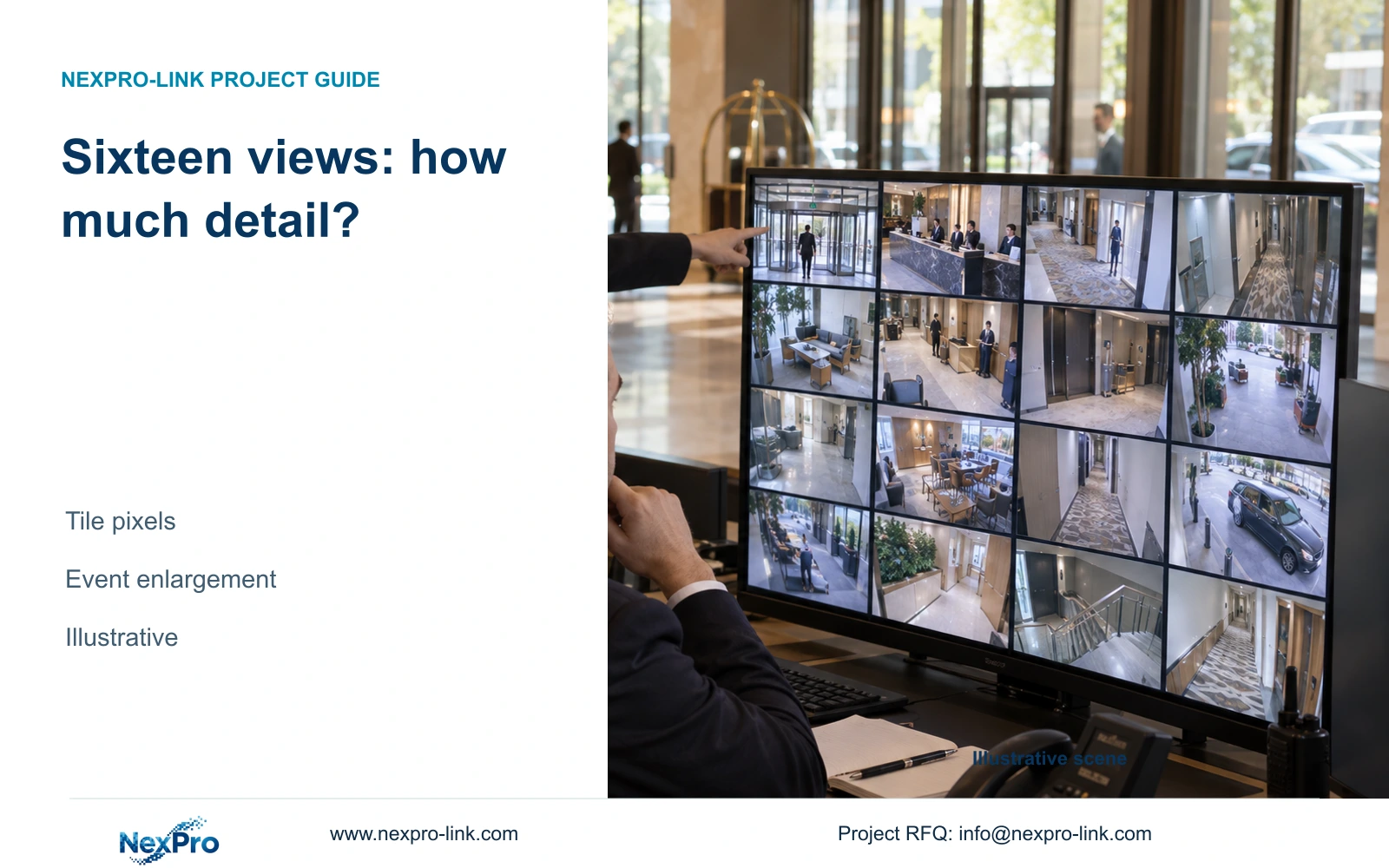
Apply the hotel's intended window arrangement to each matrix. For an additional illustrative equal 4×4 grid, the P2 concept allocates 1600/4 by 900/4, or 400×225 pixels per view. P1.25 allocates 640×360. These derived tile sizes exclude interface borders and assume the complete native canvas is available.
Both concepts still scale a higher-resolution source into a smaller overview window. A 4K camera image does not remain full 4K inside either tile. The finer pitch increases the tile's display budget, but an event-enlargement workflow may have more practical value when the operator needs to inspect a selected incident.
Compare the normal overview with the investigation state at the same seat. If the required detail remains too small, consider fewer concurrent windows, a larger event region or a separate detail display. The appropriate change depends on which information must stay visible elsewhere, not solely on purchasing the smallest pitch available.
| Layout condition | P2 concept | P1.25 concept |
|---|---|---|
| Equal 4×4 grid tile | 400 × 225 px | 640 × 360 px |
| Whole canvas for one event | 1600 × 900 px | 2560 × 1440 px |
| Recorded source detail | Checked separately | Checked separately |
Section 04
Fit the estimate to actual modules and cabinets
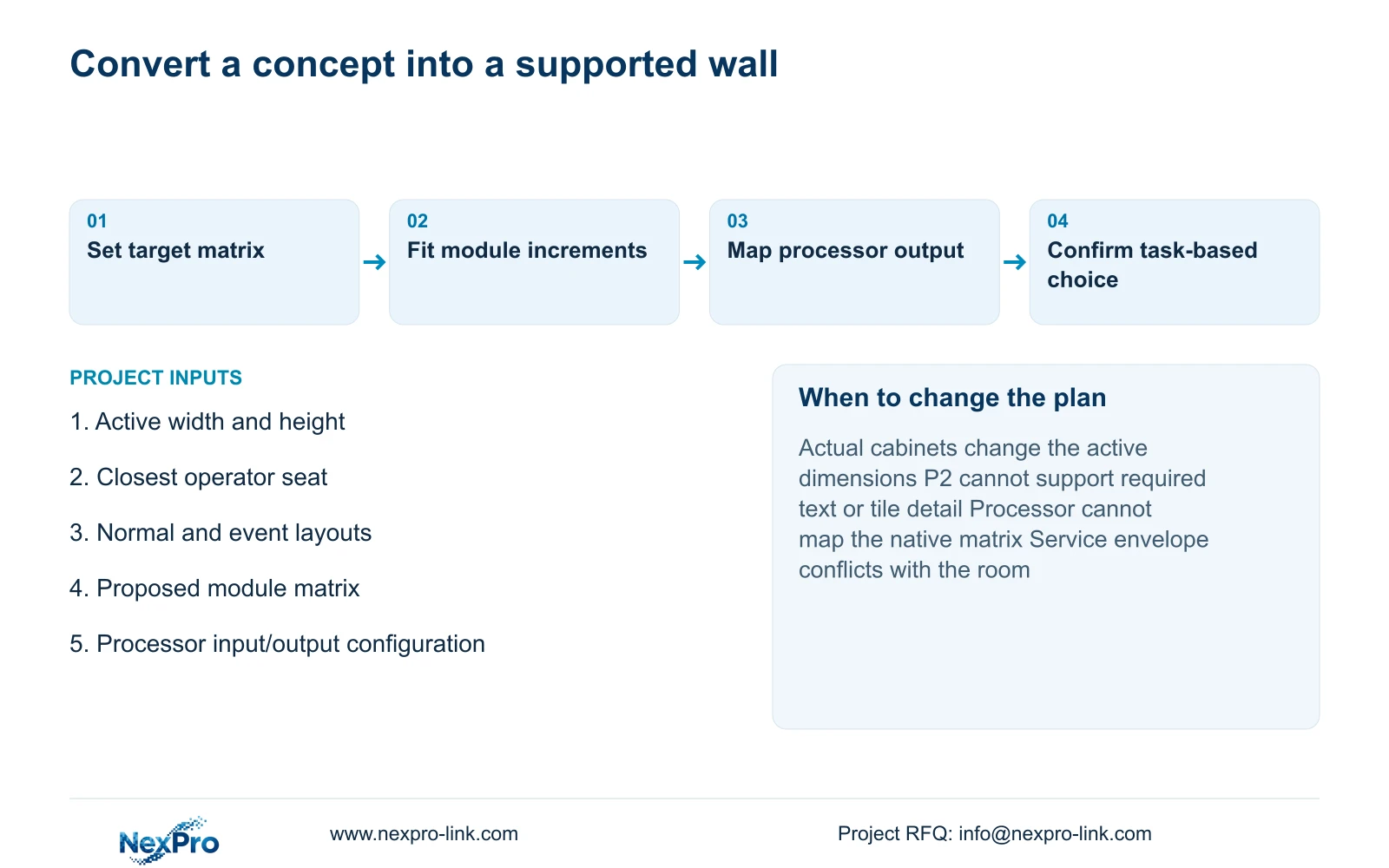
A quotient is not an orderable cabinet schedule. Obtain each proposed module's physical size and pixel matrix, then identify how modules assemble into cabinets and how cabinets form the complete wall. The actual resolution is the sum of the configured module pixels, constrained by the arrangement that can be installed.
Where the intended width or height does not fit an integer number of selected units, compare the nearest feasible arrangements. Record the revised active dimensions and rerun the pixel and tile calculations. Avoid rounding the conceptual matrix and continuing to describe it as the final native resolution.
The cabinet proposal must also identify service access and the support envelope. A finer pitch does not resolve a wall that cannot be maintained. No specific direct-view LED model or cabinet size is supplied in this evidence package, so the example establishes a requirement and comparison method without presenting an invented equipment code.
Section 05
Match source, processor and output resolutions
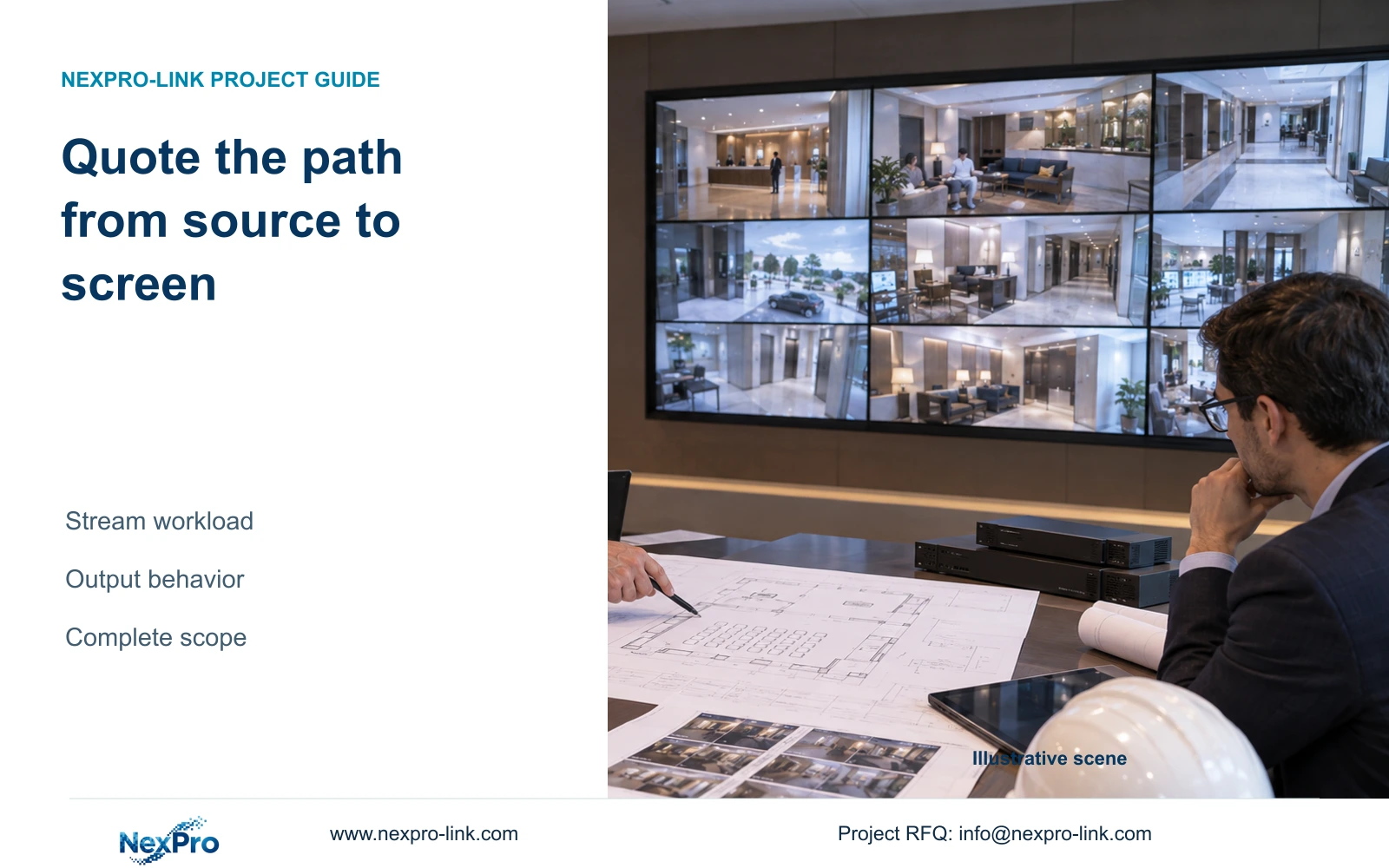
Trace the image through the source stream, decoding stage, layout processing and native LED output. These are separate limits. A high-resolution input may be scaled before it reaches the wall, while an adequate output matrix does not prove that the system can decode all required streams simultaneously.
Specify the normal grid and enlarged-event state, with source resolutions, codecs and frame rates. Include playback concurrency when required. NX-VD-4K16 is a modular decoder candidate, but its name cannot establish sixteen simultaneous 4K streams or compatibility with an unspecified LED processor. The selected interfaces and supported configuration must answer those points.
Price the control path alongside the display. Finer pitch is useful only if the upstream layout can address the additional native pixels in a way that supports the task. Electrical and thermal inputs must come from the actual configured equipment; the physical-area calculation supplies no average or peak power rating.
| Retained outcome | Extra scope to confirm | Purchase condition |
|---|---|---|
| Readable small content | Actual P1.25 cabinet and layout | P2 fails the agreed reading task; finer option meets it |
| Usable additional pixels | Processor output and mapping | Complete native canvas can be addressed |
| Required simultaneous views | Decode configuration and controls | Normal and event states are supported |
Section 06
Justify finer pitch through a specific operating requirement
Retain P2 as a candidate if the actual arrangement provides sufficient overview detail and readable content at the approved seats. Select P1.25 when its additional matrix solves a required reading problem within the fixed wall area, and the cabinet, processor and maintenance scope support that result. Neither choice is justified by pitch alone.
A smaller pitch should not silently change the operating outcome or displace necessary recording infrastructure from the budget. Keep camera recording profiles independent of the display choice. NX-VP-5535 may be considered in a separate LCD comparison, but it is a 55-inch Full HD LCD panel and supplies no direct-view LED model evidence.
Send info@nexpro-link.com the proposed active width and height, closest seat and normal/event layouts, plus any existing module or processor proposal. State whether the dimensions are fixed or adjustable. NexPro-Link can discuss the target canvas and coordinated equipment scope, with actual product selection and local installation responsibilities recorded in the proposal.
Section 07
Buyer questions
Why does pixel count increase faster than the horizontal resolution? Pitch affects both dimensions. In this example, each dimension increases by 1.6, so total pixels increase by 1.6×1.6 = 2.56. The result applies to the stated equal-area concepts and does not establish equivalent improvements in readability.
Can a processor turn the P2 concept into a native 4K wall? Processing can scale content, but the stated P2 active-area concept contains 1600×900 native pixels. A native 4K requirement needs a different physical/pitch configuration and supported hardware mapping; changing the input label does not add display pixels.
What must change if the cabinet grid alters the active size? Update the active width and height, native pixel matrix, window allocations and room-fit drawing. Preserve the agreed operator tasks and reassess the processor/output arrangement against the revised canvas.
Engineering references
These sources support the general planning principles. Always use the selected product's current datasheet and applicable project standards for final design.