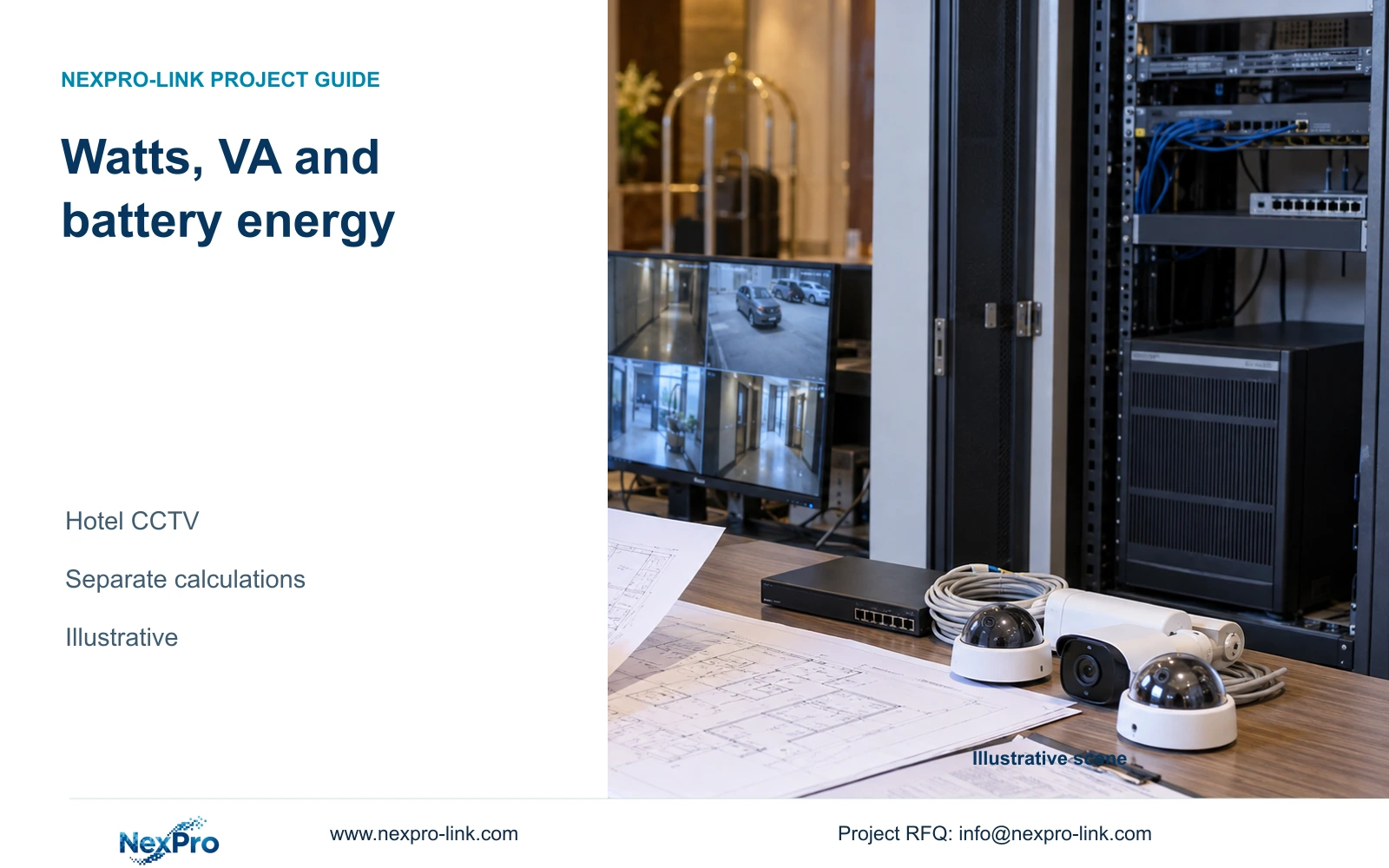
Two UPS offers marked 2kVA can have different watt limits, battery arrangements and service scope. Compare the complete protected load before judging price or runtime.
Section 01
Fix the protected hotel load
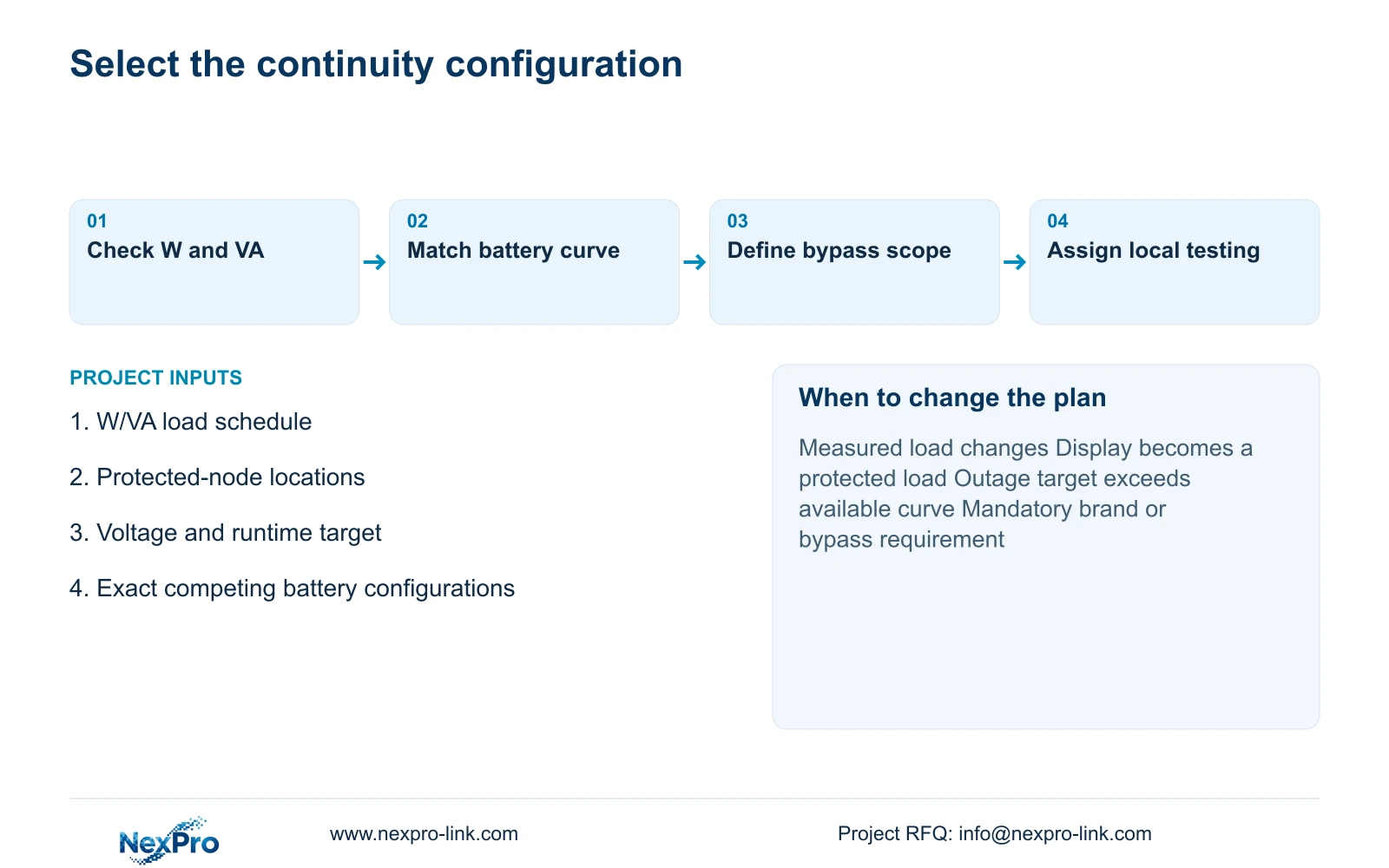
Choose the UPS configuration that supports the same complete hotel recording path, meets both W and VA limits, and has runtime information for its actual battery arrangement. Two offers marked 2kVA are insufficient grounds for comparing price or minutes. For the illustrative 750W load developed here, SP2KR(S) retains the stated capacity reserve; a runtime winner against APC or Eaton cannot be named without their exact configurations and corresponding curves.
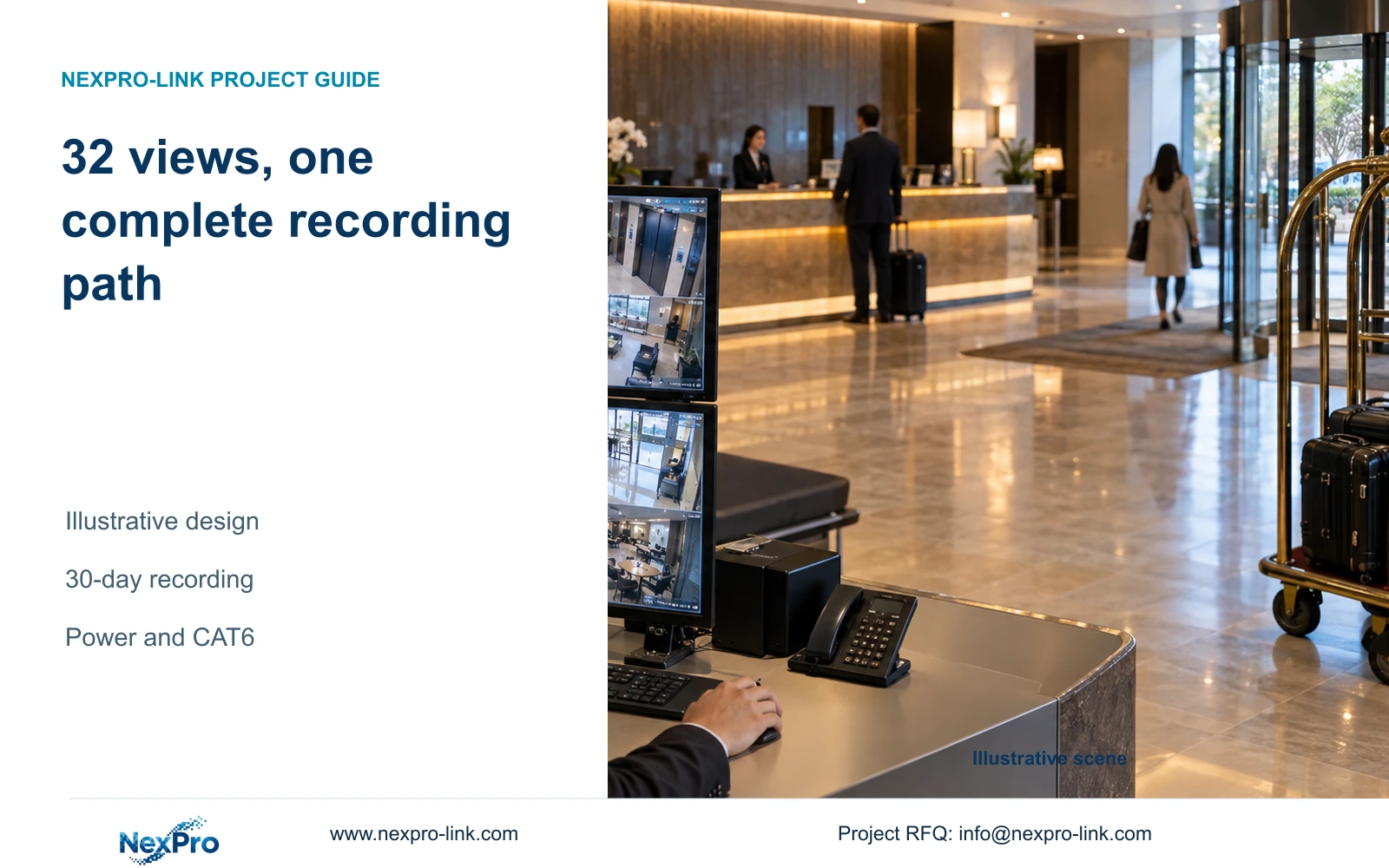
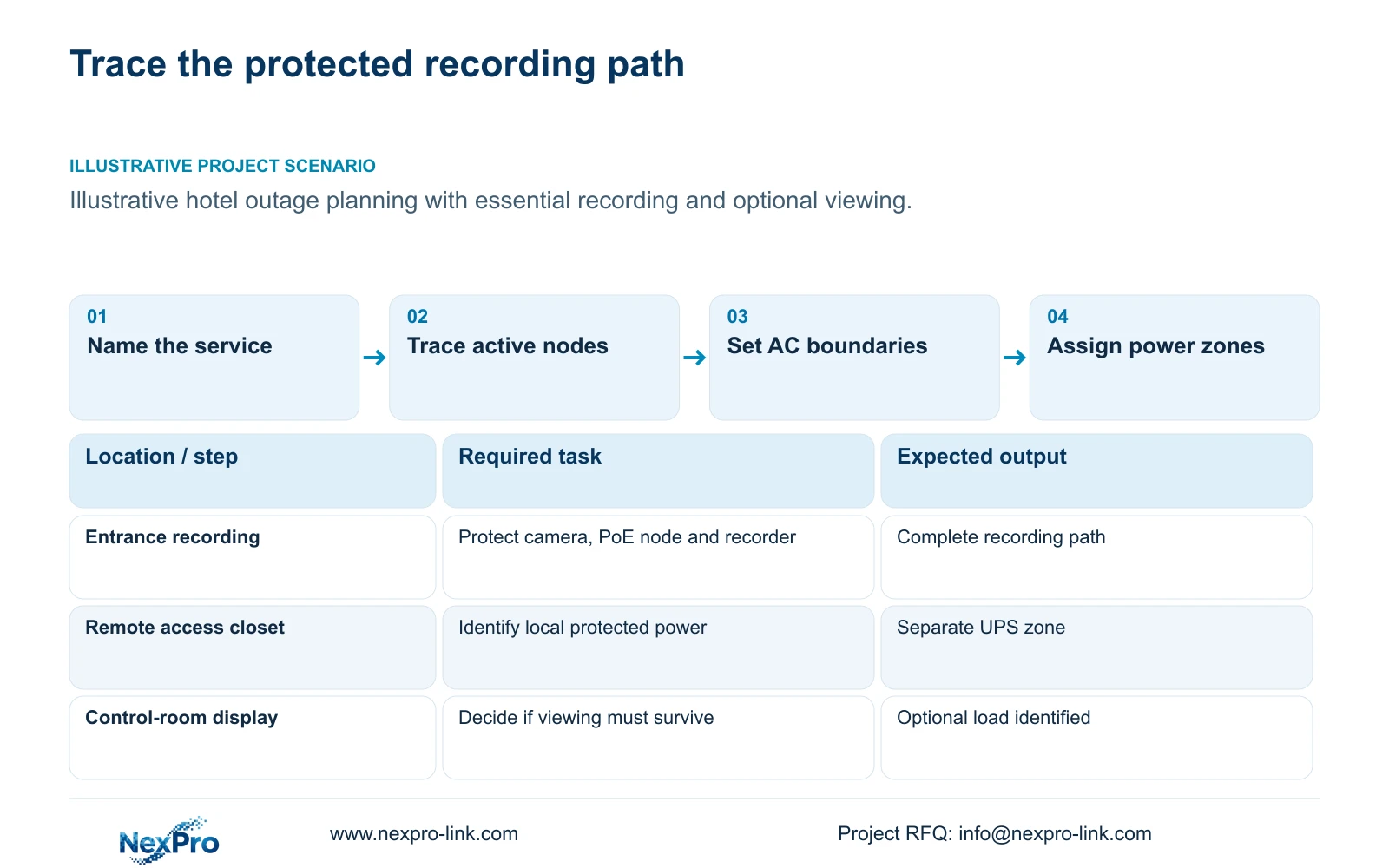
Start at the public-zone cameras and follow every active dependency to the recorder. Entrance recording can stop if an access switch loses power while the NVR remains on. Include required core networking and remote access nodes within their actual protection zones. A fibre backbone carries data but does not automatically supply remote equipment. Distributed nodes may therefore require separate UPS arrangements.
Use one AC measurement boundary throughout the load schedule. A complete PoE switch input already includes power supplied to its cameras, so adding those cameras again would inflate the UPS load. Mark each input as measured, a documented maximum, or an assumption. Add operator displays only when their outage operation is required, and recalculate the protected load when that decision changes.
| Required task | Given information | Decision still needed |
|---|---|---|
| Continue entrance recording | Camera, PoE and recorder path required | Power each essential active node |
| Operate a display during an outage | Display is independent of recording | Include only the approved viewing load |
Section 02
Compare both W and VA ratings
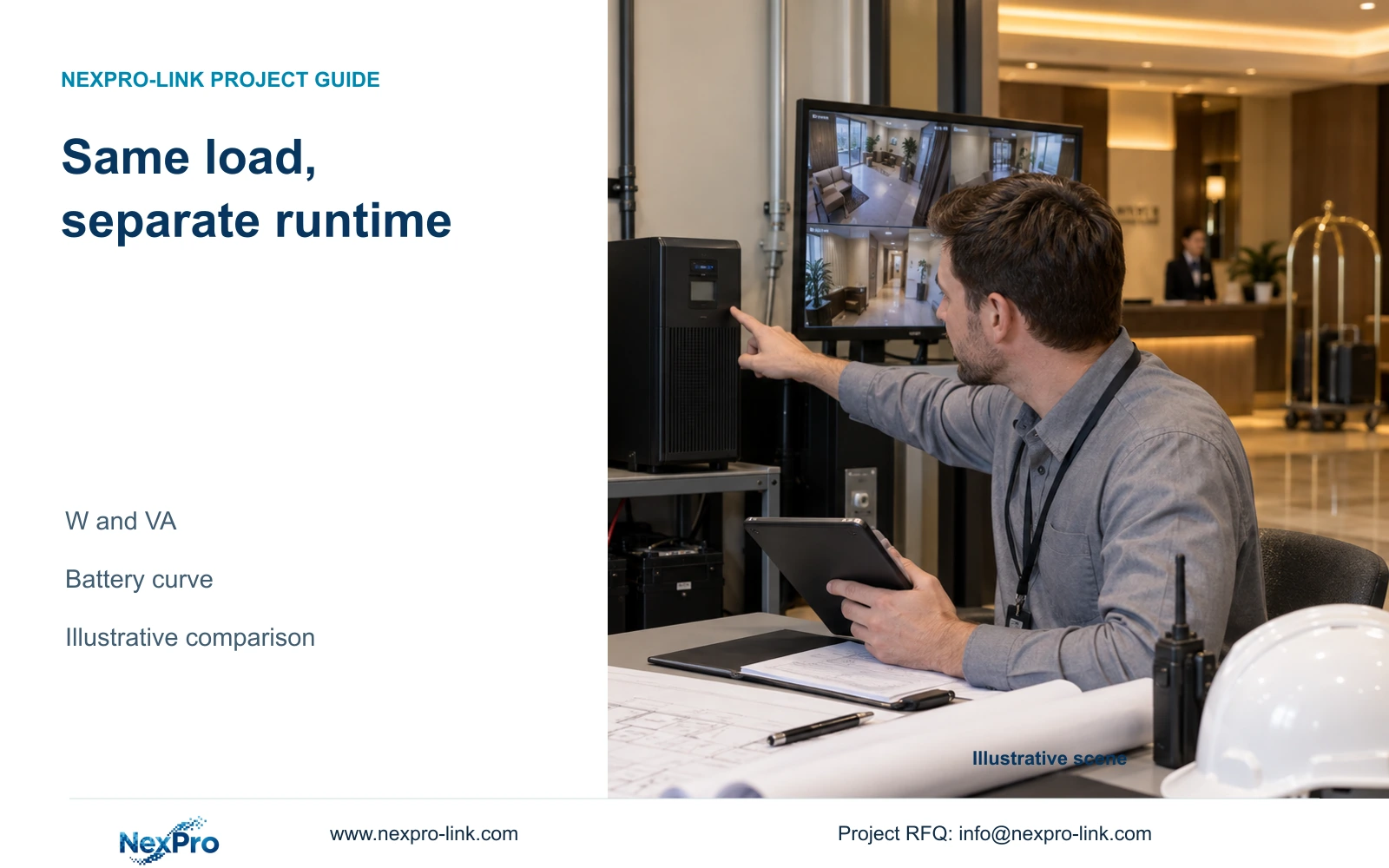
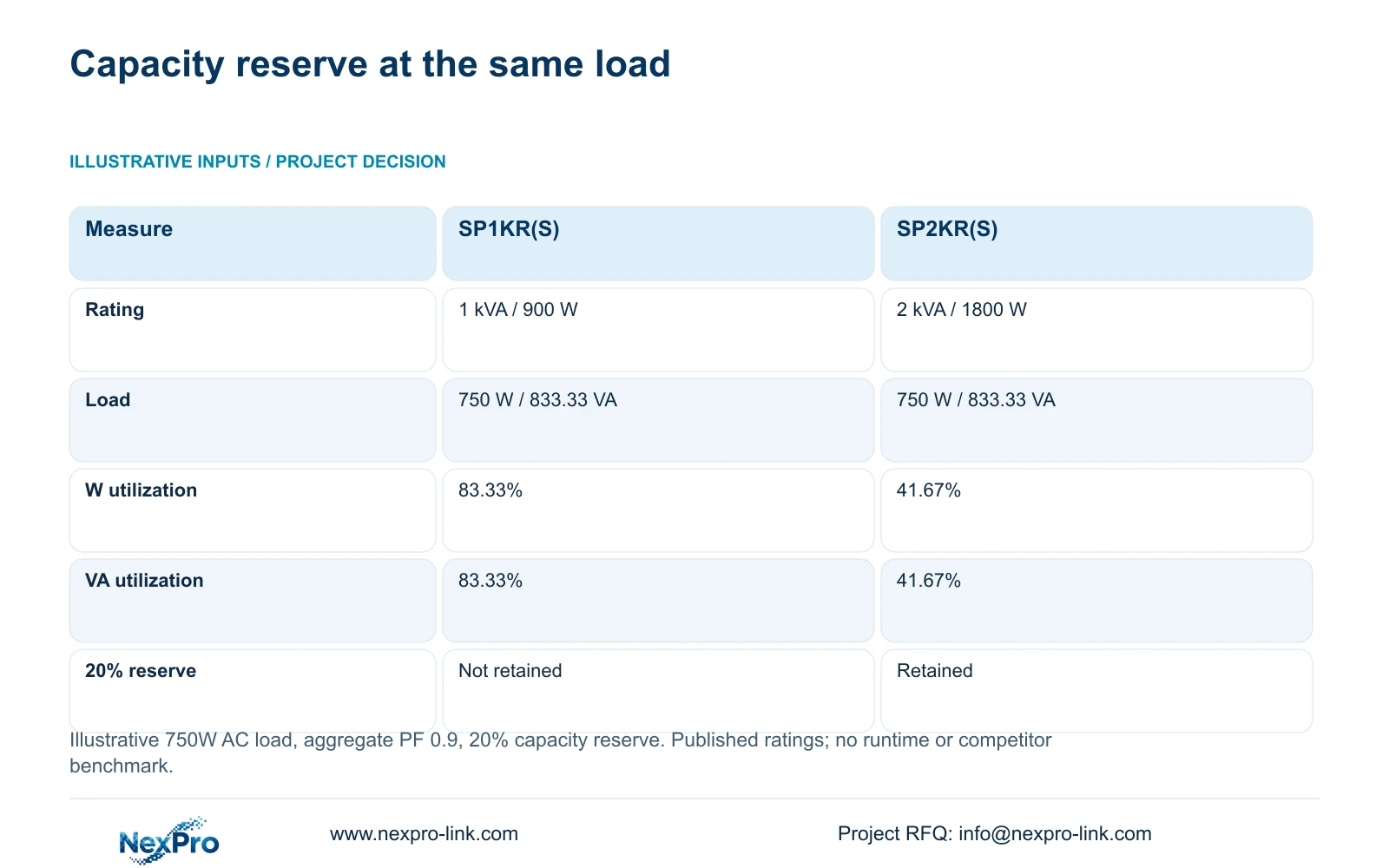
Real power in watts and apparent power in volt-amperes impose separate limits. With an illustrative aggregate power factor of 0.9, a 750W load requires 750 ÷ 0.9 = 833.33VA. Compare both values with each exact UPS rating. The 20% reserve used here means keeping utilization at or below 80% of both rated capacities; it is a project planning choice.
The published rack ratings are 1kVA/900W for SP1KR(S) and 2kVA/1800W for SP2KR(S). Their W and VA utilization calculations are load divided by the corresponding rating. Both exceed the steady load, but SP1KR(S) operates at 83.33% on both measures and misses the reserve target. SP2KR(S) operates at 41.67% and retains that reserve.
Equal kVA labels can still conceal different watt limits. The tower SP2K(S) is published as 2kVA/2000W, while rack SP2KR(S) is 2kVA/1800W. Preserve those identities in the comparison. Neither the extra watts nor the larger capacity percentage establishes how long a configured battery will support the hotel.
| Metric / condition | SP1KR(S) | SP2KR(S) |
|---|---|---|
| Model rating | 1 kVA / 900 W | 2 kVA / 1800 W |
| Protected load | 750 W / 833.33 VA | 750 W / 833.33 VA |
| W utilization | 83.33% | 41.67% |
| VA utilization | 83.33% | 41.67% |
| 20% W and VA reserve | Does not retain target reserve | Retains capacity reserve |
| Battery runtime | Configured load curve required | Configured load curve required |
Section 03
Identify topology and battery configurations
SP1KR(S) and SP2KR(S) belong to the NX-UP-RM-002 rack online double-conversion LiFePO4 series. SP2K(S) belongs to the separate tower series. Record topology, installation format, voltage and battery configuration as distinct comparison fields. Obtain these same fields for the proposed APC or Eaton model; this source package contains no exact competing UPS configuration.
A battery description must identify the supported arrangement associated with the runtime evidence. Do not transfer a default model's energy field to another member of the series. In particular, the default 960Wh field cannot become a fixed SP2KR(S) battery specification.
Nominal energy estimates can help define an inquiry, provided efficiency and usable-energy factors remain explicit assumptions. Temperature, battery condition, discharge behaviour and protective thresholds affect achieved duration. A compatible external battery arrangement also depends on voltage, BMS and charging support. A calculated Wh requirement does not authorize a buyer to construct a battery bank.
Section 04
Use load-matched runtime information
Ask each supplier for runtime information at the actual protected load and for the exact battery configuration included in its offer. A stated duration at another load cannot settle the comparison. Keep the manufacturer's configured curve, a planning estimate and a site observation in separate columns so their different evidential roles remain visible.
The capacity calculation above establishes that SP2KR(S) meets the illustrative reserve condition. It supplies no minutes of backup. If the hotel changes from generator bridging to a longer autonomous operation target, review supported battery options even when the existing UPS capacity remains adequate.
The linked 32-camera engineering reference uses an independent base load of 663.77W, not this article's 750W. Its optional display arrangement adds an assumed 580W. Those figures illustrate why display protection changes the calculation; they must not be substituted into the 750W comparison or used as product power readings. Safe changeover and full-path operation still require project-specific validation by appropriate personnel.
Section 05
Normalize bypass, service and delivery
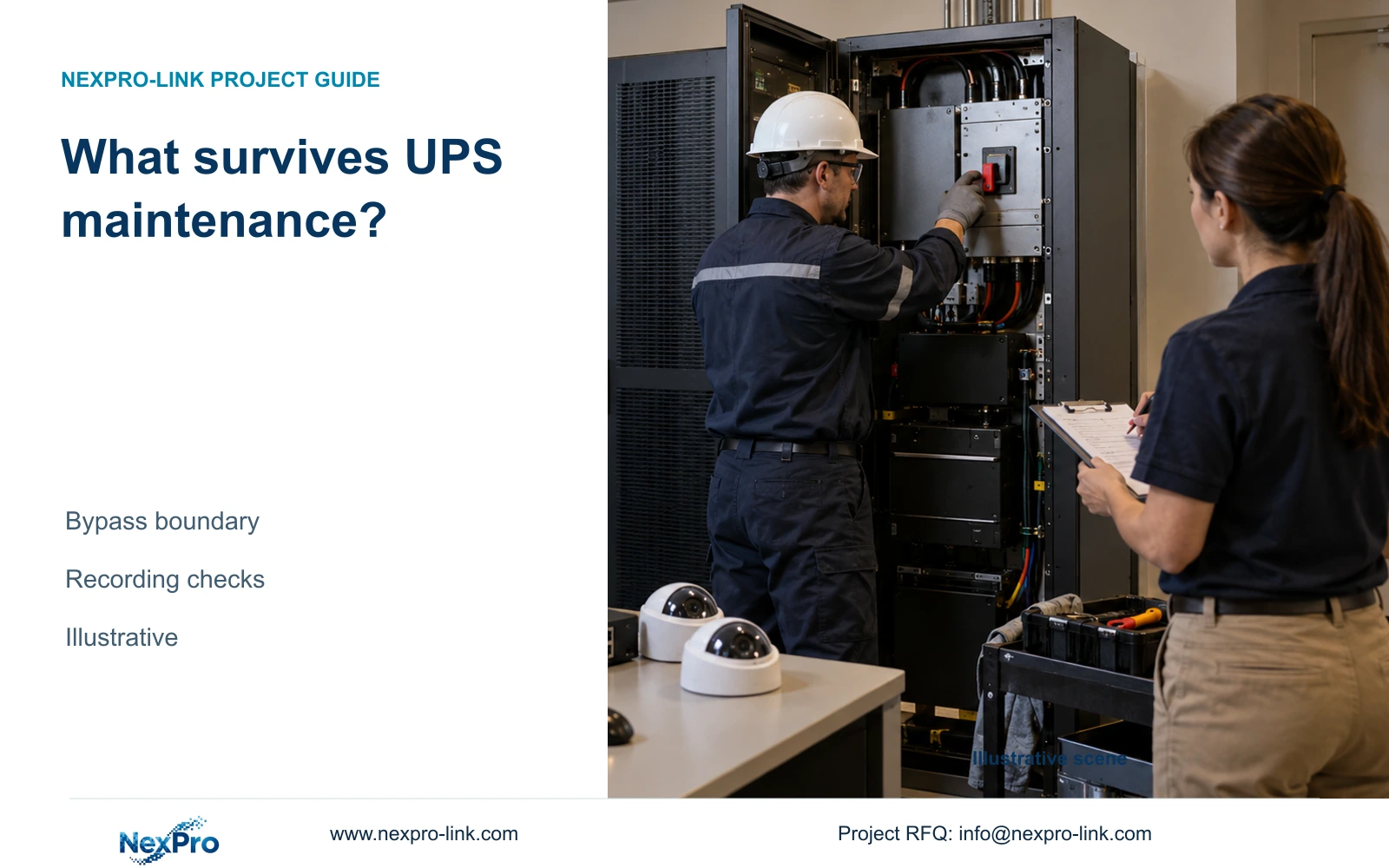
Compare the delivered continuity arrangement, including any required bypass provision, mounting equipment, battery hardware and commissioning responsibilities. Identify what remains operational during maintenance and who performs the intervention. A bypass requirement belongs in the quotation; its availability or switching behaviour cannot be inferred from the online topology label.
Separate equipment supply from local electrical installation, protection and changeover testing. Delivery destination and battery transport conditions can also affect the practical offer. A replacement unit should retain the required electrical and battery compatibility, and a spare-stock proposal needs an explicit restoration task rather than an assumed failure rate.
The supplied NexPro-Link policy record states a usual 24-month limited hardware baseline for applicable main equipment from receipt, subject to controlling written order terms. Batteries and other accessory categories have their own scope. Remote technical support does not mean unlimited free repairs, local attendance or included return freight. Compare those boundaries with the actual competing service terms.
| Retained outcome | Extra scope | Purchase condition |
|---|---|---|
| Maintenance continuity | Specified bypass and local work | Required service must remain available during intervention |
| Longer outage operation | Supported battery arrangement | Load-matched curve must meet the revised time target |
Section 06
Recommend by the actual continuity task
For the stated 750W/833.33VA load and 20% capacity-reserve target, retain SP2KR(S) as the rack capacity candidate. Reconsider SP1KR(S) only if the verified load or reserve requirement changes enough to meet both limits. Select the battery arrangement separately against the approved duration. If the hotel mandates APC, Eaton or another exact model, evaluate that configuration against the same service boundary without silently substituting brands.
NexPro-Link can discuss model matching, BOQ documentation and coordinated equipment supply. Its CCTV manufacturing core and supporting equipment coordination are distinct responsibilities; a combined order does not automatically include local installation. For a useful comparison, email info@nexpro-link.com with the W/VA load schedule, required outage behaviour and minutes, site voltage, and competing UPS and battery configurations. State the destination and any mandatory brand requirement.
Section 07
Buyer questions
Can a larger kVA model solve a short runtime problem? Only if its supported battery configuration meets the required duration at the actual load. A larger capacity rating may provide reserve without providing the required energy. Request configuration-specific runtime evidence before changing the UPS.
What if one supplier omits battery details? Keep runtime and the battery-related price comparison unresolved. Request the included battery arrangement and its load-matched curve; do not compare an unspecified package with a fully defined offer.
Do we need to submit the full hotel security design? An initial UPS comparison can start with the protected load schedule, power-zone locations, voltage, runtime target and exact competing configurations. Passwords and guest footage are unnecessary.
Engineering references
These sources support the general planning principles. Always use the selected product's current datasheet and applicable project standards for final design.