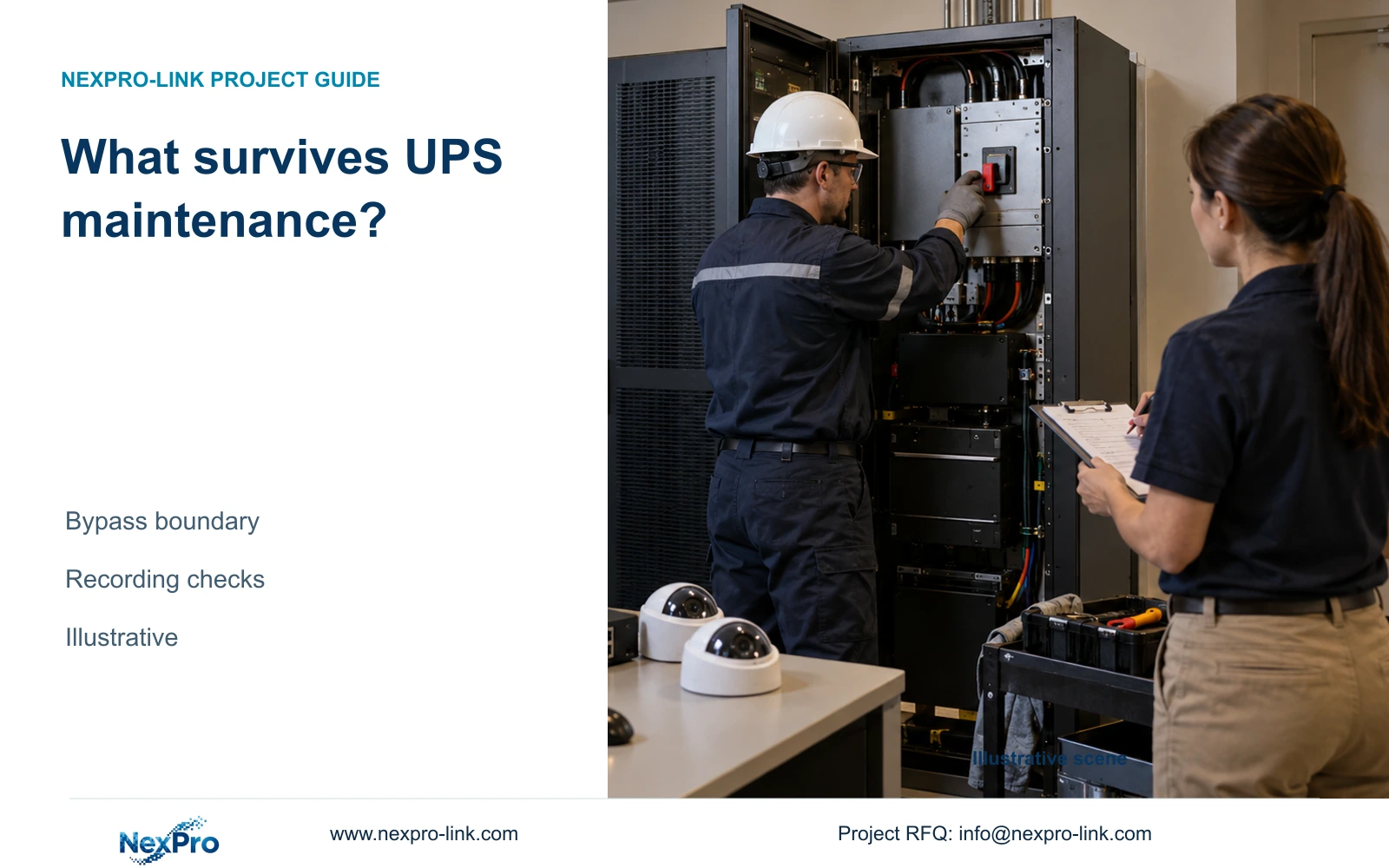
A bypass feature does not guarantee uninterrupted UPS maintenance. Define which loads remain supplied, which protection is unavailable and how recording will be verified after the work.
Section 01
Separate load transfer from maintenance isolation
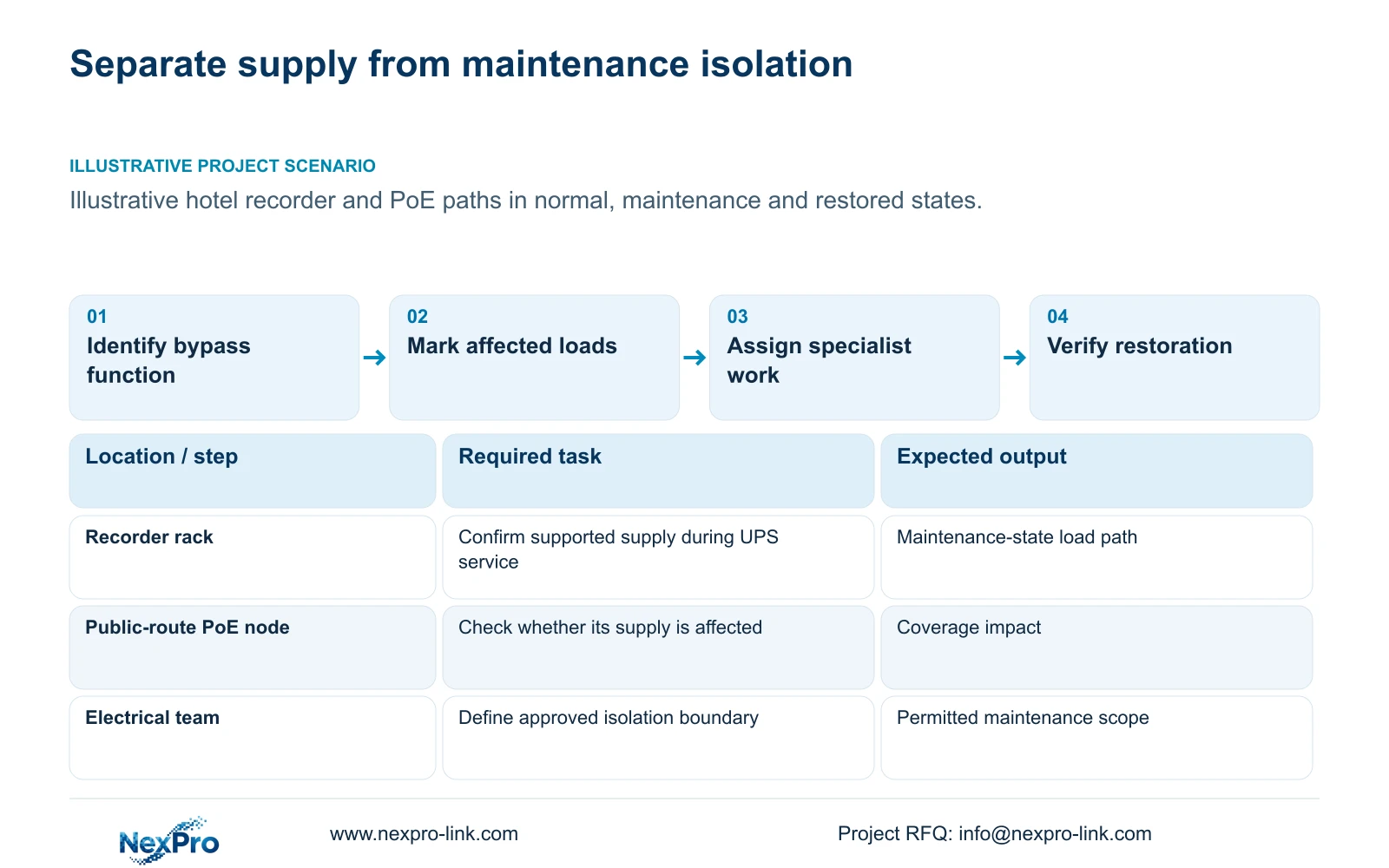
Use a maintenance-bypass arrangement only when the exact equipment supports the planned work, the connected loads tolerate its behavior and qualified personnel have an approved procedure. The presence of a bypass feature does not establish uninterrupted maintenance. Identify the work that can proceed and the protection unavailable during that state before authorizing it.
Treat static bypass and maintenance isolation as separate functions. A static bypass path concerns supplying the load through an alternative supported path. Maintenance arrangements must also address the work boundary and safe isolation of the equipment being serviced. Do not infer that an internal bypass indication permits physical UPS removal.
The supplied rack and tower records establish online double-conversion candidates and ratings, but they do not establish a particular external maintenance-bypass assembly or switching sequence. Obtain the exact supported arrangement for the selected model. Ordinary CCTV continuity requirements remain separate from life-safety systems and their specialist procedures.
Eaton's maintenance-bypass example shows an alternative supply path used when a UPS needs replacement. That manufacturer example explains why supply can continue while the UPS is removed from the load path; it is not evidence of battery protection during maintenance or of a supported bypass accessory for the proposed NexPro-Link unit. Obtain the exact arrangement and isolation procedure from the selected equipment documents and responsible electrical specialist. Assess loss of the alternative source separately before claiming continuity.
| Required task | Given information | Decision still needed |
|---|---|---|
| Keep recorder supplied | A bypass function may be described | Exact supported load path and transfer behavior |
| Service or remove UPS | Maintenance scope is proposed | Approved isolation arrangement and specialist procedure |
| Retain outage protection | Normal UPS has battery support | Which protection remains in the maintenance state |
Section 02
List every load affected by the work
Mark the recorder, core network and access switches on the proposed maintenance boundary. Identify their actual supplies and every shared device needed for recording. A central UPS procedure can affect several camera groups; a local procedure can affect one group while leaving the recorder powered. Document the views that would be unavailable in either case.
Keep data paths separate from power paths. A remote PoE node connected by fiber still needs local power, and the control-room UPS may have no influence on that supply. Conversely, maintaining a core network supply can affect streams from access nodes whose own batteries remain operational.
Include optional operator displays only where their maintenance-state role is required. If a display can be unavailable while footage continues recording, state that explicitly. Name the person who checks camera availability and the person responsible for the electrical work so the maintenance plan does not rely on one ambiguous equipment-online indication.
| Item | Normal state | Maintenance state | Effect to confirm |
|---|---|---|---|
| Recorder | Approved UPS supply | Supported alternative supply or approved interruption | Recording and storage remain available |
| PoE access node | Its assigned protected source | Depends on the work boundary | Required camera group remains captured |
| Core network | Required transport path | May share affected distribution | Camera streams still reach the recorder |
Section 03
Compare supply availability with battery protection
Describe normal operation, the approved maintenance state and a source failure during maintenance separately. A load remaining supplied through a bypass does not prove that battery protection remains available. If the serviced UPS is isolated from the load, its stored energy cannot be treated as protection for that load without another supported path.
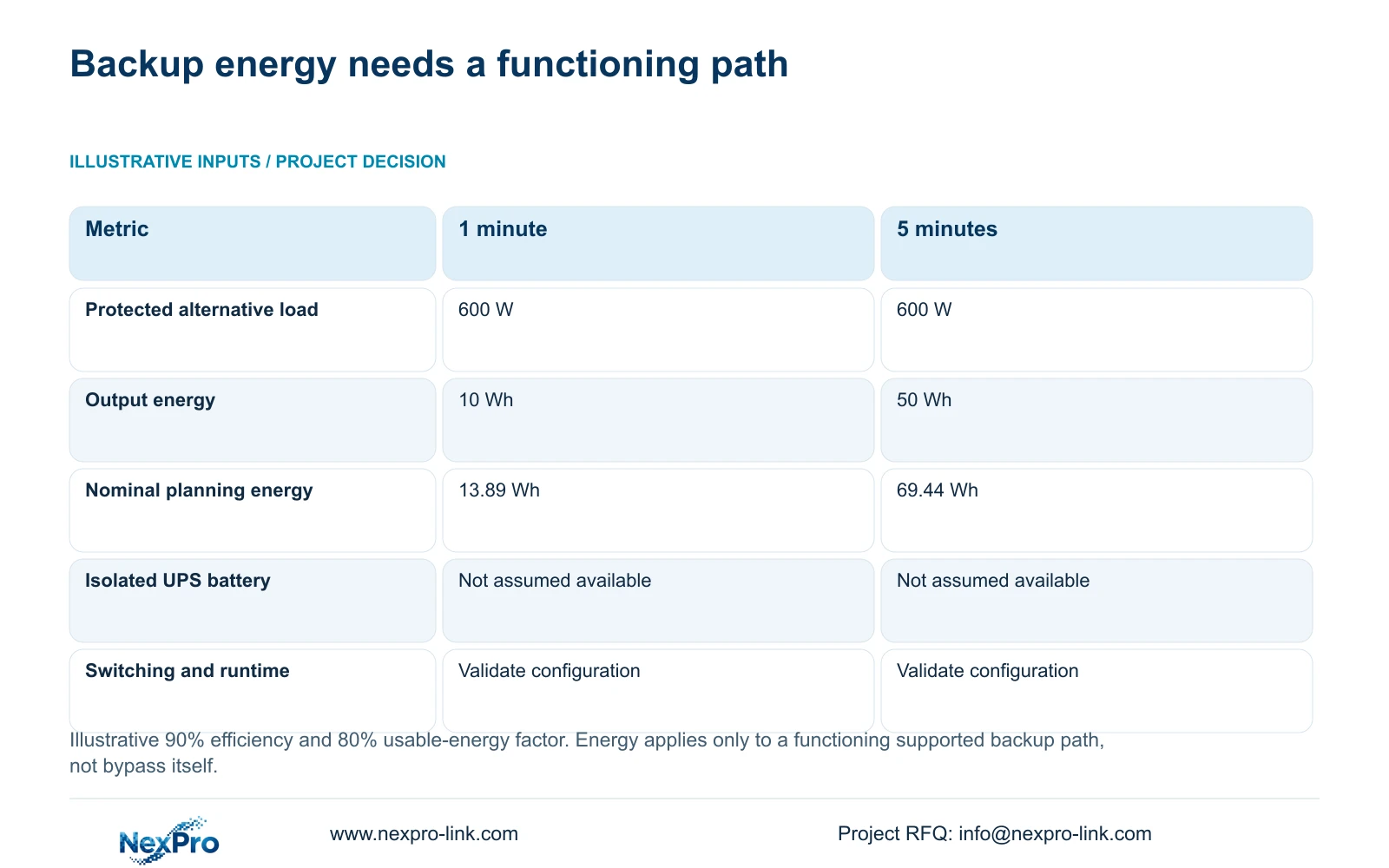
The illustrative energy comparison assumes a separate functioning backup arrangement serving 600 W for one or five minutes. Output Wh = W × minutes ÷ 60; nominal planning Wh = output Wh ÷ (0.90 × 0.80), using assumed 90% inverter efficiency and 80% usable-energy factor. This gives 10 versus 50 Wh output and 13.89 versus 69.44 Wh nominal planning energy.
These numbers help define a temporary bridge requirement where a supported backup path exists. They do not describe protection supplied by bypass itself or the duration of a maintenance job. Actual runtime and transfer require configuration validation. The 600 W topic example is independent of CASE01's hotel power totals.
| Metric / condition | 1-minute energy window | 5-minute energy window |
|---|---|---|
| Load (W) | 600 | 600 |
| Time target (minutes) | 1 | 5 |
| Output energy (Wh) | 10 | 50 |
| Nominal planning energy (Wh) | 13.89 | 69.44 |
| Actual runtime / switching | Requires configured system validation | Requires configured system validation |
Section 04
Assign electrical procedures to qualified specialists
Have the responsible local electrical personnel review the supported bypass equipment, supply conditions and isolation requirements. They must define the approved work procedure and its limits. This article does not provide a switch-by-switch sequence or authorize work on energized equipment.
Capacity screening still matters. SP1KR(S) is rated 1 kVA / 900 W, SP2KR(S) 2 kVA / 1800 W, and tower SP2K(S) 2 kVA / 2000 W. These published figures identify different candidates; they do not establish bypass ratings, interlocks, connector compatibility or maintenance transfer behavior. Those details require the actual selected configuration.
If the proposed alternative supply involves a generator, its acceptance and transfer sequence remains relevant during the work. The responsible engineer must consider charging where applicable, other connected loads and recovery conditions. When no supported continuous arrangement is available, plan an authorized interruption with a defined recording impact instead of promising seamless servicing.
Section 05
Protect footage and required coverage during servicing
Before the work, identify any authorized incident footage that needs independent preservation and confirm it can be replayed. Preserving an incident export protects existing information; it does not maintain live capture. Continuous recording requires a supported power and network arrangement throughout the work or an explicitly approved alternative recording scope.
Compare the service plan with the hotel's acceptable loss of coverage. A local spare or supported substitute can help restoration, but appearance and nominal capacity do not prove functional equivalence. Its connections, configuration and installation responsibility must be established before it is used in the plan.
Handle equipment service records separately from guest footage and credentials. Any return authorization should identify the equipment and symptoms without automatically sending storage containing sensitive recordings. Main equipment, batteries and storage have different service boundaries. The supplied main-equipment policy baseline is 24 months from receipt, subject to controlling written terms; it does not include every maintenance expense.
| Retained outcome | Extra scope | When worth buying | Counter-condition |
|---|---|---|---|
| Live recording during work | Supported alternative protected supply | Approved coverage cannot be interrupted | Transfer or isolation compatibility unresolved |
| Existing incident preservation | Authorized verified export | Relevant footage must remain independently available | Export cannot substitute for continuing capture |
| Faster restoration | Supported spare and local action | Replacement task and service access are defined | Stock lacks verified functional compatibility |
Section 06
Verify restored protection and recording
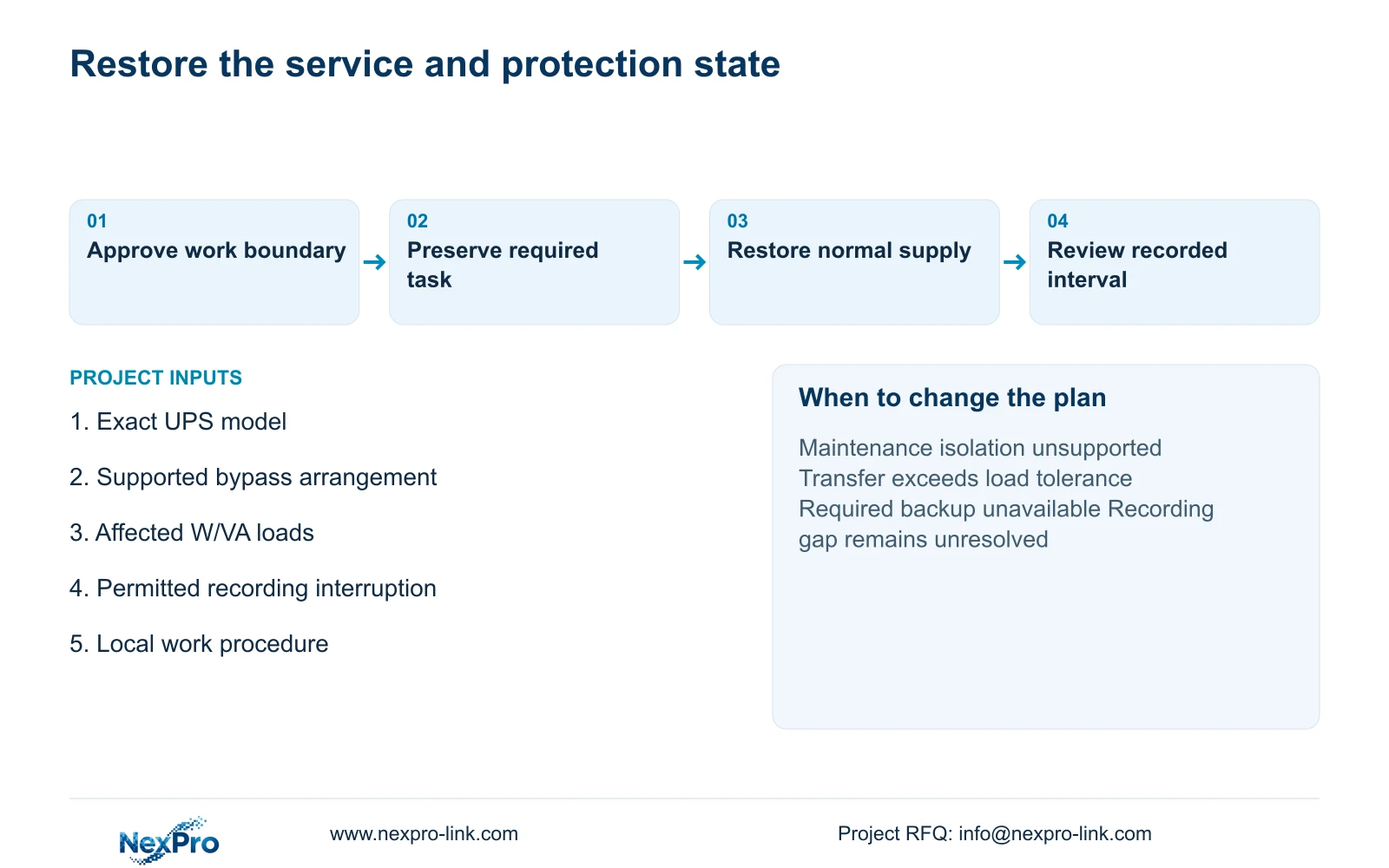
After the approved electrical restoration, confirm the intended normal supply and protection state using the selected equipment's procedure. The CCTV team should then check required camera groups, current recording and playback across the work interval. Record any gap as an observation, not as a presumed acceptable result.
Keep equipment identity, relevant configuration and unresolved tasks in the maintenance record. Confirm the required alarm or management workflow where supported. A device returning online does not establish that battery protection, all network dependencies and footage retrieval have returned to their intended state. Repeat affected checks after corrective work.
Recommend supported maintenance bypass when it preserves the approved load task and allows the planned specialist work. Change to a supported alternative supply or authorized outage when isolation, transfer tolerance or source availability prevents that outcome. Send info@nexpro-link.com the exact UPS model, proposed bypass arrangement, protected-load schedule and permitted recording interruption for scoped equipment and BOQ support.
Section 07
Buyer questions
Does an online UPS specification include maintenance bypass? It does not establish the required maintenance arrangement by itself. Request the exact supported bypass scope and identify whether the proposed work is covered, including any external equipment and local installation responsibility.
Can the battery bridge calculation justify a power cut while the UPS is isolated? Only a functioning supported backup path can provide that energy to the load. A battery in isolated equipment cannot be counted as available protection merely because its nominal capacity is sufficient.
What should the hotel retain after maintenance? Retain the configuration and service record, restoration observations, footage-gap findings and outstanding corrective tasks. Keep authorized evidence separately from credentials, and use the approved service process for equipment returns.
Engineering references
These sources support the general planning principles. Always use the selected product's current datasheet and applicable project standards for final design.