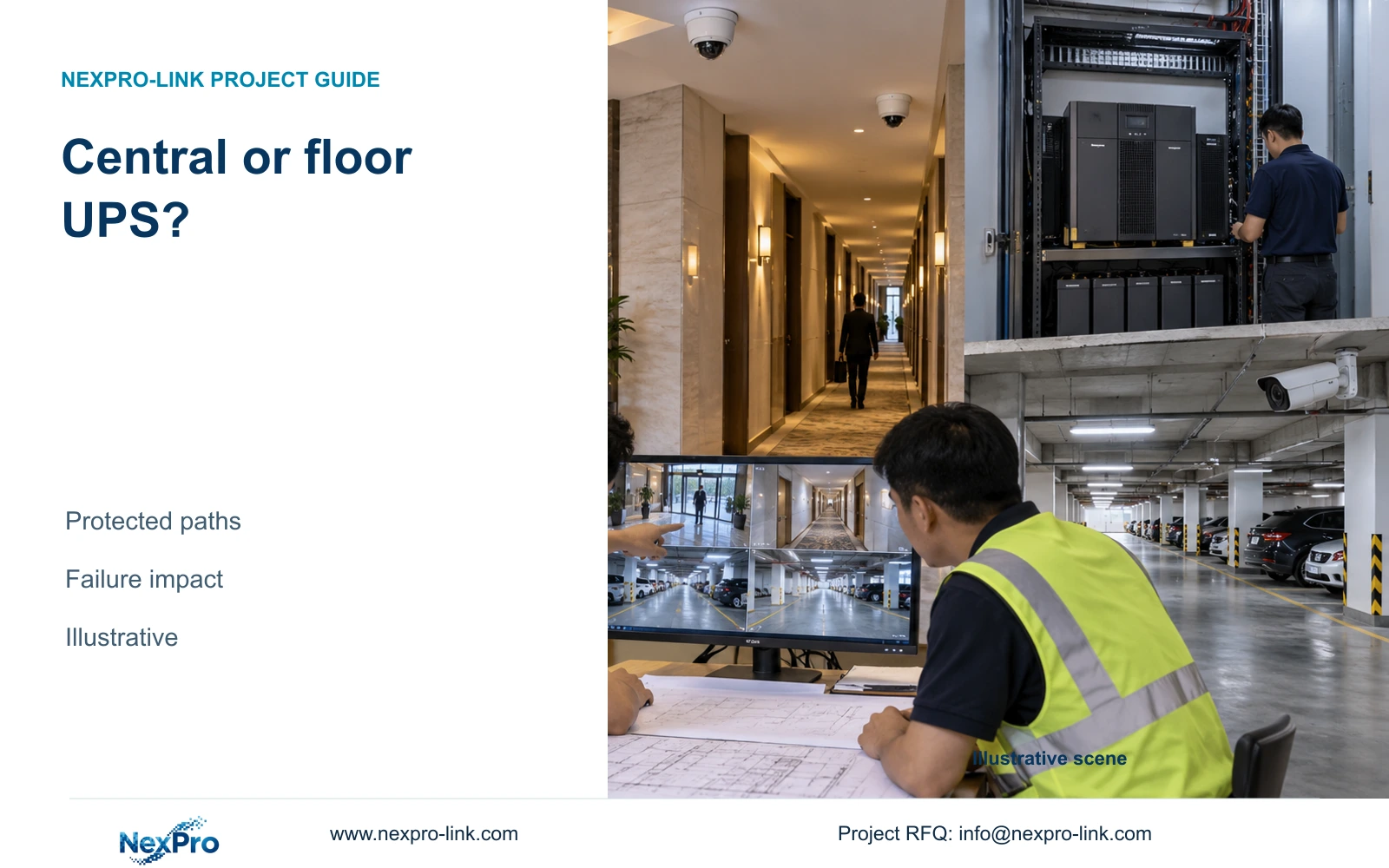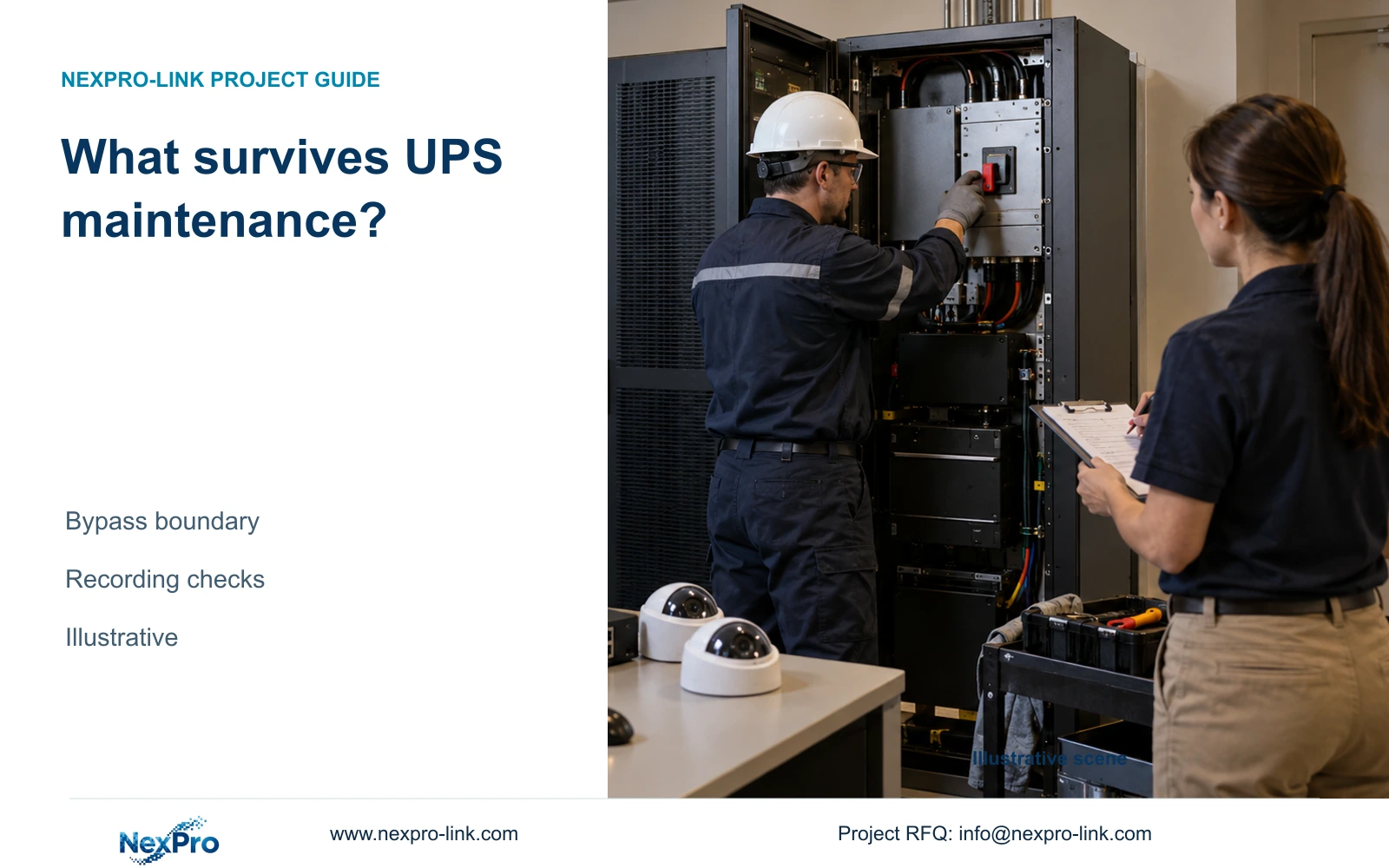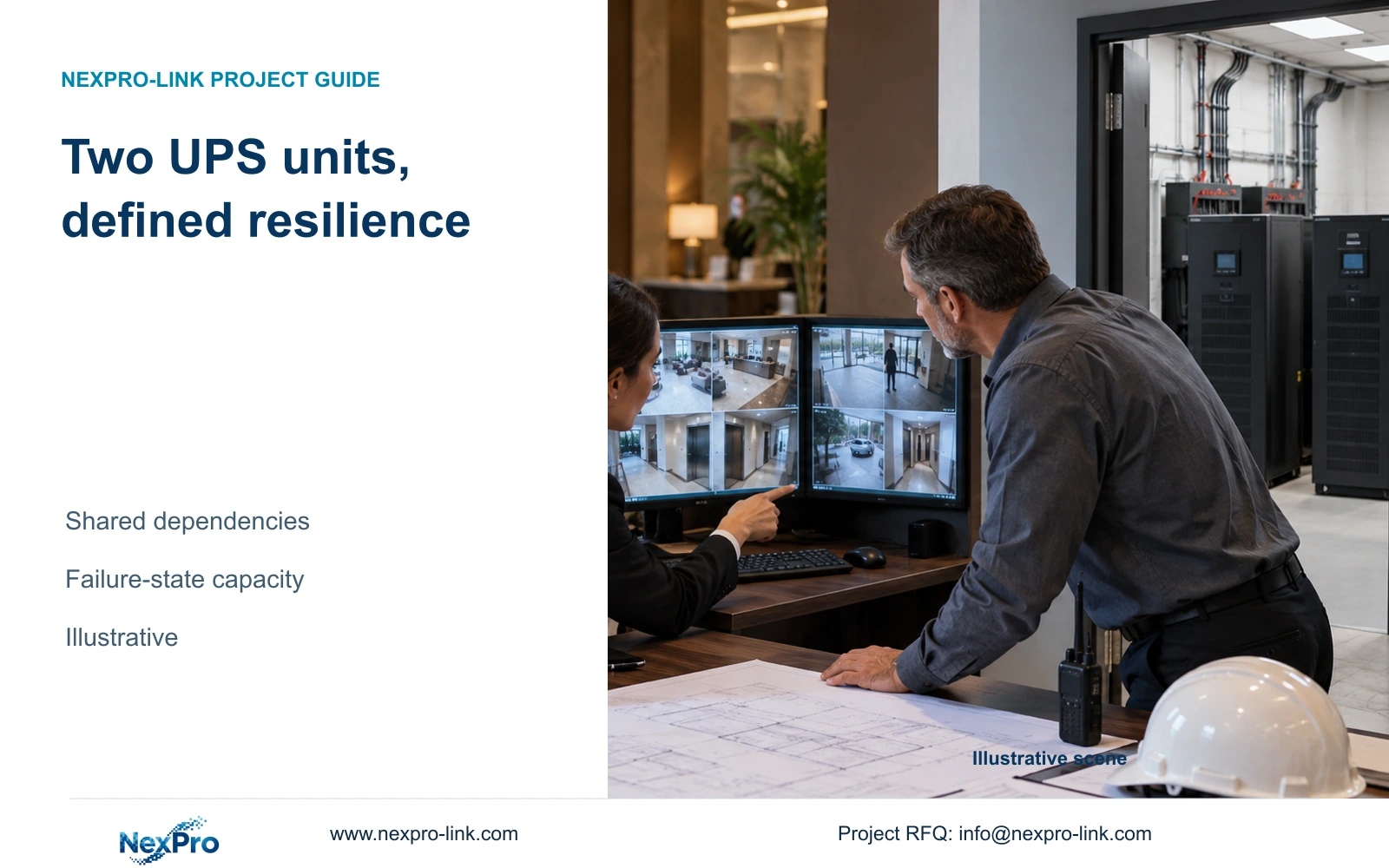
Two UPS units can protect separate camera groups without providing two complete alternative paths. Define the required failure state and check every dependency before assigning a redundancy label.
Section 01
Define the intended fault tolerance
Choose a dual UPS arrangement from the failure the hotel needs to tolerate, not from the equipment count. Two units protecting separate camera groups do not establish complete 2N resilience. Trace the upstream supply, distribution, network and single-input loads, then verify capacity and continuity in the stated failure condition. Require a different architecture if the hotel needs all designated recording to survive the loss of either path.
Write the operating outcome for each accepted failure. Losing one UPS may be allowed to remove a defined noncritical branch, or the requirement may be to retain every designated view. Maintenance continuity can create another requirement. These choices produce different equipment and installation scopes and should be settled before comparing quotations.
Use a public-area camera schedule to identify the functions at risk. Entrance, reception and service-route tasks may have different priorities, but their importance must come from the hotel brief. The supplied 32-camera reference is an illustrative planning configuration; its room count does not determine coverage or prove a delivered resilience level.
Section 02
Trace upstream and downstream dependencies
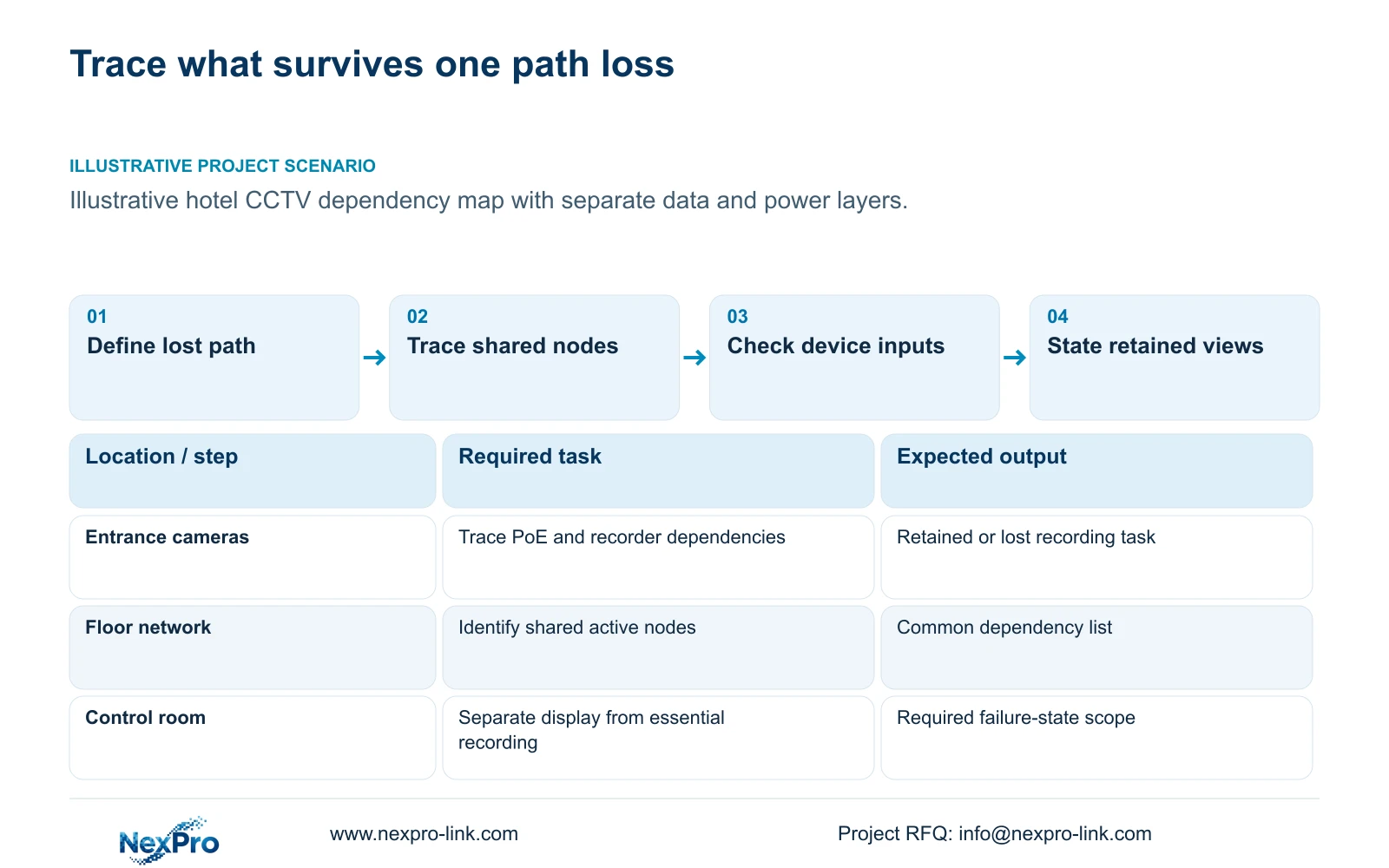
Draw the supply path to each UPS and continue through output distribution to the equipment. Name shared dependencies rather than stopping the diagram at two boxes. If both paths depend on one upstream element, its loss remains a common exposure. The responsible electrical designer must assess the actual installation and approved fault boundary.
Draw the data path separately. Cameras can retain power while a shared network node or recorder becomes unavailable. Conversely, a powered central recorder may lose video from an unprotected remote access switch. A fiber backbone supplies data connectivity, not automatic power to the remote node. Include every required active dependency in the continuity assessment.
Use a consistent AC-load boundary when building the power schedule. A complete PoE switch input already includes its camera contribution, so do not add those cameras again to the UPS total. Label measured, maximum and assumed values. Keep W and VA visible because both must fit the proposed unit in the relevant operating state.
Section 03
Identify single-input equipment
Record the actual power-input arrangement for each required device. A single-input recorder or access node needs an explicitly supported method of retaining power from the intended alternative path. Buying a second UPS does not establish that method. Leave unsupported transfer behavior unresolved in the design rather than drawing an implied connection.
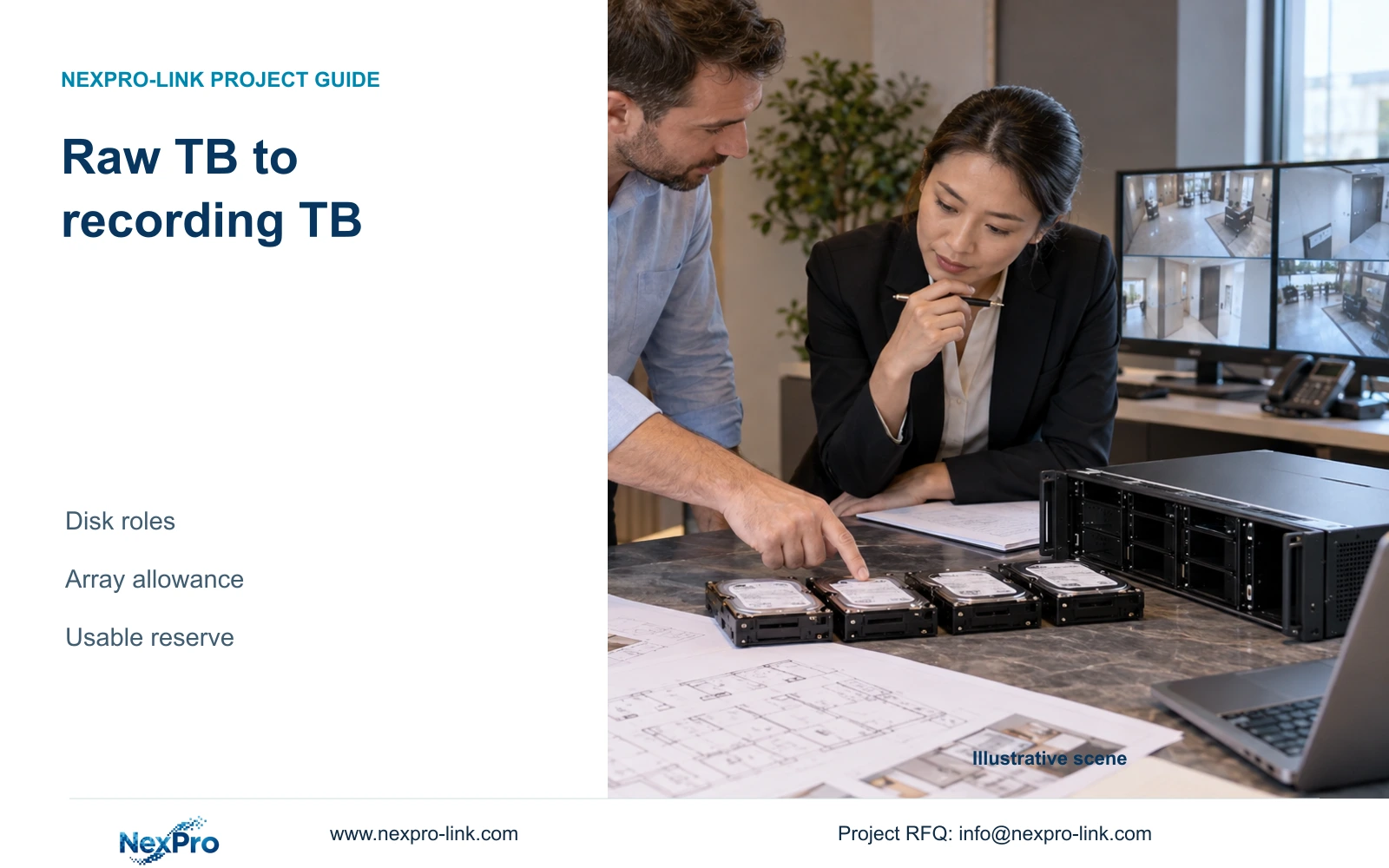
Check the selected equipment's data and storage role at the same time. NexPro-NVR4449-4K has published fields of 49 channels, 320 Mbps input and four SATA positions with 18 TB per drive. Those fields do not prove dual power inputs, automatic failover or a specific RAID level. Its summary also lists 49 × 5MP / 9 × 4K, so channel count alone cannot establish every recording mode.
NexPro SW-POE1618G remains an inquiry candidate because its access-port speed fields conflict and its total PoE power is not stated. Obtain the required power and speed information before qualifying a branch. Confirm actual camera peak loads as well; the supplied camera PDFs do not provide verified maximum watts for the planning power assumptions.
Section 04
Compare separate groups and true dual paths
Separate groups divide the protected workload. They may limit the number of views affected by a local power failure, while leaving the other group operating. Complete alternative paths require a stronger result: the agreed essential service remains available through the loss of the specified path. The device input arrangements, shared nodes and surviving capacity must support that result.
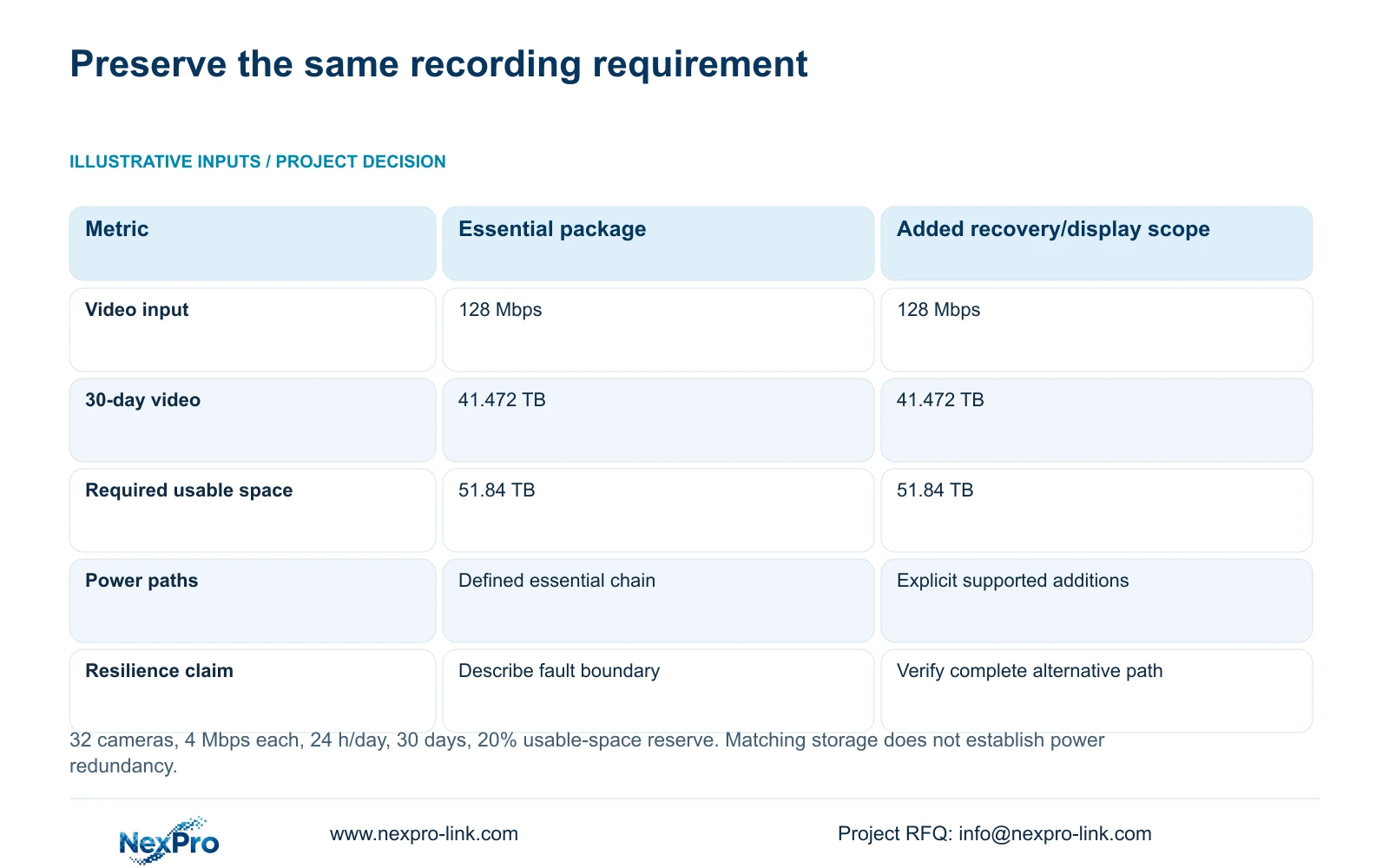
Keep the essential recording service identical when comparing the baseline package with added display or recovery scope. The supplied calculation assumes 32 cameras at 4 Mbps each, continuous recording for 30 days and 20% of usable capacity left free. Input is 32 × 4 = 128 Mbps. Video data is 0.0108 × 32 × 4 × 30 = 41.472 decimal TB; required usable capacity is 41.472 / 0.80 = 51.84 TB.
These matching storage totals agree with the complete reference, but establish no electrical redundancy. Optional display or recovery equipment must add a defined benefit without reducing that recording target. A display wall is not a recording dependency. If its protection is required, add its actual load and battery requirement separately.
| Metric / condition | Essential recording-first package | Same core plus optional display/recovery scope |
|---|---|---|
| Recording input (Mbps) | 128 | 128 |
| 30-day video data (TB) | 41.472 | 41.472 |
| Required usable capacity (TB) | 51.84 | 51.84 |
| Protected path | Cameras + network + recording | Same plus explicitly selected extras |
| Operator display | Task-sized monitor/workstation | Optional wall; independent recording |
| Cost comparison | Complete scope quotation required | Add only documented incremental scope |
Section 05
Calculate capacity in the failure state
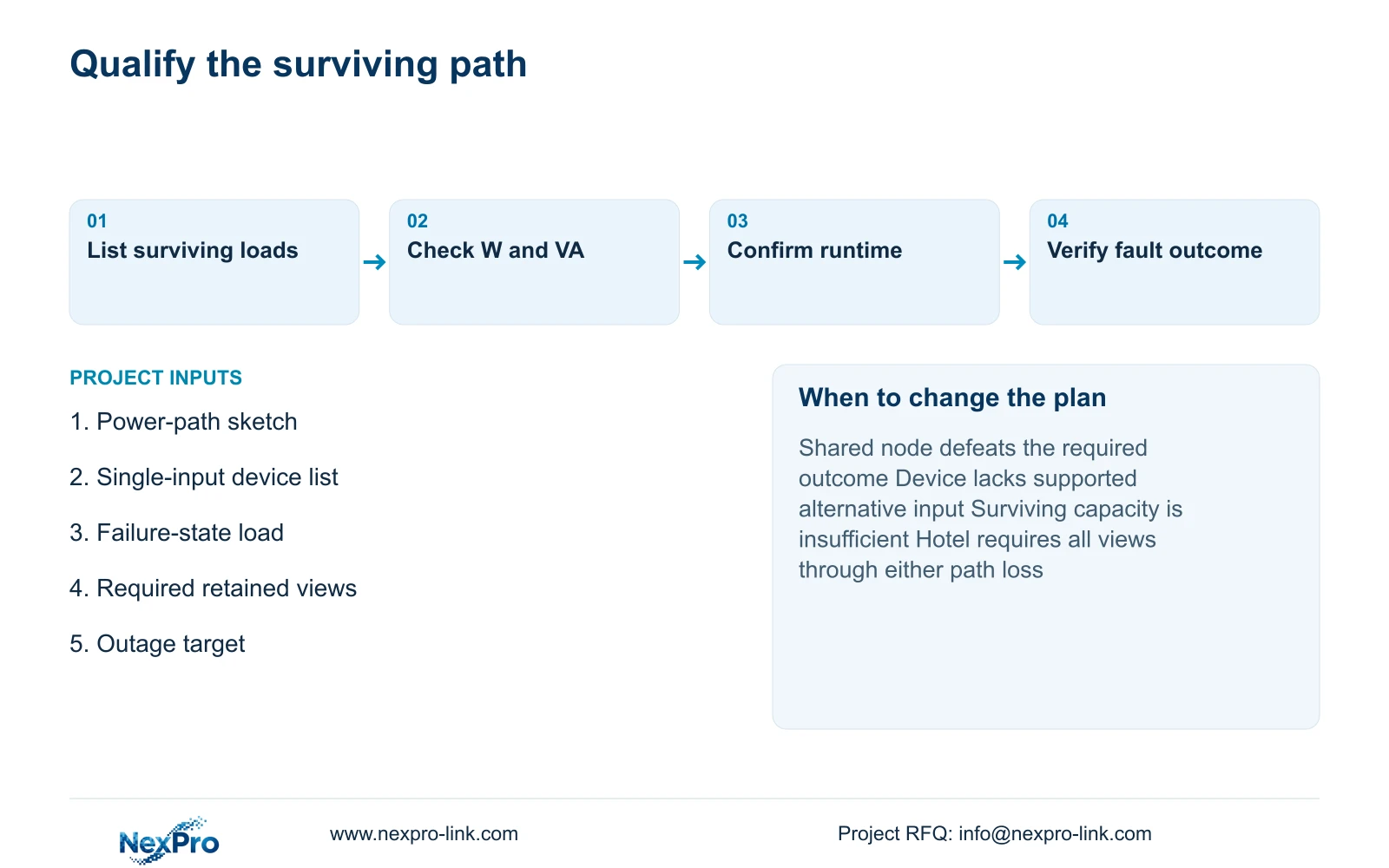
For each proposed failure, list the loads that remain on the surviving supply and the loads that are lost. Sum the required surviving watts and VA against that unit's ratings. Two capacities cannot simply be added and treated as available after one unit fails. If the intended transfer increases the surviving load, calculate that state explicitly.
Apply the chosen capacity reserve to the failure state as well as normal operation. The supplied independent UPS example uses 750 W at aggregate PF 0.9, equivalent to 833.33 VA. SP1KR(S), rated 900 W / 1 kVA, operates at 83.33% on both limits and misses its stated 20% reserve target. SP2KR(S), rated 1800 W / 2 kVA, operates at 41.67% and retains that capacity reserve.
That separate example is a capacity check, not the 32-camera hotel's power total or a failover test. Runtime still needs the actual supported battery configuration at the surviving load. Distributed nodes require resolved local protection. A central unit with sufficient aggregate watts does not establish an electrical route to every remote closet.
Section 06
Name the actual resilience level
Describe the achieved behavior in the equipment proposal: separate protected groups, continuity through a defined UPS loss, or another expressly supported arrangement. Use a 2N claim only where the project definition, complete paths and approved verification support it. List the remaining common dependencies beside the claim so buyers can compare the same boundary.
Recommend separate protected groups when the hotel accepts the stated branch loss and that arrangement meets its operating brief. Move to supported complete alternative paths when all designated recording must survive the specified path failure. Reassess when single-input equipment, shared distribution or insufficient surviving runtime prevents the required result.
Send info@nexpro-link.com a power-path sketch, camera and network schedule, required fault scenario and outage duration. Include available load records and the generator sequence. Hotel project equipment support can coordinate relevant model information; BOQ support can separate the added recovery scope from essential recording. CCTV manufacturing and coordinated supply do not imply that every device is manufactured together or that local electrical works are included.
Section 07
Buyer questions
Can we describe two floor UPS units as a redundant system? Describe the specific service they retain and the failure boundary. If each supplies a separate group, one group's loss may still remove its views. That is different from retaining every required view after either path fails.
Does a recorder with two network ports have dual power resilience? Network-port count does not establish a second power input, supported transfer or recording failover. Request documentation for the exact capability required. The supplied NVR fields do not support those inferences.
Which costs should a resilience quotation separate? Keep essential recording and storage intact, then identify the supported alternative power path, distribution, required network changes, battery configuration and acceptance work. Optional displays belong in a separate line unless their continuity is part of the operating brief.
Engineering references
These sources support the general planning principles. Always use the selected product's current datasheet and applicable project standards for final design.