A quiet UPS does not prove that every camera keeps recording. Accept the outage arrangement only after an approved test verifies the complete protected path and usable footage.
Section 01
Define a safe test scope
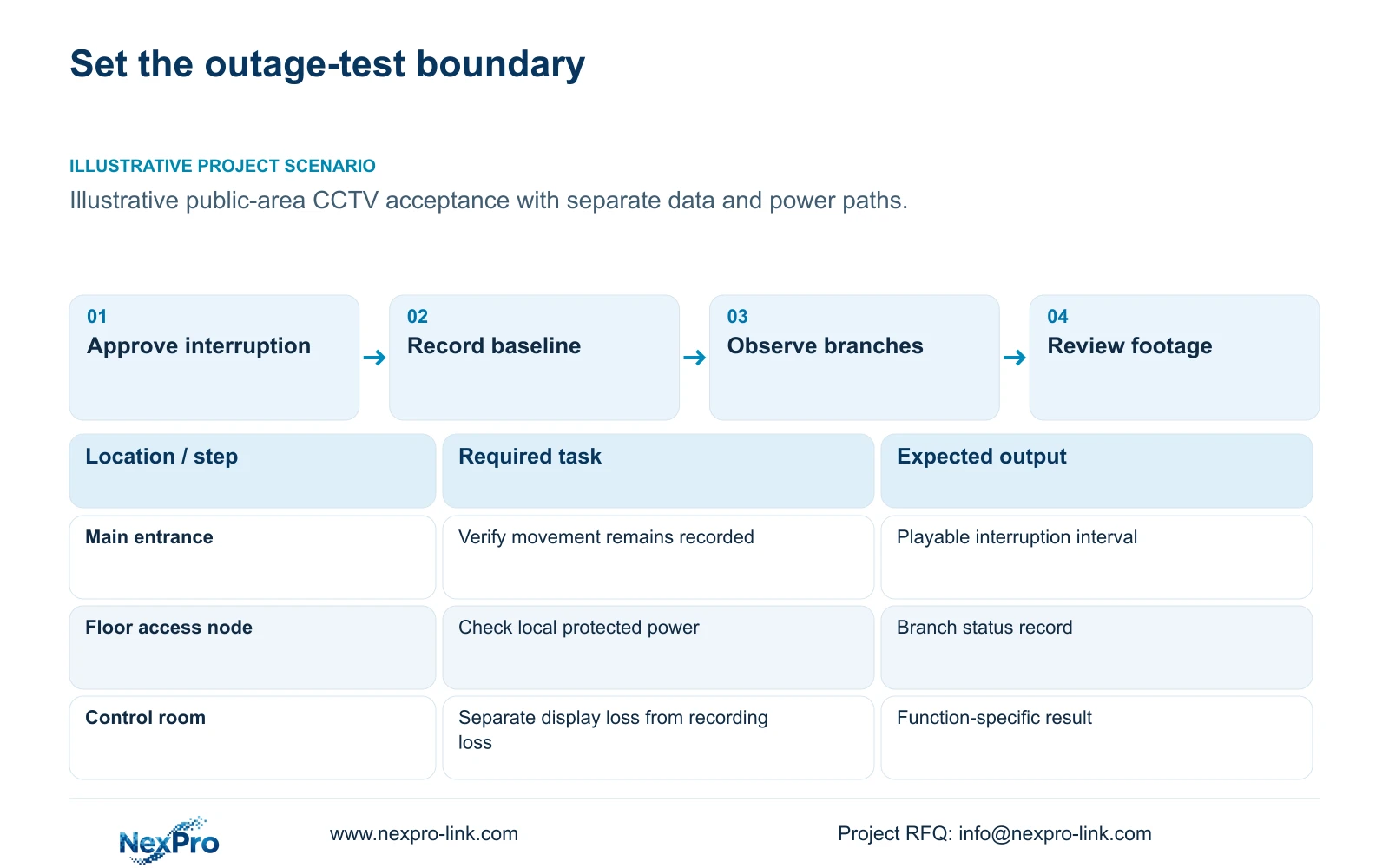
Choose task-based outage acceptance when the hotel requires recording to continue during a power interruption. A UPS without an alarm, an illuminated recorder and a clear preview cannot establish that outcome. The approved test must check the required cameras, their network path, recording timestamps, playback and restoration. If the proposed interruption could affect essential safety systems, change the test boundary or arrangement before proceeding.
The hotel operating team and responsible electrical personnel should agree on the interruption point, permitted duration and conditions for stopping the exercise. Identify which public-area views must remain available, which monitoring functions may stop, and who can restore normal power. A general CCTV UPS arrangement must not be treated as authorization to interrupt fire, evacuation, lift or other life safety circuits.
Use an observable task for each selected view, such as retaining movement through the entrance or a back-of-house passage during the agreed interruption. Exclude guest-room interiors and unnecessary private views. The acceptance record should distinguish the intended result from the result actually observed.
| Required task | Given information | Decision still needed |
|---|---|---|
| Entrance recording continues | Camera and recorder are normally online | Approved interruption point and duration |
| Remote access remains available | Client depends on a network route | Whether that route is protected |
| Normal operation is restored | Power will be returned under supervision | Responsible person and recovery checks |
Section 02
Record the initial working state
Capture the configuration before testing so that an outage symptom can be separated from an existing defect. Record the camera identifiers, recorder model, relevant firmware, recording profiles and protected-power locations. Check the selected views in playback as well as live view. A camera that was already failing to record should not enter the outage exercise as a healthy baseline.
Note the operating conditions that affect the load and image task. A daytime demonstration may omit the intended night illumination state. Record whether the test represents that state, along with the battery configuration and available load information. Maximum labels, planning assumptions and measured AC inputs should remain distinguishable in the report.
Factory checks can support device and configuration review, while hotel site acceptance addresses installed cabling, local power boundaries and actual operating tasks. The initial-state record connects those scopes. A factory pass does not establish that a remote floor switch has been connected to the protected supply.
Section 03
Observe the protected devices
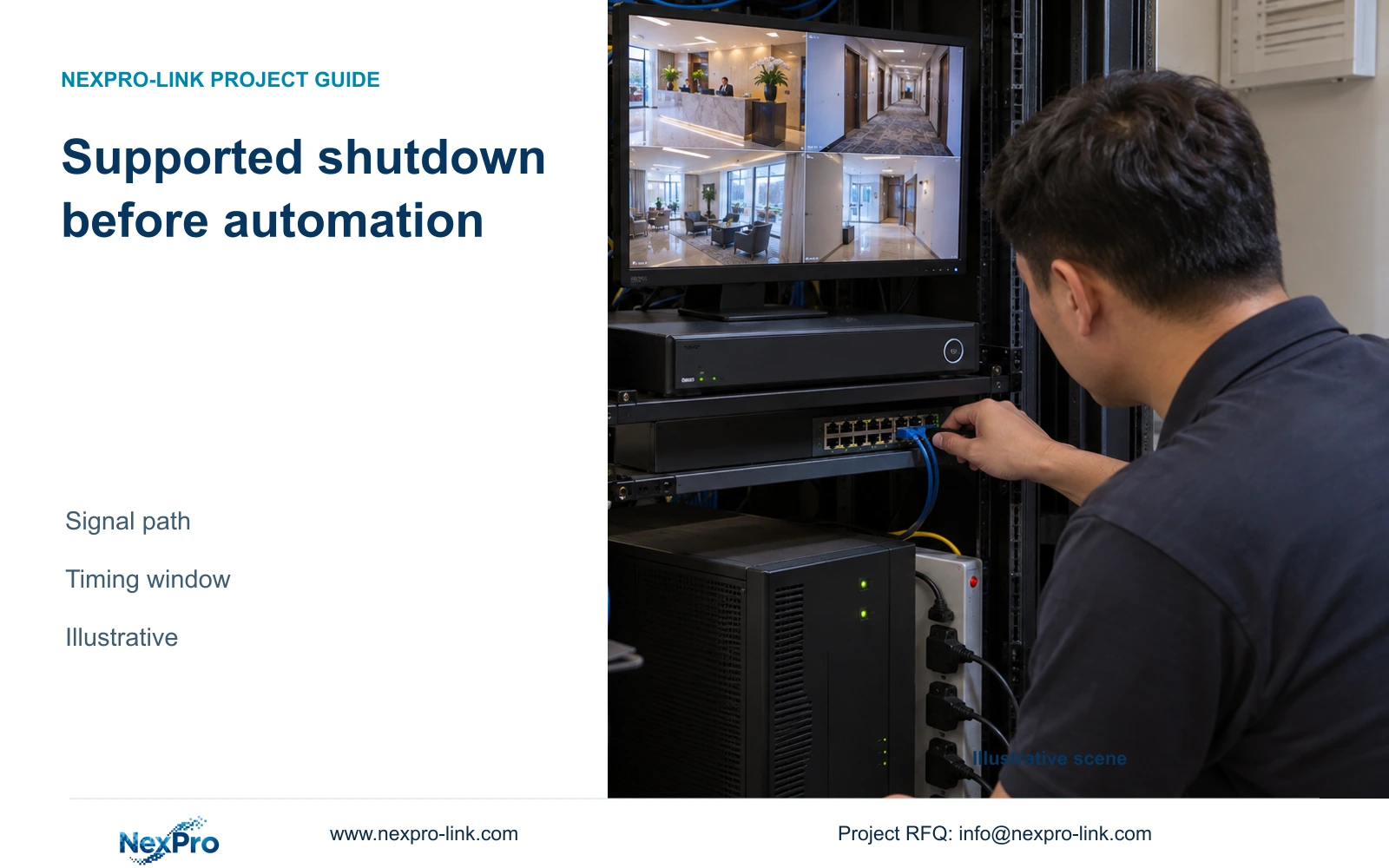
Follow the recording path from the selected camera through its PoE access node and any required backbone equipment to the recorder. Show data and protected power separately. A fiber connection can carry video while its remote switch loses local power; keeping the central recorder alive would leave that branch without incoming images.
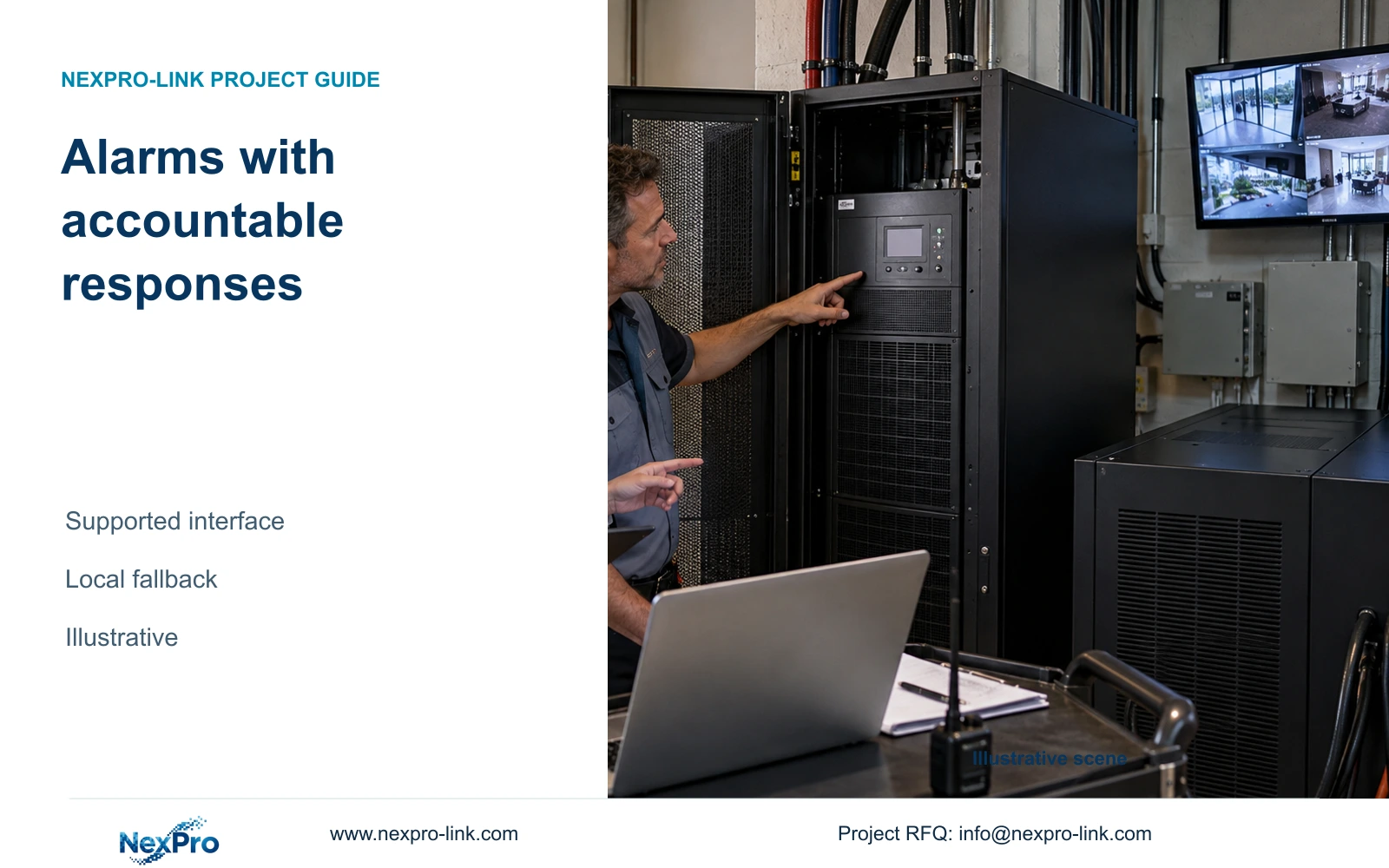
During the approved interruption, record device behavior against the baseline. Distinguish a camera losing power, a network connection disappearing and a recorder remaining online without usable incoming streams. Identify the affected view and responsible power zone. Monitoring a single screen cannot reliably describe every branch of a distributed installation.
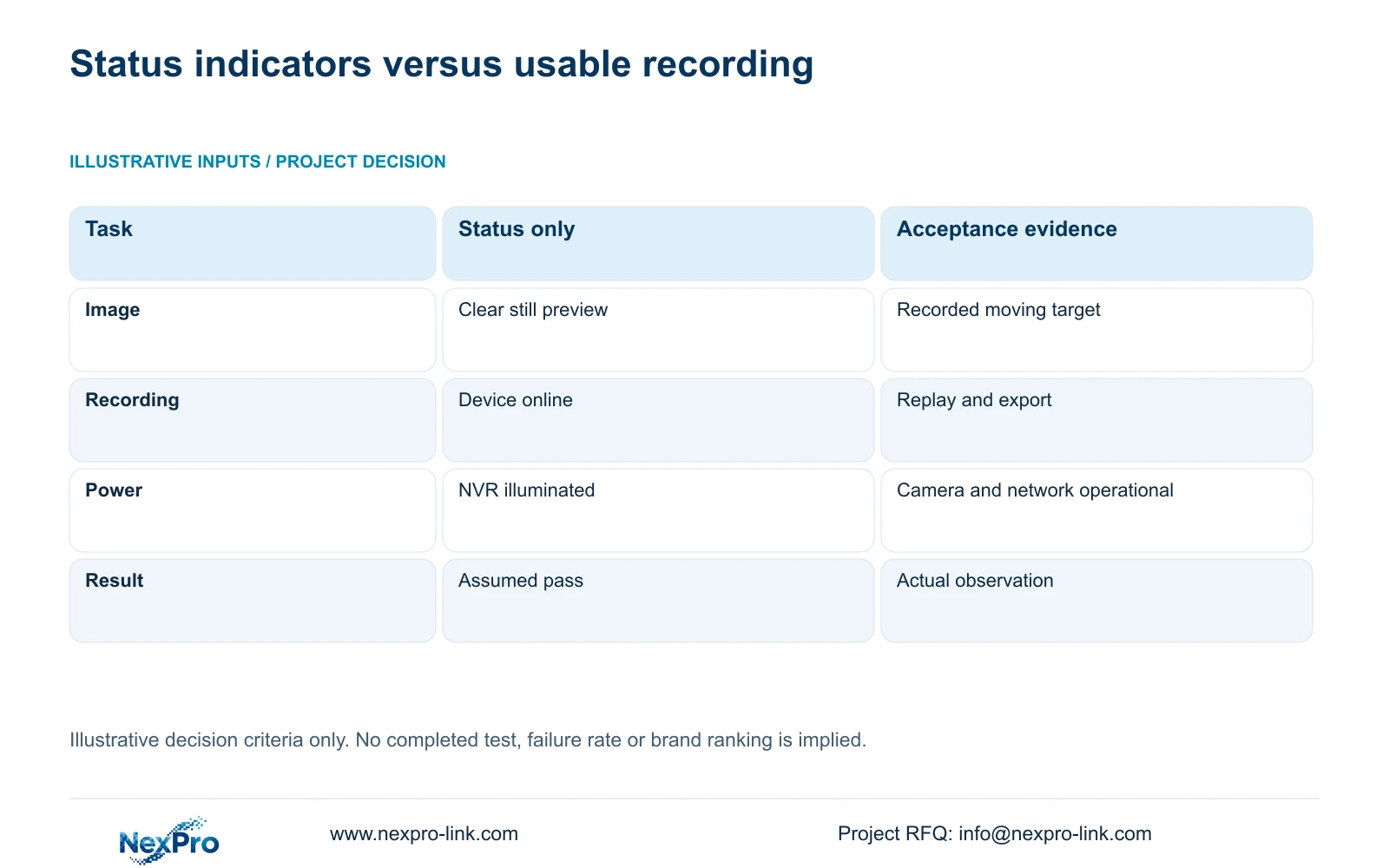
The comparison below uses illustrative acceptance criteria, not measured performance or a brand score. Its inputs are observable tasks and operating states, so there is no numerical formula or unit conversion. It changes the purchase decision by requiring evidence of the complete function instead of treating device status as a pass.
| Metric / condition | Preview-only acceptance | Task-based acceptance |
|---|---|---|
| Image | A still preview appears clear | Recorded moving target reviewed at the agreed point |
| Recording | Device online | Relevant footage can be replayed and exported |
| Power | NVR stays illuminated | Required camera and network path remains operational |
| Result status | Cannot prove complete outcome | Record actual observations; not pre-filled passes |
Section 04
Verify recorded continuity
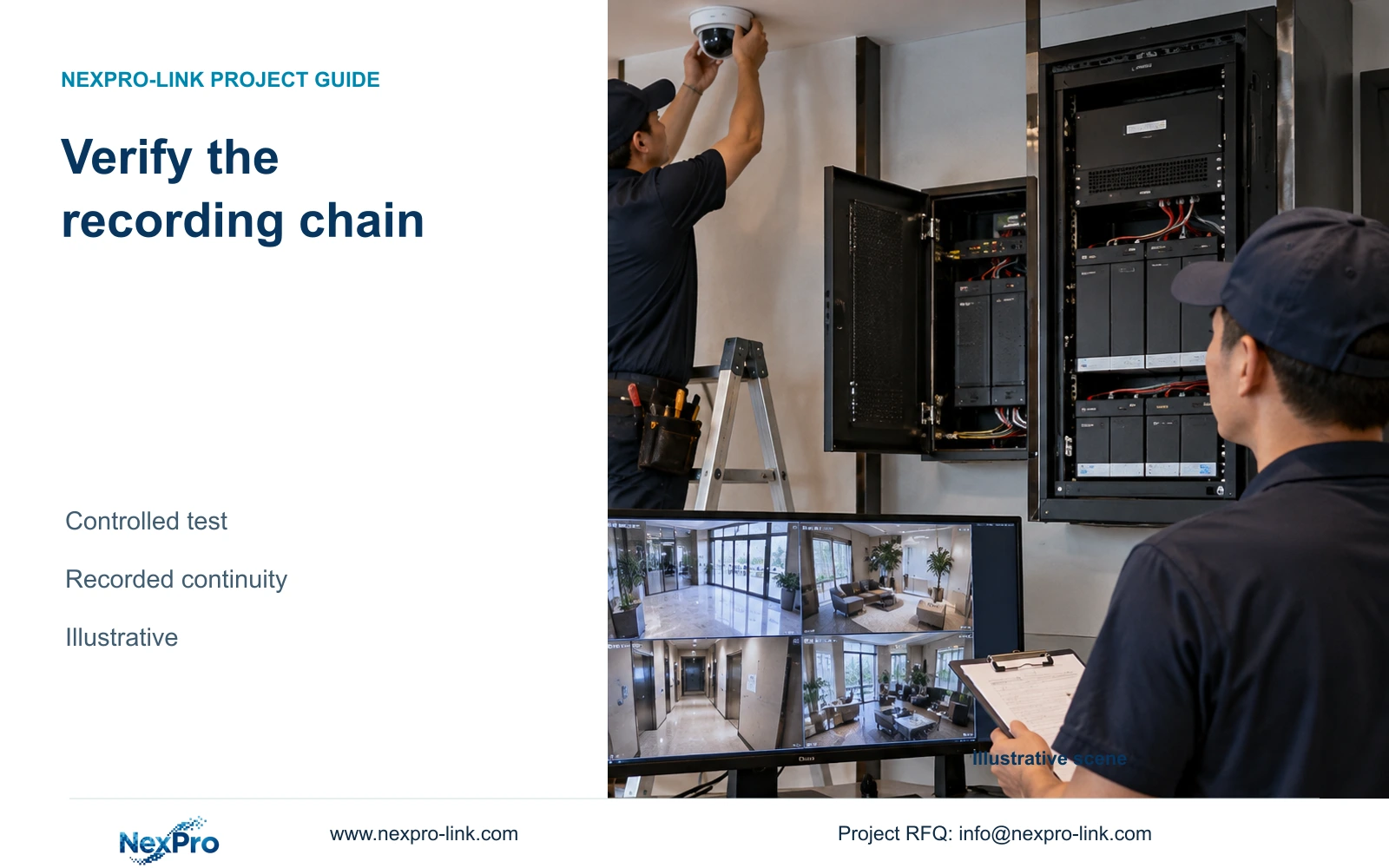
Review the recorded interval before, during and after the interruption for each view in the agreed scope. Use an authorized representative movement task to make continuity observable. Check that timestamps allow the sequence to be understood and that the intended action is retained. A static image offers little evidence about missing movement or interrupted recording.
Retrieve and export the relevant test interval through the intended operator workflow. Confirm that the exported material can be played using the agreed method. Limit the export to the authorized test scope and handle it through the hotel's approved access process. A successful live demonstration does not answer whether the footage is available afterward.
The supplied 32-camera reference illustrates why branch checks matter: four access nodes each serve eight cameras. Those counts are a teaching configuration, not a delivered installation or this article's test sample. If the hotel tests only selected branches, describe that coverage explicitly; the result cannot be expanded into a claim that every camera, firmware version or operating condition has passed.
Section 05
Compare expected and observed recovery
Define recovery in operational terms before the test. The required result may include cameras reconnecting, recording resuming, timestamps remaining usable and authorized operators retrieving the interval. Compare each expectation with the observation. A device returning to its normal indicator state leaves the recording and retrieval tasks unresolved until they are checked.
Separate local recovery from remote access. If recording resumes locally while the remote client remains unavailable, investigate the client network and access path without describing the whole system as failed or fully restored. The response should follow the lost function. This also keeps an optional display failure from obscuring a more serious gap in recording.
Additional monitoring or protected network equipment is worth considering when the observed defect lies on a required dependency. Extra display equipment has a different justification: it must support an agreed operator task. Neither addition should be accepted as a remedy until the original failure condition is repeated and the required outcome is observed.
Section 06
Close defects by function
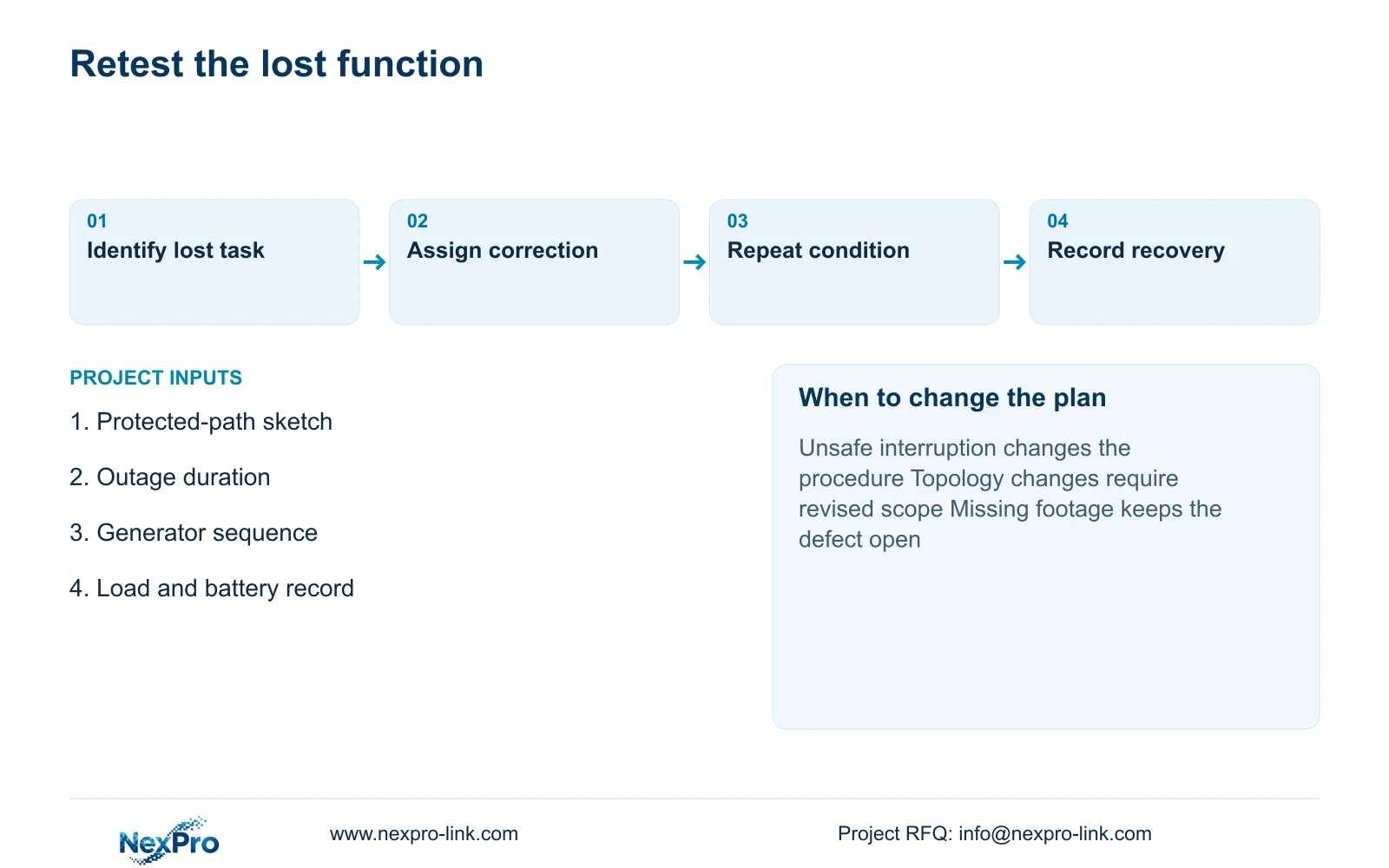
Write each defect as an unfinished task with its affected devices, conditions and responsible party. For example, a remote entrance branch that stops recording needs its power and network dependency resolved. A report marked closed after a component swap does not demonstrate restoration. Repeat the original task under comparable approved conditions and attach the actual outcome.
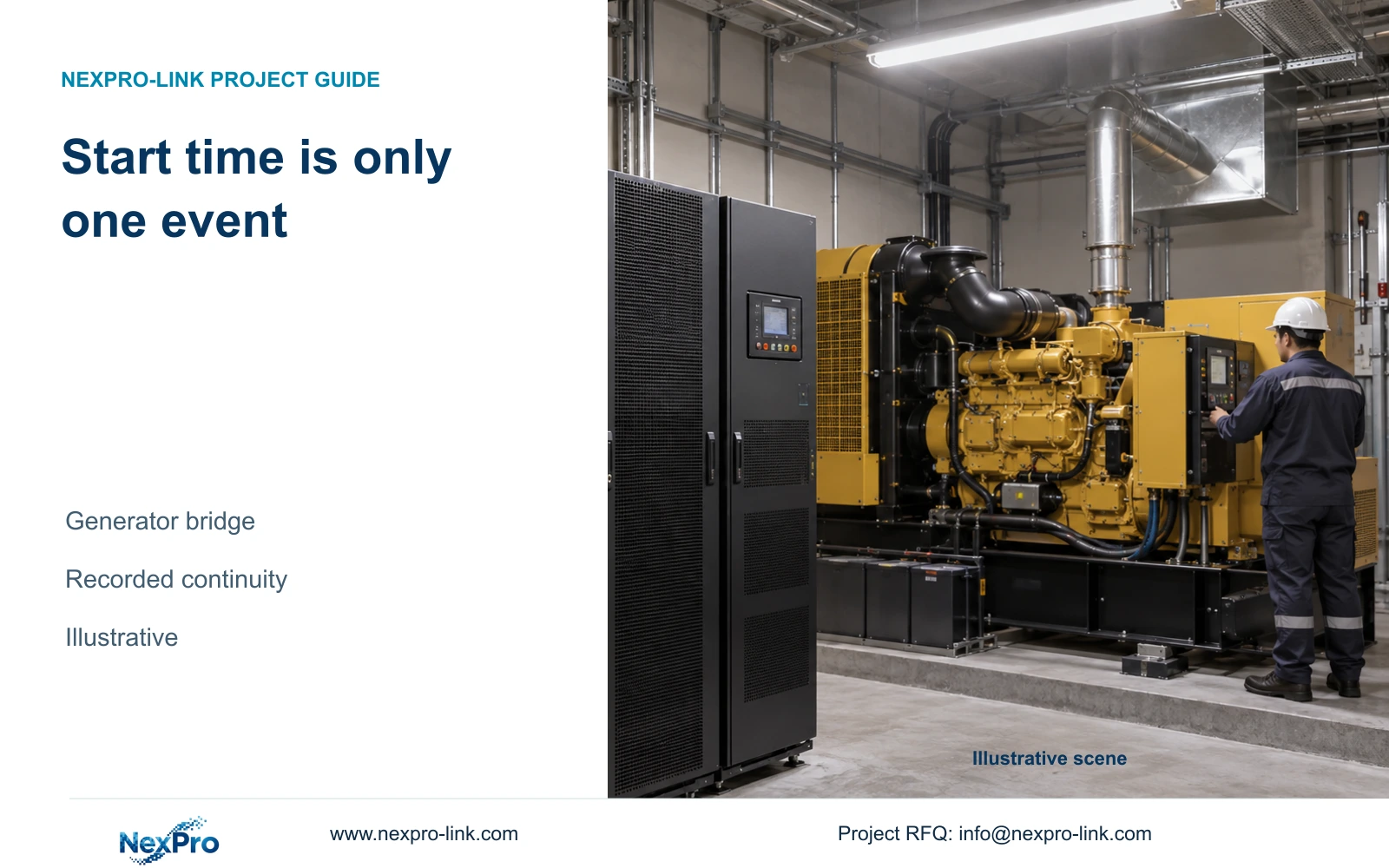
Recommend the controlled whole-chain test for acceptance of the required outage state. Revise the procedure when the protected load, battery arrangement, generator sequence or network topology changes. If safe interruption is unavailable, retain the acceptance limitation and agree a different controlled demonstration; do not substitute a preview check and describe it as equivalent.
For a scoped equipment review, send info@nexpro-link.com the protected-path sketch, desired interruption duration, generator sequence and available load record through Hotel project equipment support. NexPro-Link can discuss model matching and coordinated equipment supply. Local switching, electrical supervision and site acceptance responsibilities should remain explicit in the proposal.
Section 07
Buyer questions
Does a successful factory demonstration replace the hotel outage test? No. It can support the tested device configuration, but the installed hotel's remote power nodes, cabling and operating workflow need their own acceptance scope. Request a proposal that separates factory checks from site tasks and names the party responsible for each.
Should we accept a test that covers only one camera branch? Accept it as evidence for that stated branch and condition. If the contract requires all designated views to continue, the remaining branches still need verification. A representative sample is useful only when its limits remain visible.
What support information can we send without sharing guest footage? Send device identifiers, relevant versions, a protected-path sketch and a description of the lost function. Authorized test records can be handled separately through an approved support process. Passwords and unrelated guest images do not belong in the initial inquiry.
Engineering references
These sources support the general planning principles. Always use the selected product's current datasheet and applicable project standards for final design.