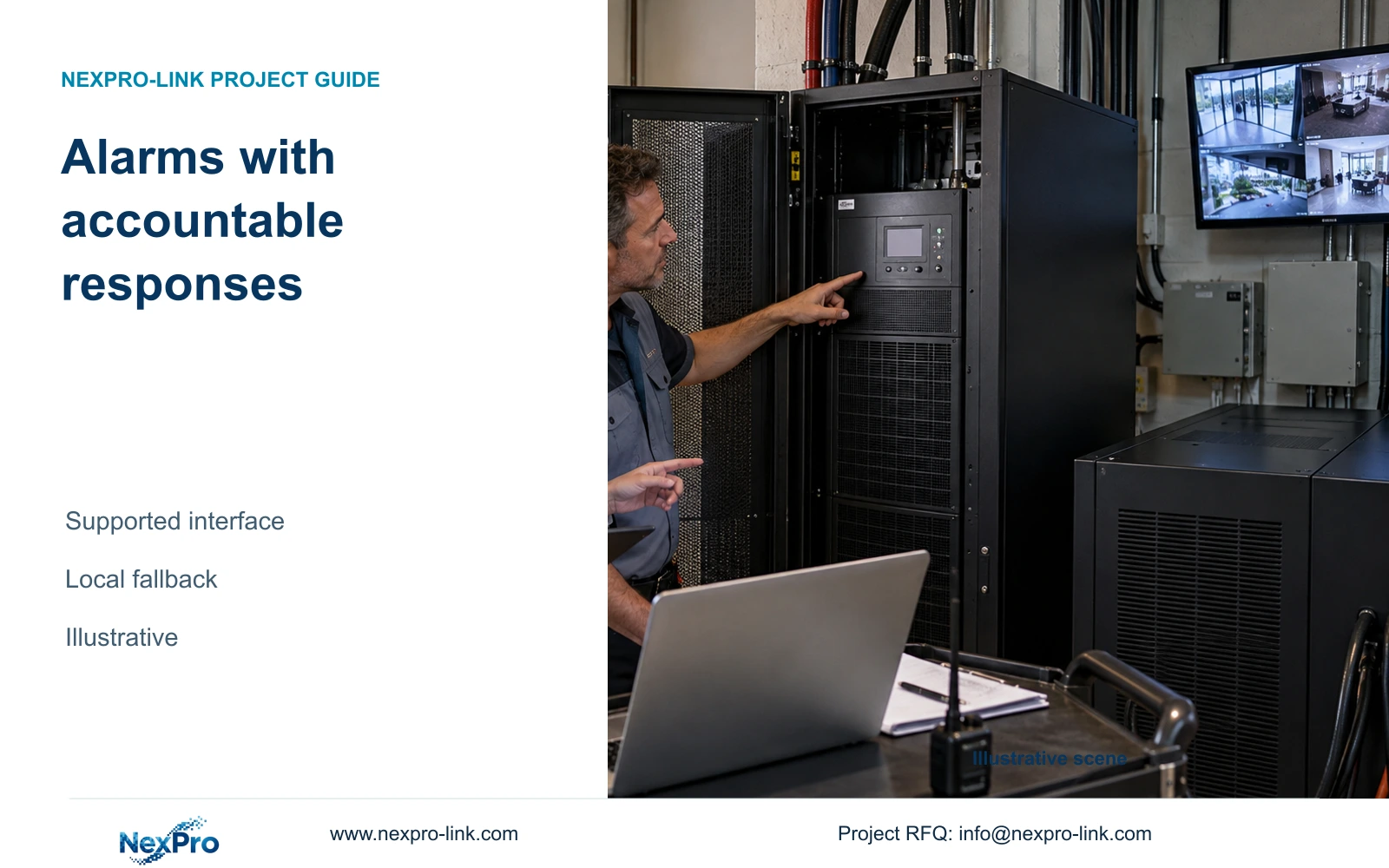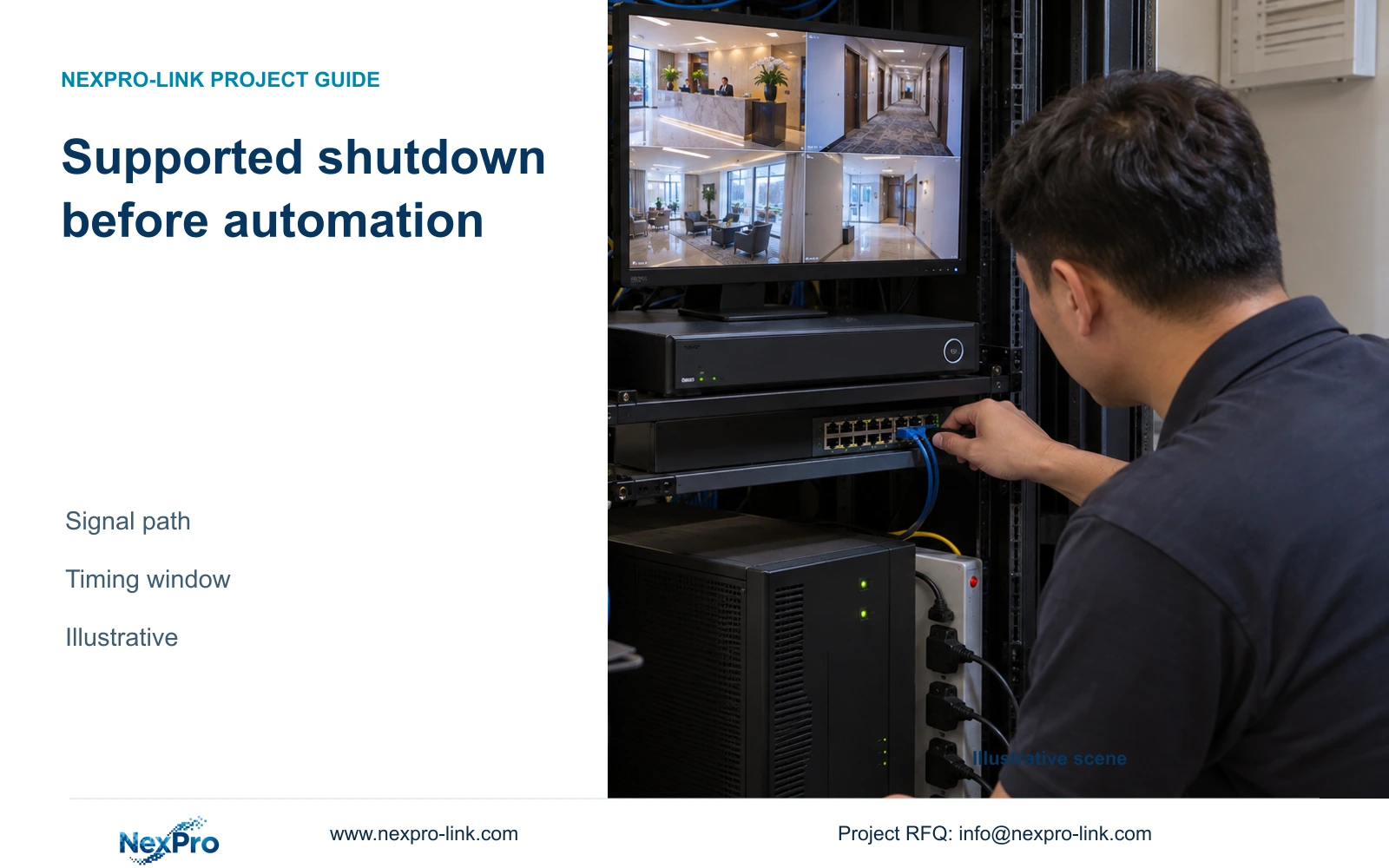
USB or SNMP on a UPS does not establish automatic NVR shutdown. Specify automation only when the exact recorder, software and signaling path support the required sequence.
Section 01
Identify shutdown-capable loads
Specify automatic low-battery shutdown only when the exact recorder, software and signaling path explicitly support it. A UPS with USB or SNMP does not establish that every connected NVR can shut down safely. Where that support is absent, choose a documented runtime or managed-response arrangement and state its limits. Change the proposal if the hotel requires unattended shutdown that the selected devices cannot provide.
List the loads by their operating role and supported response. The recorder, viewing workstation and network equipment should not receive one blanket automation claim. Record which device can accept the intended action, which must remain powered to deliver the signal and which has no confirmed automatic response. The list becomes the boundary for both procurement and acceptance.
Define the outage states separately: mains loss, generator starting, acceptable source availability, load transfer and recovery. A successful transfer may allow recording to continue without shutdown. A failed or delayed transfer creates a different decision. Use the project's accepted sequence rather than assuming every generator reaches usable supply within the same time.
Section 02
Read the supported signaling path
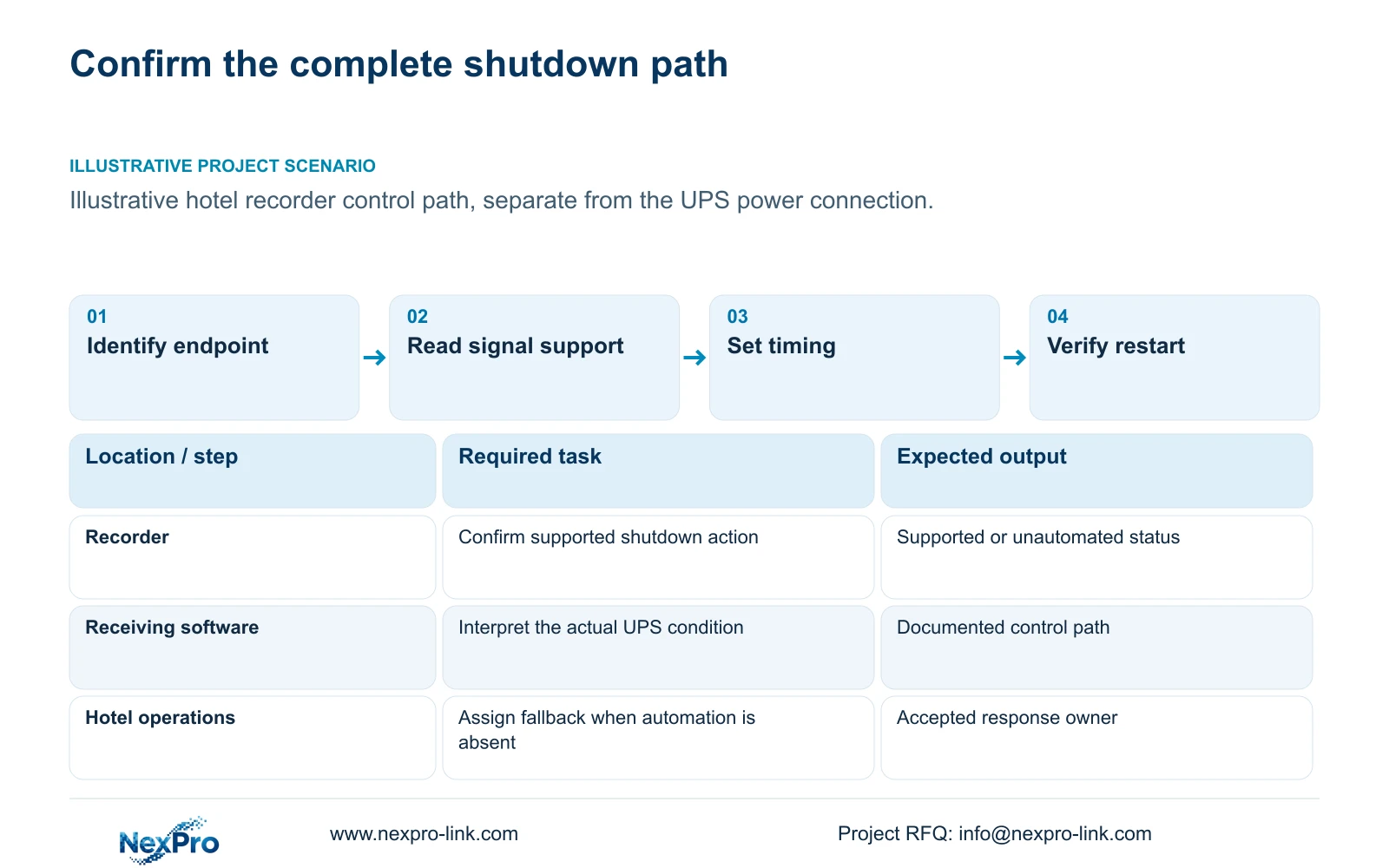
Trace the proposed action from the UPS indication to the receiving software and then to the recorder's supported shutdown behavior. Identify the exact versions and configuration needed at each step. A connector or interface name describes only part of that path. The procurement record should say what receives the event, what interprets it and what device action follows.
The supplied NexPro-Link NVR records describe recording-related fields, but do not establish automatic low-battery shutdown integration. NexPro-NVR4449-4K is therefore a recording candidate, not a proven shutdown endpoint. Require explicit support before putting that function into its project schedule. A shared equipment order cannot fill an undocumented interface gap.
Keep the signaling route powered for the period in which it must act. If the intended message uses a network node or receiving computer, include that dependency in the protected-load boundary. Assign ownership of settings and the authorized response. Do not distribute credentials in the equipment schedule or assume a remote support provider has permanent control authority.
Section 03
Set an achievable timing sequence
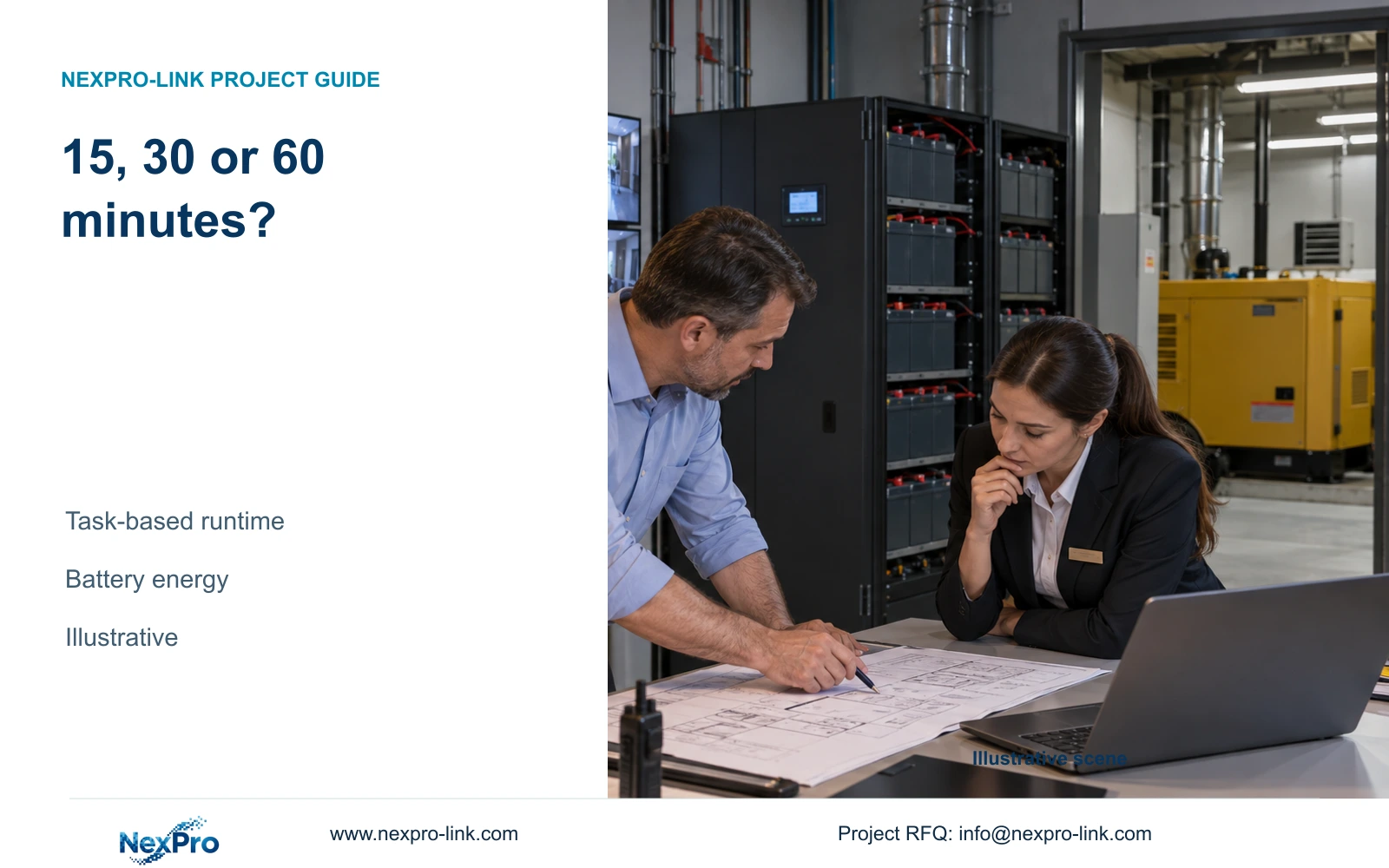
The timing plan must allow the approved transfer attempt and the fallback action to finish while usable power remains. Record the controlling project interval and the required shutdown behavior. Where shutdown is unsupported, the fallback may require longer supported runtime or an authorized local response. A low-battery indication arriving too late for the chosen task cannot support that plan.
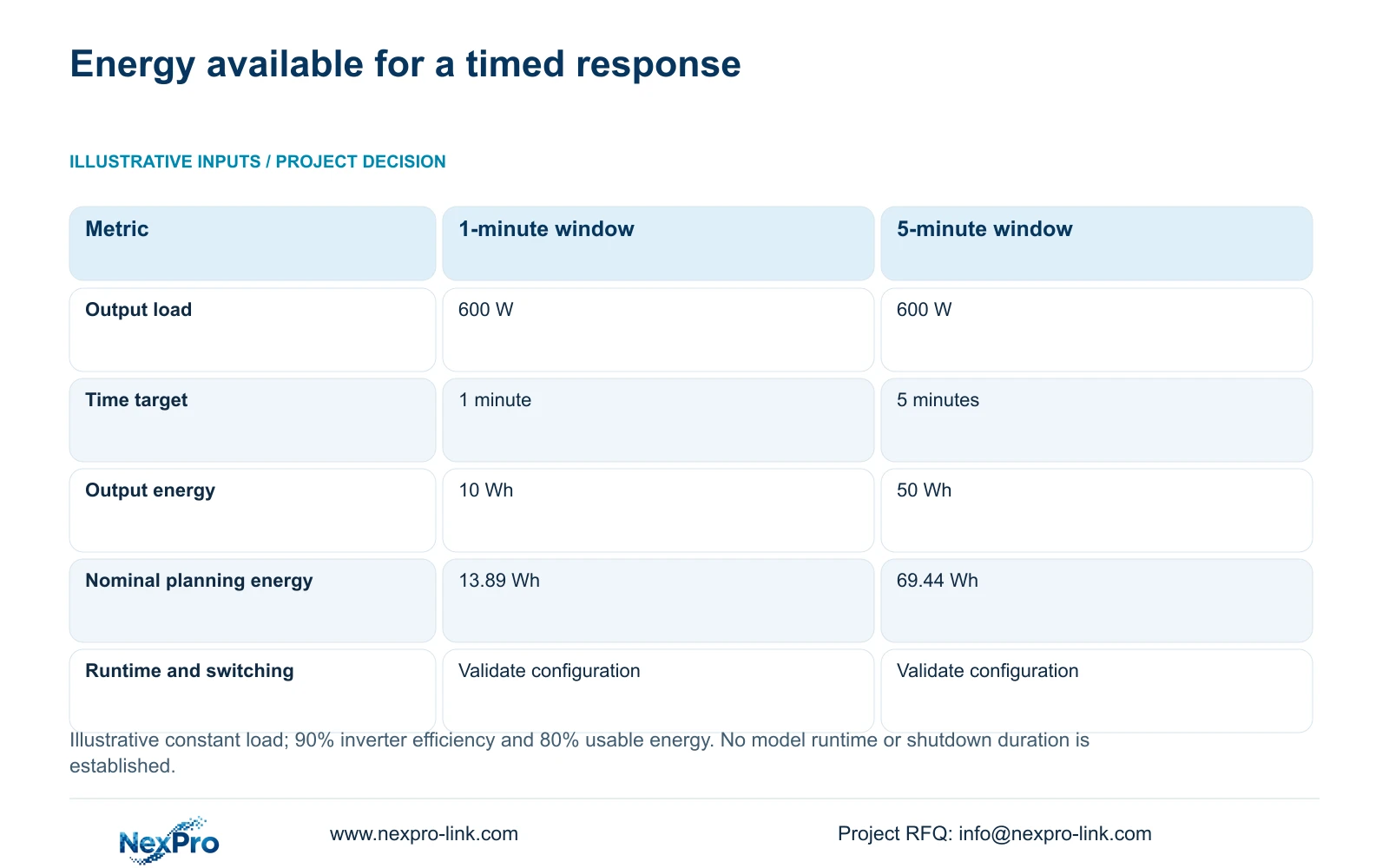
The illustrative comparison uses a constant 600 W output load and energy windows of one and five minutes. Output energy in Wh equals watts multiplied by minutes divided by 60. Nominal planning energy equals output Wh divided by (0.90 × 0.80), using assumed inverter efficiency and usable-energy factors. These are teaching inputs, independent of the complete hotel reference's load totals.
The five-minute window needs 50 Wh delivered to the load, compared with 10 Wh for one minute. The simplified nominal budgets are 69.44 Wh and 13.89 Wh. The larger window offers more time only if the supported configuration can actually provide it. These figures establish neither a shutdown duration nor a specific battery selection.
| Metric / condition | 1-minute energy window | 5-minute energy window |
|---|---|---|
| Load (W) | 600 | 600 |
| Time target (minutes) | 1 | 5 |
| Output energy (Wh) | 10 | 50 |
| Nominal planning energy (Wh) | 13.89 | 69.44 |
| Actual runtime / switching | Requires configured system validation | Requires configured system validation |
Section 04
Compare automated and managed responses
Automation is suitable when the complete supported sequence can be demonstrated for the required equipment. Compare the transfer-success state with the transfer-failure state. In the first, the system may retain recording. In the second, the approved fallback must describe whether recording continues, a supported shutdown occurs or authorized staff take action.
A managed response needs an accountable person, an available local or approved remote route and enough supported runtime for the task. If the hotel cannot provide that response, manual handling is not an adequate substitute for its unattended requirement. Reconsider the device or battery arrangement while preserving the required operating outcome.
UPS power ratings and battery runtime remain separate checks. SP1KR(S) is rated 1 kVA / 900 W, SP2KR(S) 2 kVA / 1800 W, and tower model SP2K(S) 2 kVA / 2000 W. Their published capacities do not establish shutdown integration or minutes at the illustrative load. Generator evaluation also needs charging behavior and other connected loads, beyond this energy-window calculation.
Section 05
Test recovery after power returns
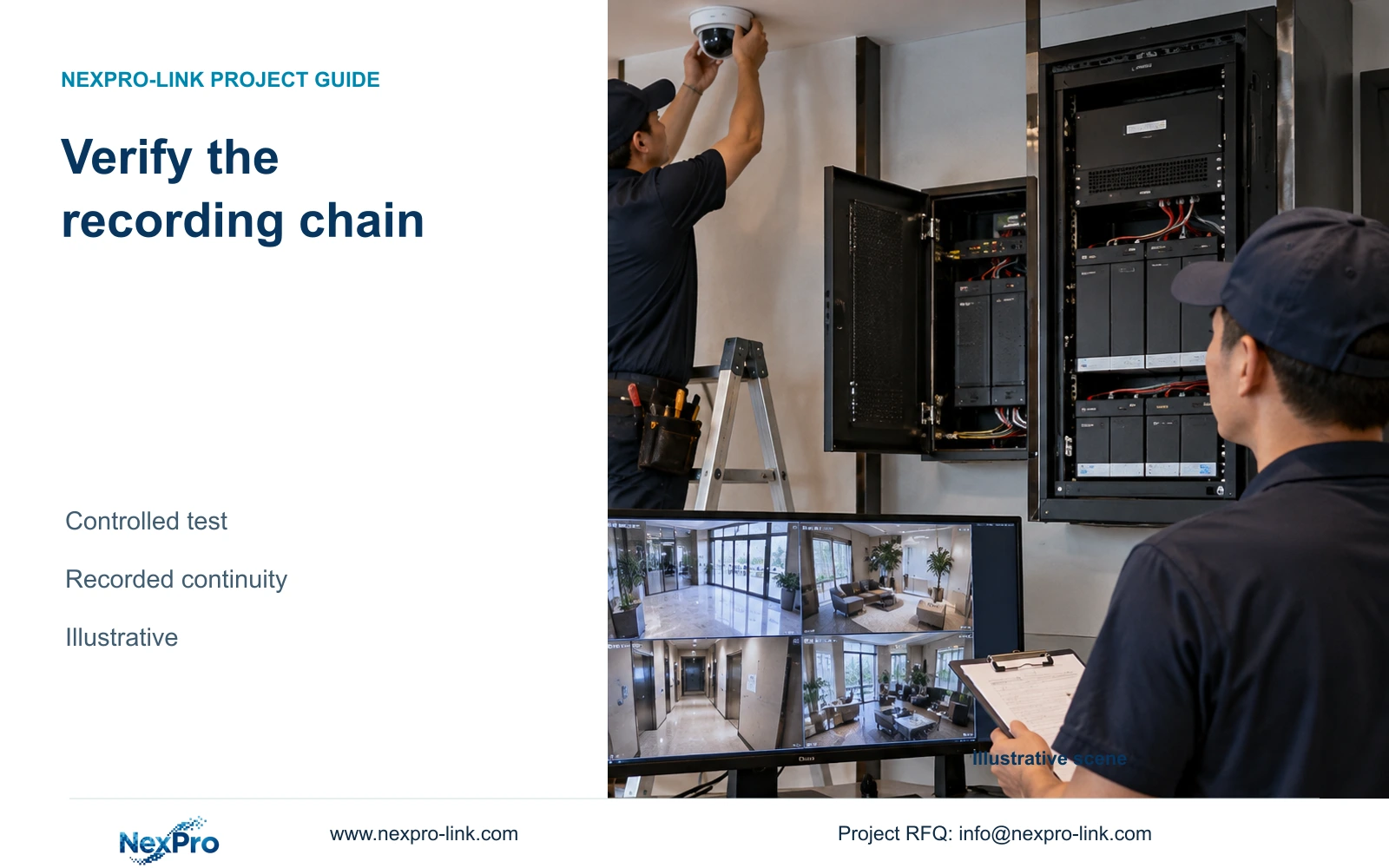
Acceptance should cover the complete sequence through restored operation. Record the observed shutdown action, the return of acceptable power and the subsequent device state. Check whether the approved configuration resumes the required recording, reconnects its camera inputs and allows retrieval. Do not infer restart behavior from the fact that power has returned.
Review footage around the interruption and recovery boundary. An orderly device action still leaves the recording outcome to be checked. Verify the relevant timestamps and use an authorized interval for playback or export. Keep any interruption visible in the test record instead of describing successful shutdown as uninterrupted recording.
Conduct the exercise under an approved procedure with the responsible electrical and operating personnel. Include the fallback condition that the hotel has agreed to evaluate, without affecting essential safety functions. A demonstrated configuration supports the observed scope; it cannot prove every recorder model, battery state or later software version. Retest affected behavior after a relevant configuration change.
Section 06
Document unautomated devices
Mark every device without confirmed automatic support in the operating schedule. State its power source, required runtime, response owner and restoration task. This prevents an unsupported endpoint from disappearing inside a general statement that the system has graceful shutdown. Separate device capability from the hotel's agreed fallback procedure.
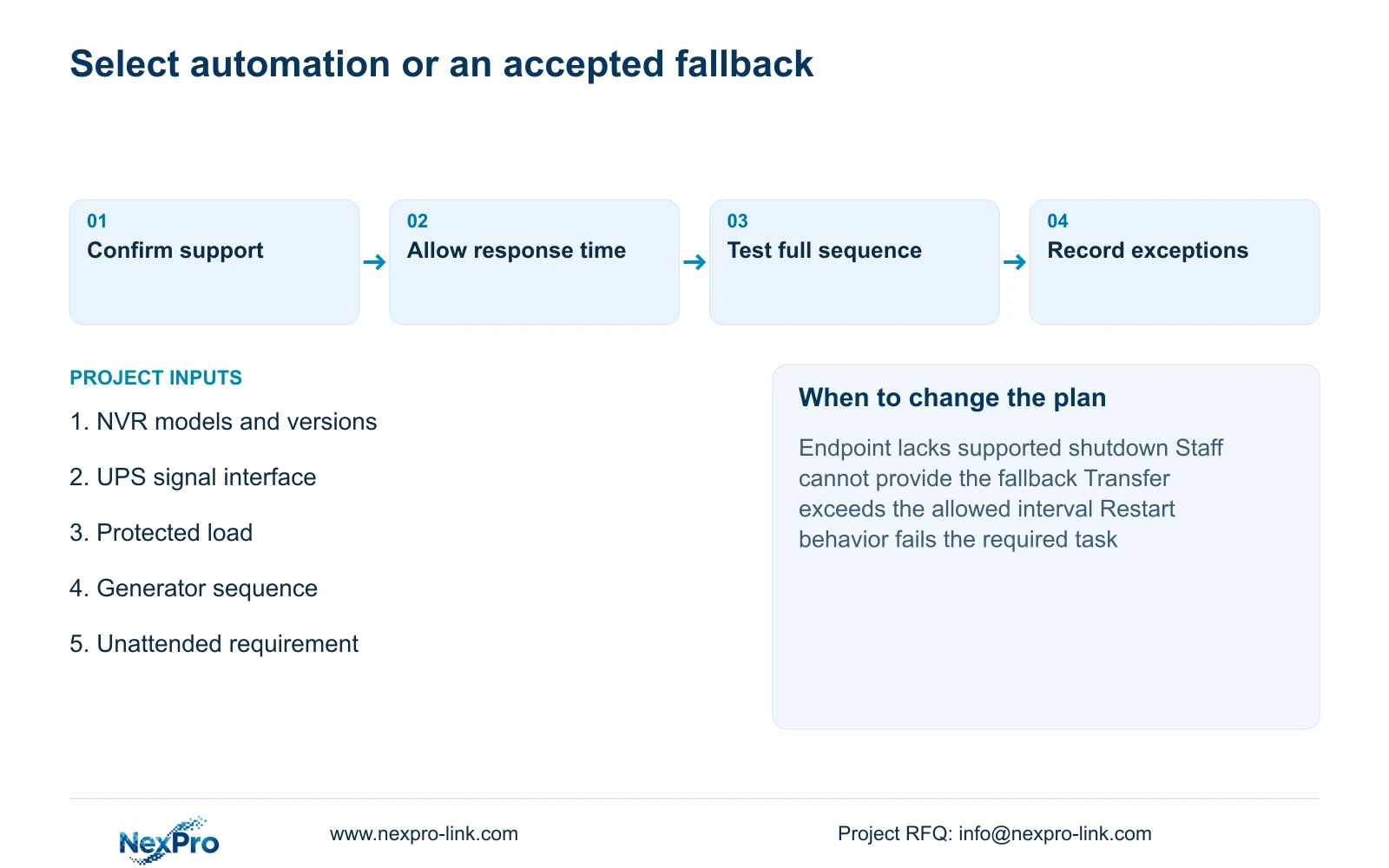
Recommend supported automation where unattended low-battery control is required and the entire path can be verified. Otherwise, use a clearly bounded runtime and managed-response plan only if it meets the hotel's accepted operating target. Revise that choice when staffing is unavailable, transfer takes longer, the load changes or a mandatory platform alters the interface.
For model and scope review, send info@nexpro-link.com the recorder models and versions, proposed UPS interface, protected load and generator transfer sequence. Include the required unattended behavior and accepted fallback. Hotel project equipment support can discuss the configuration, while BOQ support can separate supported functions from unresolved interfaces. The energy estimate cannot replace external battery, protection, grounding or generator design.
Section 07
Buyer questions
Can a larger UPS solve an unsupported NVR shutdown interface? It may change the available runtime when paired with an appropriate supported battery configuration, but it does not create recorder shutdown support. Treat power duration and control compatibility as separate purchase requirements.
Can the five-minute example be used as a generator specification? No. It budgets energy for a stated interval at an assumed load. Generator operation still requires assessment of the actual transfer sequence, charging, other loads and dynamic conditions by the responsible project professionals.
What should a shutdown integration quotation confirm? It should identify the exact UPS interface, receiving software, recorder model and versions, supported action and restart behavior. It should also identify equipment without automation and the accepted fallback. Request a demonstration scope rather than a general USB or SNMP compatibility statement.
Engineering references
These sources support the general planning principles. Always use the selected product's current datasheet and applicable project standards for final design.