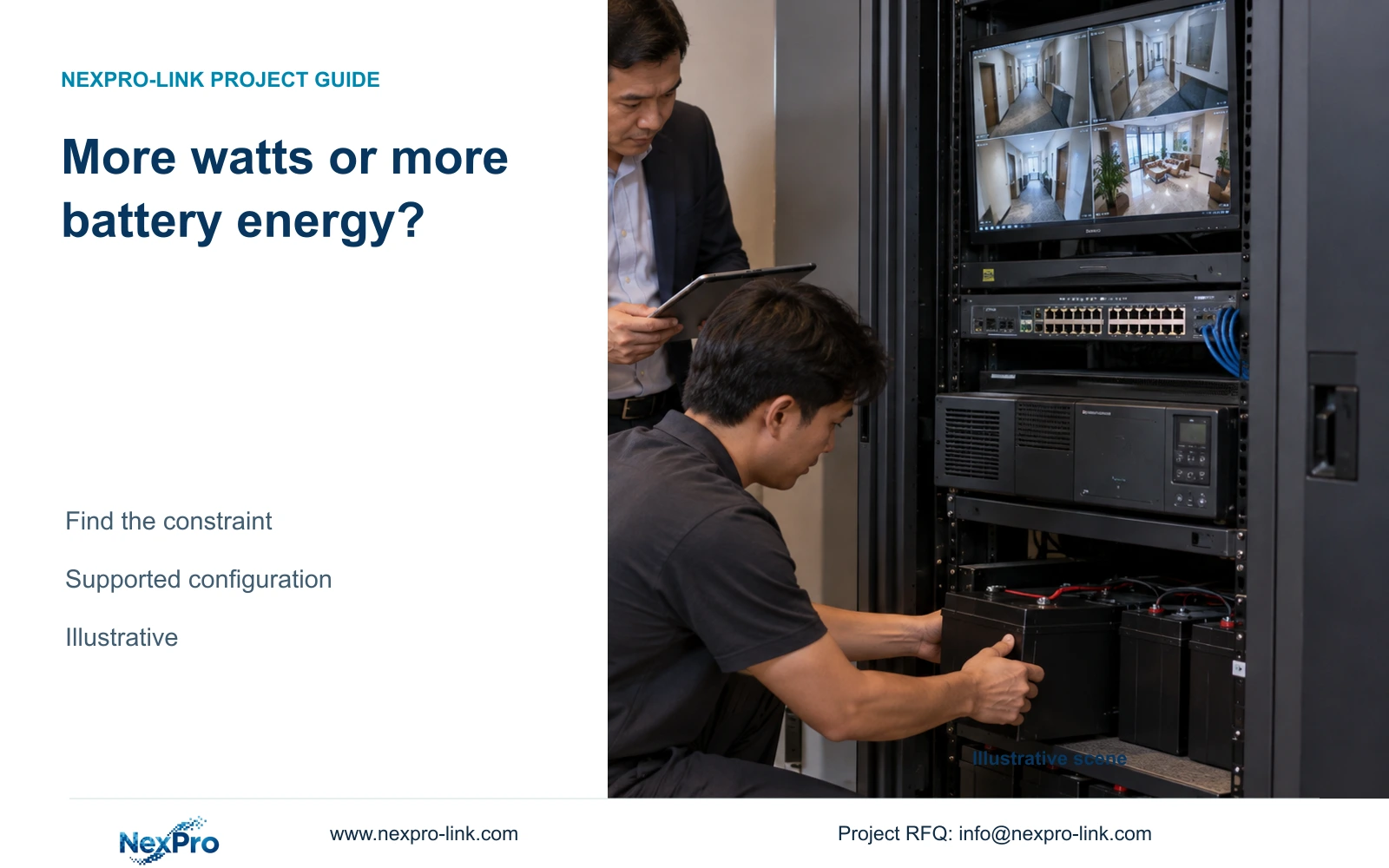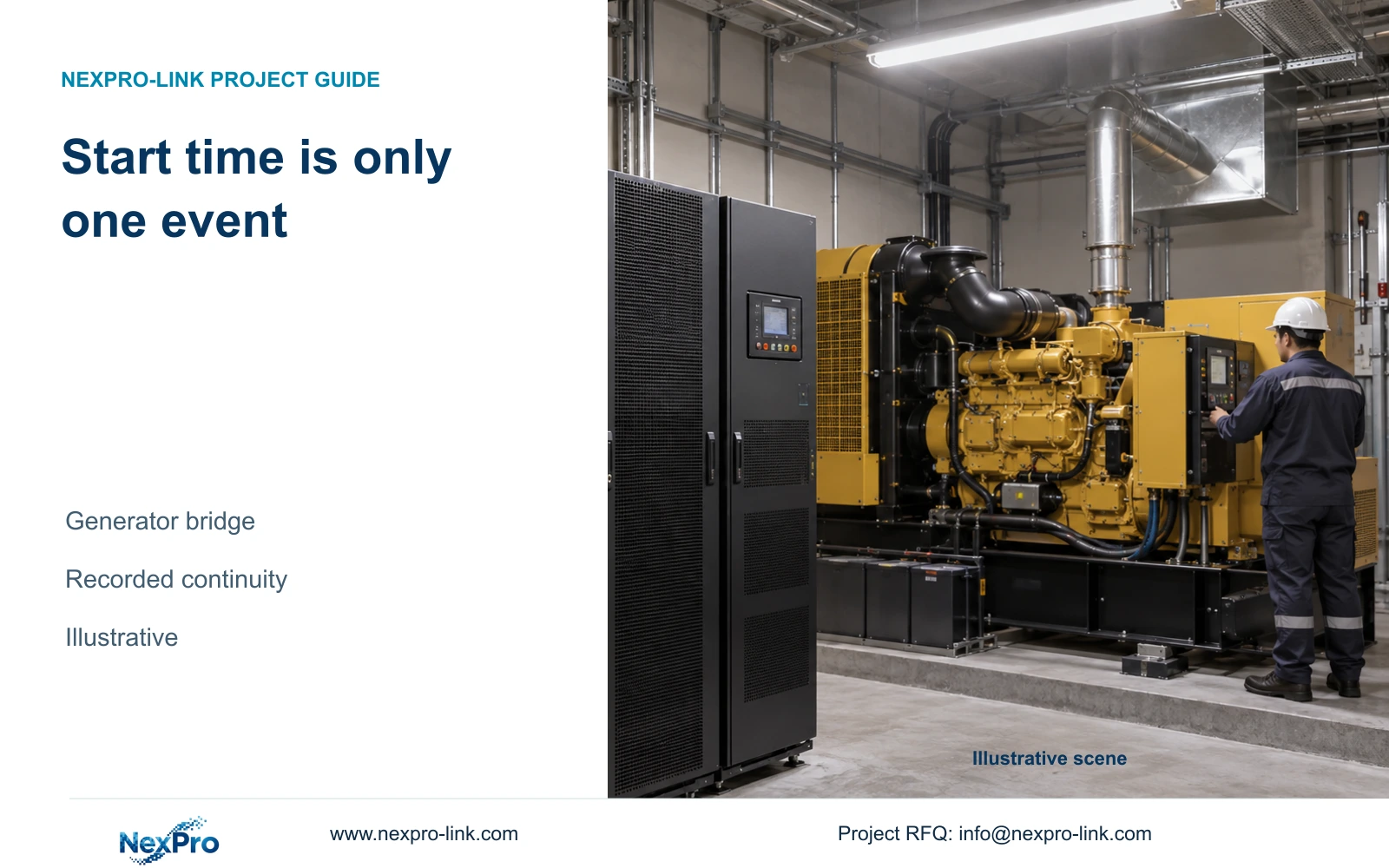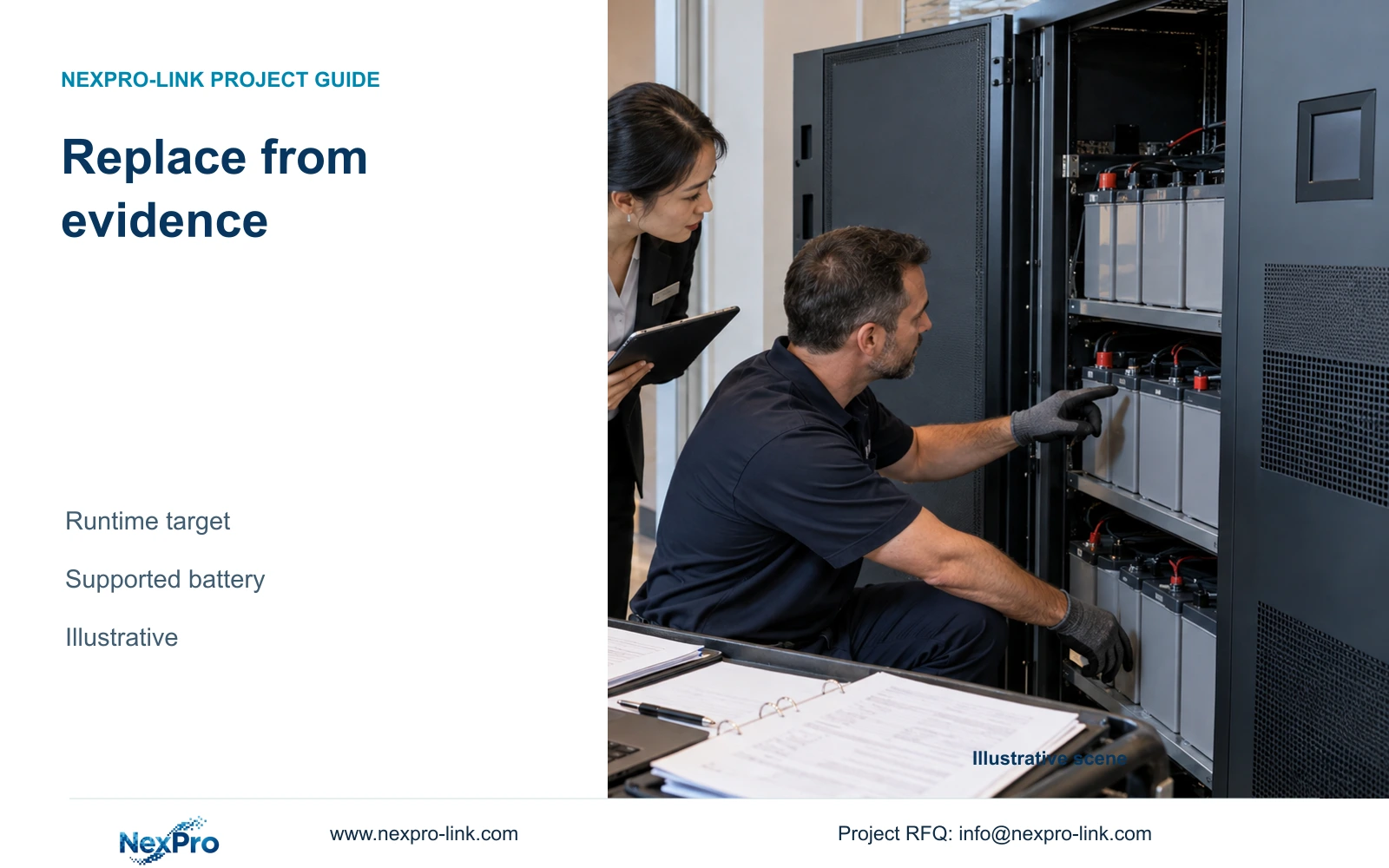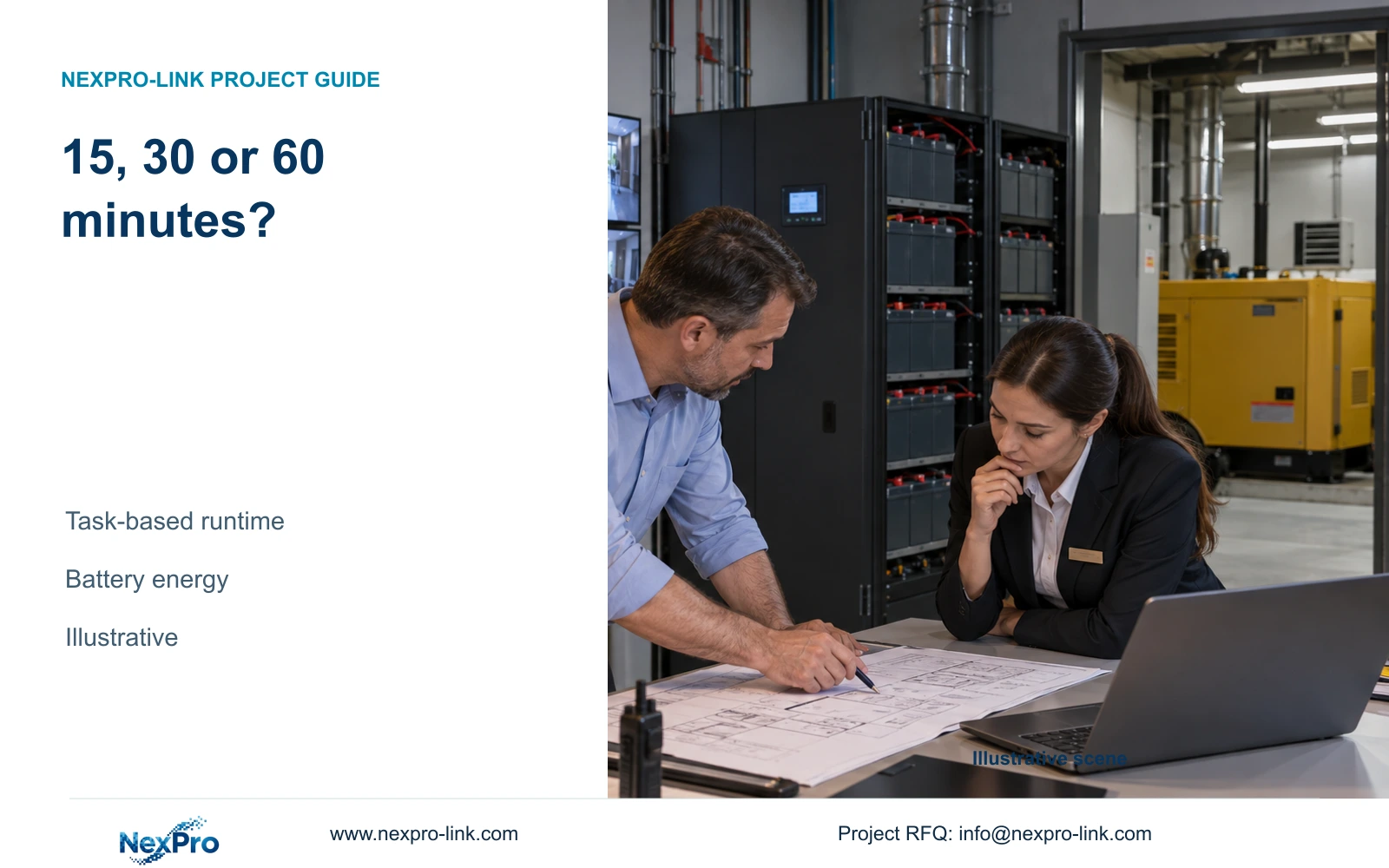
Choose backup minutes from the hotel's generator and response tasks. At equal load, a longer target changes battery energy and service scope without proving a particular model's runtime.
Section 01
Choose the outage task before choosing minutes
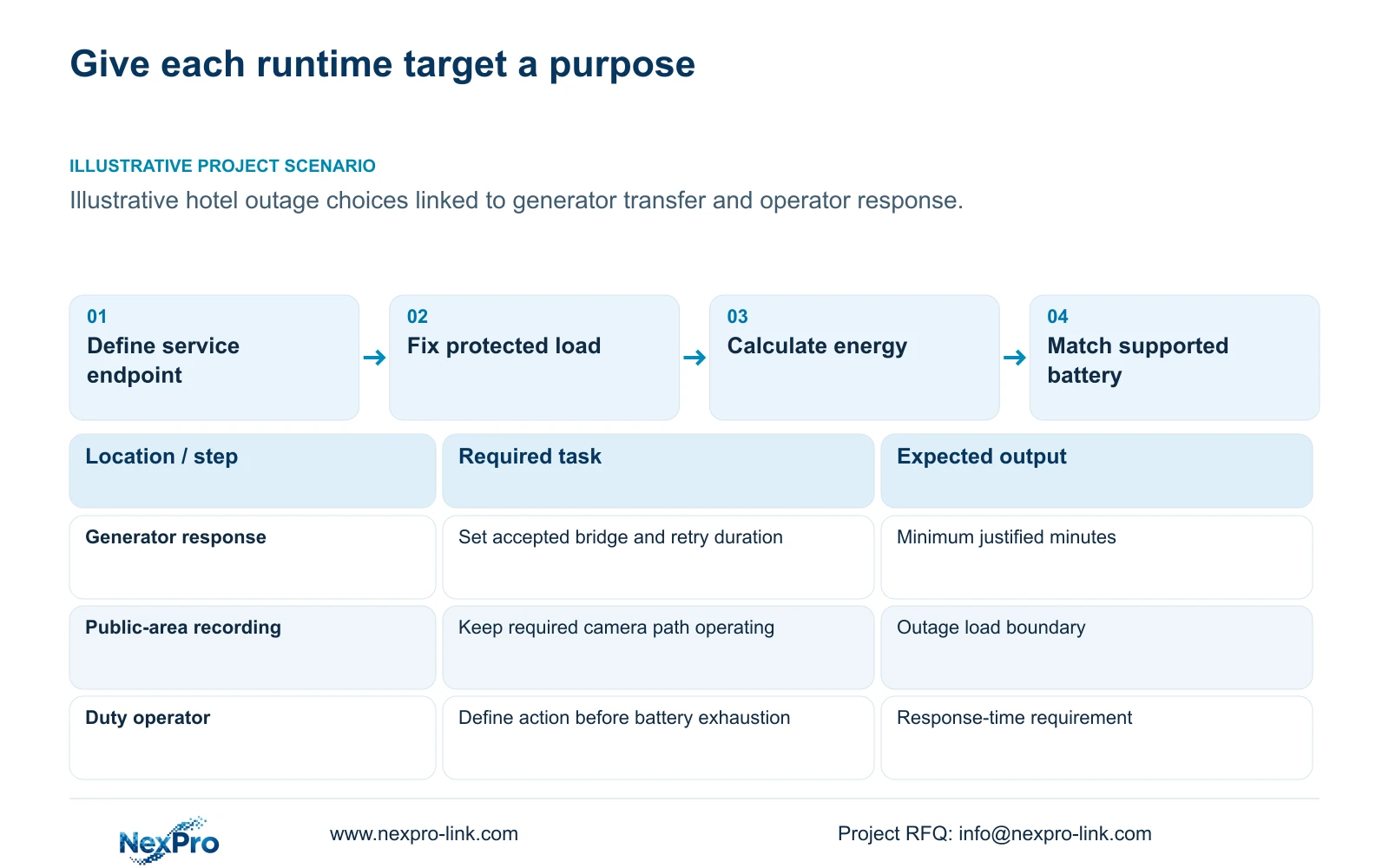
Choose the shortest supported backup duration that covers the hotel's approved generator sequence and response task. Fifteen minutes can be sufficient when the whole task fits within that interval. Select 30 or 60 minutes when the required continued recording or staffed response genuinely needs longer. None of these durations is a universal hotel requirement.
Define the endpoint of battery operation. The objective may be successful generator transfer, continued public-area recording through a longer interruption, or an authorized transition to a reduced operating state. Give that endpoint an owner and an observable condition so that the runtime target has an operational reason.
A longer target spends money on a different energy requirement and potentially a different supported battery arrangement. It should preserve a stated function. If the hotel only needs a shorter accepted bridge, additional minutes may have no approved task; if a failed generator start requires continued recording, the longer interval can be justified.
| Required task | Given information | Decision still needed |
|---|---|---|
| Bridge generator transfer | Project transfer sequence | Duration including accepted retries |
| Continue public-area recording | Required camera and network path | Maximum accepted interruption and response window |
| Respond before battery exhaustion | Assigned operator or supported automation | Action and completion condition |
Section 02
Fix one consistent protected-load boundary
List the equipment that must operate during the selected outage state. Include the recorder with its disk configuration, required core equipment and every access node serving the protected views. Add an operator client only where its outage task requires it. An optional display wall should have a separate power and runtime decision.
Use AC input figures consistently. A complete PoE switch input includes power supplied to its cameras and its own operating contribution. Adding downstream camera watts again would duplicate the load. Mark each input as a measured value, a published maximum or an explicit planning assumption, and calculate W and VA separately.
Published rack models SP1KR(S) and SP2KR(S) are rated 1 kVA / 900 W and 2 kVA / 1800 W respectively. Both limits matter during capacity selection. The 600 W calculation below is an independent teaching load, not CASE01's complete hotel total and not a measured input for either model.
| Item | Recording-first scope | Additional viewing scope | Effect |
|---|---|---|---|
| Cameras and access nodes | Required | Required | Capture remains dependent on local supplies |
| Core and recorder | Required | Required | Transport and storage must continue |
| Selected display equipment | Only if the task needs it | Explicitly added | Recalculate load and battery duration |
Section 03
Calculate the energy for 15, 30 and 60 minutes
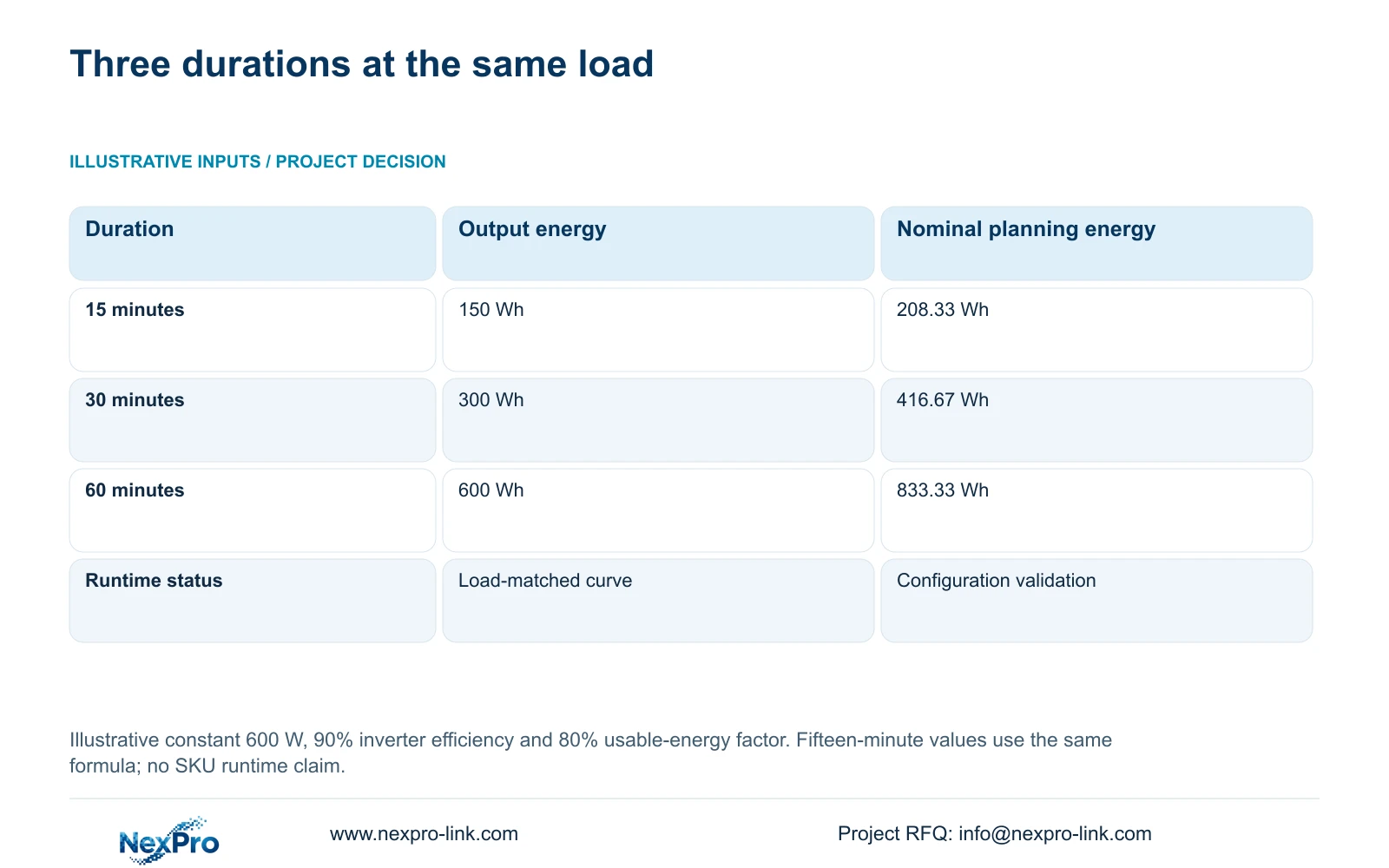
Use output energy Wh = load W × minutes ÷ 60. The supplied 30- and 60-minute example assumes a constant 600 W output load, 90% inverter efficiency and an 80% usable-energy factor. Nominal planning Wh = output Wh ÷ (0.90 × 0.80). Applying the same formula to 15 minutes completes the requested duration comparison.
At 15 minutes the load needs 150 Wh, giving a simplified nominal budget of 208.33 Wh. At 30 minutes the corresponding figures are 300 Wh and 416.67 Wh; at 60 minutes they are 600 Wh and 833.33 Wh. Doubling time doubles energy in this constant-load model.
The result helps compare configuration scope without implying proportional equipment prices. A supported battery option may change in discrete sizes, and actual discharge behavior can differ from the simplified factors. Keep the table as a planning estimate, then obtain the selected configuration's load-matched runtime information under relevant temperature and battery-condition assumptions.
| Metric / condition | 15-minute window | 30-minute window | 60-minute window |
|---|---|---|---|
| Load (W) | 600 | 600 | 600 |
| Time target (minutes) | 15 | 30 | 60 |
| Output energy (Wh) | 150 | 300 | 600 |
| Nominal planning energy (Wh) | 208.33 | 416.67 | 833.33 |
| Actual runtime / switching | Requires configured system validation | Requires configured system validation | Requires configured system validation |
Section 04
Compare supported batteries and installation space
Request the actual battery configuration proposed for each duration. Specify its supported relationship to the UPS, including voltage, battery management and charging. A watt-hour total cannot establish those interfaces. Do not assemble an external pack by improvising series or parallel connections from the energy calculation.
Compare physical dimensions, weight and service access using the selected equipment documents. A longer target can affect rack allocation or require a separate battery location, but no fixed cabinet dimensions or battery count follows from the table. Review the equipment's operating environment and supported discharge conditions before accepting a space allowance.
A larger UPS rating alone does not establish longer runtime. Rack SP2KR(S), rated 2 kVA / 1800 W, and tower SP2K(S), rated 2 kVA / 2000 W, are different models. Their battery arrangements require separate confirmation. A default battery field for another selected model cannot be transferred to either candidate.
Section 05
Plan the action before battery capacity is exhausted
Define what operators do when the generator succeeds and when it fails. Continued recording through the chosen window needs the whole path protected. If the hotel approves shedding optional loads, identify them beforehand and recalculate the resulting load state. Removing a required PoE node would change the coverage task.
Any automatic shutdown or load-management action must have supported interfaces and a verified receiving workflow. Do not assume that a UPS communication port can safely shut down the NVR. Where automation is unavailable, assign a practical operator procedure and account for its response time in the target.
Include recovery in the service plan. Battery state after one interruption affects readiness for another, and the supported charging arrangement needs review. Record restoration of required views and footage separately from restoration of utility power. The planning estimate, supplier runtime curve and actual site observation remain different forms of evidence.
| Retained outcome | Extra scope | When worth buying | Counter-condition |
|---|---|---|---|
| Recording during longer response | Supported larger energy configuration | Approved response exceeds shorter target | Shorter target already covers the task |
| Operator viewing during outage | Display load and battery allowance | Viewing is required for the response | Recording can continue without the optional display |
Section 06
Select the duration supported by the response plan
Specify 15 minutes when the approved transfer and response sequence fits within it and the selected configuration supports that duration at the real load. Move to 30 minutes when the task exceeds 15 minutes but fits the longer window. Choose 60 minutes when the hotel requires that additional continued operation, with the battery and installation scope priced explicitly.
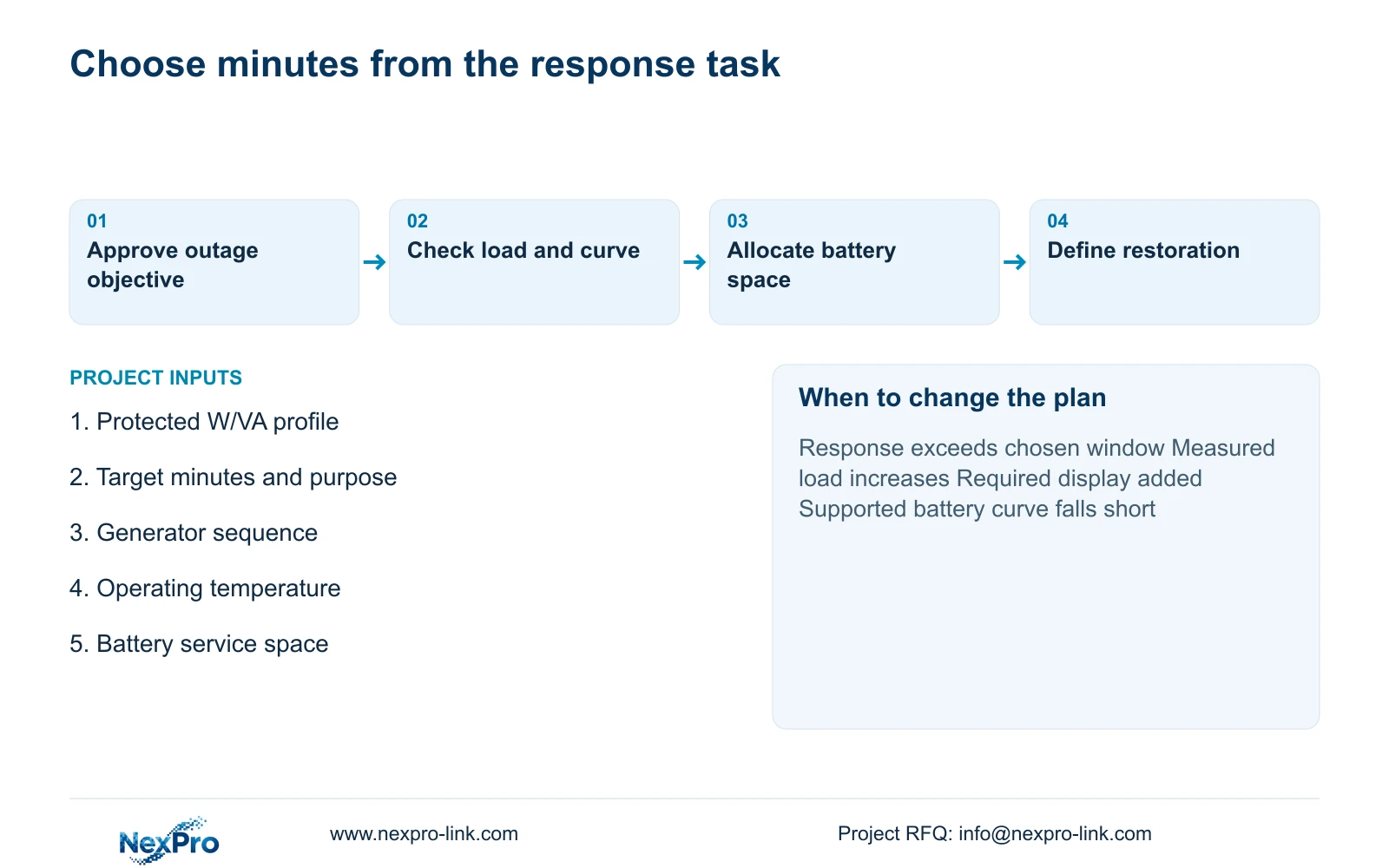
Change the recommendation when measured load rises, required response time extends or the supported runtime curve falls short under the relevant conditions. A new optional display also triggers recalculation. Compare installed battery scope and service costs, without assuming that twice the teaching energy means twice the purchase price.
Send info@nexpro-link.com the protected load profile, target minutes with their operational reason, generator sequence and battery-location conditions. NexPro-Link can discuss supported equipment matching and BOQ alternatives. Applicable main equipment has the supplied policy's 24-month limited hardware baseline from receipt; battery terms, local work and transport costs need their own written scope.
Section 07
Buyer questions
Can a 60-minute requirement be met by changing batteries only? Possibly, if the UPS supports the proposed battery, charging and management configuration and still satisfies W/VA limits. Request the actual supported option and runtime information; the Wh calculation cannot authorize the change.
Should every floor use the same battery duration? Use the required service endpoint for each protection zone. Different configurations can be appropriate, but a shorter local duration must not interrupt a camera group that the hotel requires throughout the longer system window.
What belongs in a battery-runtime quotation? Identify the UPS, battery configuration, protected load, duration conditions and installation allocation. Separate replacement service, battery coverage and logistics so the buyer can compare the same operating task across offers.
Engineering references
These sources support the general planning principles. Always use the selected product's current datasheet and applicable project standards for final design.