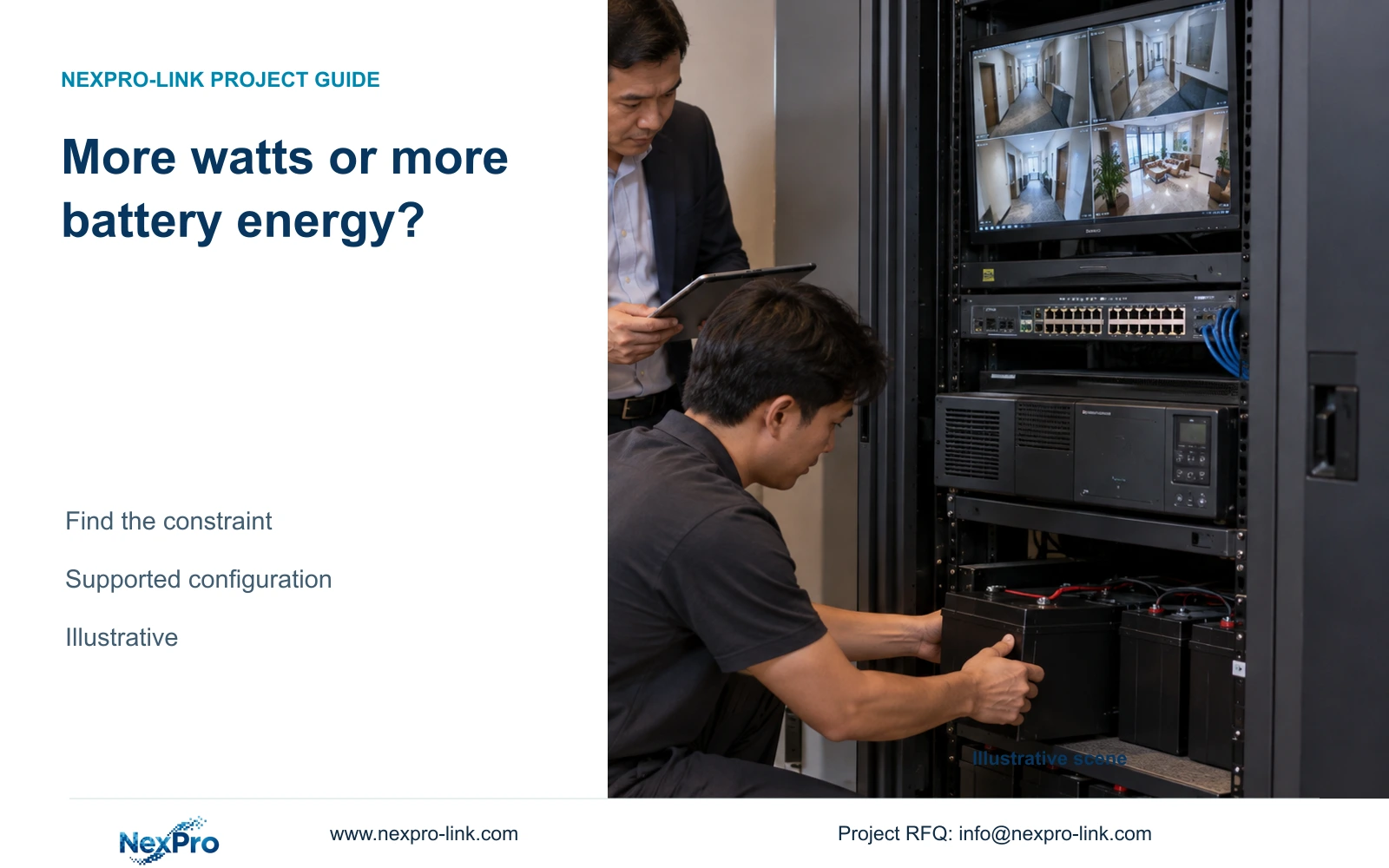
Set battery replacement priorities from the required outage service, supported configuration and condition evidence. Calendar age belongs in the record, but cannot diagnose every battery.
Section 01
Record battery configuration and environment
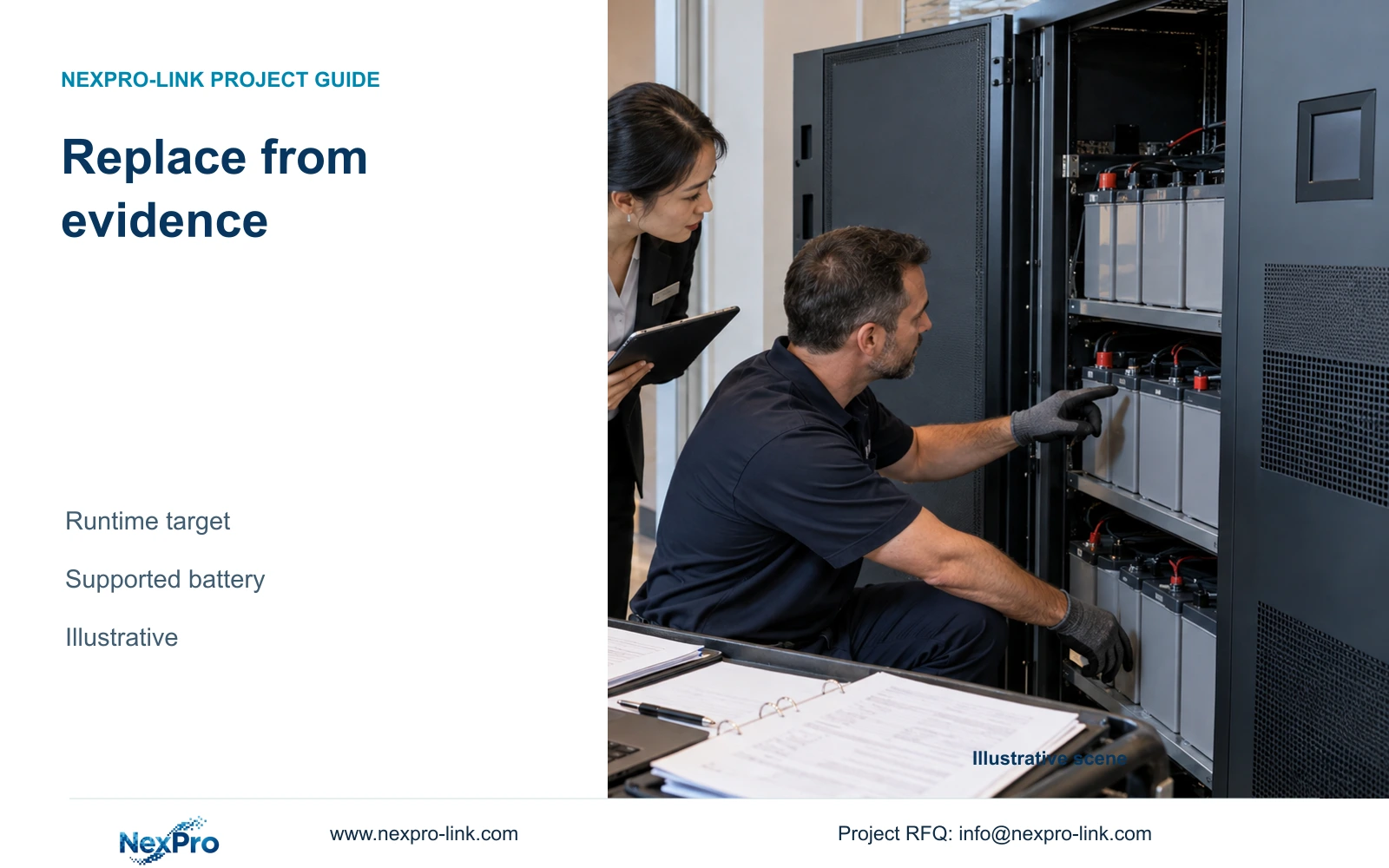
Use battery condition, required runtime and the manufacturer's maintenance requirements to decide replacement timing. Reaching a particular age does not, by itself, justify replacing every hotel UPS battery. Schedule replacement when evidence shows that a supported battery arrangement cannot meet its assigned service, or when the applicable maintenance requirements call for action. Keep uncertain configurations under review instead of assigning them an invented remaining life.
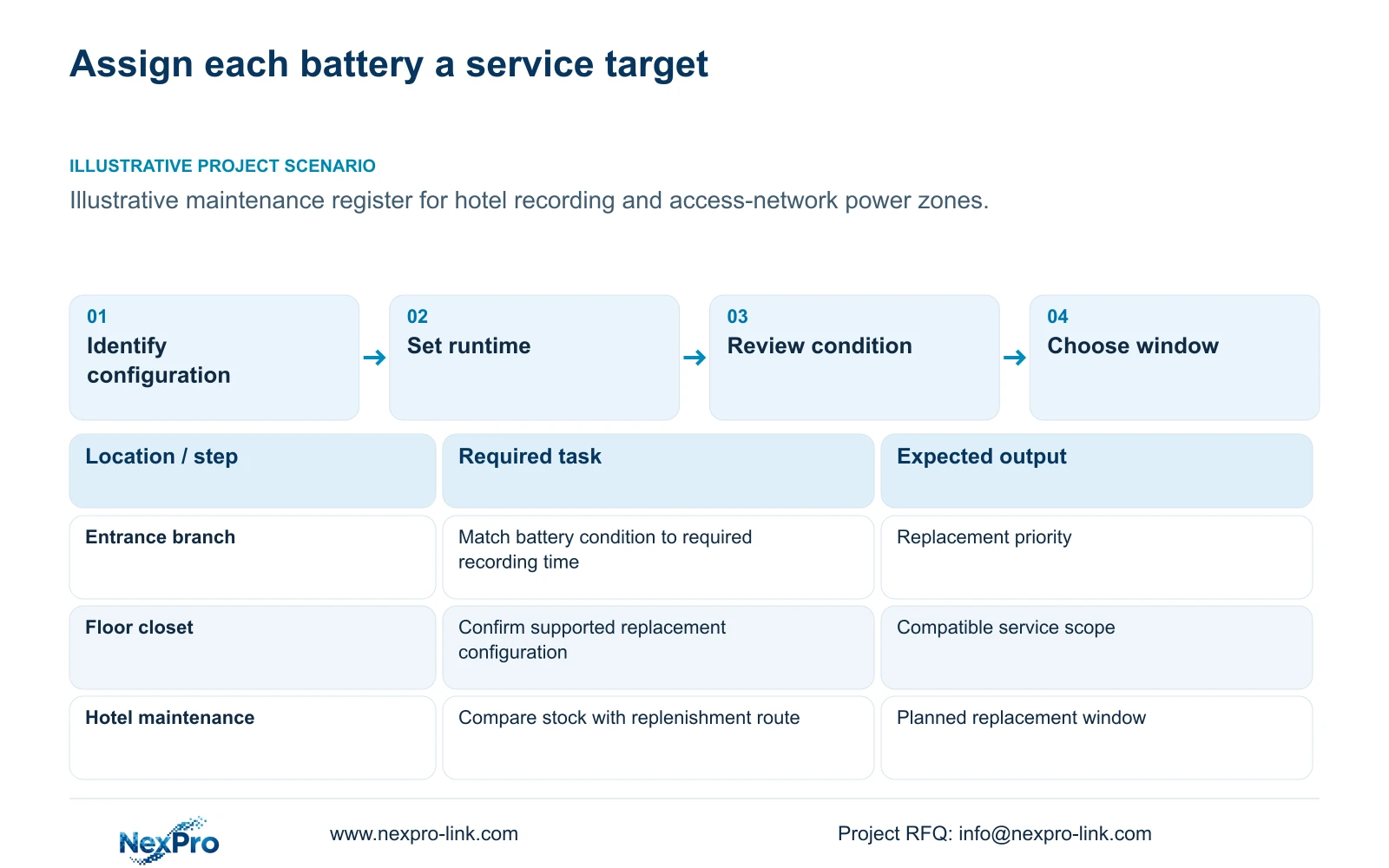
Create a register for each protected-power zone. Record the UPS model, installed battery identity, supported configuration, installation information and maintenance history. Include the equipment served by that zone and the available environmental records. Batteries in different locations should not be grouped solely because their purchase dates match.
The NexPro-Link rack and tower series in the supplied records use LiFePO4, but the exact battery configuration remains order dependent. SP2KR(S) is rated 2 kVA / 1800 W; SP2K(S) is a different tower model rated 2 kVA / 2000 W. Neither rating establishes installed battery energy or runtime. A default battery field for another selected model must not enter the maintenance register as fact.
Section 02
Define the required runtime
Assign a runtime target to the function that must continue. For an entrance recording branch, include the camera supply, required network nodes and recorder path. If the operational target is generator bridging, use the accepted transfer sequence and its fallback condition. If the hotel needs a longer standalone interval, document that requirement separately.
The relevant load is the agreed outage state. Optional displays can be excluded only if the hotel accepts their loss during that state. Use watts and VA to check UPS capacity, then evaluate the configured battery at that load. A larger kVA label cannot establish a longer operating interval without the corresponding battery information.
Output energy equals load watts multiplied by hours. That result describes energy delivered to equipment, not the exact nominal battery capacity to purchase. Any estimate that includes inverter efficiency or usable-energy factors must identify those assumptions. Maintenance decisions should ultimately refer to supported configuration data and actual observations at the relevant load.
| Protected function | Required input | Maintenance decision |
|---|---|---|
| Entrance recording | Branch load and outage duration | Battery must support the complete path |
| Generator bridge | Accepted transfer and fallback sequence | Evaluate the controlling interval |
| Optional monitoring display | Approved outage operating state | Include only if continuity is required |
Section 03
Review condition and tests
Compare inspection and test records with the runtime requirement for the same zone. Preserve the test load, battery state, relevant environment and observed result. A result without those conditions cannot explain whether a short interval reflects the battery, a changed load or a different operating arrangement.
A successful check of one unit supports that unit's observed configuration and conditions. It does not establish the remaining life of all batteries purchased in the same batch. Conversely, an isolated problem should prompt investigation of its assigned task and configuration before becoming a blanket replacement rule. The responsible maintenance provider should apply the supported inspection and test procedure.
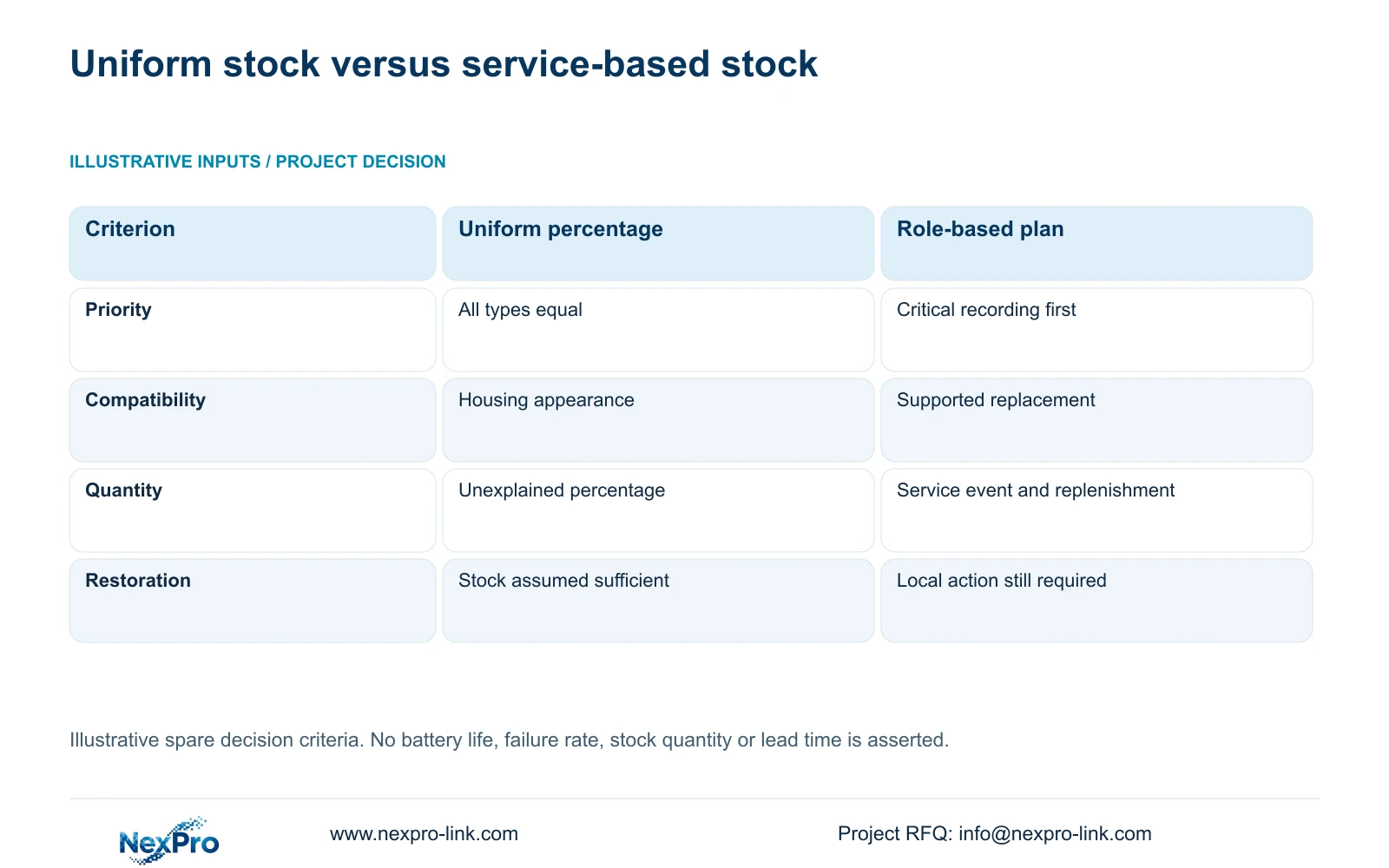
Use the supplied spare-planning comparison to decide where replacement resources belong. The table is qualitative: its inputs are critical functions, compatibility and replenishment conditions, with no failure percentages or service times assumed. For battery planning, the role-based approach directs attention to the branch whose loss would interrupt required recording and to the supported replacement that can restore it.
| Metric / condition | Same percentage of every SKU | Role-based spare scenario |
|---|---|---|
| Priority | Equal for all device types | Critical recording and entrance roles considered first |
| Compatibility | Matching housing appearance | Verified functional replacement scope |
| Quantity basis | Unexplained percentage | Explicit service event and replenishment input |
| Service | Stock assumed to eliminate downtime | Local action and restoration still required |
Section 04
Compare planned replacement windows
Compare a supported local replacement, an approved substitute and replenishment from the supply source. Each route needs its own configuration confirmation and service arrangement. A spare that has remained unused should still be checked against the current UPS configuration and applicable maintenance requirements before installation.
Plan the window around the recording service that may be interrupted. Identify the affected branch, local personnel and the method of confirming restoration. If the hotel cannot accept the proposed interruption, change the maintenance arrangement before committing to that window. Holding stock does not resolve safe access, installation or recovery responsibilities.
The comparison favors limited, role-based replacement resources where replenishment delay threatens an agreed service target. It does not justify a uniform stock percentage. If supported replacements are readily obtainable within the hotel's acceptable restoration interval, a confirmed service route may be more useful than unused stock. Use actual availability information before making that purchase.
Section 05
Account for service and disposal
The replacement allowance should identify equipment, local labor, transport and removal responsibilities separately. Confirm the approved route for handling the removed battery with the responsible local provider and applicable destination requirements. This article supplies no universal disposal rule or transport permission, and a battery purchase should not silently leave removal outside the agreed scope.
The supplied policy record states a 24-month limited hardware warranty baseline from receipt for applicable main equipment. Battery coverage, OEM terms and related costs follow their specific scope and controlling written order. Battery life estimates, main-equipment warranty and continued technical support are different matters; none should be used as a substitute for a maintenance assessment.
Where technical support needs access to records or equipment, identify the authorized contact and task. Send device identity and symptoms first. Do not put passwords or guest footage into an initial service inquiry. A return or replacement route should be agreed before dispatch, with the required handling and information boundaries stated.
Section 06
Keep the operating plan current
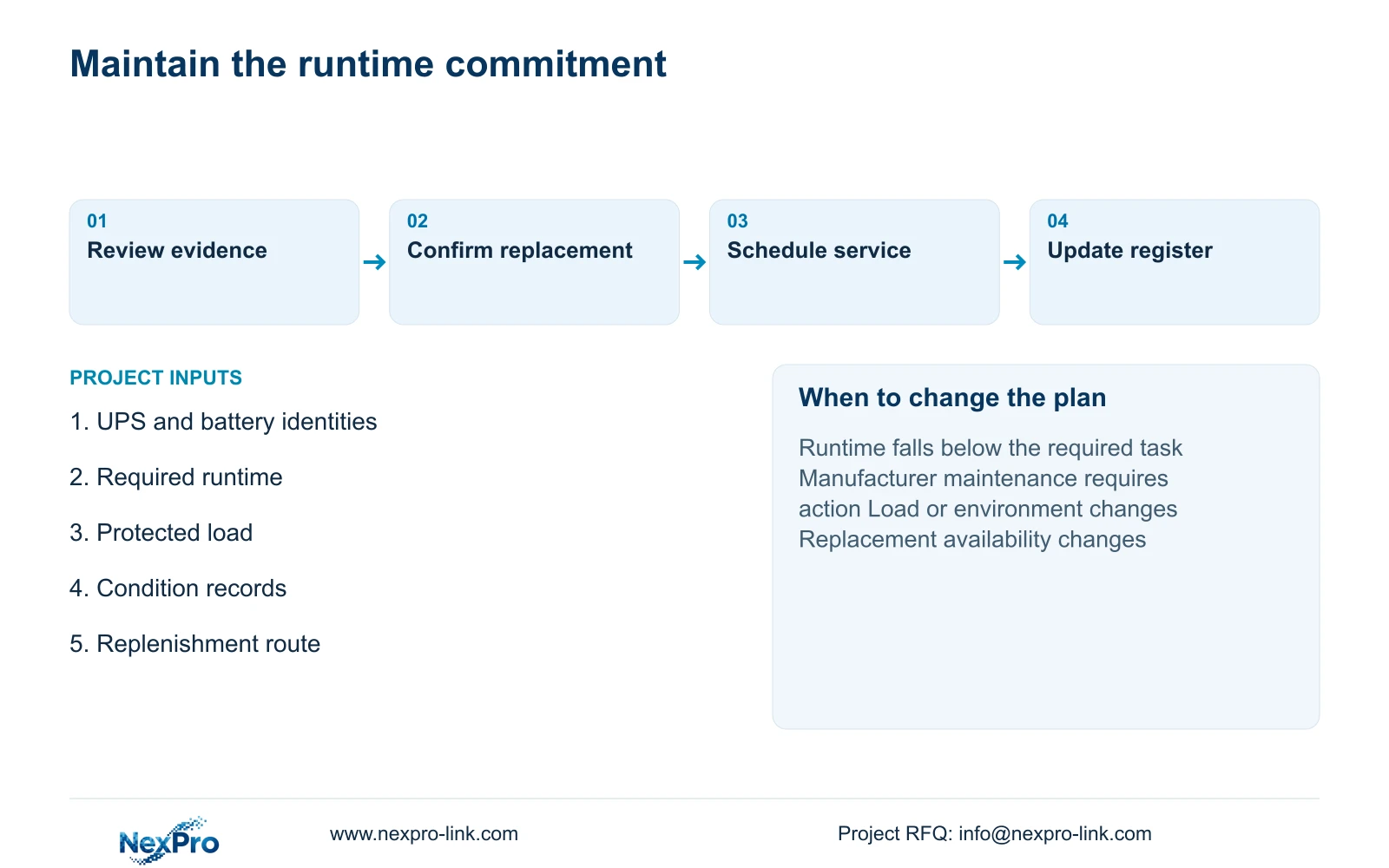
Update the register after a replacement, a load change or a revised outage target. Record the installed battery configuration and resulting service checks, while retaining the previous maintenance history. Adding a display or moving an access node can change the load boundary even when the UPS model remains unchanged.
Recommend condition-led planning with the smallest supported stock and service arrangement that meets the hotel's restoration target. Bring replacement forward when recorded condition or supported runtime is insufficient, or when manufacturer requirements demand it. Reassess the arrangement when the protected load grows, the environment changes or replenishment becomes less accessible.
Send info@nexpro-link.com the UPS and battery configuration, required runtime, protected load and relevant inspection or test summary. Include the destination and proposed maintenance window if a replacement package is needed. Hotel project equipment support and BOQ support can help define a coordinated supply scope, while local maintenance, installation and disposal remain named responsibilities.
Section 07
Buyer questions
Can we order a visually similar battery as a spare? Only after confirming the supported functional replacement scope, including the relevant voltage, BMS and charging arrangement. Housing similarity and nominal energy do not establish compatibility. Request the supported configuration for the exact UPS and installed battery arrangement.
Does a main-equipment warranty determine when batteries must be replaced? No. The supplied 24-month main-equipment baseline does not establish battery life or automatically extend to every battery. Use the battery's specific order terms for coverage and the supported maintenance requirements and condition evidence for replacement planning.
Should every hotel floor hold the same spare quantity? Use the protected function, acceptable restoration delay and confirmed replenishment route to decide. Floors with different critical tasks or battery configurations may need different arrangements. Keep the quantities tied to a stated service scenario, not an unexplained percentage.
Engineering references
These sources support the general planning principles. Always use the selected product's current datasheet and applicable project standards for final design.