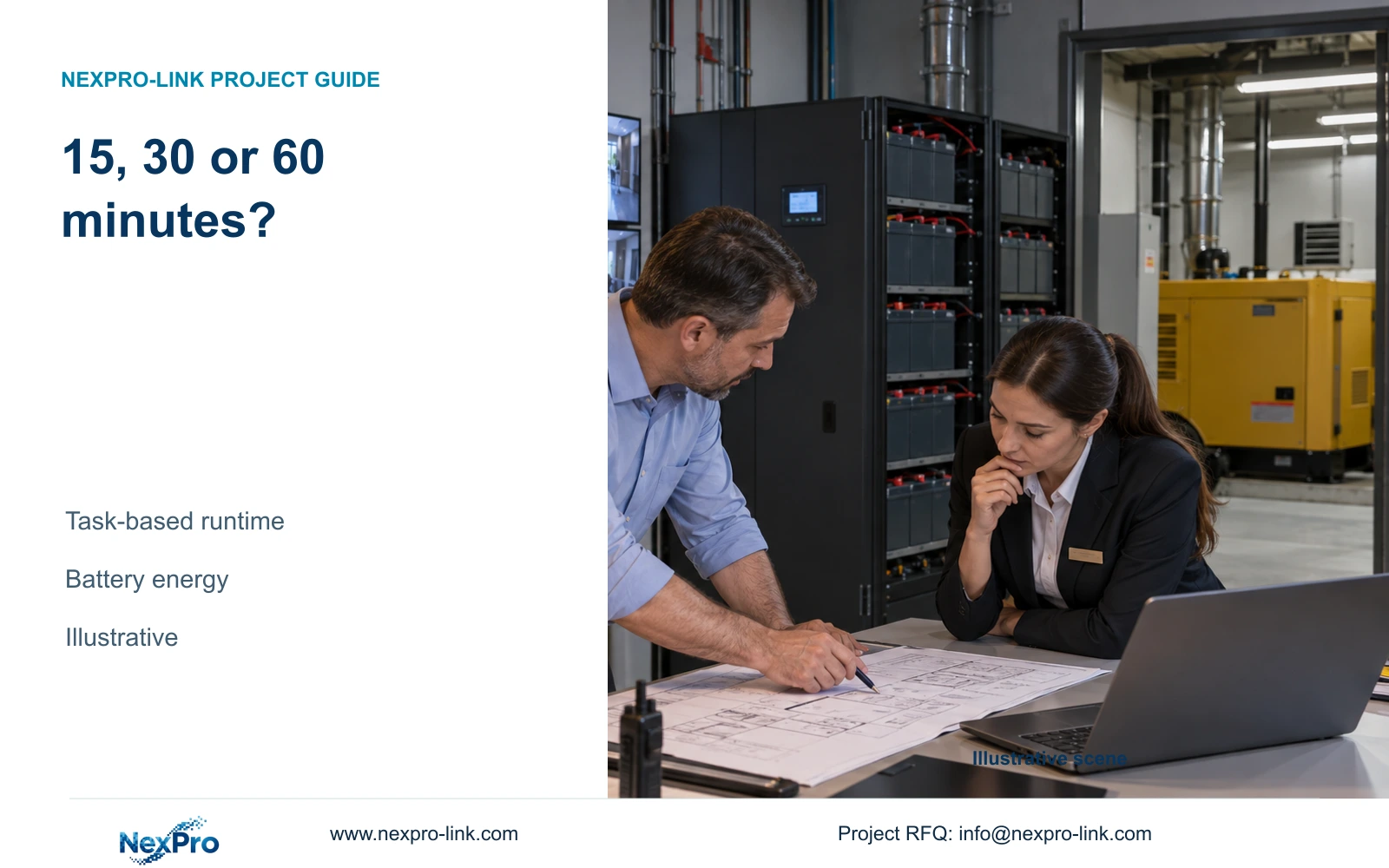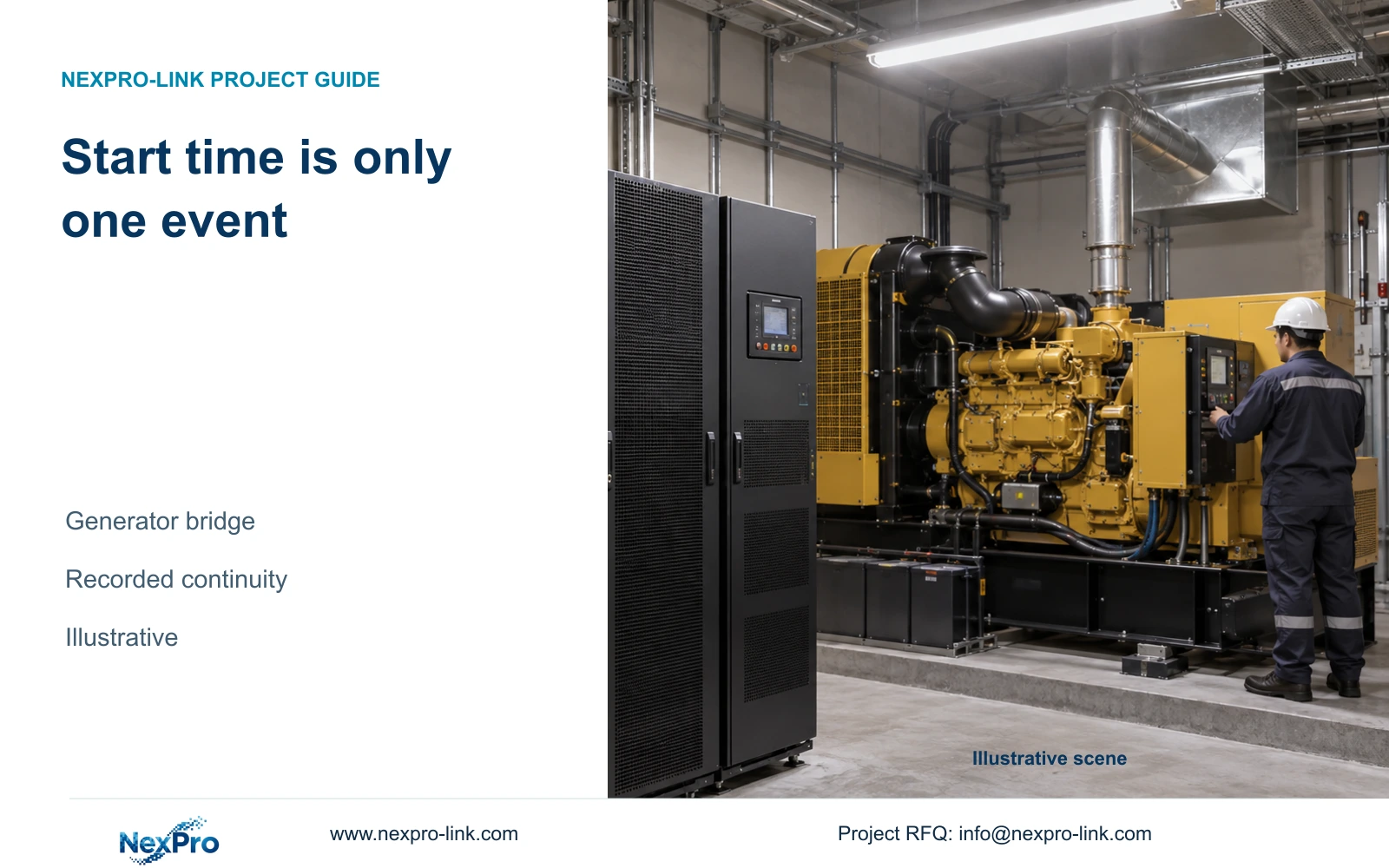
A 15-second generator start statement does not define the complete UPS bridge. Size backup from the accepted transfer sequence and the hotel's failed-start response.
Section 01
Define when generator power becomes usable
Size the UPS bridge to the complete approved sequence until usable generator power reaches the protected load. A generator described as starting in 15 seconds does not justify a battery sized for only 15 seconds. The controlling interval includes source acceptance and transfer, with an agreed allowance for retries and the hotel's fallback task.
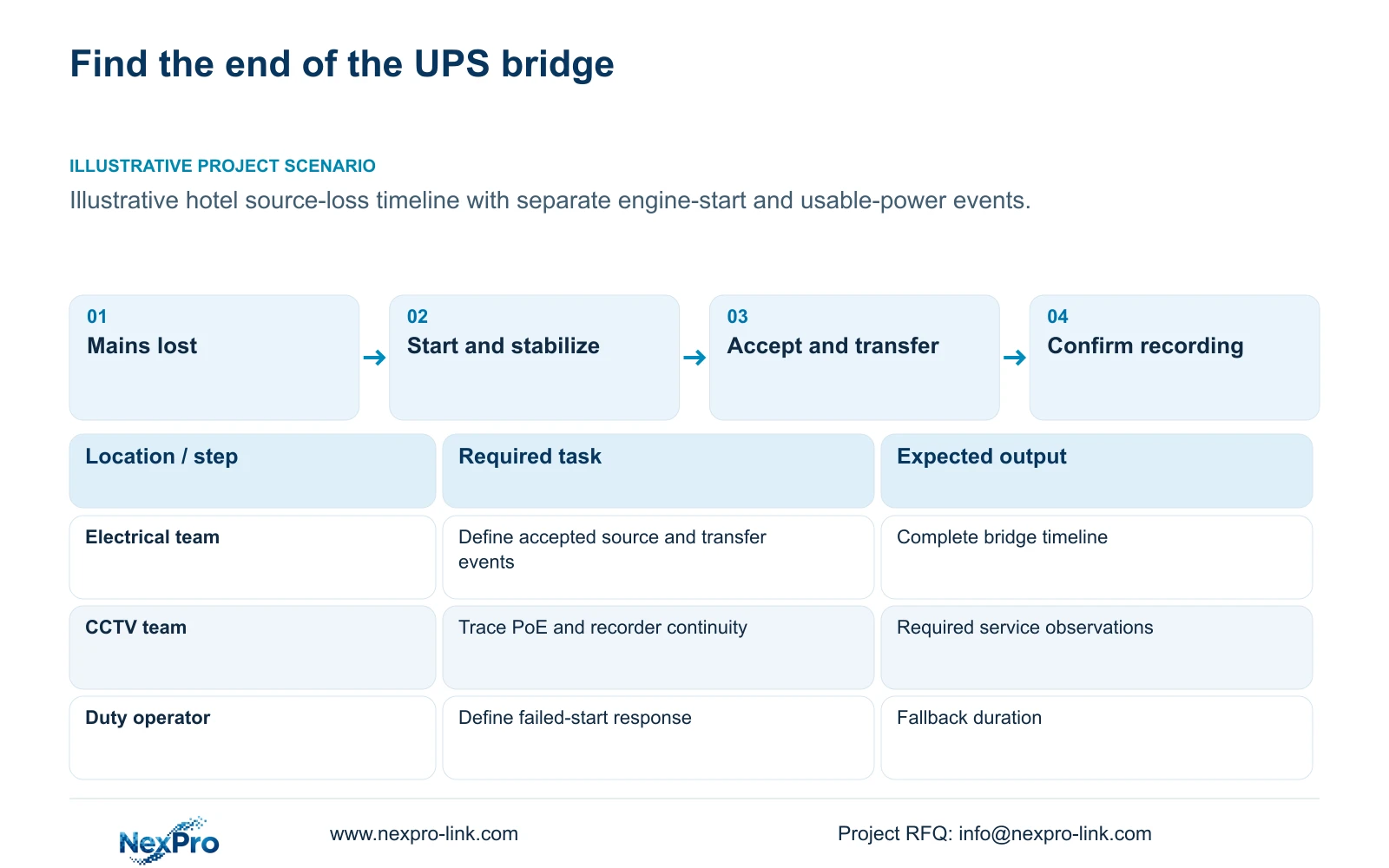
Map loss of mains, the start command, generator operation, acceptable source availability and load transfer as separate events. Identify who confirms each event and where its timing comes from. If the project record states only engine start time, the electrical team still needs to establish the remaining sequence before the CCTV backup target is fixed.
Draw the operating boundary alongside that timeline. Cameras, PoE access nodes and the recorder must remain available if continuous recording is required. Remote access may depend on additional equipment. General CCTV backup does not automatically supply life-safety circuits, and those systems require their own responsible design.
| Required task | Given information | Decision still needed |
|---|---|---|
| Start generator | Nominal start statement may be 15 seconds | Actual accepted start event and timing basis |
| Supply CCTV load | Generator must become an acceptable source | Stabilization, acceptance and transfer interval |
| Handle failed start | Battery operation continues | Retry sequence and fallback duration |
Section 02
Include stabilization, retries and recovery demand
Use the project's accepted slow sequence, not an assumed universal hotel start time. A successful first start and a sequence containing a retry are different service cases. Keep their timing separate so that the owner can see which condition determines the battery requirement and what happens if that condition is exceeded.
Stabilization ends when the relevant system accepts the source, not merely when the engine runs. The responsible electrical engineer should assess the generator supplying its other connected loads and the UPS's charging behavior after transfer. The protected CCTV output load alone does not describe generator demand during recovery.
Select reserve time for a stated purpose, such as the accepted retry or the time needed for an authorized response. Avoid an unexplained percentage that conceals the operational decision. If the longer sequence exceeds available supported runtime, revise the battery configuration or the approved fallback task before the hotel relies on it.
| Item | Accepted first transfer | Retry or failed transfer | Hotel effect |
|---|---|---|---|
| Battery interval | Ends after accepted load transfer | Continues through the defined fallback | Longer supported runtime may be needed |
| Recovery demand | CCTV load plus relevant charging behavior | Battery state may be further reduced | Recharge and repeat-event readiness need review |
| Operator task | Confirm restored supply and recording | Act on approved alarm or procedure | Interface and staffing requirements change |
Section 03
Calculate energy for the accepted bridge window
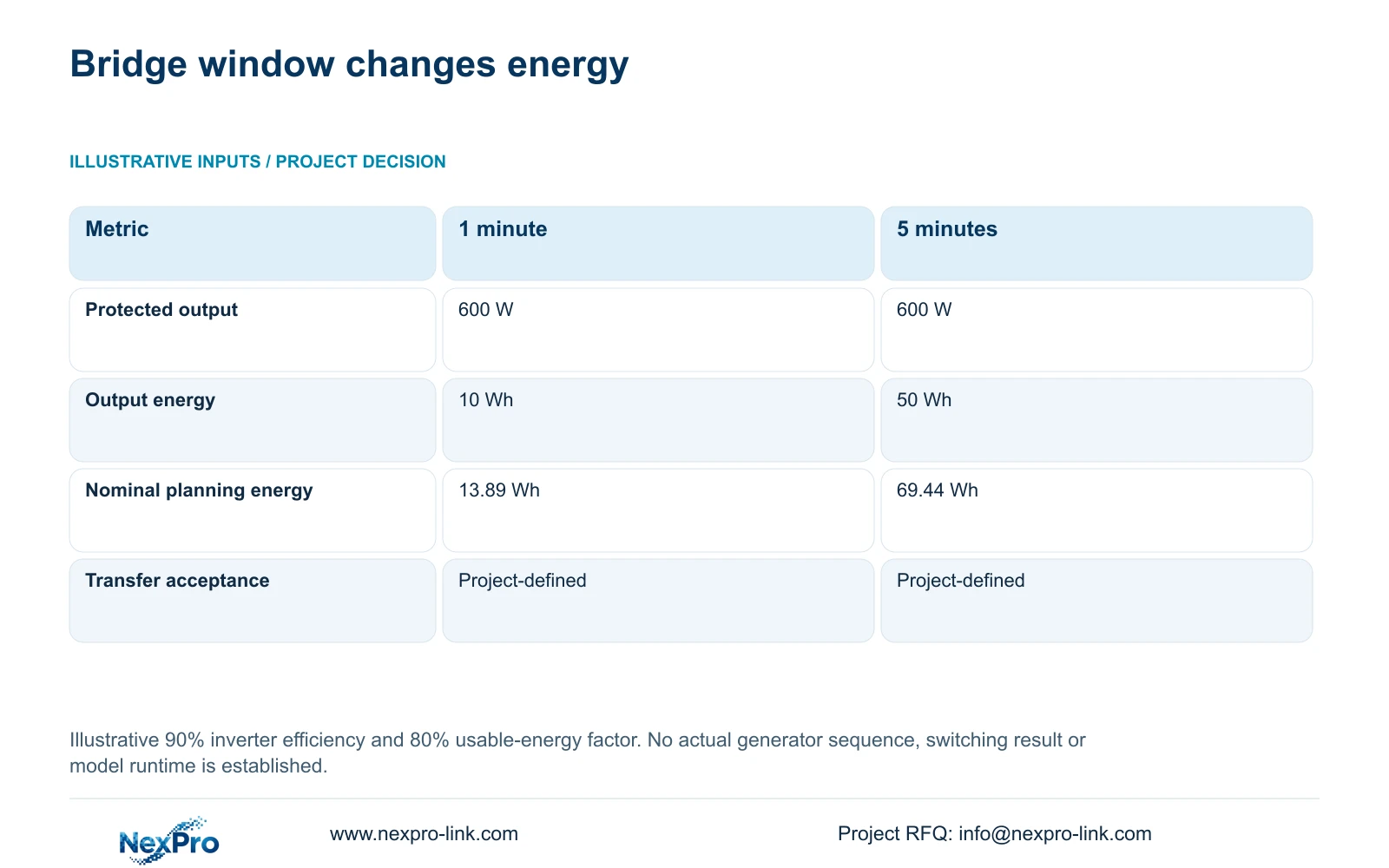
For the illustrative calculation, use a constant 600 W protected output load and compare one-minute and five-minute windows. Output energy in Wh is W × minutes ÷ 60. With assumed inverter efficiency of 90% and usable-energy factor of 80%, nominal planning Wh equals output Wh ÷ (0.90 × 0.80).
The load needs 10 Wh for one minute and 50 Wh for five minutes. The simplified nominal budgets are 13.89 Wh and 69.44 Wh. Moving to the longer window increases the energy requirement fivefold under these fixed assumptions. It does not establish that a particular battery pack can deliver either interval.
Check capacity separately. Published rack candidates include SP1KR(S), rated 1 kVA / 900 W, and SP2KR(S), rated 2 kVA / 1800 W. Their ratings do not prove bridge minutes, input compatibility or generator behavior. Use the configured load curve, and keep this 600 W topic calculation independent of CASE01's separately defined hotel totals.
| Metric / condition | 1-minute energy window | 5-minute energy window |
|---|---|---|
| Load (W) | 600 | 600 |
| Time target (minutes) | 1 | 5 |
| Output energy (Wh) | 10 | 50 |
| Nominal planning energy (Wh) | 13.89 | 69.44 |
| Actual runtime / switching | Requires configured system validation | Requires configured system validation |
Section 04
Define acceptable service when transfer fails
Describe successful transfer in operational terms: required cameras continue recording, the network carries their streams and relevant footage remains retrievable after the event. Then describe failed transfer separately. The owner must decide how long the same service should continue and what action is acceptable when battery capacity becomes insufficient.
An illuminated UPS or recorder cannot demonstrate that every camera remained recorded. A remote access node may use a different supply, and an unprotected router may remove remote viewing while local recording continues. Identify these states explicitly so that a lost viewing session is not confused with lost footage.
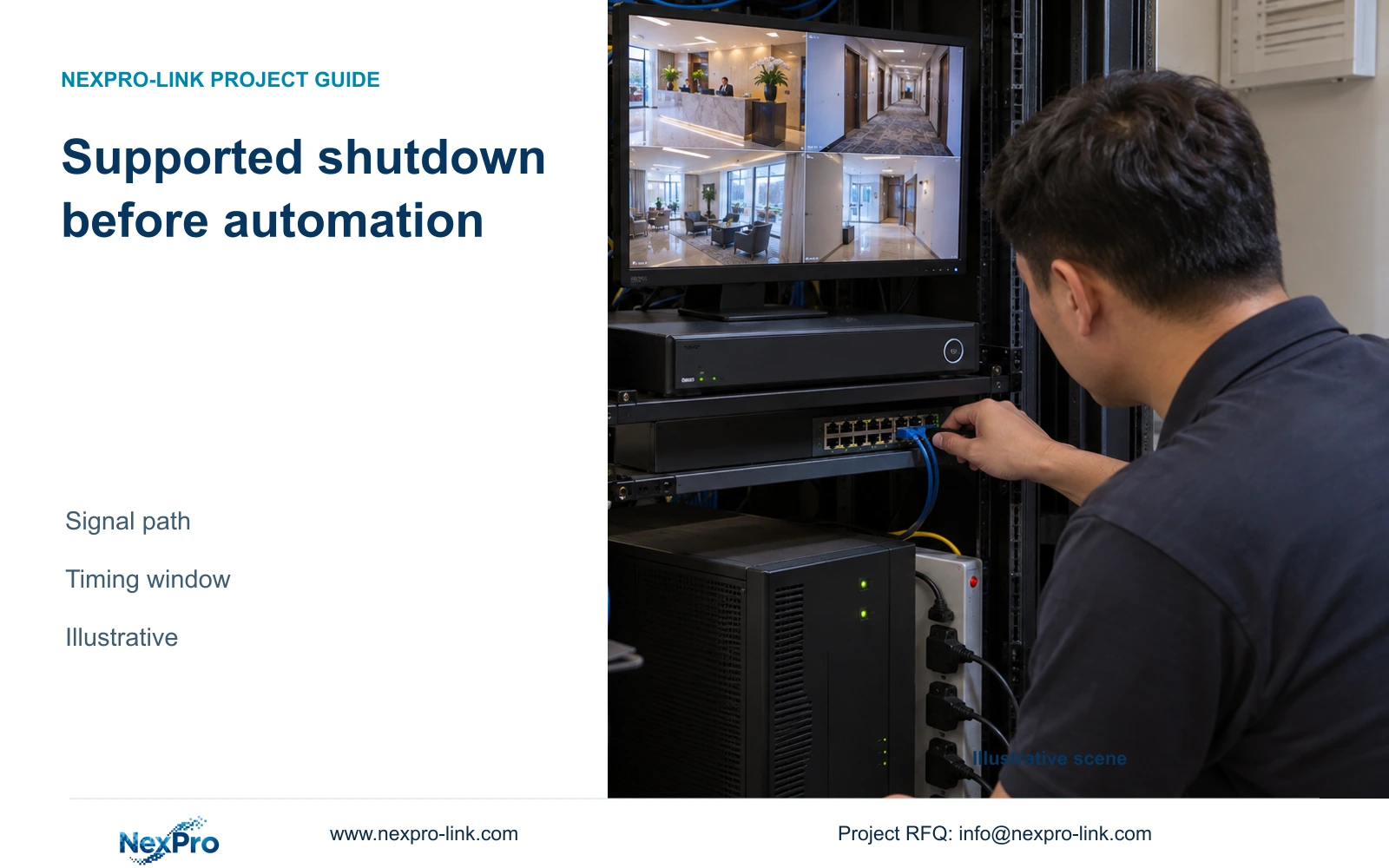
Automatic shutdown requires supported UPS signaling and a receiving device or software workflow. If that support is absent, do not write automatic shutdown into the operating plan. Provide an agreed operator response or revise the equipment scope. The energy table budgets a window only; it does not design bypass, grounding or electrical protection.
Section 05
Coordinate a controlled local transfer test
Assign electrical switching and generator assessment to the appropriate local specialists. The CCTV team should define the recording observations needed during the approved test. Hotel operations should agree the work window and fallback arrangements. This separates authority to handle power equipment from responsibility to demonstrate the surveillance task.
The test scope should include the accepted transfer sequence and relevant recovery conditions, with actual equipment identity and configuration recorded. Charging after battery operation and other connected generator loads belong in the electrical assessment. Any extended or failed-transfer scenario must follow the approved procedure; this article is not a switching instruction.
When footage or a required function is missing, record the affected task, the observed state and its responsible party. After a correction, repeat the relevant condition. Closing a report administratively does not establish restored continuity, and one successful demonstration supports only the configuration and conditions actually observed.
| Retained outcome | Extra scope | When justified | Counter-condition |
|---|---|---|---|
| Recording through accepted transfer | Coordinated full-path test | Power and CCTV dependencies must be demonstrated together | Device-only checks leave remote nodes unobserved |
| Accepted failed-start response | Supported battery and response arrangement | Owner requires a longer fallback window | No approved need for that extra duration |
Section 06
Set observable operational acceptance criteria
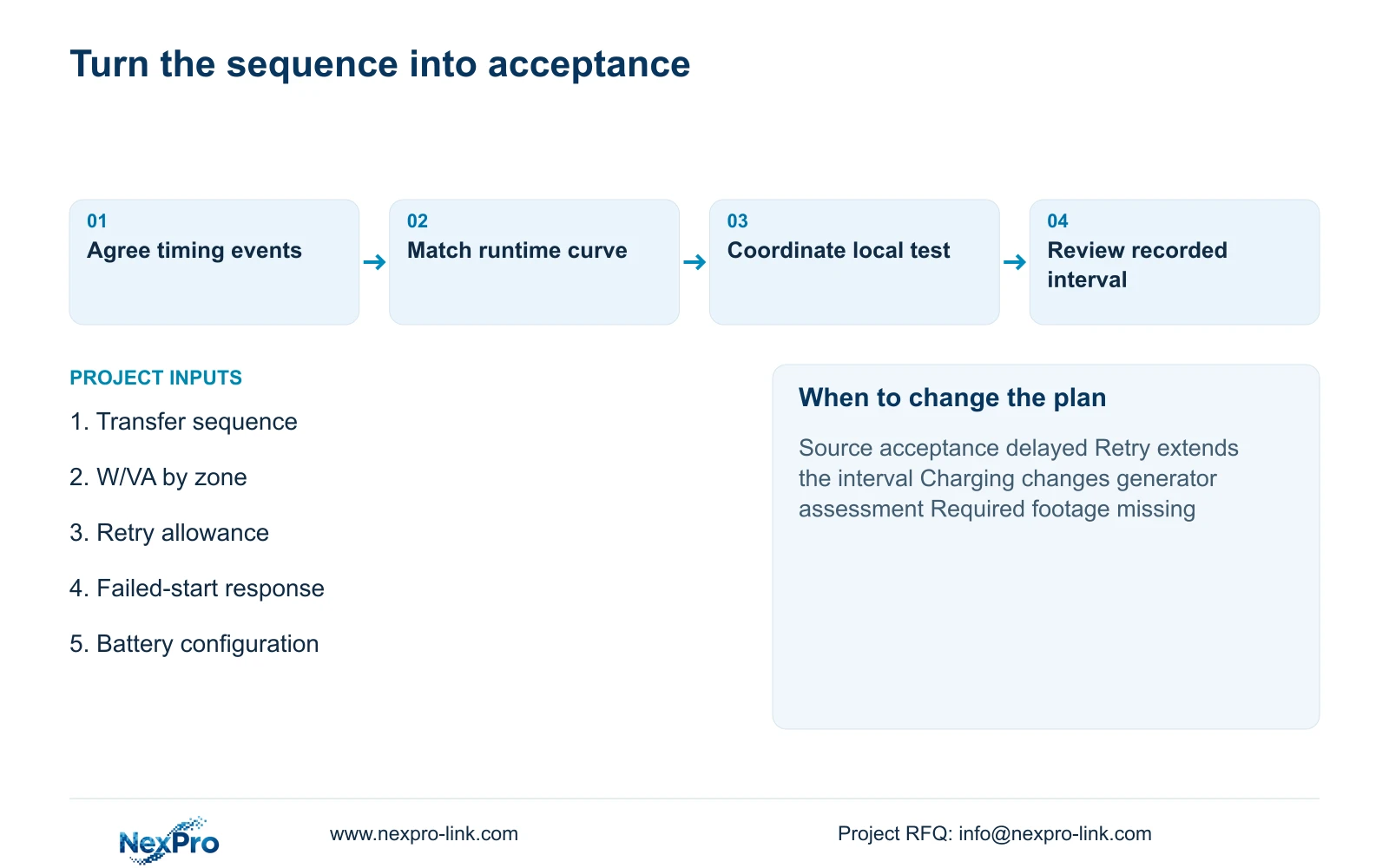
Recommend a bridge target that covers the approved source-loss, stabilization, transfer and retry sequence plus the defined response allowance. Use the one-minute window only if that complete task fits within it and the configured system supports it. Move to five minutes or another justified target when the accepted sequence or fallback task requires more time.
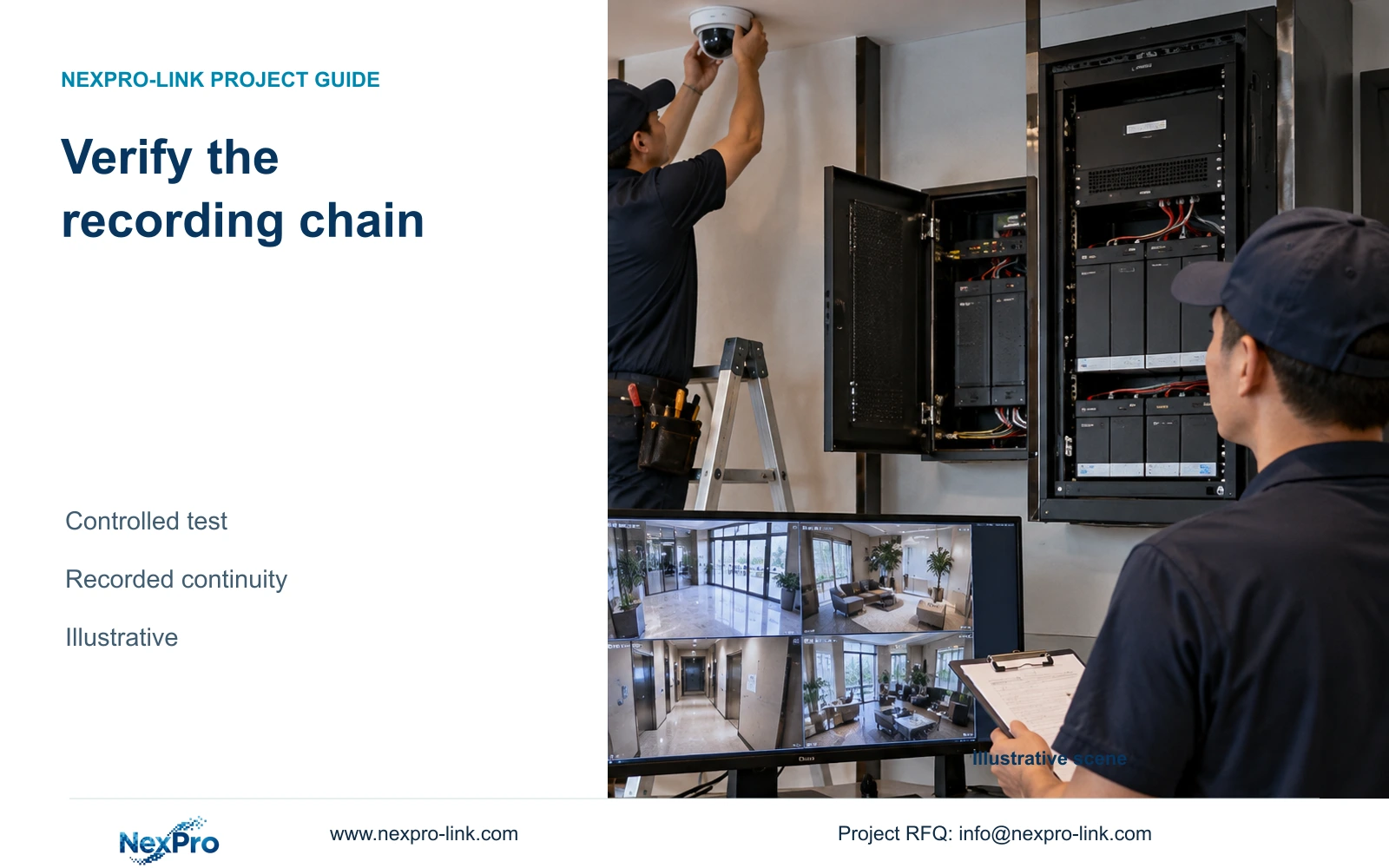
Write acceptance around required camera groups and the recorded event interval. Confirm footage before, during and after the transfer, then verify playback and an authorized sample export. Record power-state observations separately from video results. A changed firmware version, battery configuration or protection boundary may require the relevant scenario to be demonstrated again.
Send info@nexpro-link.com the generator transfer sequence, protected load by supply zone, required failed-start response and desired delivery destination. NexPro-Link can support equipment matching and a scoped BOQ response. The proposal should identify supply responsibilities and the local personnel responsible for electrical coordination and operational acceptance.
Section 07
Buyer questions
Can the one-minute example be used as the purchase target? Only after the approved complete sequence and response allowance fit within one minute, and the supported configuration demonstrates that duration at the actual load. The calculation alone is not a runtime commitment.
What changes if the generator starts but the UPS does not accept its supply? Treat battery operation as continuing until the accepted source reaches the load. The electrical team must investigate the acceptance condition, while the hotel follows the approved fallback task within supported runtime.
What records should accompany a successful acceptance test? Keep the equipment and battery configuration, relevant firmware, observed transfer timeline, recording observations and unresolved issues. Preserve only authorized sample footage needed to demonstrate the task, without circulating unrelated guest recordings.
Engineering references
These sources support the general planning principles. Always use the selected product's current datasheet and applicable project standards for final design.