Higher UPS efficiency can reduce conversion losses, but recovering a purchase premium depends on the actual load profile, operating hours, tariff and service scope.
Section 01
Fix the output load and operating mode for comparison
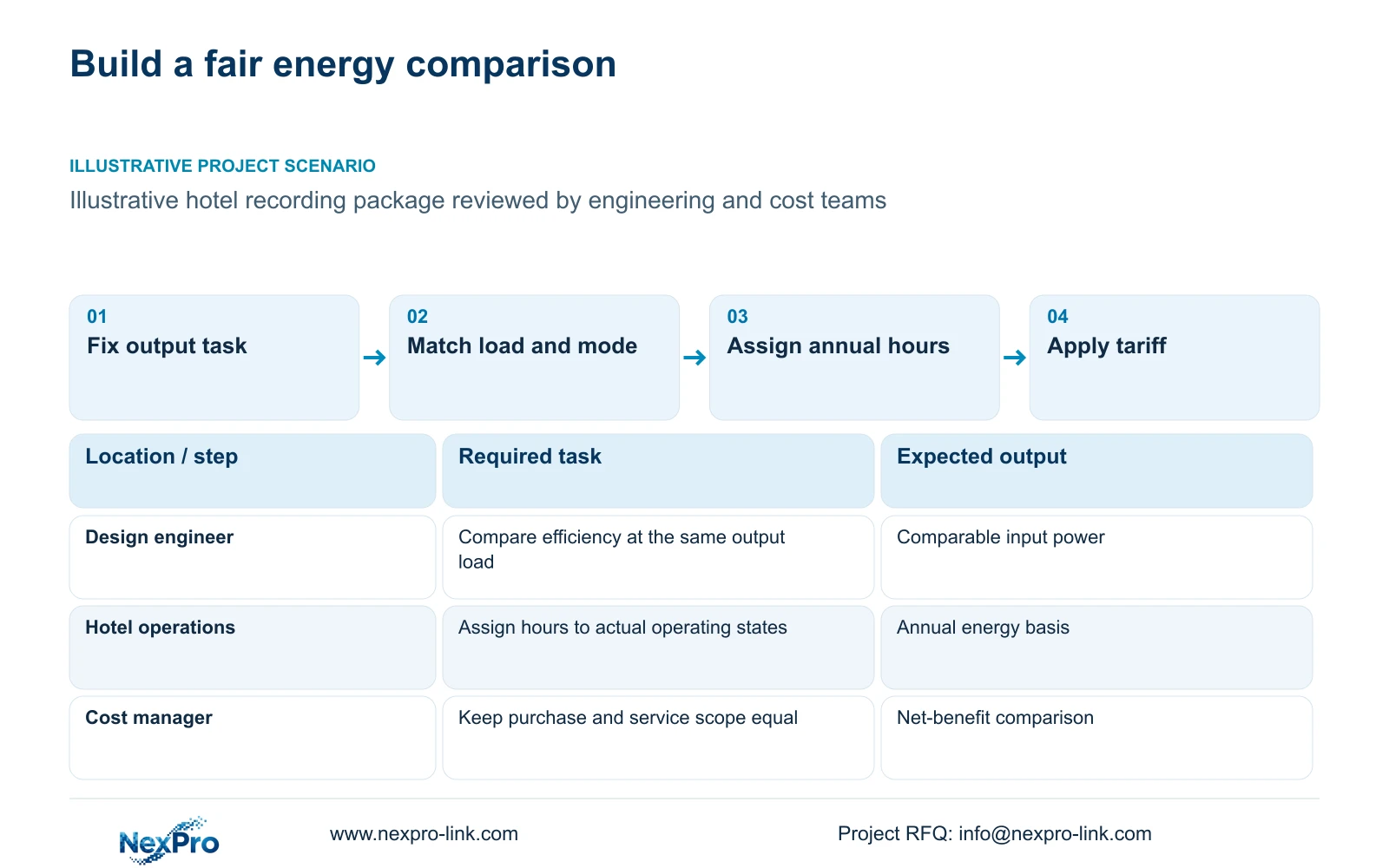
Pay an efficiency-related purchase premium only when load-matched energy savings and the complete cost comparison justify it over the hotel's chosen evaluation period. A one-percentage-point efficiency advantage does not guarantee recovery of the price difference. Use the same output load and operating mode for both options, with actual curves preferred over unrelated peak catalog values.
Define the protected equipment boundary first. Include the devices needed for the agreed recording and outage service, then identify optional viewing equipment separately. If one proposal excludes a display or network dependency, its lower input consumption does not establish better UPS efficiency for the same task.
Record the output load at which each efficiency value applies. Two differently sized units can carry the same hotel load at different utilization levels, so comparing only their best published percentages can obscure the relevant operating point. The supplied product records establish model ratings, not the illustrative 94% and 96% efficiencies used below.
| Required task | Given information | Decision still needed |
|---|---|---|
| Continuous security recording | Protected device schedule | Representative UPS output load |
| Equivalent UPS operation | Proposed operating modes | Efficiency at the same load and relevant mode |
| Economic comparison | Purchase and service scope | Operating hours, tariff and evaluation period |
Section 02
Calculate input power and conversion loss
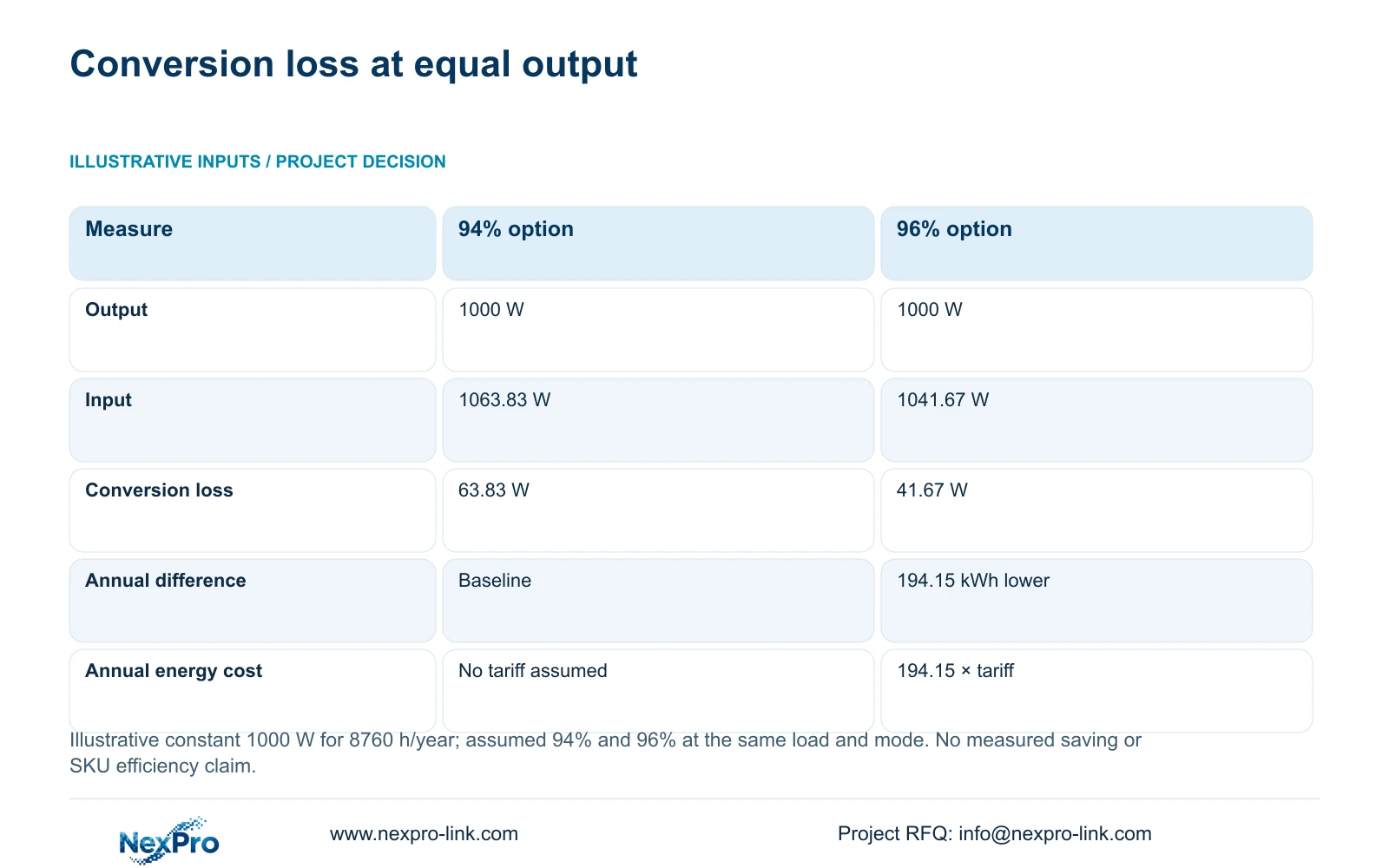
Input power equals output power divided by efficiency expressed as a decimal. Conversion loss is input minus output. At an illustrative constant output of 1000 W, option A at 94% requires 1000 / 0.94 = 1063.83 W. Option B at 96% requires 1000 / 0.96 = 1041.67 W. The lower input requirement comes from the different assumed conversion losses.
Keep watts separate from energy. The input figures describe power at the chosen operating point; they do not describe an annual bill. Multiplying their difference by the applicable operating hours and dividing by 1000 converts the result to kWh. Use unrounded intermediate values so displayed rounding does not distort the annual result.
The 94% and 96% values are teaching assumptions, not measurements of SP2KR(S), SP2K(S) or a competing brand. Both options must retain the required service before this comparison is useful. ECO and double-conversion values should remain attached to their operating conditions instead of being ranked as interchangeable percentages.
| Metric / condition | Option A: 94% | Option B: 96% |
|---|---|---|
| Output | 1000 W | 1000 W |
| Input | 1063.83 W | 1041.67 W |
| Conversion loss | 63.83 W | 41.67 W |
| Annual energy difference at 8760 h | Baseline | 194.15 kWh lower |
| Annual money difference | No tariff assumed | 194.15 × applicable tariff |
Section 03
Estimate hours for each actual operating state
The example assumes the same 1000 W output for 8760 hours in a year. Under that constant-load assumption, annual energy difference = (input A minus input B) × hours / 1000, giving 194.15 kWh. This is a calculated difference, not a measured hotel saving or evidence that a purchase premium will be recovered.
For a varying load, separate the operating states and their hours. Calculate input power using the efficiency relevant to each state, then sum the energy differences. Hours assigned to different states must describe the same evaluation period without overlap. Do not apply the busiest measured load to every hour unless that is an explicit planning assumption.
Keep the complete illustrative hotel reference independent. Its basic and enhanced display packages use their own equipment loads, which are not the 1000 W constant-output case here. If actual project loads follow that structure, collect the relevant UPS efficiency information for each selected package and power zone before estimating annual consumption.
Section 04
Convert the energy difference using the applicable tariff
Let T represent the applicable energy tariff in currency units per kWh. The example's annual energy-cost difference is 194.15 × T currency units. Leaving T as a variable prevents a teaching calculation from becoming an invented hotel electricity price. Apply the buyer's actual tariff basis when evaluating a quotation.
If the energy rate varies by period, use the hours and energy difference associated with each applicable rate. Keep other billing items outside this simplified energy calculation unless their effect is separately supported. The result estimates the cost of the conversion-energy difference; it does not reproduce the hotel's entire electricity bill.
Show sensitivity where an uncertain input controls the decision. Fewer operating hours reduce the calculated energy benefit, and a different load point may change the efficiency gap. Recalculate after adding protected equipment. A larger protected load can change energy use, capacity selection and battery requirements together, so preserve the revised service scope in the cost comparison.
Section 05
Account for battery and service costs separately
Keep battery configuration, maintenance and support costs in distinct lines. Equal conversion efficiency does not establish equal runtime, and a larger kVA rating does not establish a particular battery duration. Compare supported battery arrangements against the same outage objective, using load-matched runtime information.
For example, SP2KR(S) is a rack model rated 2 kVA / 1800 W, while SP2K(S) is a tower model rated 2 kVA / 2000 W. These supplied ratings help assess capacity and physical alternatives. They supply no basis for assigning the example's efficiency percentages, transferring battery Wh across models or predicting a replacement interval.
Include installation, delivery and later service scope when comparing total costs. The supplied policy record gives applicable main equipment a 24-month limited hardware baseline from receipt, with batteries and other categories governed by their specific scope and written order. Technical support does not automatically include all site labor or transport. Use quoted terms instead of an invented failure rate.
Remove duplicated inclusions before adding totals. If a package includes a battery arrangement or connection accessory, count it once. Optional improvements should remain visible so the buyer can distinguish a genuine lifecycle difference from a change in supplied equipment.
| Retained outcome | Separate cost input | When it changes the decision |
|---|---|---|
| Required outage duration | Supported battery configuration | One option needs additional battery scope |
| Same installed service | Connections, placement and local work | Chassis-only prices omit different installation costs |
| Agreed support coverage | Service, labor and transport terms | Recurring costs offset the energy benefit |
Section 06
State the purchase break-even condition
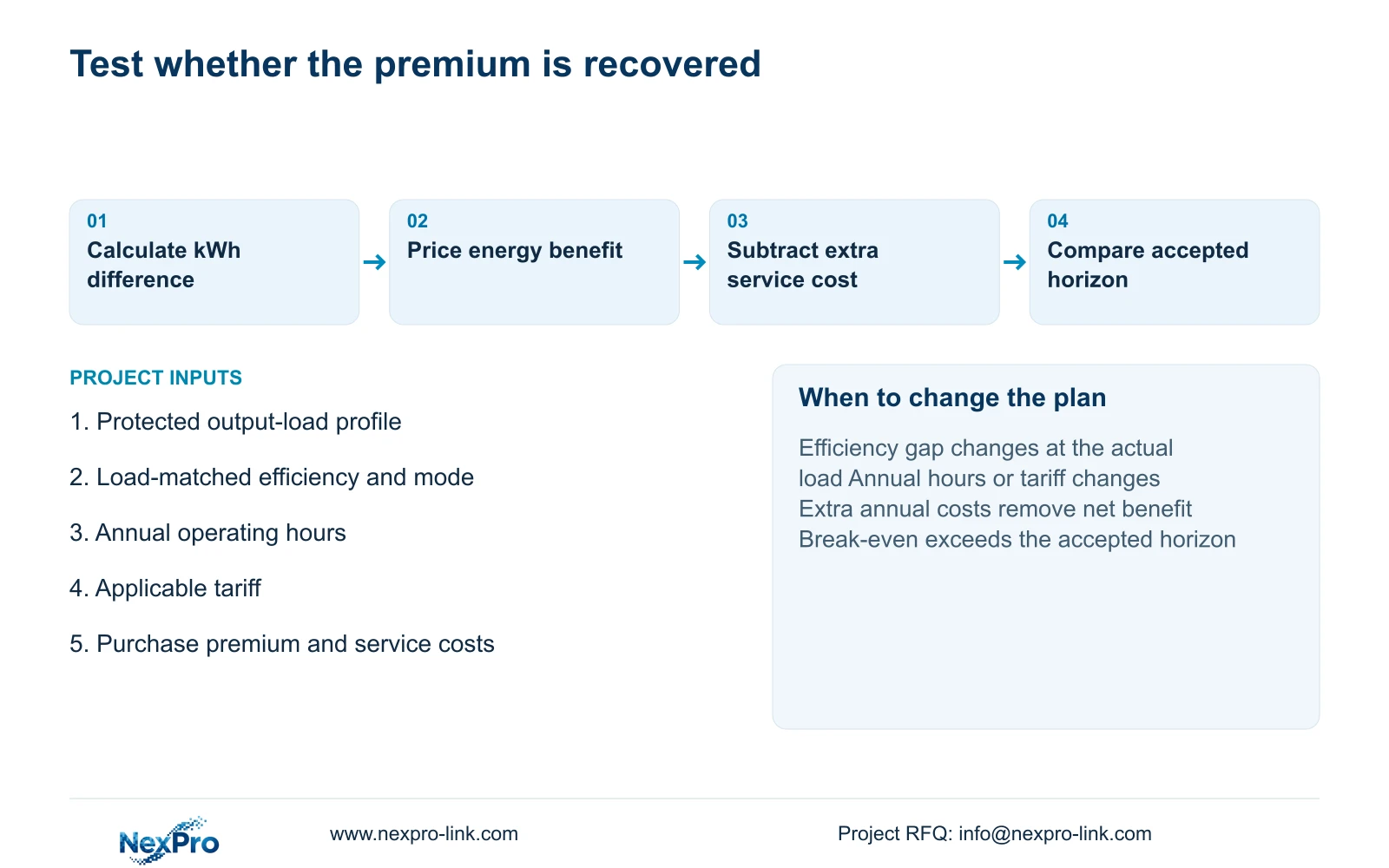
Let P be the extra initial cost of option B and C be its additional annual non-energy cost relative to A. Under the constant-load example, annual net benefit is 194.15 × T minus C. If that value is positive, simple undiscounted break-even years equal P divided by the annual net benefit. If it is zero or negative, this model shows no recovery of a positive purchase premium.
Choose B for economic reasons when both configurations satisfy the required service and its net benefit recovers the premium within the accepted horizon. Choose A when the complete cost comparison remains lower over that horizon. Revise the recommendation if the actual efficiency curve, tariff, protected load or service quotation changes; neither percentage establishes a brand ranking.
Send info@nexpro-link.com the protected load profile, efficiency data and operating modes being compared, annual hours, applicable tariff and evaluation period. Include the actual configuration quotations if available. NexPro-Link can discuss a scope-matched equipment comparison through its hotel project and BOQ support routes without presenting the teaching result as a measured saving.
Section 07
Buyer questions
Can we calculate a useful result before knowing the tariff? Yes. Calculate the kWh difference first and leave the money result as a tariff expression. The example produces 194.15 kWh per year, with annual energy cost equal to that value multiplied by the applicable rate.
Does the 94% versus 96% example answer a one-point efficiency claim? It demonstrates the method using a two-percentage-point gap. A one-point claim needs its own load-matched efficiencies and hours. The example's annual result cannot be copied to that different comparison.
What evidence supports a claim of actual hotel savings? Use real energy measurements with a defined load, operating mode and comparison boundary. A catalog percentage and a teaching annual-hours assumption support an estimate, not a measured savings claim.
Engineering references
These sources support the general planning principles. Always use the selected product's current datasheet and applicable project standards for final design.