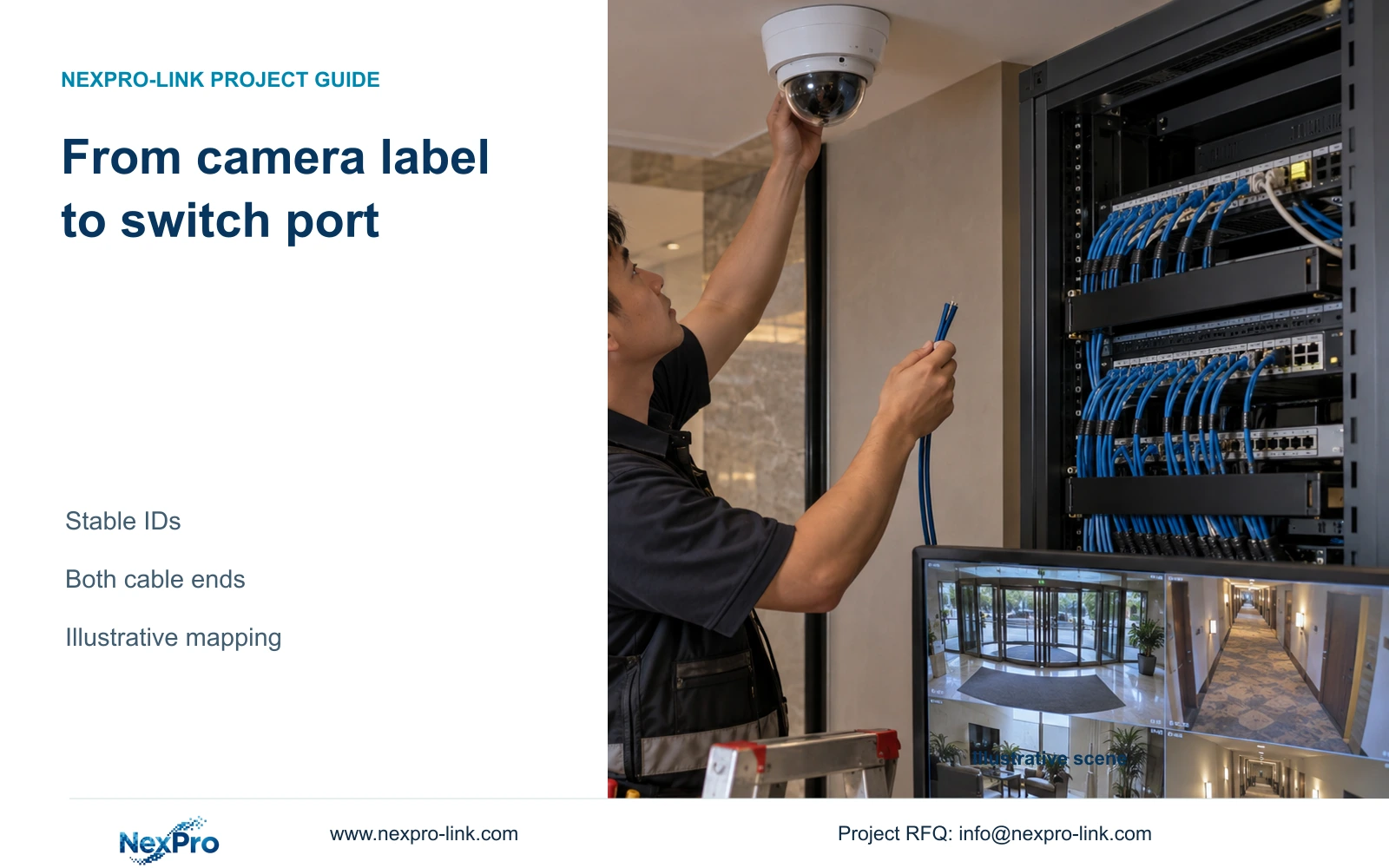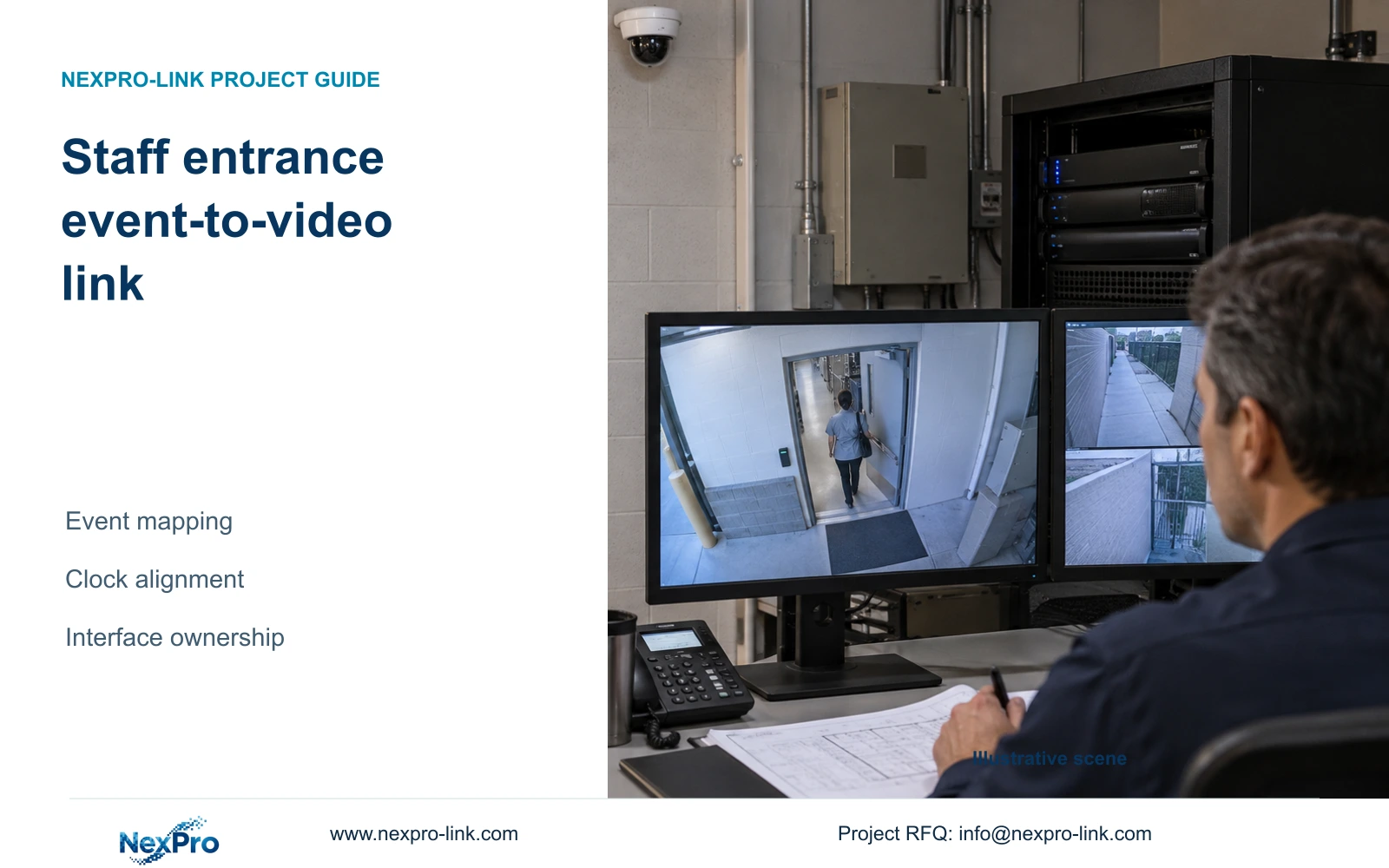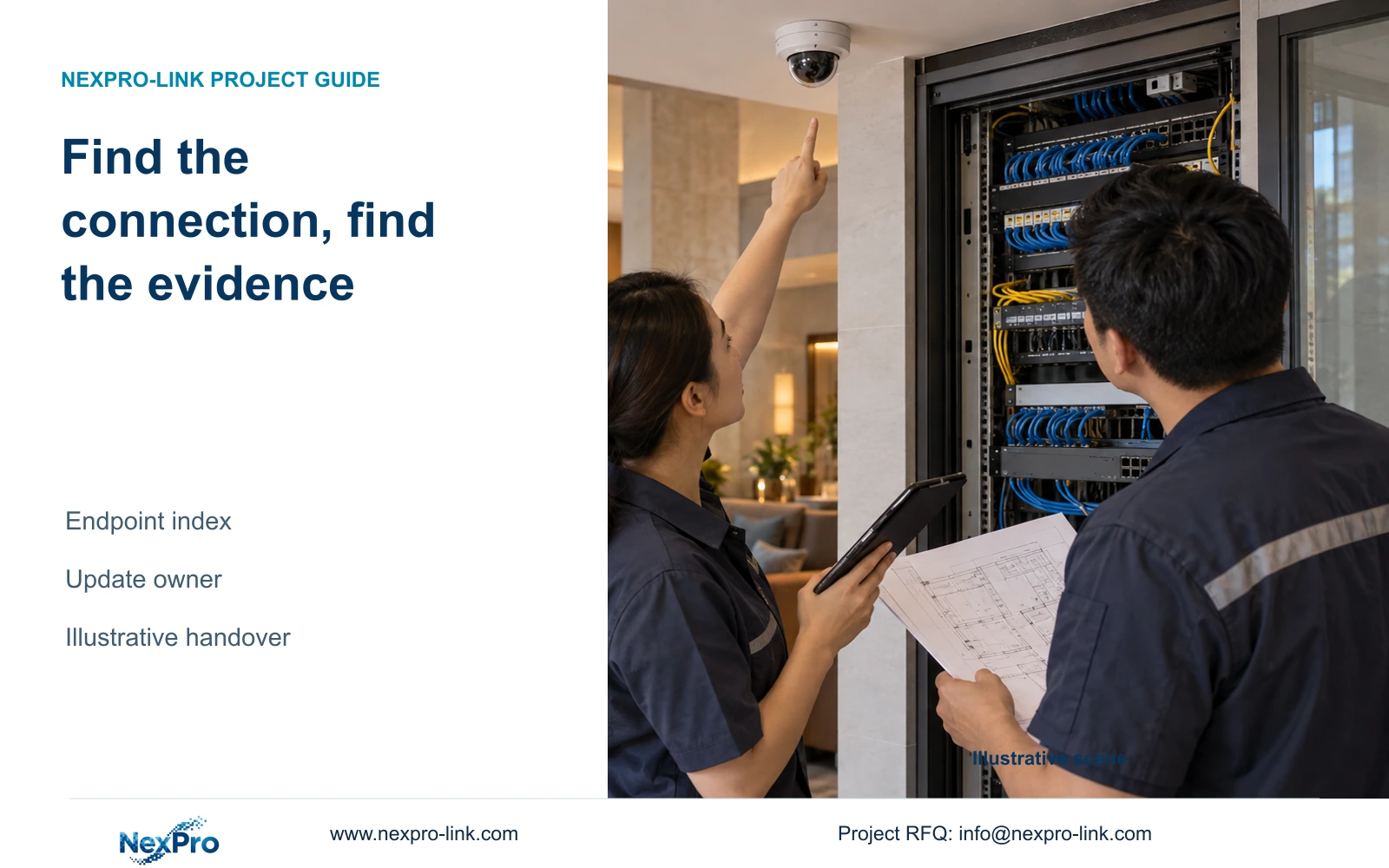
Hotel cabling records should answer where a camera connects and what was tested. An endpoint index makes drawings, port maps and final reports usable during maintenance.
Section 01
Define the maintenance task the records must support
Require an endpoint-indexed handover that lets authorized maintenance staff trace a camera connection to its drawing, panel and switch port, then retrieve the relevant test result. A searchable index with linked records suits this task. Use the operator’s required asset platform when one exists, while retaining an agreed reference format that staff can access during the specified fault conditions.
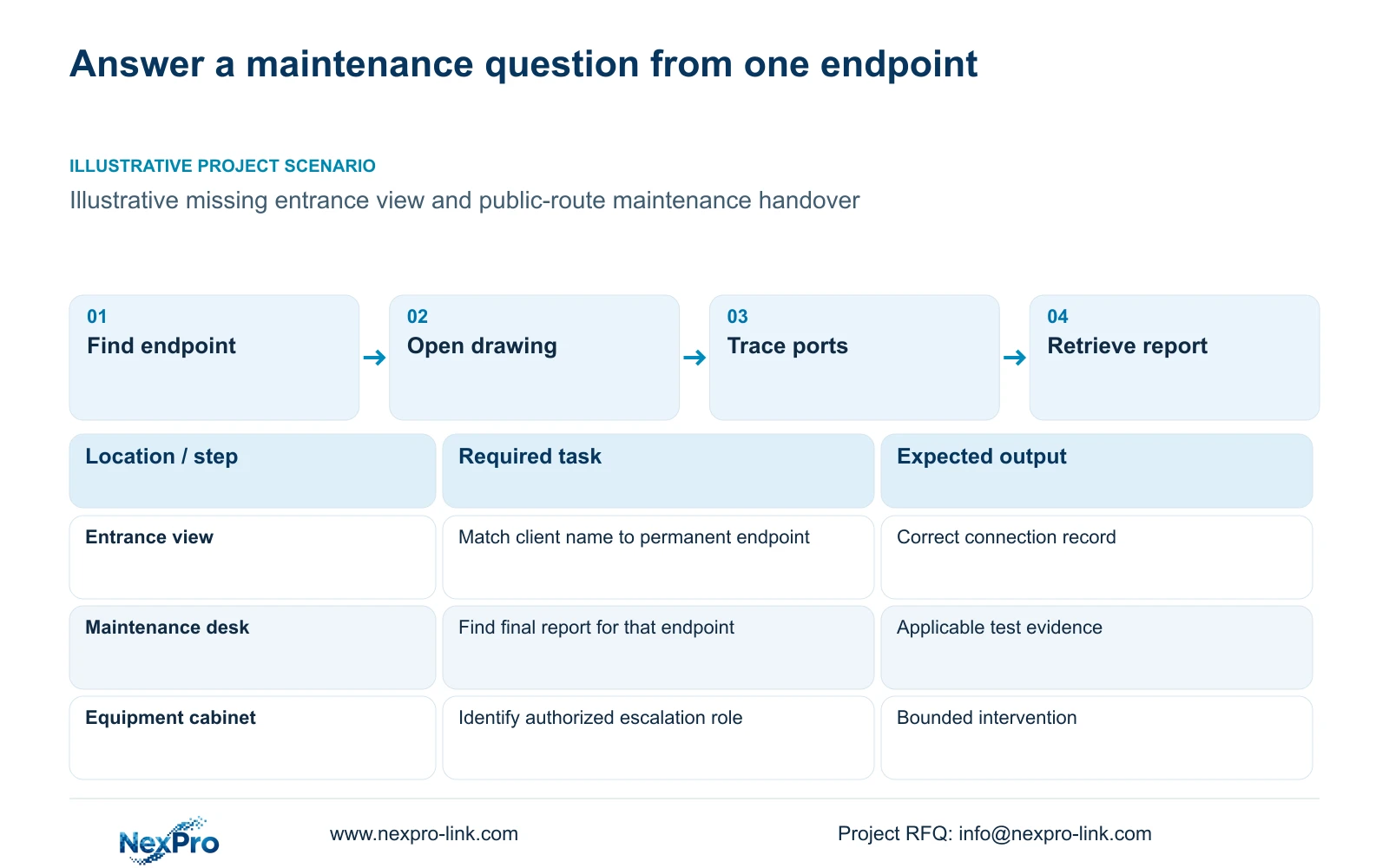
Begin with a concrete operating problem, such as a missing public-entrance view. Security needs to identify the affected view and preserve any relevant incident work. IT or the local installer needs the connection and equipment references. The owner needs a clear escalation boundary. These roles require different information and authority.
Write those tasks into the close-out scope before comparing quotations. A folder of reports may contain the evidence, but the maintenance team still needs a reliable way to find it. Price the endpoint index, drawing cross-references and final port map as defined deliverables. Do not assume a general installation allowance includes their creation and later upkeep.
| Required task | Given information | Decision still needed |
|---|---|---|
| Trace a missing entrance view | Camera name in the client | Link it to endpoint and connection records |
| Find installed test evidence | Reports exist in separate files | Provide a current endpoint index |
Section 02
Link drawings to endpoint IDs
Use a permanent endpoint identifier consistently across the drawing, camera schedule and cabling index. Keep location descriptions searchable because staff may know a lobby or corridor name rather than an asset number. Retain previous location names as references when renaming would otherwise break a maintenance search.
Connect the endpoint to cable identity, cabinet, panel termination and active switch port. Add the installed equipment model and serial information as separate fields. A replacement camera changes the device record; repatching changes the active connection. Neither event should silently attach unrelated historical reports to the current endpoint.
Keep the video path and protected-power references distinct. The illustrative CASE01 arrangement separates cameras, access nodes, recording and optional display. Its relationship diagram is not an installed electrical drawing. The handover should identify actual remote active nodes and their approved power boundary, because a powered recorder alone cannot explain the status of every camera connection.
Section 03
Attach final test reports
Link each current endpoint to the report covering its final accepted cable configuration. Record the test date, result and applicable boundary. If work changed after an earlier pass, retain the earlier file as history and identify the later result or unresolved status. Avoid requiring maintenance staff to choose between several similarly named reports without guidance.
Distinguish permanent-link evidence from complete-channel evidence. The supplied Fluke Networks record uses a typical 90 m permanent-link basis and 100 m channel basis including patch cords; the project’s selected category and test arrangement remain relevant. A permanent-link result should not be presented as evidence for every patch cord added afterward.
SP5648 is a Cat6 48-port data patch panel, and DT968MX is a Cat6 toolless module in the supplied product record. Store their installed references where they help maintenance identify parts. These descriptions do not establish the category of the whole connection. Factory checks, site cable tests and CCTV operating observations should remain distinguishable in the index.
Section 04
Compare file-dump and indexed handover
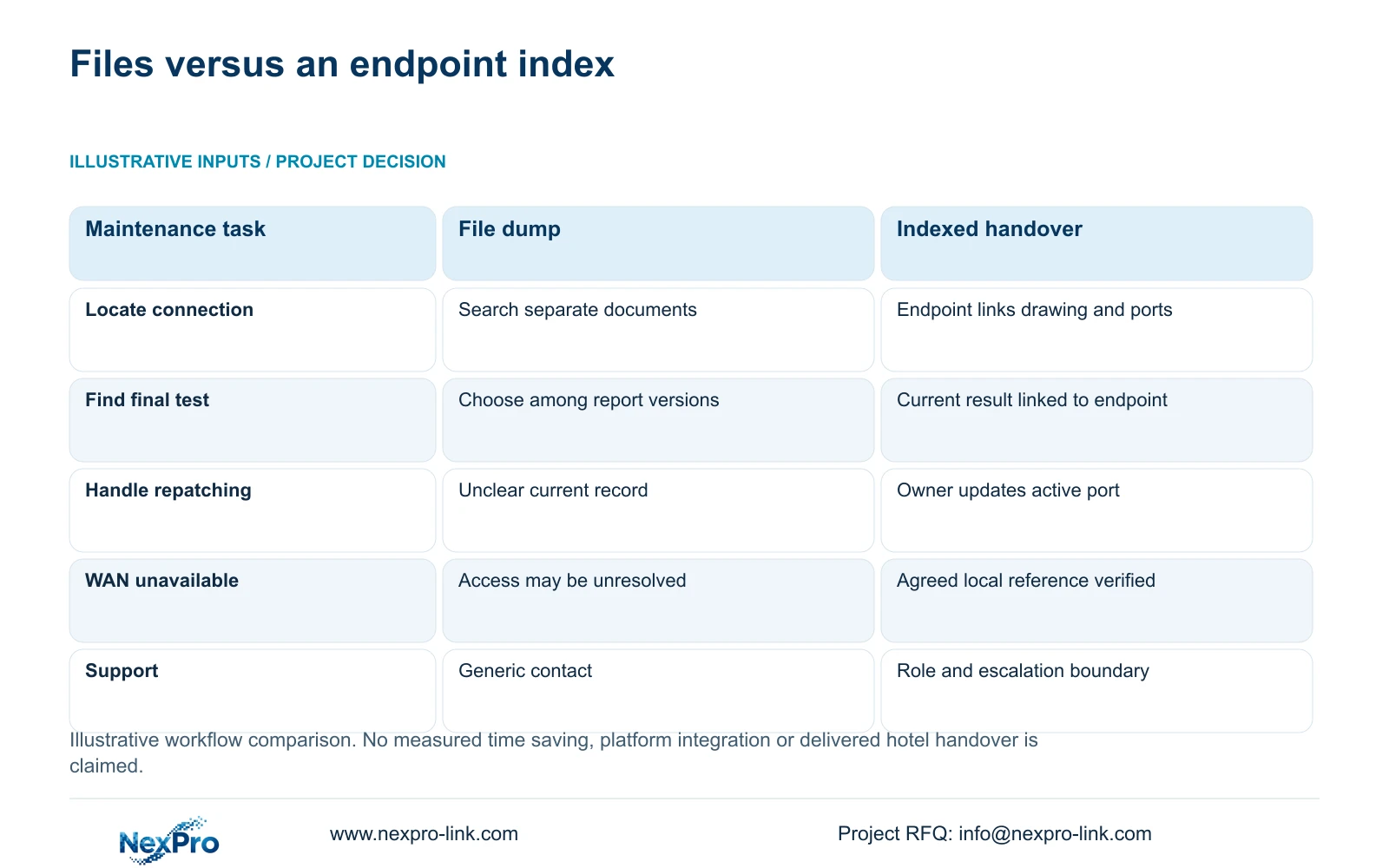
A file-dump handover groups documents by producer or file type. An indexed handover starts from the endpoint and leads to the current supporting documents. Choose the indexed structure when maintenance must trace individual connections. A controlled spreadsheet can serve that task where the hotel has no mandatory platform; extra software needs a defined operating and ownership case.
Use the comparison below to check what a file folder and an endpoint index let maintenance actually retrieve. The illustrated differences concern document lookup, current test versions, repatching ownership and access without WAN. They are workflow criteria, not recorded time savings or a claim that a particular asset platform is integrated.
Demonstrate retrieval of the correct endpoint, drawing, ports and applicable report with the intended user. Check the exception path as well: records needed during a WAN failure must remain accessible through the agreed local arrangement. A readable index does not give its reader administrator rights or establish the accuracy of every record.
| Maintenance task | File folder | Indexed handover |
|---|---|---|
| Locate connection | Search separate documents | Endpoint links drawing and ports |
| Find final test | Choose among report versions | Current result linked to endpoint |
| Handle repatching | Current record may be unclear | Assigned owner updates the active port |
| WAN unavailable | Access may remain unresolved | Agreed local reference verified |
| Escalate a fault | Generic contact | Role and escalation boundary |
Section 05
Define update ownership
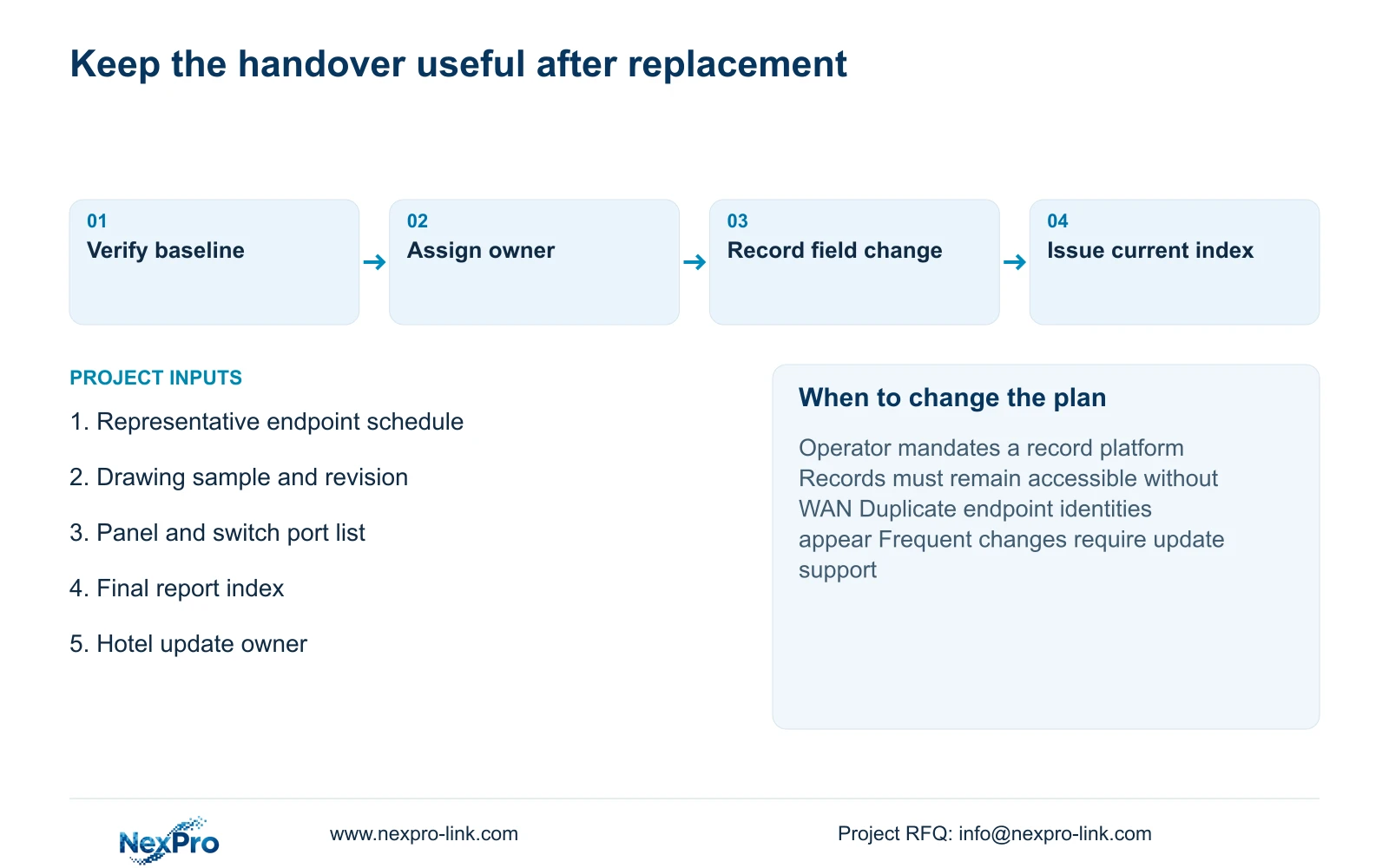
Assign a role responsible for the current index and a process for receiving field changes. The installer should provide the verified baseline within its agreed scope. After handover, the hotel needs a named owner who can incorporate authorized repatching, replacement and route changes. A supply contract does not by itself identify that owner.
Keep a read-only operational issue separate from the editable master. Record the reason, affected endpoint and responsible role for each change. Update linked drawings and test references when their content changes. A current port map paired with obsolete drawings can lead a technician to the wrong route even when each file is individually readable.
Choose ongoing update support when the hotel expects frequent alterations and has no internal capacity to maintain the records. A controlled final issue may be adequate for a stable project with a capable hotel owner. Define the included revisions and local attendance separately. Technical support does not imply unrestricted access, free future documentation or on-site service.
Section 06
Demonstrate one fault-tracing task
Use an agreed representative public-zone endpoint to demonstrate the record workflow. The authorized user identifies its client view, finds the permanent endpoint, locates the panel and switch references, and opens the applicable report. Record any missing or conflicting reference as unfinished handover work. A desk-based tracing exercise can reveal record gaps without interrupting an operating camera.
If a controlled live fault exercise is required, define the authorization, affected service and restoration responsibility first. Staff should not disconnect a connection simply to prove that a label is readable. Separate ordinary record access from technical intervention. One successful demonstration confirms the observed task and configuration; it does not establish that every hotel record is accurate.
Recommend the indexed package when these searches are required, with broader reconciliation if duplicate IDs or outdated mappings appear. Send a representative endpoint schedule, drawing sample, port list and existing report index to info@nexpro-link.com. NexPro-Link can discuss equipment documentation and BOQ coordination. The local project team must verify installed records and agree who maintains them after handover.
Section 07
Buyer questions
Do we need a new asset-management platform? Not necessarily. Use the hotel’s mandatory platform if specified. Otherwise, an agreed searchable index with reliable document links may satisfy the task. Buy additional software only when its supported workflow and maintenance owner are clear.
Can the index be shared without sharing credentials? Yes. Connection references, device identities and report links can be separated from passwords and access secrets. Give readers the records appropriate to their role, and keep sensitive configuration access under the hotel’s approved controls.
What is a practical handover acceptance demonstration? Ask an authorized maintenance user to trace a representative public-zone endpoint and retrieve its applicable report. Log missing references and corrections. Do not claim a whole-project pass or average tracing-time improvement from that single exercise.
Engineering references
These sources support the general planning principles. Always use the selected product's current datasheet and applicable project standards for final design.