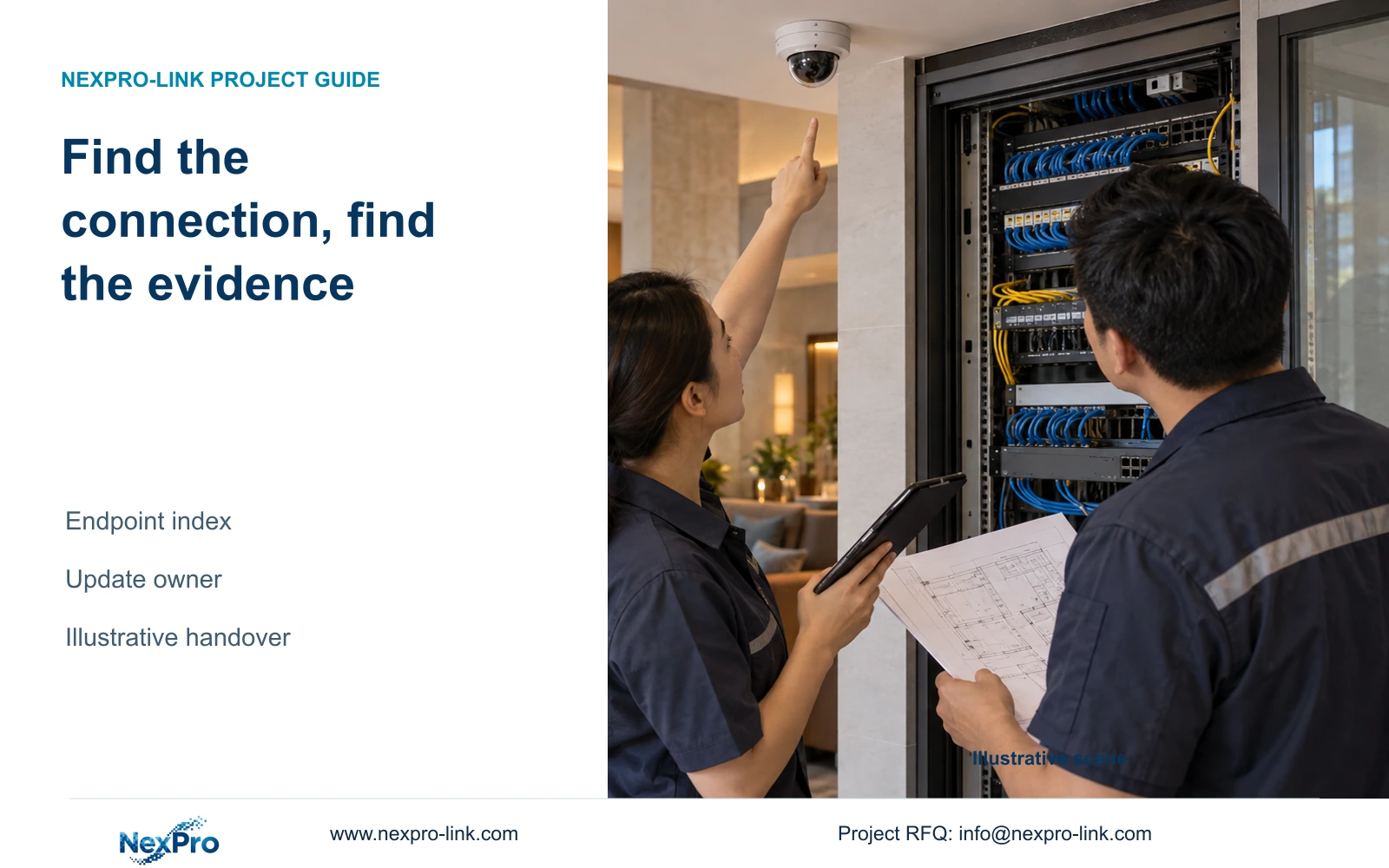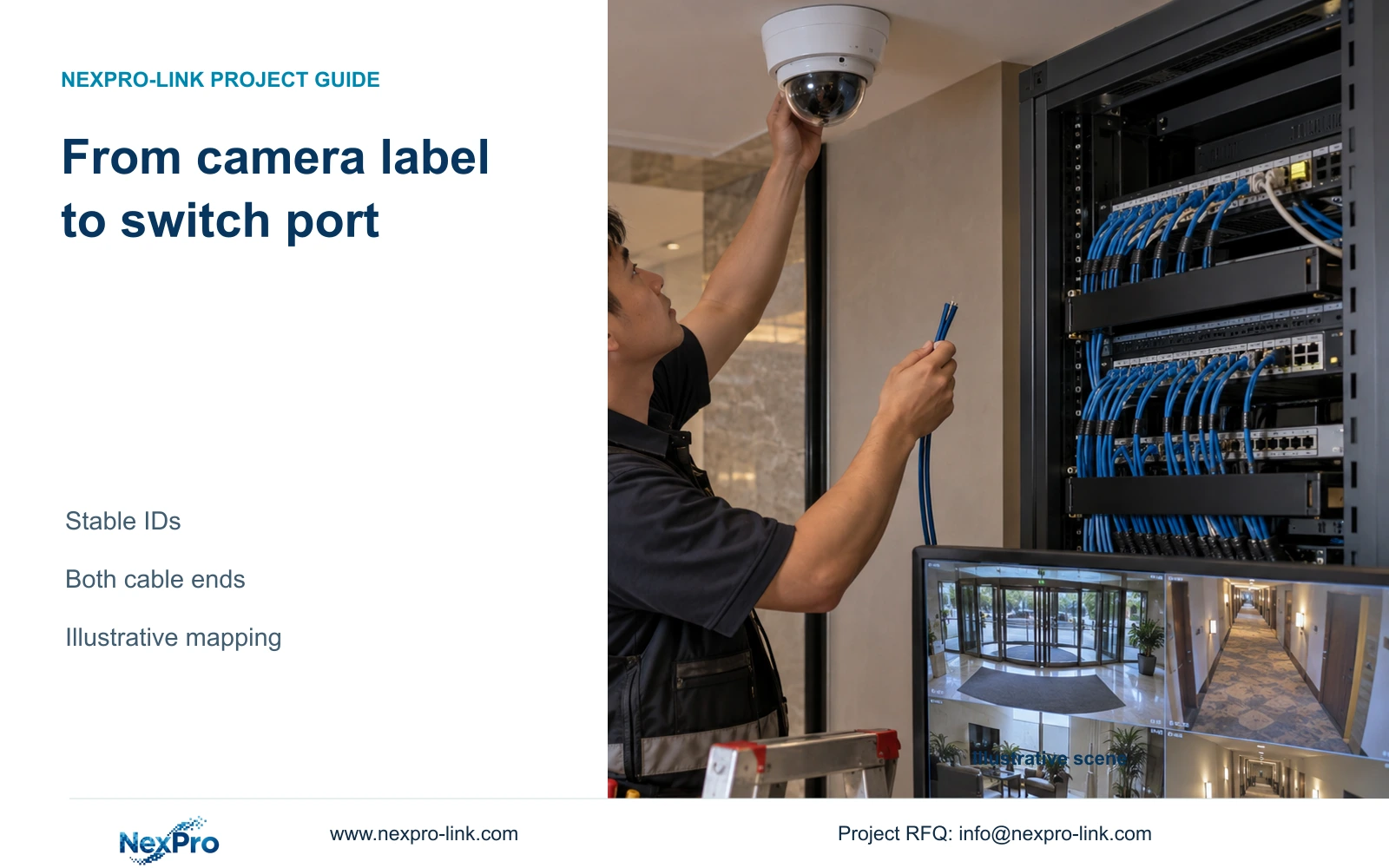
A hotel camera label becomes useful when it leads to the correct cable, panel termination and switch port. Keep permanent identities separate from floor names and replaceable equipment.
Section 01
Choose permanent asset IDs
Use a stable endpoint identity as the main reference in the camera schedule, cable labels and port map. Keep floor names as editable location descriptions. This approach suits a hotel where maintenance staff must trace a lost view through several records. If the operator already requires an asset numbering system, adopt that system and retain a cross-reference to existing contractor IDs.
Separate the observation position from the equipment installed there. The endpoint identifies the public-zone task and connection; the camera model and serial number identify the replaceable device. Changing a camera should update the equipment fields without erasing the history of its location. Moving the observation task to a different connection requires an explicit mapping change.
Agree who allocates new IDs and retires unused ones before labels are produced. Duplicate identifiers make search results ambiguous, while recycled identifiers can attach an old test report to a new route. For the quantity surveyor, this is a deliverable within the labeling and close-out scope. Count the required records and physical labels separately so that an equipment replacement does not silently create an unpriced documentation task.
| Required task | Given information | Decision still needed |
|---|---|---|
| Trace a public corridor camera | Floor description may change | Select a permanent endpoint ID |
| Replace an entrance camera | Model and serial number will change | Retain endpoint identity and update device record |
Section 02
Map both cable ends
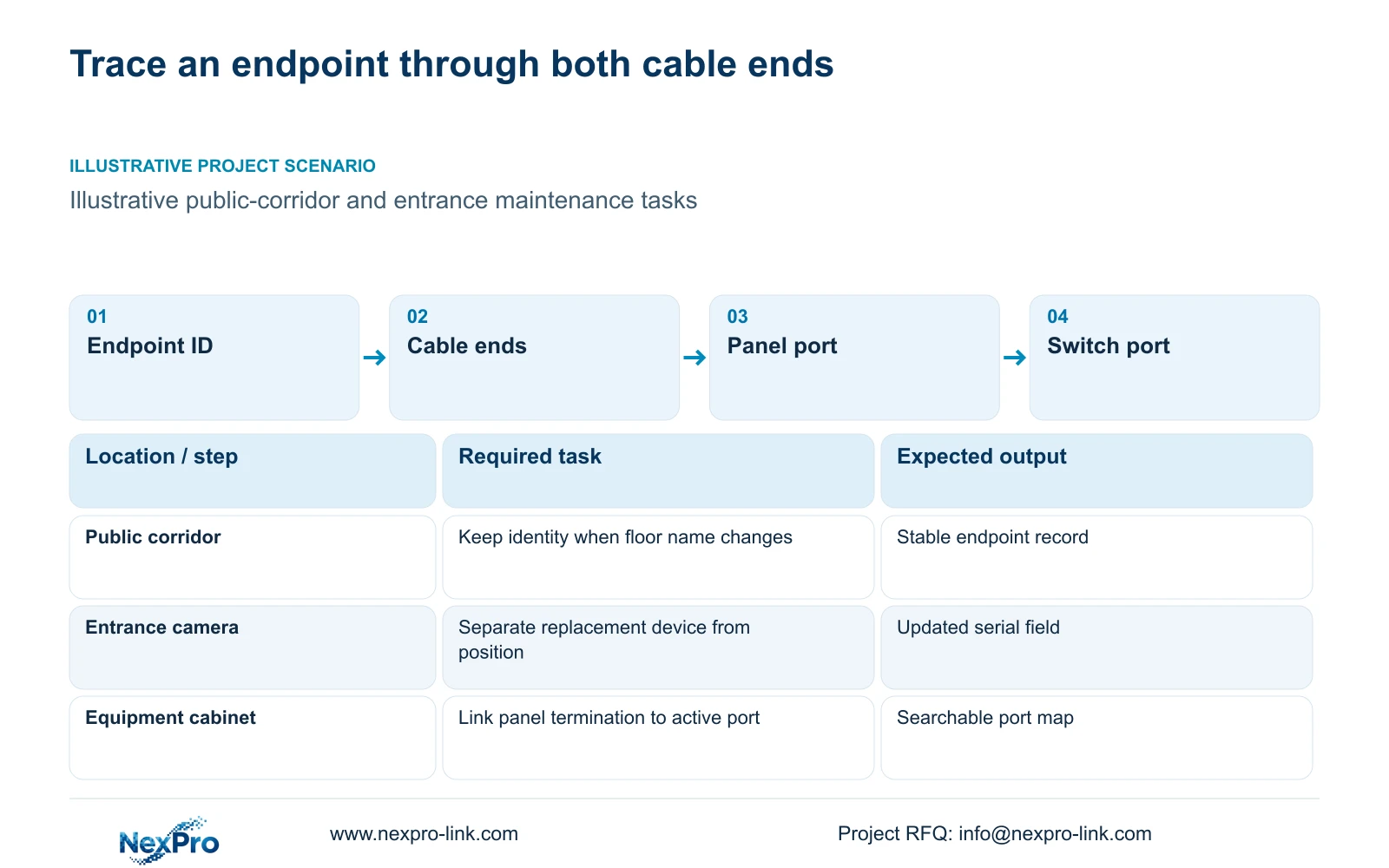
Identify each continuous permanent cable at both ends and connect that identity to its endpoint record. A camera-side label should lead to the correct cabinet and panel termination. The cabinet-side label should lead back to the camera position. A floor name alone cannot distinguish several routes serving the same public corridor.
Record the actual route length, including the stated termination allowance, alongside the cable identity. Keep permanent-link length separate from patch cords. The supplied Fluke Networks source uses a typical 90 m permanent-link basis and 100 m channel basis including patch cords; the specified category, test configuration and project requirements still control acceptance.
The illustrative CASE01 hotel uses 32 continuous routes with different lengths. Those quantities provide system context, not a label count for every hotel. Tie each installed run to the actual schedule and its test record. Spare cable stock and unused panel ports should have their own status, preventing maintenance staff from mistaking a reserved connection for an operating camera.
Section 03
Connect panel and switch ports
Keep the panel termination and active switch port in separate fields. The permanent cable may stay on the same panel port while an authorized technician moves its patch cord to another switch port. A single combined label becomes misleading after that move unless every affected record is updated.
The port map should connect endpoint identity, cable identity, cabinet, panel port and switch port. Where useful, add the recorder channel and approved client view name as references. Record protected-power dependencies separately from the data path. A working recorder does not establish that a remote PoE switch remains powered during an outage.
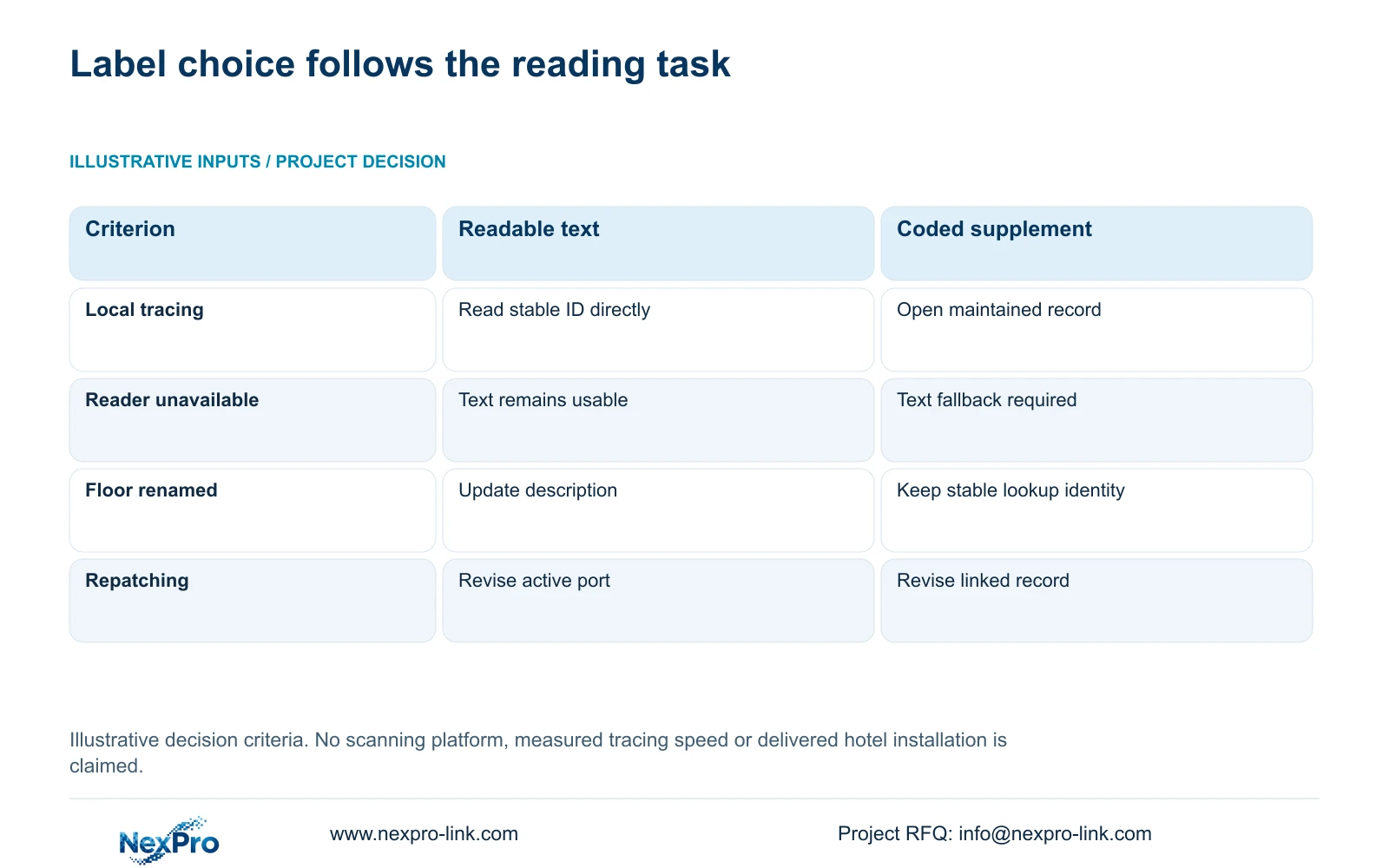
Choose the label format against the maintenance reading task. The comparison below distinguishes readable text from a coded supplement, including reader failure, floor renaming and repatching. It is an illustrative workflow decision, not a measured tracing-time improvement. Staff may read the map and contact the responsible role without permission to disconnect equipment or change network settings.
| Maintenance condition | Readable text | Coded supplement |
|---|---|---|
| Local tracing | Read the stable ID directly | Open the maintained record |
| Reader unavailable | Text remains usable | Retain a text fallback |
| Floor renamed | Update the location description | Keep the stable lookup identity |
| Repatching | Revise the active port map | Revise the linked record |
Section 04
Compare human-readable and coded labels
Print the permanent identifier in readable text. Add a concise location description when label space permits. A barcode or other coded reference can supplement the text if the hotel has a supported reading workflow, but maintenance must still have a usable fallback when that reader or its network connection is unavailable.
Choose label content according to where it will be read. The camera connection needs an endpoint reference; the cabinet needs an unambiguous port reference. Equipment branding, serial information and project location are separate fields. Project labels should preserve the manufacturer information needed for support and replacement.
A coded label earns its added scope when an authorized user can reach the correct maintained record. Retain readable identifiers when a scanner, network connection or linked service is unavailable. Where the hotel has no maintained scanning workflow, text-readable labels and an indexed map remain sufficient candidates. Verify actual lookup and update tasks before accepting a claimed improvement in fault-tracing time.
Section 05
Plan changes without losing history
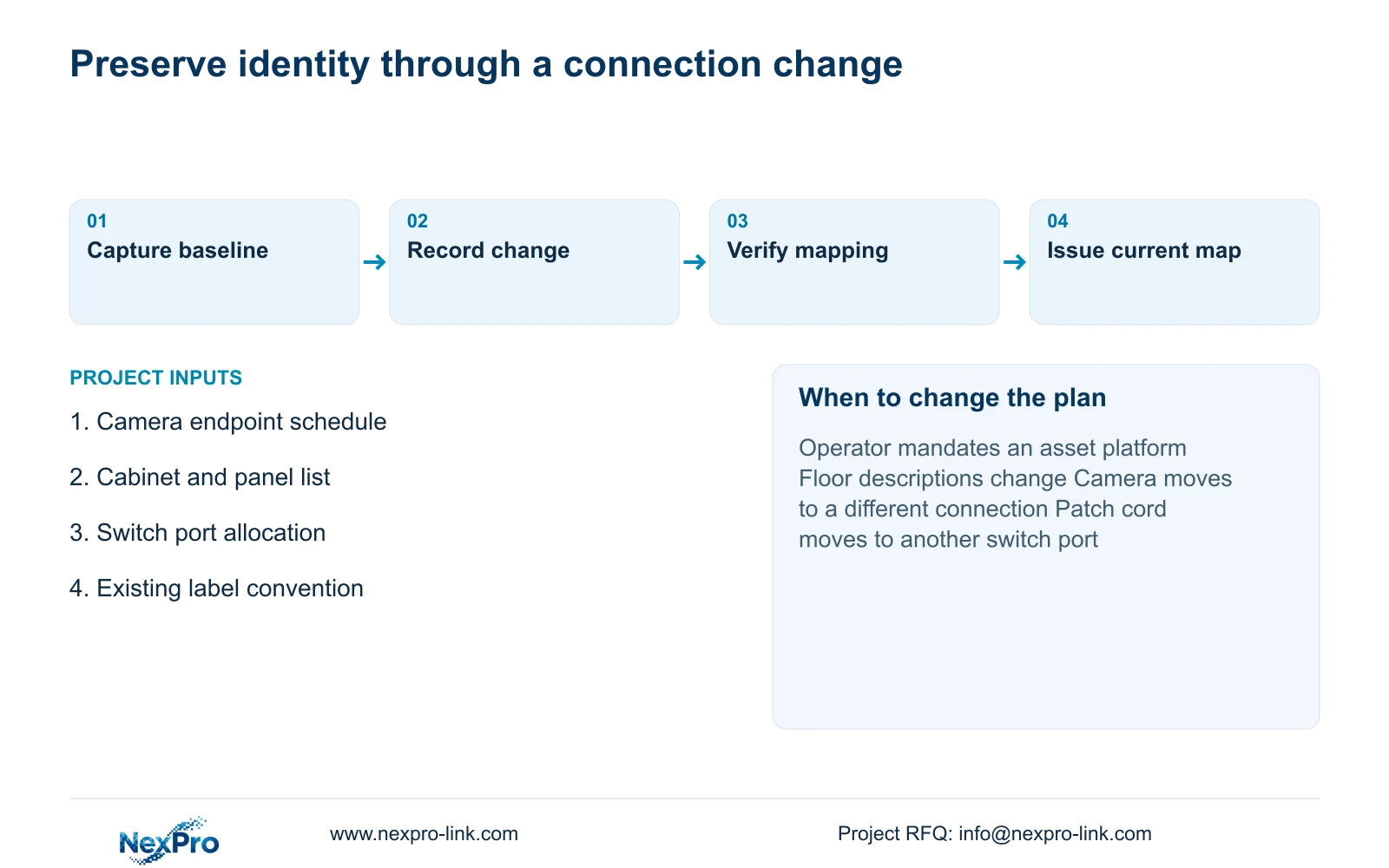
Maintain a current port map and a separate change history. A useful change entry identifies the affected endpoint, previous connection, new connection, date and responsible role. The current record should remain easy to read without requiring the technician to reconstruct every earlier revision.
Treat floor renaming, camera replacement and repatching as different events. Renaming changes the location description. Replacement changes device identity and may require functional checks. Repatching changes the active connection and may affect network or protected-power arrangements. Each event needs only the relevant fields and verification, avoiding unnecessary renumbering.
Price change work against the agreed baseline. Reusing an existing cable, replacing labels and revising drawings can have different quantities and responsibilities. Include an update service when repeated project changes are expected; a controlled handover revision may be sufficient for a stable installation. Neither approach justifies assuming that all later alterations are free.
Section 06
Deliver a searchable port map
Deliver an editable, searchable index with a controlled read-only issue for everyday reference. Staff should be able to search by endpoint, current floor description, cabinet or port. Use consistent field names across the camera schedule, drawings and test reports. Assign responsibility for maintaining the editable record after handover.
SP5648 is a Cat6 48-port data patch panel, and DT968MX is a Cat6 toolless module in the supplied NexPro-Link record. Neither identifies a complete cable run or proves the installed channel category. Their actual installation positions belong in the map alongside the selected cable, connectors and test references.
Recommend text-readable permanent IDs with an indexed port map where the hotel needs local fault tracing. Add coded access when the operator can maintain it, and use its mandatory asset platform where one is specified. Send a representative camera schedule, cabinet and port list, and existing label convention to info@nexpro-link.com. NexPro-Link can discuss BOQ and equipment coordination; the local installer must confirm the installed mapping and testing scope.
Section 07
Buyer questions
Can we retain existing labels when floors are renamed? Yes, if the labels contain stable identifiers. Update location descriptions and drawing references. Where existing labels use only floor names, establish a cross-reference before replacing them so earlier test and maintenance records remain traceable.
Must every port-map user have administrator access? No. Reading connection records and changing switch configuration are separate tasks. Give maintenance readers the information needed to identify and escalate a fault; reserve configuration changes for the authorized technical role.
What should the labeling quotation include? Request labels at both cable ends, endpoint and port records, the agreed searchable format, and responsibility for updates before handover. Identify whether drawing revisions and later repatching records are included or separately priced.
Engineering references
These sources support the general planning principles. Always use the selected product's current datasheet and applicable project standards for final design.