An early cable pass applies to its recorded configuration. Use fit-out changes and the final connection arrangement to decide which links need retesting and what remains unverified.
Section 01
Record the initial tested configuration
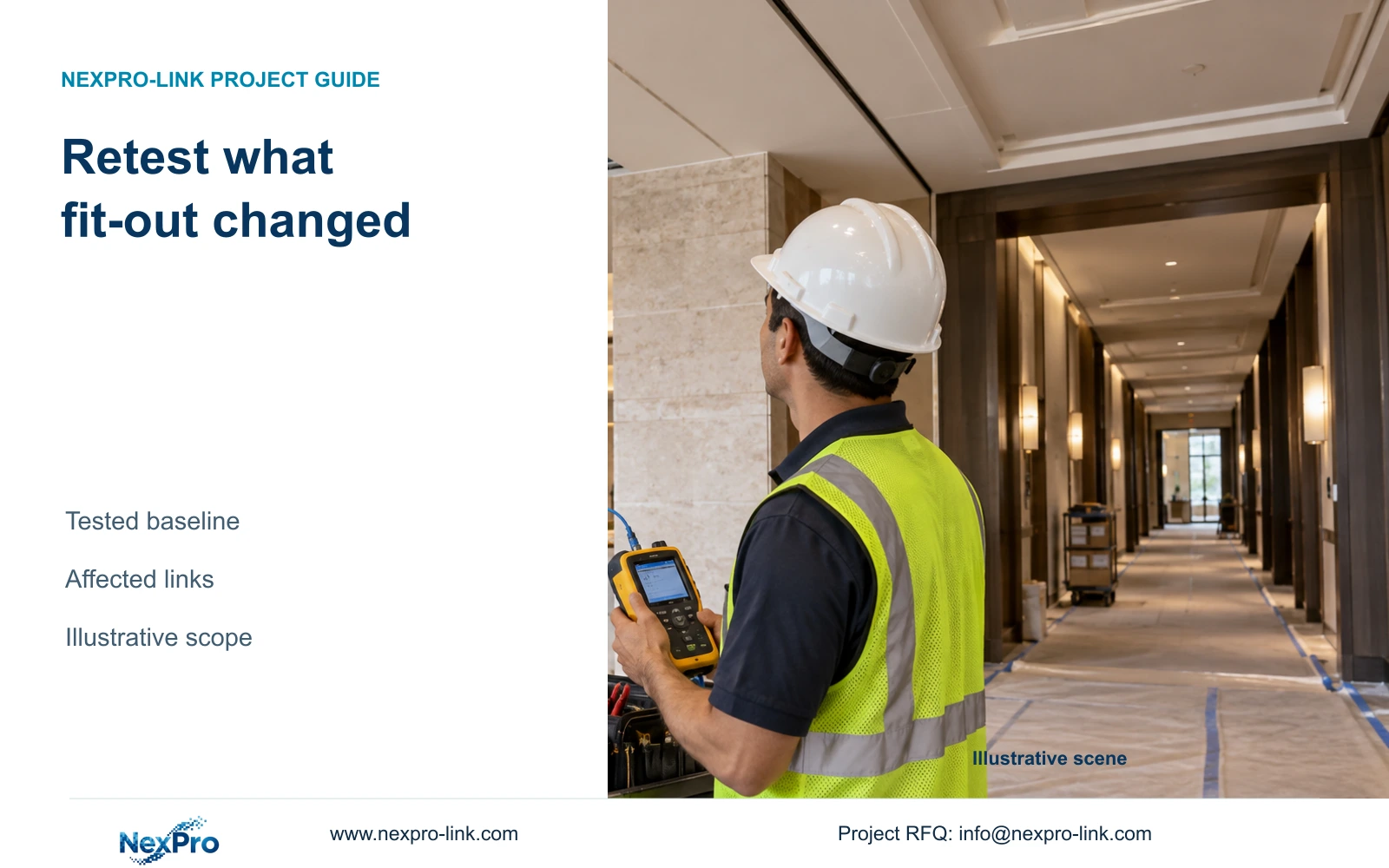
Retest connections affected by fit-out changes or suspected damage, and verify the final connection scope required by the project. Use a targeted retest when affected links are reliably identified and the contract permits it. Expand to a complete defined scope when change records are unreliable, disturbance is widespread or the acceptance requirement explicitly calls for final testing.
Retain the initial report with endpoint identity, route reference, termination details and the test configuration used. Record whether it covered a permanent link or a complete channel. An early pass describes that tested arrangement. It cannot automatically describe a later route, replacement termination or final patch-cord configuration.
Keep cable tests and operating observations in separate records. A public-lobby camera may show a picture while its installed cable documentation is incomplete. Conversely, a passing cable report does not establish the camera’s recording, replay or outage behavior. The quantity surveyor needs the agreed deliverables for both scopes to compare initial testing and post-fit-out work fairly.
| Required task | Given information | Decision still needed |
|---|---|---|
| Retain an initial result | Tested permanent-link configuration | Confirm whether that configuration changed |
| Accept final connection | Final patching may differ | Confirm required final test boundary |
Section 02
Track changes during fit-out
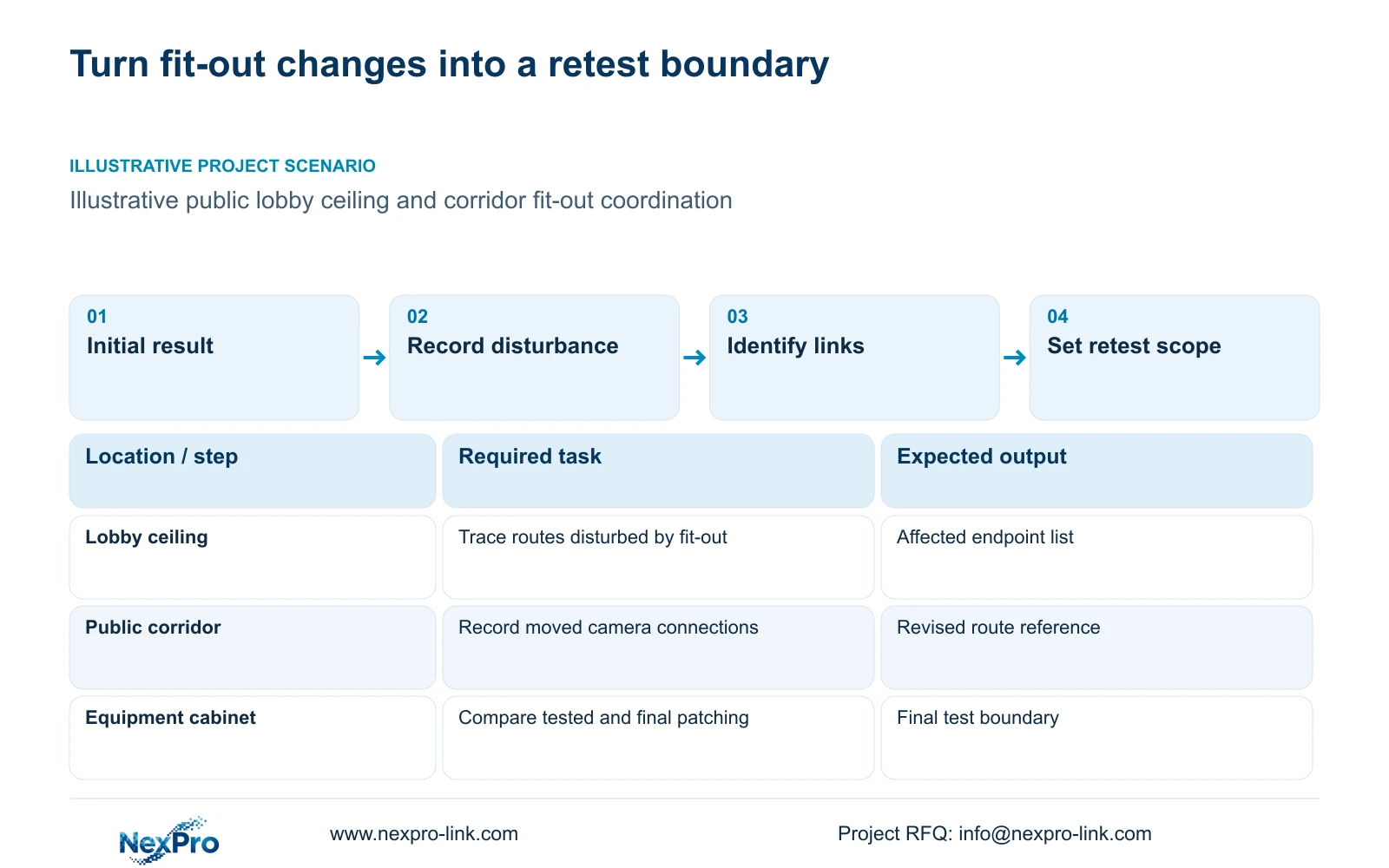
Record work that changes or disturbs the cable installation as it occurs. Relevant entries include moved camera positions, rerouted cable, replaced terminations and work within shared pathways. Tie the entry to endpoint IDs and the affected drawing revision. A broad note that ceiling work is complete does not identify which connections were touched.
Separate added endpoints from modifications to existing ones. An added public-route camera needs its own installed and tested connection. Moving an existing camera may change route length or require a new cable. It can also change switch allocation and the protected-power boundary, so the cable record should alert the responsible network and power designers.
Record access conditions before ceilings and finishes are closed. A later retest or repair may require a different work window and reinstatement scope. The cost manager should distinguish original close-out work, a documented fit-out change and corrective work arising from damage. The record should not preassign liability before the cause and contract basis are understood.
Section 03
Identify affected links
Build the retest list from the change record and physical route information. Include the modified endpoint and connections within a disturbed shared termination or pathway where their condition needs verification. Explain each inclusion. Where the affected boundary cannot be identified, retain that uncertainty and broaden the review instead of declaring untouched links by assumption.
The supplied Fluke Networks source uses a typical 90 m permanent-link basis and 100 m channel basis including patch cords. A route altered during fit-out must remain within its specified acceptance arrangement. Measure the installed route with its allowances; a straight-line drawing distance is insufficient for deciding whether the revised connection fits the intended basis.
Factory component checks do not establish the condition of cable after hotel fit-out. The illustrative CASE01 hotel includes public-route, entrance and service-area connections, but no completed site tests. Use the actual installation record to determine affected links. A limited successful sample supports only the observed scope and cannot establish a whole-project failure rate or reliability claim.
Section 04
Compare targeted and complete retesting
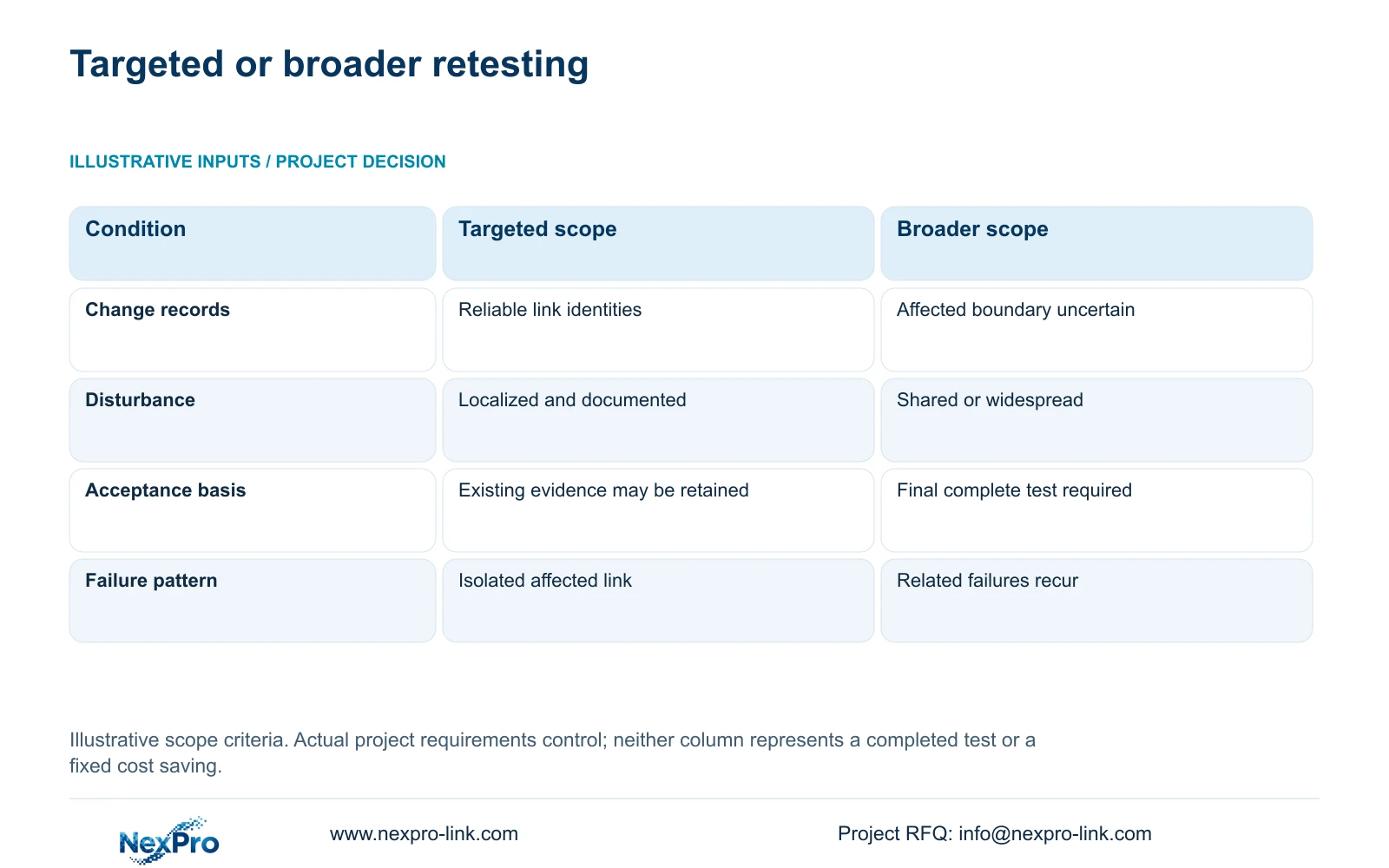
Targeted retesting is appropriate when the initial evidence is usable, changes are traceable and the agreed acceptance scope allows unaffected results to remain valid. Complete retesting of a defined floor, cabinet group or project scope becomes appropriate when disturbance is broad or traceability is insufficient. Describe the boundary explicitly; complete testing of one group is not complete testing of the hotel.
Compare the two cable retest boundaries using the change records, extent of disturbance, acceptance requirement and failure pattern shown below. These are scope-selection criteria, not completed tests or fixed cost savings. A CCTV live picture cannot select the cable certification scope; that scope follows the installed changes and the project requirement.
Keep the agreed CCTV operating checks alongside cable evidence rather than substituting one for the other. Review relevant recorded motion, replay and export after affected work. Where outage operation is in scope, confirm the required powered path under professional supervision. Record the actual configuration and observations, leaving any unperformed check open.
| Condition | Targeted retest | Broader defined scope |
|---|---|---|
| Change records | Reliable affected-link identities | Affected boundary uncertain |
| Disturbance | Localized and documented | Shared or widespread |
| Acceptance basis | Unchanged evidence may be retained | Complete final testing required |
| Failure pattern | Isolated identified link | Related failures recur |
Section 05
Verify final labels and patching
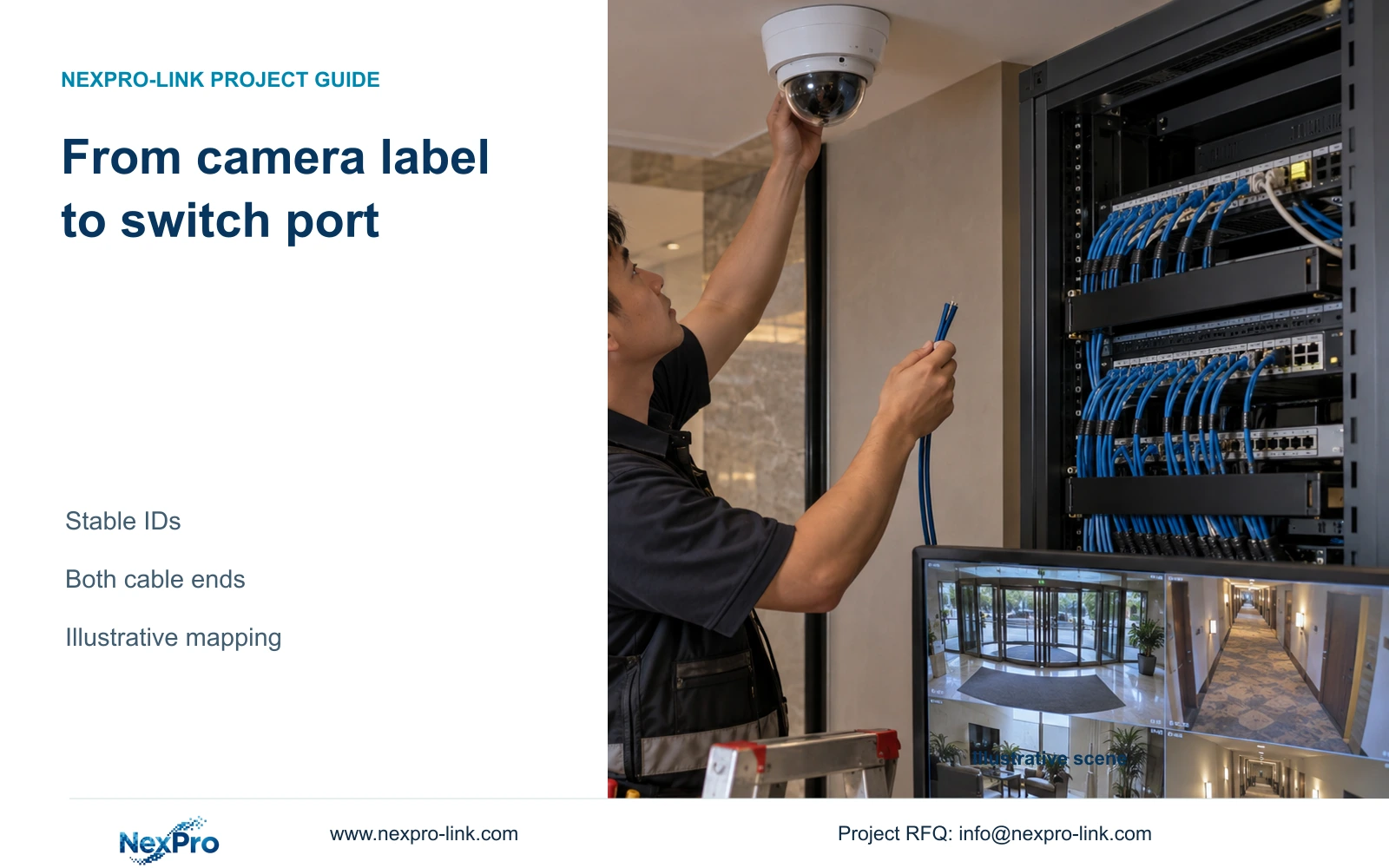
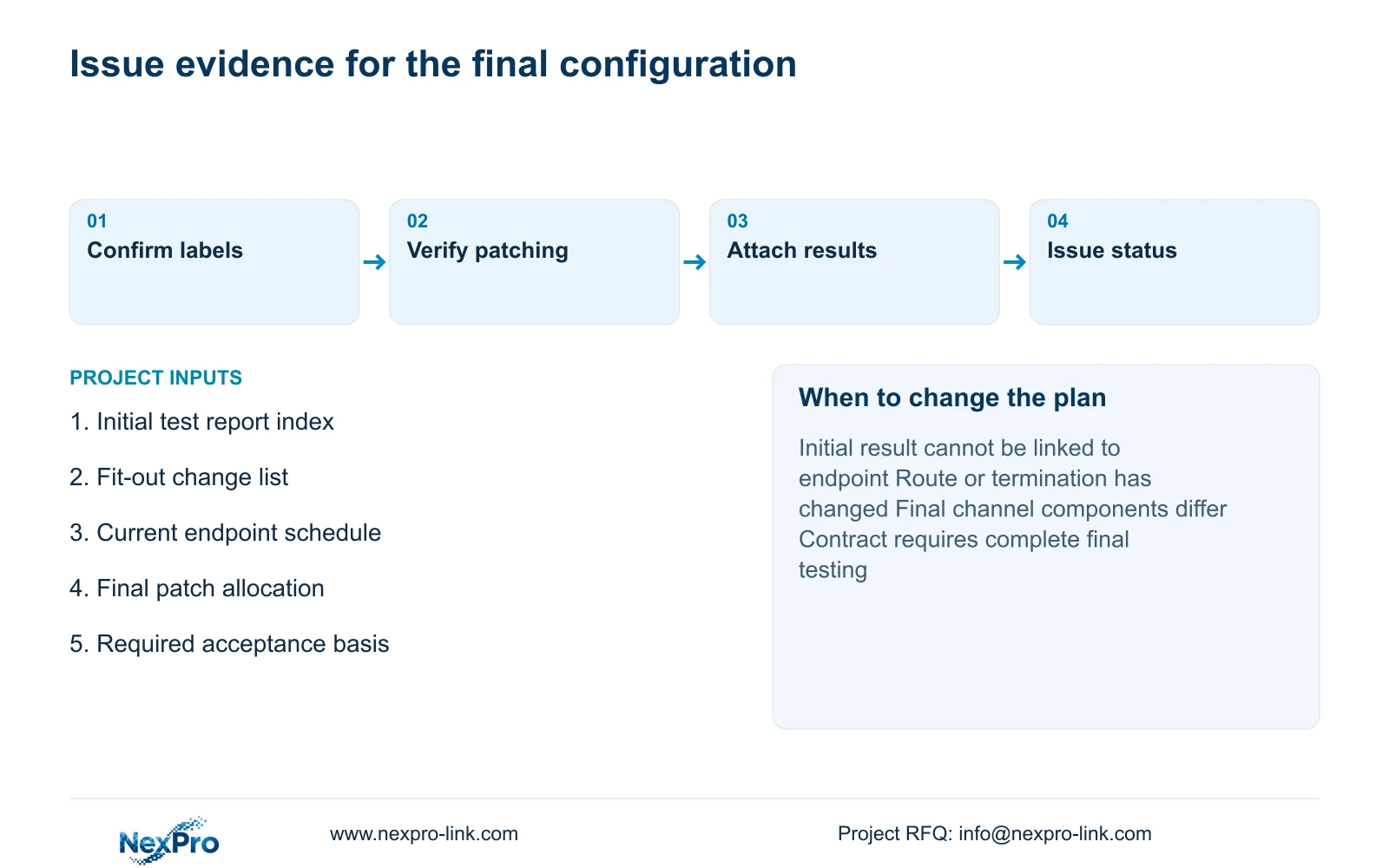
Check that the final physical labels match the endpoint index and test reports. Trace the permanent cable to its panel termination, then record the actual patch connection to the active switch port. A passing report attached to the wrong endpoint cannot answer the hotel’s maintenance question or establish the status of the intended route.
Keep final patch cords within the scope assigned to them. If acceptance covered only the permanent link, do not describe it as a test of every subsequently installed cord. Where complete-channel testing is specified, verify the final component arrangement against that requirement. Record any remaining difference between the tested configuration and the operational connection.
SP5648 and DT968MX are identified in the supplied record as a Cat6 patch panel and module. Their category descriptions do not substitute for installed results. Retain selected cable and component identities even when project packing or floor descriptions change. Additional mapping work is worth pricing when final repatching would otherwise leave the camera schedule and reports inconsistent.
Section 06
Deliver the final test status
Issue an endpoint-indexed status list that distinguishes unchanged tested links, links retested after change, failed connections and work still awaiting completion. Link each status to its supporting result and applicable configuration. An older pass should remain available as history without appearing to be the final evidence for a changed route.
Retain the targeted approach when the changed scope is clear and permitted. Change to broader retesting when records cannot identify what was disturbed, several related failures emerge or the project requires a complete final test. Specify the additional labor, access and reinstatement boundary before comparing quotations. No fixed saving percentage follows from choosing a smaller test scope.
Send the initial report index, fit-out change list, current endpoint schedule and required final test basis to info@nexpro-link.com. NexPro-Link can discuss revised components and BOQ scope through its project support routes. Actual site testing and acceptance observations belong to the responsible project team, with results recorded against the installed configuration.
Section 07
Buyer questions
Do all early passes expire when the ceiling is closed? Ceiling closure alone does not define the retest requirement. Review actual disturbance, the recorded configuration and the contract’s final acceptance scope. Keep unchanged evidence where permitted, and retest affected or uncertain connections.
Can final patch cords be excluded from the quotation? Only if their supply and acceptance responsibility is clearly assigned elsewhere. State whether the quoted test covers the permanent link or complete channel, and avoid describing a partial scope as final channel verification.
What if no reliable fit-out change log exists? Identify the uncertain area using drawings and available site records, then agree a broader verification boundary. Do not infer that every connection remained unchanged simply because an earlier report passed.
Engineering references
These sources support the general planning principles. Always use the selected product's current datasheet and applicable project standards for final design.