Start hotel security value engineering with required outcomes, duplicate scope and optional displays. Change camera specifications only where the task remains achievable.
Section 01
Freeze the outcomes that must remain
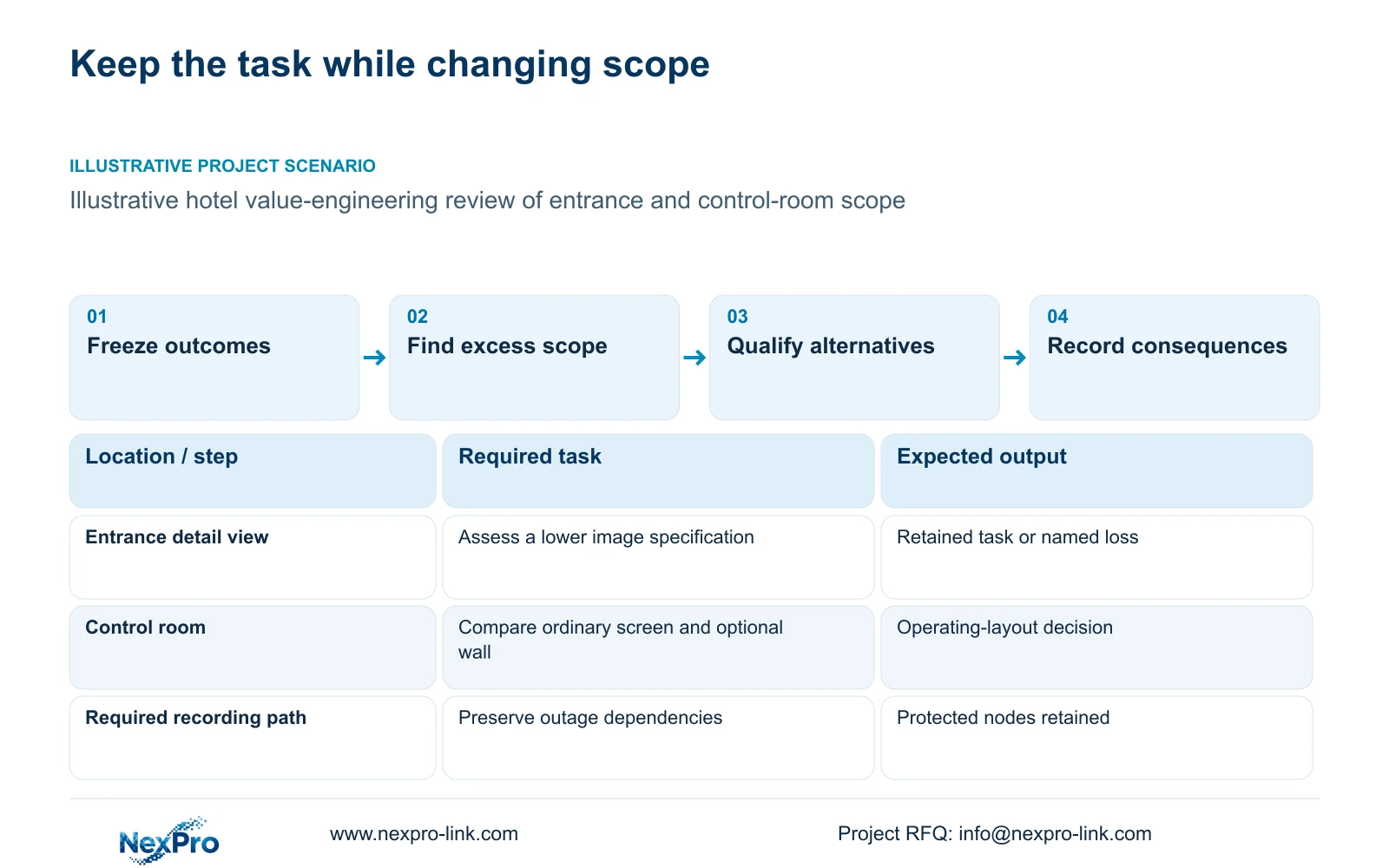
Start cost reduction with duplicated scope, excessive specifications and optional displays. Preserve required public coverage, recording retention and the agreed outage state before pricing alternatives. Reduce a camera specification only when the revised position and recorded image still meet its assigned task. Removing a required UPS or disk changes the service and needs an explicit owner decision.
Write the baseline as operating outcomes. Define the entrance view, the time window available for retrieval and the equipment path that must remain operational during an outage. Include mandatory operator or brand conditions. A cheaper configuration cannot qualify as an equivalent alternative if it loses one of these requirements.
Keep supply boundaries fixed as well. Use the same destination, quantities and installation responsibilities when comparing offers. The illustrative 32-camera reference provides a way to trace cameras through networking, recording and protected power, but its quantities remain teaching inputs. Value engineering must start from the actual project's approved schedule, not from a generic camera count.
| Required task | Given information | Decision still needed |
|---|---|---|
| Retrieve a public entrance event | Position and recording requirement | Acceptable revised image and retrieval workflow |
| Continue recording during an outage | Protected service requested | Required nodes and supported runtime configuration |
Section 02
Identify over-specified positions
Review each camera position against its observation task. A stable overview may permit a simpler lens arrangement than a location requiring field adjustment. A detail task may still require the higher output or an altered position. Record the installation distance, target width and relevant lighting before deciding that resolution or lens capability is excessive.
The supplied lens comparison uses the same 12 m target width with horizontal outputs of 2880 and 3840 pixels. Its geometric budgets are 240 and 320 pixels per meter. These figures explain what a resolution change removes from the planning budget; they do not guarantee identification or night performance. A lower-resolution alternative needs task-based recorded-image assessment.
Review duplicate accessories and unnecessary display scope separately from image changes. An item may be duplicated in pricing, or two devices may perform different necessary tasks. Confirm which case applies before deleting it. Where ordinary operator viewing meets the requirement, retain that arrangement and price a wall as an option. If several staff require a shared continuous view, the display decision needs a different baseline.
Section 03
Compare qualified alternatives
Qualify alternatives against the same task matrix before examining their price. Compare recording modes, interfaces and required environmental conditions, then check installation and support scope. A matching megapixel label or sensor size does not establish equivalent night images, event behavior or reliability. Any required function that remains unconfirmed should stay visible in the comparison.
Use exact models and software versions when evaluating a substitution. ONVIF profiles provide a basis for checking relevant device and client functions, but generic ONVIF support does not establish all audio, event, search or account workflows. If a hotel mandates a platform, retain it unless the approved substitution process permits a different one.
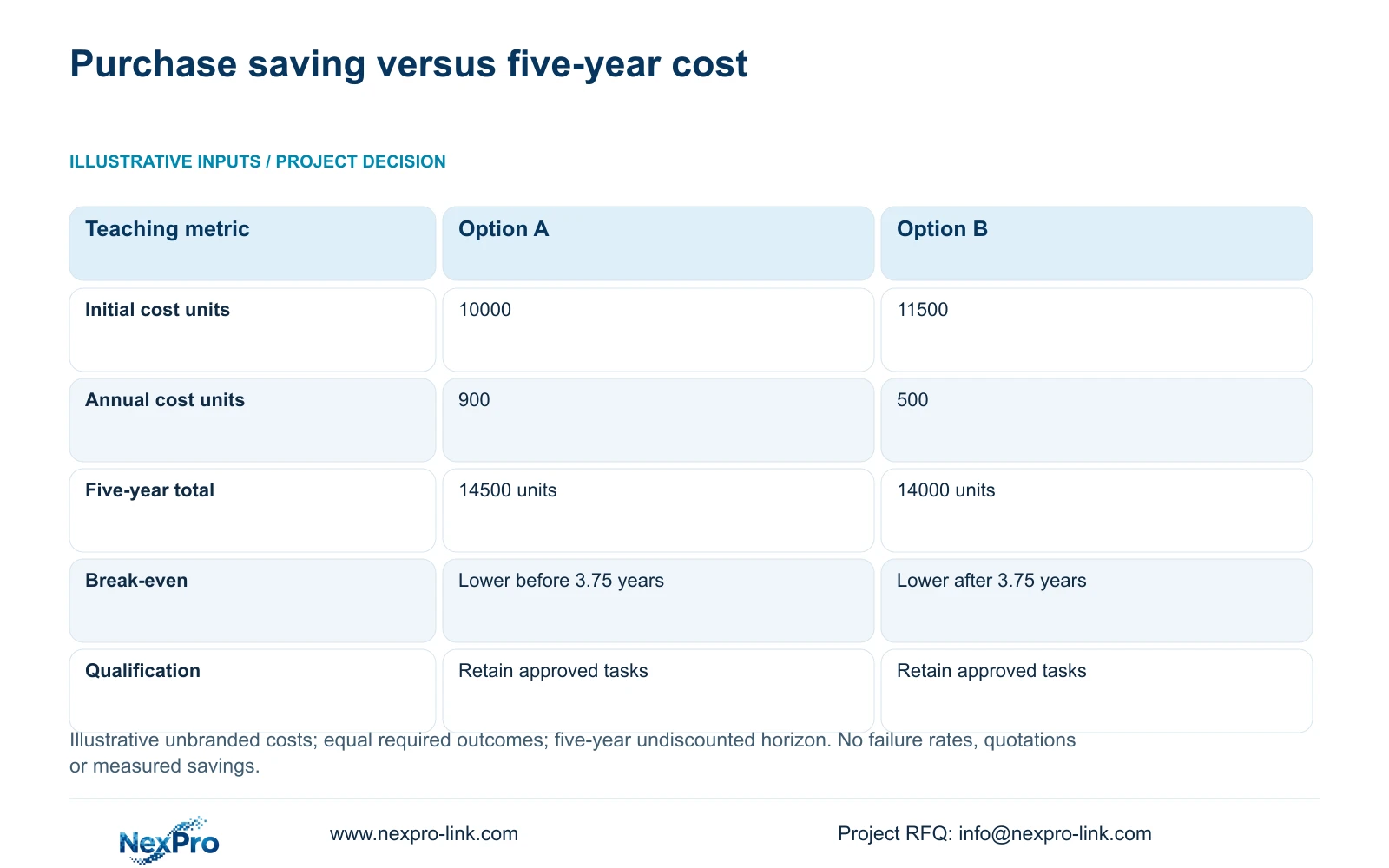
Prepare an economic comparison only after that qualification. The independent teaching model assumes equal required outcomes: A has 10000 initial cost units and 900 annual units; B has 11500 initial units and 500 annual units. These figures are not assigned to NexPro-Link or a competitor. They demonstrate how a lower purchase amount can coexist with a higher modeled ownership cost.
Section 04
Calculate complete cost changes
Show equipment changes separately from installation, freight, taxes and software. If an alternative requires extra configuration or different mounting accessories, include that consequence. Keep reusable equipment and cancelled items visible so the same change does not enter the saving twice. An excluded necessary service needs an evaluated amount or an unresolved status.
For the teaching comparison, five-year total equals initial cost plus five times annual cost. A therefore totals 14500 units and B totals 14000. The 1500-unit initial premium for B is offset by 400 units of assumed annual reduction after 3.75 years. B is 500 units lower at five years under these undiscounted assumptions.
The model supports B when equal outcomes are established, the five-year period is appropriate and the annual inputs are accepted. A is lower before 3.75 years. Changed service fees or installation costs can reverse the result. No brand failure rates, current prices or realized savings are implied, and the model is independent of the full hotel reference.
| Metric / condition | Option A | Option B |
|---|---|---|
| Initial teaching cost | 10000 | 11500 |
| Annual assumed cost | 900 | 500 |
| 5-year undiscounted total | 14500 | 14000 |
| Break-even time | Before 3.75 years: A lower | After 3.75 years: B lower |
| Actual tender ranking | Requires actual scope-matched quotes | Not established by this example |
Section 05
Record lost and retained functions
Maintain a change record that names the original requirement, proposed change and operational consequence. A lens substitution can retain an overview while removing adjustment capability. A display reduction can retain event retrieval while changing shared visibility. Removing required battery capacity can shorten the agreed outage service, even if all cameras work under normal power.
Keep technical and commercial effects separate. If the outcome is retained, show the evidence or assessment still needed to qualify the alternative. If a function is lost, identify it directly and obtain the appropriate scope decision. A feature list marked equivalent is insufficient when the hotel operator must use a different retrieval or export workflow.
Plan acceptance around the affected task. Review recorded moving targets for image changes, replay and export for recording changes, and the complete required path for protected-power changes. Factory checks and hotel site checks address different conditions. Expected passes should not be entered as completed observations, and a limited sample does not establish whole-batch reliability.
| Proposed change | Retained outcome | Condition for acceptance |
|---|---|---|
| Simpler camera specification | Assigned public-zone view | Recorded task remains achievable |
| Ordinary display replaces wall | Authorized viewing and retrieval | Shared continuous wall view is not required |
| Remove required UPS scope | Normal-power operation only | Outage requirement must be explicitly revised |
Section 06
Recommend a defensible option
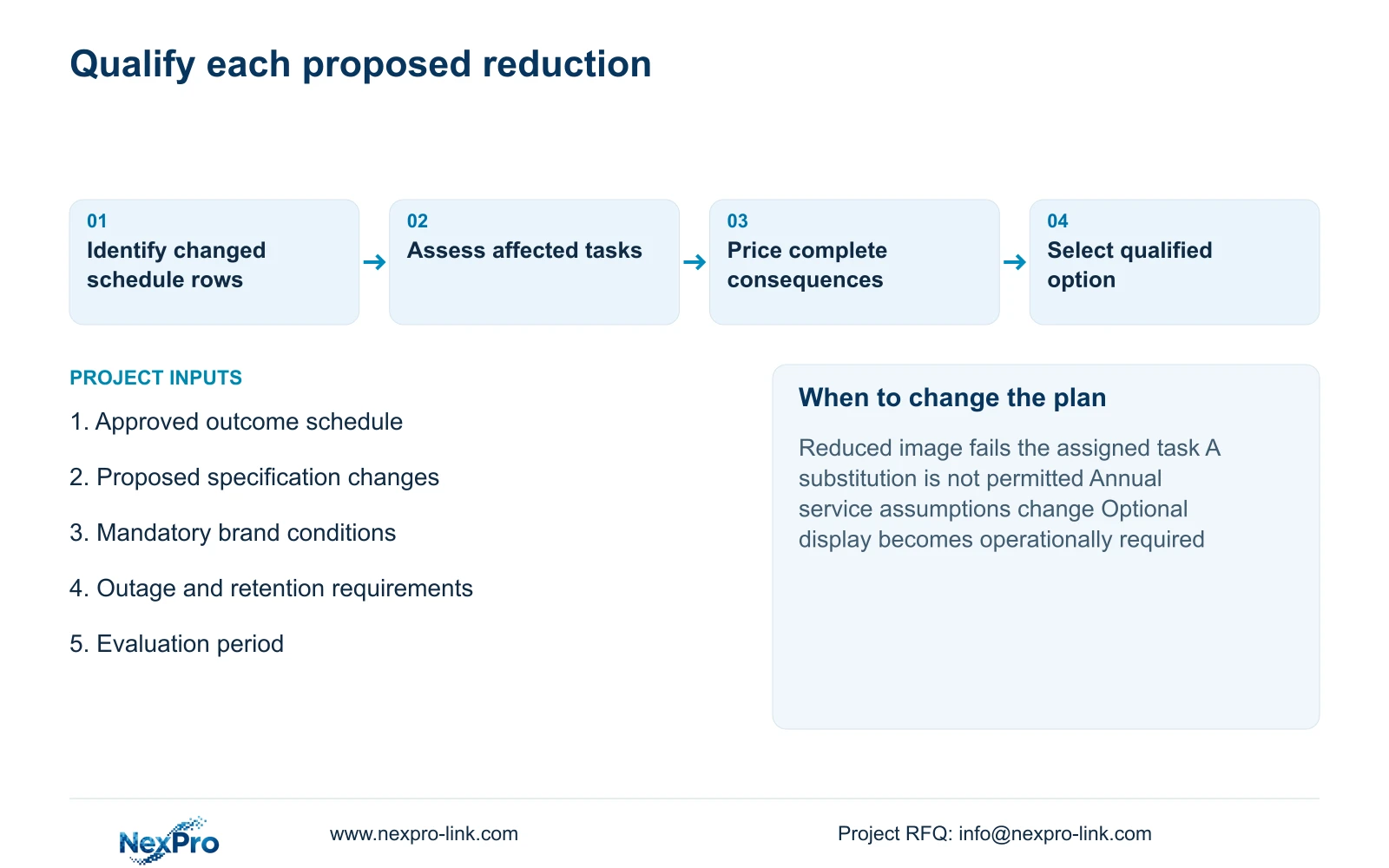
Recommend the lowest evaluated cost among alternatives that retain the approved outcomes and supply boundary. Review duplicated pricing and optional display work first, then position-specific specifications. Retain a higher specification where the reduced option cannot meet the required image, environment or integration task. An unaffordable compliant baseline needs a transparent scope discussion rather than an unexplained substitution.
In the supplied cost model, B is the five-year economic candidate and A is the shorter-period candidate before 3.75 years. Actual qualified quotations must determine the purchasing result. A mandatory platform, changed service terms or unproven task performance can disqualify either option. RICS separates planning and maintenance-cost purposes; this calculation does not replace project measurement or contract rules.
NexPro-Link can discuss model matching, BOQ deviations and coordinated equipment supply, with CCTV manufacturing and other supply responsibilities stated accurately. Send the affected schedule rows, proposed reductions, retained coverage and outage requirements, plus the evaluation period, to info@nexpro-link.com. State whether brand alternatives are permitted and identify the delivery destination so the response can address the actual cost-reduction decision.
Section 07
Buyer questions
Should every camera be reduced to the same specification? No. Group positions by the required observation task. A lower specification at an overview position does not qualify it for an entrance detail task or a different lighting condition.
Can a saving be claimed before the alternative is qualified? Describe it as a proposed cost reduction with outstanding qualification conditions. Keep it outside the confirmed saving until required functions and the complete price boundary are established.
What if the hotel does not permit another brand? Keep the approved brand baseline. Examine permitted model choices, duplicated scope and optional equipment within that boundary; do not present an unauthorized replacement as an equivalent procurement option.
Engineering references
These sources support the general planning principles. Always use the selected product's current datasheet and applicable project standards for final design.