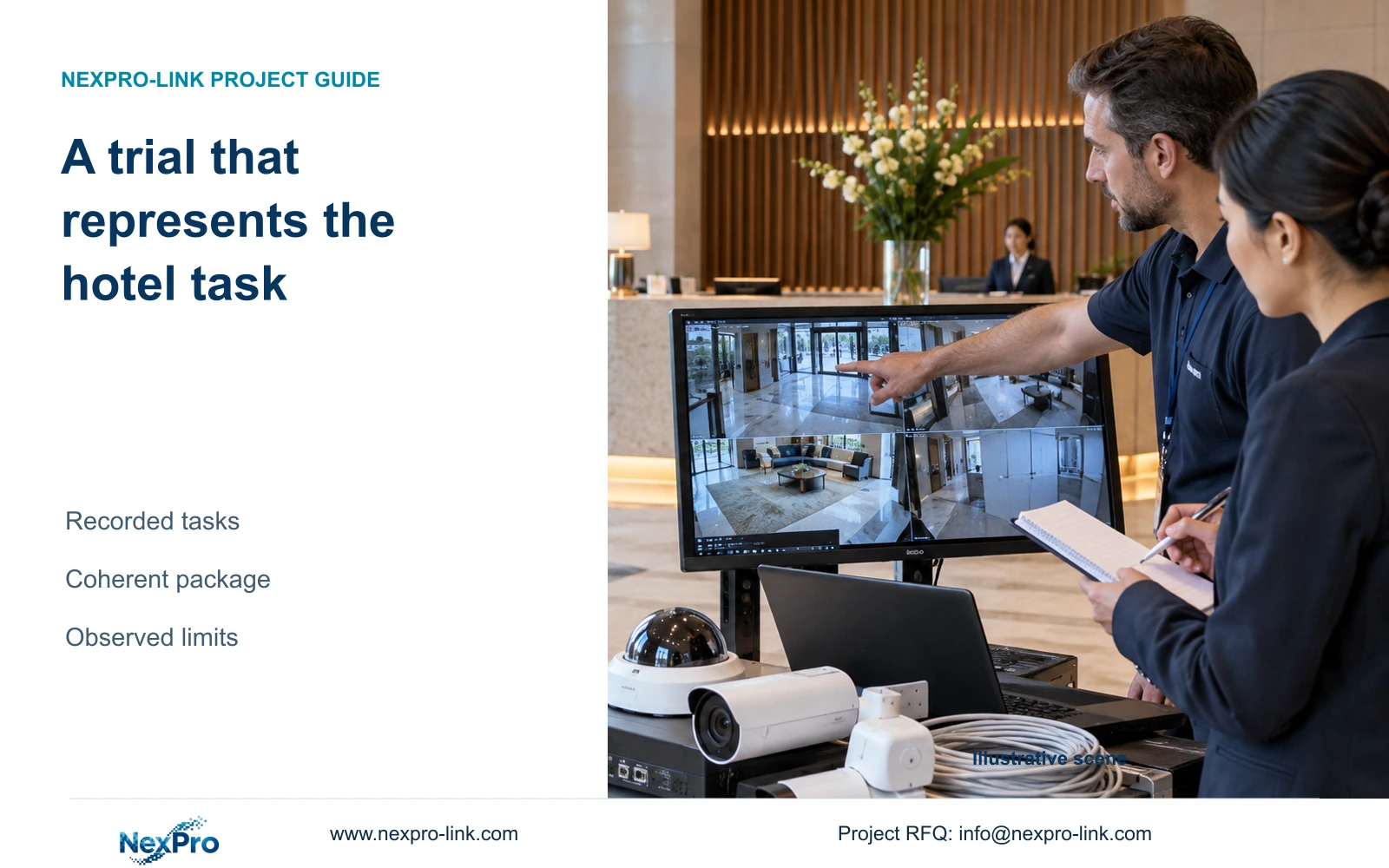
A useful hotel trial order combines representative public-zone views with recording and client tasks. Document the tested configuration and its limits before extending the result to the main equipment order.
Section 01
Select representative hotel tasks
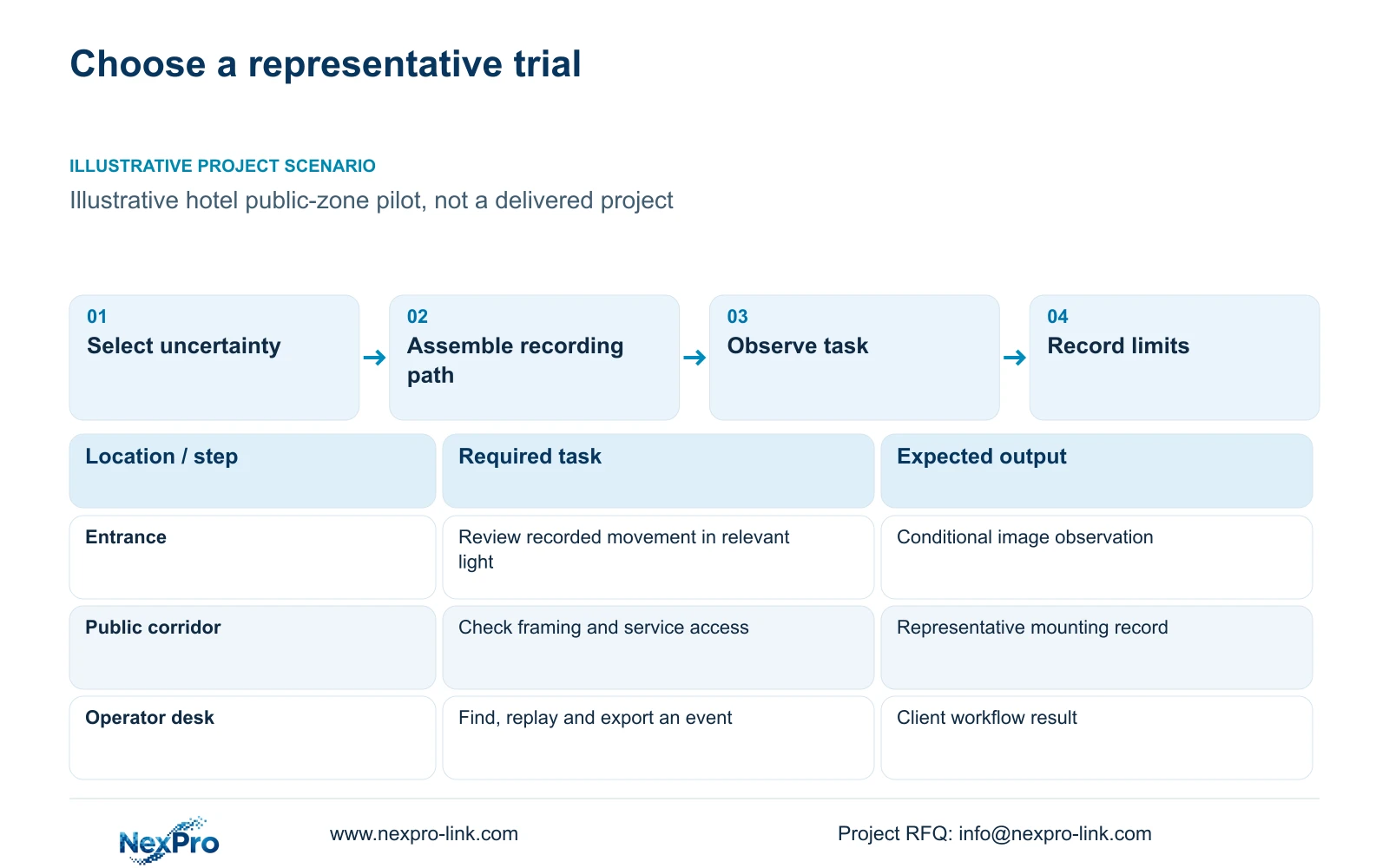
Choose a trial package around a critical entrance view, a typical public corridor and the recording-client workflow when these represent the intended hotel deployment. Expand procurement after the package demonstrates the agreed tasks under recorded conditions. Change the trial scope if the main project introduces a different environment, mandatory platform or operating workload that the initial sample does not represent.
Select views because they expose a purchase uncertainty. An entrance can reveal whether movement and changing light leave useful recorded detail. A public corridor can test the intended framing and installation access. The operator task should include finding an event and exporting the required time window. Random cameras on a bench may leave all of these questions unanswered.
Record the permitted view boundary, target route and relevant lighting before choosing sample hardware. Public-route coverage must avoid unnecessary views into private spaces. Define sample identities and firmware references at the start. A trial can establish observations for a particular configuration, but its expected results must not appear as completed pass marks.
| Required task | Given information | Decision still needed |
|---|---|---|
| Entrance movement | Authorized public route | Recorded detail under relevant lighting |
| Public corridor view | Typical mounting position | Framing, access and privacy boundary |
| Incident retrieval | Defined event time window | Playback and usable export workflow |
Section 02
Choose a coherent camera and recorder set
Include enough of the actual recording path to exercise the selected tasks: camera, required network equipment, recorder, supported storage and the intended client. Identify which accessories belong to the trial and which the hotel or local installer provides. A camera demonstration without its planned recording mode cannot establish the recorder-client combination.
NexPro-BL2812M55-5MP-DIC-AI and NexPro-DM2812M55-5MP-DIC-AI are supplied 5MP motorized-lens candidates. Their PDFs list 2.8 to 12 mm lenses and PoE, but no verified maximum watts. Use the actual sample's supported configuration for the trial. Motorized adjustment is not PTZ, and the Dome series name does not prove an impact rating.
Check recorder channels, input bandwidth, playback and disk support separately. NexPro-NVR4449-4K lists 49 channels and 320 Mbps input, while its summary references 49×5MP/9×4K; this does not prove 49 simultaneous 8MP streams. A small trial may verify a selected camera-recorder mode, but full-scale capacity needs its own calculation. Unresolved fields cannot be replaced with assumptions simply because the sample connects.
| Item | Isolated demonstration | Coherent package | Effect on the hotel task |
|---|---|---|---|
| Camera | Live image only | Planned stream recorded | Allows review of retained footage |
| Client | Any convenient viewer | Intended client and version | Tests the actual retrieval workflow |
| Power | Recorder supplied alone | Required network and camera path included | Exposes the intended outage boundary |
Section 03
Define measurable observations
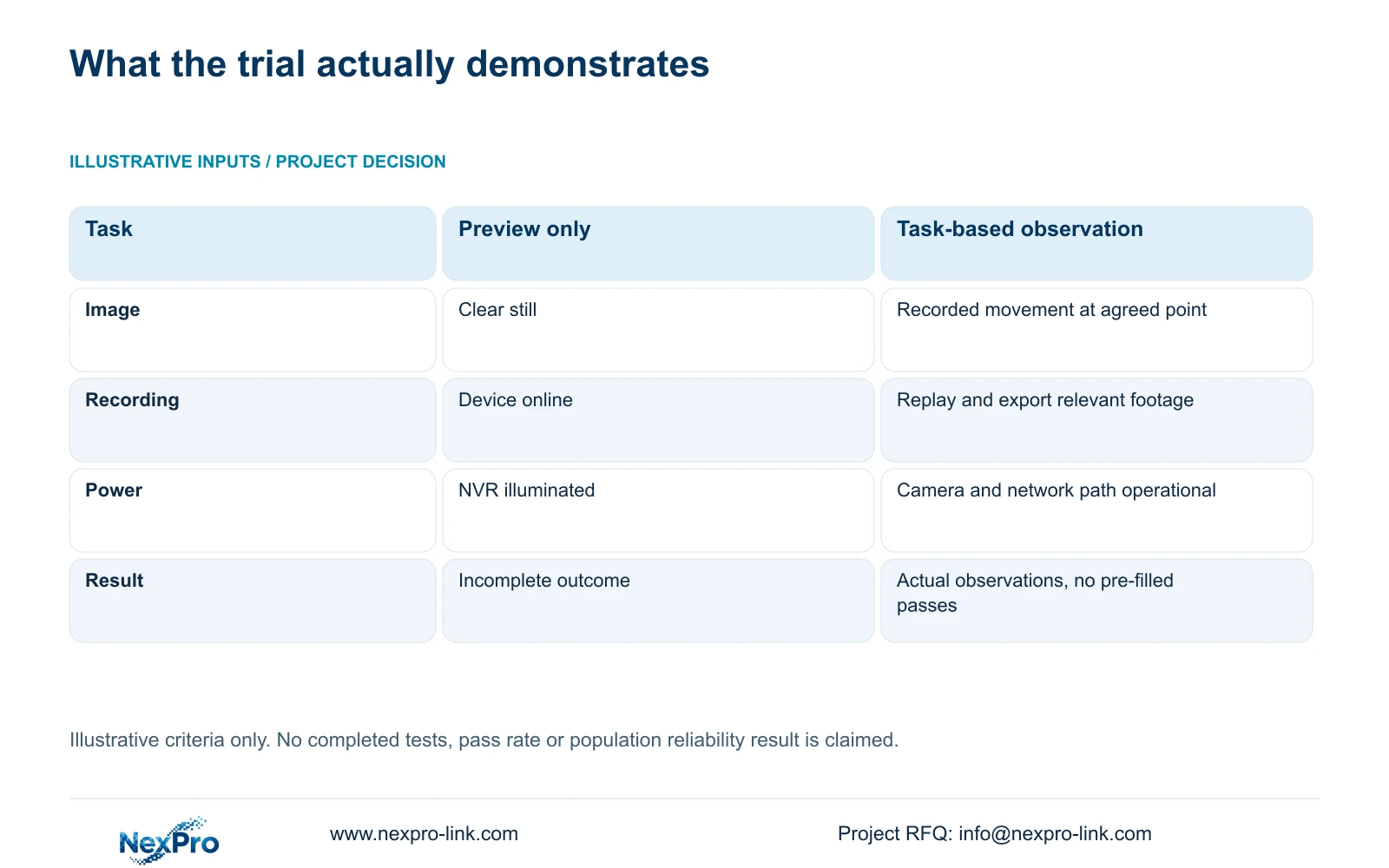
Write each observation as an action, a condition and a result to record. For moving detail, use the agreed target route and review recorded footage at the relevant point. For incident work, locate a specified time interval, replay it and check the exported file. Log configuration changes so different attempts can be compared meaningfully.
The decision matrix below uses illustrative acceptance criteria. It provides no performance scores or measured results. A clear still preview, an online status or an illuminated recorder each answers a limited question. Task-based acceptance examines whether the required operating outcome survives the complete workflow.
Separate factory-reproducible checks from hotel site checks. A factory can exercise a declared configuration, but the hotel's glazing, mounting, cable route and local network conditions need their own observations. A factory acceptance result does not complete site acceptance. Keep failed or inconclusive tasks open, assign the responsible party and repeat the original condition after a correction.
| Trial task | Record with the observation | Main-order limit |
|---|---|---|
| Entrance/corridor image | Point, target movement, lighting, model and settings | Different environment or housing requires scoped review |
| Record/search/export | Stream profile, recorder/client version and authorized task | Sample workload does not prove final concurrency or retention |
| Protected path | Approved condition and all participating powered nodes | Capacity label is not runtime or an observed pass |
| Receiving/documentation | Actual accessories, identity labels, artwork/manual revision | Sample packing does not establish production MOQ |
| Issue closure/scale-up | Correction, repeated condition, result and remaining gaps | A few samples supply no population failure rate |
Section 04
Include packaging and documentation roles
Use the trial to check whether the package can be received and installed without losing equipment identity. Compare the carton contents with the agreed schedule, including accessories and documentation. A location label can help installation, but it should sit alongside the real model and serial information required for support and replacement.
For authorized OEM work, identify the artwork version and distinguish permanent branding from variable floor or location fields. NexPro-Link's OEM scope can include labels, manuals and project packing as agreed. Hardware branding does not confer the right to rename third-party software. Keep the actual client and product identities in the records even when the exterior carries customer branding.
The acceptance matrix's requirement to record observations also applies to packing. Note missing accessories, ambiguous labels and mismatched documents as specific receiving tasks. If the main order needs floor-based cartons, demonstrate that mapping on the sample package before scaling it. Request actual setup, marking and packing costs; a trial quantity does not establish a production MOQ or a universal process price.
Section 05
Compare pilot scope with future scale
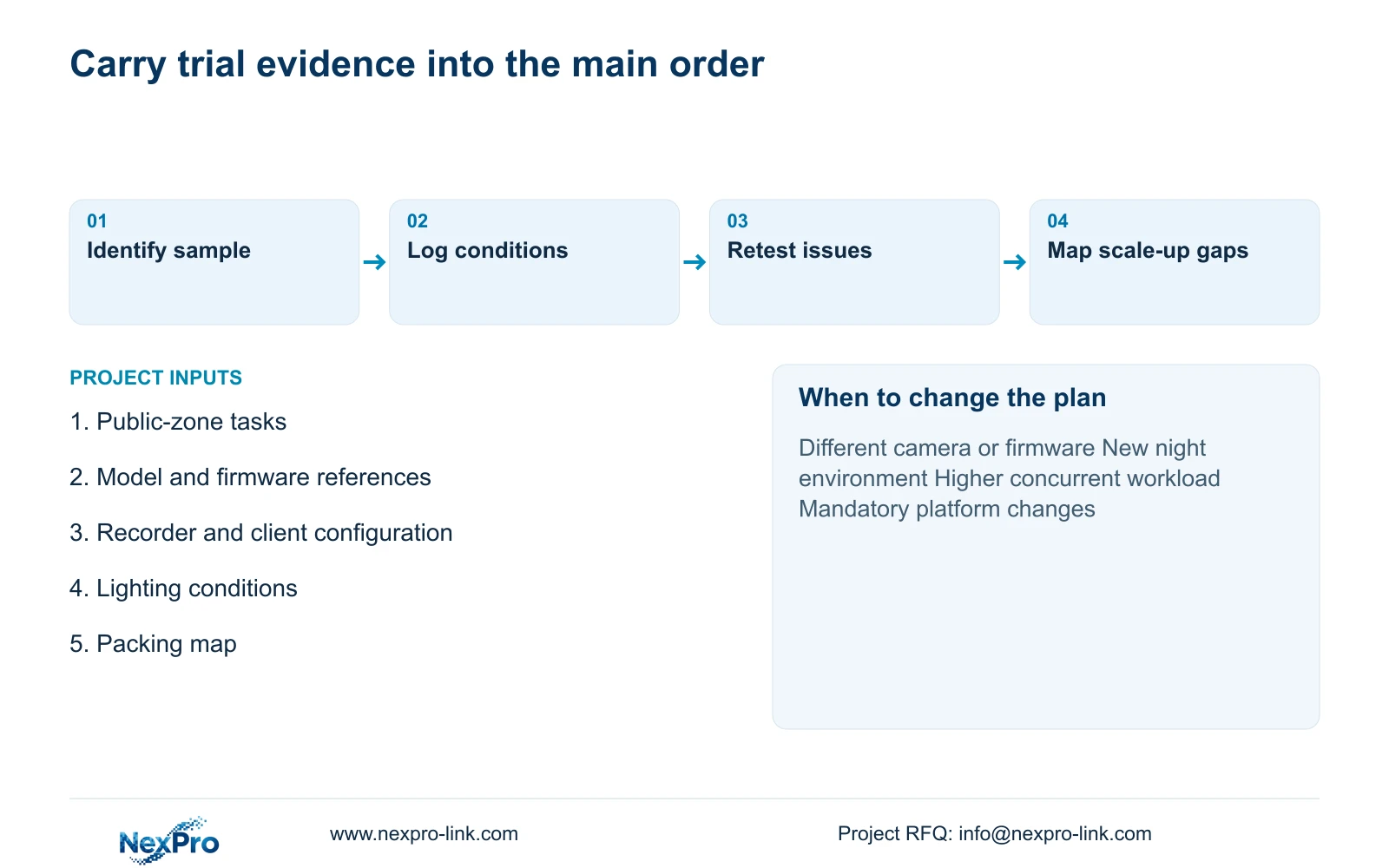
Create a scale-up record showing which tasks the pilot represents and which new loads the main order adds. A successful retrieval exercise with the sample streams does not establish full concurrent viewing, recorder throughput or the final retention period. A small sample also supplies no defensible population failure rate or lifetime reliability claim.
CASE01 is an independent illustrative reference for a larger system. Its assumed 32 cameras at 4 Mbps produce 128 Mbps input and 41.472 TB of video over 30 days of continuous recording. Its 20% usable-space reserve increases the required usable capacity to 51.84 TB. Keep these planning figures separate from pilot observations and recalculate them for the actual main-order schedule.
The extra work worth buying depends on the unresolved task. If the intended deployment introduces night lighting unlike the pilot, extend the observation scope. If it adds simultaneous client activity, define that workload and test the supported configuration. Cosmetic sample changes do not substitute for these tasks. Price any additional equipment and site work separately, and avoid repeating observations that already address an unchanged configuration.
Section 06
Record what the trial does and does not establish
Prepare the trial record around actual equipment identities, configuration, conditions and observed outcomes. State unresolved functions alongside successful ones. An administrative closure should follow a repeated operating task that demonstrates the correction; a changed status label alone provides no evidence that useful recording or export has been restored.
Recommend a representative integrated package before a broader order when its tasks match the planned hotel system. Reopen the evaluation if the camera family, firmware, platform or operating conditions change materially. The buyer's registration and order decisions remain independent of the trial result, and a limited observation cannot support a claim that every future unit or site condition has been verified.
Send the intended public-zone tasks, preliminary camera-recorder combination, client or platform requirement and available observation conditions to info@nexpro-link.com. Include the destination and any sample-packing requirement. NexPro-Link can discuss model matching and coordinated supply boundaries through hotel project equipment support. Do not send guest footage or account credentials as initial inquiry material.
Section 07
Buyer questions
Can a few successful samples justify the complete hotel order? They can support the tested configuration and representative tasks. Full-system throughput, retention and new site conditions remain separate checks. Document those gaps before expanding the order.
Must the trial use the final client software? Use the intended client and version where retrieval or export is part of the purchase decision. A different viewer may demonstrate an image while leaving the required operating workflow untested.
What evidence closes a failed trial task? Record the correction and repeat the original task under comparable conditions. Keep the new configuration and result with the original issue so the buyer can see what changed.
Engineering references
These sources support the general planning principles. Always use the selected product's current datasheet and applicable project standards for final design.