Approve a representative public-zone operating result and record the configuration that produced it. Copy stable details while checking each location's lighting and view.
Section 01
Choose a representative public-zone mock-up
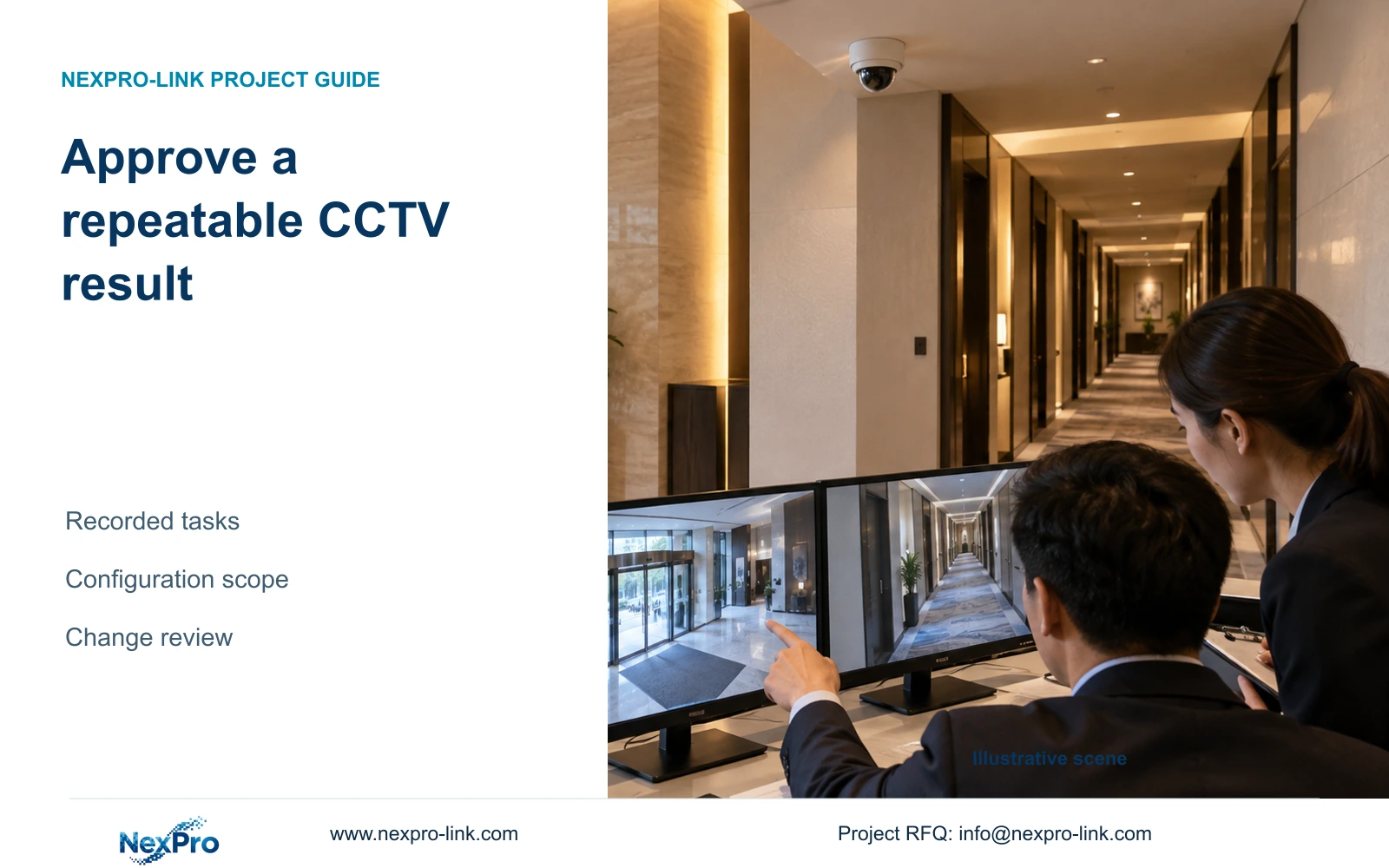
Approve a recorded operating result before releasing repeat CCTV installations, and freeze the configuration and conditions that produced it. Copy stable equipment and mounting details only within that approved scope. Require renewed review when another location changes the observation task, lighting, interface or protected power path.
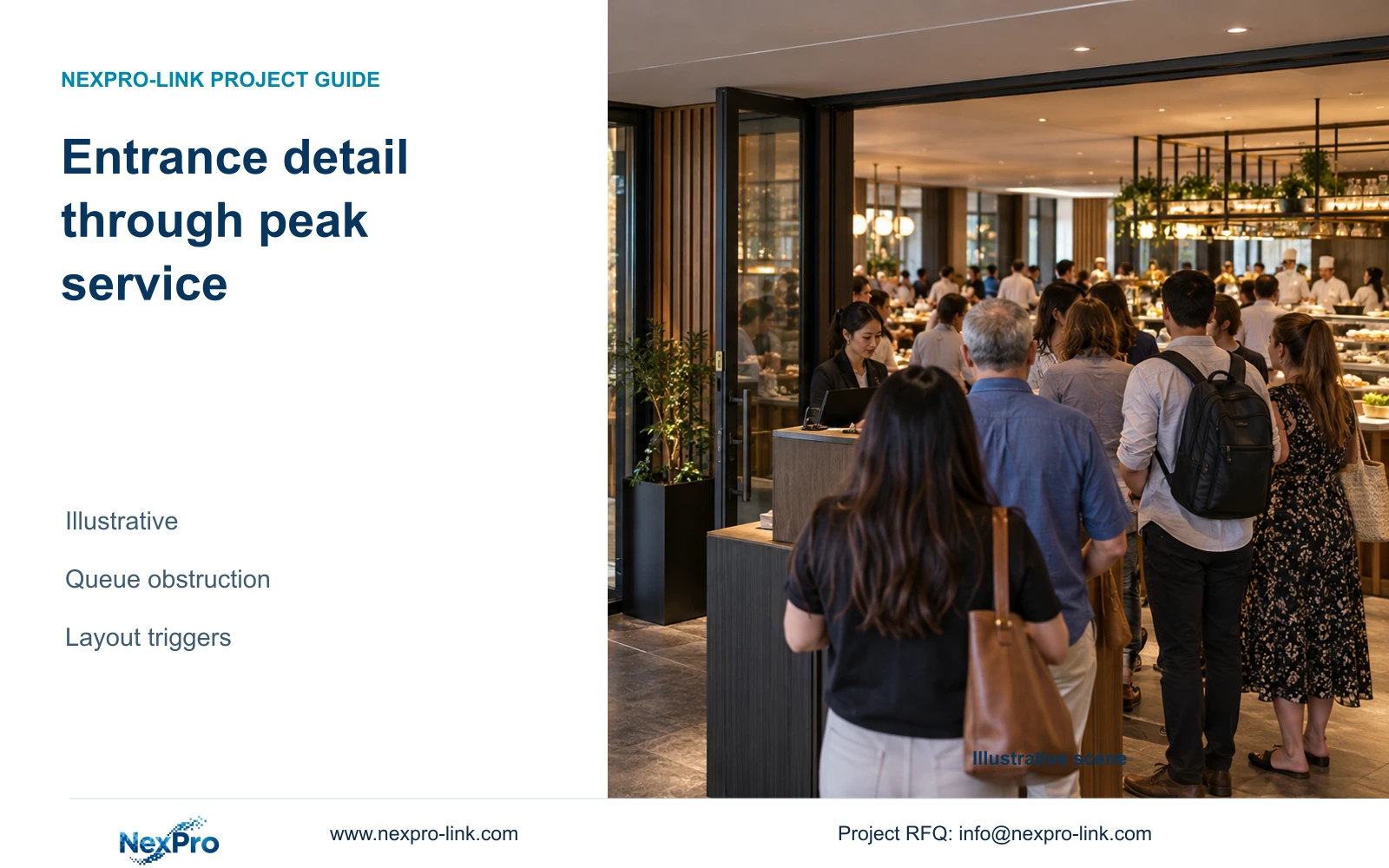
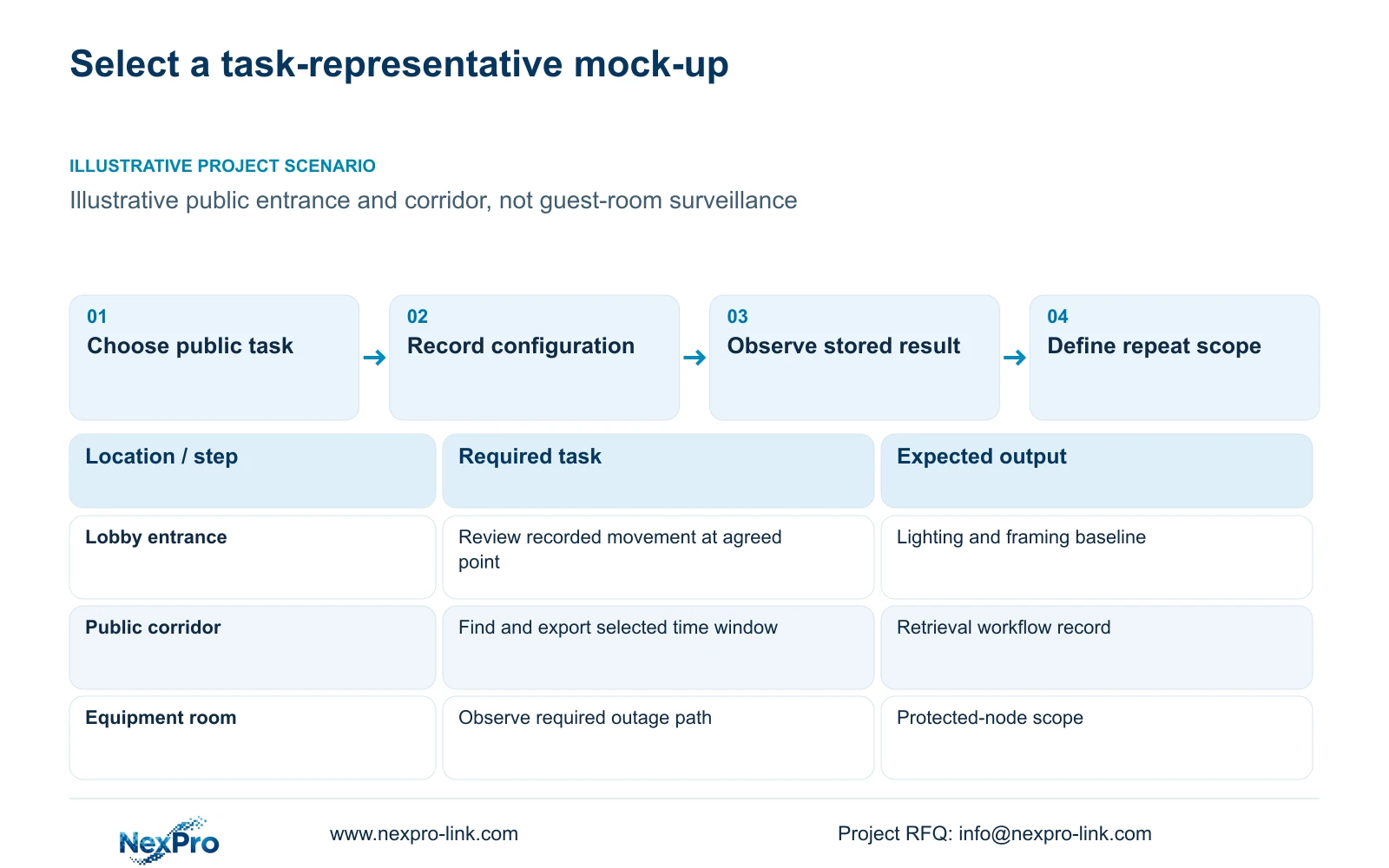
Choose a public area that represents the intended task, such as a lobby entrance or corridor endpoint. State the route a target will follow, the detail needed at the agreed observation point and the lighting conditions to examine. A convenient display position may show the equipment attractively without representing its intended work.
A sample-room programme can coordinate finishes and hardware appearance, but does not justify surveillance inside a guest room. Keep the CCTV mock-up within appropriate public-zone boundaries. Where one sample cannot represent entrance backlighting and a different corridor condition, identify the additional task separately. The result of one observed configuration supports that scope, not every hotel location.
| Required task | Given information | Decision still needed |
|---|---|---|
| Entrance movement | Public target route identified | Relevant lighting and observation point |
| Corridor incident retrieval | Proposed camera position | Recorded time window and authorized workflow |
| Outage recording | Protected path proposed | Which camera and network nodes must continue |
Section 02
Record configuration and viewing tasks
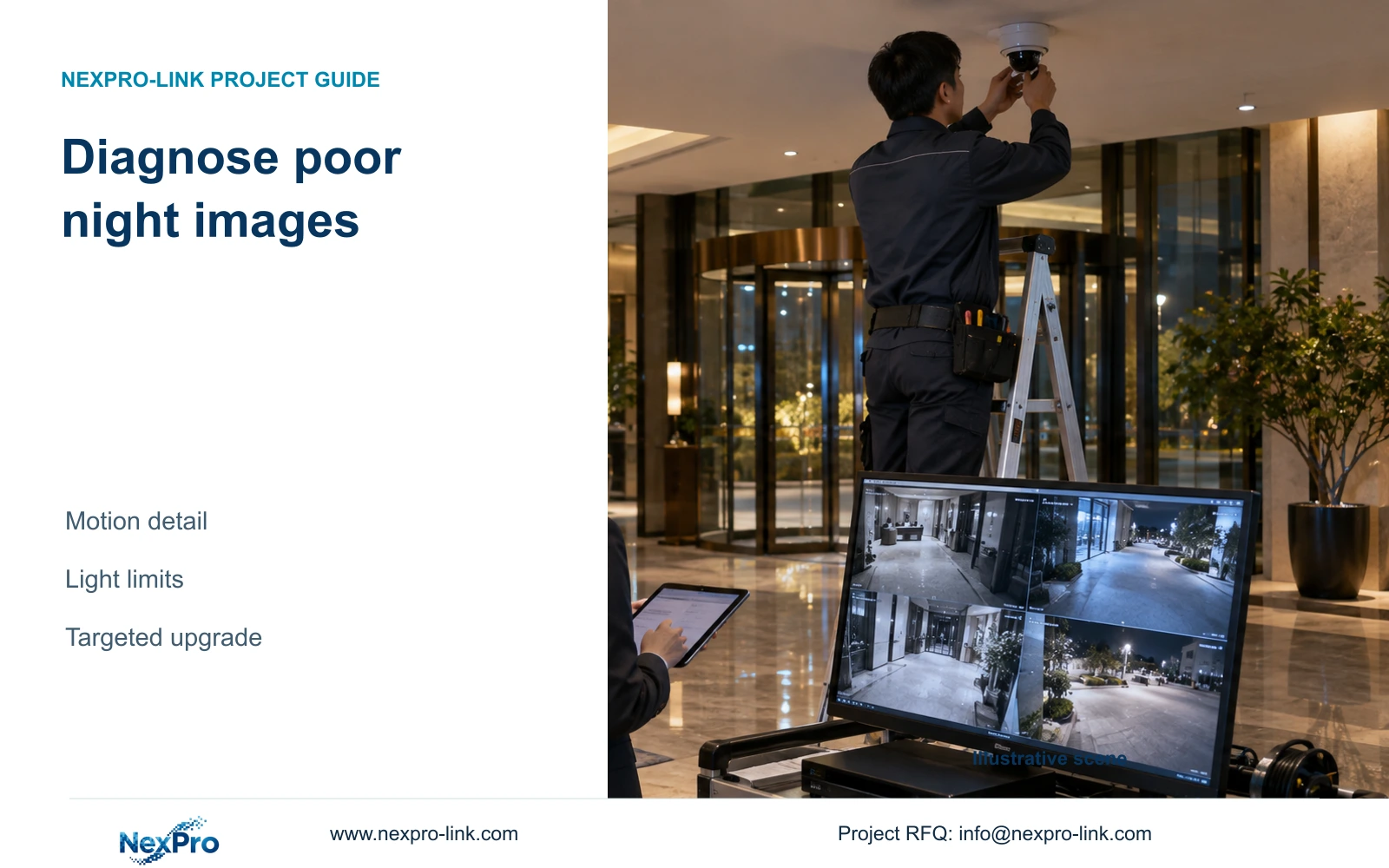
Record the exact camera model, mounting arrangement and position reference. Include lens framing, firmware and relevant image settings, together with the lighting state used for the observation. Associate the recorder, client and network interfaces with the same record so the approved result can be traced to a complete setup.
The supplied PDFs list NexPro-BL2812M55-5MP-DIC-AI and NexPro-DM2812M55-5MP-DIC-AI as 5MP-series candidates with 2.8-12 mm motorized lenses. The stated 5MP modes include 2880×1620 horizontal and vertical output. Those fields identify equipment capabilities; they do not establish the field of view at a particular installation, night movement detail or a verified maximum power draw.
Write viewing and retrieval tasks separately from recording settings. Record whether the operator used a live overview, enlarged event view or playback, and identify the authorized export workflow examined. A successful client preview does not establish the stored result. Keep credentials outside the mock-up record and use only the hotel-approved access arrangements.
| Item | Appearance-only record | Task-based record | Effect |
|---|---|---|---|
| Camera | Housing photograph | Exact model and firmware | Repeat equipment can be identified |
| Mounting | General ceiling appearance | Position, bracket and framing reference | Installation scope is reproducible |
| Viewing | Live display screenshot | Recorded task and client configuration | Operating result can be checked |
Section 03
Distinguish appearance from performance
Record appearance acceptance as its own decision. The hotel may accept housing visibility or the bracket's relationship to the ceiling while technical tasks remain unresolved. Do not let a finish approval automatically authorize a different lens, firmware or recording profile merely because the replacement looks the same.
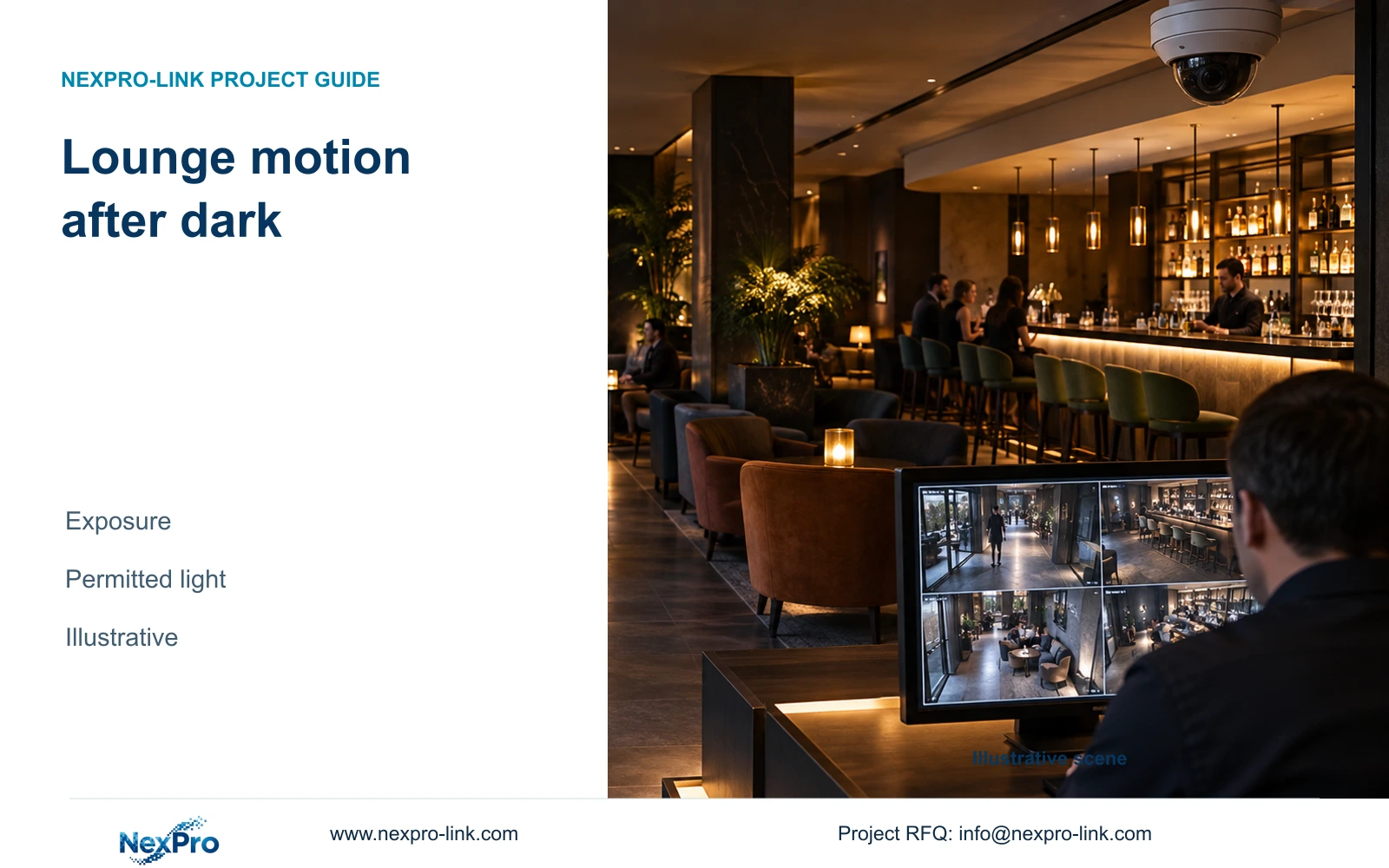
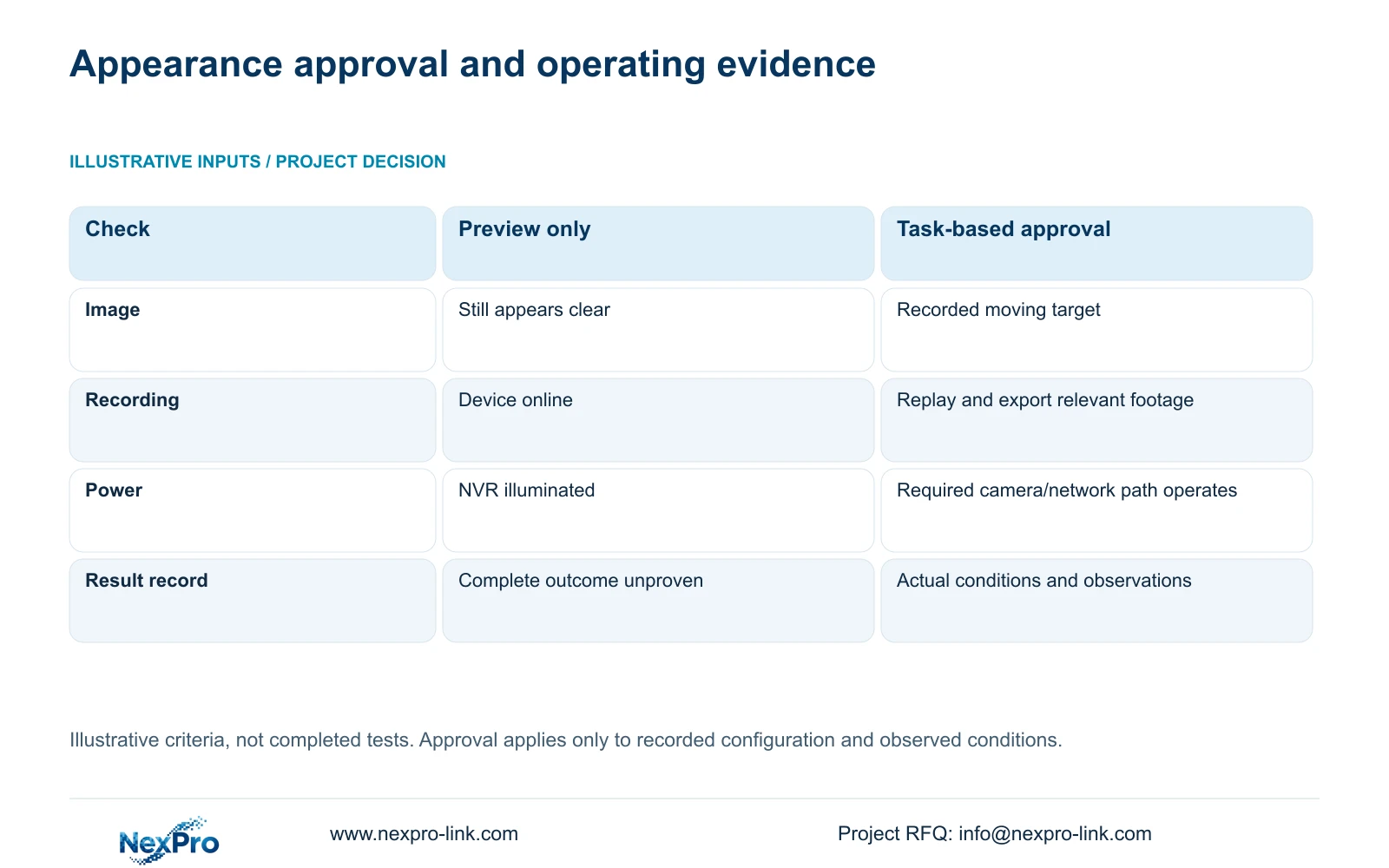
Use the quality comparison below to define the operating evidence required. Review a recorded moving target at the agreed point, then retrieve and export the relevant footage. For the selected outage task, observe the required camera and network path, rather than relying on the NVR's illuminated front panel.
These are illustrative acceptance criteria, not test results for the named cameras or any delivered hotel. No pass marks, failure percentages or performance scores are supplied. If the mock-up identifies an unresolved task, record it against the affected configuration and responsible party. An attractive still image can remain useful as an appearance record while motion performance awaits observation.
| Review item | Observation and record | Limit on repeating approval |
|---|---|---|
| Appearance | Selected body, mount, visible route and agreed location | Different mounting/access conditions need separate review |
| Image task | Recorded moving subject at the named plane, lighting and settings | A static preview does not approve night or moving detail |
| Incident workflow | Authorized search, replay and export on the actual chain | Another platform or configuration is not automatically covered |
| Protected operation | Approved observation across the required camera/network/recorder path | Do not infer runtime or every-zone protection from one sample |
| Repeatability | Frozen model, firmware, lens, position and relevant settings | Identify changed conditions that trigger another test |
Section 04
Compare repeatable and site-specific settings
Separate details that can repeat from those that require a location check. Exact equipment identity and an accepted bracket arrangement can form a repeat baseline where the installation conditions match. Final framing, the permitted view and the relevant lighting conditions remain tied to the actual target plane and position.
A motorized lens permits adjustment within its supported range; it does not turn the camera into a PTZ or guarantee equivalent detail at different distances. Document adjustments against the same observation task. If a wider view reduces the required detail or captures an unnecessary private area, the location no longer matches the approved result.
CASE06 illustrates first-phase public areas followed by later upper-floor and conference work. Its phased quantities do not make every later location equivalent to the first mock-up. Use the recorded approval to identify which later positions match and which need separate checks. Factory-reproducible configuration work can support preparation, while hotel-specific lighting and installed network conditions remain site tasks.
Section 05
Identify changes needing renewed review
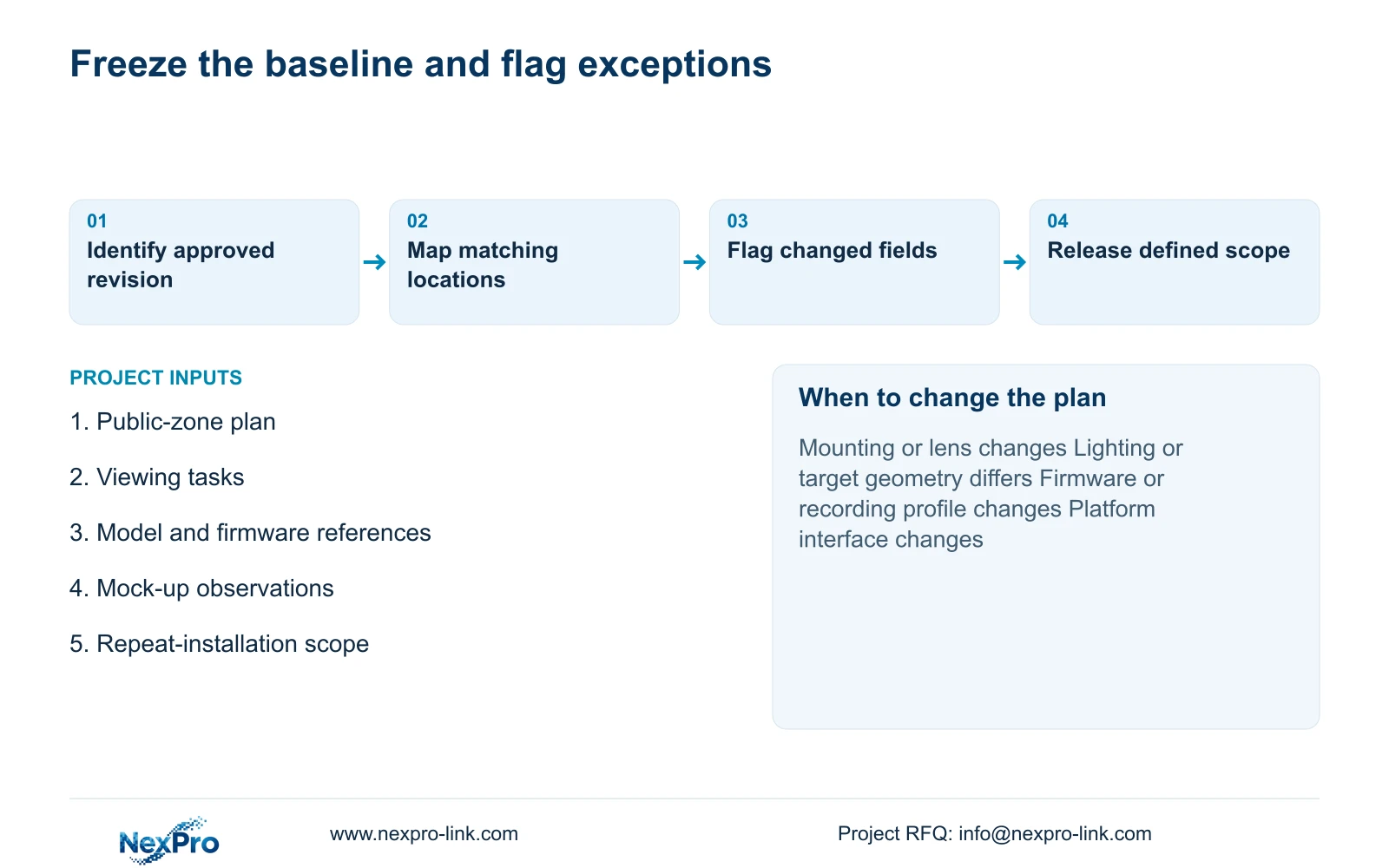
Renew review when a change affects the basis of the approved operating result. Examples include another camera model, a changed bracket or mounting height, a different firmware version with relevant behaviour changes, and altered lighting or target geometry. A revised recording profile also needs examination when it changes the footage used to judge the task.
Keep a proportionate change record. Identify the original configuration, the changed field and the observation needed to resolve its effect. Repeat the affected task under comparable conditions after correction. An administrative closure or a revised catalogue does not demonstrate that the original problem has been resolved.
Before purchasing the changed scope, distinguish reusable items, cancelled items and remaining installation work. Obtain the applicable approval for the revised version and identify actual cost or programme effects. The supplied evidence does not support an assumption that substitution, repacking or a late interface change is free. If an operator requirement prohibits alternatives, retain it as a release condition.
| Retained outcome | Extra scope | Renewed review needed when | Counter-condition |
|---|---|---|---|
| Recorded entrance detail | Repeat relevant motion observation | Lens, position or lighting changes | No affected technical field changes |
| Correct installation appearance | Bracket or finish review | Mounting interface changes | Accepted arrangement is repeated unchanged |
| Supported retrieval workflow | Interface and client task check | Recorder, firmware or platform changes | Same supported configuration is retained |
Section 06
Release the approved configuration scope
Release a revision that identifies the approved equipment, installation arrangement and observed tasks. State the locations or conditions to which it applies, alongside outstanding site checks. Link that revision to the camera schedule, accessory allocation and relevant technical submission. This gives procurement a defined configuration to order without implying broader acceptance.
Keep approval authority separate from the mock-up record. Appearance acceptance, technical model approval and purchase authorization can belong to different parties. NexPro-Link can support model matching, BOQ documentation and a scoped equipment package. Its CCTV manufacturing scope and coordinated supporting-category supply should be stated separately; a multi-category order does not prove native interoperability.
Recommend repeating the recorded configuration where task and conditions match, with location-specific framing verified. Use another representative check where lighting, mounting or interfaces differ materially. Send the public-zone plan, required viewing tasks, proposed model and firmware references, mock-up observations and repeat-installation scope to info@nexpro-link.com. Highlight the unresolved decision so the hotel project and BOQ support discussion can address that scope.
Section 07
Buyer questions
Does approving the housing approve the complete camera system? Only if the recorded decision expressly includes the technical tasks and configuration. Otherwise, keep appearance approval separate from recorded image, retrieval and outage observations, with each unresolved task visible.
Must every floor repeat the entire mock-up? Use the approved baseline for matching conditions and check the fields that vary by location. A materially different observation task, lighting condition or interface needs a representative review. The supplied evidence does not define a universal sample percentage.
Can ONVIF support justify substituting a different camera? ONVIF Profiles provide a basis for checking device and client functions. They do not prove every event, audio, retrieval or account workflow is interchangeable. Verify the affected tasks against the exact proposed configuration before accepting substitution.
Engineering references
These sources support the general planning principles. Always use the selected product's current datasheet and applicable project standards for final design.