Judge hotel security support through documented diagnosis and restored operating tasks. Separate acknowledgement, resolution and causes outside the supplier's scope.
Section 01
Define the service responsibilities being evaluated
Use an event-based service scorecard when repeat hotel orders depend on reliable diagnosis, accurate documents and restored operating tasks. A fast acknowledgement is useful, but it cannot establish resolution. Evaluate each supplier against its agreed responsibilities, and change the next order when documented events reveal an unresolved service boundary or a recurring configuration problem.
Begin with the actual order scope. Equipment supply, remote technical guidance and local commissioning are separate responsibilities. NexPro-Link's hotel and BOQ support records describe coordinated equipment and model-matching assistance; they do not establish that every supplied category is manufactured in-house or that local installation is included. Score the work that was actually agreed.
The supplied warranty record states a 24-month limited hardware baseline from receipt for applicable main equipment, subject to controlling written terms. Accessory and OEM scope may differ. This term does not establish a response deadline, free travel or unlimited repair. Keep promised service, observed support and commercial remedy in separate fields so the scorecard does not reward an invented commitment.
| Required task | Given information | Decision still needed |
|---|---|---|
| Diagnose failed retrieval | Recorder identity and agreed support scope | Supplier diagnostic action and local execution owner |
| Restore required outage recording | Approved protection target | Responsibility for remote-node power correction |
Section 02
Choose measures that show useful support
Record whether the first substantive response identifies the affected task and provides a usable next action. An acknowledgement and a diagnostic instruction are different observations. Keep timestamps where available, but also record the information supplied and whether the action matched the reported configuration. Speed alone can conceal repeated requests that do not advance the problem.
Measure diagnosis through the quality of its connection to the symptom. Record the proposed cause, evidence requested and responsibility assigned, with unresolved assumptions visible. For document accuracy, compare the response with the controlling model, version and order scope. A technically precise answer about a different configuration should not count as a useful solution for the hotel.
Evaluate repeat-configuration stability through traceable records. Compare what was approved, ordered and supplied, including authorized substitutions. An unchanged product label does not establish unchanged operating behavior. Where no service event or repeat order has occurred, mark the measure unobserved. Do not fill it with a forecast score or a manufacturer's general reputation.
| Item | Weak measure | Useful measure | Effect on the hotel task |
|---|---|---|---|
| Response | Reply received | Relevant diagnostic action provided | Moves the reported task toward restoration |
| Documents | Files attached | Model and scope match the controlling record | Reduces configuration uncertainty |
| Closure | Ticket closed | Original operating task successfully retested | Establishes the observed resolution |
Section 03
Separate acknowledgement, diagnosis and restoration
Keep the event's milestones distinct. A supplier may acknowledge the issue before enough information is available to diagnose it. Diagnosis can be complete while local work or approved equipment remains outstanding. Restoration requires an observation of the original operating task under relevant conditions. These stages show progress without treating an email as an operating result.
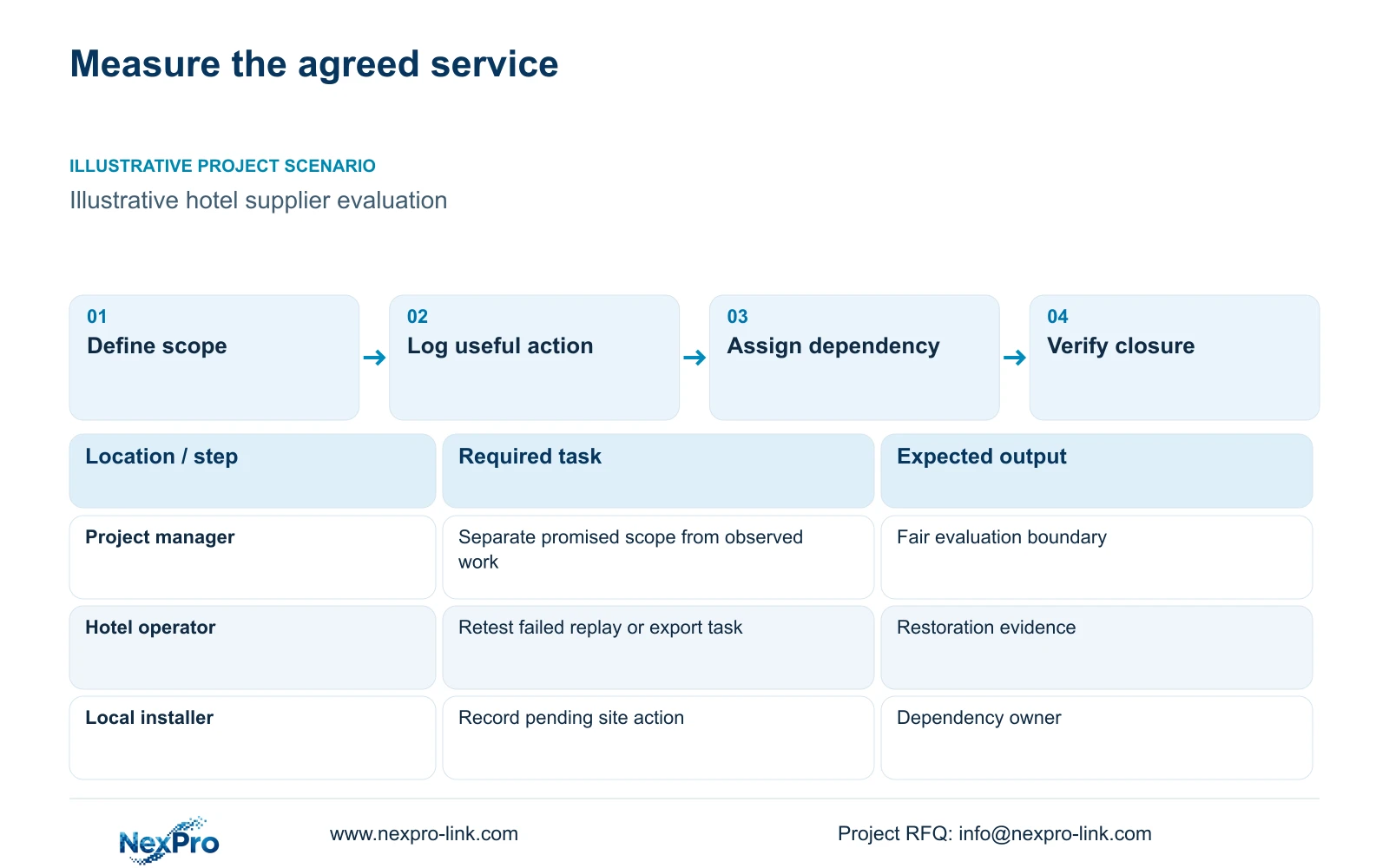
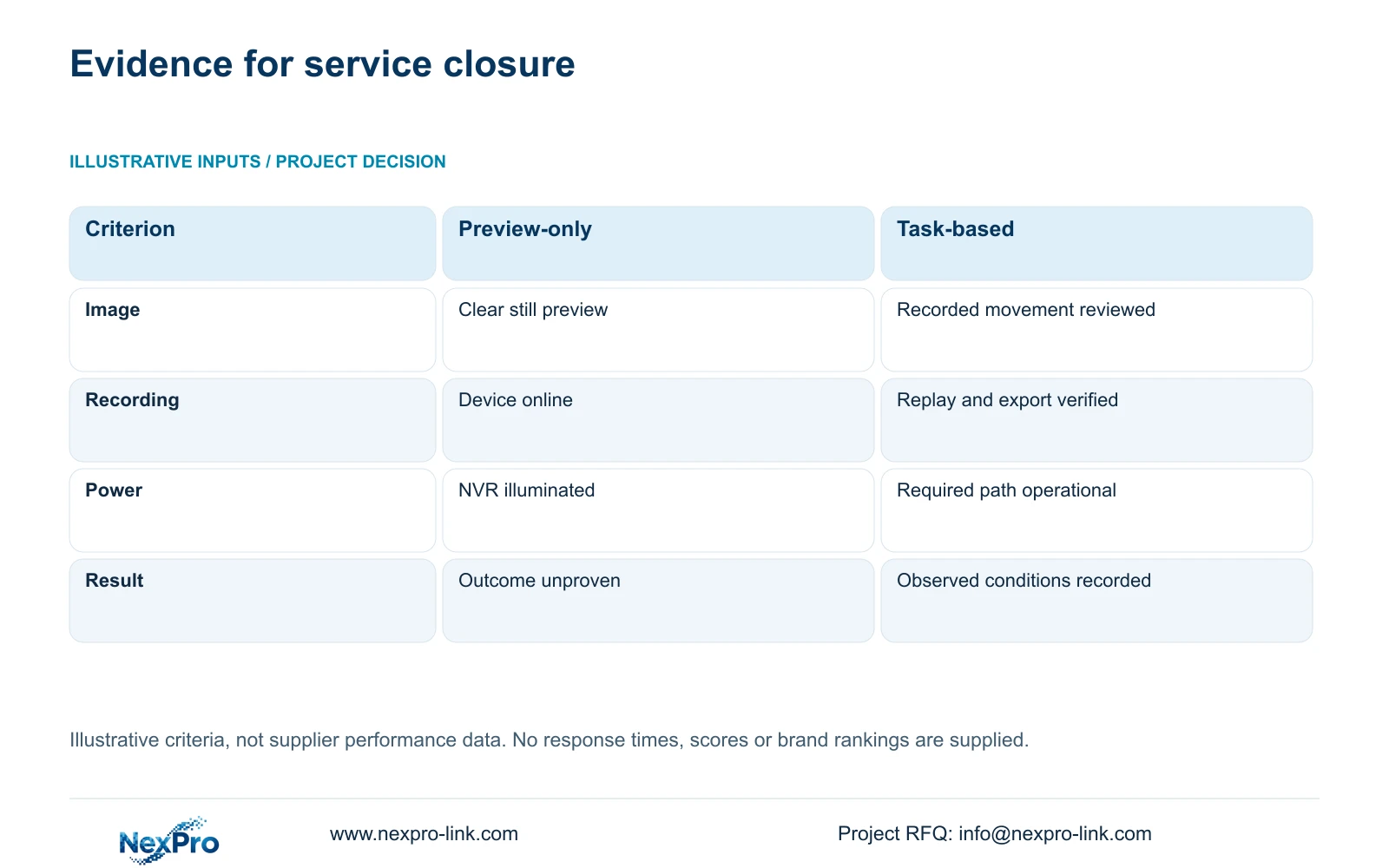
The retained figure shows why a task observation is stronger than a menu demonstration, not how fast a supplier responded. Record the event milestones below separately. Compare only events with sufficiently similar scope and inputs; leave durations or scores unavailable where no dated event evidence exists.
For an image issue, a factory check can establish behavior under its recorded conditions while the hotel still needs a site observation. For retrieval or power issues, the complete configuration and dependencies matter. Keep the model, firmware and observation scope with the result. A passing small sample cannot establish fleet reliability or resolve every site condition.
| Milestone | Required event record | Do not treat as equivalent |
|---|---|---|
| Acknowledgment | Received time and relevant responder | Diagnosis or restoration |
| Useful next action | Requested inputs and executable guidance | A generic reply |
| Diagnosis | Supported cause, device/configuration and unresolved evidence | Confirmed local repair |
| Restoration | Responsible local work and repeat task observation | Parts dispatch or email closure |
| Waiting interval | Input, access or approval outstanding; responsible party | Supplier-controlled delay without supporting evidence |
| Comparison basis | Same service scope and event conditions | Brand-wide reliability or a fleet failure rate |
Section 04
Record site dependencies without losing accountability
Record causes outside the supplier's control with the same care as equipment defects. Hotel lighting, installed cable routes, network access and local power can affect the task. A claim that the problem is external needs a documented basis and a responsible next action. Do not remove the unresolved outcome from the record simply because responsibility crosses an organizational boundary.
Separate elapsed time from cause attribution. If access approval or local installation is pending, retain that dependency alongside the supplier's completed and outstanding actions. If the supplier's document is inaccurate, record that separately even when another site problem also exists. This prevents all delay being assigned to one party or all responsibility being dismissed as external.
The illustrative CASE01 reference shows why such separation matters: a recorder and optional display are different dependencies, while required remote network nodes need their own power scope. It is not evidence of a real service event. Use the actual hotel's task and topology to identify the responsible action; do not import the reference case's loads or equipment totals into the scorecard.
Section 05
Compare service outcomes across comparable events
Review real events by task and impact before combining observations. A request for a datasheet and a shared recording outage require different support effort. Keep open issues visible and note where the local team has not yet performed the agreed retest. An event history is more informative when the reader can see what each result actually represents.
If the hotel uses a numerical score, define its criteria before evaluating suppliers and retain the evidence behind each entry. Unobserved categories should remain identifiable rather than receiving favorable assumed values. This article supplies no weighting or benchmark score. Any project scoring method should preserve differences in event scope and the agreed service responsibility.
Look for recurring document errors, incompatible substitutions or unresolved operating tasks across actual events. These can justify a targeted change to the next purchase. A small collection of tickets does not establish a general brand failure rate, lifetime performance or global ranking. Keep conclusions proportional to the observed configuration and period.
| Retained outcome | Extra scope | When worth buying | Counter-condition |
|---|---|---|---|
| Verified local restoration | Defined local service arrangement | Remote support cannot execute required site work | Existing local responsibility already meets the task |
| Repeat configuration consistency | Version and substitution records | Orders show unexplained configuration differences | Existing records are accurate and traceable |
| Critical task continuity | Compatible spare arrangement | Actual replenishment conflicts with interruption target | Approved alternative already provides cover |
Section 06
Use the findings to improve the next order
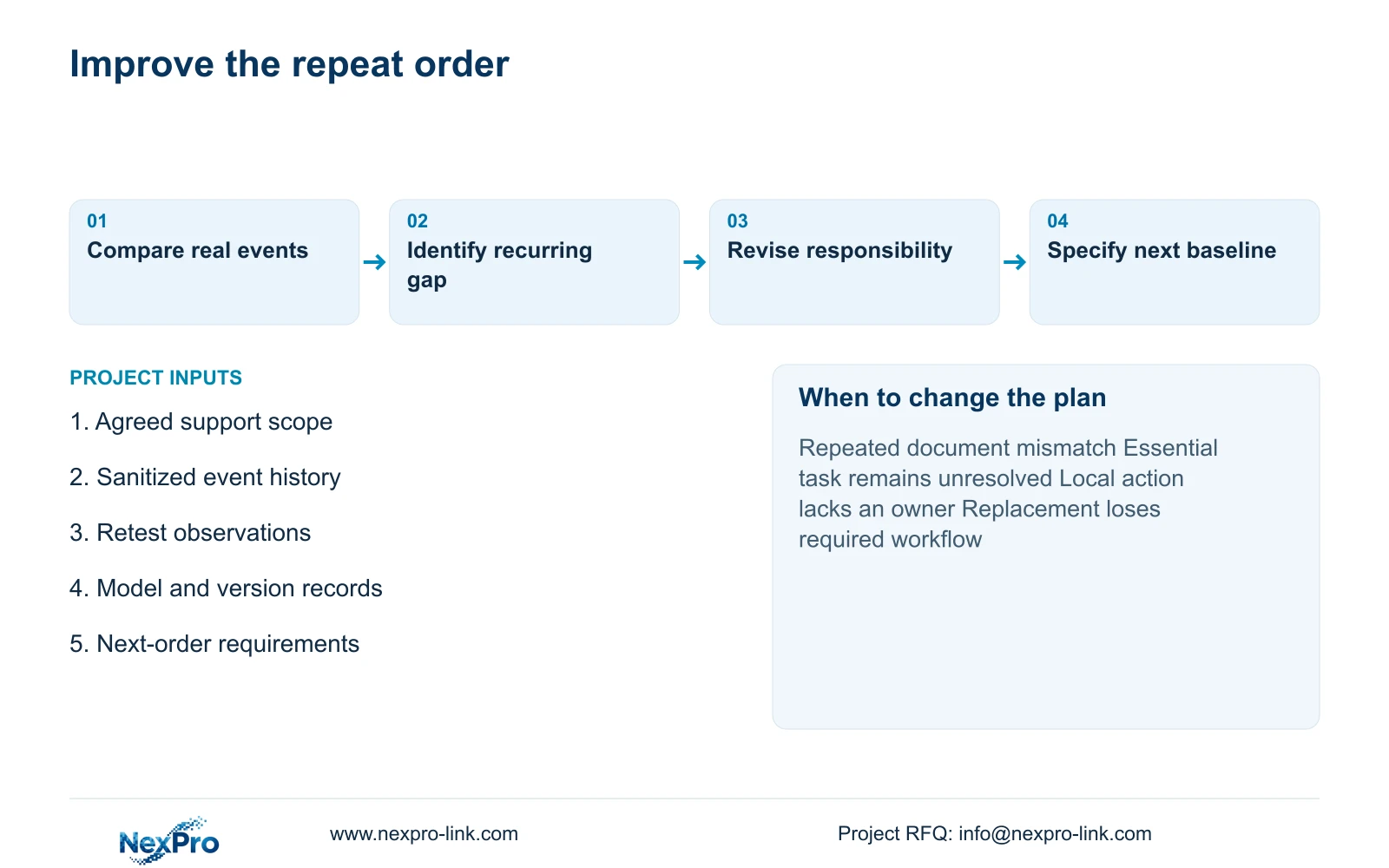
Convert each supported finding into a specific purchase or handover change. An inaccurate model record calls for a corrected controlled schedule. A delayed local intervention calls for a defined execution owner. A replacement that loses client functionality calls for an explicit compatibility requirement. Preserve the necessary hotel task while evaluating the cost of the revised scope.
Recommend continued supply where the observed configuration and support meet the agreed requirements. Require a targeted change where records show a recurring unresolved task, and consider another supported arrangement if that requirement cannot be met. A single quick response should not outweigh missing resolution, while an isolated delay should retain its documented context.
For a repeat-project discussion, send info@nexpro-link.com the agreed support scope, sanitized event history and unresolved tasks, with the relevant models and versions. Include the next order's required configuration and local-service boundary. NexPro-Link can discuss model matching, technical documents and coordinated supply; the proposal should name included actions and responsibilities. Initial review does not require guest footage, passwords or unrelated confidential tender material.
Section 07
Buyer questions
Should the fastest reply receive the highest score? Record response speed separately from usefulness and restoration. A prompt reply can be valuable without resolving the task. Compare the diagnostic action, document accuracy and observed retest result within the agreed scope.
How should a service category with no events be scored? Keep it marked unobserved. A promise or expected result is not operating evidence. The next order can still define the required service scope without claiming that its performance has already been demonstrated.
Can a scorecard support a repeat order without ranking brands? Yes. It can identify the configuration, documents and local support needed for that project. Base the decision on comparable observed events and unresolved requirements, without turning a small sample into a general market ranking.
Engineering references
These sources support the general planning principles. Always use the selected product's current datasheet and applicable project standards for final design.