Standardize operating tasks and approved equipment roles across a hotel group, while recalculating each property's views, storage, power and installation options.
Section 01
Choose the operating tasks to standardize
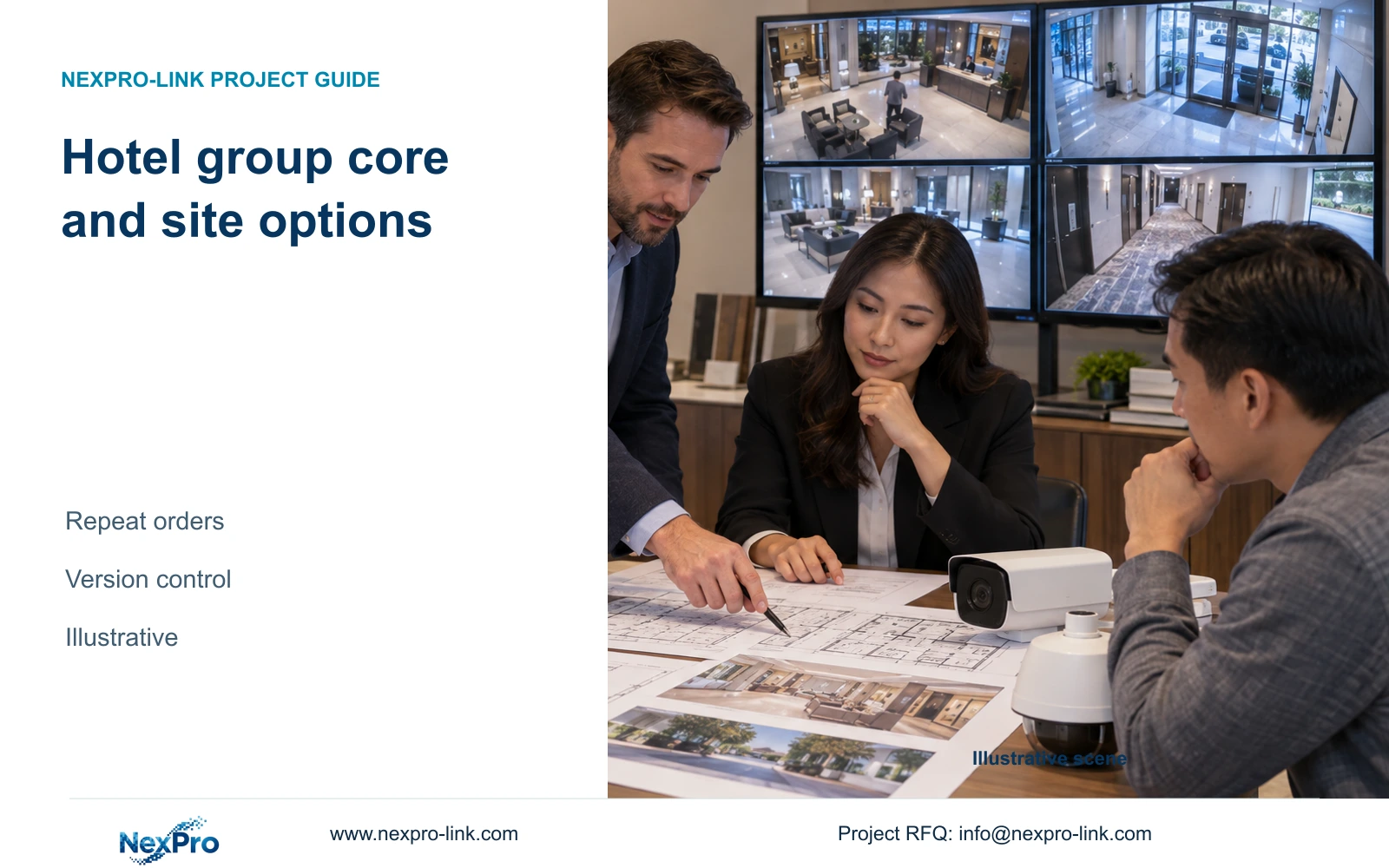
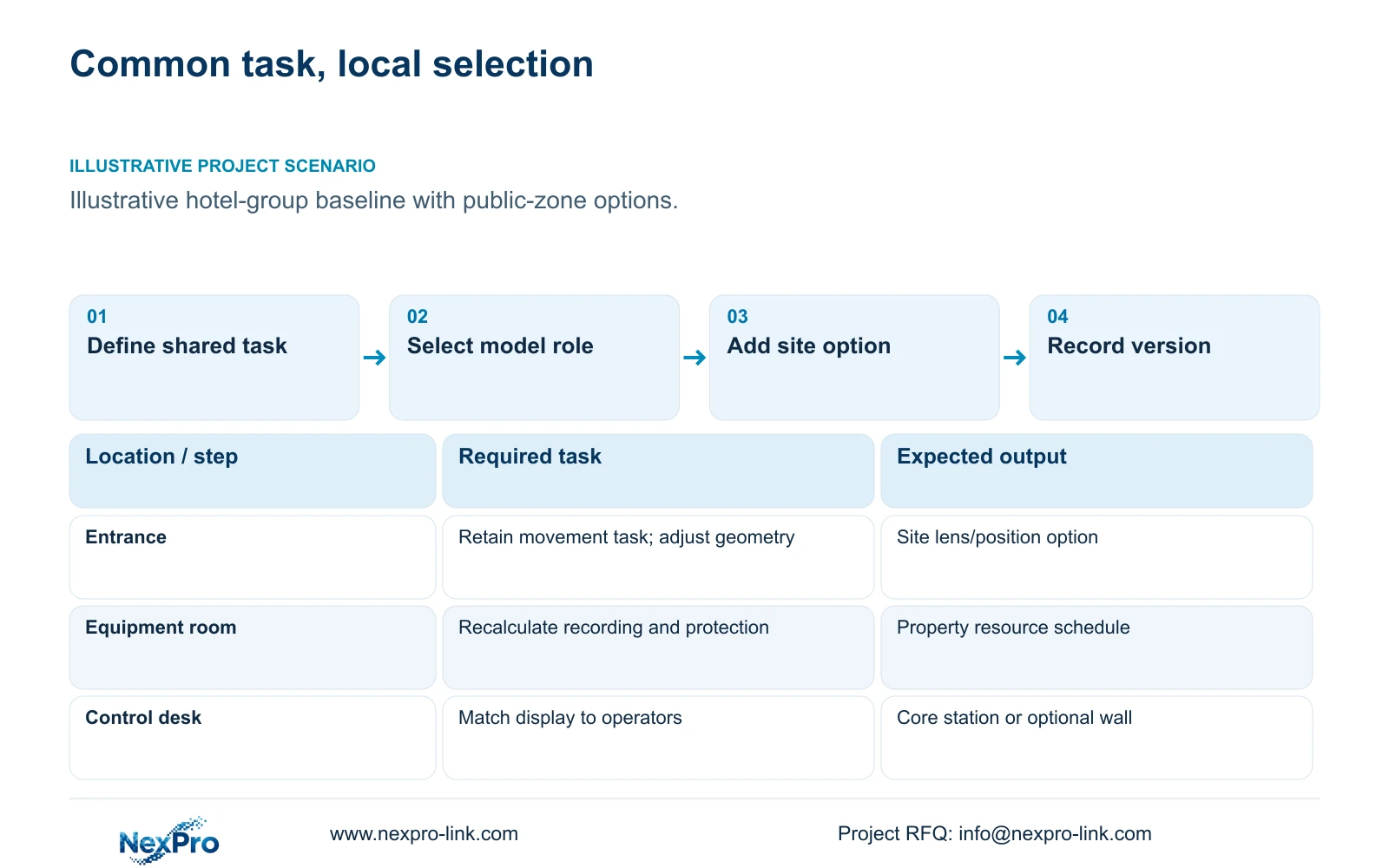
Standardize the operating tasks and controlled model families when hotel properties share recording and support requirements. Keep camera positions, lens settings, environmental suitability and resource quantities specific to each site. Reopen the core selection when an operator platform or site condition prevents an approved model from meeting its assigned task.
Define what staff must do consistently: open an authorized public-zone view, retrieve a specified incident and maintain the agreed recording state during an outage. These requirements can support common documentation and training. They do not establish that every lobby needs the same camera count or that a single cabinet arrangement fits every property.
The illustrative CASE01 reference assigns 32 views to public-zone tasks in a 100-room hotel. Room count is background information, not a camera quantity formula. For repeat orders, retain the method of assigning views to entrance, circulation and service tasks, then use each property's drawings to determine quantities. Private interiors and unnecessary views through open doors stay outside the routine scope.
| Required task | Common reference | Site decision |
|---|---|---|
| Entrance recording | Recorded movement review | Position, target width and lighting |
| Incident retrieval | Authorized playback and export | Local users and existing platform |
| Outage recording | Capture/network/recording continuity | Protection zones and active nodes |
Section 02
Select a controlled equipment core
Create a baseline by functional role, exact model and approved configuration. A recorder entry should identify its recording modes and disk arrangement, while a camera entry should identify the task and supported environment. Record the relevant software version and interface conditions. A family name alone leaves too much room for substitutions.
NexPro-BL2812M55-5MP-DIC-AI is a sourced 5MP motorized-varifocal candidate with a 2.8 to 12 mm lens range and a listed 2880 × 1620 main-stream mode. Its supplied BL2812M specification PDF does not state maximum power. Reusing that camera role therefore does not authorize copying a hypothetical wattage into every property's PoE calculation.
Keep display hardware outside the mandatory core unless every property needs the same monitoring task. NX-VP-5535 is a 55-inch 1920 × 1080 LCD panel. Seating distance, wall dimensions and event layout determine whether it is appropriate. If direct-view LED is considered, physical dimensions divided by pitch give a conceptual canvas; actual modules and controllers determine the final configuration.
| Item | Core arrangement | Optional arrangement | Operating effect |
|---|---|---|---|
| Recording | Approved recorder and storage | Same retained requirement | Incident availability stays unchanged |
| Viewing | Task-sized operator station | Larger LCD or other selected display | Changes shared observation layout |
| Display design | Local screen requirement | Site canvas and signal-path review | Avoids copying an unsuitable wall |
Section 03
Separate site-specific options from the baseline
Use an option schedule for lens adjustment, outdoor conditions, backbone routes and packaging. An entrance with a different target width may retain the camera family but require a revised position or lens setting. A condition outside the model's documented environment requires a different selection, not an unexplained exception hidden in the order.
Option changes must identify their resource effect. Recording input equals the sum of selected stream bitrates. For a uniform illustrative profile, input is n × 4 Mbps; continuous video volume over 30 days is 0.0108 × n × 4 × 30 decimal TB. Required usable capacity divides that video volume by 0.80 when 20% remains free.
Show data and power routes separately for each property. A distributed access switch adds a local electrical and maintenance dependency even when the recorder remains in a standard equipment room. The site's UPS boundary must include each required active node. Optional display protection should be an explicit addition, with its own load and battery implications.
Section 04
Calculate each property's resource demand
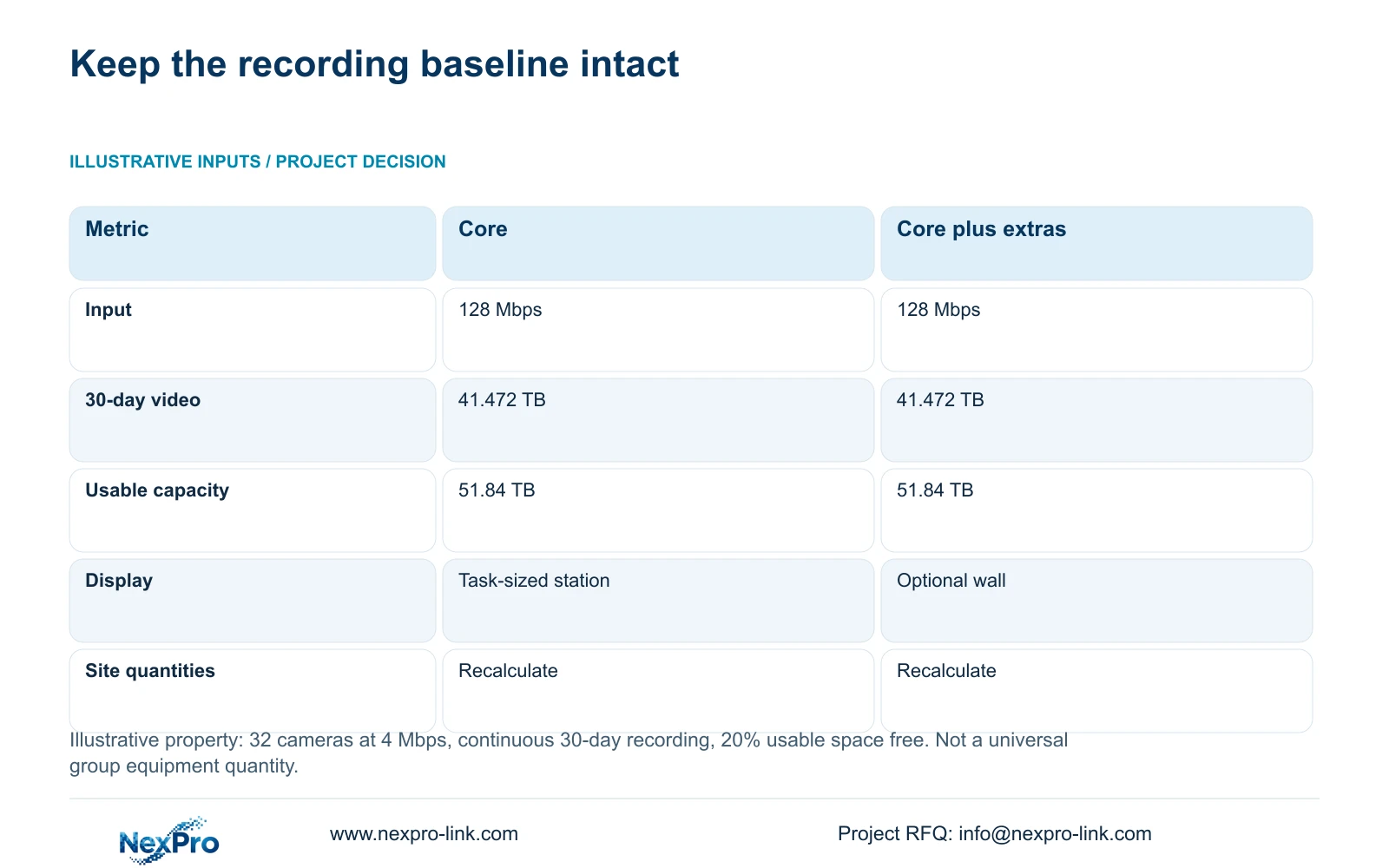
Apply the formula to an illustrative 32-camera property at 4 Mbps average per camera, 24 hours per day and 30 days. Input is 128 Mbps, video data is 41.472 TB and required usable capacity is 51.84 TB. These inputs match the storage assumptions in CASE01, but its separate cable and power totals are not universal repeat-order allowances.
NexPro-NVR4449-4K has published 320 Mbps input, four SATA positions and an 18 TB per-disk field. Those fields support candidate evaluation, while recording modes, playback and the chosen disk configuration still need confirmation. The source summary lists 49 × 5MP and 9 × 4K; 49 channels do not establish 49 simultaneous 8MP streams.
Calculate PoE by actual switch group and UPS demand by protection zone. NexPro SW-POE1618G has no stated numerical total output budget in the supplied record, and its access-port speed fields conflict. It cannot become an automatically qualified group standard. Obtain explicit selection information before putting it in a repeatable package.
| Metric or condition | Essential recording-first package | Same core plus display/recovery scope |
|---|---|---|
| Recording input | 128 Mbps | 128 Mbps |
| 30-day video data | 41.472 TB | 41.472 TB |
| Required usable capacity | 51.84 TB | 51.84 TB |
| Protected path | Cameras + network + recording | Same plus explicitly selected extras |
| Operator display | Task-sized monitor/workstation | Optional wall; independent recording |
| Cost comparison | Complete scope quotation required | Documented incremental scope only |
Section 05
Compare standardization and exception costs
Evaluate the baseline and site exceptions against equal required outcomes. Separate initial equipment and preparation costs from recurring software or service charges. A standard package that omits required disks is not an equivalent lower-cost offer. Likewise, extra hardware purchased solely to preserve a common catalogue needs a stated economic reason.
Where standardization requires an additional initial cost, divide that increment by the supported annual cost reduction to estimate a simple break-even period. Use actual scope-matched quotation inputs and state the evaluation horizon. If annual savings are unknown, the break-even result remains unresolved; assumed support savings should not be attributed to NexPro-Link or another brand.
Packaging can be standardized by field structure while retaining property-specific labels and carton allocations. NexPro-Link's OEM scope includes branding and project packing discussion. Authorized artwork, exact device identity and traceability should remain controlled. Hardware branding does not grant permission to rename a third-party client.
| Retained outcome | Extra scope | Worth buying when | Counter-condition |
|---|---|---|---|
| Required entrance detail | Different lens or camera | Site geometry defeats the core selection | Approved core meets the recorded task |
| Shared monitoring | Display upgrade | Multiple operators need persistent views | Single station meets the workflow |
| Traceable delivery | Property-specific packing | Installation batches require separation | Neutral identified cartons suffice |
Section 06
Maintain the repeat-order baseline
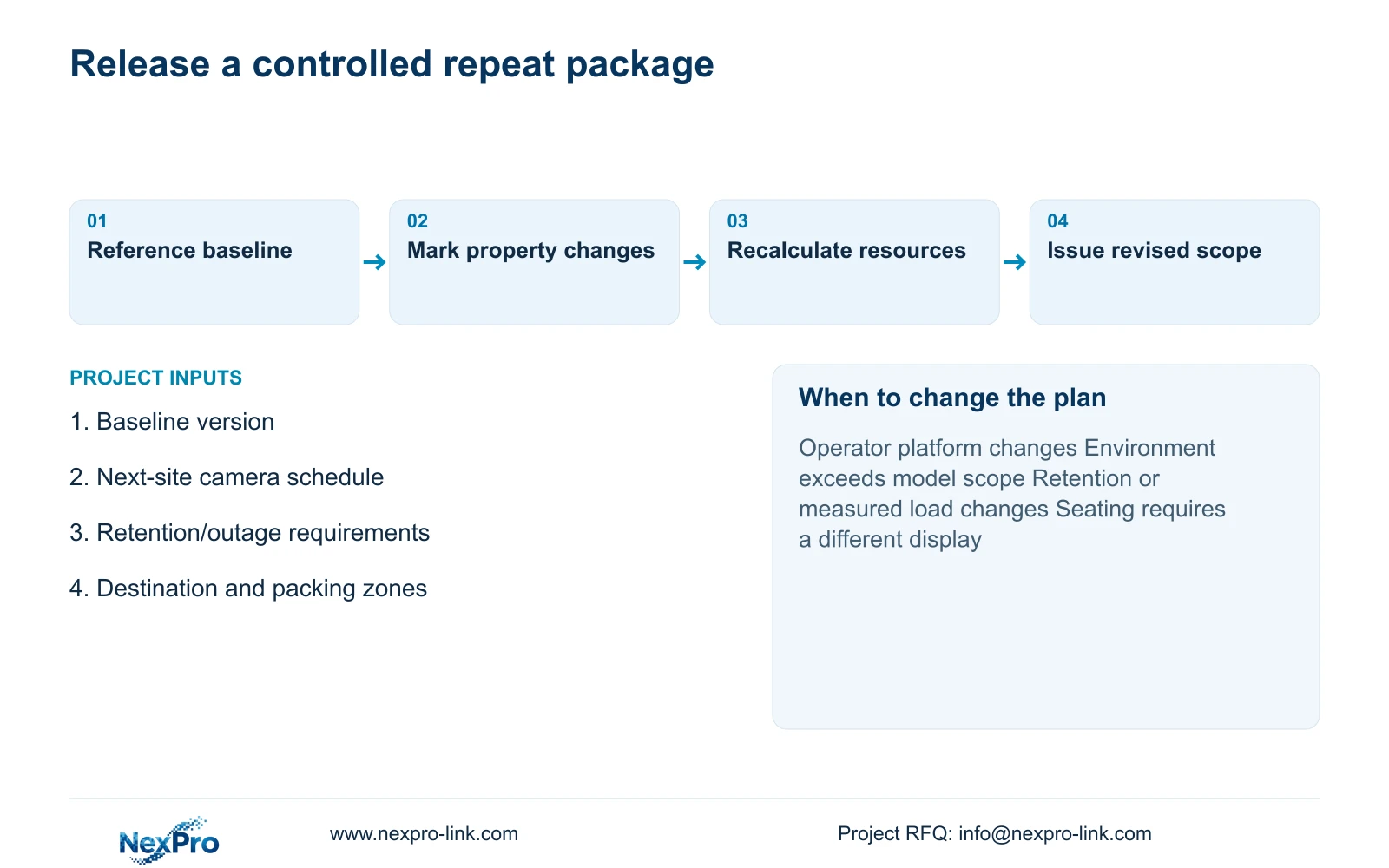
Maintain an approved baseline plus a property option schedule, and identify every revision that affects the next order. Preserve unchanged equipment identity and explain substitutions by task. The next purchase should reference the accepted configuration, not merely the previous invoice or the outside appearance of a device.
Recommend this controlled-core approach while the common operating tasks remain valid. Require a revised selection when retention, mandatory software, environmental exposure or measured load changes. NexPro-Link can support model matching, BOQ/BOM preparation and coordinated supply, with local installation and actual integration responsibilities stated separately.
Send info@nexpro-link.com the current baseline, a short list of next-property differences and its available camera schedule. Include destination, delivery point and required installation batches. These inputs allow hotel project equipment support and OEM and project packing discussions to address the repeat order without copying quantities that belong to another site.
Section 07
Buyer questions
Can existing equipment remain in a group standard package? Yes, where its actual supported functions and condition meet the required task. Record the retained devices and verify the relevant recording, retrieval and interface workflow. Coordinated procurement does not establish automatic integration.
Should every property buy the same video wall? Only when operator tasks, viewing conditions and supported signal paths justify the same arrangement. Keep the display selectable when those inputs differ; recording capacity and continuity must remain intact.
What is the minimum useful repeat-order request? Provide the baseline version, property differences, available equipment schedule and delivery destination. Identify mandatory operator requirements and whether substitutions may be proposed. Add packing allocations when deliveries follow installation zones.
Engineering references
These sources support the general planning principles. Always use the selected product's current datasheet and applicable project standards for final design.