Use hotel-group forecasts for coordination, then release hardware, branding and shipments through explicit property-level authority and confirmed dependencies.
Section 01
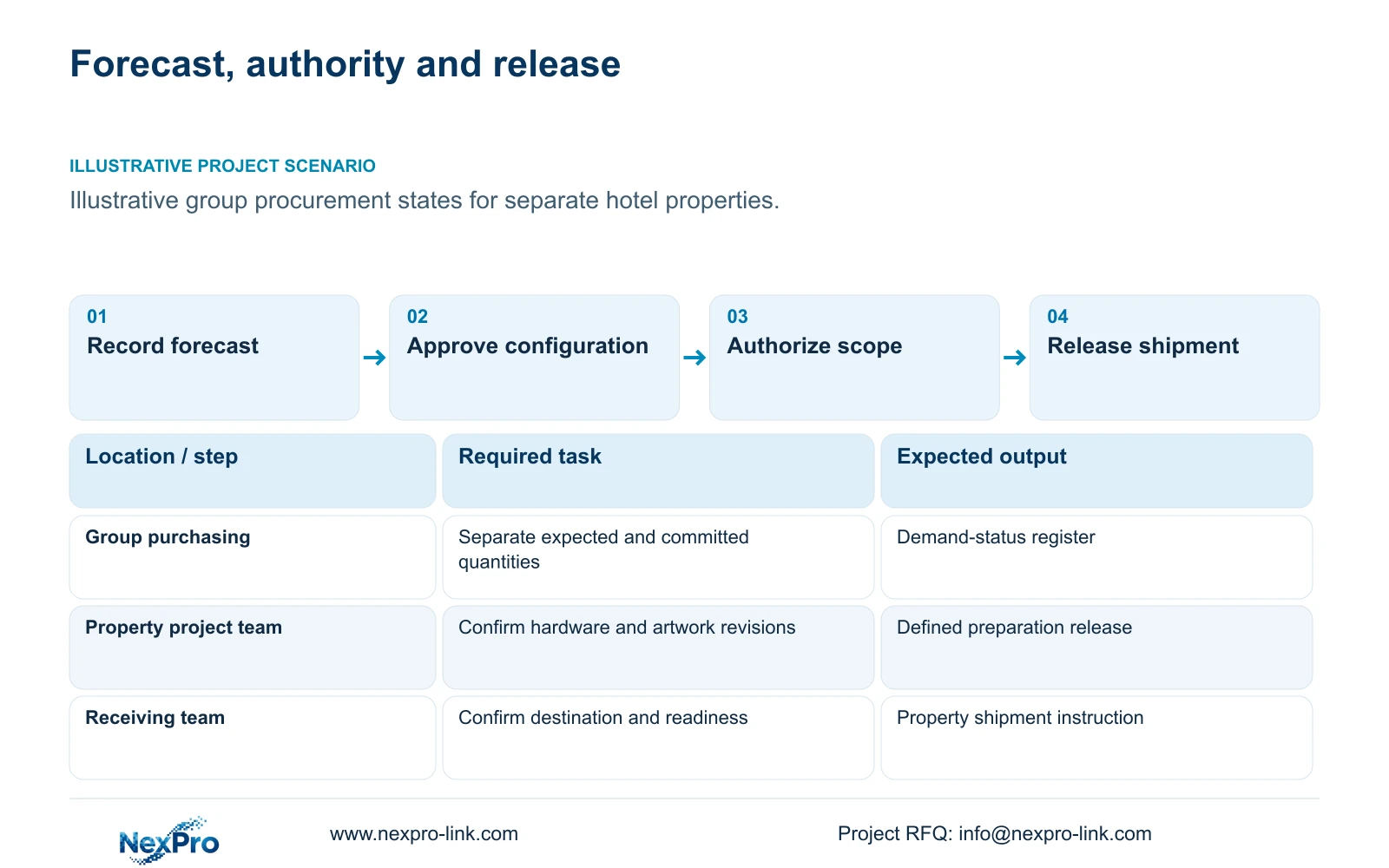
Separate forecast demand from authorized commitments
Use a hotel-group forecast to discuss demand and configuration, but commit full customization only against explicit purchasing authority and an agreed scope. Separate technical approval from procurement authorization and shipment instructions. Choose staged releases when property quantities, artwork or opening dates remain unsettled; reconsider a single commitment once those inputs are stable and its obligations are understood.
A useful forecast identifies properties, expected equipment categories and the current project stage. Mark quantities as provisional where drawings or camera tasks can still change. Keep committed demand in a separate record so the supplier can distinguish a planning revision from an instruction affecting preparation.
Work backwards from usable hotel functions at opening. Arrival, installation and acceptance are separate milestones. A forecast delivery date cannot establish when the local team will have access to ceilings, network permissions or ready equipment rooms. Each property needs a programme that connects its required recording service to the decisions and site work that enable it.
| Required task | Given information | Decision still needed |
|---|---|---|
| Plan group supply | Forecast property quantities | Which quantities are provisional |
| Prepare equipment | Technically reviewed configuration | Authorized purchase scope |
| Dispatch to property | Expected destination | Confirmed release and receiving point |
Section 02
Define who can release each stage
Name the party authorized to approve models, the party authorized to commit expenditure and the party authorized to instruct shipment. These roles may sit in different organizations or departments. A consultant's technical comment should not be treated as a purchase instruction unless the project's actual authority arrangements support that action.
For every release, state what it permits. Hardware preparation, application of an approved logo and dispatch to a named recipient can have different prerequisites. Record the configuration and artwork revision with the authorization so later correspondence cannot silently replace the released scope.
Parallel review is useful only when both branches have the inputs they need. Technical approval and artwork can run together if artwork does not depend on a model identity still under discussion. If a label includes a changing SKU or required marking, the relevant artwork work may need to wait. Clarifying that dependency is more useful than assuming all approvals can overlap.
| Item | Forecast-led action | Authorized release | Effect on hotel task |
|---|---|---|---|
| Hardware | Prepare assumed quantities | Prepare agreed configuration | Limits mismatch with revised site demand |
| Branding | Use preliminary artwork | Use identified approved artwork | Preserves device and package identity |
| Shipment | Follow indicative date | Follow confirmed property instruction | Matches delivery with receiving readiness |
Section 03
Map preparation and customization dependencies
List the dependencies of long-lead or customizable items without assigning unsupported lead times. Selected battery configurations may affect transport planning. Model freeze affects labels and accessories; property packing allocation affects carton preparation. Site IT permission belongs on the commissioning path even when equipment is ready to ship.
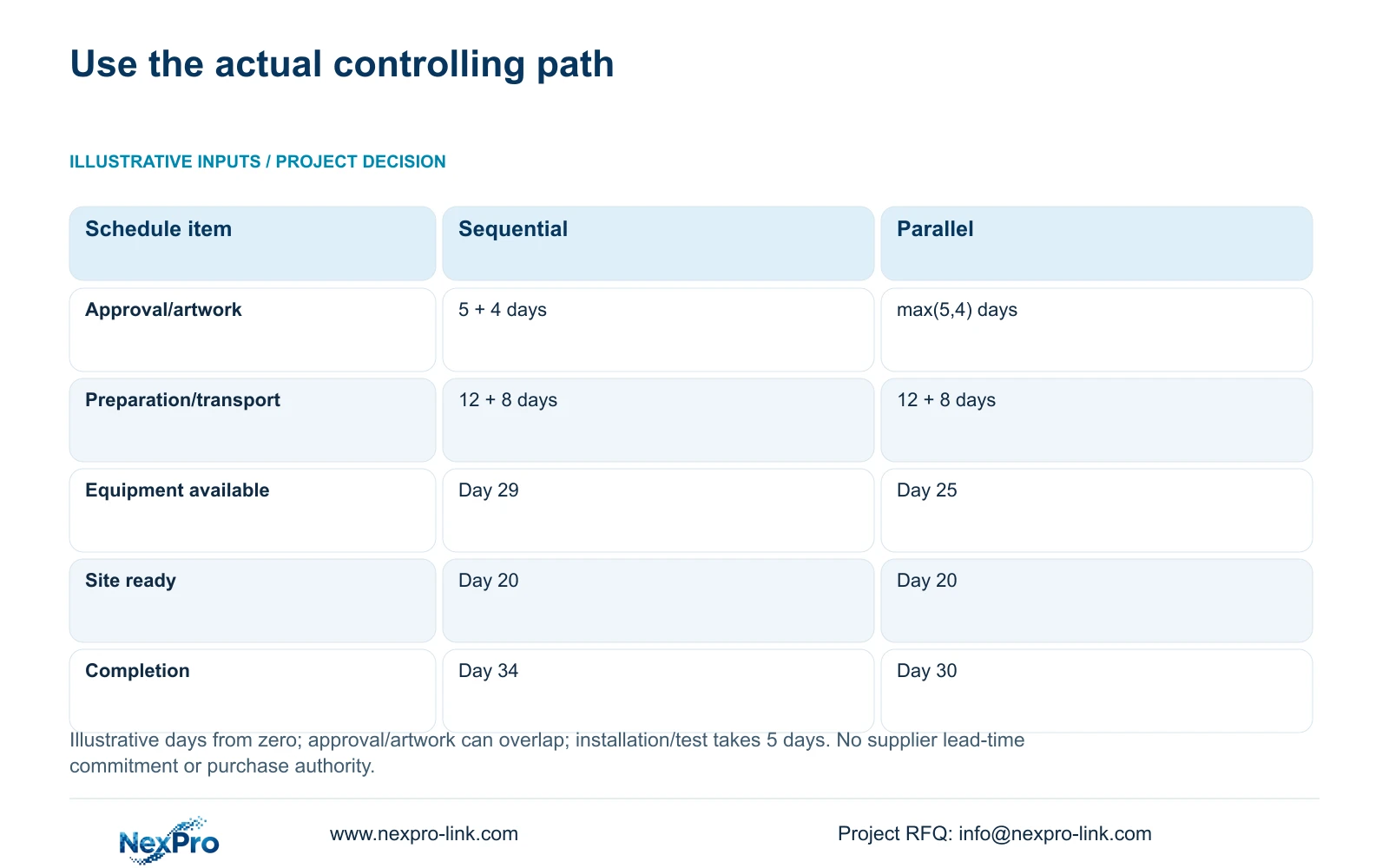
The illustrative schedule assumes technical approval takes five days and artwork four days, starting together from day zero. Preparation then takes 12 days and transport eight days. Site readiness is day 20, with five days for installation and testing. All durations are teaching inputs, not quoted NexPro-Link commitments.
Use ready-to-install day = max(max(approval, artwork) + preparation + transport, site readiness). Completion adds installation and testing. Under these dependencies, approval and artwork finish at day five, equipment arrives at day 25 and completion is day 30. If artwork genuinely depends on completed approval, that branch becomes sequential and the calculation must change.
Section 04
Compare rolling releases and a single commitment
A rolling release can isolate unresolved properties while allowing an authorized functional package to proceed. Keep all equipment needed for that package's recording and retrieval task together. An optional display may be released later only when its absence does not prevent required operation or acceptance.
A single commitment can suit stable quantities and common preparation requirements, provided receiving arrangements and contractual obligations are clear. Compare split transport and handling with the exposure of preparing material before each site is settled. No price advantage or cancellation flexibility should be assumed without the actual offer.
The retained schedule compares sequential and genuinely parallel branches, not commercial strategies. It gives day 34 versus day 30 under stated teaching inputs. Use the property-release record below to choose a commitment scope; neither that four-day difference nor a forecast authorizes preparation.
| Release field | Rolling property releases | Single agreed commitment |
|---|---|---|
| Quantity status | Authorized subset; remainder visibly provisional | Entire committed quantity and scope identified |
| Configuration/artwork | Revision attached to each permitted preparation step | Common released baseline with documented site options |
| Commercial exposure | Actual split transport/handling and revision terms | Actual commitment, cancellation and receiving obligations |
| Functional readiness | Each subset supports its named install/test task | Receiving and local work can support the full package |
| Open dependency | Hold unresolved model, artwork or battery transport branch | Do not erase dependency by calling the forecast an order |
Section 05
Calculate the consequences of a revision
Anchor a revision to the previously authorized scope. Separate quantity increases from specification changes and shared-resource additions. Added cameras can cross recorder, PoE or storage thresholds, so the total effect may exceed the price of the additional front ends. Review the resulting operating requirement before issuing a revised instruction.
A separate teaching cost example illustrates the bridge: 32 units at 100 cost units total 3,200. Moving to 36 units adds 400 at the original rate; changing the rate to 110 adds 360 across the revised quantity. A shared item adds 250, giving 4,210. These are unbranded teaching units, not quotation prices.
Record reusable material, unavailable cancellation options and outstanding work separately. Recalculate the programme from the affected dependency rather than adding an unexplained delay to every activity. Late artwork or hardware changes may affect cost and dates, but neither free revision nor a particular delay follows automatically from this example.
| Effect | Calculation | Cost units |
|---|---|---|
| Original | 32 × 100 | 3,200 |
| Quantity | (36 − 32) × 100 | 400 |
| Rate/specification | 36 × (110 − 100) | 360 |
| Shared resource | Separate addition | 250 |
| Revised total | 3,200 + 400 + 360 + 250 | 4,210 |
Section 06
Confirm each property's actual release
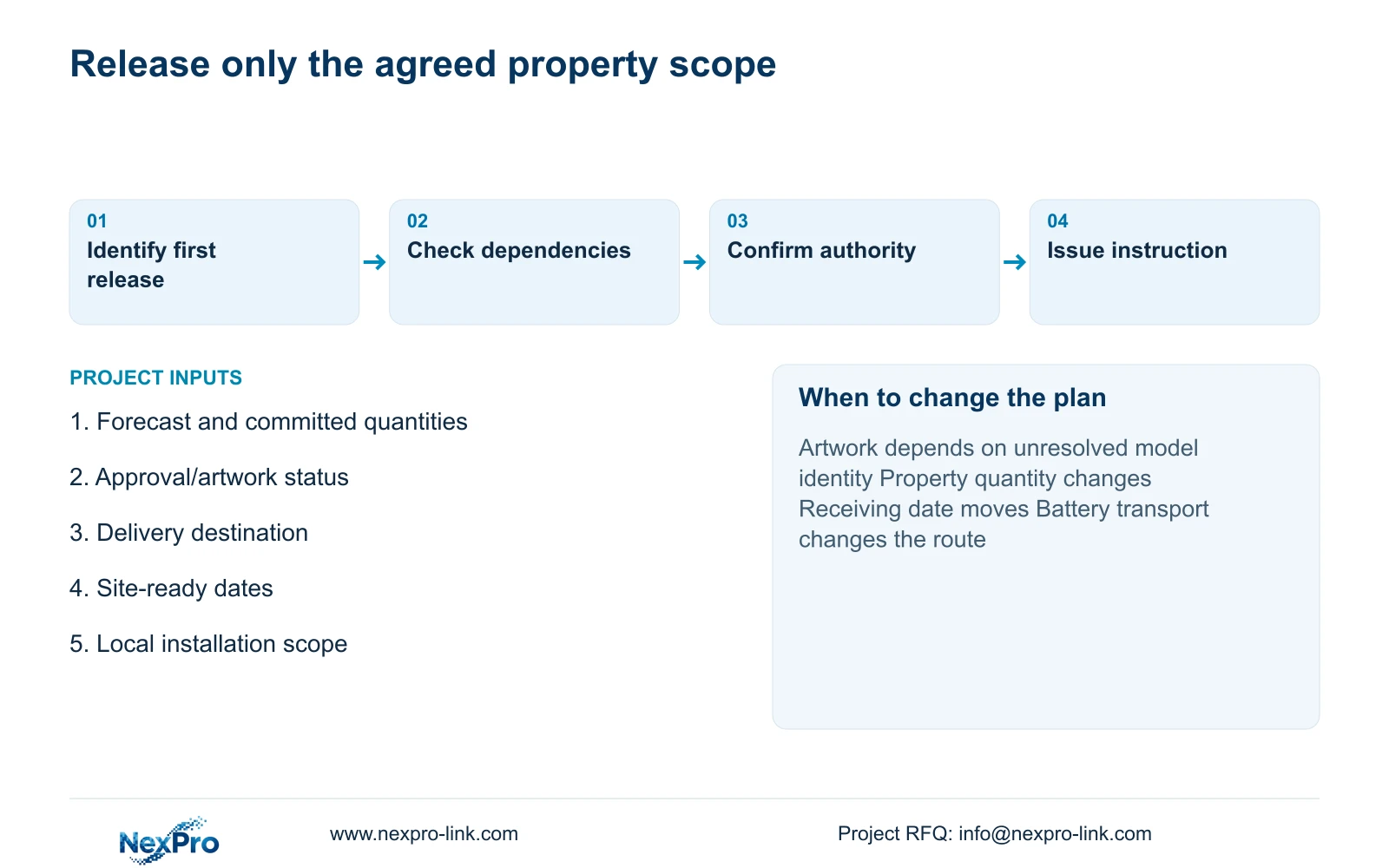
Issue a property-level release record naming the authorized quantity, selected configuration, artwork status and destination. Identify what the supplier may do next and what remains on hold. Shipment instructions should reference the same revision as the prepared equipment and packing list.
Recommend staged commitments while site demand or branding remains uncertain. Change to a consolidated release when the group can authorize the full scope and accept the agreed preparation and delivery conditions. NexPro-Link can discuss model matching, BOQ/BOM records and coordinated overseas supply; these services do not replace the buyer's authority or local installation responsibility.
Send info@nexpro-link.com the forecast separated from the requested first release, the approval status and the destination or delivery point. Include site-ready dates and the local installation scope for the properties being released. Hotel project equipment support and BOQ and tender support can then address a defined next action without treating the forecast as an order.
Section 07
Buyer questions
Can equipment be discussed before all property drawings are final? Yes. Identify a limited planning scope and mark unresolved quantities and site options. Request a conditional configuration response. Discussion and technical review do not authorize preparation or full customization.
Can branded packing wait while hardware proceeds? Only where the agreed preparation process and commercial scope allow it. Identify hardware, labeling and carton dependencies separately. Preserve necessary device identity and confirm the later artwork release before assuming the stages can be separated.
What must accompany the first property release? Provide the authorized scope revision, purchasing authority, destination and delivery point. State artwork status, receiving readiness and the installation milestone. Keep any remaining group forecast visibly provisional.
Engineering references
These sources support the general planning principles. Always use the selected product's current datasheet and applicable project standards for final design.