Buy reusable renovation CCTV for defined permanent roles, while keeping temporary routes, installation work and contractor permissions separate.
Section 01
Choose the temporary tasks that need equipment
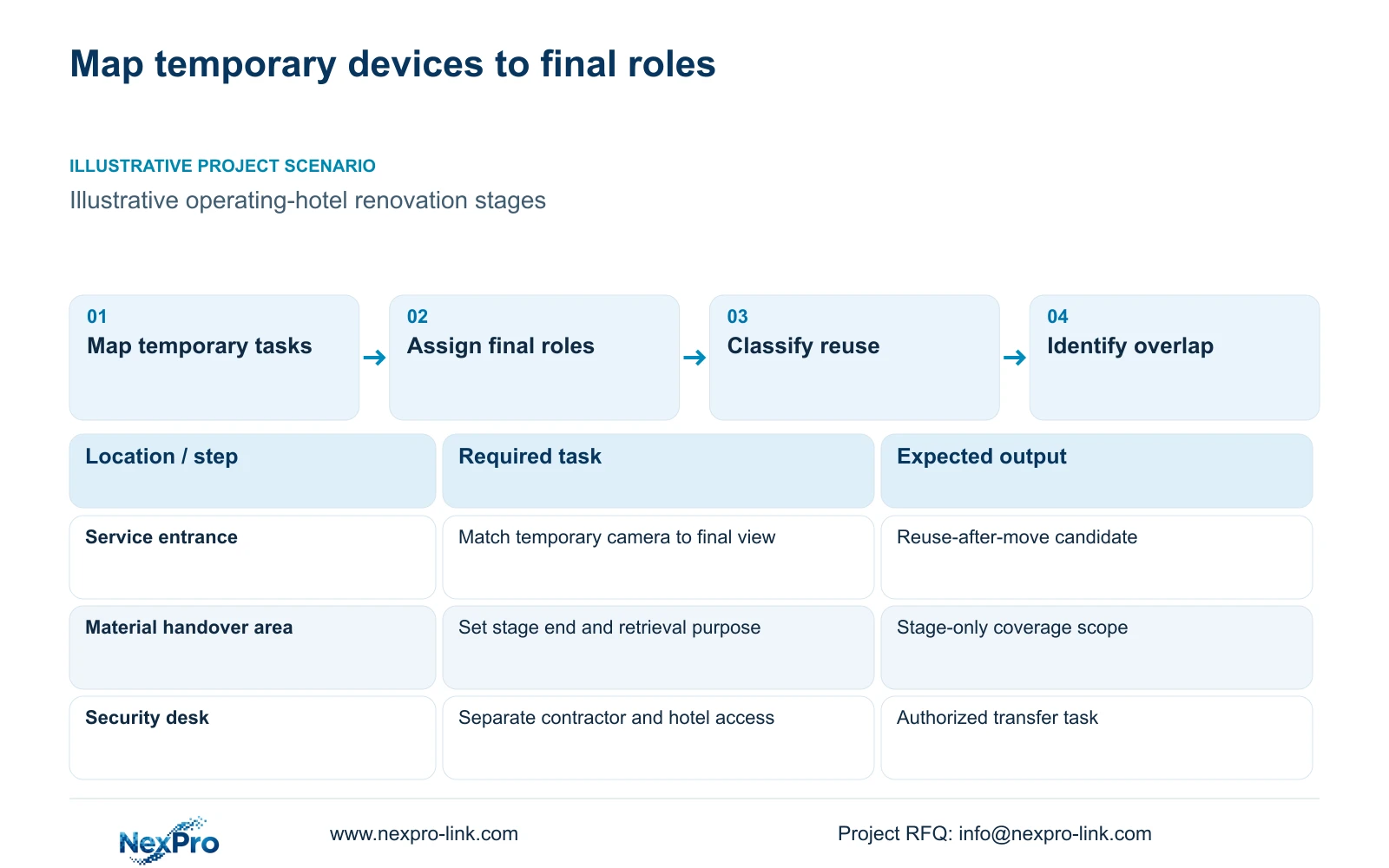
Buy renovation CCTV for reuse only where a device has a credible role in the final hotel design. Map temporary security tasks against permanent requirements, then separate reusable equipment from stage-only attachments and work. Change the purchase when construction conditions or final operating requirements make that shared role unsuitable.
Temporary tasks may include observing a service entrance, a material handover area or a public route temporarily affected by works. Define the required view, recording destination and authorized retrieval responsibility for each stage. A point useful during construction may cease to be useful when partitions, access routes or operating patterns change.
Record which hotel functions must remain available while the works proceed. Temporary coverage should address the affected task without expanding capture into private spaces. Do not treat guest-room interiors, bathrooms or changing areas as routine surveillance zones.
Tie the temporary schedule to construction stages. State what moves when a work area changes and who confirms the replacement view. This prevents a portable equipment list from becoming a fixed coverage assumption throughout a changing project.
| Required task | Given information | Decision still needed |
|---|---|---|
| Service-entry observation | Entrance remains active during works | Temporary view and final device role |
| Material handover recording | Construction-stage location identified | Retention, authorized retrieval and removal stage |
Section 02
Define the final operating design
Establish the final camera schedule before calling a construction purchase reusable. Assign permanent positions by required observation tasks, then connect them to recording, network access and power. Room count does not determine camera count.
For each final position, define framing needs and the maintenance route. A device that can move from a temporary entrance to a final service point still needs suitable housing, mounting and environmental conditions. Reuse should not force a poor permanent angle merely to avoid buying another bracket or cable.
The BL2812M product PDF lists NexPro-BL2812M55-5MP-DIC-AI with PoE, a 2.8-12 mm motorized lens, IP66 and a stated temperature range of -20 to +60°C. These fields can support a candidate role assessment. They do not establish a verified peak wattage, an impact rating or suitability outside that environment.
Keep final operator duties explicit. Incident retrieval may suit a monitor and workstation; continuous multi-seat observation may justify a larger display arrangement. Recording should remain available independently of whether the optional display wall is switched on.
| Item | Temporary role | Permanent role | Decision effect |
|---|---|---|---|
| Camera | Observe a stage-specific entrance | Meet approved final view | Reuse only with suitable framing/environment |
| Access account | Limited contractor task | Hotel-authorized operation | Reconfigure at handover |
| Cable route | Stage-specific installation | Qualified permanent link | Temporary use does not qualify final route |
Section 03
Identify reusable recording and equipment roles
Classify each purchase as reusable in place, reusable after relocation or stage-specific. Record the final destination and the work needed to make it operational there. Equipment with no established final role should remain temporary scope, not an assumed saving.
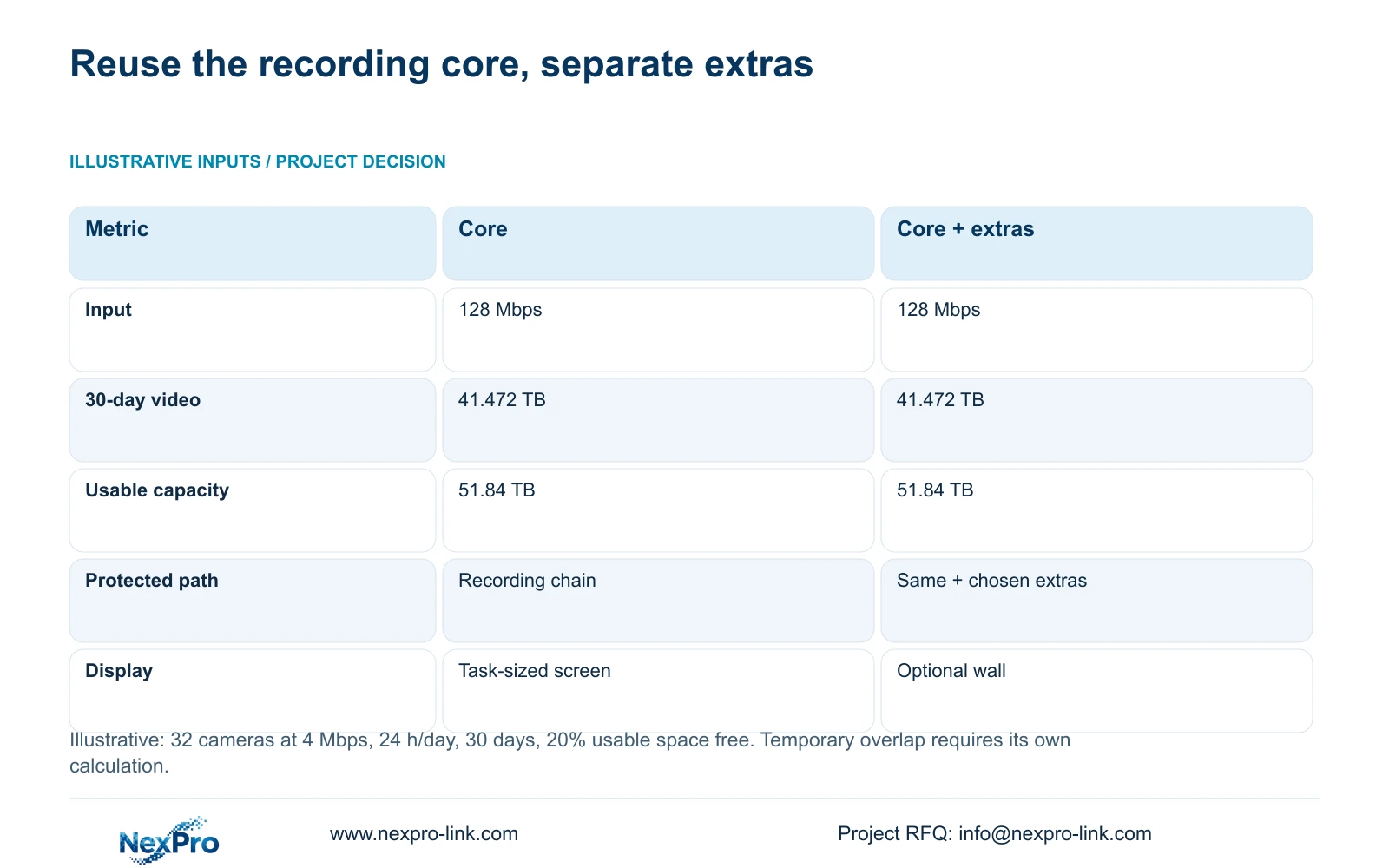
The independent teaching system comparison uses 32 cameras at an average 4 Mbps, recording 24 hours daily for 30 days. Input equals 32×4 = 128 Mbps. Decimal video data equals 0.0108×32×4×30 = 41.472 TB. Keeping 20% of usable space free gives 41.472/0.80 = 51.84 TB required usable capacity.
Both options in the table retain that same recording target. A temporary monitor or a later display wall changes viewing scope, not the video amount required by the stated profile. If construction-stage and final recording policies differ, calculate each stage independently.
NexPro-NVR4449-4K is a candidate with published 49-channel, 320 Mbps input and four-SATA fields. Its summary lists 49×5MP/9×4K; those limits need review for the selected image modes. Buying it early does not establish compatibility with every camera retained later.
| Metric / condition | Essential recording-first package | Same core plus display/recovery |
|---|---|---|
| Recording input | 128 Mbps | 128 Mbps |
| 30-day video data | 41.472 TB | 41.472 TB |
| Required usable capacity | 51.84 TB | 51.84 TB |
| Protected path | Cameras + network + recording | Same plus selected extras |
| Operator display | Task-sized monitor/workstation | Optional wall; independent recording |
| Cost comparison | Complete scope quotation | Documented incremental scope |
Section 04
Compare stage-specific infrastructure
Draw separate data and power paths for the temporary and final stages. The same camera and recorder can depend on different access nodes after relocation. Moving the recorder to a permanent room does not protect cameras that remain on an unprotected remote circuit.
For every temporary active node, include its enclosure, local power and access for maintenance. If the final backbone uses fiber, budget the remote PoE source separately. Temporary routes also need defined installation responsibility; their earlier operation does not qualify them as finished permanent links.
The supplied NexPro SW-POE1618G record lists 16 PoE access ports and two uplinks, but contains conflicting port-speed descriptions and no numerical total PoE budget. Select it only as an inquiry candidate until its required speed and power fields are established.
Optional display changes deserve their own scope. NX-VP-5535 is a 55-inch Full HD LCD panel with a listed 3.5 mm seam, not direct-view LED. A proposed wall needs its actual signal and decoder configuration; its use should not obscure an incomplete recording path.
Section 05
Calculate incremental purchases and relocation work
Calculate the additional quantity for each final role from the required total minus the equipment demonstrably available for that role. Include equipment still needed by another construction stage. A device cannot count simultaneously as available permanent stock and an essential temporary unit.
Add relocation, retermination, testing and configuration work to the comparison. Temporary attachments may be stage-specific even when the camera is reusable. Separate those costs from final accessories so that the buyer can see what early purchasing actually avoids.
CASE07 is an independent teaching renovation with 20 retained and 12 proposed positions. Its complete system assumptions include their own PoE, power and cable budgets. The matching 128 Mbps and 41.472 TB recording figures do not make every temporary arrangement equivalent to that case.
Recommend the essential package first, then buy defined optional scope when its operating benefit is required. Compare complete quotations with the same retention and service boundaries. No source percentage establishes how much construction-stage equipment a real hotel will reuse.
| Retained outcome | Extra scope | Worth buying when | Counter-condition |
|---|---|---|---|
| Final camera role | Relocation and verification | Device meets final task | Final environment or view differs |
| Recording through overlapping stages | Additional temporary equipment | Shared device must stay in active zone | Transfer can occur within approved window |
| Continuous team viewing | Optional display wall | Defined operator duty requires it | Workstation meets the task |
Section 06
Reconfigure authorized access at handover
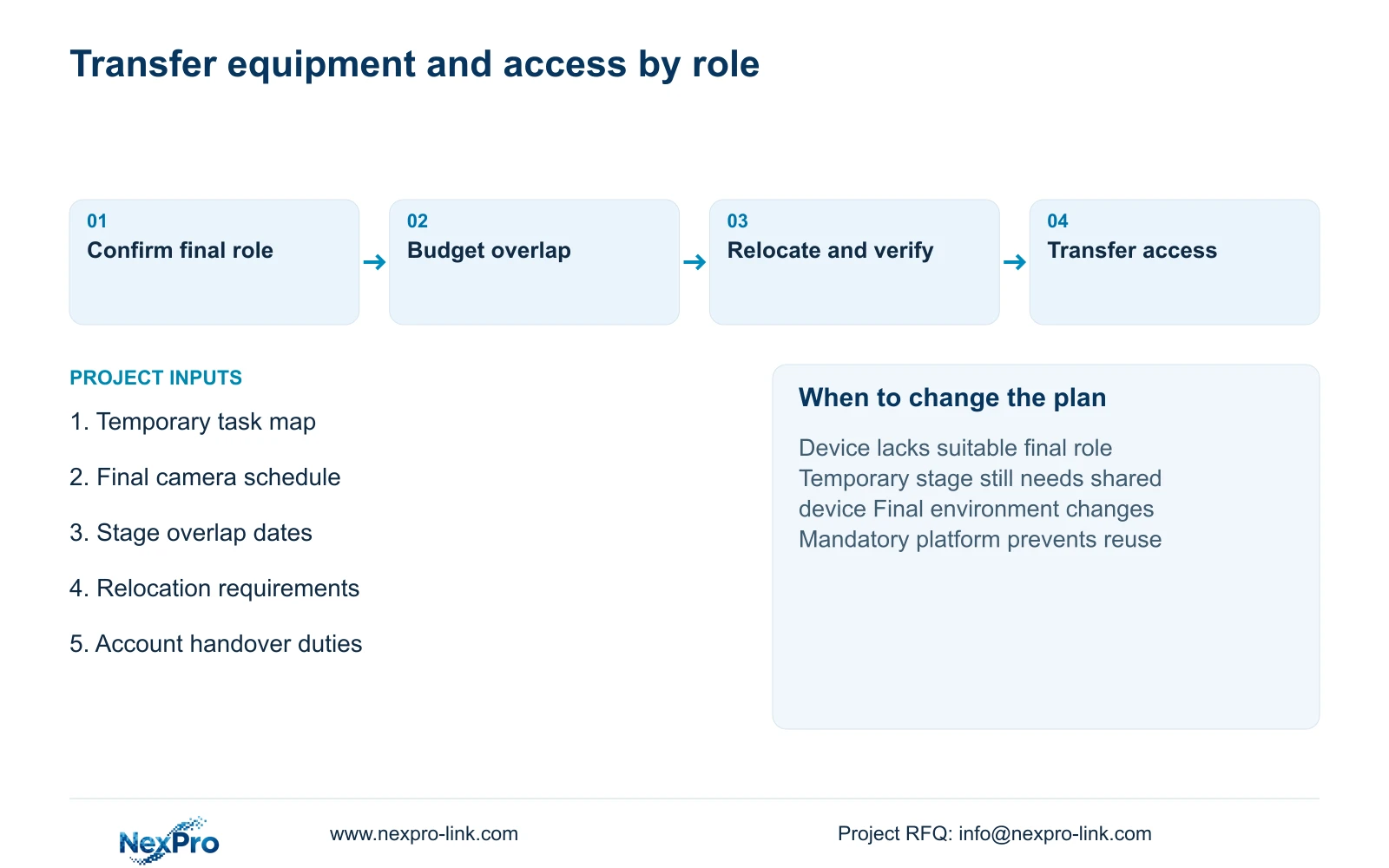
Transfer operation using the delivered equipment and software identities. Confirm camera names, recording schedules and the hotel team's permitted tasks. Demonstrate opening the required view, finding an event and exporting an authorized time window.
Remove or transfer construction access through the supported account and device-binding workflow. Hotel security, IT and installers have different duties; do not leave a permanent shared contractor administrator account. Preserve needed construction records according to the hotel's approved purpose and retention arrangements.
Early receipt also affects service planning. The supplied policy records a 24-month receipt-based limited hardware baseline for applicable main equipment. Opening later does not automatically restart that term; batteries, storage, cable and OEM terms follow their specific scope and controlling order.
Send the temporary task map, final camera schedule, overlap dates and intended access handover to info@nexpro-link.com. NexPro-Link can discuss coordinated equipment supply and BOQ support. Revise the reuse plan when final roles, stage overlap or mandatory platform requirements change.
Section 07
Buyer questions
Can one recorder serve temporary and final cameras together? Only when the simultaneous configuration fits its supported image modes, input, usable storage and access requirements. Calculate the overlap stage separately; a final-stage capacity estimate cannot establish capacity for additional temporary streams.
Does moving a camera to its final position complete acceptance? No. Verify the final framing, route, recorded detail and operator workflow. A construction-stage observation supports only the conditions observed before relocation.
Can branding and packing help staged installation? Authorized labels and project packing can map equipment to stage and final roles. Keep true model and traceability information intact. Hardware branding does not establish a right to rename third-party software or change its account behavior.
Engineering references
These sources support the general planning principles. Always use the selected product's current datasheet and applicable project standards for final design.