A useful hotel commissioning list connects each failed operating task to its dependency, action owner and closure evidence, while keeping temporary workarounds visible.
Section 01
Define the operating task that has failed
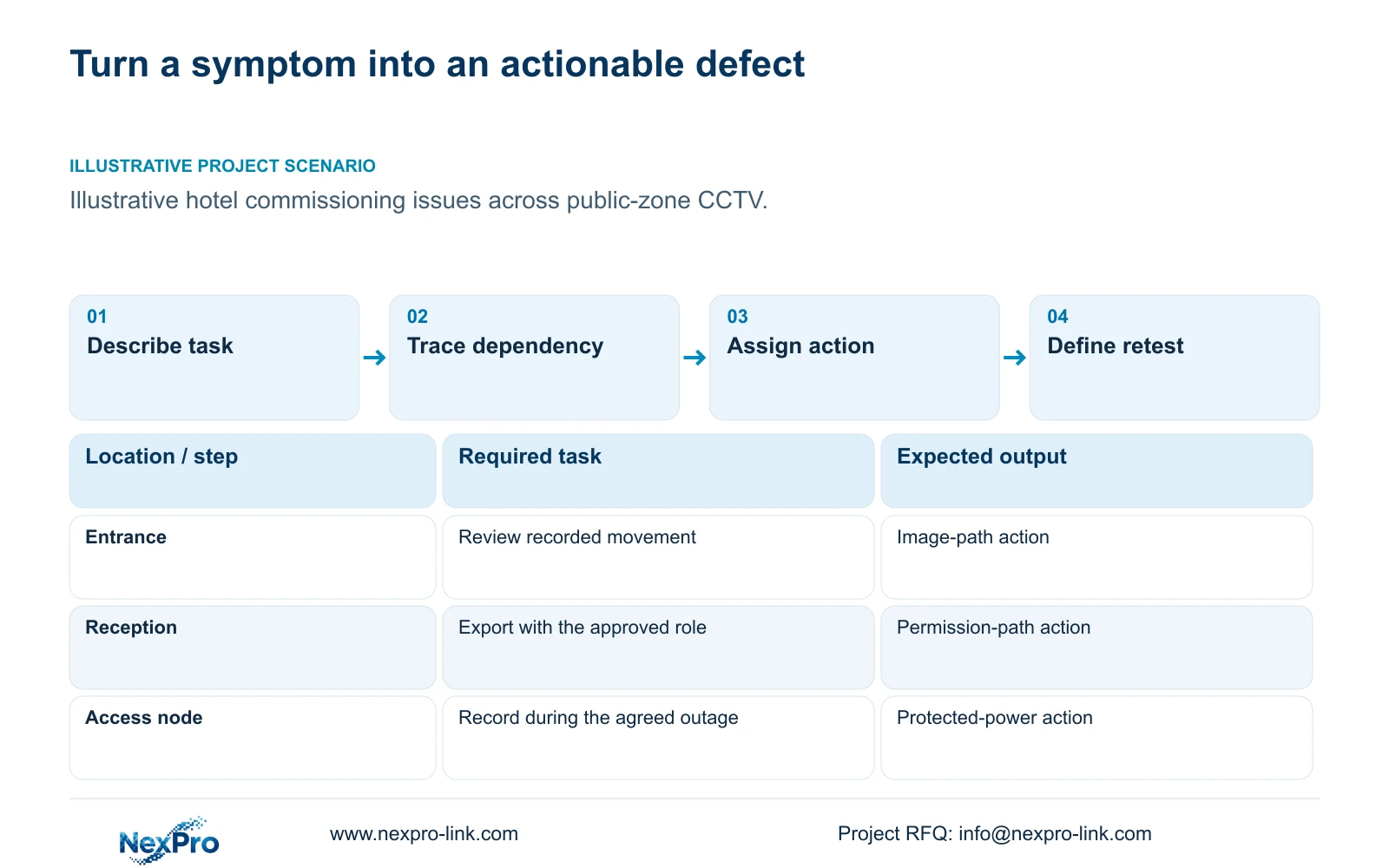
Organize the hotel CCTV snag list around incomplete operating tasks and the parties able to resolve them. Close an item only after the required task is observed under the agreed conditions. If a workaround changes the operating requirement, retain the original issue as open unless the hotel formally accepts the revised scope.
Write the defect so someone unfamiliar with the investigation can reproduce it. Identify the camera or interface, relevant time or operating state, expected outcome and actual observation. An entry such as 'image problem' gives little direction; an entrance movement-review task that lacks required detail provides a defined starting point.
Keep the effect on the hotel visible. A missing view during an agreed outage affects recording continuity, while an unreadable camera name affects operation. These may involve the same equipment without having the same correction. Separate task-level entries when they need different owners or closure observations.
| Required task | Given information | Decision still needed |
|---|---|---|
| Review an entrance event | Camera tag and recorded time window | Image or viewing-path correction |
| Export reception footage | Authorized user and selected interval | Permission or export-path correction |
| Record through an outage | Affected camera/network group | Unprotected dependency and action owner |
Section 02
Identify the dependency affecting the outcome
Trace the failed task through the equipment and interfaces it uses. Recorded incident review depends on the source image, recording configuration, storage and replay path. A live preview can work while retrieval fails. Record what has been observed at each boundary before attributing the issue to a particular device.
Use separate data and power diagrams for outage problems. The recorder can remain on while a remote PoE switch loses supply. The required camera and access-network path must be included in the approved protection scope. Optional display equipment should not be treated as a necessary node for recording.
Classify the suspected cause as equipment, configuration, site condition or interface, while keeping an unconfirmed diagnosis provisional. This prevents a camera replacement from being ordered for a permissions problem or a network problem from being assigned to an installer without configuration access.
Where procurement information is unresolved, retain that dependency in the issue. The NexPro SW-POE1618G source has conflicting access-port speed descriptions and no numerical total PoE budget. A port count cannot close a power-capacity question; the selected configuration needs explicit output and speed information.
Section 03
Assign the party that can perform the correction
Give each issue an action owner with the access or authority needed to perform the next step. The local installer may control physical terminations, hotel IT may control network access, and the equipment supplier may need to address a model-specific configuration question. The actual contract should determine these responsibilities.
Separate the action owner from the person accepting closure. A party can report that a setting was changed without establishing that the hotel's required operation has been restored. The engineer should define the repeat observation and identify who records the result, with hotel authorization where footage or account access is involved.
For an interface issue, assign a lead coordinator and identify the contribution required from each participant. A shared supply order does not make every device natively compatible or give one supplier access to all hotel systems. Relevant ONVIF profile matching can support an investigation, but it does not prove every event, audio or retrieval function.
Keep the next action specific enough to execute. Requesting a configured power figure, repeating an export with an approved role or checking the identified termination moves the issue forward. A general request to 'investigate CCTV' leaves the responsibility boundary and expected response unclear.
Section 04
Compare workarounds with permanent resolutions
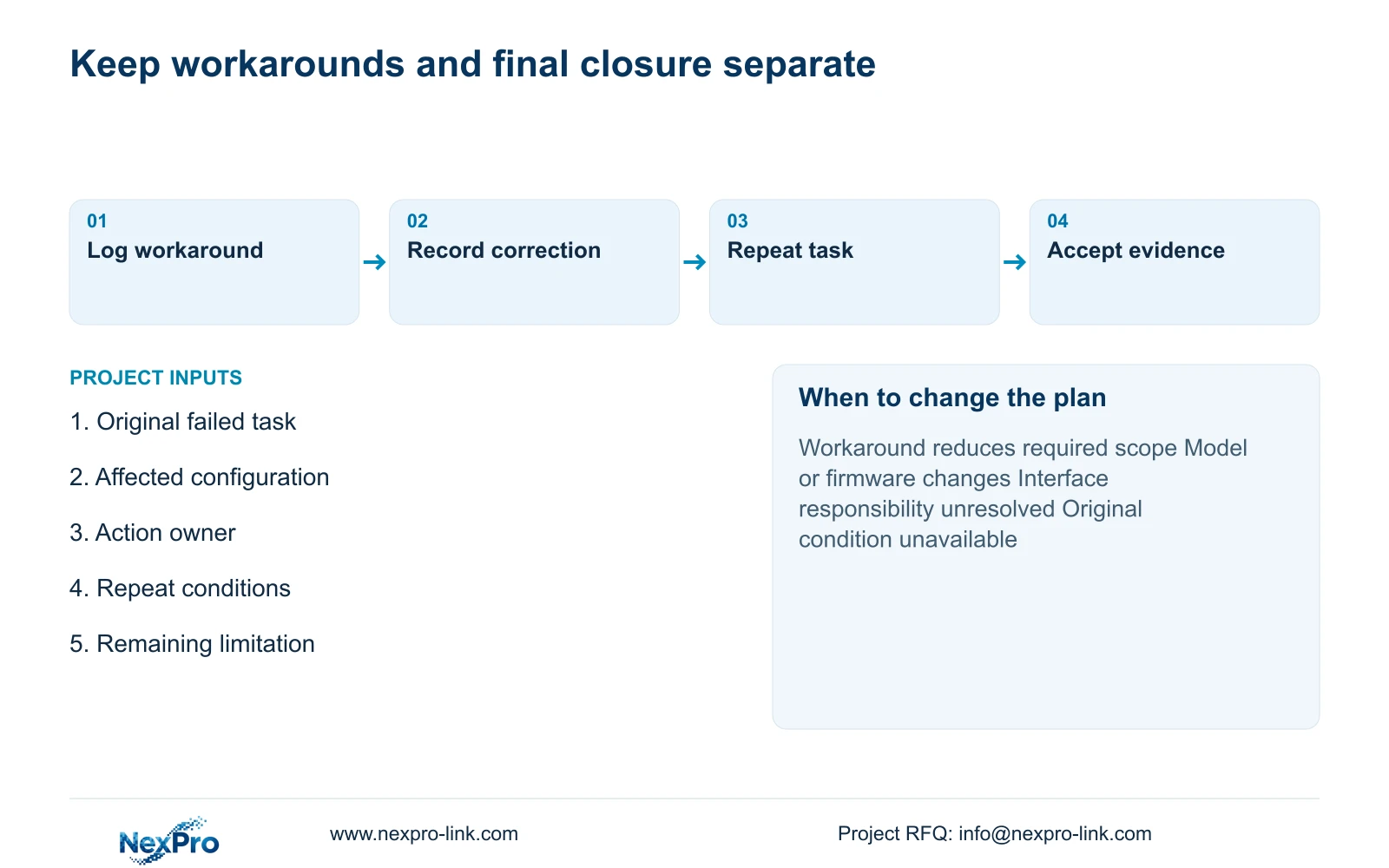
A temporary measure can restore part of the service while a permanent correction is arranged. Record exactly which task it preserves and which limitation remains. Reducing a viewing workload may restore a grid without proving that the required concurrent replay mode works. Moving a camera can improve the image while leaving its approved coverage task unresolved.
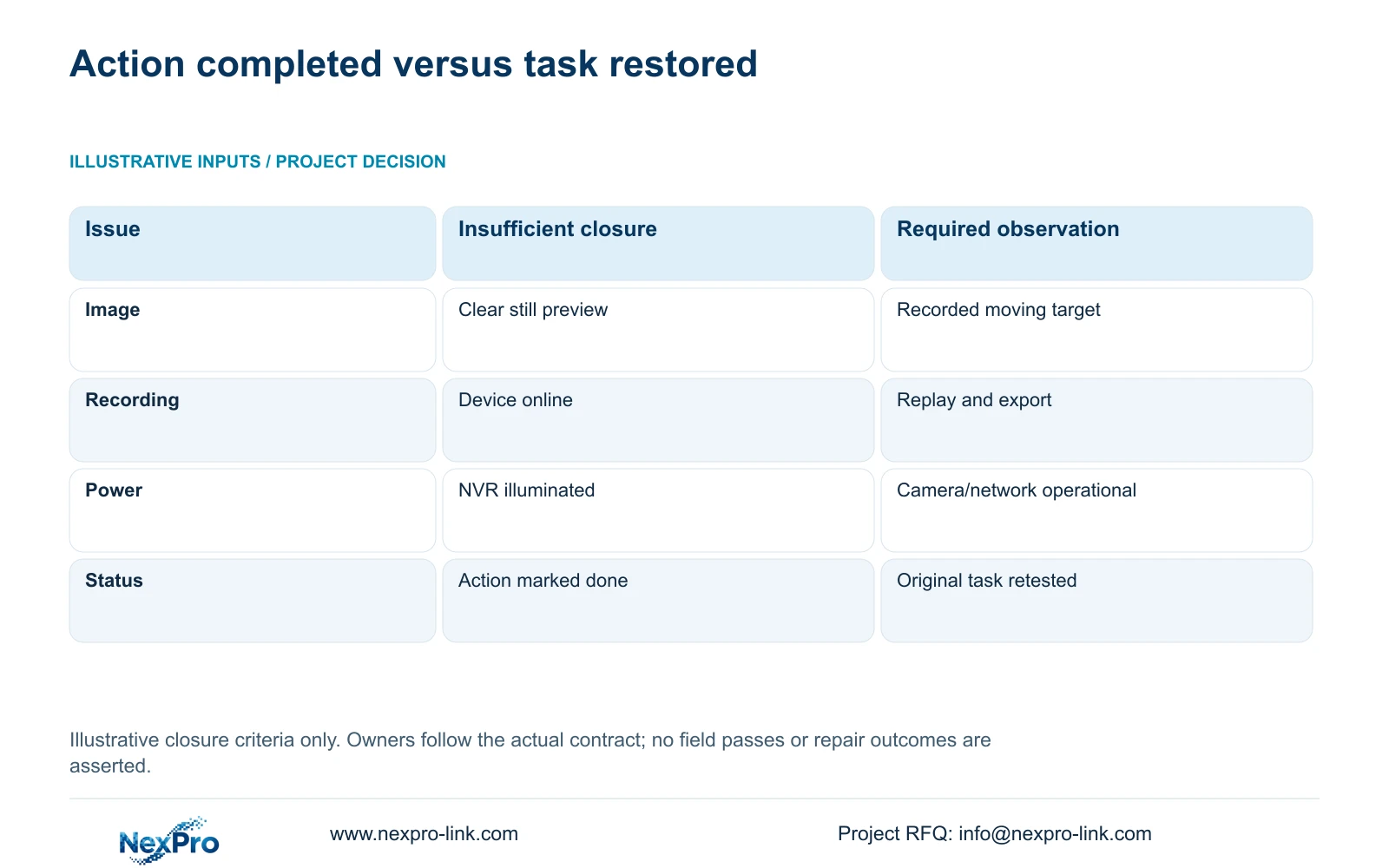
Use the snag record below to keep actions, workarounds and closure evidence distinct. The retained illustration shows why a clear preview, online device or illuminated NVR is insufficient for a failed operating task. Record the actual repeat observation instead of copying a generic pass statement.
Compare a local spare, supported substitute and replenishment option by their restoration steps. Confirm the substitute's relevant function and configuration before use. Equipment replacement, site labor and transport belong in separate scope lines, so a workaround does not become an unpriced permanent change.
The supplied warranty record states a 24-month limited hardware baseline for applicable main equipment from customer receipt, subject to controlling written terms. Batteries, disks, cable and OEM scope require their own terms. That baseline does not establish free site labor, travel or every return-shipping cost.
| Record field | What to enter | Closure boundary |
|---|---|---|
| Failed task and condition | Tag/interface, time/state, required versus observed outcome | Keep diagnosis provisional until supported |
| Action owner and dependency | Party with the required access; contribution of other parties | Contract scope is not inferred from a shared supply order |
| Workaround | Function preserved and limitation remaining | Original issue stays open unless revised scope is accepted |
| Correction and retest | Changed model/version/setting plus repeat conditions | An easier or different test does not close the original task |
| Final observation and acceptance | Evidence reference, accepting role and unresolved limitations | Completed action and accepted outcome are separate states |
Section 05
Repeat the original operating condition
Retest the failed task after the action is complete, preserving the conditions that made the problem relevant. For recorded movement, use the agreed route and relevant lighting. For retrieval, retain the required user role and workflow. For outage operation, examine the approved protected path instead of observing only the recorder's front panel.
Document what changed between observations, including model, firmware or configuration where relevant. If the retest uses a different condition, state why and identify which part of the original requirement remains unexamined. A successful easier test should not silently supersede the failed task.
Check related functions affected by the correction. A stream-profile change can affect viewing and recording scope; a permissions change can affect export access. Keep those consequences tied to the modified dependency so a resolved item does not introduce an unrecorded loss elsewhere.
Retain the issue when the required observation cannot yet be performed. A completed action and an accepted outcome are different states. Limited observations should remain limited in the record, without being extended into claims of zero defects or reliability across the whole equipment series.
Section 06
Close the item with reproducible evidence
The closure entry should preserve the original task, correction and final observation, together with the relevant configuration and date. Record remaining limitations and any accepted scope change. Another authorized engineer should be able to understand how the conclusion was reached without reopening an undocumented sequence of messages.
Use functional closure when the original requirement can be demonstrated. Change the requirement only through the project's agreed authority when a platform limitation, site constraint or revised operating need makes the original task unsuitable. Keep the commercial effect of that change separate from the technical observation.
For equipment-support discussion, send a redacted snag extract, affected model and firmware references, the relevant dependency diagram and repeat-test conditions to info@nexpro-link.com. NexPro-Link can discuss model-specific information and coordinated supply or BOQ changes. Do not include guest footage, passwords or account credentials in an initial inquiry.
Section 07
Buyer questions
Can a restarted device be marked as a closed defect? Only if the restart restores the required task and the agreed retest demonstrates it. If the same symptom remains unexplained or the workflow still fails, record the restart as an action and retain the issue.
Who owns a problem spanning the camera and hotel network? Assign a lead coordinator and separate actions according to actual access and contract responsibility. Keep the interface issue visible until the full task has been observed, even if each participant reports its individual component operational.
What information is needed before returning equipment? Confirm return authorization, device identity and symptoms with the responsible supplier. Agree how credentials and stored footage will be handled before shipping. Warranty eligibility and transport or site-service costs require the applicable written scope.
Engineering references
These sources support the general planning principles. Always use the selected product's current datasheet and applicable project standards for final design.