Factory checks can confirm an agreed equipment configuration. Hotel acceptance must also establish that installed views, recording paths and authorized workflows work under site conditions.
Section 01
Define the operating outcome to accept
Use factory acceptance testing to confirm the agreed configuration and reproducible equipment tasks, then use site acceptance testing to verify the installed hotel's views, network paths, permissions and outage behavior. Retain both stages when the required outcome depends on site conditions. A factory pass cannot establish that a camera sees the intended action through the hotel's actual lighting and obstructions.
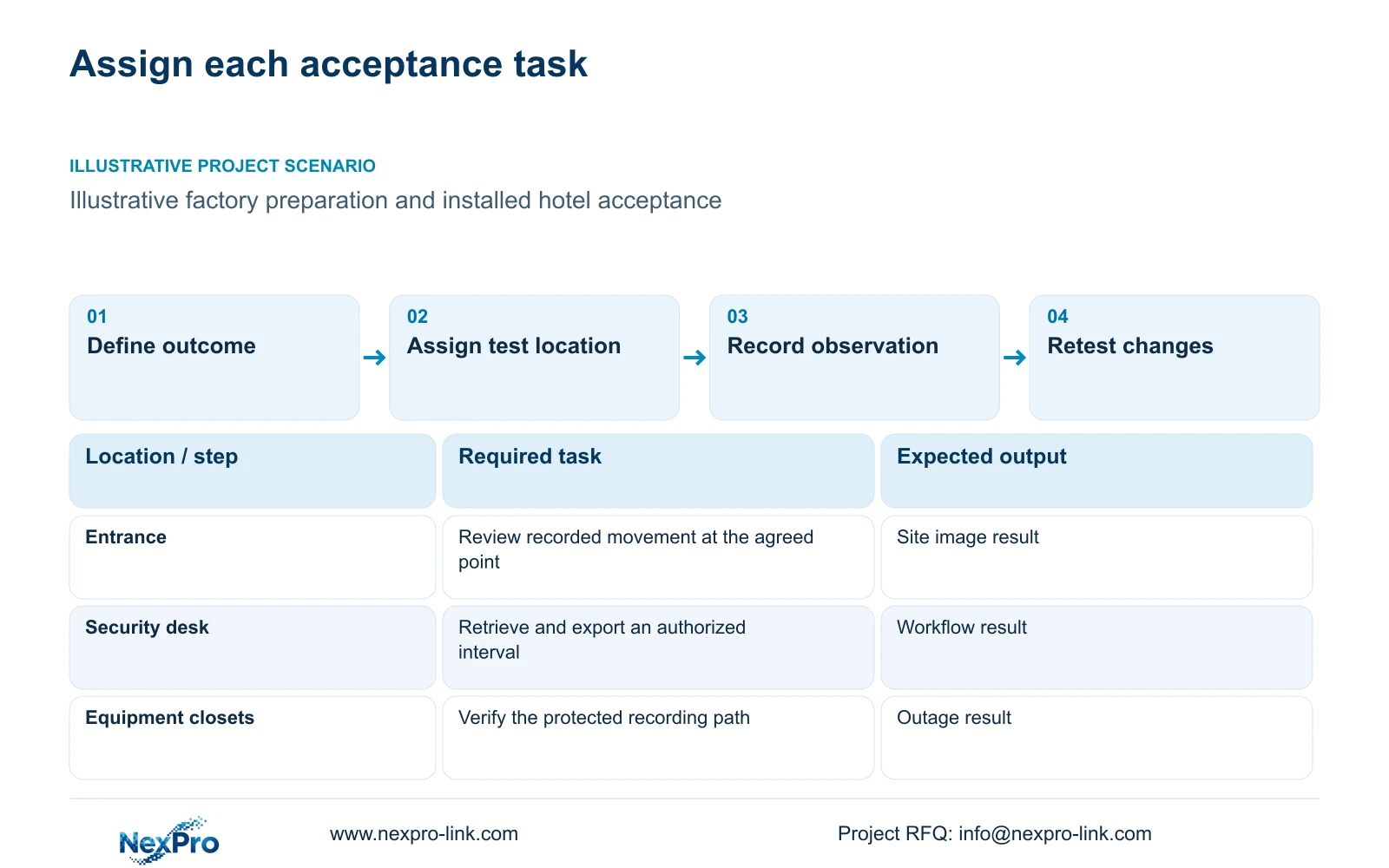
Write acceptance criteria around observable work. At an entrance, the task might be to retain a moving person's passage at an agreed observation point. For an incident workflow, an authorized operator must locate the relevant interval, replay it and produce a usable export. State the camera group, recording profile and conditions associated with each result.
Separate the acceptance criterion from the observation field. The criterion describes what must happen; the observation records what happened during the test. A blank result remains untested. This distinction lets the design engineer identify missing work without turning an intended outcome into a pre-filled pass.
| Required task | Given information | Decision still needed |
|---|---|---|
| Entrance movement recording | A public entrance view is required | Agree observation point and night conditions |
| Authorized incident export | Replay and export are required | Agree user role, interval and playback check |
| Outage recording continuity | Recording must remain available | Identify every protected active node |
Section 02
Identify factory-observable tasks
Give the factory the approved model schedule and the specific configuration to prepare. Record equipment identities, firmware references, stream settings and the connected recorder or client used for the demonstration. These details establish which combination the result covers and provide a baseline for later site comparison.
Factory-observable work can include checking device identity against the schedule, demonstrating recording and retrieval with the selected equipment, and examining export playback under the agreed setup. A reproducible image task can also be demonstrated when its target route and lighting conditions are defined. A bench arrangement does not reproduce the installed hotel's cable routes or public-space geometry.
Keep equipment preparation and interface verification separate. ONVIF Profiles provide a basis for checking relevant device and client functions, but general ONVIF support does not establish every event, audio, search or account workflow. If an enterprise platform is mandatory, include its actual supported configuration in the test scope instead of relying on a basic live-view connection.
| Item | Factory scope | Site scope | Effect on the hotel task |
|---|---|---|---|
| Equipment identity | Match approved models and configuration | Check installed identities and revisions | Preserves the tested baseline |
| Recorded footage | Demonstrate replay and export in the setup | Repeat through installed paths and roles | Checks the operational workflow |
| Image task | Use reproducible target conditions | Use actual position and lighting | Establishes whether the installed view is useful |
Section 03
Separate site-dependent conditions
Site acceptance starts with the installed observation task. Reception glazing, entrance backlighting, corridor obstructions and the final lens adjustment can change what recorded footage contains. Test the relevant public route without extending coverage into guest rooms or other private spaces. A clear factory scene leaves these installed conditions unresolved.
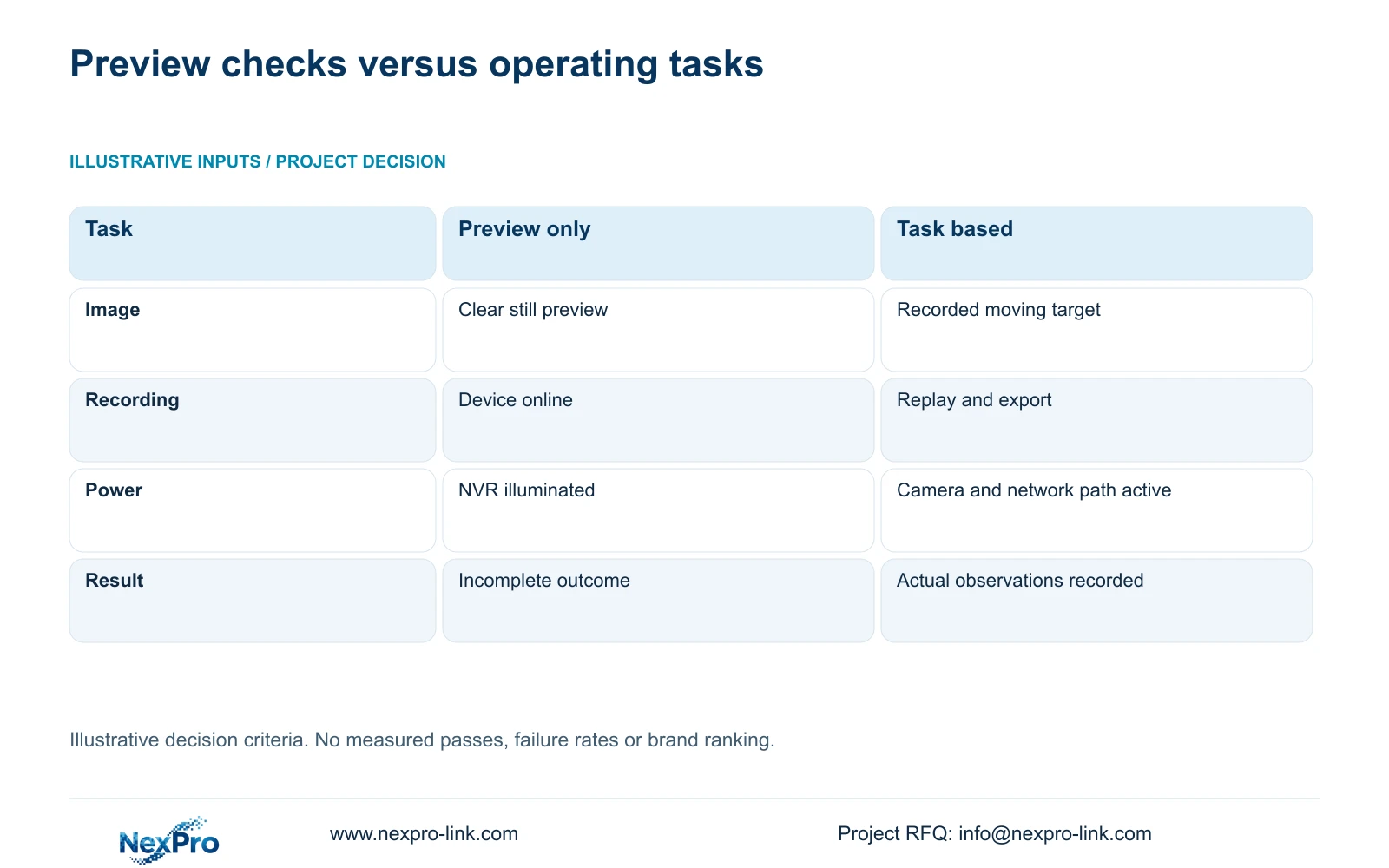
The same separation applies to power. The NVR can remain illuminated while an unprotected access switch stops supplying cameras. Trace the recording path through its required active nodes, then identify the power source for each node. Fibre carries data and does not automatically provide remote equipment power.
Use the traceability matrix to decide which factory evidence remains applicable and which installed condition needs a new observation. The retained illustration contrasts a visible preview with a completed operating task. Neither it nor the matrix reports a passed test: the responsible team records actual models, versions, conditions and remaining issues.
| Task | Factory evidence can cover | Repeat or resolve on site |
|---|---|---|
| Model/configuration identity | Approved combination and demonstrated versions | Installed substitutions or configuration changes |
| Recorded image task | Defined target, light and stream in the test setup | Actual geometry, light, obstructions and public-space boundary |
| Retrieval/export | Selected recorder/client and supported role in the setup | Installed paths, authorized accounts and usable exported result |
| Protected recording | Equipment in the demonstrated power boundary | Every essential installed remote node and approved outage state |
| Closure | Observed scope and outstanding items | Same task after correction; no pre-filled pass |
Section 04
Compare test scope and results
Use the comparison to allocate tests, not to score brands. Preview-only checks can confirm a limited visible condition, such as whether an image reaches a screen. Task-based checks establish whether that image remains useful in recording, retrieval and the selected outage state. Keep the limited check when it helps diagnosis, while retaining the complete task as the acceptance criterion.
Compare factory and site records by task reference and configuration. A result obtained on one sample under one lighting arrangement supports that observation. It does not establish a population failure rate, lifetime reliability or performance across every hotel zone. Record untested conditions explicitly so the buyer can distinguish completed work from remaining risk.
When a task fails, describe the missing outcome and assign the correction to the responsible party. After the change, repeat the original task under comparable conditions. Closing a defect entry without replaying the required workflow leaves the technical result unresolved, even if the paperwork appears complete.
Section 05
Record configuration changes between stages
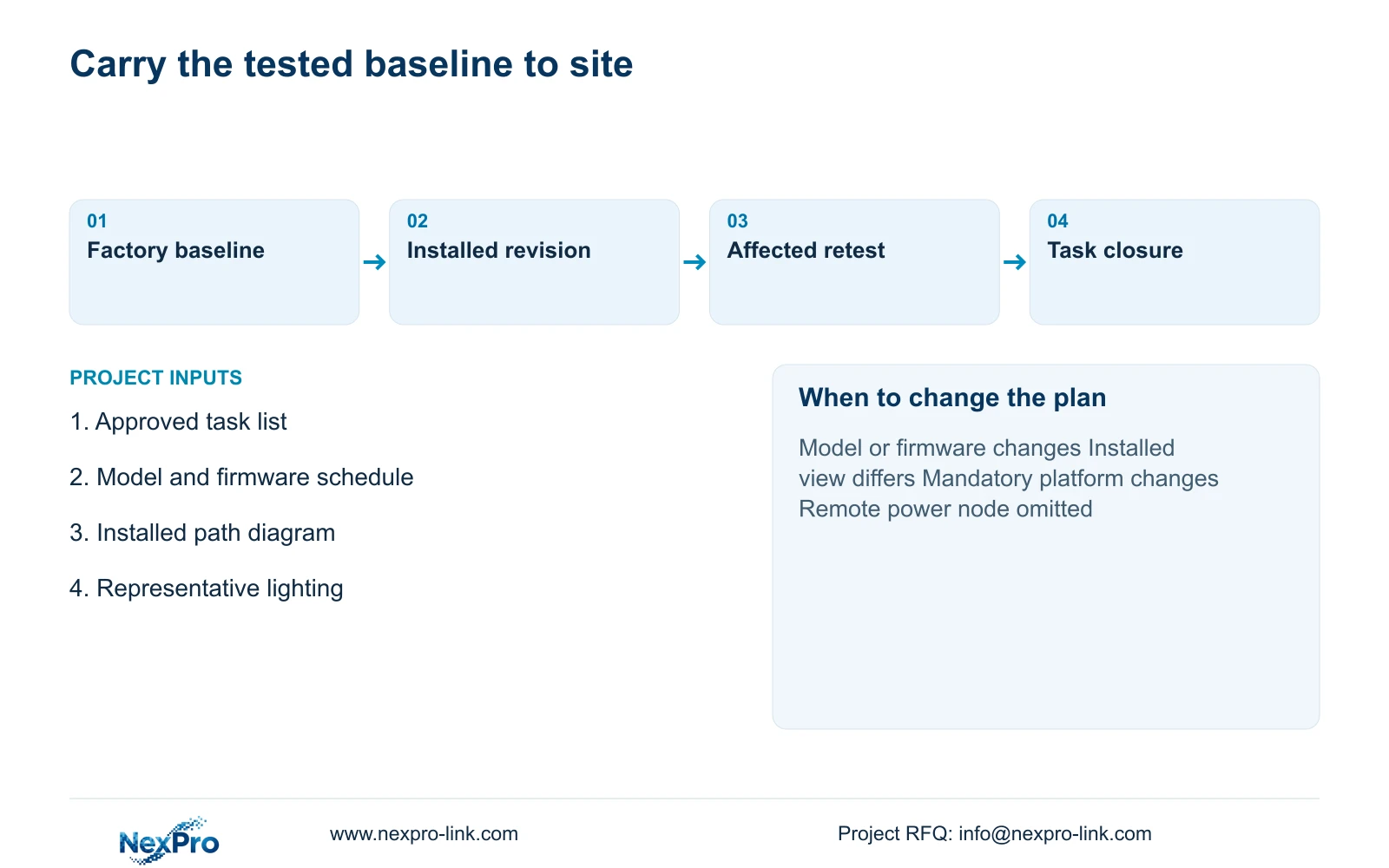
Keep the factory baseline available during installation. A substituted camera, revised firmware, different disk configuration or altered stream profile can change the meaning of an earlier result. Record the previous and installed configurations, the reason for the change and which acceptance tasks need repetition.
Commercial changes need the same clarity. Additional cameras may require more ports, storage or protected power. A display upgrade can introduce decoder and electrical scope without improving essential recording. Separate quantity changes from specification changes and shared-resource additions so the revised quotation explains what the buyer receives.
Retain the required outcome before buying extra scope. A mandatory platform interface warrants additional verification when the hotel needs that workflow. A larger display warrants its own task and signal-path assessment when operators need it. Neither addition should silently replace the approved recording or outage requirement.
| Retained outcome | Extra scope | When it is worth buying | Counter-condition |
|---|---|---|---|
| Usable incident retrieval | Platform interface verification | Required workflow uses that platform | Basic connection alone cannot establish support |
| Continuous essential recording | Display and decoder checks | Display is an agreed operational dependency | Optional display must not reduce recording protection |
Section 06
Close the chain at the installed hotel
Recommend linked FAT and SAT records for projects with site-dependent views or infrastructure. Change the equipment proposal if installed conditions, a mandatory platform or a revised operating task invalidates the tested configuration. Preserve the requirement and repeat the affected task before treating the change as accepted.
Where a control-room display is included, establish its reading task and operating layout before accepting the screen arrangement. A working screen does not prove usable event presentation or concurrent decoding. NX-VP-5535 is a Full HD LCD panel; NX-VD-4K16 remains a decoder candidate whose name does not establish sixteen simultaneous 4K streams.
NexPro-Link can support model matching, technical documents and coordinated equipment supply. CCTV manufacturing and coordination of supporting categories have separate responsibilities; local installation and site testing belong in the agreed scope. Send the acceptance tasks, model and firmware schedule, and representative site conditions to info@nexpro-link.com through the hotel project support or BOQ support route. Initial inquiries do not need guest footage or credentials.
Section 07
Buyer questions
Can we reduce repeated testing after a documented factory pass? Reuse the factory record for the unchanged configuration and conditions it actually covered. Keep site tests for installed views, paths, permissions and outage behavior. Repeat any equipment task affected by a configuration change.
Does acceptance extend the equipment warranty? The supplied policy record gives applicable main equipment a 24-month limited hardware baseline from receipt. Acceptance does not create a different start event. OEM, batteries, disks, cable and service costs follow their written scope and controlling order.
What should an unresolved acceptance item contain? Identify the failed operating task, tested configuration, observed conditions, responsible party and repeat-test criterion. Keep the observation separate from the planned remedy so administrative closure cannot substitute for a restored function.
Engineering references
These sources support the general planning principles. Always use the selected product's current datasheet and applicable project standards for final design.