The lowest camera price cannot establish the lowest hotel security cost. Normalize technical outcomes and omitted work, then compare initial and recurring costs over a stated evaluation period.
Section 01
Define the evaluated scope
Recommend the lowest evaluated cost among technically qualified, scope-matched offers. A low camera unit price is a valid saving only when the complete offer preserves the hotel's required coverage, recording, power and service outcome. If an exclusion or changed specification removes a required task, return the offer for clarification before treating its price difference as a saving.
Establish a common comparison baseline with the same quantities, recording policy, destination, currency and delivery boundary. Separate confirmed quantities from provisional allowances. A bid based on a preliminary camera count should remain identifiable when the design later changes, otherwise quantity growth can be confused with a supplier rate increase.
Define the financial decision period before comparing recurring services. The owner may be choosing an initial equipment purchase, a complete installation package or a longer operating commitment. Those scopes produce different totals. A cost plan can contain assumptions, but an unknown excluded item must stay visible until it is priced or assigned to another party.
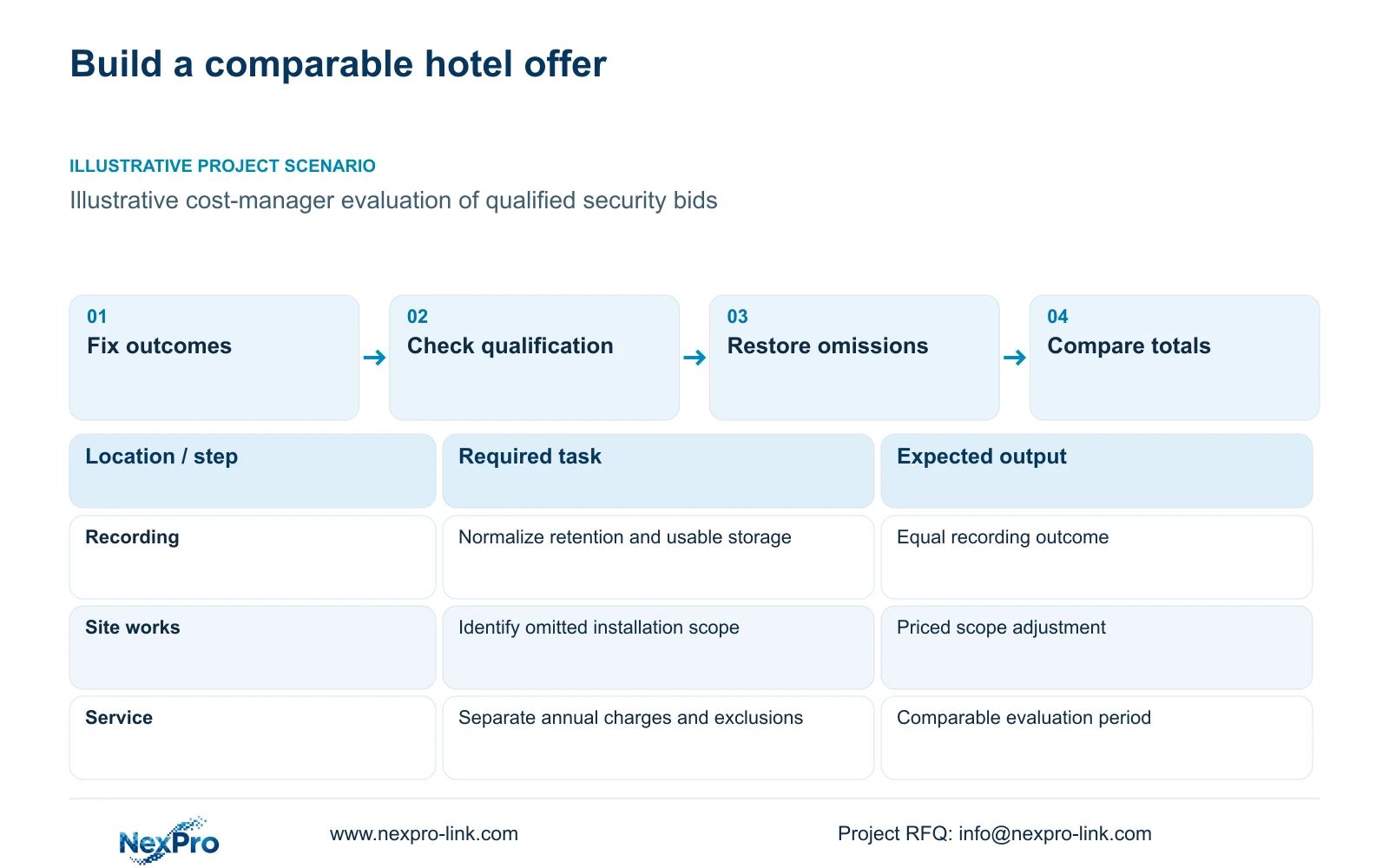
| Required task | Given information | Decision still needed |
|---|---|---|
| Retain required footage | Camera and recorder allowance | Usable storage and approved retention |
| Install usable equipment | Device supply prices | Mounting, cabling and site labor scope |
| Restore service | General support description | Local action, freight and replacement boundaries |
Section 02
Apply technical entry conditions
Have the engineering team identify the technical entry conditions before the cost manager ranks offers. The proposed system must support the approved camera tasks, recording modes, usable storage and required operating state during an outage. Commercial normalization cannot make an unsupported recorder mode or an incomplete power path technically acceptable.
CASE01 provides an illustrative baseline, independent of the cost example below. Its 32 assumed streams at 4 Mbps require 128 Mbps recording input and 51.84 TB of usable capacity for its stated 30-day policy with 20% free space. A cheaper package with less usable storage would need a documented correction before comparison. The case is not a current quotation or evidence of delivered performance.
Check unresolved product fields explicitly. NexPro SW-POE1618G has conflicting port-speed descriptions and no stated numerical total PoE budget in the supplied record. NexPro-NVR2232-4K has conflicting disk-capacity and playback descriptions. Neither uncertainty should be resolved by choosing the most favorable value to justify a lower bid. Request an exact supported configuration or compare another admissible option.
Section 03
Normalize all required cost layers
Build the evaluated total from equipment, installation, software and delivery costs, with taxes and subsequent service stated separately where relevant. Restore omitted scope to the comparison using a documented allowance or a clarified quotation. Check bundled accessories before adding allowances so the same disk, patch lead or installation task is not counted twice.
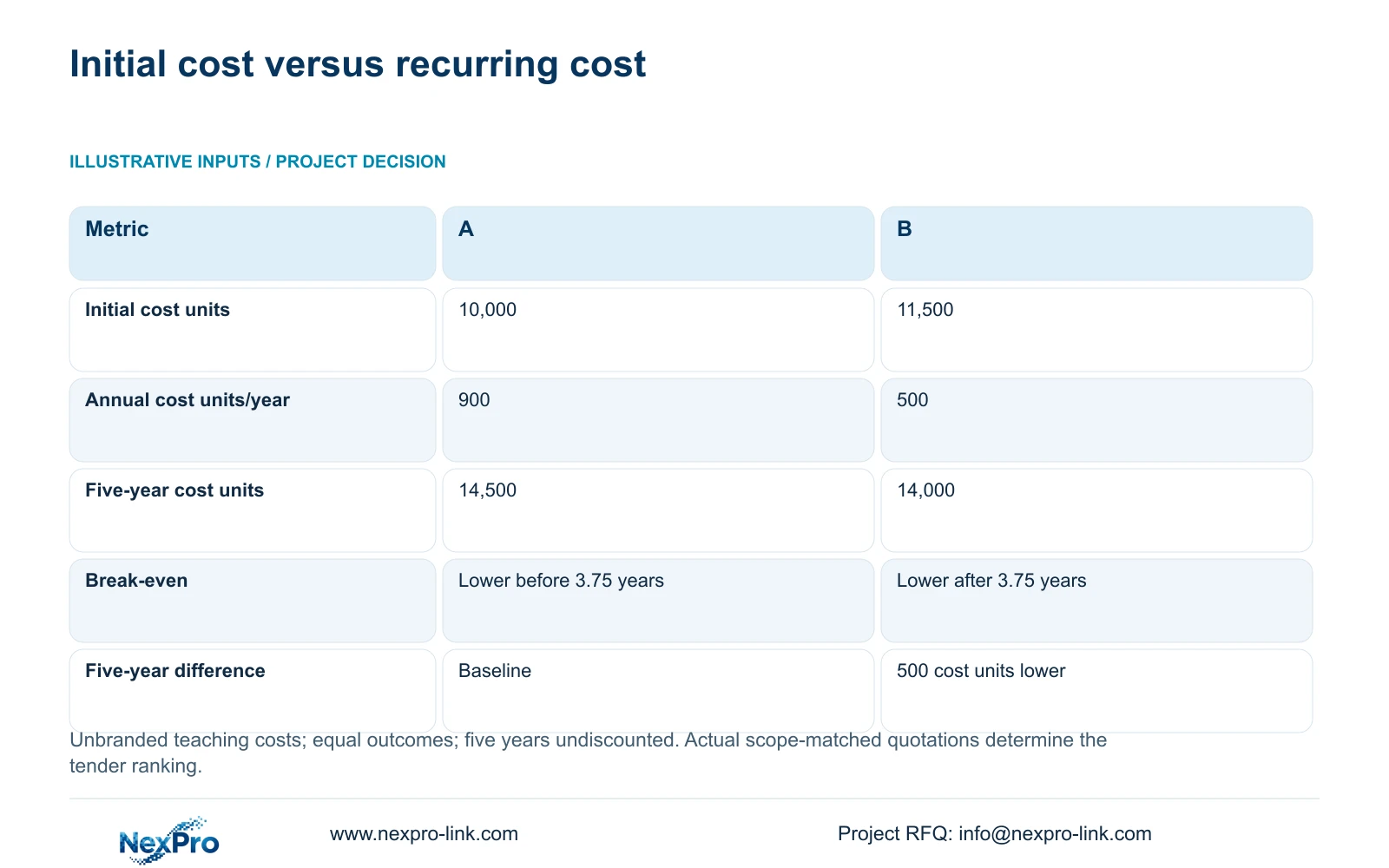
The table uses unbranded teaching cost units. Option A has an initial cost of 10,000 and an assumed annual cost of 900; Option B starts at 11,500 with an annual cost of 500. Both are assumed to deliver equal required outcomes over a five-year undiscounted horizon. These are not market prices, brand failure data or NexPro-Link service charges.
Calculate five-year total as initial cost plus five times annual cost. A totals 14,500 cost units and B totals 14,000. The 500-unit advantage for B depends on the annual costs actually applying throughout the period. The model excludes discounting and supplies no separate escalation assumptions, so use the buyer's agreed financial method for a real tender.
| Metric / condition | Option A | Option B |
|---|---|---|
| Initial teaching cost | 10,000 cost units | 11,500 cost units |
| Annual assumed cost | 900 cost units/year | 500 cost units/year |
| 5-year undiscounted total | 14,500 cost units | 14,000 cost units |
| Break-even time | Before 3.75 years: A lower | After 3.75 years: B lower |
| Actual tender ranking | Requires actual scope-matched quotes | Not established by this example |
Section 04
Compare change and service assumptions
Ask each bidder to explain how quantity changes, model substitutions and shared-resource upgrades affect the quotation. Preserve the original quantity and rate, then calculate the quantity effect at the original rate and the specification effect on the revised quantity. Identify added shared resources separately. This sequence prevents the same change from appearing in two adjustments.
A small increase in camera quantity can cross a recorder, storage or switch-power limit. The resulting cost may be discontinuous. Compare genuine reuse of existing equipment with replacement, and record any cancellation or partial-release conditions. A late artwork change or a revised battery requirement cannot be assumed to carry no cost or schedule effect.
The supplied warranty record gives an applicable main-equipment baseline of 24 months from receipt, subject to controlling written order terms. Batteries, disks, cable and OEM scope require their own treatment. Compare site labor, return freight and expedited transport separately. Ongoing technical support does not establish unlimited free repair or local attendance. A longer headline term is insufficient without a comparable remedy and expense boundary.
Section 05
Test break-even conditions
The illustrative break-even calculation is the additional initial cost divided by the annual cost reduction: (11,500 minus 10,000) divided by (900 minus 500), giving 3.75 years. Before that point A has the lower accumulated cost. At the point they are equal; afterward B is lower under the stated assumptions.
Use this result to identify the input that could reverse the decision. B needs its recurring cost advantage to continue long enough to recover the higher initial allowance. If the evaluation ends earlier, or its annual service scope changes, recalculate the comparison. An unpriced license or return-freight obligation could remove the apparent advantage.
Keep additional scope attached to a retained outcome. An optional control-room wall can be considered where multiple operators need continuous observation, but its incremental equipment, decoding, installation and power costs need a separate line. If the required work is incident retrieval on an ordinary monitor, the larger display cannot be justified solely by a lower panel unit price. Evaluate the complete added service before buying it.
| Retained outcome | Extra scope | Worth evaluating when | Counter-condition |
|---|---|---|---|
| Equal required service | B's higher initial allowance | Annual advantage persists beyond 3.75 years | Shorter horizon or higher recurring costs |
| Incident retrieval | Optional display wall | Continuous multi-operator viewing is required | Ordinary monitor meets the task |
Section 06
Recommend a qualified commercial option
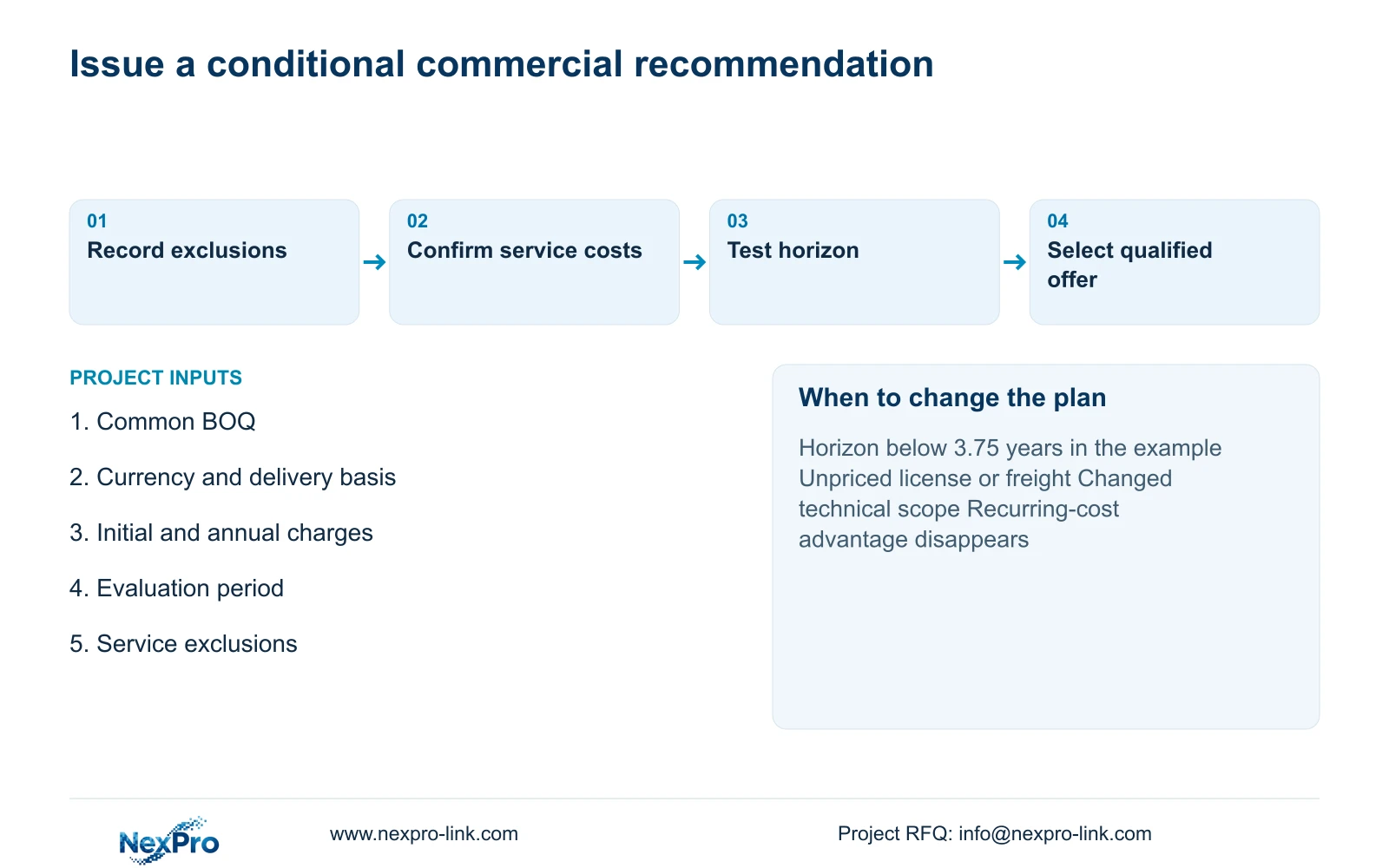
For the teaching comparison, choose B over five years if both offers remain technically equal and the annual costs remain 900 and 500 cost units. Choose A for a period shorter than 3.75 years under those same assumptions. For an actual procurement, replace every teaching input with the qualified quotation and the agreed evaluation method before naming a commercial winner.
Present the recommendation with its inclusions, unresolved allowances and change triggers. A supplier with the lowest complete price can be recommended without claiming superiority in every technical category. If a mandatory platform, destination requirement or service obligation changes, reopen the affected comparison rather than carrying forward an obsolete ranking.
NexPro-Link can discuss model matching, BOQ/BOM support and coordinated equipment supply, while CCTV manufacturing and supporting-category responsibilities remain distinct. Send the common equipment schedule, scope-matched quotation details, currency and delivery basis, evaluation period and required service boundary to info@nexpro-link.com. State whether alternatives are permitted. The BOQ and tender support route can help organize a comparable response without requesting unrelated confidential material.
Section 07
Buyer questions
Should an excluded installation item be entered as zero? No. Mark it unresolved and obtain a price or a documented evaluation allowance. Zero is appropriate only when the item is genuinely unnecessary or already included elsewhere in the same comparison.
Can this example show which CCTV brand is cheaper? No. Its cost units are unbranded teaching inputs. A brand comparison requires actual quotations for the same technical configuration, destination and service scope.
What cost information is needed before a supplier recommendation? Provide the common scope schedule, initial and recurring charges, delivery basis, currency, evaluation period and service exclusions. Identify uncertain items that could change the commercial ranking.
Engineering references
These sources support the general planning principles. Always use the selected product's current datasheet and applicable project standards for final design.