A full replacement quote can overlook usable assets, while a reuse quote can omit integration work. Compare complete operating outcomes and identify the costs that change the preferred scope.
Section 01
Decide what each existing asset still needs to do
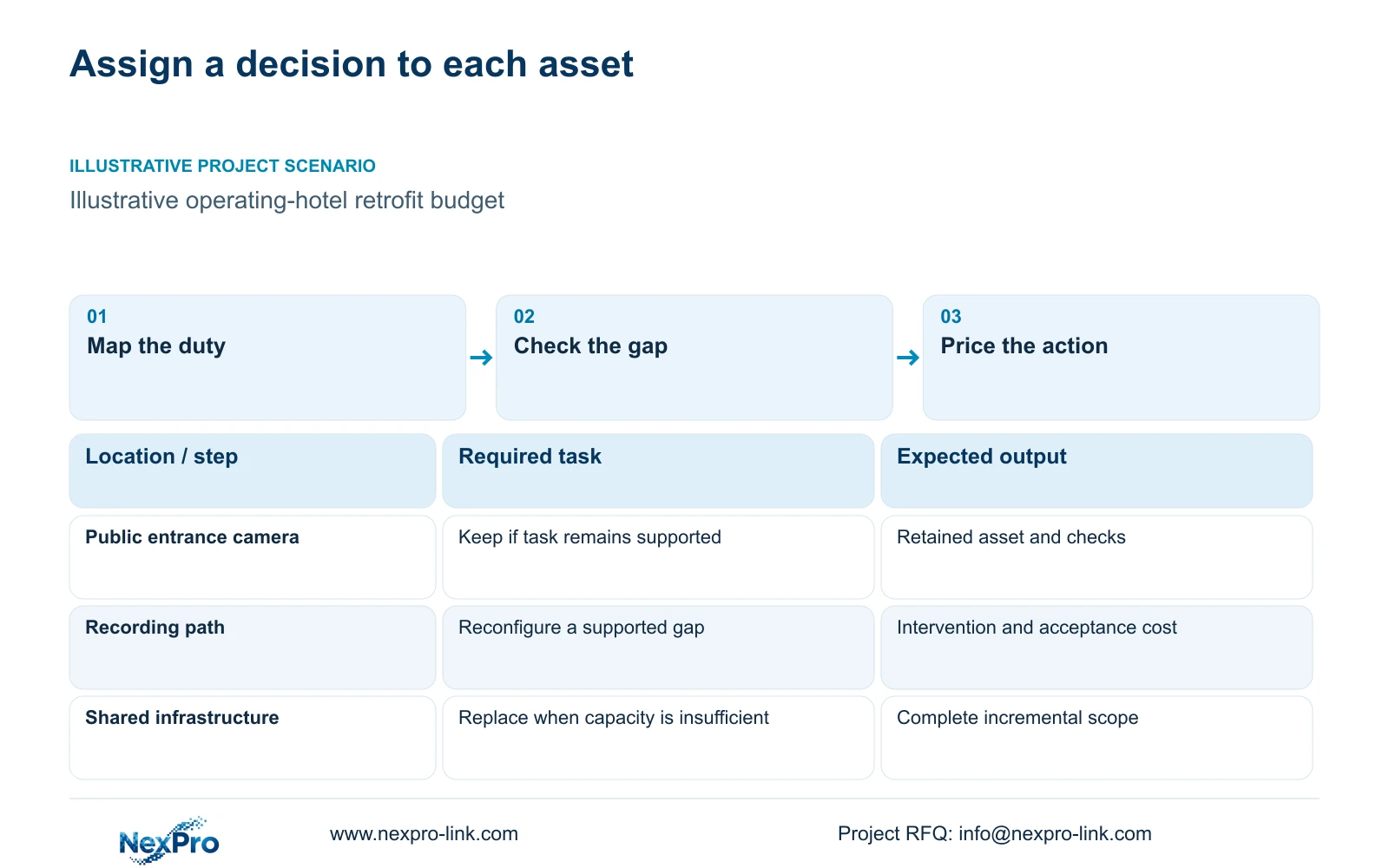
Retain equipment that demonstrably meets the hotel's required task and has a workable maintenance path. Reconfigure assets where a defined change closes the gap, and replace those that cannot support the required outcome. Compare the complete costs of those choices before accepting a whole-system replacement or a low-cost reuse proposal.
Inventory assets by function and dependency. A public-area camera needs a usable view and a supported recording route. A switch must provide the required ports, power and throughput. A recorder needs sufficient input capability, supported image modes and usable storage. Appearance and age alone do not settle those decisions.
Fix the comparison basis before collecting totals: camera tasks, retention, delivery destination, currency and service boundaries. Otherwise one bidder may include incident export and protected networking while another prices cameras only. Record the condition and known configuration of retained assets alongside the work needed to keep them.
CASE07's illustrative 20 retained and 12 proposed positions provides a renovation context. It is not evidence that 20 devices are suitable for a particular hotel or that reuse has a stated saving. The actual asset schedule must establish that scope.
| Required task | Given information | Decision still needed |
|---|---|---|
| Retain entrance recording | Existing camera and recorder identities | Can the complete path meet the task? |
| Add missing public-route views | Proposed locations | Which shared capacities change? |
| Maintain incident retrieval | Current client workflow | Does reuse preserve supported search and export? |
Section 02
Classify assets as keep, reconfigure or replace
A keep decision should identify the demonstrated task and any continuing service obligation. It does not mean the asset requires no work. Inspection, configuration records and integration checks may still belong in the retrofit scope, especially where a retained camera joins a different recorder.
Use reconfigure for a specific, supported intervention. Examples include adjusting an approved view or changing a stream profile while retaining the required image detail. State the intervention, its cost and its acceptance task. Do not treat a lower bitrate as a saving unless the resulting recording remains useful.
Replace an asset when its required duty cannot be supported, its condition prevents accepted operation or a mandatory operator requirement excludes it. A replacement can also be justified by a complete evaluated cost comparison, but the recurring assumptions need evidence from the actual proposed service arrangement.
For each classification, separate equipment, labor and any shared-resource effects. Hardware interoperability does not prove every client or account function. A missing integration or software price remains an open cost input rather than disappearing from the reuse total.
| Choice | Required evidence | Included work | Change condition |
|---|---|---|---|
| Keep | Required task remains usable | Checks and continuing support | Task or support gap appears |
| Reconfigure | Supported change closes the gap | Configuration and repeat verification | Change removes required detail |
| Replace | Retained asset cannot meet scope | New device and integration | Qualified reuse meets scope at lower evaluated cost |
Section 04
Price each complete operating option
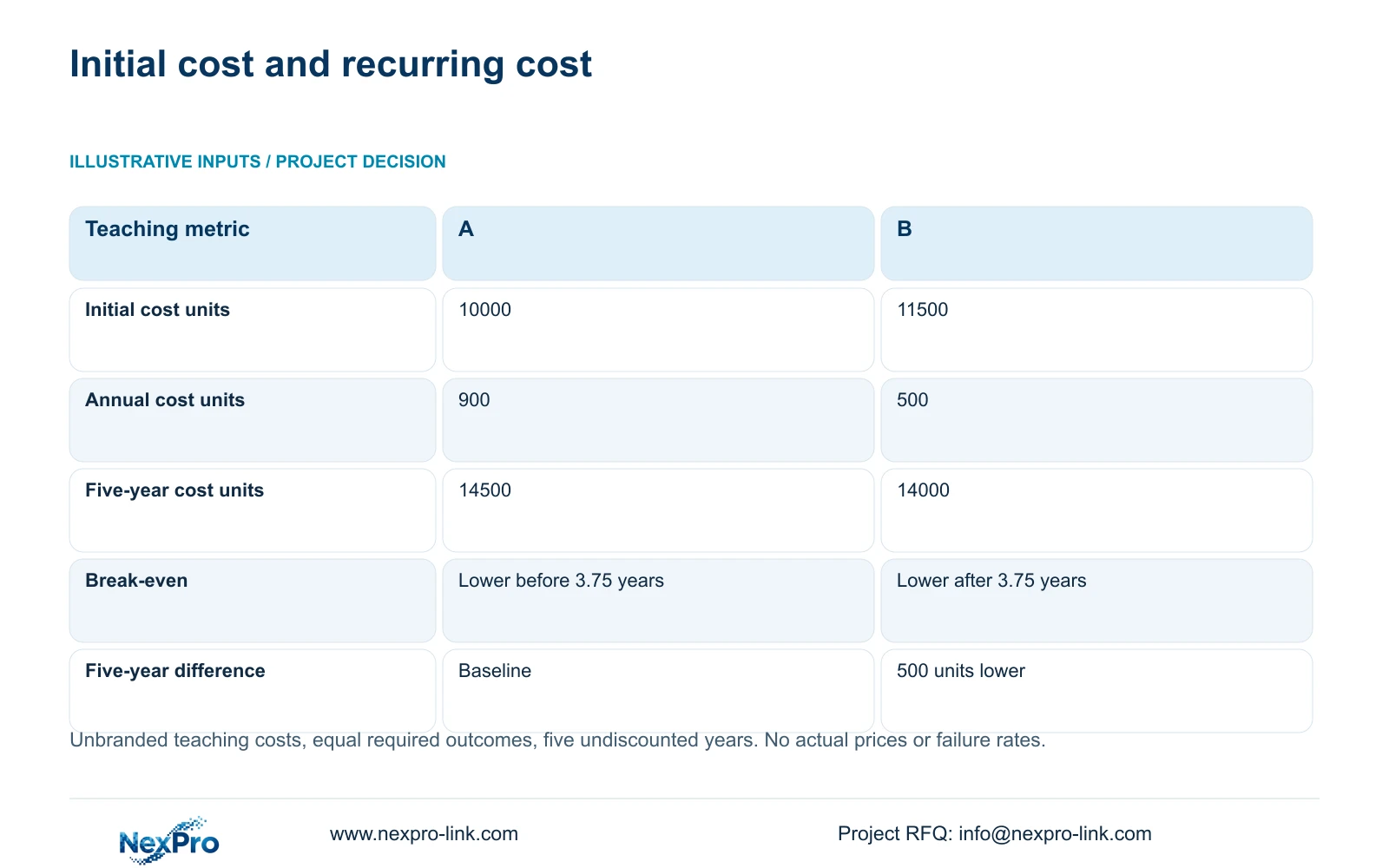
Option A totals 10,000 + 5 × 900 = 14,500 cost units. Option B totals 11,500 + 5 × 500 = 14,000. The extra initial amount is 1,500 units and the assumed annual difference is 400, giving 1,500 ÷ 400 = 3.75 years to break even.
B is 500 cost units lower at five years under those assumptions. Before 3.75 years, A is lower; at the break-even point the totals are equal. This shows how an evaluation period changes a decision without assigning a price advantage, failure rate or service performance to any brand.
For actual quotations, normalize equipment and installation with freight, taxes, software and later services. Identify what is included in each package and add excluded required work to the evaluated scope. Shared disks, patching or commissioning should not be charged twice through overlapping equipment and installation allowances.
Show continuing costs by their contractual basis. A stated annual service amount differs from an assumed repair event or upgrade allowance. This model is undiscounted and does not supply financing, inflation or residual-value inputs; use the owner's agreed evaluation method where those matter.
| Metric / condition | Option A | Option B |
|---|---|---|
| Initial teaching cost | 10000 | 11500 |
| Annual assumed cost | 900 | 500 |
| 5-year undiscounted total | 14500 | 14000 |
| Break-even time | Before 3.75 years: A lower | After 3.75 years: B lower |
| Actual tender ranking | Requires actual scope-matched quotes | Not established by this example |
Section 05
Test the costs that can reverse the result
The illustrative five-year advantage is only 500 units. An omitted required cost greater than that amount on B would reverse its five-year position if the other inputs remained unchanged. Trace the difference to the cost layer that creates it before presenting B as the economical choice.
The evaluation horizon is another change condition. A hotel planning a shorter period than 3.75 years would select A on this simplified cost basis, provided both outcomes remain equal. If B's annual saving is not supported by actual terms, the break-even result cannot justify its higher initial price.
Review reuse costs most likely to be uncertain: integration labor, documentation recovery, historical-footage preservation and site cutover work. Price known work and identify conditional allowances. Do not manufacture repair frequencies to make new equipment appear cheaper.
Warranty and restoration arrangements also need separate scope. The supplied policy record states a 24-month limited hardware baseline from receipt for applicable main equipment; batteries, disks, cabling, OEM terms and site costs depend on their written scope. That baseline is not an annual maintenance budget or a promise of immediate local replacement.
| Retained outcome | Extra scope | When worth buying | Counter-condition |
|---|---|---|---|
| Supported reused recording | Integration work | Complete reuse cost remains favorable | Unsupported workflow remains |
| Lower recurring cost | Higher initial scope | Supported saving over required horizon | Horizon is below break-even |
| Controlled cutover | Overlap and site work | Required continuity needs it | Cost is omitted from the comparison |
Section 06
Recommend a scoped renewal package
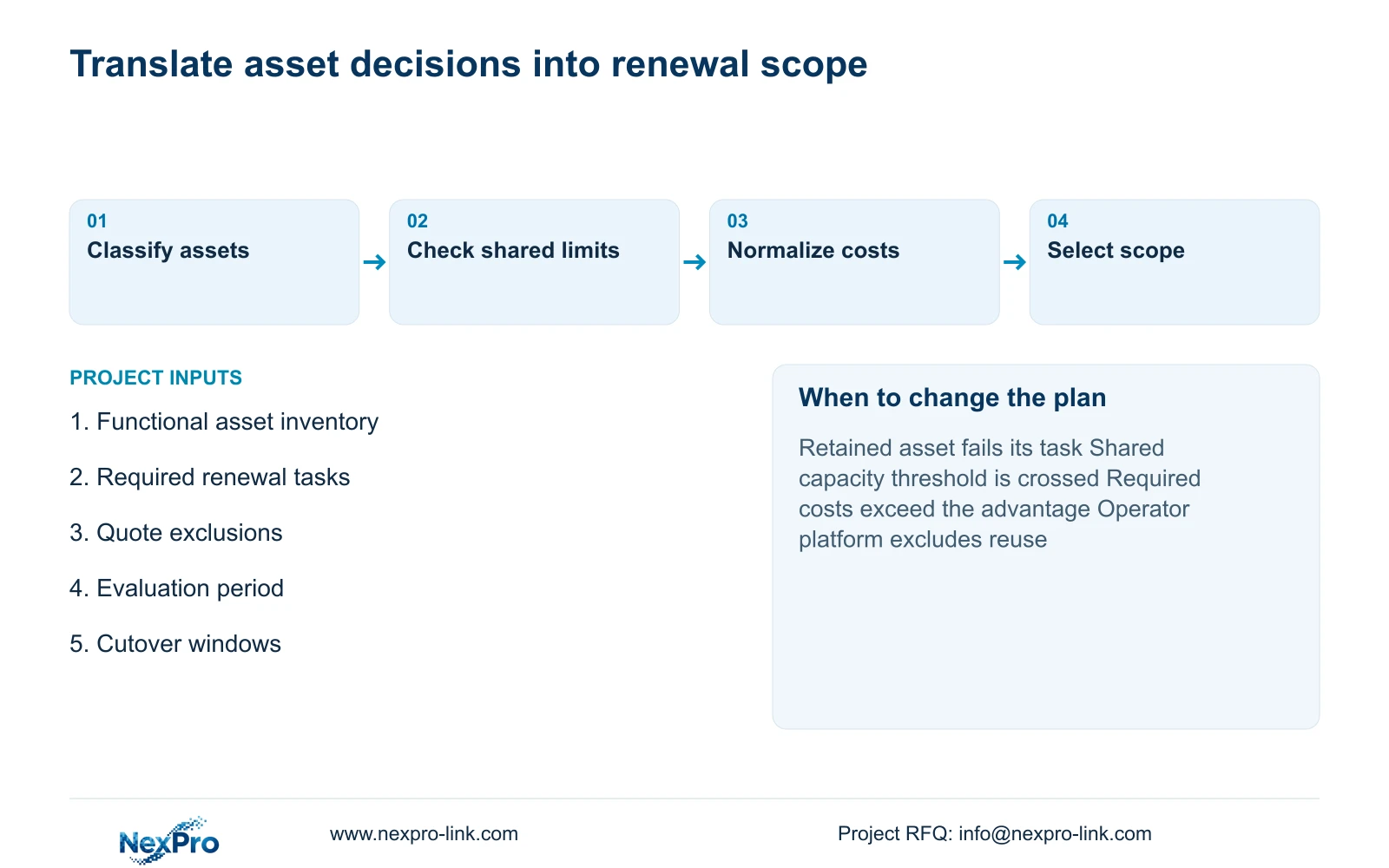
Select the lowest evaluated complete option among those that meet the required recording, retrieval and service duties. Keep verified assets, price defined reconfiguration and replace documented gaps. Change that plan if a retained dependency fails acceptance, a mandatory platform excludes it or actual scope-matched costs favor replacement.
Separate the renewal package into retained identities, interventions, new equipment and shared-resource changes. Define cutover and historical-access responsibilities. The cost manager can then reconcile the approved asset decisions with the quotation without converting every uncertainty into a whole-system replacement.
NexPro-Link's BOQ and tender support can assist model matching and a coordinated supply comparison, without assuring tender approval. Send the functional asset schedule, required renewal tasks, scope-matched quotations or cost exclusions, evaluation period and allowed cutover windows to info@nexpro-link.com. State the currency and delivery destination. Local installation and ongoing service belong in the agreed boundaries.
Section 07
Buyer questions
Is reuse automatically cheaper than replacing the system? No. Include integration, verification, cutover and continuing service in the reuse scope. Reuse is economical only when the complete qualified option costs less while preserving the required tasks.
Can the teaching comparison rank actual brands? No. Its 10,000/11,500 initial and 900/500 annual figures are unbranded assumptions. A commercial ranking needs actual quotations with equal scope, currency and delivery terms.
What makes the illustrative recommendation change? A period below 3.75 years favors A in the simplified model. At five years, more than 500 additional required cost units on B can reverse its advantage if all other inputs remain unchanged.
Engineering references
These sources support the general planning principles. Always use the selected product's current datasheet and applicable project standards for final design.