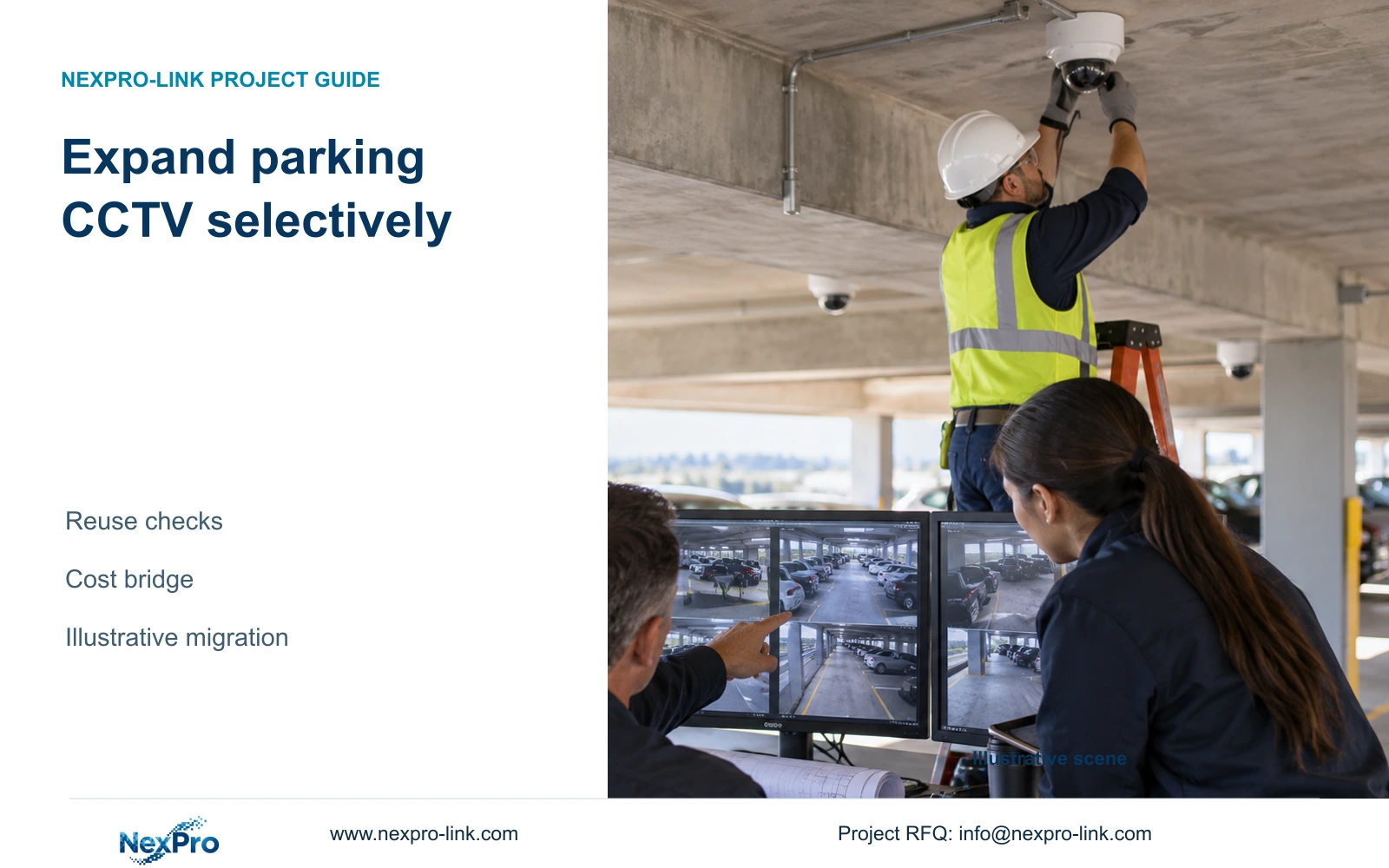
Retain working parking CCTV equipment when its supported capacity and functions meet the expanded task. Identify the actual bottleneck, explain each cost change, and compare reuse with replacement on equal scope.
Section 01
Inventory the equipment that can still serve the task
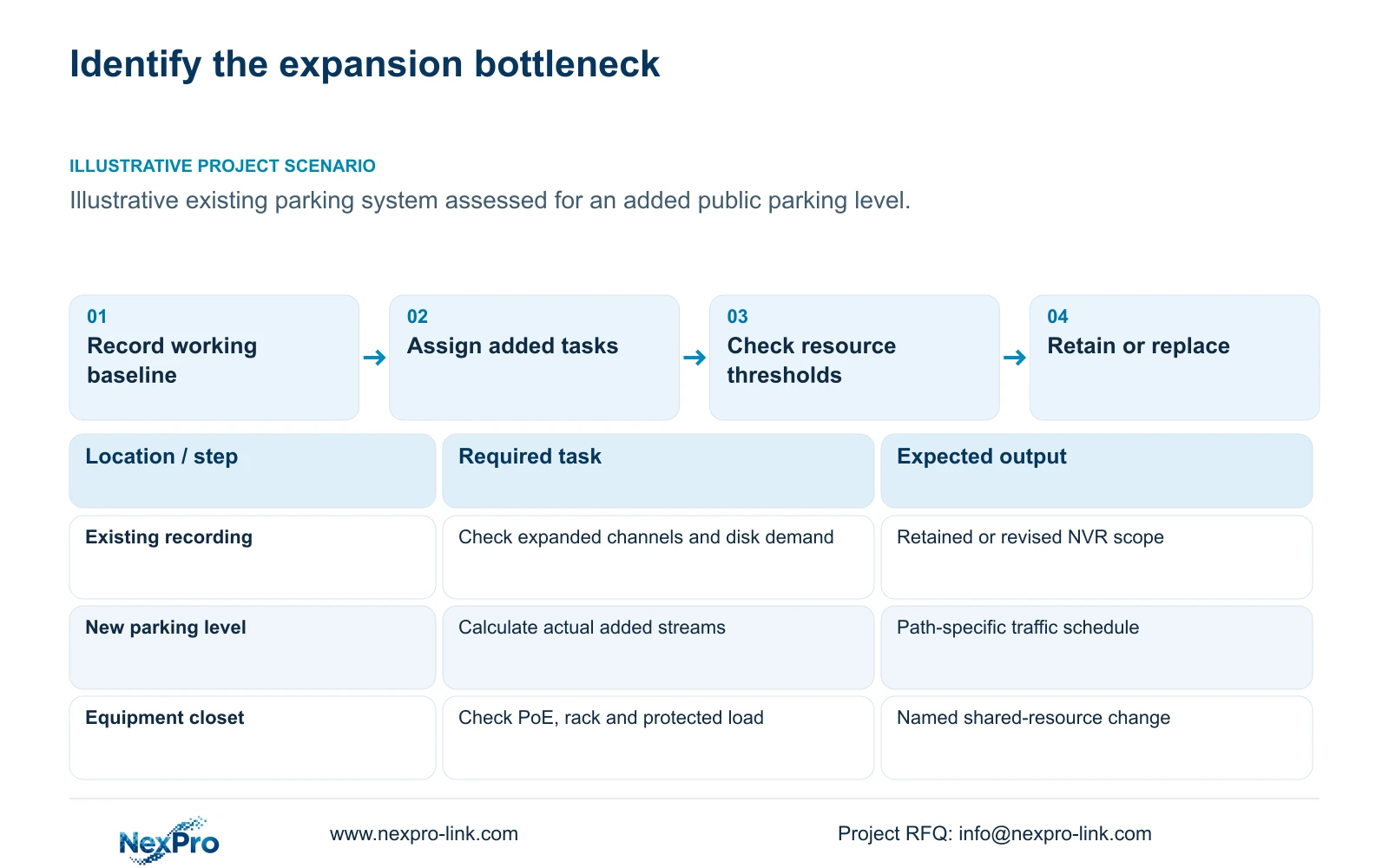
Retain existing cameras, recording and network equipment when their supported functions and remaining resources meet the expanded parking task. Replace the component that fails that check, and compare the complete reuse scope with complete replacement before purchase. A new parking level does not, by itself, justify either keeping every device or replacing the entire system.
Create a dated baseline showing installed quantities, exact models, recording profiles and the current operating responsibility. Identify which views record and can be replayed, which interfaces are in use and which equipment has a documented configuration. Equipment being powered on supplies less evidence than completing the required retrieval and outage tasks.
Preserve the commercial baseline alongside the technical record. Separate equipment already owned from items in an unplaced quotation, since reuse and cancellation have different consequences. CASE09 is an independent 16-camera teaching annex; it cannot supply the inventory of an existing hotel or be combined with the 32-to-36-unit cost illustration below.
| Required task | Given information | Decision still needed |
|---|---|---|
| Keep existing recording | Recorder model and working profiles | Expanded input, modes and usable capacity |
| Reuse access networking | Port allocation and current load | Added per-port and total PoE demand |
| Preserve incident retrieval | Current client and archive workflow | Supported old/new search and export path |
Section 02
Define the added parking coverage tasks
List the new level's public observation tasks, including its ramp connection and pedestrian approach. Assign views according to the layout and required detail, then assess whether an existing position can serve a changed route. Camera quantities should follow those tasks, not a uniform count per floor.
Record added quantity separately from changed specification. An extra overview at an unchanged profile consumes different resources from replacing several existing views with higher-rate recording. Keep specialized plate reading and barrier control outside ordinary overview quantities unless their own supported scope is explicitly revised.
Classify each schedule line as retained, relocated, added or removed. Identify accessories and local work associated with those classifications. A retained camera may still need a new mount or route; a removed item may have no recoverable commercial credit. Compare an alternative only after it preserves the approved view and retrieval outcome, including the relevant lighting and maintenance requirements.
Section 03
Calculate added channels and traffic on each path
Calculate the expanded recorder input from the actual camera groups and profiles. Show existing input, added streams and any changed existing profiles separately. Count recording channels, supported image modes, input bandwidth and disk resources as independent checks. Spare channel numbers alone do not establish room for every proposed recording mode.
At each shared link, add only the recording, viewing and export flows that traverse that segment. State any chosen engineering allowance separately. Switch access speed, uplink speed, aggregate forwarding and client decoding describe different limits. Replacing a bottleneck uplink does not prove that the recorder or operator workstation can accept the new task.
For example, NexPro-NVR2232-4K is a 32-channel model, so a design requiring 36 simultaneous recording channels needs a different supported allocation. Its source also contains conflicting 2×8TB and 2×18TB capacity descriptions and differing playback fields; do not adopt the larger figure as a reuse promise. The cost bridge later in this article uses 32 and 36 teaching units, independently of any specific recorder choice.
Section 04
Check cabinet space and protected-power limits
Check actual equipment height, depth, weight and service access before retaining a cabinet. Added switches or batteries need supported mounting and airflow arrangements. Free rack units do not establish sufficient depth, load capacity or a usable cable route, and equipment at a remote parking level needs its own resolved power boundary.
Recalculate protected W and VA for each zone. When using a switch's measured AC input, avoid adding the same downstream PoE camera watts again. Confirm per-port output and total PSE budget separately. NexPro SW-POE1618G's source has conflicting access-speed fields and no numerical total PoE budget, so an unused port cannot establish adequate power reserve.
Battery runtime needs a separate configuration check after the load changes. SP1KR(S) is rated 1 kVA/900 W and SP2KR(S) 2 kVA/1800 W; those capacity fields do not establish minutes of backup. Adding displays or remote nodes while keeping an earlier runtime promise would leave the operating scope unsupported. Threshold changes belong in the variation as identifiable shared-resource items.
Section 05
Compare reuse and replacement with a clear cost bridge
Price selective expansion and complete replacement against the same views, retention, outage state and operator tasks. Include local work, configuration and delivery conditions in both. Identify reusable materials and cancellation credits only where available. No actual reuse saving can be inferred from a lower equipment-only subtotal.
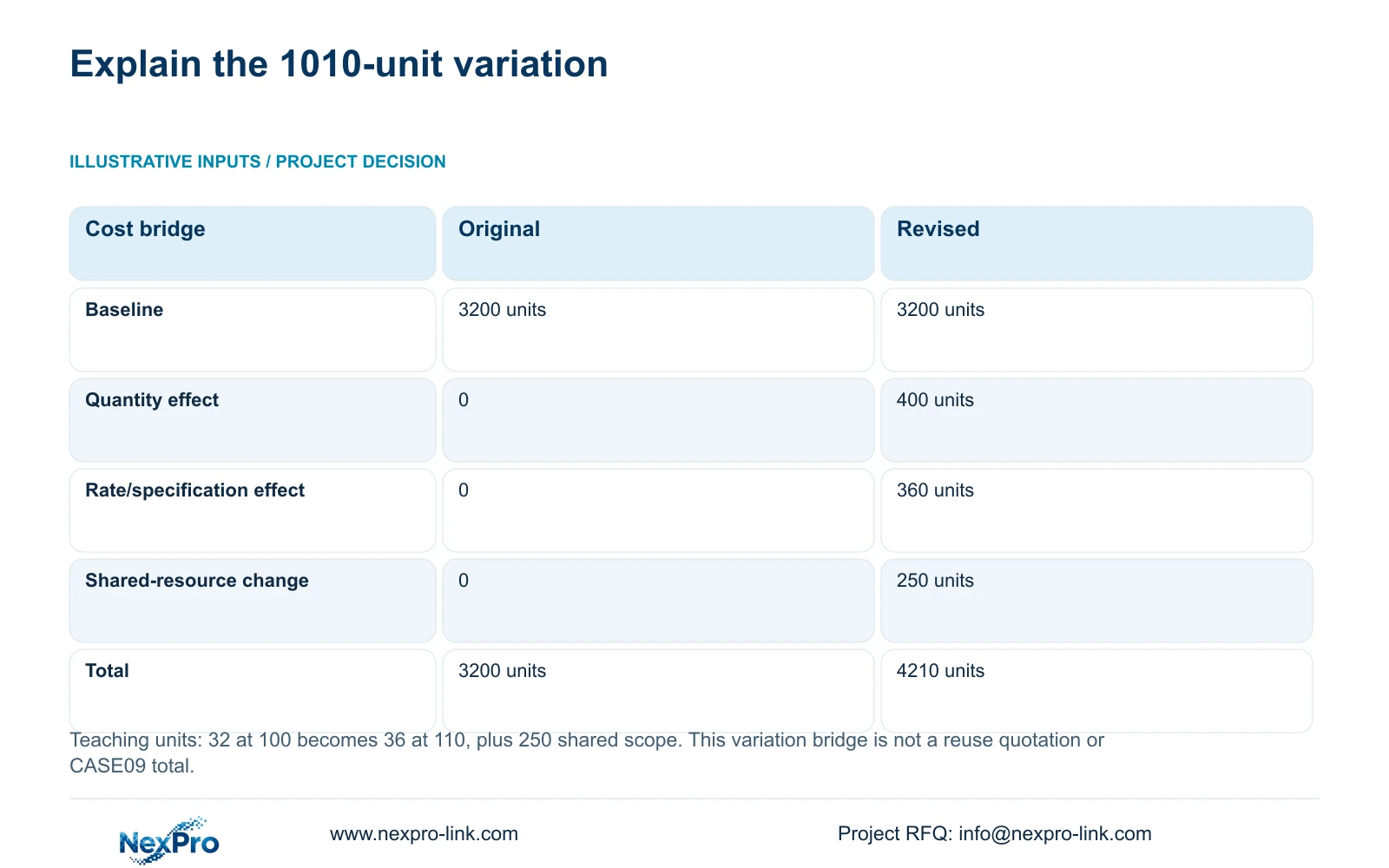
The table is a variation illustration in teaching cost units, not a quotation for either upgrade option. Its original quantity is 32 at 100 units each; the revised quantity is 36 at 110, with an added shared item of 250. Original = 32 × 100 = 3200. Quantity effect = (36 - 32) × 100 = 400. Rate/specification effect = 36 × (110 - 100) = 360. Revised total = 3200 + 400 + 360 + 250 = 4210.
The 1010-unit difference therefore has three stated causes. The rate change applies to all 36 units in this illustration; it must not be copied to a real reuse proposal where retained equipment incurs no new purchase rate. Ask for the reason behind each increment, then recalculate using the actual retained and purchased scope.
| Metric / condition | Original: 32 at 100 | Revised: 36 at 110 |
|---|---|---|
| Original total | 3200 | 3200 |
| Quantity effect | 0 | 400 |
| Rate/specification effect | 0 | 360 |
| Shared-resource change | 0 | 250 |
| Final teaching total | 3200 | 4210 |
Section 06
Approve a migration sequence that preserves required records
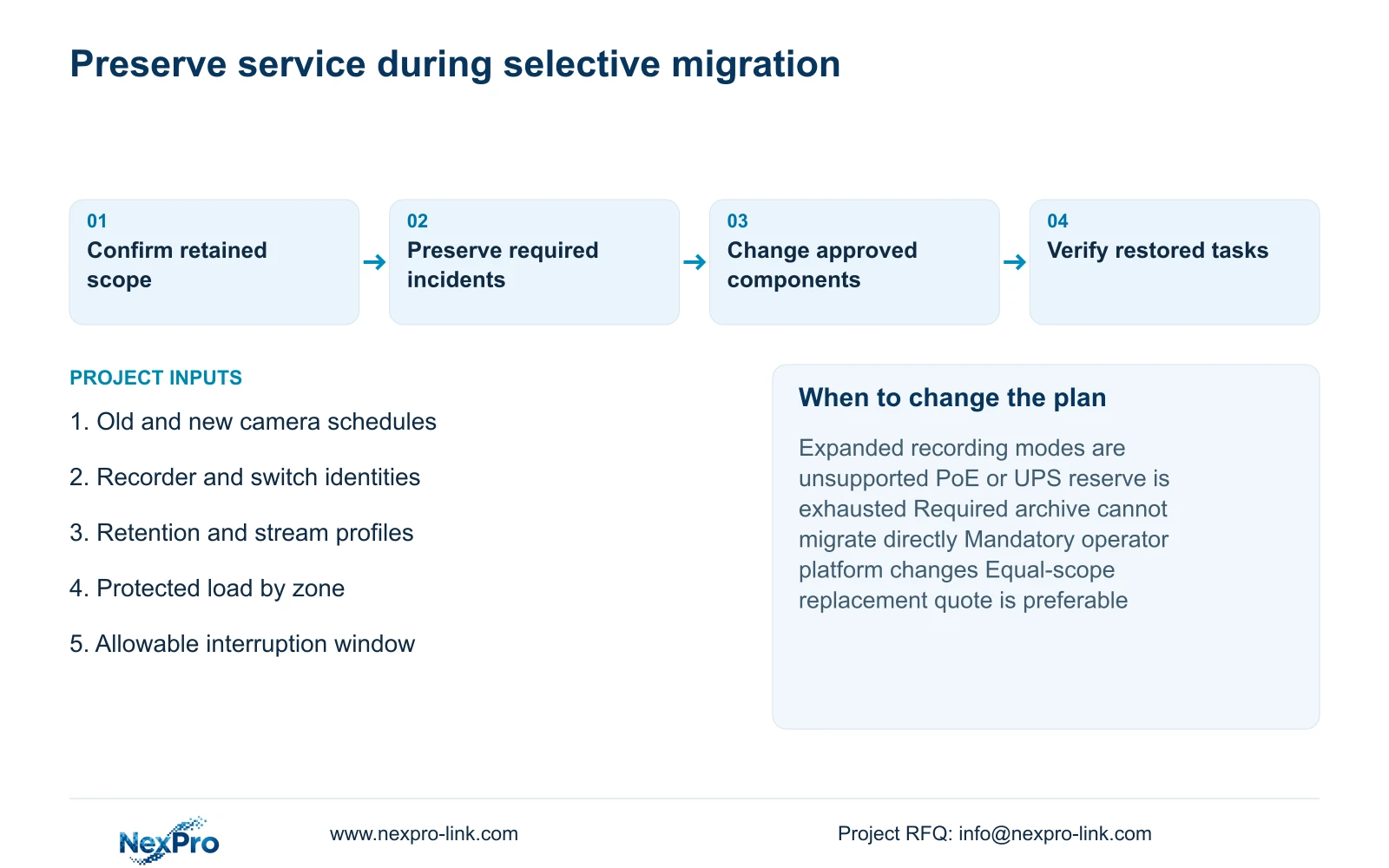
Recommend selective replacement where retained equipment supports the expanded task and its complete evaluated scope is preferable. Change to broader replacement if supported recording modes, required interfaces or protected-power resources cannot be retained, or if equal-scope quotations reverse the economic decision. Mandatory operator equipment requirements must remain visible.
Agree which existing services stay active during changeover and which interruption is permitted. Confirm authorized incident exports and playback before removing records needed by the hotel. Old disks are not automatically readable in a new recorder. Define a return-to-service check and a practical fallback for any stage that does not complete, with responsibility assigned to the local installer and hotel team.
Send the old and proposed camera schedules, recorder and switch identities, retention requirement and allowable interruption window to info@nexpro-link.com. BOQ and tender support can help separate added quantity from configuration and shared-resource changes. The supplied warranty policy gives applicable main equipment a 24-month limited hardware baseline from receipt, subject to controlling order terms; existing equipment age, accessories and local migration work require separate treatment. Only the agreed revision should become the purchase scope.
Section 07
Buyer questions
Can spare recorder channels justify keeping the NVR? They are one check. Also confirm supported recording modes, aggregate input, usable storage and required playback. A retained recorder must satisfy the expanded operating task across all of those limits.
Why can a small camera addition create a shared-resource charge? It can cross a switch power, recorder, disk or UPS threshold. Ask the supplier to identify the exceeded resource and show the revised requirement instead of applying an unexplained uplift.
Can we move existing disks directly into the replacement recorder? Do not assume that stored recordings will remain readable. Confirm the supported migration route and validate authorized exports of required incidents before removing the original recording arrangement.
Engineering references
These sources support the general planning principles. Always use the selected product's current datasheet and applicable project standards for final design.