After a room-layout revision, issue a public-task delta identifying unchanged views, relocated views and new transitions. Record any private-space sightline introduced by the change and resolve it before release.
Section 01
Separate added rooms from monitoring tasks
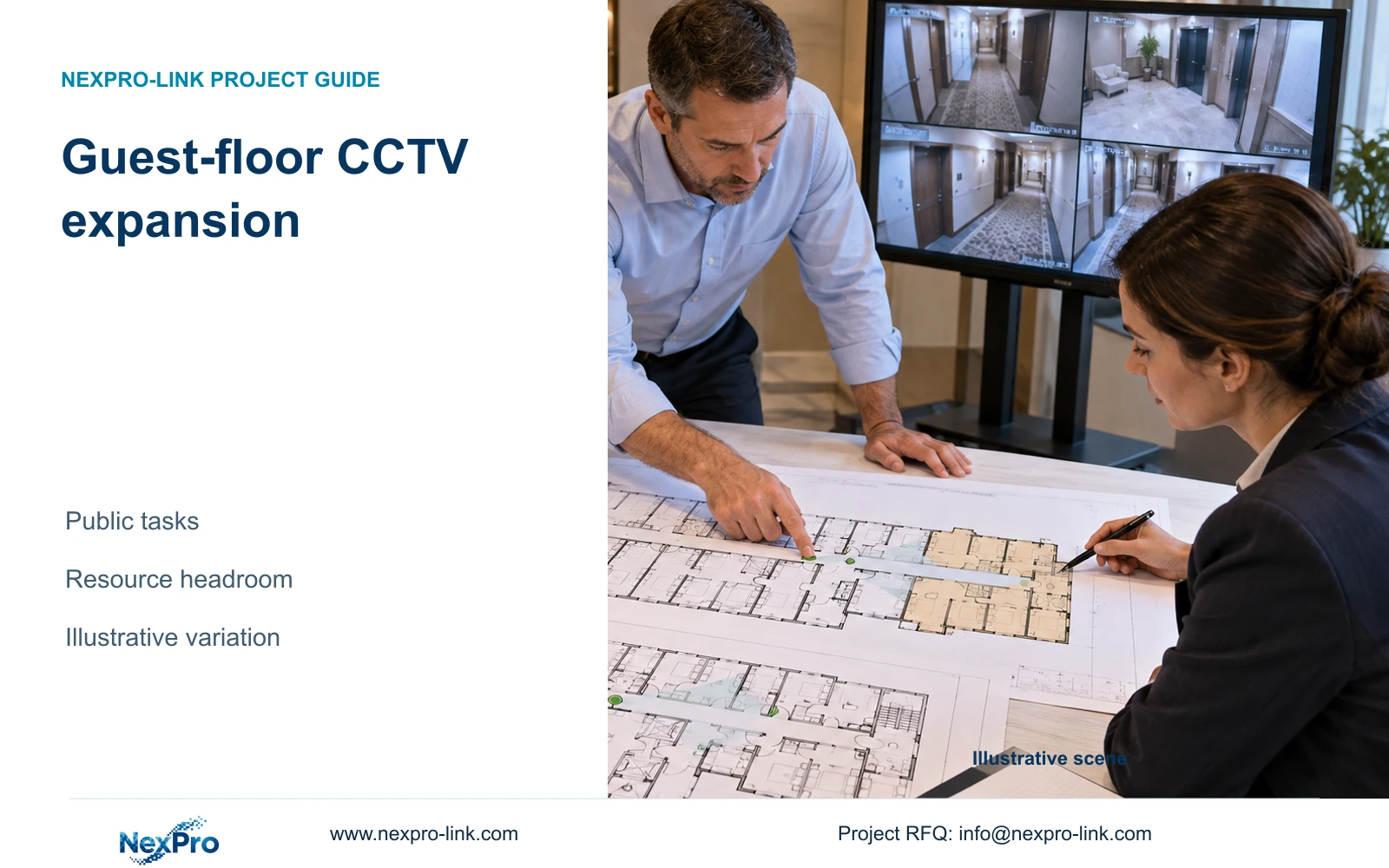
After a room-layout revision, issue a public-task delta identifying unchanged views, relocated views and new transitions. Record any private-space sightline introduced by the change and resolve it before release. Keep room count separate from camera quantity. This delta lets the buyer approve the altered public coverage without reopening every unaffected line.
Retain the existing CCTV equipment where it can support the revised public-area tasks, then add or replace resources only where a documented coverage or capacity gap appears. Ten new guest rooms may create a corridor extension or lift-lobby transition, but they do not establish ten new camera positions. For the cost manager, the first deliverable is a revised task schedule tied to the changed plan.
Keep guest-room interiors outside routine coverage. Compare the old and new corridor geometry, permitted views and door-opening conditions. An existing endpoint view may remain useful after expansion, need reframing, or become obstructed. Those outcomes have different equipment and installation consequences.
Additional camera count also does not establish a need for a video wall. Define the operator's required views and incident enlargement task before changing display scope. Physical display size and pixel canvas are separate inputs. Four Full HD panels in a suitable 2×2 signal arrangement provide a nominal 3840×2160 canvas, but that fact alone does not justify the expenditure.
| Required task | Given information | Decision still needed |
|---|---|---|
| Retain corridor endpoint coverage | Ten rooms added to revised plan | Whether endpoint geometry requires another view |
| Review incidents from new public area | Existing operator station | Whether current viewing layout remains usable |
Section 02
Map the new public transitions
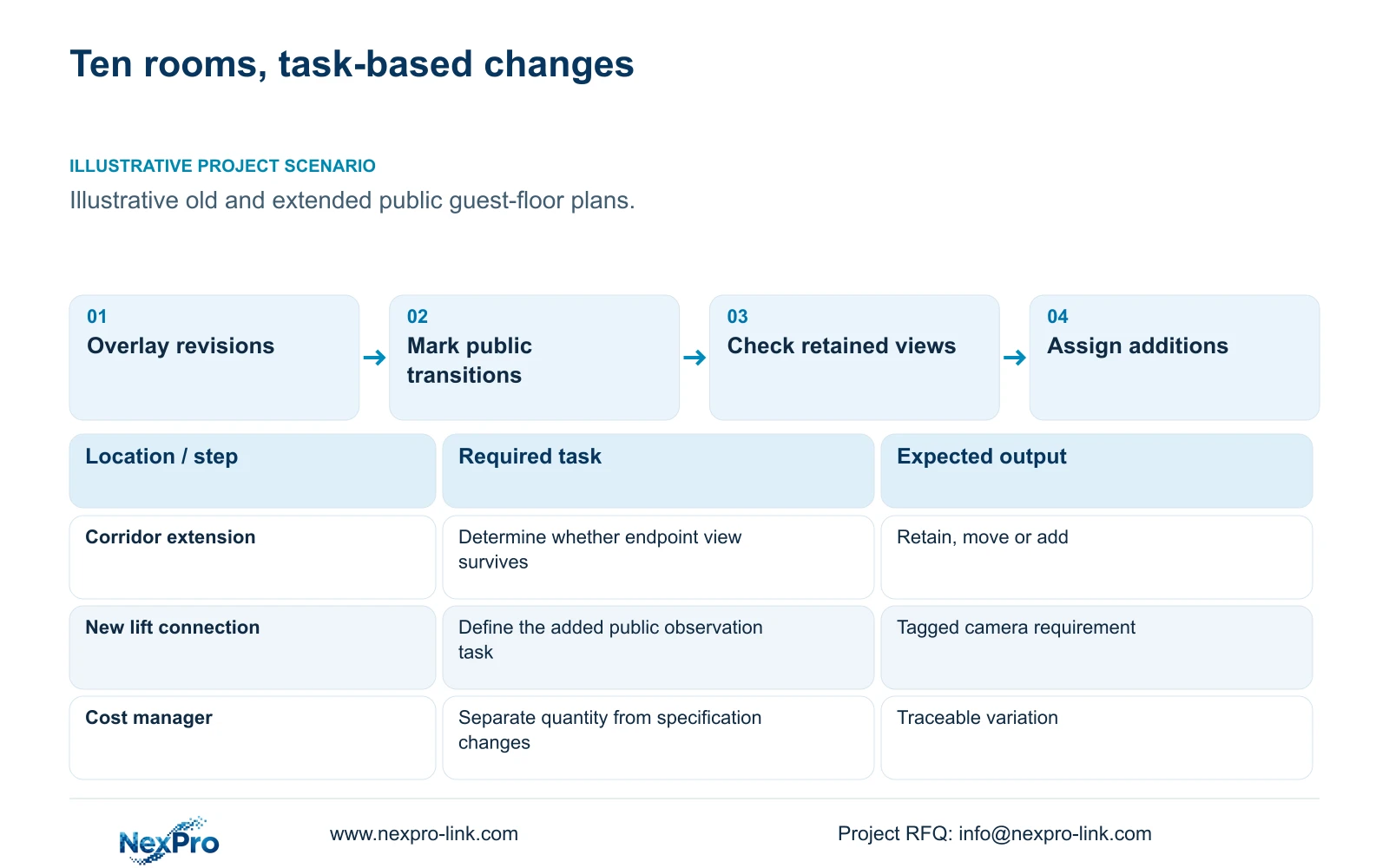
Overlay the revisions and mark new public transitions individually. A new turn, service-door approach or lift connection can create an observation task that the original schedule did not contain. Preserve the original camera tags and assign new tags only to justified additions. Record relocations separately so that a moved camera is not priced as both retained equipment and a new purchase.
For each changed view, retain the baseline model, recording profile and route destination. Describe whether the change affects quantity, specification or installation conditions. A longer cable route and a different lens requirement can occur at the same point, but they should remain distinguishable in the variation.
Compare extending an existing view with providing a separate view. Reframing can reduce detail at the original task plane or introduce unnecessary capture near open guest-room doors. Accept it only when both the retained and added tasks remain usable. This establishes the technical reason for a quantity change before the supplier applies rates.
Section 03
Calculate resource headroom and the cost bridge
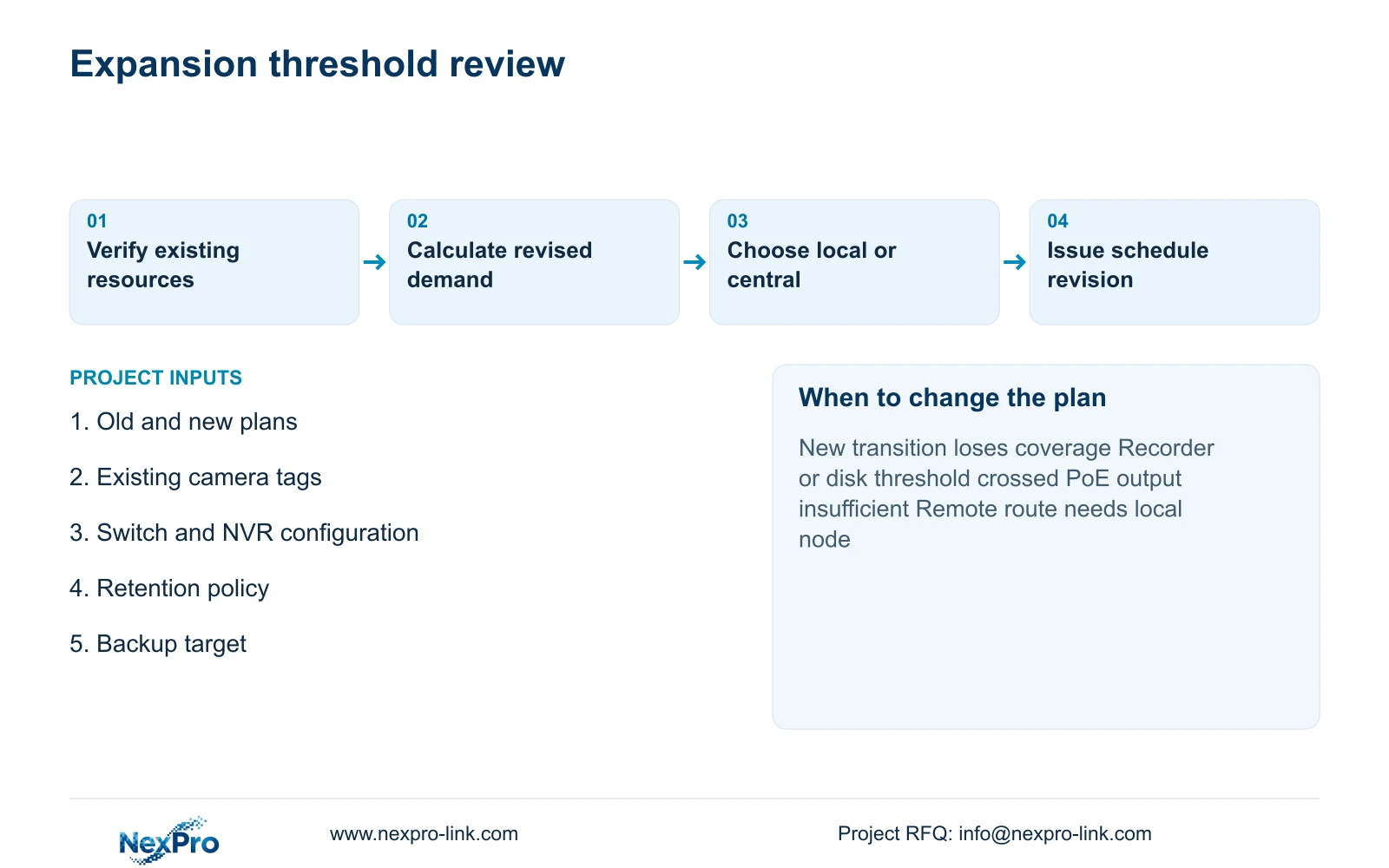
Check spare resources at the actual points of connection. Available recorder channels, input bandwidth and disk capacity are separate limits. At each switch, inspect free ports and total PoE output against the revised camera group. Recalculate protected AC load and the required runtime for the affected power zone. An unused port does not establish spare power.
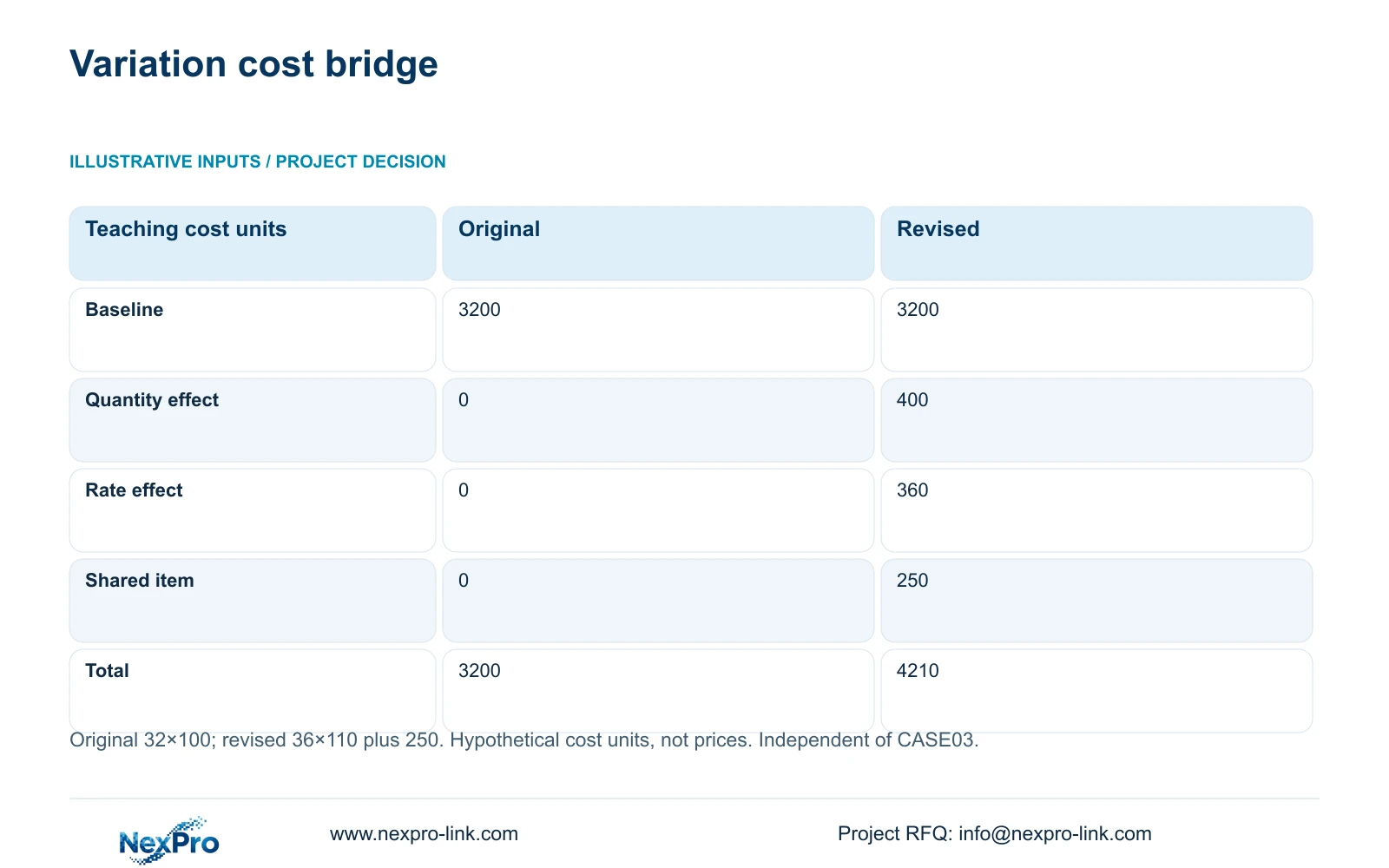
The following independent teaching example moves from 32 units at 100 cost units each to 36 units at 110, plus a shared item of 250. These are hypothetical quantities and rates, not a hotel quotation or CASE03 totals. Original cost is 32×100 = 3200. Quantity effect is (36−32)×100 = 400; rate effect is 36×(110−100) = 360.
The revised total is 3200+400+360+250 = 4210. Its 1010-unit increase can therefore be examined by decision owner. The rate change applies to all 36 units in this example. If an actual project changes only the new units, the rate calculation must reflect that narrower scope.
| Metric / condition | Original: 32 at 100 | Revised: 36 at 110 |
|---|---|---|
| Original total | 3200 | 3200 |
| Quantity effect | 0 | 400 |
| Rate/specification effect | 0 | 360 |
| Shared-resource change | 0 | 250 |
| Final teaching total | 3200 | 4210 |
Section 04
Identify the capacity thresholds
A small floor extension can cross a shared-resource threshold. A recorder with no free channel needs a different response from one with spare channels but insufficient storage. Maintain a threshold register showing the existing configuration, revised demand and the exact resource that triggers replacement or expansion. Keep reusable disks, accessories and cancelled work visible in the cost reconciliation.
CASE03 illustrates this distinction independently: its 48 cameras produce 192 Mbps at an assumed 4 Mbps each, and require 77.76 TB of usable capacity for its stated 30-day policy and 20% reserve. That storage requirement drives its recorder choice. Those values are not the baseline for the 32-to-36-unit cost example and should not be added to it.
Use resolved specifications for the real threshold check. NexPro SW-POE1618G has conflicting access-port speed fields and no stated total PoE wattage in the supplied source. NexPro-NVR2232-4K has conflicting disk-capacity and playback descriptions. Neither unresolved field should be replaced with the more favourable value to make an expansion appear feasible.
Section 05
Compare local and central additions
Reuse the central recorder and existing access arrangement when their verified headroom, routes and operating tasks support the extension. A local switch or recorder may be justified by route constraints or an intended failure boundary. It also adds maintenance access, local power and potentially another search location. Include those responsibilities in the comparison.
A fibre connection to a new floor node does not supply power to that node. Protect the remote switch when the new cameras must continue recording during an outage. If switch AC input already includes its PoE loads, avoid adding the same camera wattage again when calculating UPS demand.
Evaluate central and local alternatives using the same retention and retrieval outcome. Show additional enclosure, cabling, backup power and installation work separately from equipment rates. Choose a local addition when its route or service advantages justify that complete scope; retain the central arrangement when it meets the tasks without introducing unnecessary operating dependencies.
| Retained outcome | Extra scope | Purchase condition |
|---|---|---|
| Common recording and search | Verified central capacity expansion | Existing routes and operating limits remain suitable |
| Coverage at a remote extension | Local node, power and maintenance provision | Route or service boundary justifies local equipment |
Section 06
Update the approved equipment schedule
Issue a revision that identifies retained, relocated, added and cancelled items. Link camera tags to switch ports and recording profiles, then reconcile the BOQ against that version. A resource calculation supports a decision; it does not itself authorize a purchase or a change to the installed configuration.
Separate equipment arrival from the usable expansion milestone. Confirm which technical decisions release preparation and which site conditions release installation. Independent branches can run in parallel when their inputs permit it, while serial work remains dependent on the preceding activity. Do not assume late changes are free or leave the programme unchanged.
Recommend a task-led expansion using existing equipment wherever verified headroom allows. Change the proposal when a revised public transition, mandatory platform requirement or measured resource demand crosses a supported limit. Send old and new floor-plan revisions, affected camera tags, the existing equipment schedule and required retention to info@nexpro-link.com. NexPro-Link's hotel project and BOQ support can help structure the configuration and quotation response, with local work and supply boundaries stated separately.
Section 07
Buyer questions
Must all existing cameras be replaced during expansion? No. Identify the requirement that makes each retained camera unsuitable. A revised rate for every unit, as in the teaching example, needs a corresponding scope explanation in an actual quotation.
Is a spare PoE port enough for another camera? Check the actual camera peak load, per-port capability and remaining total switch output. Also verify the route and the protected AC load. Port availability establishes only one part of the decision.
What should a supplier show in the variation? Request the baseline revision, changed quantities and specifications, shared-resource additions, reuse credits and revised delivery scope. This allows the cost manager to reconcile the increase without counting the same change twice.
Engineering references
These sources support the general planning principles. Always use the selected product's current datasheet and applicable project standards for final design.