Prioritize hotel security RFIs that change camera tasks, capacity, platform requirements, site responsibility or a release date. Give the reviewer bounded options and their measurable consequences.
Section 01
Identify the decision that needs an answer
Prioritize an RFI when its answer changes a camera task, equipment capacity, platform requirement, site responsibility or a controlling release date. Attach the affected baseline and a bounded proposed solution. Routine information requests can remain in the document register when they do not require a design or commercial decision.
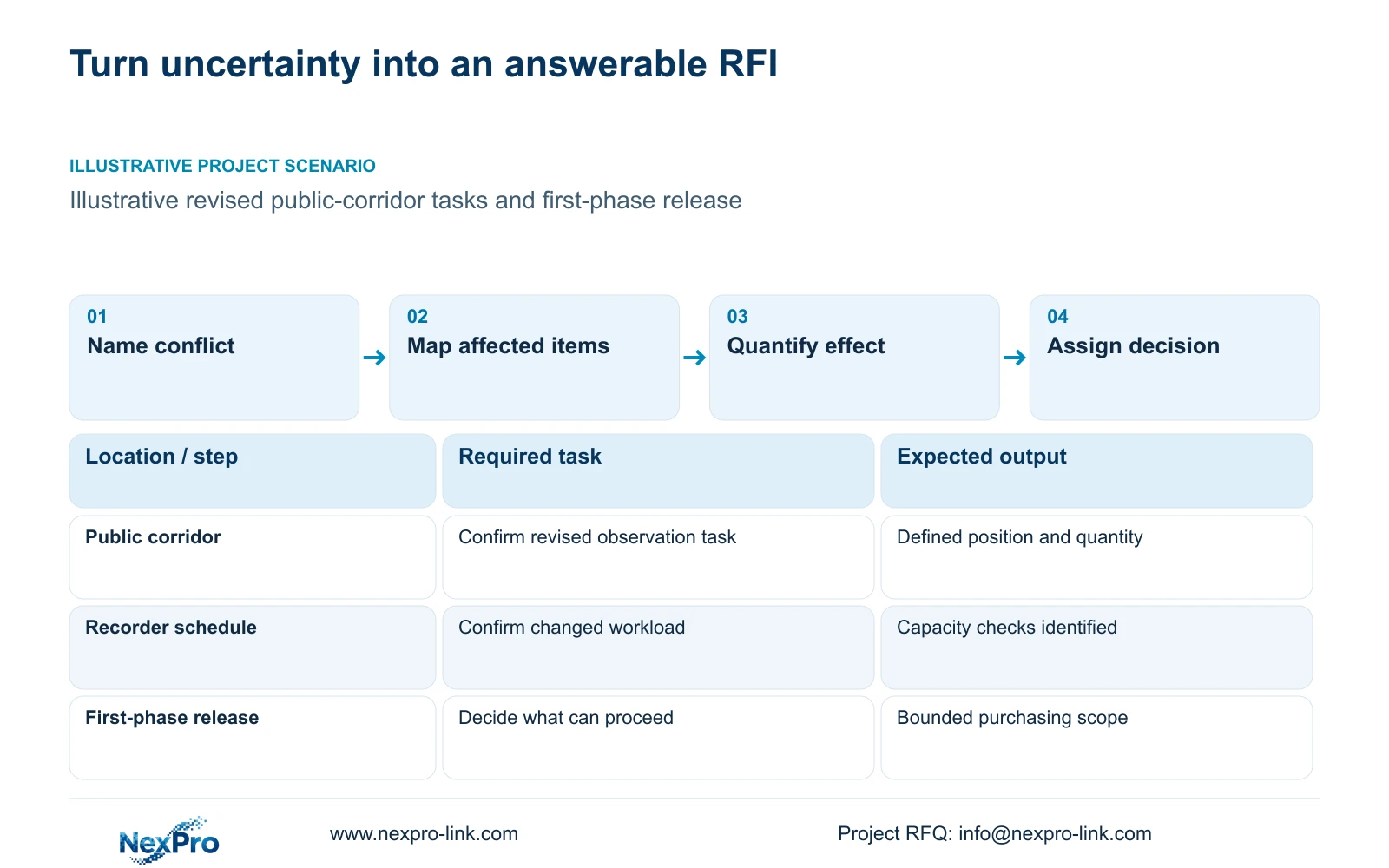
A request for information should make the uncertainty visible. Identify the conflicting drawing, schedule entry or specification clause and state what cannot proceed without clarification. For example, a public corridor may have a revised observation requirement while the camera schedule still shows the original position. The reviewer needs to decide the required task before the supplier can finalize its equipment consequences.
Preserve the dated quantity, model, interface and quoted scope. Distinguish additional points from changed specifications, missing supporting items and delivery-condition changes. This prevents a response about one issue from being treated as authority to change several others. The RFI should also name the affected work front and the date by which its answer becomes a dependency.
| Field | Input to provide | Why it matters |
|---|---|---|
| Reference and conflict | Current drawing/clause revisions and affected point tags | Recipient can locate the actual ambiguity |
| Required decision | One precise question and what is blocked | Avoid a general request to redesign the system |
| Bounded alternatives | Supported choices, retained outcome and limits | A suggestion is not an approved substitution |
| Consequences | Quantity/resources, timing and priced or unresolved scope | Unknown cost is not zero; assumptions remain visible |
| Answer and authority | Required date, deciding role and reply reference | RFI response does not itself authorize purchase or shipment |
Section 02
Show the schedule items and dependencies affected
List affected camera and BOQ identifiers so the answer can be applied consistently. Include dependent recorder, switch, storage and power entries where their capacity could change. If an RFI concerns platform access, identify the software workflow and responsible IT interface instead of treating it as another hardware quantity.
Then show which activity the answer starts. Technical approval can control equipment preparation. Authorized artwork can control marking or packing. Site access and network permissions control installation and commissioning. Parallel branches use their controlling maximum only when their inputs genuinely allow concurrent work; sequential steps are added.
CASE06 illustrates why a phased hotel's clarification needs a release boundary. Its first 32-camera operating package sits within a final 64-camera design. An answer affecting a shared resource may alter both phases, while a later conference-extension point may affect only the second release. Those illustrative quantities do not establish the scope of a real RFI or the independent cost calculation below.
| Item | Existing basis | Proposed basis | Effect on the hotel task |
|---|---|---|---|
| Camera schedule | Approved public-zone tasks | Revised tasks and quantities | Changes coverage and dependent loads |
| Release boundary | Complete first operating package | Affected scope held or revised | May change first-phase readiness |
| IT interface | Existing approved workflow | Requested platform change | Needs supported function and permission review |
Section 03
Calculate quantity, specification and shared-resource effects
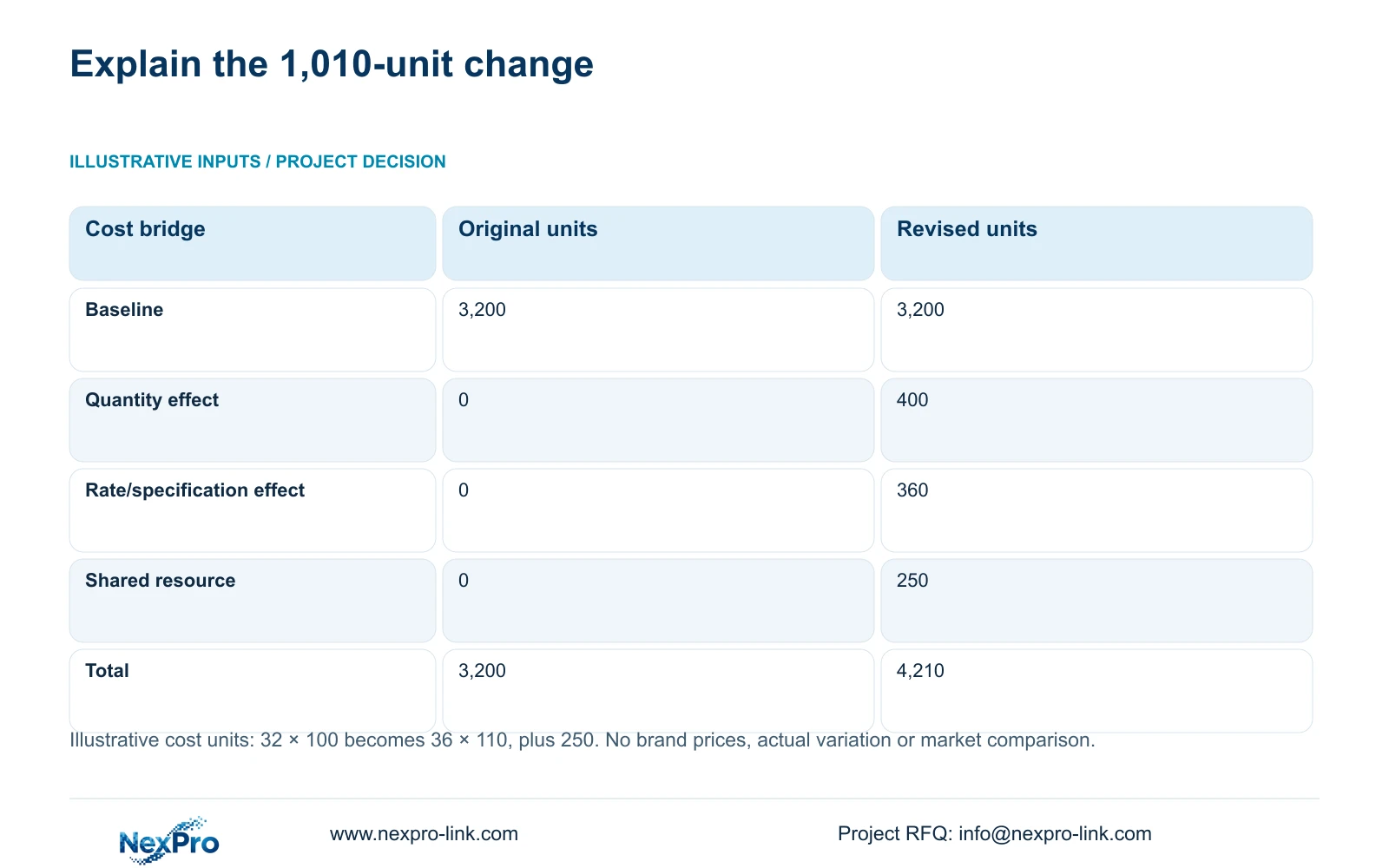
Use a fixed calculation order so the reviewer can see which answer drives each cost. The independent teaching example starts with 32 items at 100 cost units each. The revision has 36 items at 110 units, plus a shared item of 250 units. These are unbranded assumptions, not quotations, market prices or an actual hotel variation.
The original total is 32 × 100 = 3,200 units. Price the four added items at the original rate first: (36 − 32) × 100 = 400 units. Then apply the rate or specification change to the revised quantity: 36 × (110 − 100) = 360 units. Add the shared resource once, giving 3,200 + 400 + 360 + 250 = 4,210 units.
The 1,010-unit increase therefore contains three separately reviewable consequences. The buyer may accept the extra quantity while asking whether every item requires the higher specification, or request evidence for the shared resource. The calculation makes those decisions explicit without implying that any part can safely be removed.
Check actual capacity thresholds before using this method as a unit-rate extension. Added cameras may require another recorder, greater PoE output or a different disk arrangement. The revised work also needs any recurring software or service costs stated separately. No assumed failure rate or brand price advantage belongs in the RFI.
| Metric / condition | Original: 32 at 100 | Revised: 36 at 110 |
|---|---|---|
| Original total | 3,200 | 3,200 |
| Quantity effect | 0 | 400 |
| Rate/specification effect | 0 | 360 |
| Shared-resource change | 0 | 250 |
| Final teaching total | 3,200 | 4,210 |
Section 04
Offer alternatives with defined limits
An alternative should retain the required operating outcome and state what changes. For a revised corridor, compare a supported relocation with an additional view only if both address the observation task. For a platform requirement, compare the mandated system with an allowed alternative against the same workflow and support scope.
Show the quantity and specification consequences of each option using the same baseline. Explain which supporting item is added and why. A lower total created by omitting approved retention or an essential network node is a different scope, so it cannot be presented as an equivalent economical option.
Record potential reuse, cancellation and partial release separately. Their availability depends on actual preparation status, interfaces and commercial terms. A late hardware or artwork change may affect cost and timing; the RFI should request the relevant consequence without promising free changes. Unknown amounts remain identified quotation inputs until the responsible supplier responds.
Section 05
Route the answer to the responsible authority
Identify who can decide the technical requirement and who can authorize its commercial implementation under the project. The designer may define the required view, the hotel operator may control an operating standard, and IT may control access or platform requirements. Purchasing authority remains a separate matter.
Assign the response to the decision object. Company registration, brand acceptance and model approval are different from an instruction to order revised quantities. A supplier's suggested solution is an assessment input. It does not amend the contract or authorize production by itself.
For each option, show the retained task, additional scope and condition that makes it appropriate. The cost manager can identify the financial consequence while the authorized reviewer decides whether the scope is required. Keep the revision pending if a mandatory operator or platform condition has not been resolved, even when the numerical difference is clear.
| Retained outcome | Extra scope | Worth buying when | Condition against it |
|---|---|---|---|
| Required corridor observation | Additional view and supporting capacity | Relocation cannot preserve the task | Existing position can meet the revised task |
| Complete first operating release | Separate preparation or delivery | Unaffected scope can be released independently | Unresolved interface affects both packages |
Section 06
Carry the answer into the controlled design
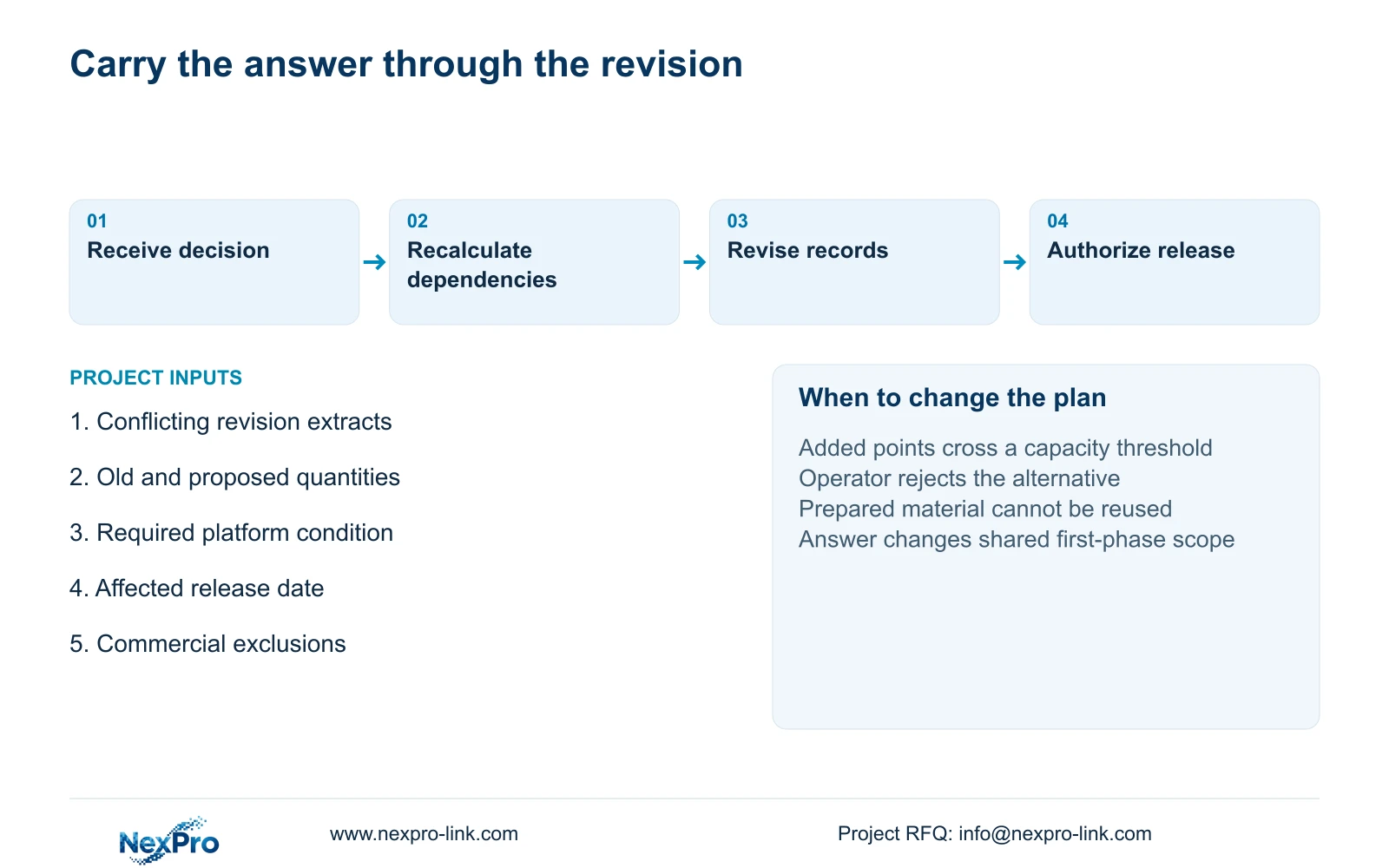
When the answer arrives, update the affected drawing, camera schedule and BOQ together. Recalculate dependent capacities and record the basis of any revised quotation. Reference the RFI answer in the revision record so installers and suppliers can identify which requirement changed and which remains in force.
Recommend a focused decision-led RFI with a quantified bridge whenever its answer affects procurement or an operating release. Expand it when a shared capacity threshold or mandatory platform requirement creates wider consequences. Proceed only from the agreed revision and the appropriate order authority; an answered question alone is not a production instruction.
For a scoped supplier response, send the conflicting extracts, old and proposed quantities, unresolved requirement and decision deadline to info@nexpro-link.com. Include any mandatory brand or platform condition and the affected opening milestone. NexPro-Link can support model matching and BOQ clarification, with CCTV manufacturing and coordinated supporting supply distinguished from local design and installation responsibilities.
Section 07
Buyer questions
Is a supplier's RFI response enough to place a revised order? It supplies technical or commercial information for the project decision. The agreed design revision and authorized purchasing instruction must identify what can be ordered. Keep any unresolved exclusions or interfaces visible in the release.
Should each added camera use the original unit rate? That is useful for separating the quantity effect in a cost bridge, but it does not settle the actual quotation. Confirm changed specifications, supporting capacity and delivery scope. A recorder or power threshold can make the complete variation larger than a camera-only extension.
What should be attached to the first RFI inquiry? Send the relevant conflicting drawing or schedule extracts, their revisions and the proposed bounded options. Identify the affected equipment entries and the answer deadline. Passwords, guest footage and unrelated confidential tender material are unnecessary.
Engineering references
These sources support the general planning principles. Always use the selected product's current datasheet and applicable project standards for final design.