Turn a hotel security allowance into a task-based cost plan before treating it as a purchasable package. Keep confirmed quantities, unresolved scope and optional improvements visible throughout quotation review.
Section 01
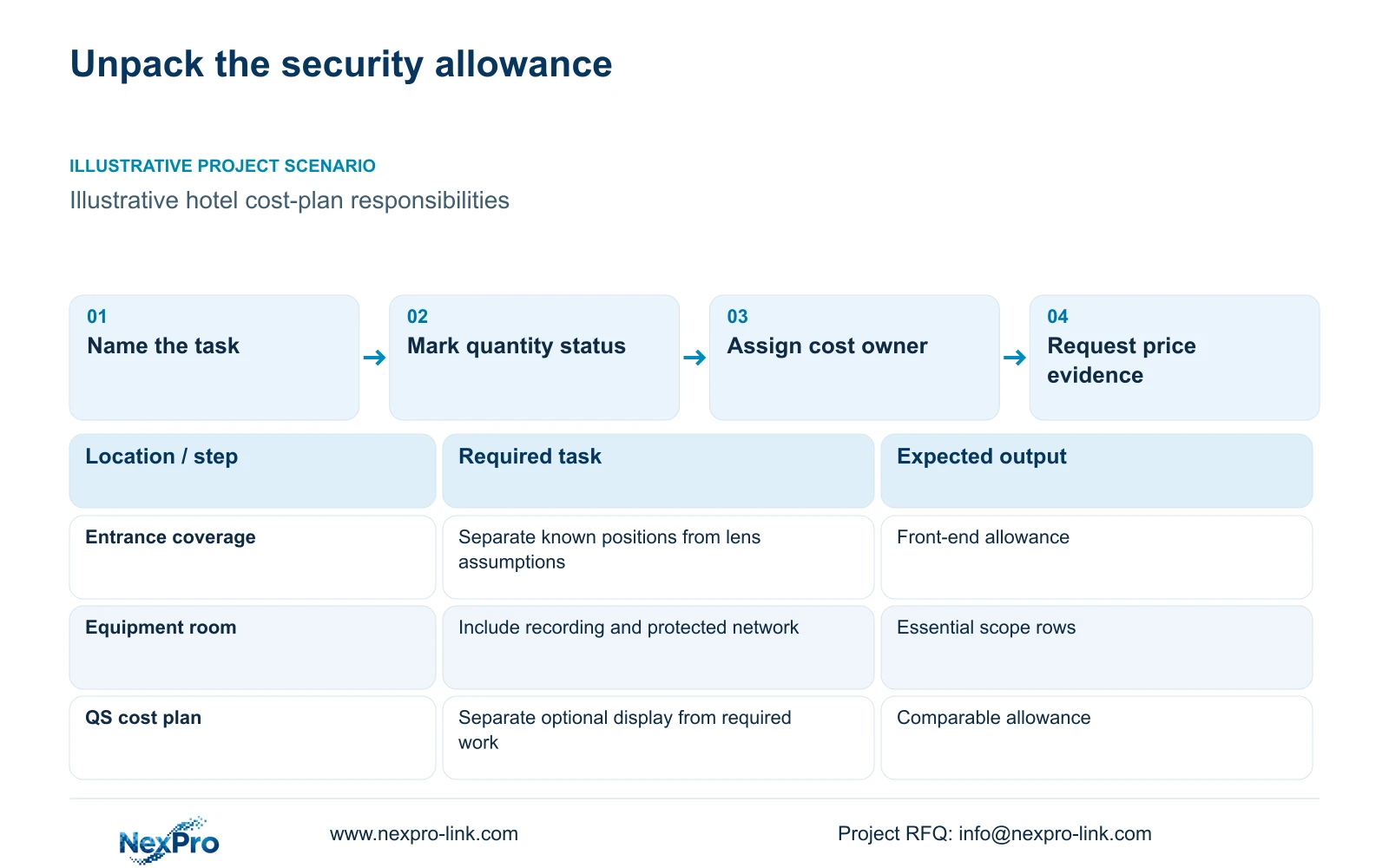
Separate known work from unresolved scope
Convert the provisional security amount into named operating tasks and explicit quantity assumptions before requesting a procurement price. Use it as a cost-plan allowance while the scope remains incomplete. Replace it with a quoted package only when its inclusions and responsibilities are sufficiently defined for the decision being made.
A single allowance may contain camera supply while leaving recording, cable installation or backup power unresolved. Divide it by required function and record what the current drawings actually establish. Keep measured quantities, provisional quantities and risk allowances in separate fields. An amount approved for budgeting does not show that a supplier has priced all the required work.
The first review should distinguish uncertainty about quantity from uncertainty about specification. An entrance position may be known while its lens remains undecided; an exterior route may still lack a confirmed installation path. Each needs a different clarification. RICS measurement guidance distinguishes cost planning, detailed measurement and maintenance purposes, but the working tables here are illustrative project tools, not prescribed contract forms.
| Required task | Given information | Decision still needed |
|---|---|---|
| Entrance recording | Public entrance shown on drawing | Camera tasks and recording policy |
| Outage continuity | Security backup requested | Protected nodes and target duration |
| Cable installation | Equipment locations proposed | Measured routes and installer scope |
Section 02
Create a task-based allowance
Build the allowance around a functioning chain: image capture, network transport, recording, retrieval and agreed outage operation. An operator display has a task of its own. A larger wall can remain optional where ordinary viewing equipment meets the required workflow; required recording capacity cannot be removed to make the essential allowance appear lower.
Assign shared equipment and activities once. If a recorder package includes disks, mark the storage allowance as included in that package. If an installer prices patch leads or commissioning, reconcile those inclusions with the equipment offer. Use the same rule for shared network infrastructure, while identifying any capacity upgrade needed specifically for CCTV.
Keep ownership of each allowance visible. The cost manager maintains the consolidated plan, the designer defines performance and the relevant package provider supplies price evidence. This prevents a networking allowance from disappearing because another discipline is expected to cover it without agreement. The resulting structure also makes exclusions easier to return to the responsible package.
| Item | Camera-only allowance | Complete functional allowance |
|---|---|---|
| Storage | No retention provision shown | Recording capacity included |
| Protected power | Outage path unresolved | Required active nodes budgeted |
| Installation | Devices priced without site work | Routes, termination and testing assigned |
Section 03
Choose transparent quantity assumptions
State where each provisional quantity comes from. Camera counts should follow public-zone observation tasks and layout, not room count. Cable quantities require installed routes and allowances. A recorder quantity needs the stream and storage design, while UPS quantity follows the actual protection zones. These dependencies can be explored before final drawings without calling the estimate final.
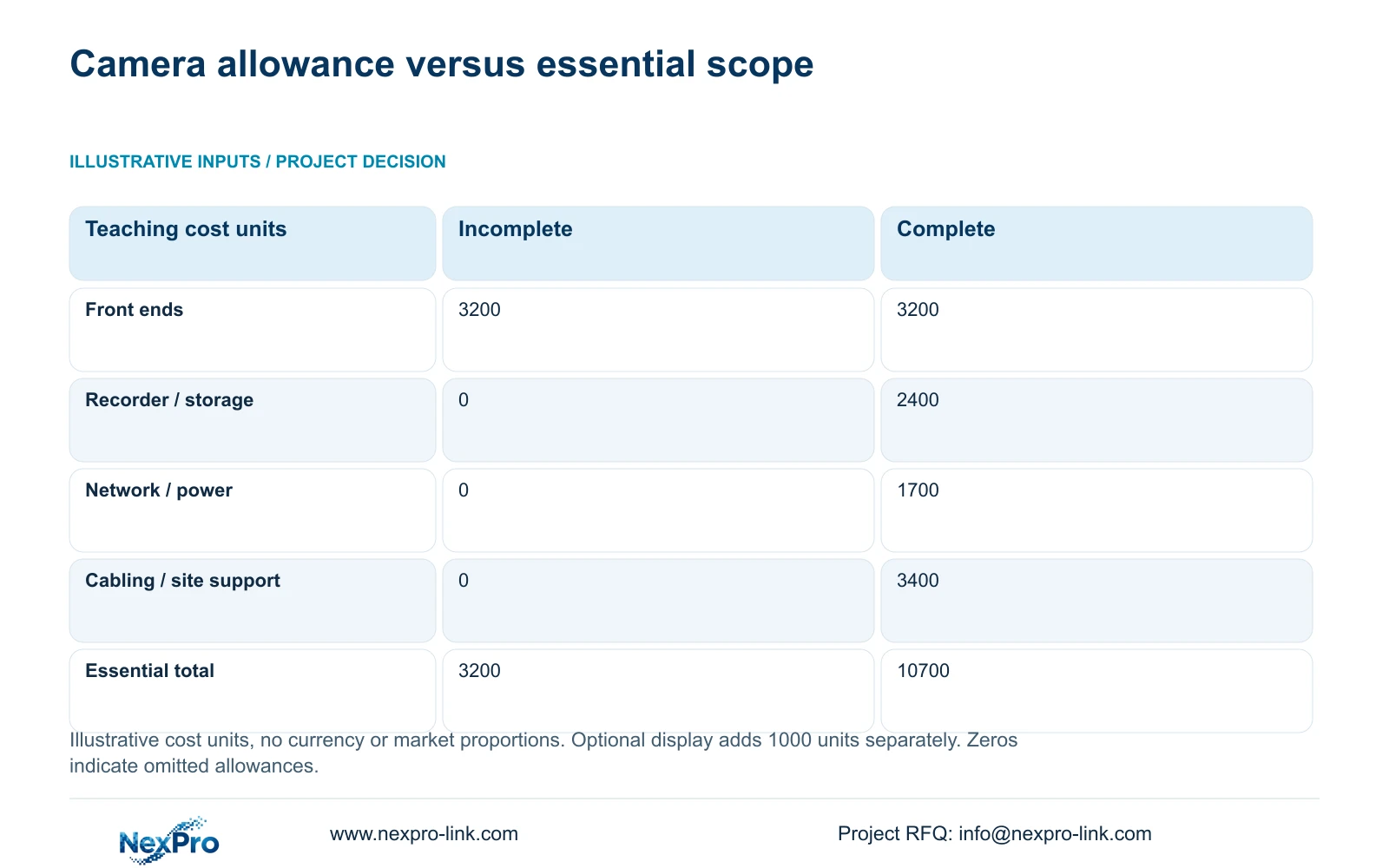
The teaching inputs below allocate 3200 cost units to front ends, 2400 to recorder and storage, 800 to networking, 900 to power, 1600 to cabling and 1800 to installation and support. The formula is the sum of required scope rows; optional upgrades stay separate. Cost units have no currency and are neither quotations nor typical market proportions.
Use replacement and spare assumptions with the same care. State the service event and replenishment need that justify stock. Similar housings do not establish interchangeable lenses, power or firmware. A spare allowance should identify its functional replacement scope and service boundary, rather than rely on an invented failure percentage.
| Metric / condition | Incomplete camera-only allowance | Illustrative complete allowance |
|---|---|---|
| Front ends | 3200 | 3200 |
| Recorder and storage | 0 | 2400 |
| Network and protected power | 0 | 1700 |
| Cabling and site/support work | 0 | 3400 |
| Essential total | 3200 | 10700 |
| Optional display | Not included | +1000 separately |
Section 04
Compare low and high scenarios without changing the task
The example expands 3200 units into 10700 units because essential cost layers were absent. The zeros in the incomplete column mean no allowance was included; they do not mean the functions cost nothing. The separate 1000-unit display option should be considered only after the essential scope is understood. These figures are independent of the complete hotel reference case.
For a genuine low and high range, keep the same operating requirement and change only documented uncertain inputs. A low route-length scenario and a longer measured-route scenario can both retain the same camera tasks. A specification change, such as an approved platform requirement, should have its own effect rather than be buried in quantity growth.
Describe the condition that moves the project between scenarios. A clarified obstruction can add a view, while a remote active node can change power and installation scope. The owner can then judge which uncertainty deserves attention first. Removing disks from the low scenario would create an incomplete system, so it cannot be presented as an equivalent economy option.
Replace the corresponding allowance when the defined scope is approved and quoted; do not leave both figures in the same total. The original quantity illustration is a separate sensitivity example, not a provisional-sum reconciliation or a supplier price.
| Open input | Evidence to resolve it | Closeout entry |
|---|---|---|
| Incomplete point quantity | Approved drawing, tagged schedule and counted units | Final quantity, revision and allowance replaced |
| Unspecified equipment duty | View, recording, outage and permitted platform brief | Qualified model/configuration and exceptions |
| Unpriced local activity | Named installer scope and exclusions | Quoted amount or explicitly unresolved item |
| Final reconciliation | Compare approved replacement scope with original allowance | Remove superseded allowance; record residual uncertainty separately |
Section 05
Replace allowances with scoped quotations
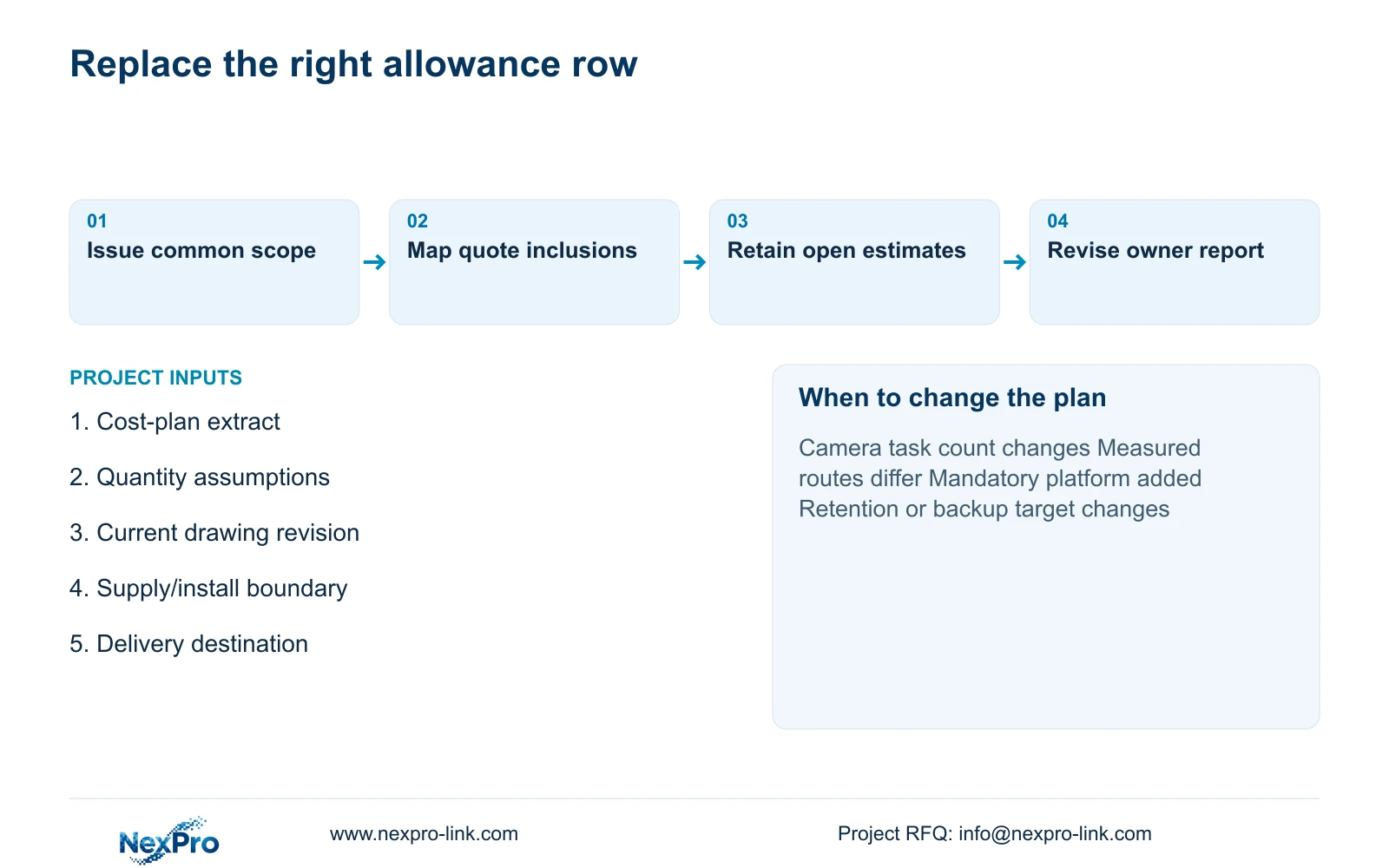
Send suppliers the same task and quantity basis, together with the current revision and unresolved fields. Request separate equipment, delivery and site-work boundaries. Each quoted amount should identify the allowance row it replaces. Preserve the estimate where no quote exists, with its status visible, instead of silently converting an unknown into zero.
A coordinated NexPro-Link response can include model matching, BOM or BOQ support and relevant equipment supply. Its CCTV manufacturing core and coordinated supporting categories should be described accurately. A combined order does not prove that every category is manufactured by one company, that every interface integrates automatically or that installation is included.
Compare service costs on the same basis. The supplied policy record gives applicable main equipment a 24-month limited hardware baseline from receipt, subject to controlling written terms. Storage, batteries, cable and OEM scope require separate terms. Site labor, faster replacement transport and other support costs should remain explicit where relevant to the allowance.
| Retained outcome | Additional scope to price | Decision condition |
|---|---|---|
| Required recording | Confirmed disks and configuration | Replace estimate when capacity and quote align |
| Outage operation | Protected remote-node supply | Add when the actual path needs it |
| Operator viewing | Optional larger display | Buy only for a defined observation task |
Section 06
Explain remaining uncertainty to the owner
Report the quoted portion, remaining provisional scope and optional choices separately. Alongside each open item, name the missing input and the decision it can affect. An unresolved route length may change installation quantities; an undecided retention policy may change storage. Avoid describing both as one unexplained contingency percentage.
Recommend a complete task-based allowance as the working baseline, then replace its rows progressively with comparable quotations. Recalculate when the camera schedule, operator platform, retention requirement or protection boundary changes. If mandatory work no longer fits the approved budget, present a scoped redesign for the owner's decision rather than remove required functions without notice.
Send info@nexpro-link.com the security cost-plan extract, current public-area drawing or schedule, quantity assumptions and intended supply boundary. Include the destination so the response can address relevant delivery scope. BOQ and tender support can then connect an equipment proposal to the allowance rows that need price evidence, without requiring unrelated confidential documents.
Section 07
Buyer questions
Can we obtain an equipment quote while cable routes remain provisional? Yes. Identify the equipment scope that can be priced and leave cable measurement and site work as separate provisional rows. The consolidated allowance must retain those rows until the responsible installer provides a defined scope.
Should a contingency be removed when a supplier quote arrives? Remove or revise only the allowance for uncertainty that the quote actually resolves. A camera supply quote may settle unit prices while leaving route quantities, interfaces or local work unresolved.
Can the 10700-unit example be used as our hotel budget? No. It demonstrates missing cost layers using teaching units. Your budget needs project quantities, specifications, destination and applicable quotations; the example establishes no currency price or per-room allowance.
Engineering references
These sources support the general planning principles. Always use the selected product's current datasheet and applicable project standards for final design.