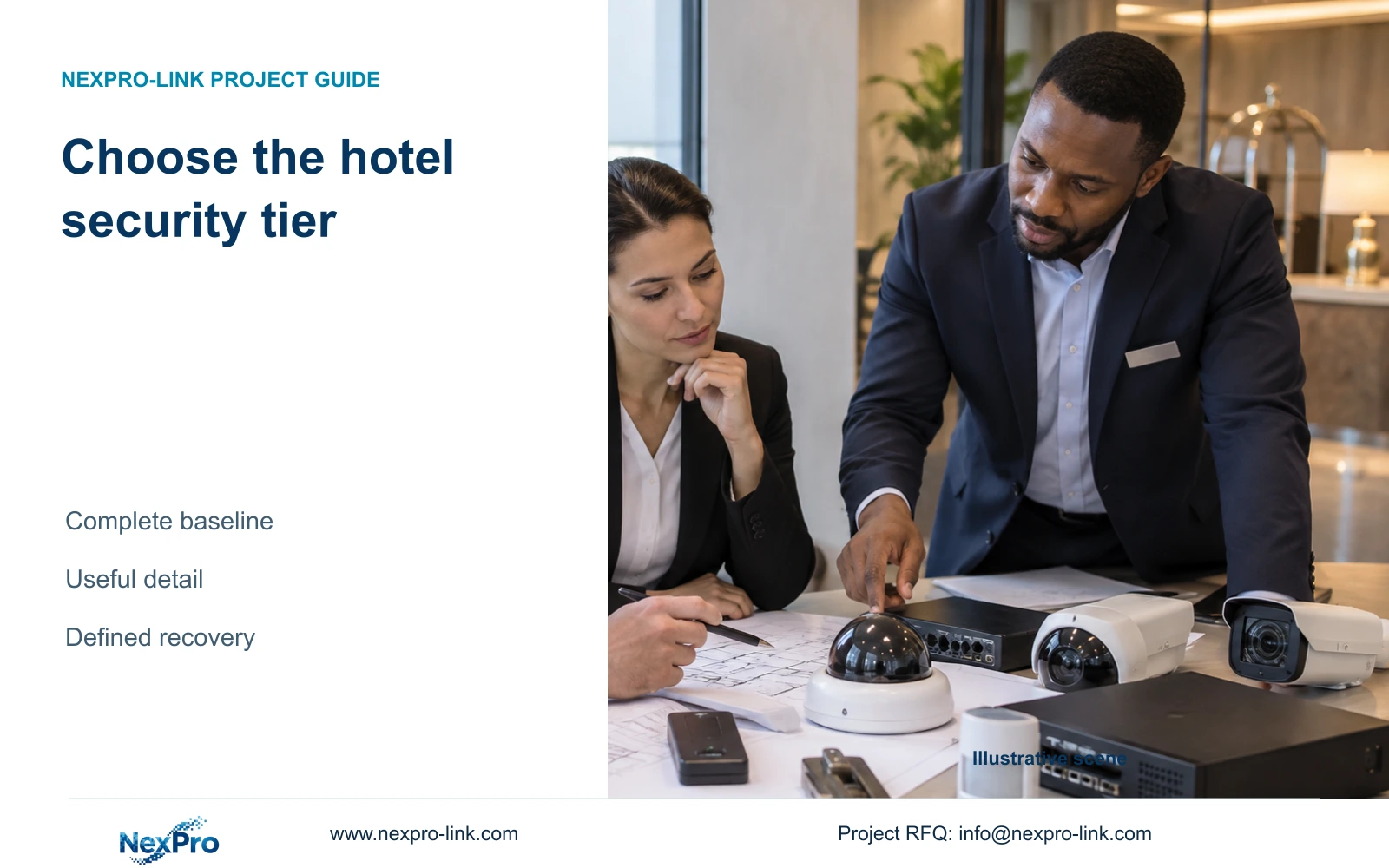
Choose a complete essential package when it meets the operating brief. Add targeted image improvements or recovery scope only for a defined task, while preserving the common recording baseline.
Section 01
Define a complete essential package
Choose the essential tier when it meets the hotel's required views, recording policy and agreed outage state. Select the enhanced tier for a defined detail or operator improvement, and resilience scope for a named failure or recovery requirement. Every tier must retain the same necessary acceptance tasks. A package with missing recording dependencies is incomplete even if its camera list appears economical.
Define the baseline through the public-zone schedule. Each view needs a purpose, a recording requirement and an authorized retrieval workflow. Guest-room interiors and other private spaces are outside this scope. Include the network and protected-power nodes that make those views available during the accepted operating state.
An essential package should support the hotel team finding and exporting relevant footage. It also needs a stated supply boundary covering storage and supporting infrastructure. The comparison can then distinguish an optional improvement from an item that should have been present in the baseline.
| Required task | Given information | Decision still needed |
|---|---|---|
| Record public views | Accepted observation schedule | Supported recording modes and storage |
| Retrieve an incident | Authorized operator role | Playback and export workflow |
| Maintain agreed outage state | Continuity objective | Protected path and battery configuration |
Section 02
Locate the highest-value enhancements
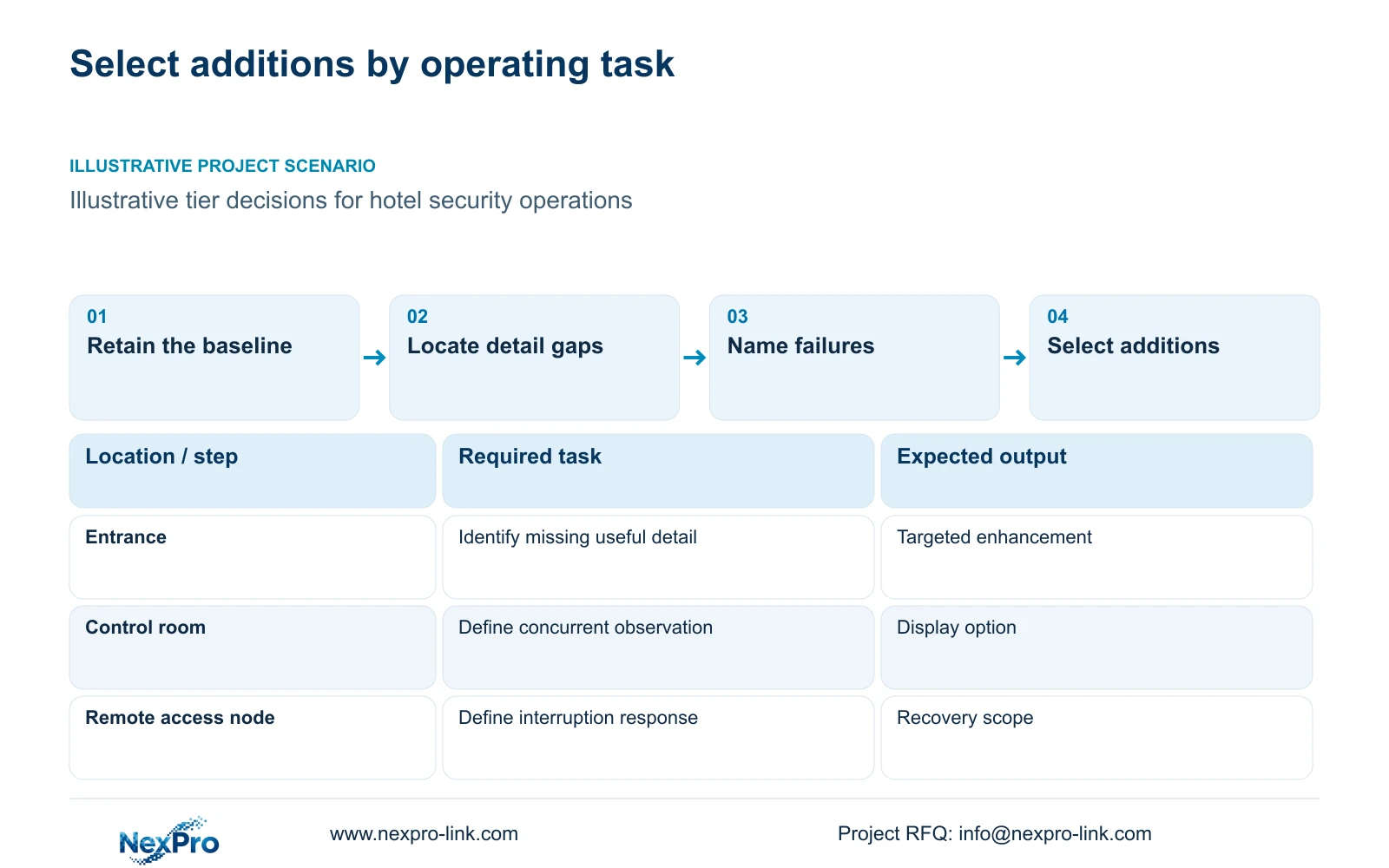
Place enhancements where the baseline has an identified operating limitation. At a public entrance, the improvement may be tighter framing or a more suitable position. In reception, it may be a separate detail view. Additional pixels are useful only when they contribute to the required recorded task; they cannot remove an obstruction.
The supplied BL2812M Series PDF identifies NexPro-BL2812M55-5MP-DIC-AI as a 5MP candidate with a 2.8-12 mm motorized lens and a listed 2880 × 1620 main mode at 25 fps. Its maximum power is not stated. An upgrade decision must therefore use the selected recording profile and an established power input, rather than assuming that a resolution label fixes either value.
Price the affected cameras and their downstream changes together. A different stream profile may change storage and recording input. A selected illumination mode can change the power requirement. Keep unaffected views at their accepted specification so the enhanced option has a clear purpose and an identifiable incremental scope.
| Item | Essential | Enhanced | Effect |
|---|---|---|---|
| Entrance view | Accepted baseline framing | Task-specific position or lens change | Improves the defined detail task |
| Operator viewing | Event-focused workstation | Larger concurrent layout | Supports an identified observation workload |
Section 03
Describe resilience by failure scenario
Name the failure before specifying recovery equipment. A mains interruption requires a supported power bridge across the required recording path. A remote access-node failure calls for a different restoration plan. Disk fault tolerance and independent incident preservation also address different problems. A single label such as resilient does not define which service continues.
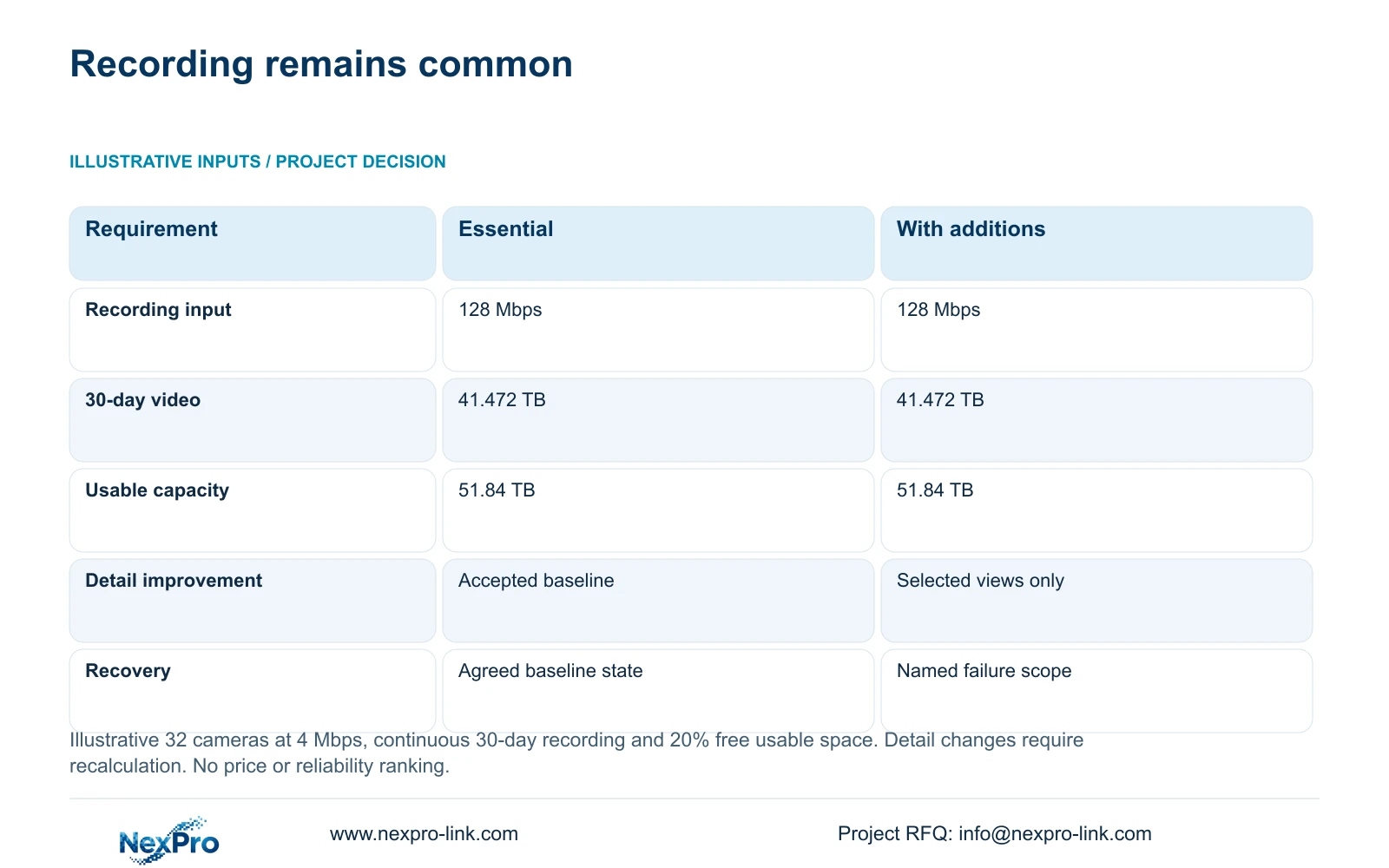
For the shared teaching baseline, use 32 cameras averaging 4 Mbps, recording continuously for 30 days, with 20% of usable storage free. Input is 32 × 4 = 128 Mbps. Video data is 0.0108 × 32 × 4 × 30 = 41.472 decimal TB, and required usable capacity is 41.472 / 0.80 = 51.84 TB. These recording assumptions remain unchanged while the recovery options are compared.
Draw the data path separately from protected power and identify remote dependencies. UPS capacity must satisfy both watts and VA, while duration needs the supported battery configuration and load curve. SP2KR(S) is rated 2 kVA / 1800 W; that published capacity does not establish how long a proposed hotel system will run.
Section 04
Compare shared and incremental costs
Carry the complete baseline once in the cost comparison. Add only the changed equipment and work for each option. Separate purchase and installation costs from recurring software or service charges, using the same destination and delivery scope. An apparent tier saving disappears if necessary disks or local commissioning are left outside one quotation.
The table preserves the recording requirement while additions are priced. It establishes no brand price ranking or maintenance saving. Where an upgrade premium depends on future service savings, request those actual inputs. A simple undiscounted break-even period is the initial premium divided by the annual cost reduction, provided both figures cover equivalent outcomes.
Check configuration boundaries before treating capacity as secured. NexPro-NVR4449-4K lists 320 Mbps input and four SATA positions, but its stated channel count does not prove every resolution combination or RAID mode. NexPro SW-POE1618G has conflicting access-port speed fields and no stated total PoE budget. Neither uncertainty can be resolved by assigning the item to a more expensive tier.
| Metric / condition | Essential recording-first package | Same core plus display/recovery |
|---|---|---|
| Recording input | 128 Mbps | 128 Mbps |
| 30-day video data | 41.472 TB | 41.472 TB |
| Required usable capacity | 51.84 TB | 51.84 TB |
| Protected path | Cameras + network + recording | Same plus explicitly selected extras |
| Operator display | Task-sized monitor/workstation | Optional wall; independent recording |
| Cost comparison | Complete scope quotation required | Documented incremental scope only |
Section 05
Keep optional displays out of core recording
Use the simplest display arrangement that supports the operator's actual workload. A workstation or ordinary monitor can be appropriate for incident retrieval. A wall becomes a separate option when the hotel needs a larger persistent view layout or multiple observers. Recording should continue when that optional wall is switched off.
NX-VP-5535 is a 55-inch 1920 × 1080 LCD panel with a stated 3.5 mm seam, not a direct-view LED product. Four Full HD panels in a 2 × 2 arrangement produce a theoretical 3840 × 2160 canvas through a suitable signal path. A 4 × 4 camera grid allocates 960 × 540 pixels per tile, compared with 480 × 270 on one Full HD display.
A single 4K monitor has the same nominal canvas as that wall, although physical size and seams differ. Include mounting, decoding and actual power in the wall option. NX-VD-4K16 is a decoder candidate; its name does not prove 16 simultaneous 4K streams. Viewing concurrency still needs configuration-specific confirmation.
| Retained outcome | Extra scope | Worth buying when | Counter-condition |
|---|---|---|---|
| Required recording | LCD wall and decoder | Continuous observation needs the layout | Simple viewing meets the task |
| Agreed outage recording | Protected display load | Live observation must continue | Display may stop while recording continues |
Section 06
Select a tier with explicit triggers
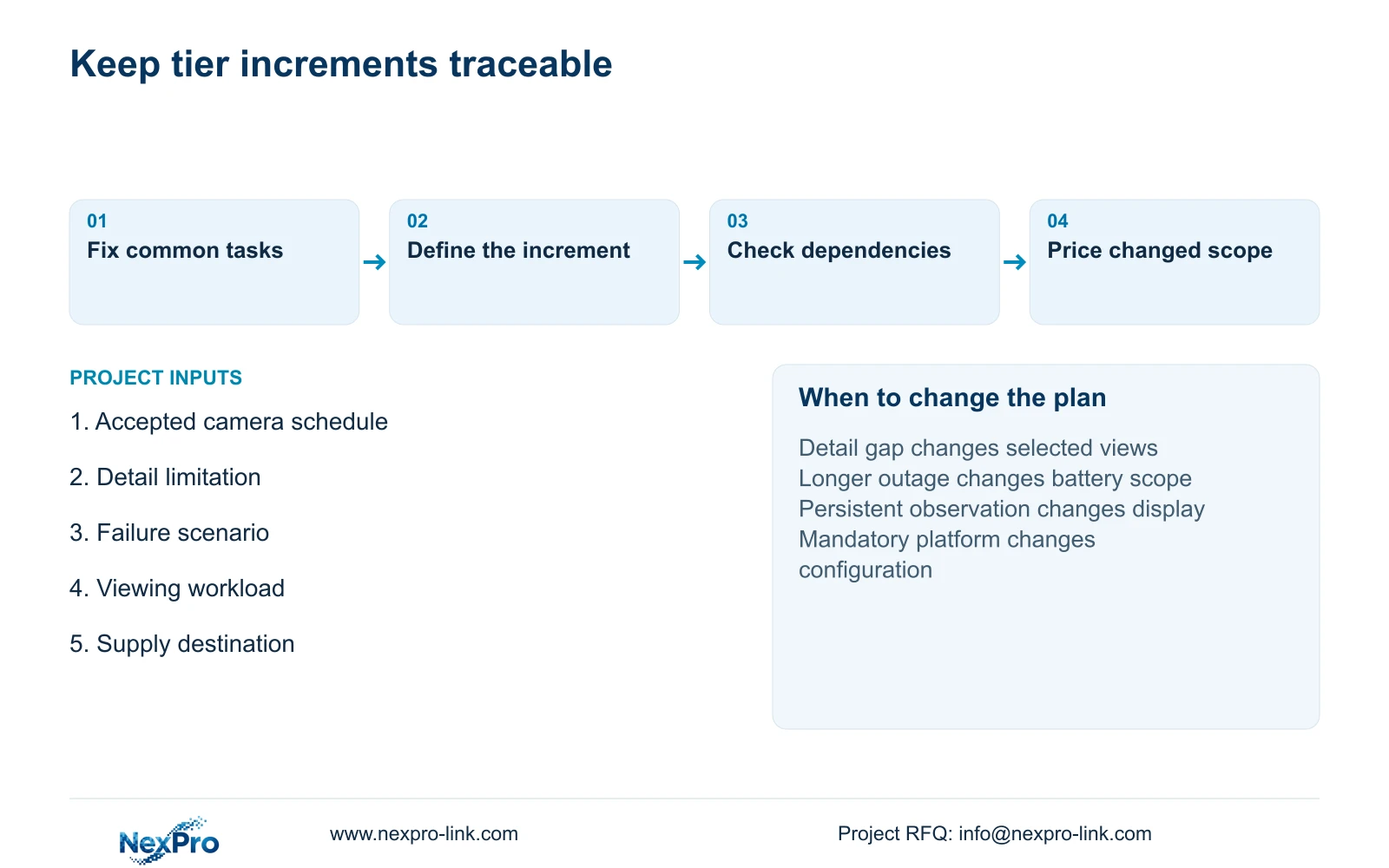
Select essential scope when the accepted views and operator workflow already meet the brief. Add enhanced scope when a specific view lacks useful detail or concurrent observation needs a different layout. Add resilience scope when the owner identifies an interruption that the baseline cannot tolerate and the proposed recovery arrangement is supported. These additions can be combined without upgrading every device.
A mandatory operator platform, changed retention purpose or unsuitable site environment can alter that selection. Keep the requirement and revise the configuration. In particular, do not reduce necessary storage to fund a wall, or treat a larger UPS rating as a substitute for a defined runtime.
Send the public-zone schedule, the improvement sought, the failure scenario and operating priorities to info@nexpro-link.com, with the destination. NexPro-Link can discuss scoped model matching and coordinated equipment options. The supplied October 7, 2026 policy record gives applicable main equipment a 24-month limited hardware baseline from receipt; accessories, OEM and site service costs follow their written scope. Continuing technical support does not establish unlimited free repair or local attendance.
Section 07
Buyer questions
Must resilience include a video wall? No. A wall addresses viewing tasks. Recovery scope addresses named interruptions and restoration requirements. Price them separately unless the hotel explicitly requires the wall to remain operational during the selected outage.
Can we enhance only the entrance cameras? Yes, if those views have the identified detail requirement. Retain suitable baseline cameras elsewhere and recalculate the affected recording, network and power inputs. Confirm that the recorder supports the resulting mixed configuration.
What evidence should support a higher tier? Request the task gained, the supported configuration and the acceptance method. For recovery additions, require the relevant failure state and restoration responsibility. A catalogue feature or tier name alone cannot establish the proposed operating outcome.
Engineering references
These sources support the general planning principles. Always use the selected product's current datasheet and applicable project standards for final design.
- N01: Hotel & Hospitality Project Supply
- N02: BOQ & Tender Support
- N04: NexPro-NVR4449-4K product record
- N05: NexPro SW-POE1618G product record
- N09: Rack online UPS ratings
- N10: Video wall and decoder system
- N14: Warranty policy
- Supplied BL2812M Series product specification
- NX-VP-5535 55-inch LCD panel
- NX-VD-4K16 decoder