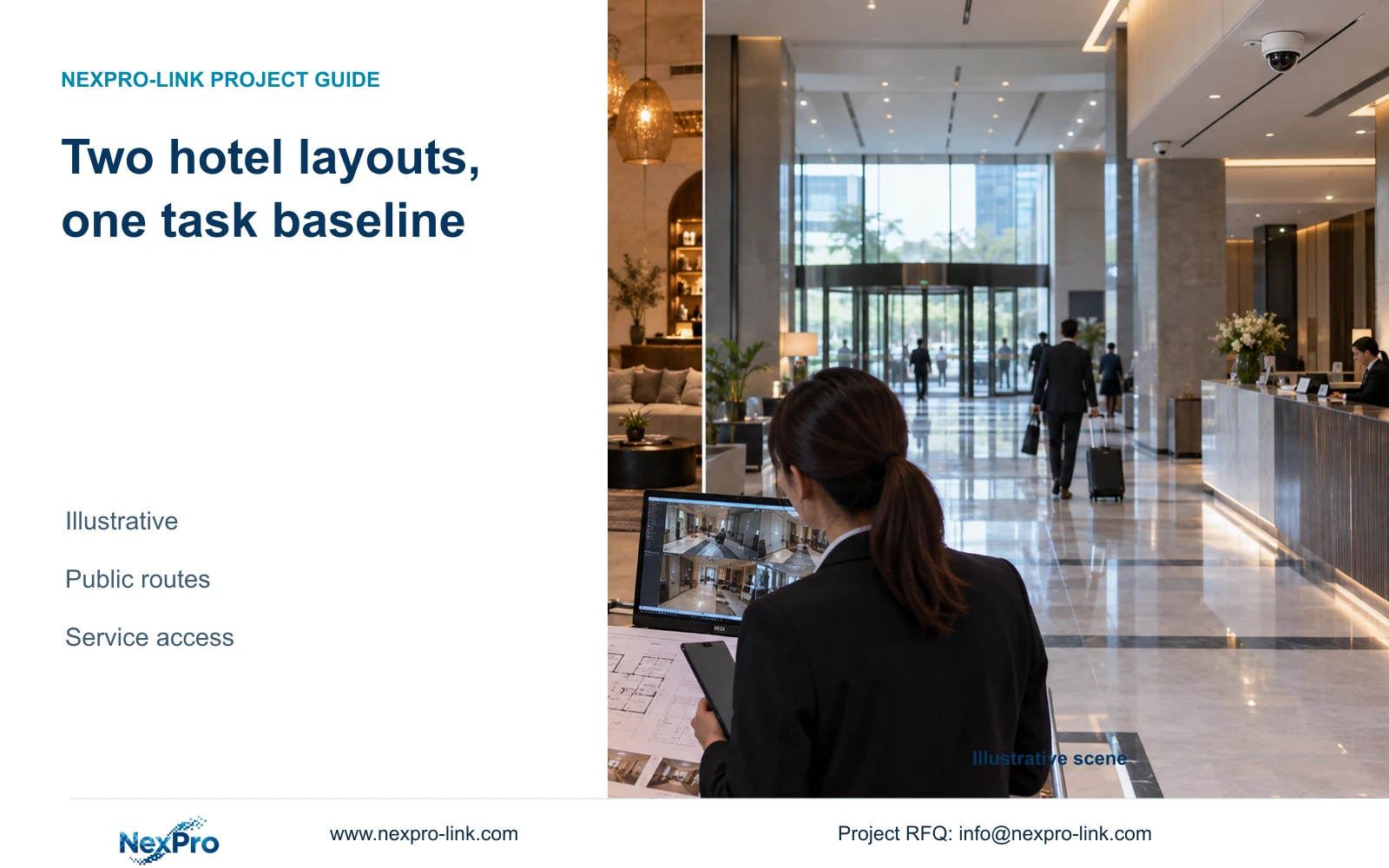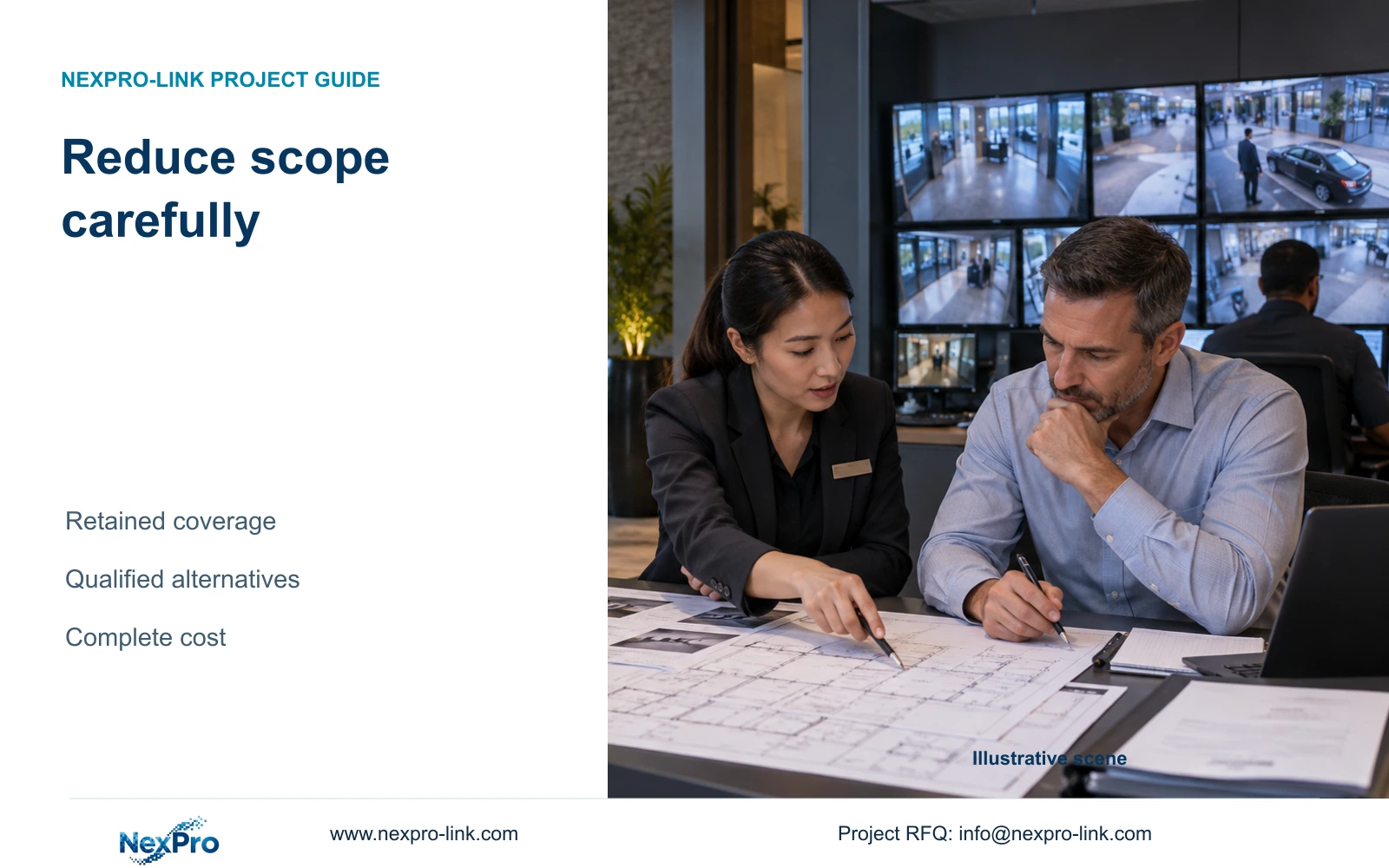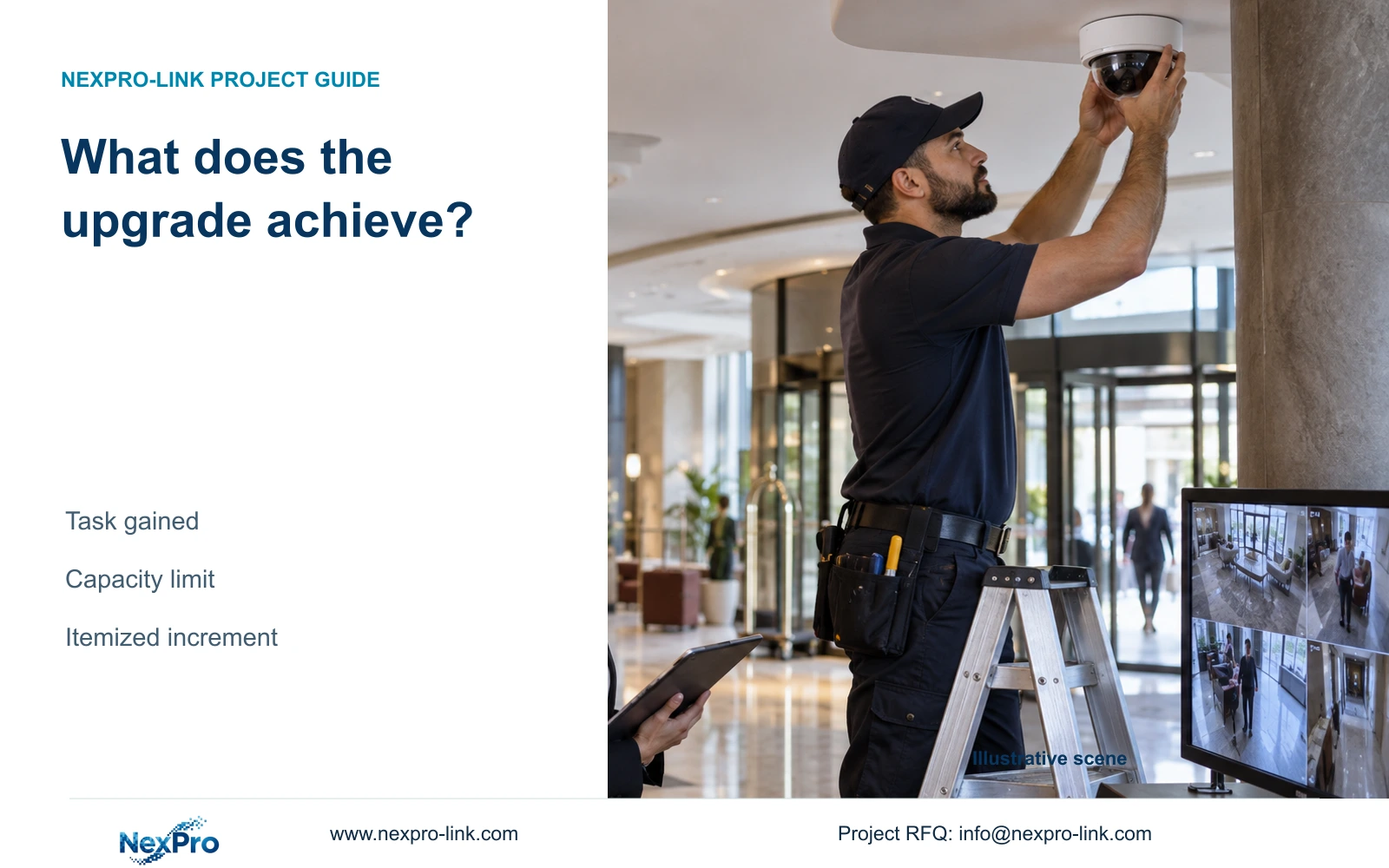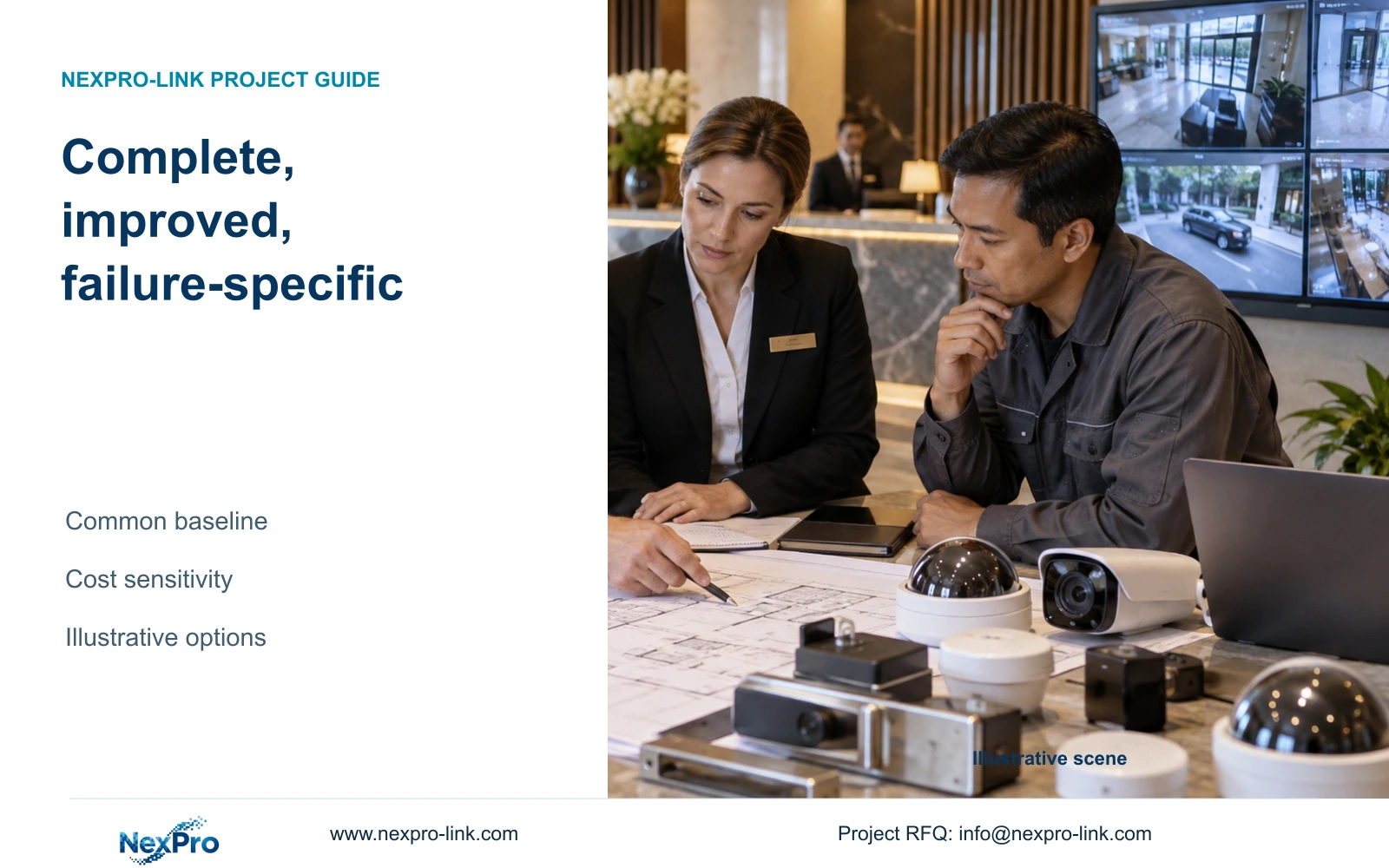
For each optional tier addition, record the unmet task, trigger and acceptance evidence that would justify purchase. Preserve the complete essential baseline in every release.
Section 01
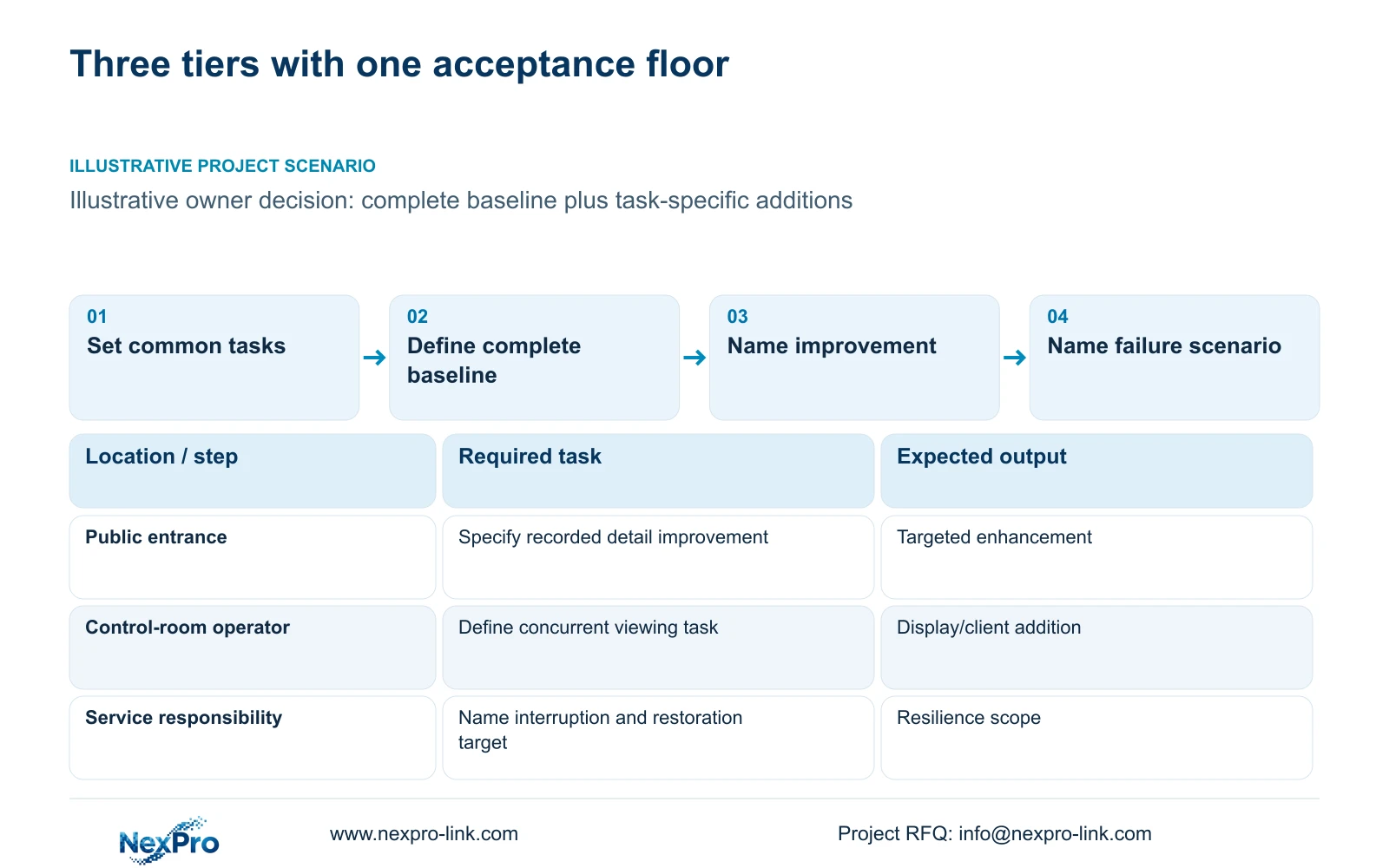
Set the acceptance floor for every option
For each optional tier addition, record the unmet task, trigger and acceptance evidence that would justify purchase. Preserve the complete essential baseline in every release. If the trigger has not occurred, quote the addition separately. A resilience label cannot substitute for identifying the actual failure and supported restoration behavior.
Choose the essential complete system when it meets the hotel's approved recording, retrieval and outage tasks. Add enhanced scope for a defined image or operator improvement, and resilient scope for an explicitly identified failure or restoration requirement. A lower tier that omits necessary storage or protected networking is an incomplete offer and should not enter an equal-outcome price comparison.
Write the common baseline as observable tasks. Required public-zone movement must be recorded at the agreed point and light condition. An authorized operator must find and export the relevant time window. The selected camera, network and recorder path must remain operational through the agreed outage state. Set these criteria before assigning tier names.
Record the intended models, firmware and test conditions with the acceptance scope. Expected results cannot be presented as completed tests. Factory checks and hotel-site observations answer different questions, so the proposal should identify who demonstrates each task. A trial of one configuration establishes only what was observed under those conditions.
| Required task | Given information | Decision still needed |
|---|---|---|
| Record required public views | CASE01 uses 32 illustrative positions | Actual views and image conditions |
| Retrieve an incident | Playback and export are required tasks | Authorized workflow and output |
| Continue through outage | Required path must be protected | Duration and operating state |
Section 02
Define a complete essential equipment path
Connect the camera schedule to access networking, recording, disks and protected power. Include the operator's necessary viewing arrangement and the installed cabling scope. Draw data and power separately so every active dependency is visible. Recording should not require the viewing wall to remain switched on.
The independent CASE01 reference assumes 32 cameras at 4 Mbps, continuous 30-day recording and 20% usable-space reserve. It requires 128 Mbps input, 41.472 TB video and 51.84 TB usable capacity. Its proposed four 16 TB disks provide 64 TB raw, with an assumed 60.8 TB formatted and 48.64 TB video budget after reserve. These are planning values without RAID loss, unrelated to the cost example below.
Select hardware against the actual stream and disk combination. NexPro-NVR4449-4K publishes four SATA positions and 320 Mbps input, but its summary resolution modes do not establish arbitrary 49-channel 8MP recording. CASE01 also assigns power assumptions independently. Count switch AC input without adding its PoE-fed cameras again, then size protection by actual location.
Section 03
Buy enhancements against an operator or image task
An enhanced option should name the improvement and the position or workflow receiving it. An entrance may need different framing or recorded detail. A control room may need persistent shared views while another operator retrieves footage. Review the task before applying a higher resolution or larger display to the entire camera schedule.
The supplied lens comparison gives 240 px/m for 2880 horizontal pixels across a 12 m target width and 320 px/m for 3840 across the same width. This geometric increase does not establish identification or night performance. A changed image mode also changes the stream configuration that must be checked against storage and recorder limits.
A 2×2 arrangement of Full HD NX-VP-5535 LCD panels has a theoretical 3840×2160 canvas and 960×540 pixels per tile in a 16-view grid. A single Full HD screen gives 480×270 per tile; a single 4K monitor has the wall's same nominal total pixels. Actual signal control, viewing distance and seams determine usefulness. NX-VD-4K16's name does not prove 16 simultaneous 4K decodes.
Keep the enhancement's initial and recurring costs separate. Demonstrate the specified operator task without claiming an invented average time saving. The cost formula used for comparison is total over the evaluation period equals initial cost plus years multiplied by annual cost.
Section 04
Add resilience for a named interruption
Define resilience by the failure considered and the function retained or restored. A longer battery target addresses a power-duration requirement. A supported spare arrangement addresses replacement access and restoration work. An approved alternative data path addresses a link dependency. None establishes continuity against every possible outage.
Describe the normal, interrupted and restoration states for each addition. Identify the responsible local action and any required reconfiguration. Spare equipment still needs functional compatibility and an available installation route. An array's disk-failure tolerance does not replace independent incident preservation, and RAID support must be explicit for the selected recorder.
Compare the one-time resilience item with its recurring service and maintenance scope. Do not invent a failure rate or use assumed maintenance savings as a brand characteristic. Where the advantage relies on annual savings, calculate the break-even point and show the threshold at which the owner should choose differently. A mandatory continuity outcome belongs in every compliant tier.
Section 05
Compare incremental outcomes and complete costs
Normalize quotations for the same task, quantity, destination, currency and delivery basis. Separate equipment, installation, software, logistics and taxes from later service. Missing items belong back in the evaluated scope. Keep mandatory requirements constant while showing each optional addition and its accepted benefit.
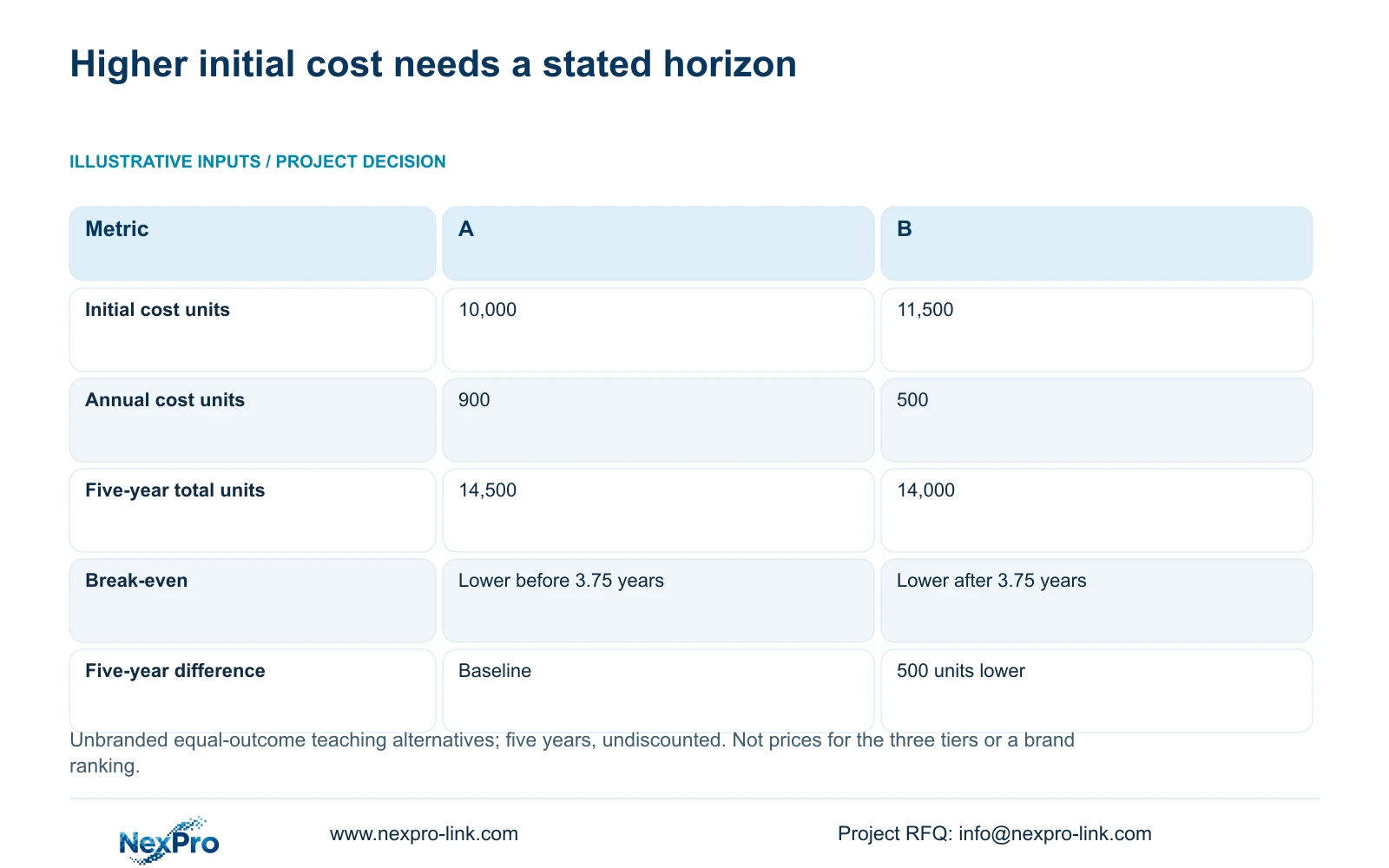
The following independent teaching example compares unbranded alternatives with equal required outcomes. A costs 10,000 units initially and 900 annually; B costs 11,500 initially and 500 annually. Five-year undiscounted totals are 10,000 + 5 × 900 = 14,500 and 11,500 + 5 × 500 = 14,000. The units are not a currency or current supplier prices.
Break-even is (11,500 - 10,000)/(900 - 500) = 3.75 years. A is lower before that point, the totals are equal there, and B is lower afterward under unchanged assumptions. At five years B is 500 units lower. This does not price the three technical tiers or prove that enhancement and resilience pay for themselves. Actual recurring costs or evaluation period can reverse the result.
The tier matrix identifies what must be justified before an enhancement or resilience item is purchased. The separate cost illustration compares two hypothetical options; it does not price these three tiers or establish that every additional device improves the accepted service.
| Tier | Retained requirement | Additional inputs before selection |
|---|---|---|
| Essential | Approved public views, recording, retrieval and protected nodes | Scene schedule, streams, retention and outage target |
| Enhanced | All essential outcomes remain unchanged | Named viewing/image gap; candidate configuration and recorded comparison |
| Resilient | All essential outcomes plus a defined failure response | Failure boundary, supported fallback, restoration task and repeat-test conditions |
Section 06
Choose a tier with explicit upgrade triggers
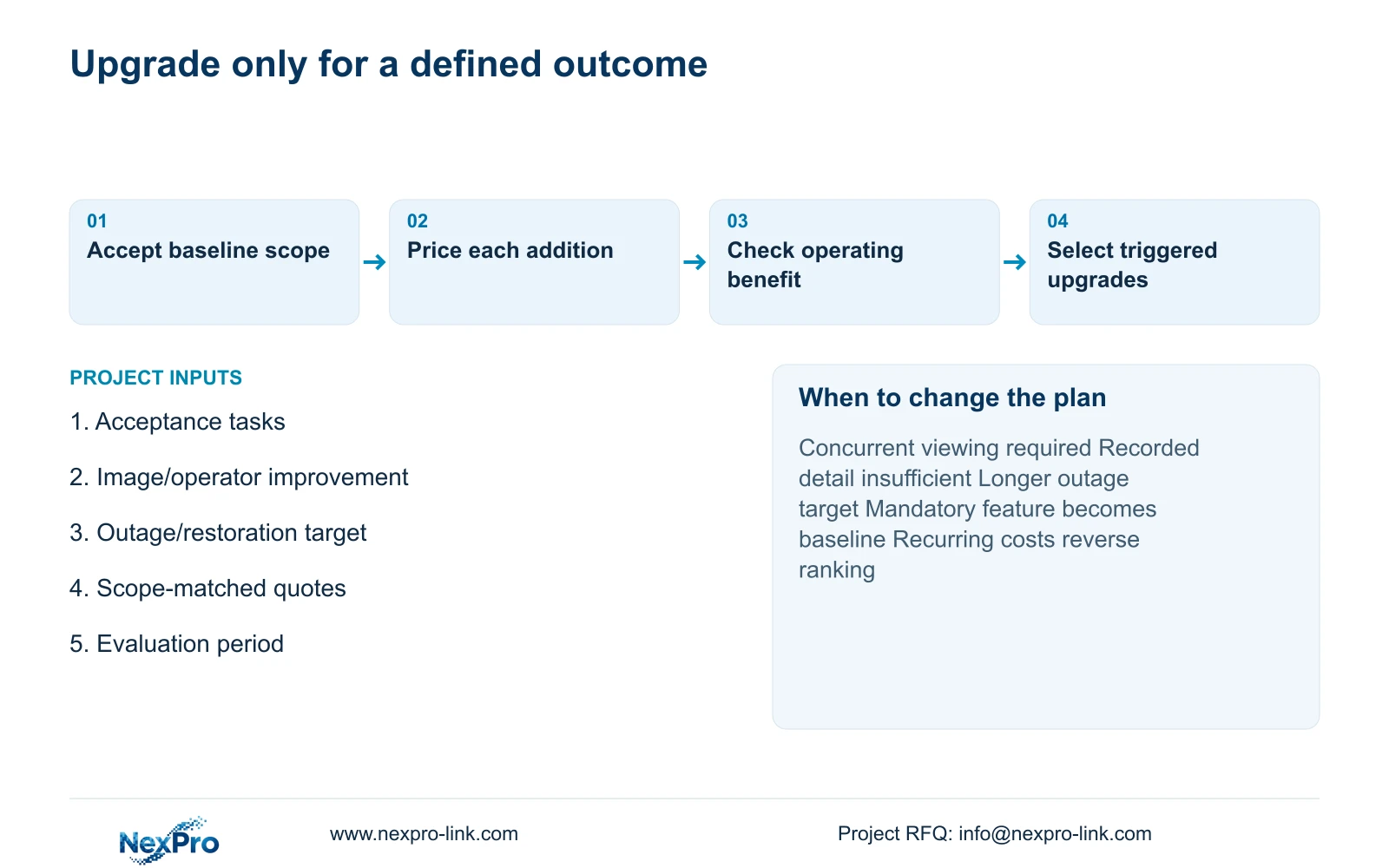
Recommend the economical complete baseline when one authorized workstation and the approved protected recording path meet the operating need. Add enhanced scope when a specific image or concurrent viewing task cannot be met by that arrangement. Add resilience when the owner requires continuity or restoration under a defined interruption that the baseline does not address.
Separate warranty from resilience. The supplied policy record gives applicable main equipment a 24-month limited hardware baseline from receipt, subject to controlling written order terms. Batteries, disks, cable, OEM scope and service expenses require their own boundaries. A warranty term does not promise immediate local restoration, and technical support does not imply all site labour is included.
Send the common acceptance tasks, proposed optional outcomes, outage/restoration target and scope-matched quotations or budget basis to info@nexpro-link.com. Include destination and evaluation period for commercial comparison. NexPro-Link can discuss a tiered equipment schedule and BOQ response, distinguishing its CCTV manufacturing core from coordinated supporting products and local site responsibilities.
| Situation | Required record | Decision boundary |
|---|---|---|
| Essential baseline released | Required recording and operator tasks | Do not remove essentials to fund options |
| Optional trigger not reached | Unmet task and review point | Keep addition as a conditional offer |
| Trigger is reached | Supported remedy and acceptance task | Release only the justified increment |
Section 07
Buyer questions
Can enhanced and resilient options be combined selectively? Yes. Apply each addition to its named task and affected dependency. The owner may need better entrance detail without a wall, or faster restoration without changing all camera resolutions.
Is B the resilient tier in the cost example? No. A and B are unbranded equal-outcome teaching alternatives. Their numbers illustrate recurring-cost sensitivity and do not assign prices or service performance to a technical tier.
When should an optional feature become baseline scope? When the owner or mandatory operator requirement makes its outcome necessary for acceptance. Move it into every compliant option before comparing prices, including its supporting network, power and software scope.
Engineering references
These sources support the general planning principles. Always use the selected product's current datasheet and applicable project standards for final design.