Early delivery needs a named custodian, suitable product-specific storage and a documented return to installation. Receipt and later commissioning remain separate events.
Section 01
Decide whether the store can support the waiting period
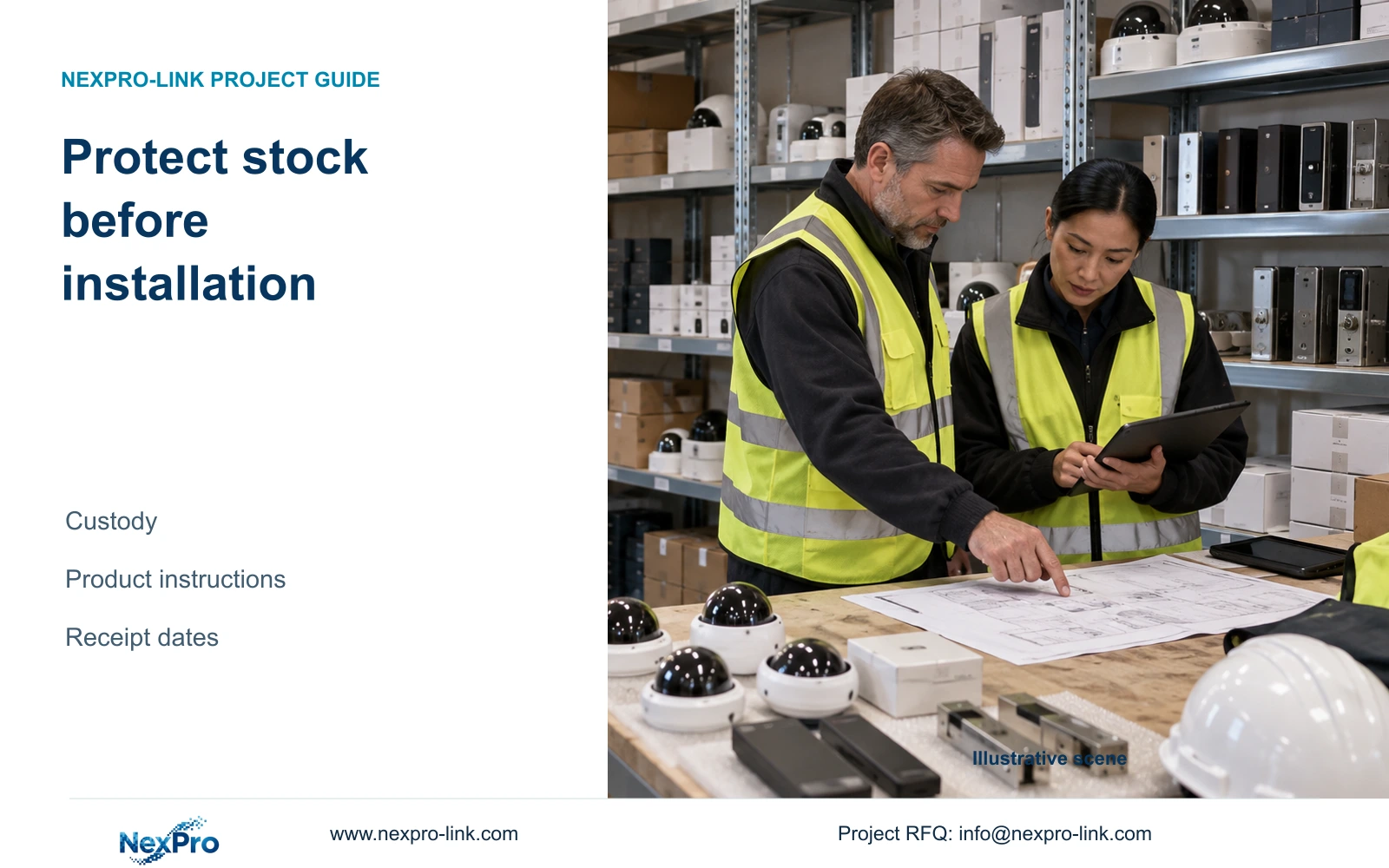
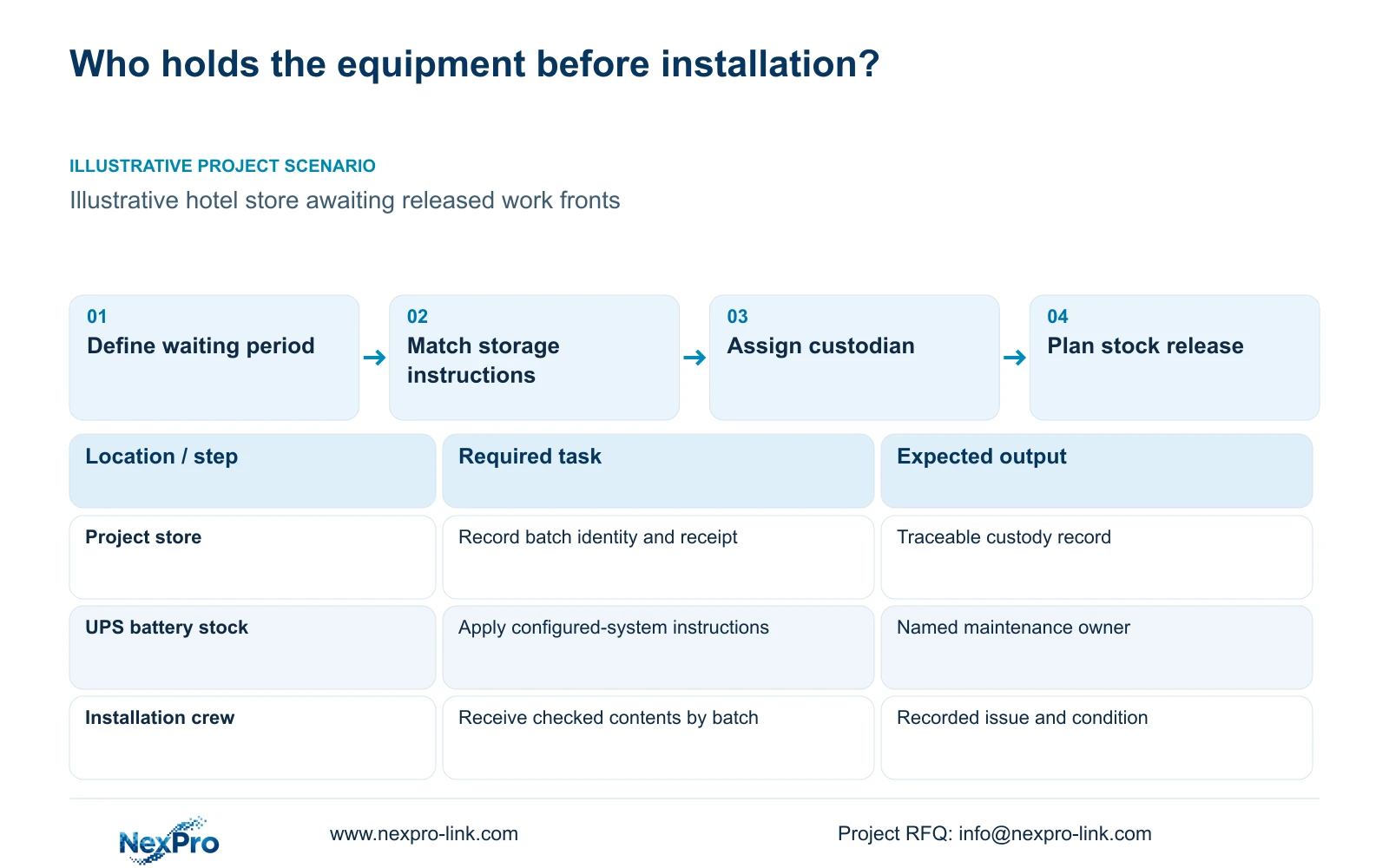
Accept early equipment delivery only when a named custodian can maintain the selected products under their documented storage conditions until installation. Separate batteries, drives and ordinary accessories by their handling needs, and plan checks before release to the crew. If the store cannot support those conditions, prefer staged delivery of complete operating packages.
Record expected receipt and installation dates for each batch. The waiting period determines which product instructions and maintenance actions must be considered. Describe the proposed store and its actual environment, including whether construction activities affect the space. A planned equipment room may not yet provide the conditions expected once the hotel is operational.
Do not substitute an operating specification for a storage instruction. A camera's stated operating temperature or ingress rating does not establish how its unopened package should be stored. Request model-specific requirements where the documents supplied with the order leave a gap. Avoid inventing a universal temperature, humidity range or battery recharge interval for the whole equipment package.
| Required task | Given information | Decision still needed |
|---|---|---|
| Hold cameras before ceiling access | Installation date remains pending | Suitable store and named custodian |
| Hold UPS and batteries | Configured system is ordered | Applicable storage and maintenance instructions |
| Release drives for recorder installation | Receipt batch is identified | Handling record and installation check scope |
Section 02
Separate equipment handling needs
Create handling groups from the actual products. Cameras and network equipment require their own packaging and storage instructions. Drives need identifiable handling and installation records. UPS units and batteries require the instructions for the selected configuration, including any supported maintenance procedure during the waiting period. A generic accessory list cannot cover those differences.
SP2KR(S), for example, is a rack online UPS candidate rated 2 kVA and 1800 W in the supplied product record. Those capacity ratings do not specify a storage recharge schedule or prove battery condition after months on site. The actual battery configuration and its instructions belong with the batch. Do not transfer energy values or procedures from a different selected model.
Separate receipt inspection, factory checks and hotel site acceptance. Receipt can establish what arrived and its observed condition. Factory testing can cover reproducible equipment tasks. Hotel lighting, installed cabling and the full protected recording path need site observations. Keep expected outcomes unmarked until their relevant checks occur.
| Item | Common-stock approach | Product-specific approach | Effect |
|---|---|---|---|
| UPS and batteries | No scheduled instruction review | Configured battery instructions retained | Maintenance responsibility is visible |
| Recording drives | Loose unidentified stock | Batch and recorder allocation retained | Installation identity remains traceable |
| Accessories | Mixed with installed-device stock | Contents and intended issue recorded | Missing items can be distinguished |
Section 03
Record receipt and ownership
Record the receipt date, order reference, carton contents and observable condition. Associate serial identities with the batch where available, then note the storage location and custodian. Preserve photographs or observations of relevant packaging damage through the project's approved records. A signed quantity receipt should not be represented as a completed functional acceptance result.
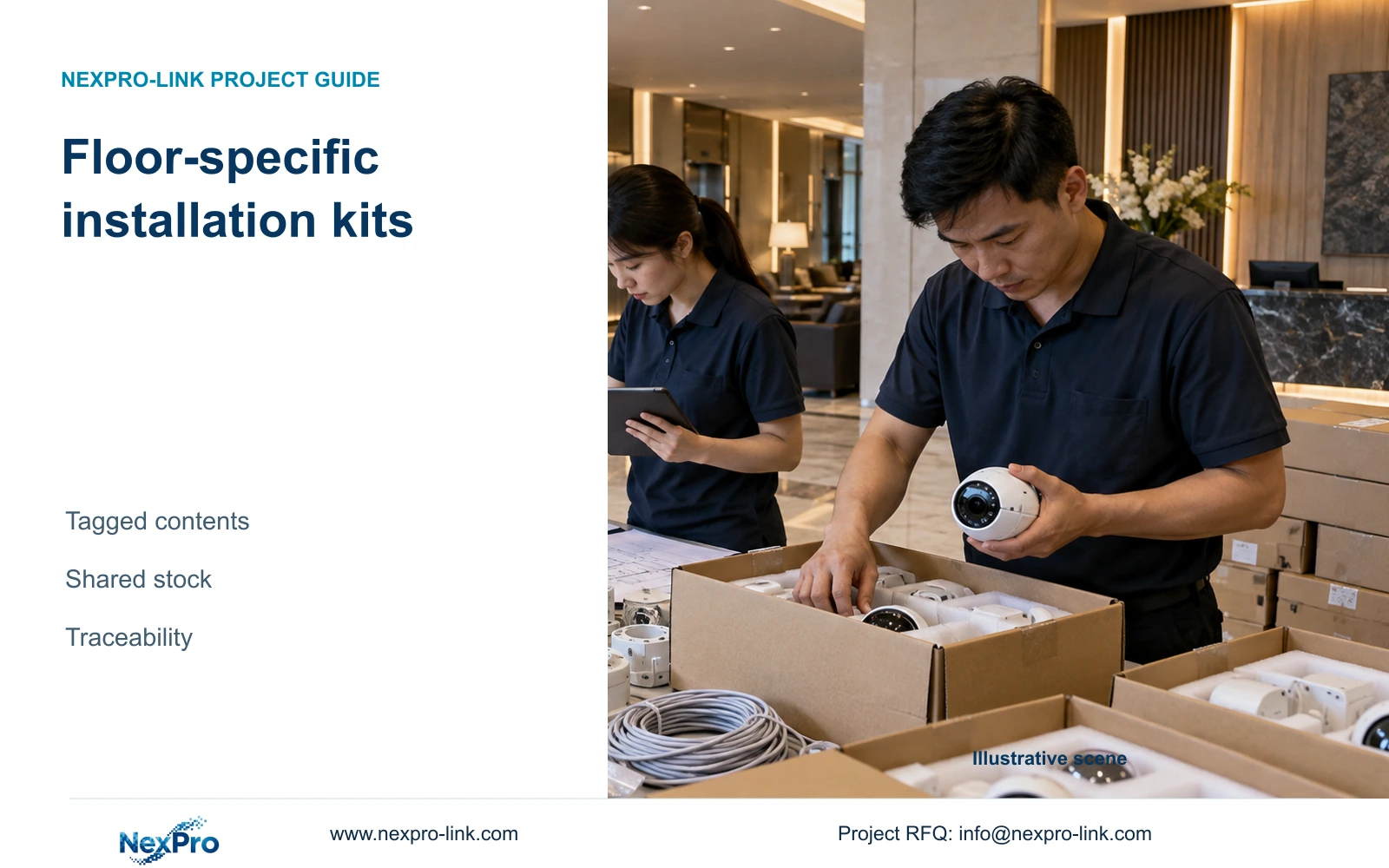
Make custody transfers explicit when stock moves from a central store to a floor crew or another location. Record the quantity, identity and condition at transfer. This distinguishes stock that remains in storage from equipment issued for installation and helps locate accessories that were packed separately.
Treat responsibility for safekeeping and contractual ownership as separate fields. Their legal or commercial effects follow the controlling project terms, not an assumed rule in a stock spreadsheet. NexPro-Link's coordinated supply support can help define equipment and document scope, but does not automatically include site storage, local insurance or custody after delivery. Assign those responsibilities before the first batch arrives.
Section 04
Compare staged and early full delivery
Early full delivery can suit a stable installation programme with suitable storage and a clear maintenance owner. It also places the waiting stock under the project's custody arrangements. Compare that scope with staged delivery using actual transport, handling and storage inputs. The supplied evidence does not establish which option costs less.
CASE06 illustrates an independently usable first 32-camera release within a final 64-camera design. That structure can reduce how much later-phase equipment waits on site, provided the first package includes its recording, network and protected power dependencies. It is an illustrative supply arrangement, not a claim that any batch has been stored or delivered.
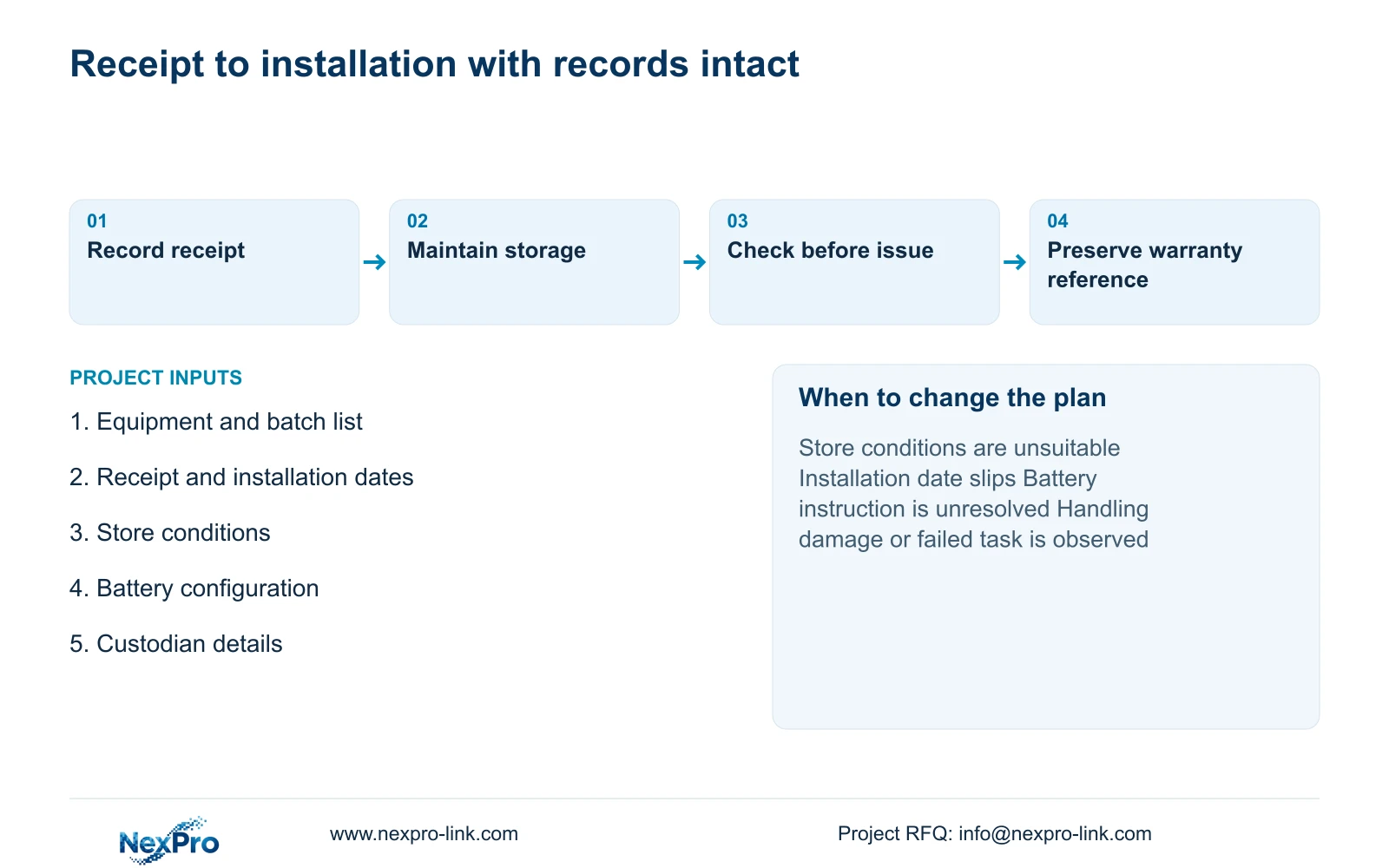
Do not defer an essential shared component simply to reduce stock. Conversely, a later optional display package need not arrive with the opening recording equipment if the operating brief permits separation. Change from early full delivery to staged release when storage conditions or battery maintenance cannot be supported. Change back when separate releases would prevent a complete opening function or introduce unacceptable supply dependencies.
| Option | Retained outcome | Required scope | Change condition |
|---|---|---|---|
| Early full delivery | Equipment available for all planned fronts | Suitable custody and product maintenance | Store cannot support the waiting period |
| Complete staged delivery | First operating package remains usable | Separate releases and receipt records | Essential shared equipment cannot be separated |
Section 05
Plan pre-installation checks
Before issuing stored equipment, reconcile identity and contents, review the storage record and identify any unresolved handling event. Carry out supported checks for the selected configuration. Record model, firmware and test conditions for functional observations, and separate a bench check from tasks that require the actual hotel installation.
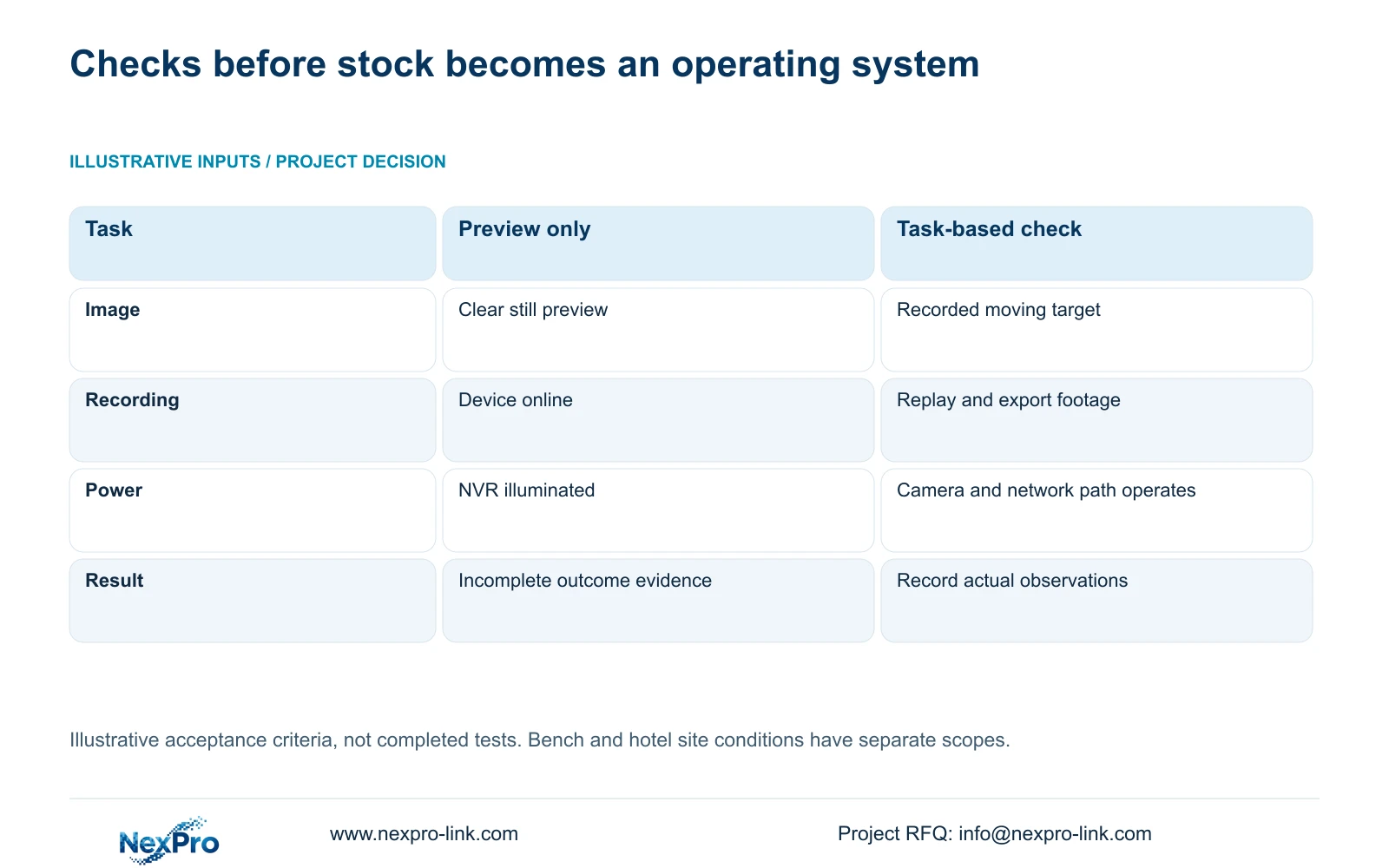
Separate custody release from later functional acceptance. The retained illustration contrasts preview-only checks with recorded image, replay/export and complete-path power observations; it does not prove that stored equipment was kept correctly. Record those functional tasks under their actual bench or site conditions, without pre-filled passes.
If a check finds a problem, retain the unresolved task, responsible party and repeat-test conditions. After correction, repeat the affected task under comparable conditions and record the observation. A limited sample cannot establish a whole-batch failure rate or lifetime reliability. Pre-installation inspection also does not extend the contractual warranty.
| Record | Evidence to retain | Release boundary |
|---|---|---|
| Identity and contents | Model/serial, accessories and receiving record reconciled | Missing or substituted items remain open |
| Storage and handling | Custodian, location, dates and any recorded incident | Operating ratings do not prove acceptable storage conditions |
| Batteries or special handling | Exact product instructions and unresolved condition | Do not invent a charging interval or override manufacturer instructions |
| Bench observation | Configuration, task and actual observed result | Does not establish hotel lighting, network or outage performance |
| Issue to installation | Responsible recipient and outstanding tasks | Custody transfer does not restart warranty or imply commissioning |
Section 06
Preserve warranty and batch references
The supplied warranty policy record, checked on October 7, 2026, states a 24-month limited hardware baseline from customer receipt for applicable main equipment. A delayed installation or opening does not automatically change that start event. Different written order terms control where expressly agreed; historical five-year wording should not be carried across the package.
Keep batteries, storage drives, cable and OEM conditions separately identified. Record applicable handling and service boundaries alongside the batch reference. Remote technical support does not establish free local labour, travel or return transport. Before the order, define the reporting path and cost responsibilities needed if stored equipment later requires attention.
Recommend product-specific custody with documented checks where early delivery is justified; stage complete packages when the storage obligation cannot be met. Send the equipment list, expected receipt-to-installation interval, proposed store conditions and responsible custodian to info@nexpro-link.com. Highlight the selected UPS battery configuration and any written start-event arrangement. Use the hotel project support and warranty policy routes for the relevant supply discussion.
Section 07
Buyer questions
Does commissioning restart the equipment warranty? The supplied policy baseline starts at receipt for applicable main equipment. Commissioning does not automatically restart it. Keep any expressly agreed alternative start event with the controlling order records.
Can one storage procedure cover every item? Only where the actual product instructions support the same conditions and actions. Keep battery procedures, drive handling and accessory custody distinct. A camera operating rating cannot replace the storage instructions for another category.
Is a successful bench check enough to release site acceptance? It supports the tasks actually observed in that setup. Installed routes, hotel lighting and the full outage state still need their applicable site checks. Record those as outstanding tasks instead of extending the bench result.
Engineering references
These sources support the general planning principles. Always use the selected product's current datasheet and applicable project standards for final design.