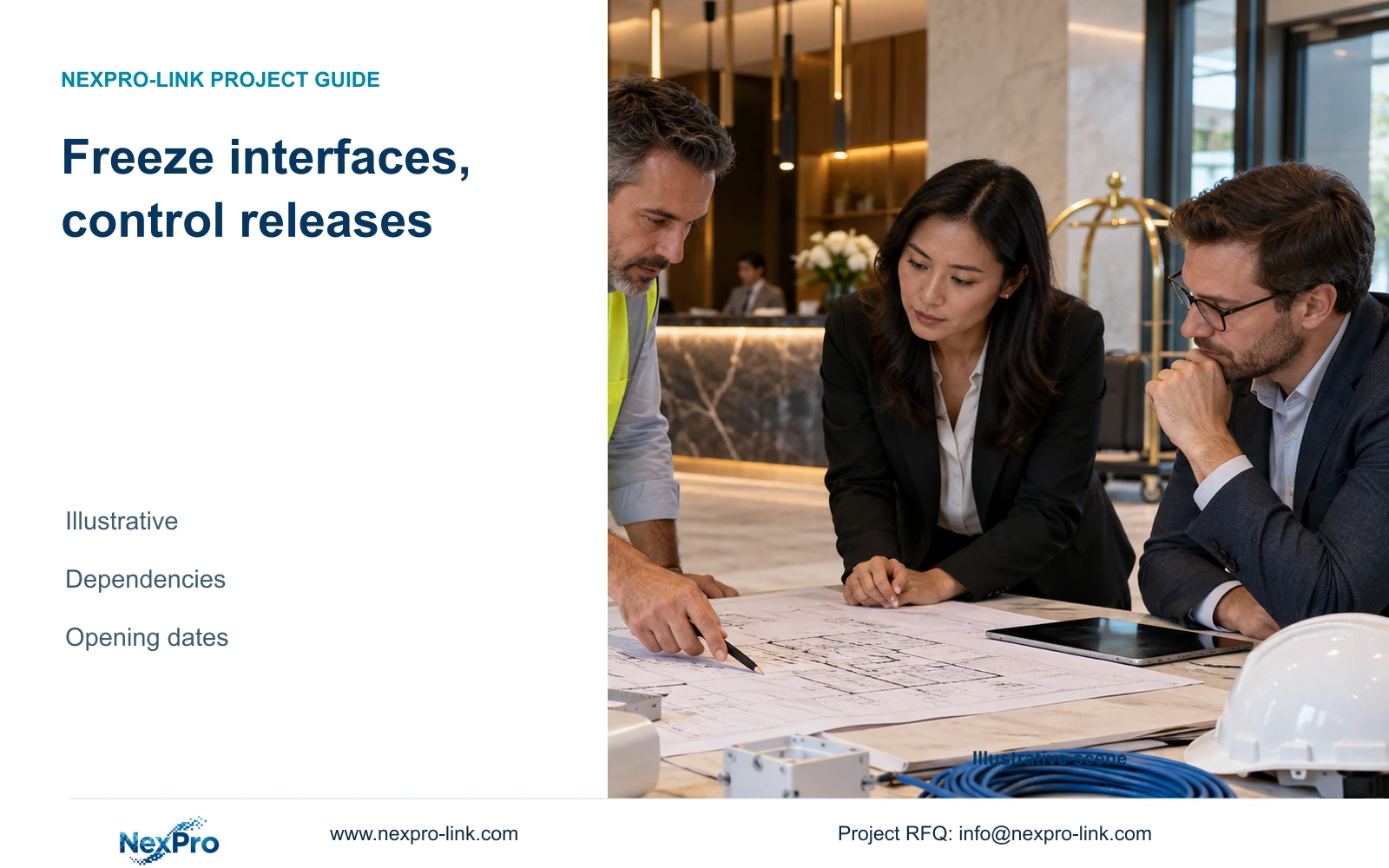
Freeze routes, mounting and power interfaces before they become costly to change. Keep later hardware and artwork decisions controlled through separate release dependencies.
Section 01
Freeze interfaces before construction closes
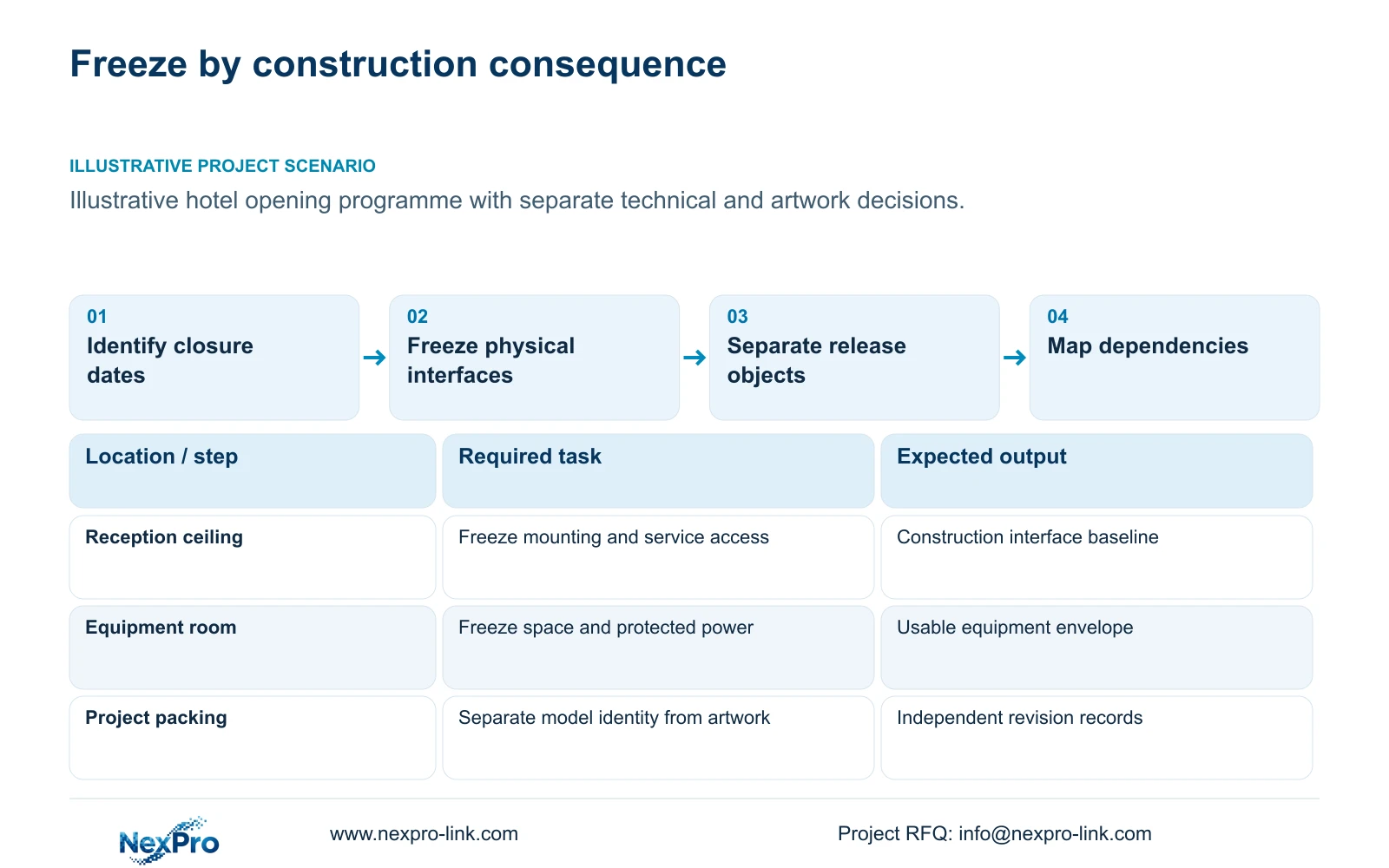
Freeze the interfaces that affect construction and protected power first, then release hardware and packaging against their actual dependencies. Leave later choices open only where they cannot invalidate completed work or block an essential opening function. A single deadline for the entire security package obscures which decision is delaying installation.
Work backward from usable recording, retrieval and authorized operation at opening. Identify cable routes, mounting locations and equipment-space access before ceilings or finishes close. The responsible site team should confirm the physical and electrical arrangements; a supplier schedule does not establish that the hotel is ready to receive or operate equipment.
Record the information required to freeze each interface and the consequence of changing it afterward. A recorder selection can remain open within an agreed space and interface envelope, but only if all proposed models fit it. If the unresolved selection can change depth, load or connections, the associated installation interface remains provisional.
| Required task | Given information | Decision still needed |
|---|---|---|
| Install reception cameras | Ceiling closure milestone | Mounting, cable route and service access |
| Keep the recording path powered | Equipment zones identified | Protected circuits and remote-node responsibility |
Section 02
Separate hardware from artwork decisions
Hardware approval establishes the operating configuration. Artwork approval establishes the authorized presentation and packing information. Track them separately, while recording any real dependency between them. A label cannot be finalized before the model identity is settled, but an independent carton graphic may be reviewed alongside technical approval.
Treat laser marking, printed labels and project cartons as distinct order options. Their material and batch implications belong in the agreed process. Preserve exact model identity, serial information and required markings when adding a customer logo. Hardware branding does not grant permission to rename third-party software.
Use separate revision fields for technical configuration, brand artwork and variable installation tags. This avoids reopening a stable hardware record when floor-by-floor packing changes. If the requested process requires final artwork before preparation, retain that dependency in the programme. Parallel working is appropriate only when the supplier can genuinely proceed on the approved inputs.
| Item | Technical decision | Artwork decision | Effect on release |
|---|---|---|---|
| Equipment label | Exact model and identity | Authorized logo and layout | Final label depends on stable identity |
| Project carton | Contents and packing scope | Graphic and zone markings | Parallel review only where inputs are independent |
Section 03
Map approval dependencies
Connect technical approvals to the calculations that support them. Camera streams determine recorder input and storage demand; camera grouping determines PoE requirements; protected equipment determines UPS load. Approving one channel count does not settle these different limits. Draw data and power paths separately, including remote nodes required for recording.
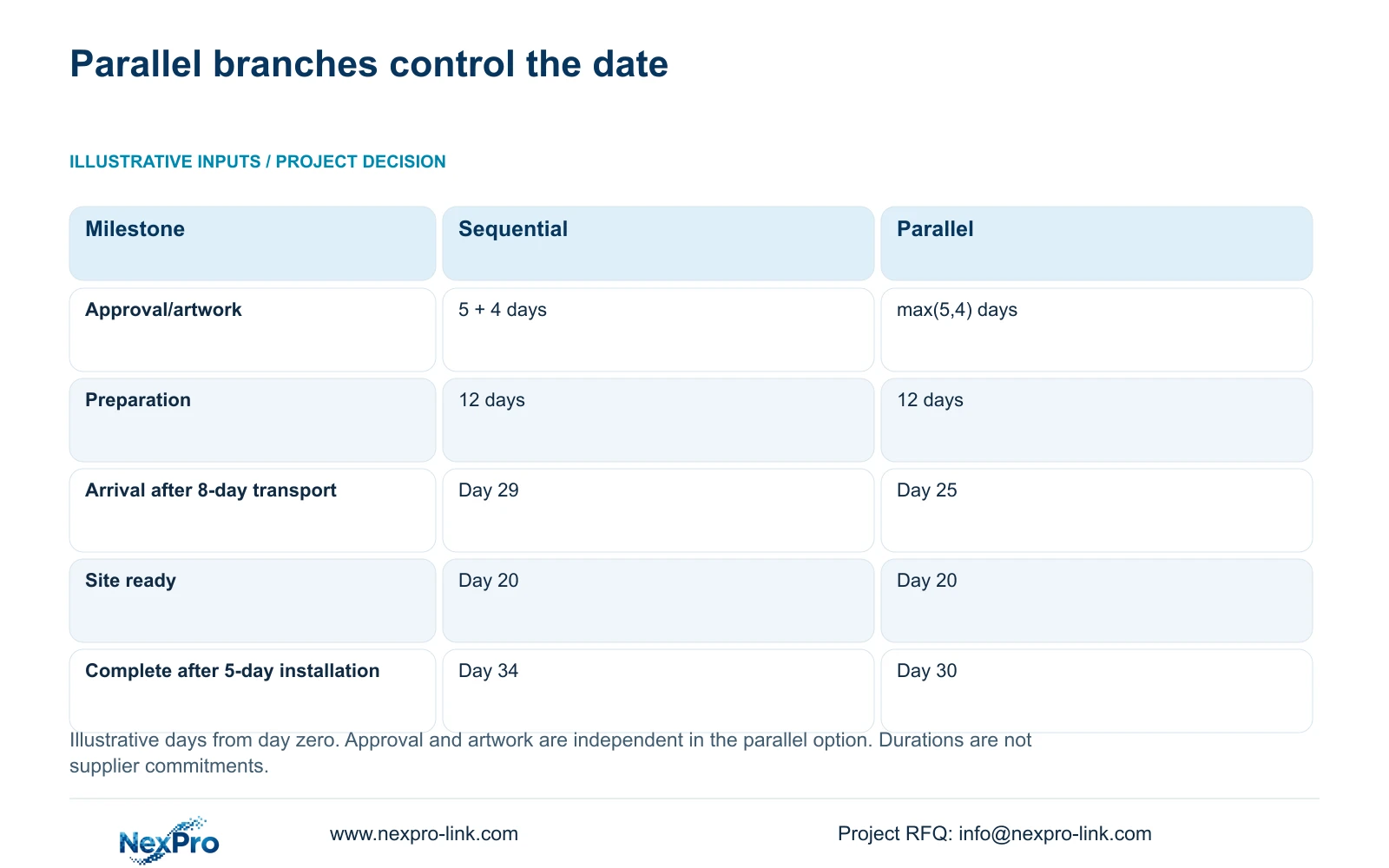
For the schedule illustration, technical approval takes 5 days and artwork takes 4 days, starting together at day zero. Preparation then takes 12 days, transport 8 days, and installation/testing 5 days. The site is assumed ready on day 20. All durations are teaching inputs, not quoted NexPro-Link lead times.
Ready-to-install day equals the later of equipment arrival and site readiness. Equipment arrival follows the later completed approval branch plus preparation and transport. Completion adds installation/testing. Include project-specific battery transport requirements and IT access permissions on the branch they actually constrain. A completed device can still be waiting for an unresolved release input.
Section 04
Calculate the latest release dates
With independent approval branches, arrival is max(5,4) + 12 + 8 = day 25. The later of day 25 and site-ready day 20 is day 25; adding 5 days of installation/testing gives day 30. Treating approvals as sequential produces arrival on day 29 and completion on day 34.
The four-day difference comes from the dependency assumption. It is available only if the work can run in parallel. For a required completion at illustrative day 30, installation must start by day 25 and preparation by day 5. Technical approval must therefore start by day zero. Four days of independent artwork must finish by day 5, so its latest start is day 1.
These latest dates contain no schedule float. If transport or approval takes longer, recalculate the controlling path and any contingency separately. If site readiness moves beyond day 25, it controls installation even when equipment arrives on time. Convert relative days into agreed project dates before using the calculation for an actual release.
| Metric / condition | Sequential treatment | Independent parallel branches |
|---|---|---|
| Approval and artwork | 5 + 4 days | max(5,4) days |
| Equipment available | Day 29 | Day 25 |
| Site ready | Day 20 | Day 20 |
| Completion | Day 34 | Day 30 |
| Actual commitment | Requires agreed sequence and dates | Requires genuine branch independence |
Section 05
Compare phased and single releases
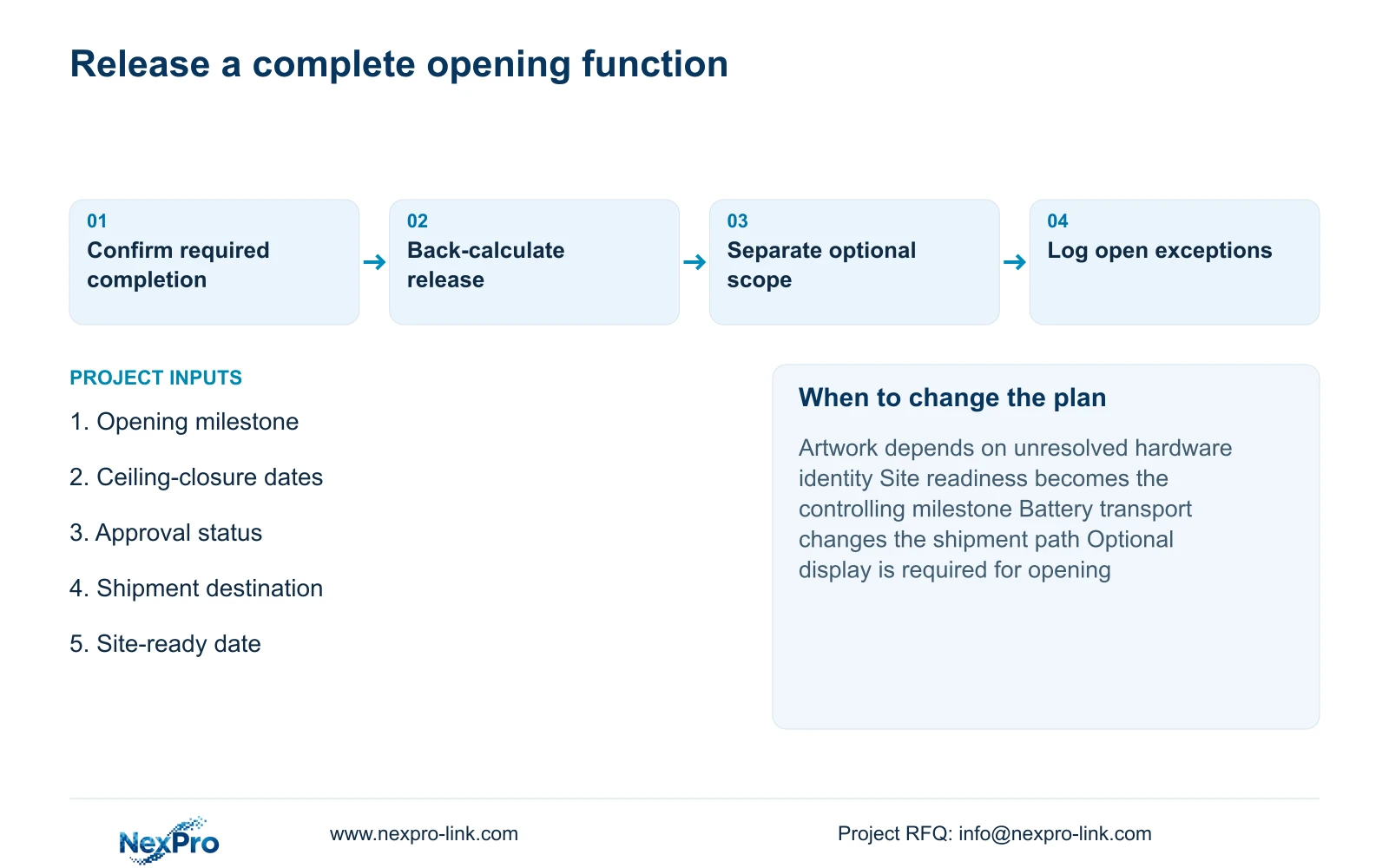
A functional first release can proceed when its approved scope includes every dependency needed for opening. Cameras without required access switches, storage or protected power do not form a usable recording release. An optional wall may follow later if the hotel can complete its accepted operating tasks with the first display arrangement.
Compare the programme benefit with additional handling, shipment and installation work. A phased release can reduce waiting for an unrelated option, but it can also create extra visits or packing effort. Obtain actual commercial inputs for those effects. No fixed saving follows from splitting a purchase.
Name who decides, who executes and who authorizes each release. The project manager can forecast a need, the engineer can confirm a configuration, and the buyer can issue the order authority under the project's arrangements. A forecast schedule is not a purchase instruction. Retain a single configuration baseline so separately delivered items remain traceable.
| Retained outcome | Extra scope | Use when | Counter-condition |
|---|---|---|---|
| Complete opening recording | Separate optional display shipment | Display approval blocks an otherwise complete release | Display is an opening dependency |
| Coordinated installation | Single package release | All inputs are ready together | An independent option delays essential work |
Section 06
Record controlled exceptions
A controlled exception should identify the open decision, its owner and the interface that remains protected. For an unresolved display choice, retain the approved viewing task, available space and power envelope. A conceptual direct-view LED wall still requires its actual module, cabinet and control layout; a nominal pixel-pitch calculation cannot freeze an unspecified product.
Use dependency-based releases when the configuration and independent branches are sufficiently defined. Change to a linked or single release when mandatory integration, transport conditions or installation sequencing makes separation impractical. Reopen frozen interfaces only with a recorded cost, programme and operating consequence, then update every affected schedule.
Send the opening milestone, ceiling-closure dates, approval status and proposed release split to info@nexpro-link.com, with the destination. NexPro-Link can discuss technical schedules and OEM packing scope through its hotel project and BOQ support. The supplier response should distinguish the next customer decision from the equipment or documents that can follow it.
Section 07
Buyer questions
Can packaging wait until after the equipment model is approved? Yes where the agreed preparation process allows it. Keep required product identity stable and confirm whether marking or packing approval is needed before preparation. Do not assume late artwork has no delivery effect.
Does equipment arrival mean the opening milestone is met? Arrival leaves installation, configuration and the agreed operating checks outstanding. Site access, power and IT permissions can still control completion even when all cartons have arrived.
Can an indicative schedule authorize a partial order? No. A partial order needs the project's actual release authority and a defined functional scope. The schedule identifies dependencies and timing; it does not replace procurement authorization.
Engineering references
These sources support the general planning principles. Always use the selected product's current datasheet and applicable project standards for final design.