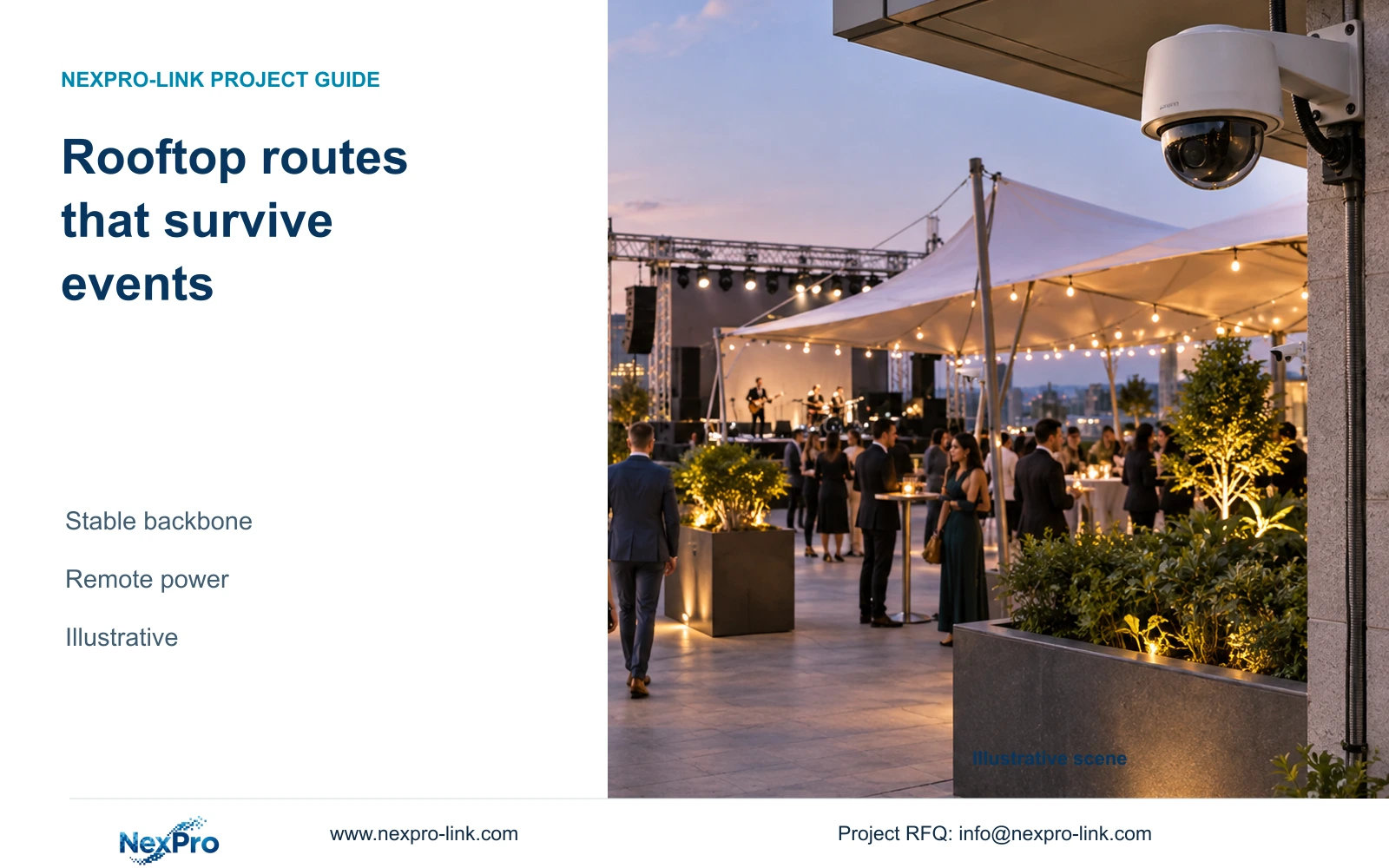
Keep the rooftop backbone stable and adjust endpoints around approved event layouts. Choose remote fibre access only with a complete local power and maintenance scope.
Section 01
Separate permanent routes from movable event endpoints
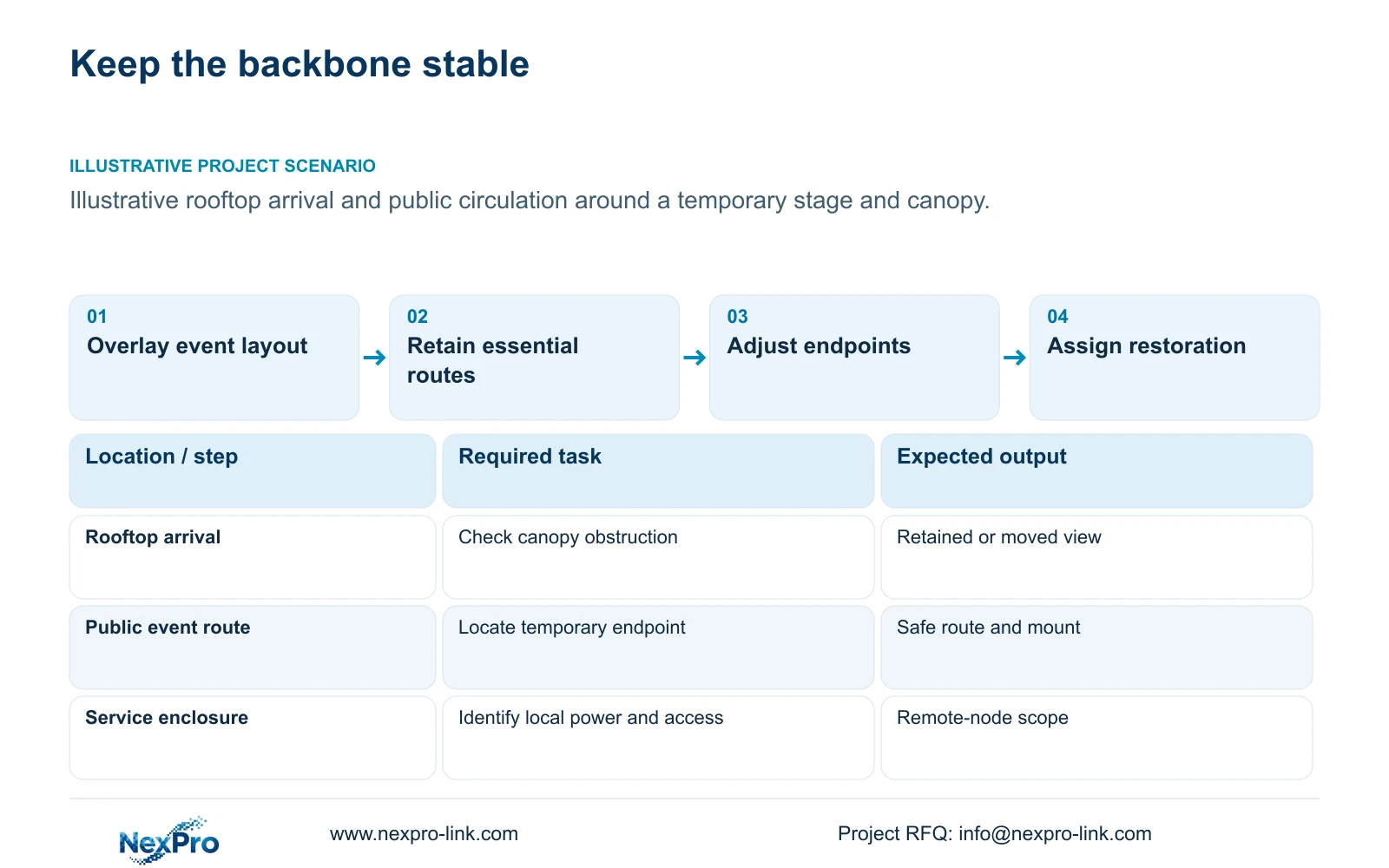
Keep the rooftop backbone and protected recording route permanent where practical, with adjustable camera endpoints for approved event layouts. For the illustrative 98 m permanent copper route, choose a qualified fibre node with a 24 m local copper tail if suitable remote power and maintenance access are available. Otherwise shorten or relocate the copper route before selecting equipment.
Overlay the normal rooftop plan with the stage, canopy and service arrangements for the event. Identify the arrival point and public circulation routes that still need observation after reconfiguration. A fixed camera can remain operational while its intended view disappears behind temporary structures.
Classify each point as retained, repositioned or temporary, and assign an acceptable restoration delay to the essential function. Any replacement stock should address that function and a verified interchangeable device family. An arbitrary spare percentage cannot establish whether the entrance view can be restored using the available mount, power and recording configuration.
| Required task | Given information | Decision still needed |
|---|---|---|
| Observe rooftop arrival | The entry remains fixed | Whether the canopy obstructs the retained view |
| Observe the event public route | Stage and furniture positions change | Temporary endpoint and safe cable route |
Section 02
Compare complete installed cable routes
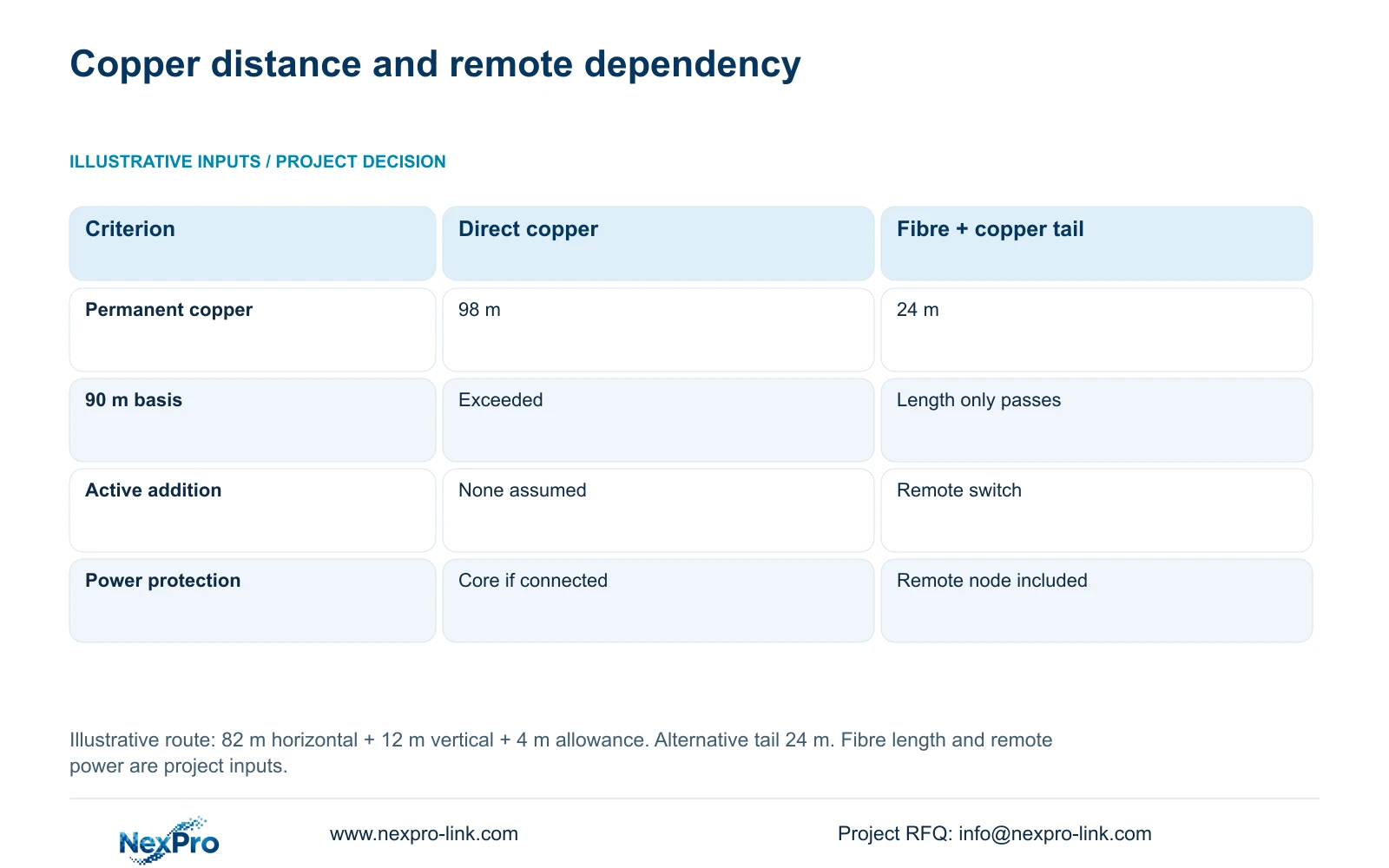
Measure the installable route from termination to termination. Include the horizontal path, vertical sections and explicit termination allowance. In this independent teaching example, 82 m horizontal plus 12 m vertical plus 4 m allowance equals 98 m. A straight-line drawing distance would miss part of that requirement.
The typical copper permanent-link basis cited by Fluke Networks is 90 m; the channel basis including patch cords is 100 m. Those are different boundaries. Treating a 98 m permanent route as acceptable because it is below 100 m confuses them. Final category, connection arrangement and testing basis still belong in the project specification.
The alternative places a qualified fibre access node nearer the rooftop cameras, leaving a 24 m copper tail. That resolves the illustrated permanent-length issue, but adds a switch and local power dependency. Include connectors, patching and testing in both options. SP5648 is a Cat6 48-port patch panel, not a reel of cable or proof that the whole link meets its category.
| Metric / condition | Direct copper route | Qualified fibre node + local copper |
|---|---|---|
| Planned copper permanent route (m) | 98 | 24 |
| Typical 90 m permanent-link basis | Exceeds this basis | Within length basis only |
| Extra active dependency | None assumed | Remote switch and local power |
| Backup boundary | Core supply if fully connected | Remote node must also be protected |
Section 03
Check mounting, exposure and service access
The route decision also changes where equipment must survive and be maintained. Identify whether the remote node is inside a suitable service enclosure or exposed on the rooftop. Describe the actual environment for cameras, connectors and local power equipment individually; an indoor switch assumption should not carry into an outdoor event installation.
The supplied camera PDFs include IP66 fields for the relevant BL2812M and DM2812M candidates. A camera enclosure field does not establish protection for its cable junction, mount or surrounding assembly. Structural mounting, weather protection and electrical safety need their own project decisions and appropriate local professional input.
Check the required view with the stage and canopy in place, including the intended night illumination. A bright static preview cannot establish useful movement beneath changing light. Compare recorded passage along the same route after any repositioning. Keep access for later adjustment and removal clear so servicing does not depend on dismantling an event structure.
Section 04
Protect every active recording dependency
Draw the video path and protected power path separately. Fibre transports data to the remote node; it does not automatically supply power to that node or the cameras. The protected scope must include the local switch and any required intermediate network equipment as well as the recorder.
Compare failure consequences before choosing an extender, cascade or additional switch. Each active addition needs an identified supply and restoration responsibility. Calculate traffic on the actual uplink, check per-port PoE capability and total output budget, and establish the outage state the hotel expects. A low interface price can omit these necessary resources.
NexPro SW-POE1618G is a 16-PoE-port, two-uplink inquiry candidate with af/at described in the supplied public record. Its title and detailed access-port speed fields conflict, and a numeric total PoE budget is absent. Do not approve it for the rooftop node until the intended speed and output requirement have a clear configuration response.
Section 05
Review the event operator's actual views
Prepare a viewing layout for the event's essential public routes, retaining camera identities even when positions change. Have an authorized operator open the required view, locate a defined recording period and demonstrate the supported export workflow. Training should correspond to the actual equipment and software version.
A temporary overview display can be useful for event staff only within the hotel's approved access scope. Keep security footage away from public presentation screens. Changes to display layouts should leave main recording intact, and an optional wall should not become a prerequisite for recording.
Compare a revised workstation layout with an additional display or decoder using the same response task. Include setup, permissions and removal in the evaluated scope. Add display hardware when the existing seat cannot support the required concurrent work; retain the simpler arrangement when the operator can complete the task without it. Do not claim time savings without recorded observations.
| Retained outcome | Extra scope | Worth buying when | Counter-condition |
|---|---|---|---|
| Authorized view of essential routes | Event workstation layout | Existing views need regrouping | Normal layout already supports the task |
| Concurrent event observation | Additional display and supported signal path | Actual operator concurrency exceeds the existing seat | An existing screen with event enlargement is sufficient |
Section 06
Restore the normal rooftop configuration after removal
Assign post-event restoration before installation starts. Record which camera positions, ports and view names changed, and which temporary cables and devices will be removed. Retain a baseline map so the removal team can distinguish event equipment from permanent recording dependencies.
After dismantling, confirm the normal public routes are visible, inspect the retained connections and replay a new recording. Remove temporary access while preserving any authorized incident material under the hotel's approved handling process. If the event changes the permanent layout, revise the baseline instead of restoring a view that no longer serves the task.
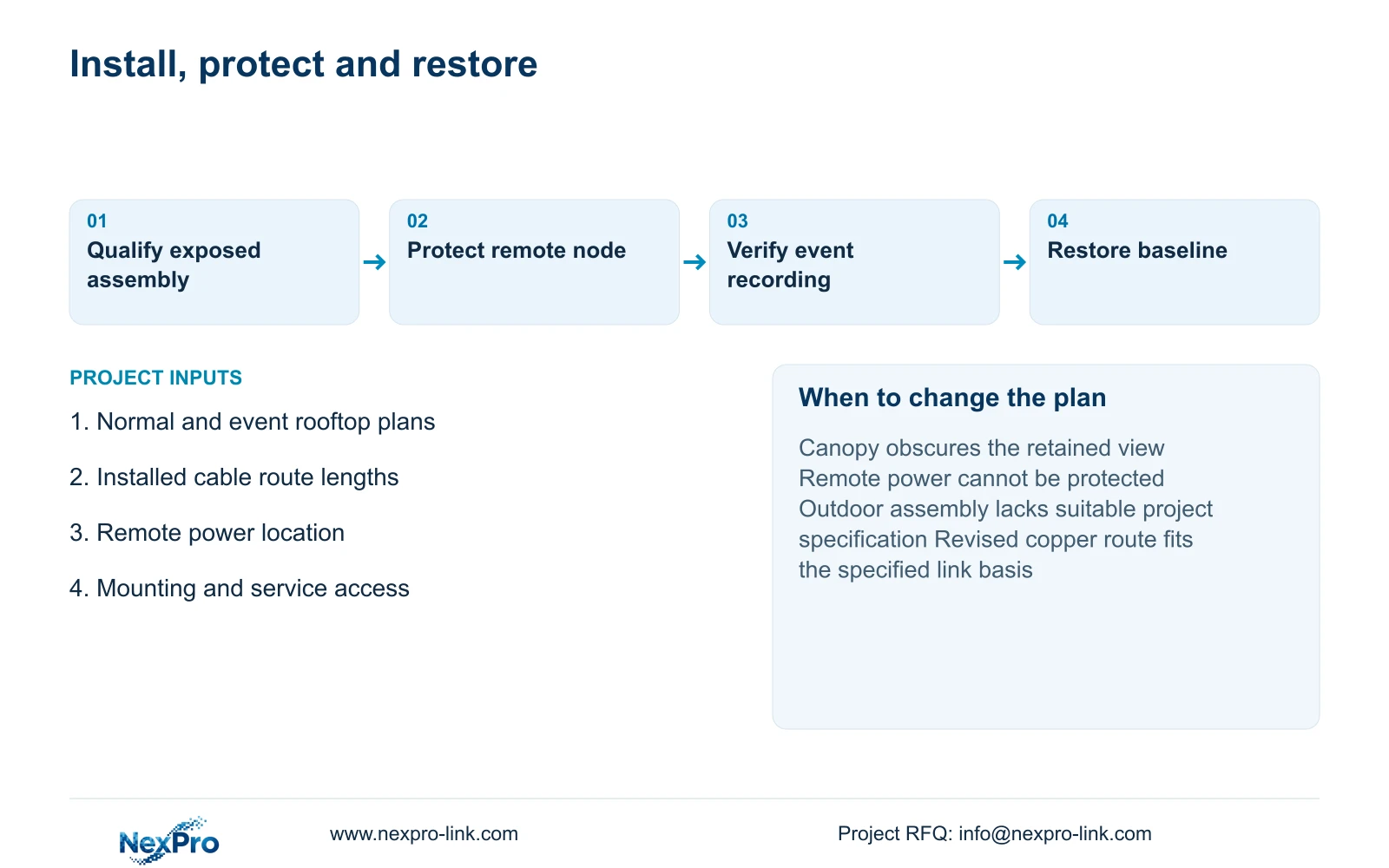
Send normal and event rooftop plans, installed route lengths, the proposed remote power location and maintenance access constraints to info@nexpro-link.com. NexPro-Link can discuss coordinated equipment and BOQ support, separating its CCTV manufacturing scope from supporting equipment supply and local installation. Recommend fibre plus local copper for the illustrated long route only when the remote node's environment, power and protection are resolved.
Section 07
Buyer questions
Can a 98 m permanent copper run use the 100 m channel limit? The two limits describe different link boundaries. The illustrative permanent route exceeds the typical 90 m basis before patch cords are considered. Ask for a revised route or a complete alternative with an explicit testing basis.
What must be included in a remote fibre-node quotation? Include the qualified network interfaces, local copper connections, suitable enclosure, local power, required backup and maintenance responsibility. Confirm the actual route and equipment configuration rather than pricing only the fibre interface.
Can a spare rooftop camera be chosen by housing appearance? A usable spare must match the required mounting, power, lens and recording behaviour. Keep replacement scope tied to the essential public task and the supported device configuration, with a clear local restoration action.
Engineering references
These sources support the general planning principles. Always use the selected product's current datasheet and applicable project standards for final design.
- Published NexPro BL2812M series specification: model-specific fields
- Published NexPro DM2812M series specification: model-specific fields
- O02 | Fluke Networks cable testing guidance
- N05 | NexPro SW-POE1618G product record
- N07 | Structured Cabling
- N01 | Hotel & Hospitality Project Supply
- N02 | BOQ & Tender Support