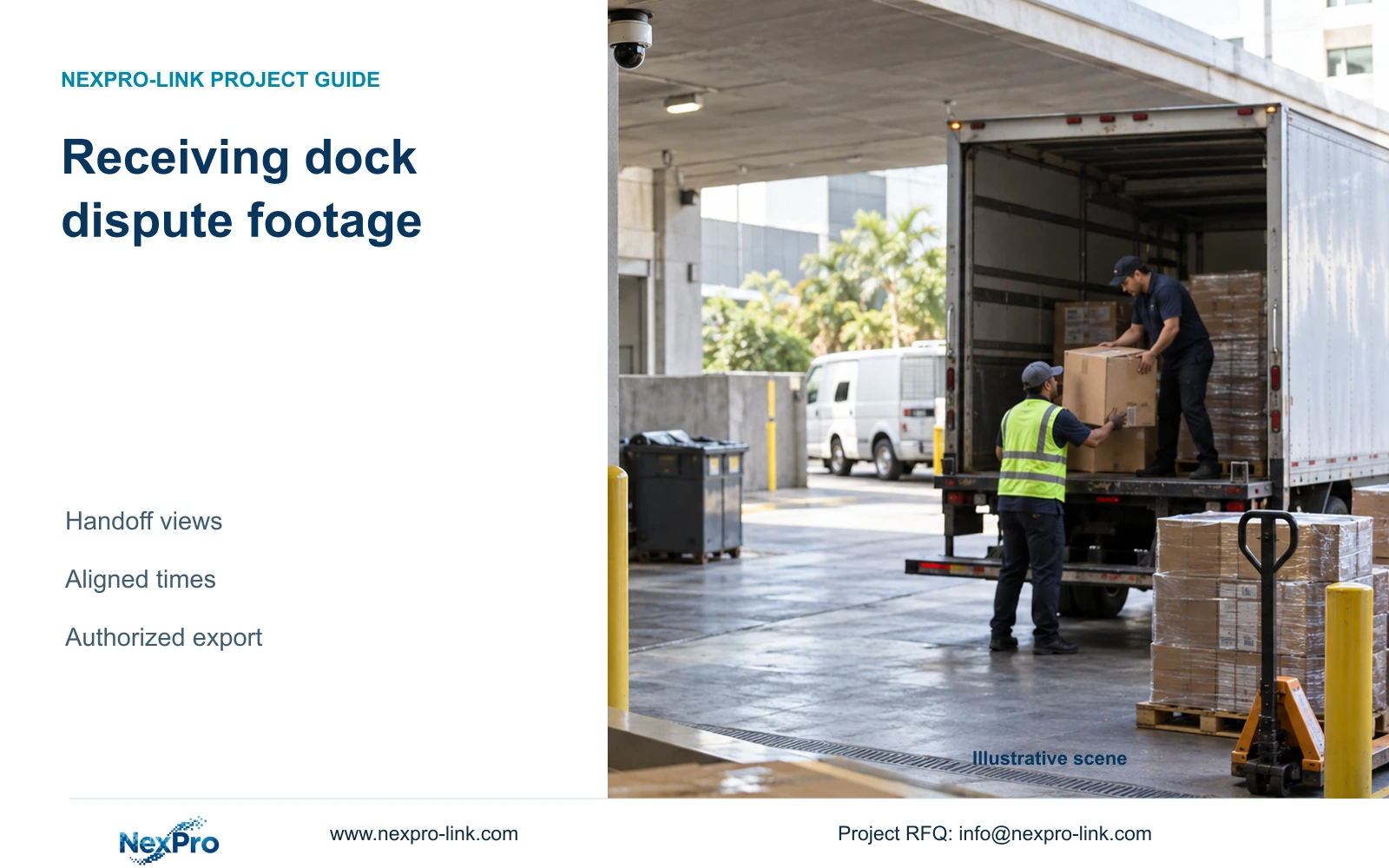
Design receiving dock footage around the unloading sequence and the actual handoff. Useful dispute records need clear views, aligned times and a workable export process.
Section 01
Choose which delivery handoff to record
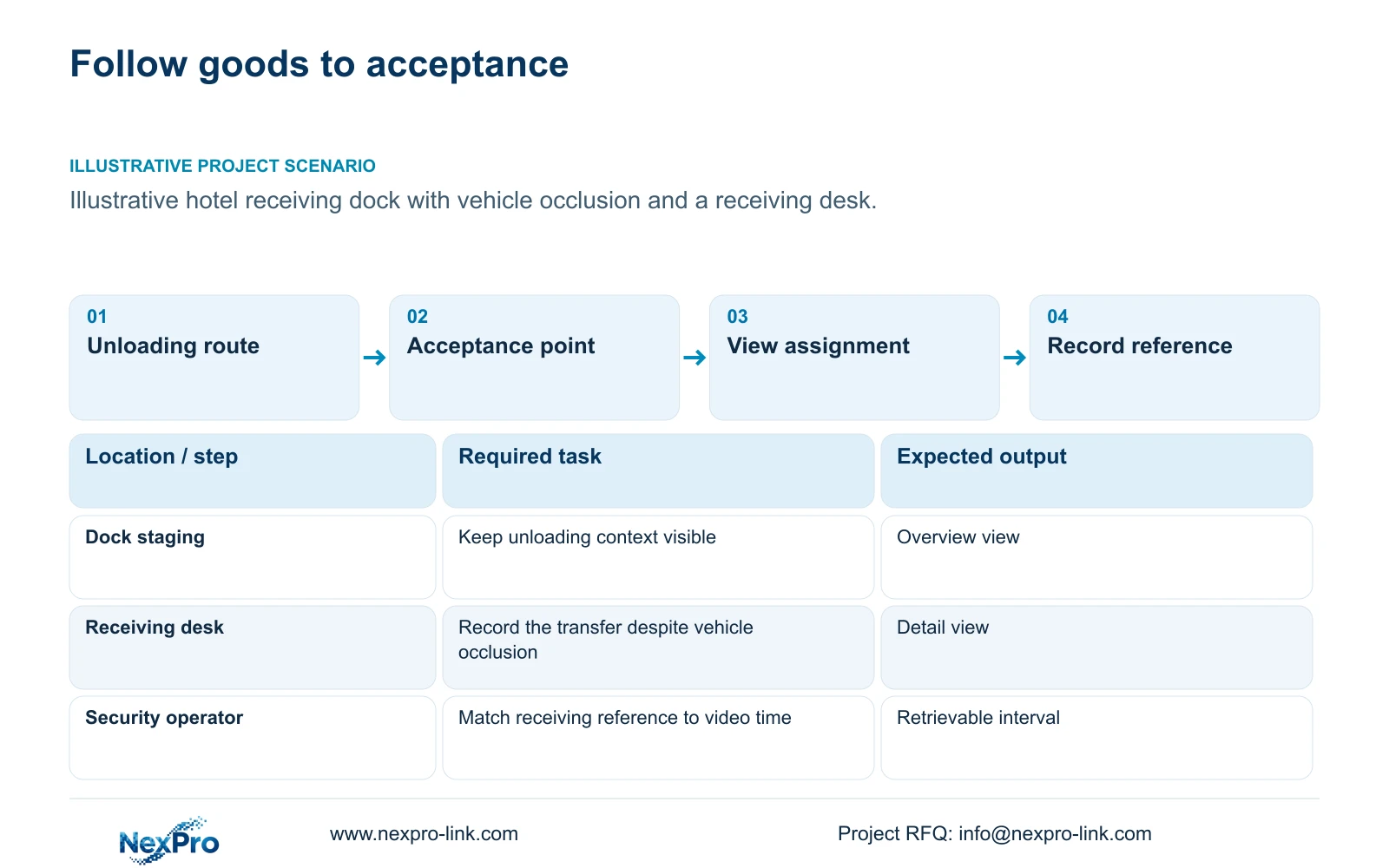
Record the unloading overview and the point where the hotel accepts goods, with timestamps that can be related to receiving records. Choose separate views when a vehicle, trolley or loading door hides the handoff. A camera showing vehicle arrival alone will leave the project short of its purpose if the dispute concerns what changed hands or when acceptance occurred.
Map the sequence from arrival through unloading, temporary staging and transfer into the hotel. Mark where responsibility changes and where the receiving team creates its record. An illustrative service route might connect the dock to stores and a kitchen approach, but each observation task needs its own boundary. Avoid extending coverage into unrelated staff activity simply because the route continues.
Make the recording workflow an opening-readiness milestone. Technical approval, equipment preparation, arrival and installation have separate dependencies; shipment does not establish that staff can retrieve useful footage. The project manager should identify which decisions can proceed together and which need the final handoff location before camera placement can be settled.
| Required task | Given information | Decision still needed |
|---|---|---|
| Review unloading context | Vehicle and staging route | Position clear of vehicle occlusion |
| Review acceptance | Receiving handoff point | Detail view and receiving record time |
| Retrieve a disputed delivery | Receiving reference exists | Authorized search and export workflow |
Section 02
Select detail and overview views
Use the overview to establish the delivery sequence and the detail view to show the agreed transfer action. In a compact dock, one position may satisfy both tasks. Where the vehicle body blocks the receiving desk or a trolley crosses the camera's sightline, compare moving the camera with adding a second view. Extra pixels cannot recover an action hidden behind an obstruction.
Translate the view into an operator action: open the dock overview, select the handoff view, and replay the relevant interval. The receiver may need to identify a delivery reference while security retrieves the footage. Give each role the supported permissions required for its work; a shared monitor does not establish permission to export.
The supplied BL2812M and DM2812M product PDFs provide motorized-lens candidates, but lens range alone does not establish the required field of view or readable package detail. Agree on the target area and relevant lighting before model matching. Review recorded movement at the handoff, including transitions between exterior daylight and the covered receiving area.
| Item | Single overview | Overview plus detail | Effect |
|---|---|---|---|
| Unloading sequence | Broad context | Broad context retained | Follow goods through staging |
| Acceptance point | May be small or blocked | Dedicated framing | Review the transfer action |
| Equipment scope | One justified view | Additional justified view | Recheck recording, ports and cable |
Section 03
Connect records by timestamp
Specify the time basis used by cameras, the recorder and the receiving record. Include the date format, time zone and any seasonal clock treatment relevant to the project. The team needs to distinguish the time goods arrived from the time someone entered the transaction. Those events may occur separately, so the search procedure should preserve that distinction.
Use a delivery reference and a named camera location to connect the receiving record with a video interval. This can be a documented manual process. Do not describe an automatic receiving-system link unless the actual interface, software version and access path support it. Demonstrate the method with an authorized sample delivery and record any observed clock discrepancy.
Define the exception path as well. If WAN access is unavailable, authorized staff may still have a local retrieval task, depending on the configured system. A display failure, remote-access failure and recording interruption are different states. The operating instructions should identify the available route in each state without promising functions that have not been demonstrated.
Section 04
Compare retrieval steps
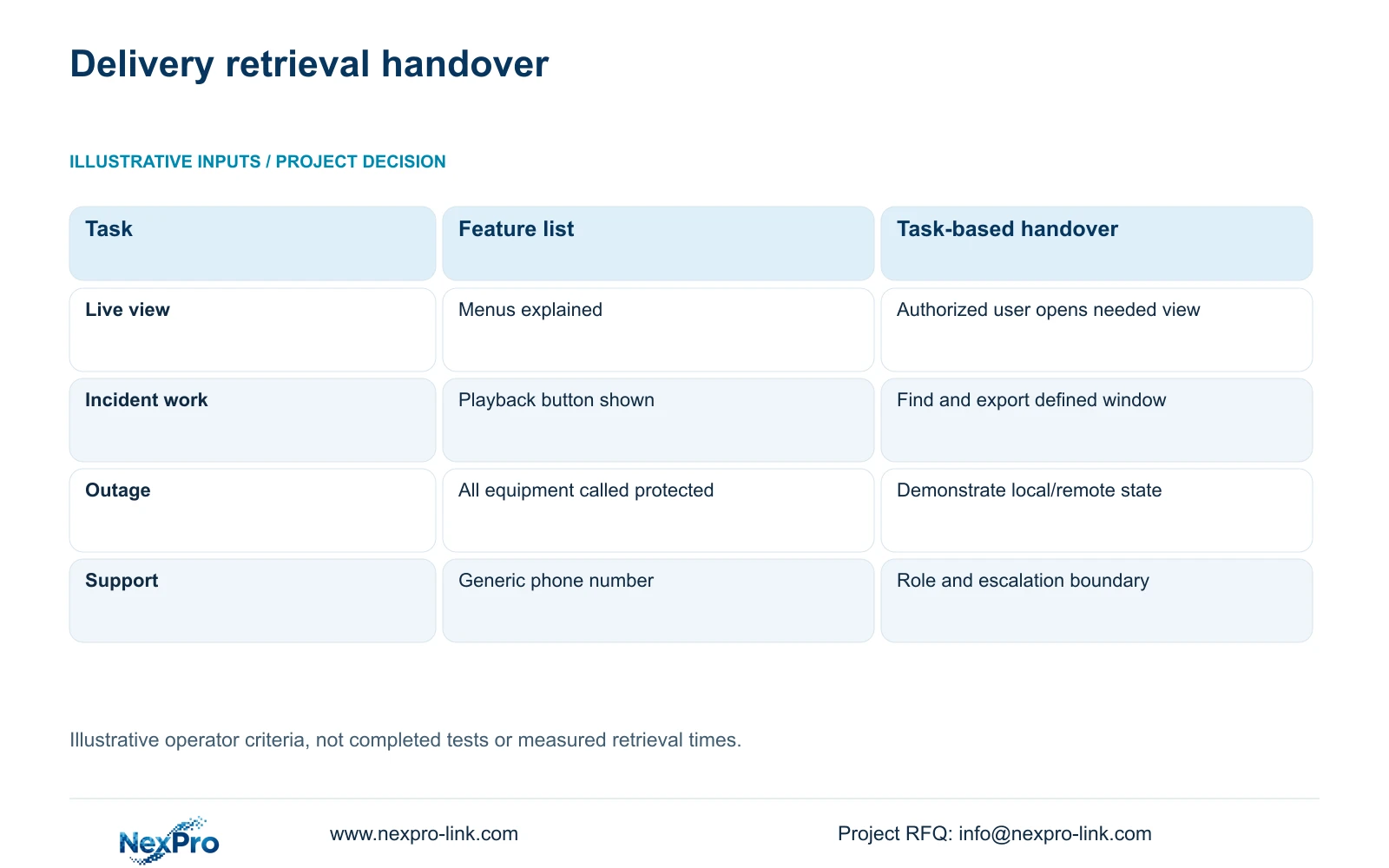
Use task-based operator handover as the acceptance approach. The illustrative comparison below contains decision criteria, not measured retrieval times or completed test results. Its inputs are the authorized roles, required delivery task and selected local or remote operating state. There is no numerical performance formula for this comparison.
For a representative dispute, ask the authorized user to start from the receiving reference, find the appropriate view and time window, replay the handoff and prepare an export. Record where the process stops or requires a different permission. An engineer showing the playback menu cannot establish that the receiving or security team can complete this sequence.
Keep the instructions tied to the supplied recorder and client versions. Staff absence should lead to an approved alternate role, not disclosure of another person's administrator credentials. Refresh the task instructions when responsibilities or software change. Any claim that the workflow saves time needs actual recorded observations; this planning matrix establishes no saving.
| Metric / condition | Feature-list handover | Task-based operator handover |
|---|---|---|
| Live view | Menus explained | Authorized user opens the needed view |
| Incident work | Playback button shown | Find and export a defined time window |
| Outage | All equipment called protected | Demonstrate the selected local/remote state |
| Support | Generic phone number | Correct role, contact and escalation boundary |
Section 05
Size event export capacity
Budget export around the authorized event scope. The supplied independent export illustration uses four streams at 4 Mbps for 30 minutes. Video payload equals streams multiplied by Mbps and seconds, divided by 8 and 1000 to obtain decimal GB. The result is 3.6 GB, before differences from packaging, audio or metadata.
At effective transfer rates of 20 Mbps and 80 Mbps, the transfer component takes 24 minutes and 6 minutes respectively. These are illustrative throughput assumptions, not recorder benchmarks. Recorder processing, file preparation and playback validation add time. Use effective throughput on the approved path rather than the interface's nominal speed.
Buy extra export capability when the existing route cannot meet the hotel's agreed response task while retaining required recording. Otherwise, retain a tested local process and avoid an unsupported platform upgrade. This event example is separate from CASE01's whole-hotel recording and power totals.
| Metric | Option A | Option B |
|---|---|---|
| Video payload | 3.6 GB | 3.6 GB |
| Effective transfer | 20 Mbps | 80 Mbps |
| Ideal transfer component | 24 minutes | 6 minutes |
| Processing and validation | Additional | Additional |
Section 06
Agree on authorized evidence handling
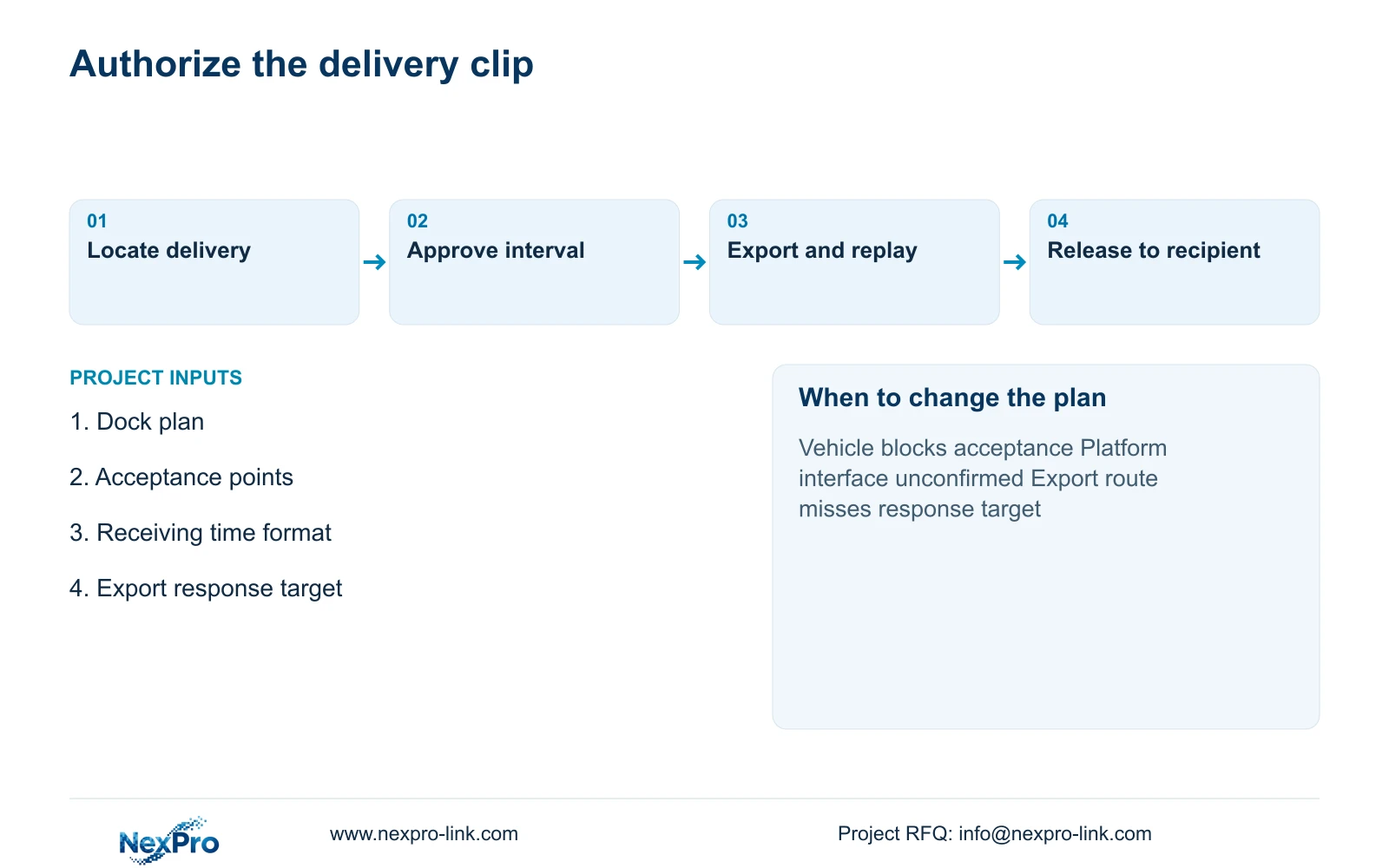
Name who may request footage, who may export it and who may receive the file. Limit the camera range and interval to the approved delivery inquiry. Preserve the event context and confirm that the recipient can play the export before removing any original record needed for the inquiry. Retention and disclosure require the hotel's applicable policy and local professional judgment.
Recommend paired overview and handoff views when occlusion prevents a single view from recording acceptance, with task-based retrieval and a documented time reference. Change the proposal if the operator requires a particular platform, the existing system cannot provide the necessary permissions, or recorded samples show that the selected position misses the transfer.
Send the dock/service-route plan, marked acceptance points, receiving timestamp format and required export response to info@nexpro-link.com. Include the destination and any mandatory platform. NexPro-Link's hotel project and BOQ support can address model matching, documentation and coordinated supply; CCTV manufacturing and supporting-category coordination remain distinct, and local installation or integration must be expressly included.
Section 07
Buyer questions
Can we request a proposal before the receiving desk location is final? Yes. Identify the provisional handoff area and the alternative positions still under consideration. The proposal can separate fixed equipment requirements from view placement that must change when the receiving layout is settled.
Does buying the camera and recorder together include receiving-system integration? No automatic interface follows from a shared order. Request the exact integration scope, supported versions and responsible party. A documented manual reference-to-video process can remain the baseline where automation is unconfirmed.
Who handles a failed dispute export? The handover should name the hotel task owner and the technical escalation contact. State whether support covers recorder configuration, client playback or the transfer route, and separately identify any local attendance or chargeable service.
Engineering references
These sources support the general planning principles. Always use the selected product's current datasheet and applicable project standards for final design.