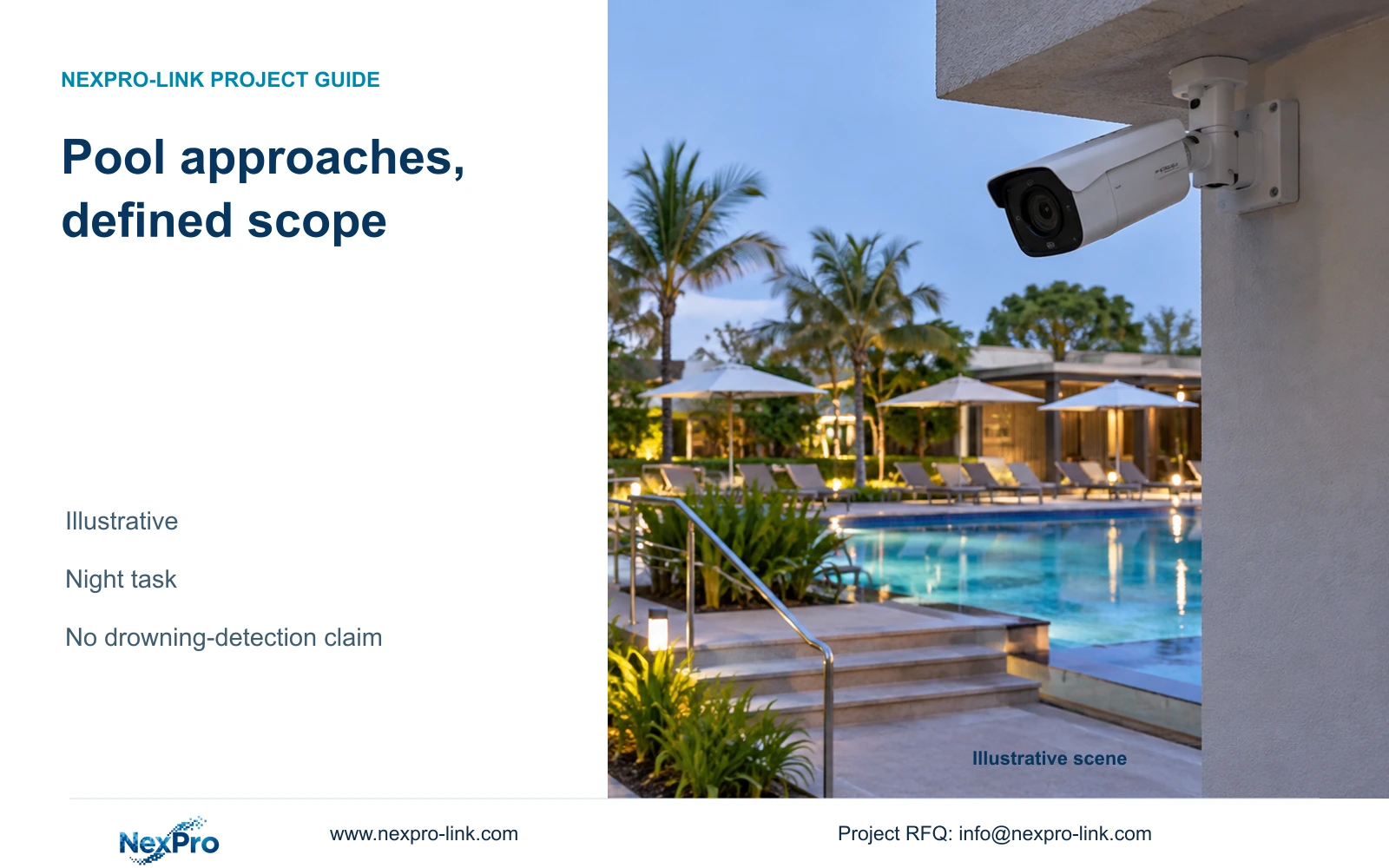
Ordinary CCTV can support approved pool-approach security tasks. Its picture quality or AI label does not establish drowning detection or replace pool supervision.
Section 01
Limit ordinary CCTV to approved approach tasks
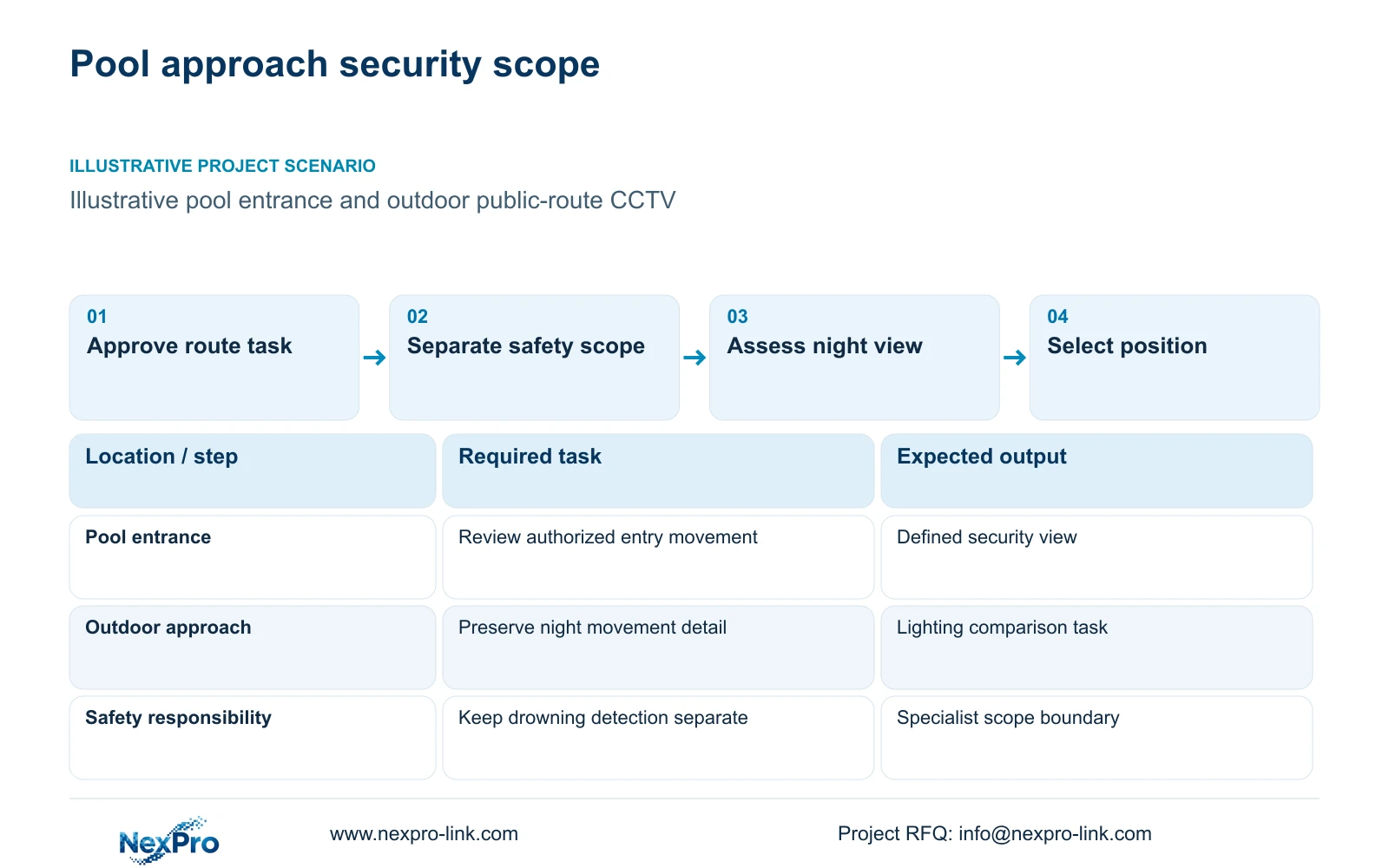
Use ordinary CCTV for approved pool entrances and public approach routes. Do not specify it as drowning detection or a replacement for lifeguards and specialist safety arrangements. If the hotel requires a water-safety detection function, assign that requirement to a separately defined specialist scope with its own responsible team.
Describe each security view in practical terms, such as reviewing entry movements or following an authorized public access route. Identify whether the recorded task needs a general outline, colour information or moving detail at a particular point. These requirements affect position and lighting; they cannot be reduced to a camera's minimum-lux headline.
Mark permitted boundaries before choosing hardware. Keep changing areas and other private spaces outside routine coverage, including internal views through open doors. A pool-adjacent location does not justify capturing every surrounding activity. The hotel operator should approve the purpose and intended recipients, with local requirements addressed by the relevant project professionals.
| Required task | Given information | Decision still needed |
|---|---|---|
| Review pool entrance movements | Entrance and approach plan | Permitted view and recorded detail |
| Review a night access route | Lighting arrangement | Allowed illumination and motion task |
| Provide drowning detection | Separate safety requirement | Specialist system and responsibility |
Section 02
Keep specialist safety systems separately specified
Give the CCTV schedule and the specialist safety schedule separate functional descriptions. A standard camera may contribute pictures to an authorized operator, but an AI label or person-detection feature does not establish detection of a drowning event. No supplied ordinary-camera record proves that function.
Build the CCTV package from its actual tasks. Connect the camera schedule to recorder input, retention capacity and PoE grouping, then identify the complete protected power path. Do the equivalent coordination for a specialist system only from its own supported requirements. Sharing a cabinet or order does not establish native integration or common acceptance criteria.
For any proposed interface, identify the signal, receiver and responsible party. Ordinary CCTV must not be presented as the controller for a life-safety response merely because equipment has an output or remains powered by a UPS. Local electrical and safety design stays with the appropriately responsible professionals. Keep these interfaces visible in the quotation so a missing specialist item cannot disappear inside a general security allowance.
| Scope | Acceptance task | Boundary |
|---|---|---|
| Ordinary CCTV | Replay approved entrance or route event | Visual security record |
| Specialist safety system | Meet its separately specified function | Requires its own evidence and team |
| Shared interface | Demonstrate defined supported signal | No assumed life-safety integration |
Section 03
Assess glare with a task-matched night comparison
Compare camera options under the same permitted view and relevant lighting state. Pool approaches may include glass, reflective finishes and changes between bright interior doors and darker outdoor routes. Identify these conditions on the layout. A position change may remove a reflection that additional image pixels cannot resolve.
Read low-light figures with their exposure, aperture and gain conditions. Where those conditions differ or are incomplete, the figures cannot establish a defensible ranking. Compare recorded movement along the defined route, keeping the target action and recording requirement consistent. A static colour image after the subject stops does not demonstrate preserved moving detail.
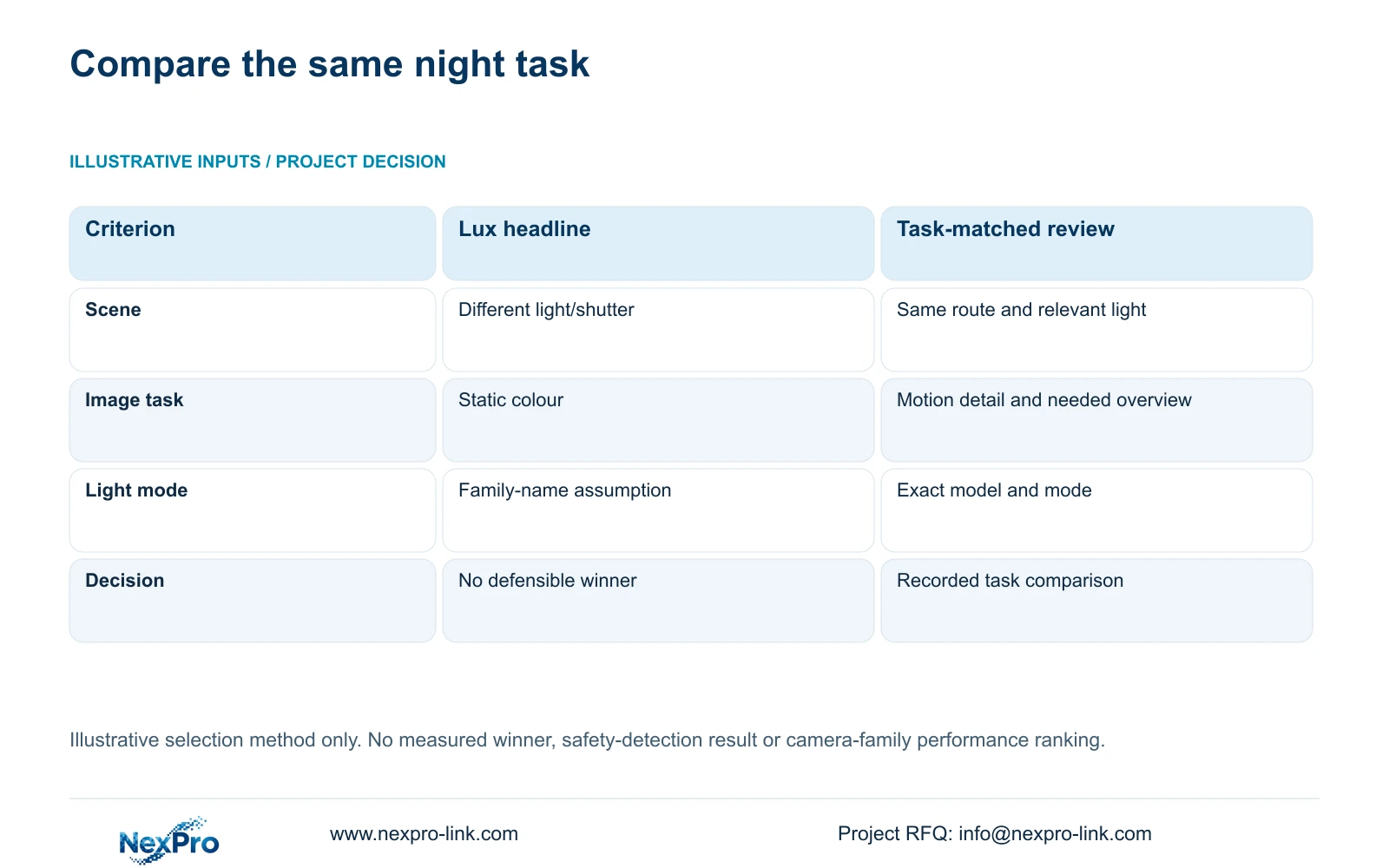
The matrix below compares a single low-lux headline with a task-matched night review. It contains decision criteria, not field results. Record the selected illumination mode and its permitted light spill. Choose the option that retains the approved route task under those conditions; request a position or lighting revision if neither option does.
| Metric / condition | Single low-lux headline | Task-matched night comparison |
|---|---|---|
| Scene | Different light and shutter conditions | Same target route and relevant light |
| Image task | Static color appearance | Motion detail plus required color/overview |
| Light control | Assumed by marketing family | Exact model and selected mode |
| Decision | No defensible winner | Choose after recorded task comparison |
Section 04
Compare camera positions before increasing resolution
Evaluate a mounting position by the view it preserves, the reflections it introduces and the access needed to maintain it. A position near glass may produce an attractive daytime overview yet a problematic night view. Compare another angle using the same route and movement, then assess what coverage is lost or gained.
The supplied DM2812M Series PDF identifies NexPro-DM2812M55-5MP-DIC-AI with a 2880×1620 main-stream mode, PoE, IP66 and a temperature range of minus 20 to plus 60°C. NexPro-DM2812M88-8MP-DIC-AI lists 3840×2160 at 25 fps, a 2.8–12 mm lens, dual light and two-way audio. These fields support candidate selection, not a pool-environment or drowning-detection claim.
Compare infrared, visible-light and supported event-illumination modes on the exact selected variant. Use visible light where the hotel permits it and the recorded task benefits; choose an appropriate infrared or other supported arrangement where light spill is sensitive. Do not infer thermal imaging, corrosion resistance or an impact rating from these ordinary-camera specifications.
Section 05
Plan outdoor links and reachable maintenance
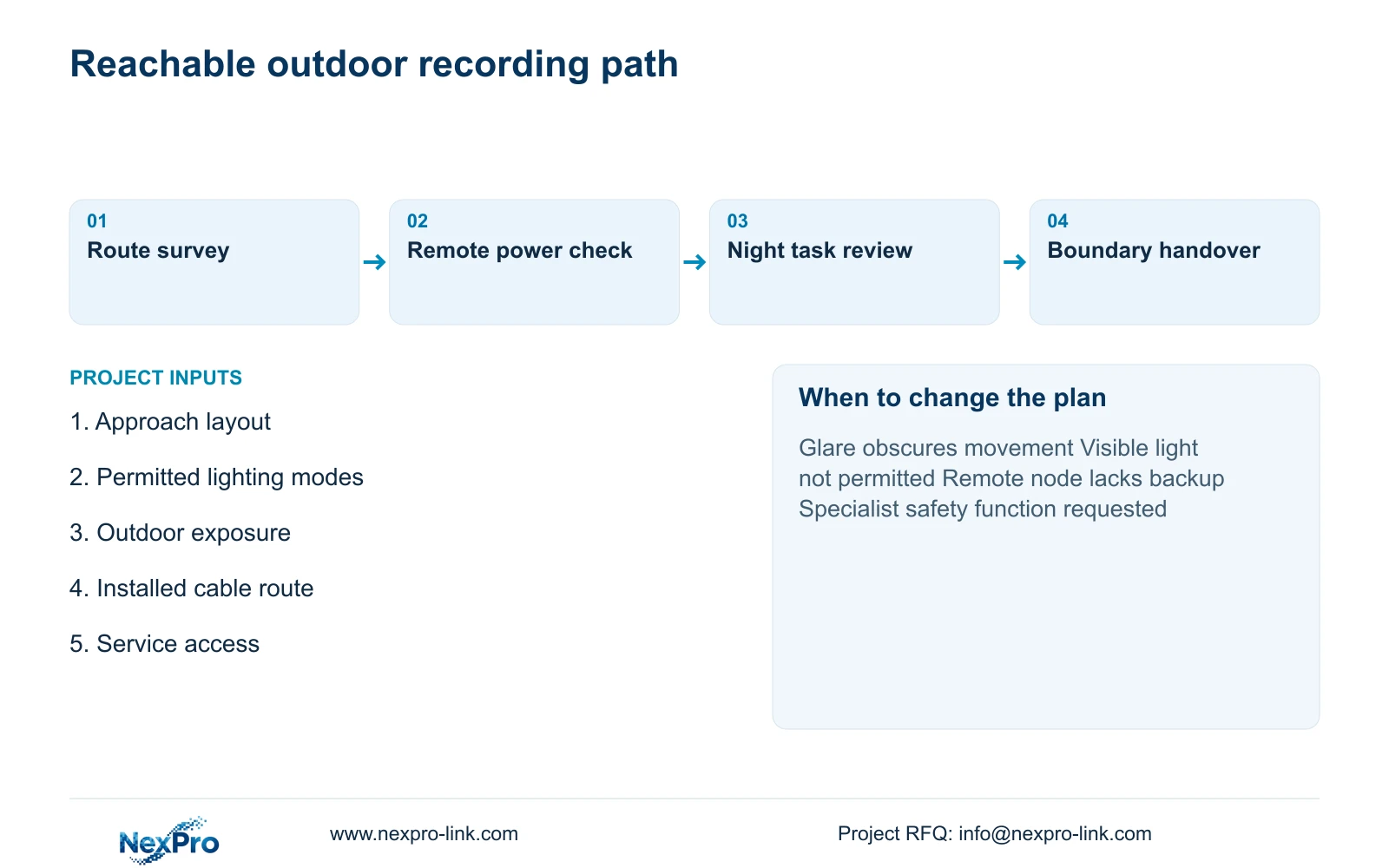
Trace the installed data route from each approach camera to its access node. Include vertical routing, bends and termination allowance, then check the project's cable basis. The supplied Fluke guidance distinguishes a typical 90 m permanent link from a 100 m channel including patch cords. Neither figure substitutes for the full specification and test configuration.
If distance or site boundaries require a remote switch, include its local power and any required backup. Fibre carries data and does not automatically power that remote node. Compare the added enclosure, active equipment and maintenance responsibility with a revised access location. Separate data paths from protected power on the proposal.
Specify accessible cleaning and service arrangements without compromising the accepted view. Camera protection, connection details and the actual environmental exposure need review together. Price brackets, routes and local installation explicitly. The source PDF does not state maximum camera watts, and the SW-POE1618G source has conflicting port-speed fields with no stated total PoE budget, so neither can settle the final power design.
Section 06
Communicate the operating boundary at handover
Describe the accepted function as entrance or public-route CCTV in schedules and operator instructions. Show staff how to retrieve the relevant recording and report a missing view. Keep specialist safety procedures with their responsible team. A security picture must not become an informal promise of continuous safety detection.
Recommend a task-matched night comparison and accessible outdoor placement before final camera selection. Change the candidate or position if permitted lighting cannot preserve moving detail, reflections obscure the route or the environment exceeds the supported conditions. If drowning detection becomes a requirement, add the specialist scope instead of relabelling the CCTV package.
Send the approach plan, night task, lighting restrictions and proposed cable/access-node route to info@nexpro-link.com. NexPro-Link can discuss CCTV model matching and coordinated supply with local installation boundaries. The supplied policy record gives applicable main equipment a 24-month limited hardware baseline from receipt; batteries, storage, cables and order-specific costs have separate scope. This does not include unlimited repair or local attendance.
Section 07
Buyer questions
Does an ordinary AI camera provide drowning detection? The supplied ordinary-camera evidence does not establish that function. Keep the CCTV purchase limited to its approved security tasks and procure any required specialist safety function separately.
Does IP66 establish suitability for every pool-side location? No broader environmental suitability is established by that field. Identify the actual exposure and request the relevant equipment and connection details. Do not infer corrosion or impact performance.
Can we avoid visible camera lighting near guest accommodation? Compare an appropriate supported infrared mode and alternative mounting positions against the required recorded task. Accept the choice only if moving detail remains useful under the permitted lighting conditions.
Engineering references
These sources support the general planning principles. Always use the selected product's current datasheet and applicable project standards for final design.
- Published NexPro DM2812M series specification: model-specific fields
- Axis: exposure and motion principles, not a NexPro model test
- N01 | NexPro-Link Hotel & Hospitality Project Supply
- N02 | NexPro-Link BOQ & Tender Support
- O02 | Fluke Networks cable testing mistakes
- N05 | NexPro SW-POE1618G source with unresolved speed and power fields
- N14 | NexPro-Link Warranty Policy