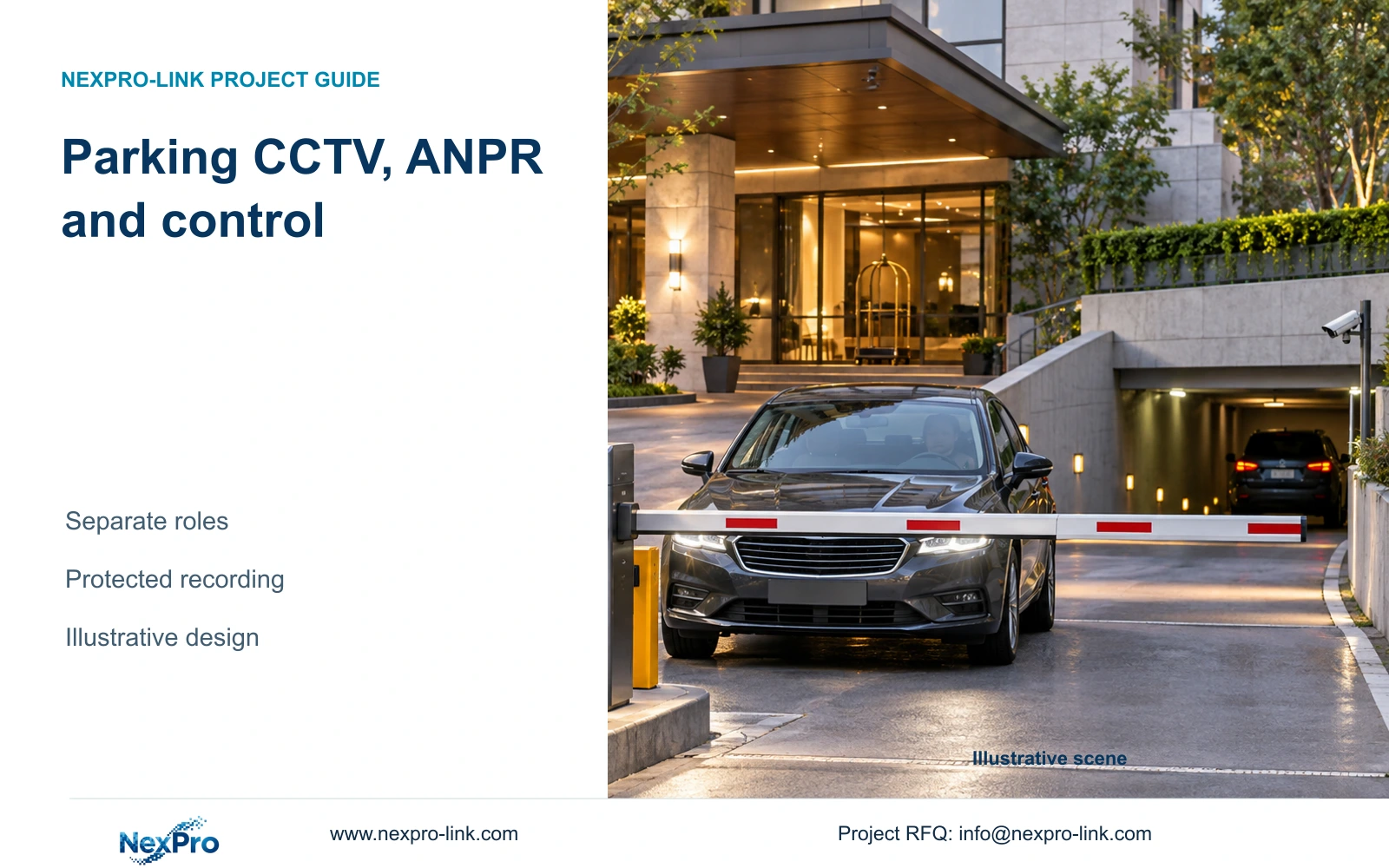
Use CCTV for parking overview and recorded context, dedicated ANPR for authorized plate recognition, and a separately defined controller for barrier operation.
Section 01
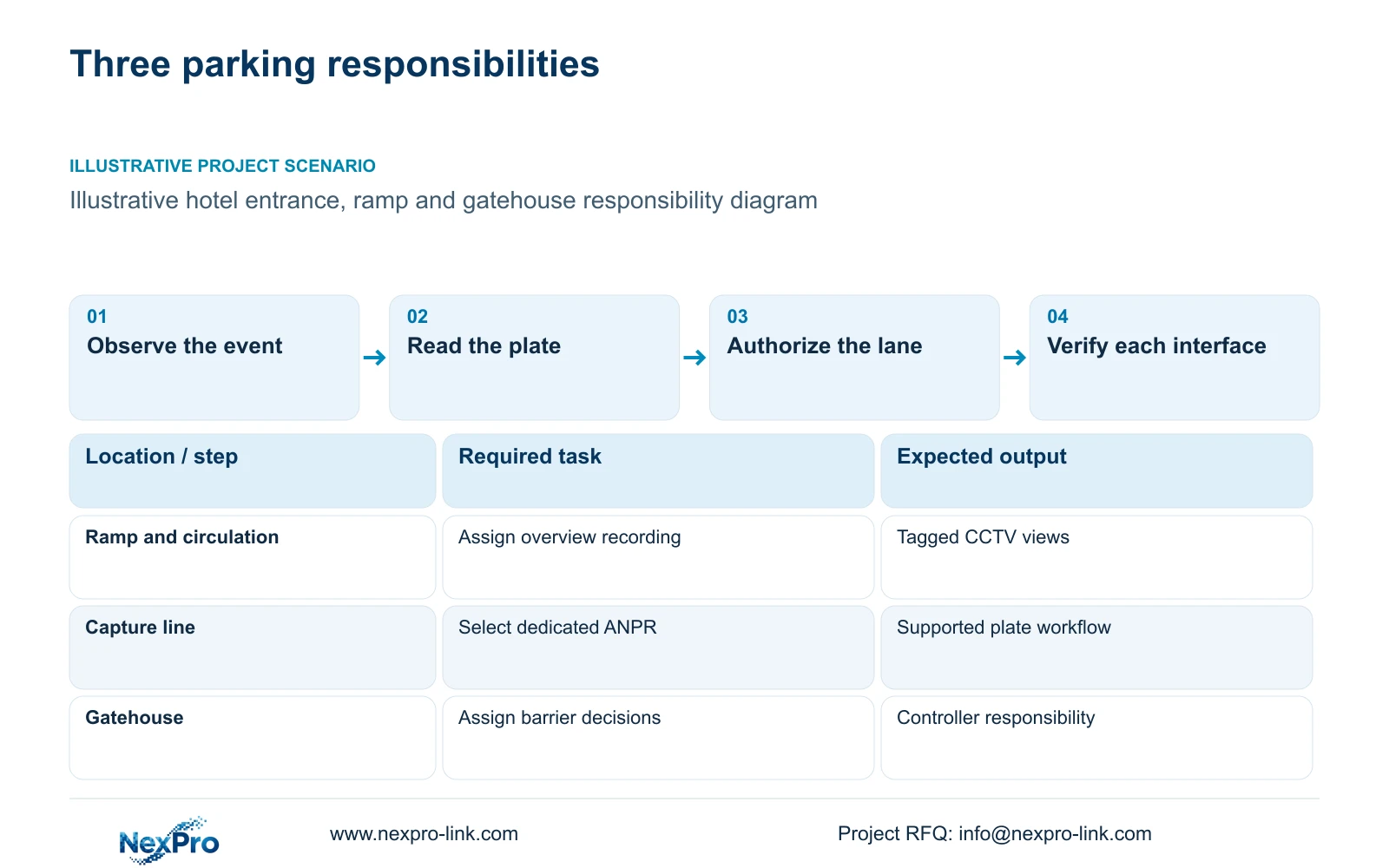
Assign observation, recognition and barrier decisions
Specify ordinary CCTV for parking overview and incident recording, dedicated ANPR for plate recognition, and a supported vehicle-access system for barrier decisions. Combine their procurement only when the proposal identifies each interface and responsible party. If the hotel requires automatic admission, a CCTV camera with vehicle detection cannot replace the recognition database and control workflow.
The observation task should describe the event that security staff need to reconstruct, such as a vehicle approaching a ramp or a pedestrian crossing an entrance. The recognition task needs its own capture conditions and authorized plate-record workflow. Barrier operation includes the decision to admit a vehicle and the required safe response when recognition, communications or power fails.
Give each task an acceptance outcome. Recorded context must be retrievable; a recognition event must reach its intended supported destination; the access contractor must demonstrate the agreed control behavior. A combined quotation should retain these separate outcomes so a missing integration does not disappear inside a general parking-system allowance.
| Required task | Given information | Decision still needed |
|---|---|---|
| Overview and incident recording | Ordinary CCTV candidates are documented | Approve views, recording profile and retrieval task |
| Authorized plate recognition | Dedicated ANPR is separately scoped | Select supported recognition hardware and database workflow |
| Barrier operation | CCTV is not the lane controller | Assign control interfaces and safe operating responsibility |
Section 02
Define lane views around the parking tasks
Build the camera schedule from vehicle and pedestrian routes. The illustrative parking-annex reference uses 16 views: four ramps, four entrance or exit overviews, four pedestrian approaches and four circulation views. These are teaching quantities, independent of bedroom count. Dedicated ANPR remains outside that overview count unless the revised schedule explicitly adds its recording streams.
At a lane entrance, a wide view may preserve the relationship between a vehicle, a barrier and nearby pedestrians. A plate-capture view may need a narrower target area. Keep both when one framing cannot preserve the required context and detail. Combining views is reasonable only when the approved tasks remain visible under the relevant lighting and obstruction conditions.
The supplied BL2812M product PDF documents NexPro-BL2812M55-5MP-DIC-AI with a 2.8-12 mm motorized lens, PoE and IP66. It is an overview candidate, not a documented ANPR device. Its focal-length range does not establish an exact field of view. Record mounting position, target width and maintenance access before turning the candidate into an ordered item.
Section 03
Size local recording without changing the core service
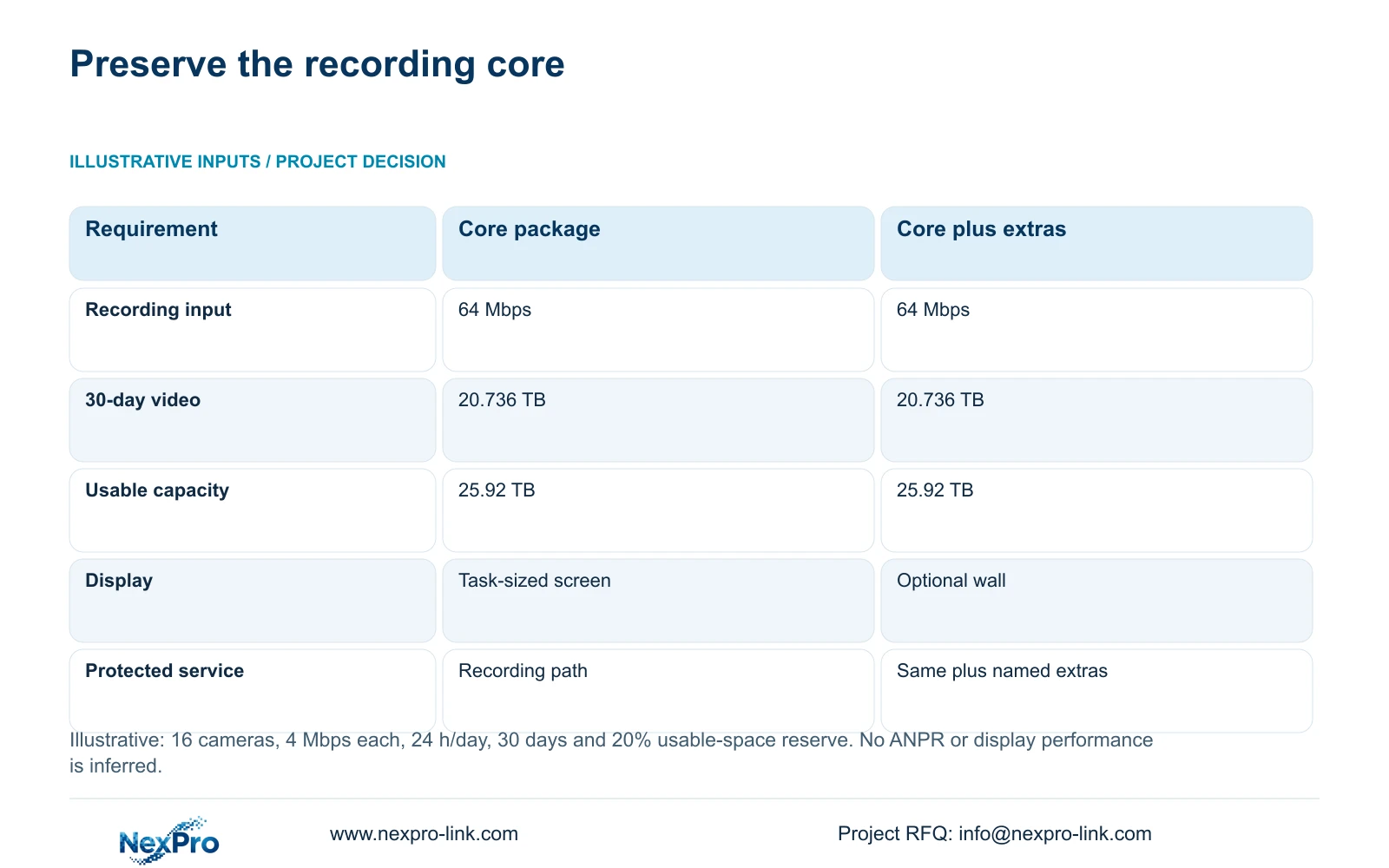
For this illustrative comparison, 16 cameras each average 4 Mbps and record continuously for 30 days. The required free-space allowance is 20% of usable capacity. These are planning inputs, not measured camera bitrates or a legal retention rule. Aggregate recording input is 16 × 4 = 64 Mbps.
Using decimal TB, video data equals cameras × Mbps × 10^6 × 24 × 3600 × days ÷ 8 ÷ 10^12. The result is 20.736 TB. Required usable capacity is 20.736 ÷ 0.80 = 25.92 TB. Multiplying by 1.20 would not preserve the stated fraction of usable space.
The matching CASE09 reference considers one NexPro-NVR4449-4K with four 8 TB drives. Under its separate 95% formatting assumption and no RAID capacity loss, 32 TB raw becomes 30.4 TB usable. That is a capacity illustration, not proof of every recording or playback mode. The product page lists 320 Mbps input and four SATA bays, but its image-mode scope still requires checking. Do not substitute the unresolved disk limits on NexPro-NVR2232-4K.
| Metric or condition | Essential recording-first package | Same core plus optional display or recovery |
|---|---|---|
| Recording input | 64 Mbps | 64 Mbps |
| 30-day video data | 20.736 TB | 20.736 TB |
| Required usable capacity | 25.92 TB | 25.92 TB |
| Protected path | Cameras, network and recording | Same path plus explicitly selected extras |
| Operator display | Task-sized monitor or workstation | Optional wall; recording remains independent |
| Cost comparison | Complete scope quotation required | Add documented incremental scope only |
Section 04
Map recognition and controller interfaces explicitly
Draw the video path from cameras through access nodes to the recorder. Draw the recognition and control path separately, naming the device or platform that owns the plate database and the supported interface that carries its decision. A view appearing on an operator screen does not establish that a barrier controller receives a valid admission command.
For every interface, record the sending component, receiving component, required function and responsible supplier. Include the behavior when an event arrives without a usable plate result or when the connection is unavailable. The hotel should approve the operational fallback; the relevant specialist should define the controller's safe response.
ONVIF Profiles provide a basis for checking relevant device and client functions. An ONVIF statement alone does not prove plate-event exchange, database synchronization, audio or third-party account behavior. Preserve the same 64 Mbps recording input and 25.92 TB usable-capacity target when comparing interface or display upgrades. Additional functions need their own supported configuration and cost.
Section 05
Protect the complete gatehouse operating path
Follow each required outage task through its powered dependencies. Local recording needs the cameras, PoE access nodes and recorder to remain operational. Remote viewing also needs the network components on that route. Recognition and authorized control may add other loads, which must be identified separately from barrier motors and safety circuits.
CASE09 assumes two access nodes with eight cameras each. Its hypothetical 12 W camera peak and 90% cable-delivery efficiency produce 106.67 W required PSE output per group. Retaining 20% output reserve requires 133.33 W per node. The camera PDF does not supply a verified 12 W maximum, and NexPro SW-POE1618G has no stated total power budget and conflicting access-port speed descriptions.
Keep an ordinary operating display when staff need it during an outage. Add wall-display protection only for an approved continuous-observation task, with revised capacity and battery calculations. A fiber-connected remote node still needs protected local power. Barrier drive and safety responsibilities must remain with their qualified system and electrical specialists.
Section 06
Release a parking BOQ with separate supply responsibilities
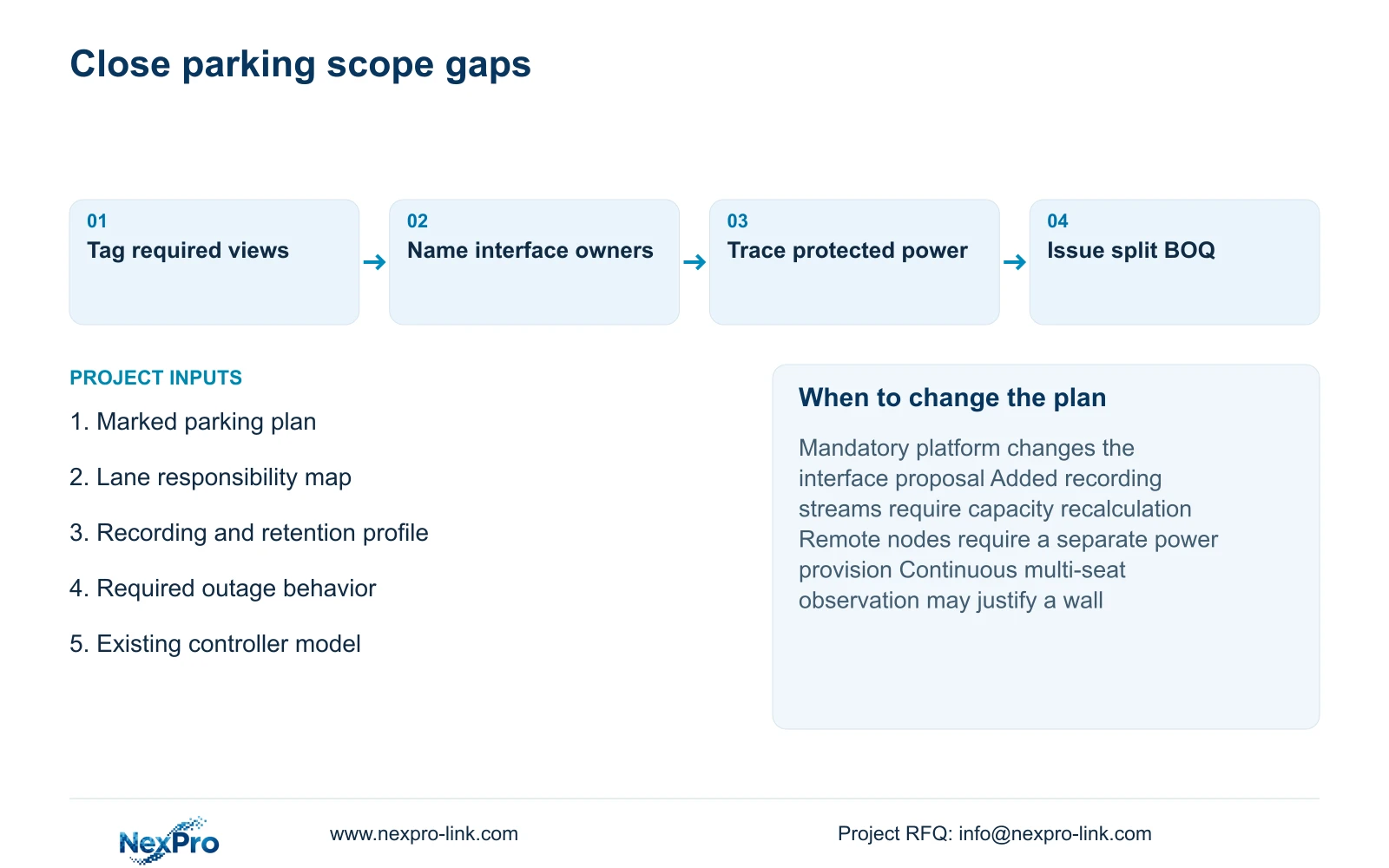
Issue separate lines for overview cameras, recording and disks, network access, protected power, dedicated ANPR and controller interfaces. Include termination, mounting and site work where required. Identify software or integration scope explicitly; a shared purchase order does not establish native interoperability.
Choose the recording-first package when the hotel needs incident retrieval and occasional operator viewing. Add a wall or recovery arrangement when a defined staffing or outage task requires it. Change the proposal if the approved platform, capture conditions, retention or remote-power layout differs from the assumptions. NexPro-Link can support CCTV model matching and coordinated equipment supply while local installation and specialist control duties remain separately stated.
The supplied current policy gives applicable main equipment a 24-month limited hardware baseline from receipt, subject to controlling written terms. Battery, storage, cable and OEM scope require their own terms. Send the parking plan, lane responsibility map and recording requirements to info@nexpro-link.com, with the destination and required dates, for a scoped equipment and BOQ response.
Section 07
Buyer questions
Can the parking package retain our existing barrier controller? Yes, the comparison can start with retained equipment. Identify its exact model and the required recognition-to-control function. Replacement is justified only if the supported interface or required operating behavior cannot be achieved; inclusion in a combined order does not establish compatibility.
Does a video wall increase the recording capacity we need? The illustrative core recording target remains unchanged. Wall viewing creates separate decode, network and power requirements. Additional recorded streams or changed recording profiles would require a new storage calculation.
What is enough information for a first parking quotation? Provide a marked parking plan, the owner of the plate database and barrier system, and the required recording and outage behavior. State mandatory brands and whether alternatives are allowed. Guest recordings and passwords are unnecessary for the initial inquiry.
Engineering references
These sources support the general planning principles. Always use the selected product's current datasheet and applicable project standards for final design.