A distant parking annex needs a local power and recording decision before a camera order. Define what continues when its link to the main hotel is unavailable.
Section 01
Separate parking overview from identification
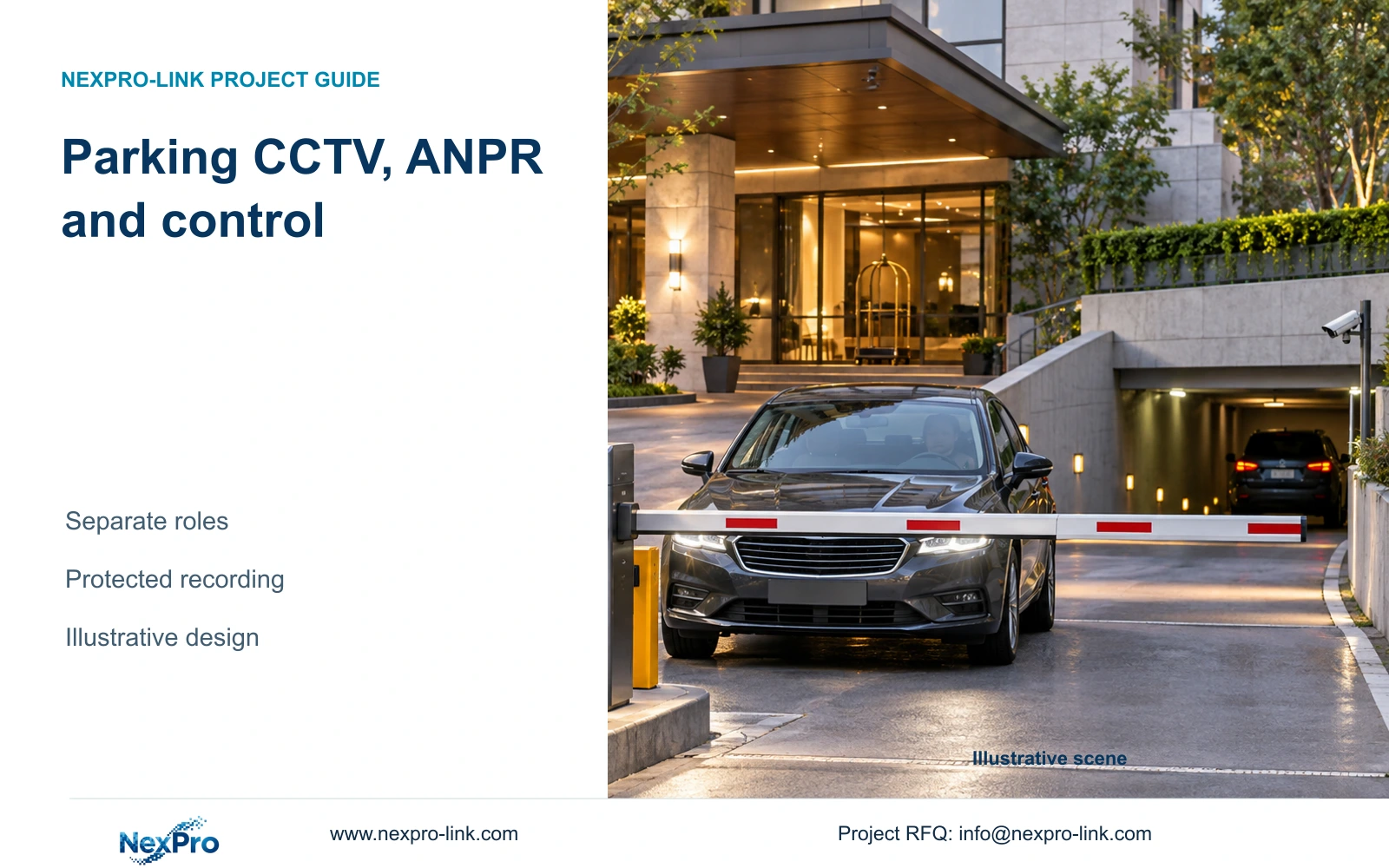
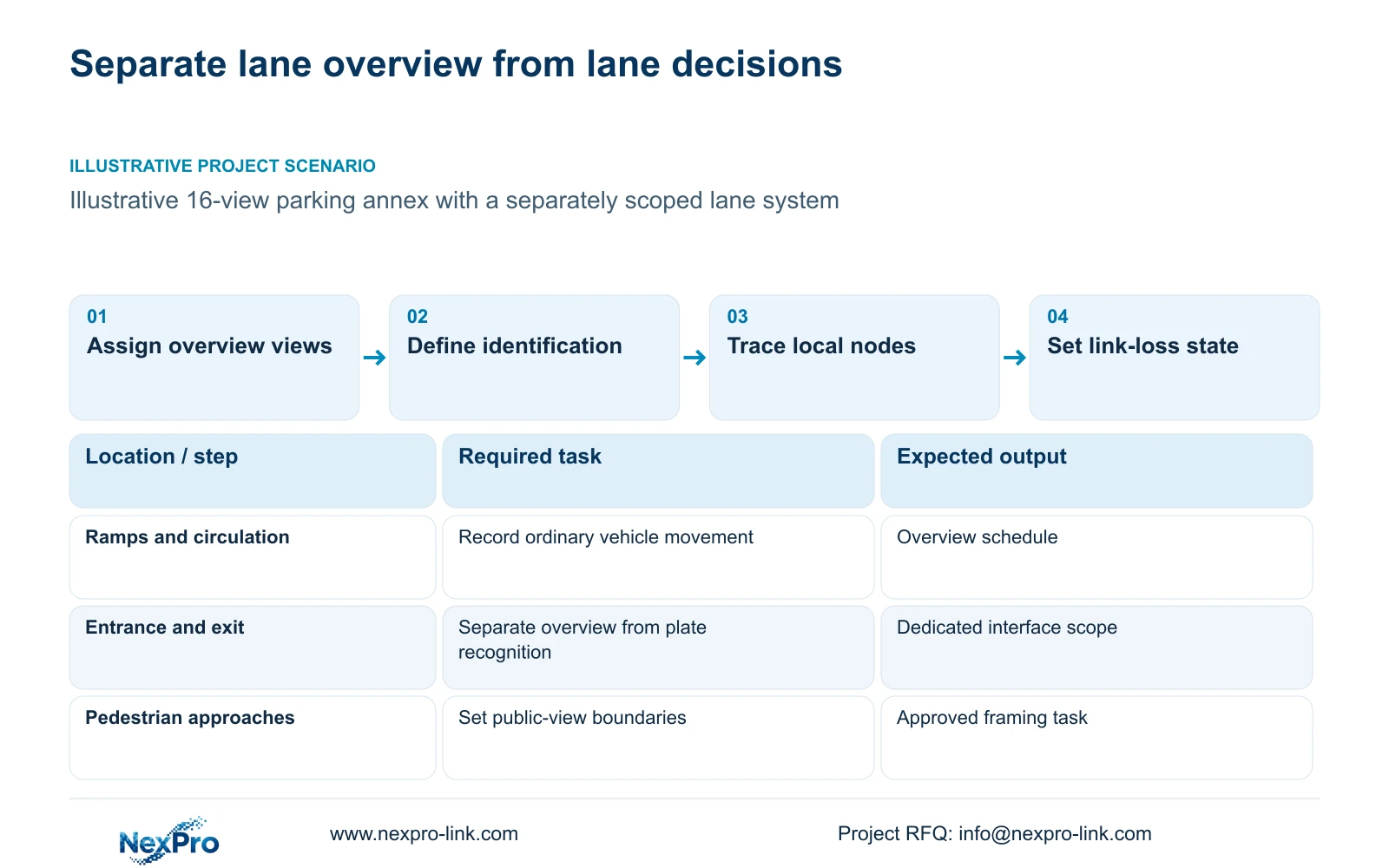
Choose local recording and protected access networking when the annex must preserve footage during loss of its main-building link. Central recording is suitable only where the approved link and power arrangement meet the required operating and interruption conditions. Define plate identification and lane control as separate supported tasks before counting their equipment.
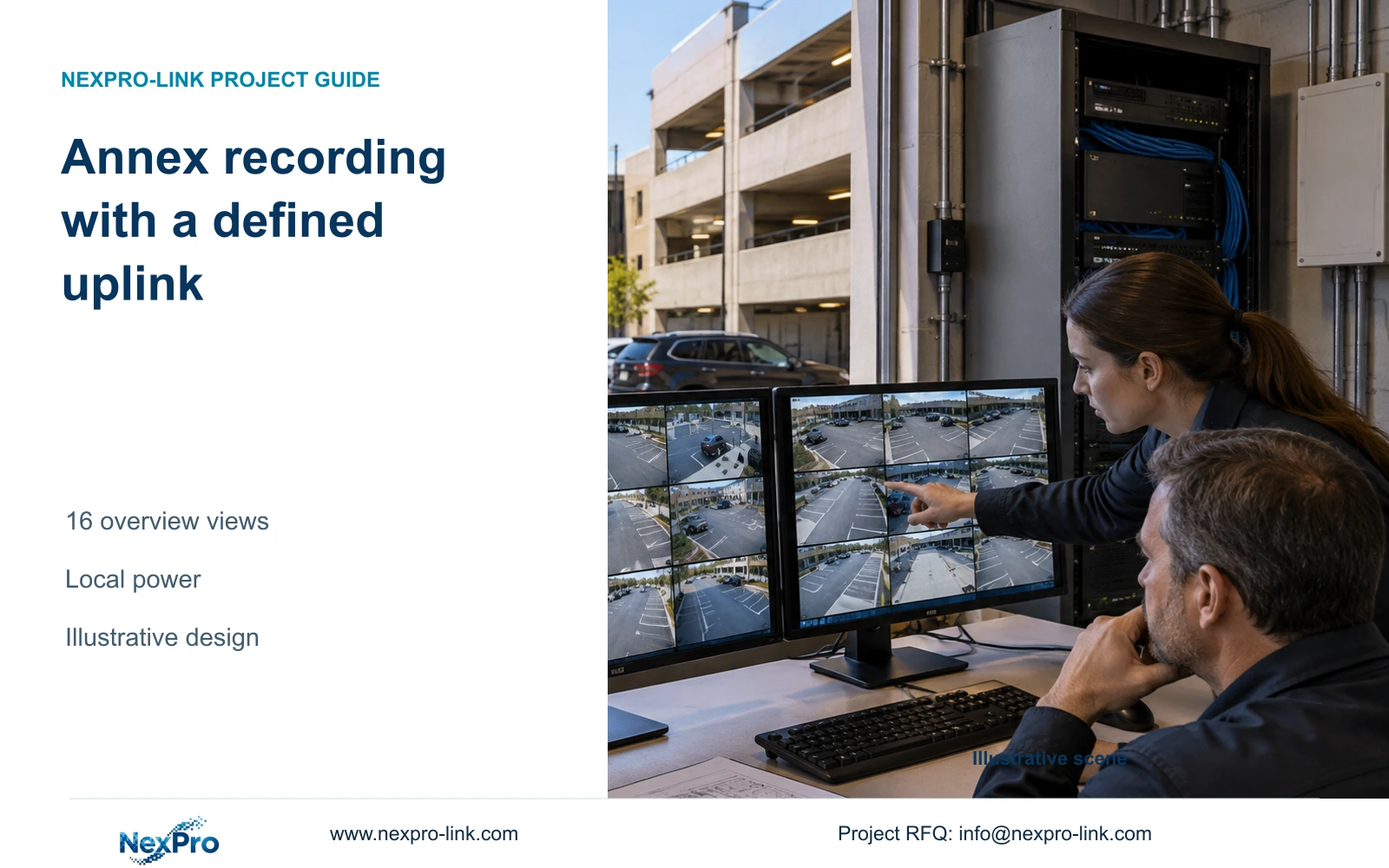
The illustrative CASE09 assigns 16 ordinary views: four ramps, four entrance/exit overviews, four pedestrian approaches and four circulation-area views. That schedule supports an overview design discussion. It does not establish identification at every lane or include dedicated ANPR. Camera counts follow the observation tasks and actual layout, not hotel bedroom quantity.
For each position, state the target route, required recorded detail and relevant lighting. NexPro-BL2812M55-5MP-DIC-AI is a candidate from the supplied PDF with a 2.8–12 mm motorized lens, PoE and IP66 fields. Its human/vehicle detection does not establish plate recognition. The PDF's temperature range is -20 to +60°C; neither an unlisted impact rating nor maximum power should be inferred.
| Required task | Illustrative information | Decision still needed |
|---|---|---|
| Ramp and circulation overview | Eight assigned ordinary views | Recorded movement and framing |
| Entrance/exit observation | Four overview positions | Any separate plate-identification scope |
| Pedestrian approaches | Four assigned positions | Permitted view boundary and lighting |
Section 02
Locate power where the active nodes operate
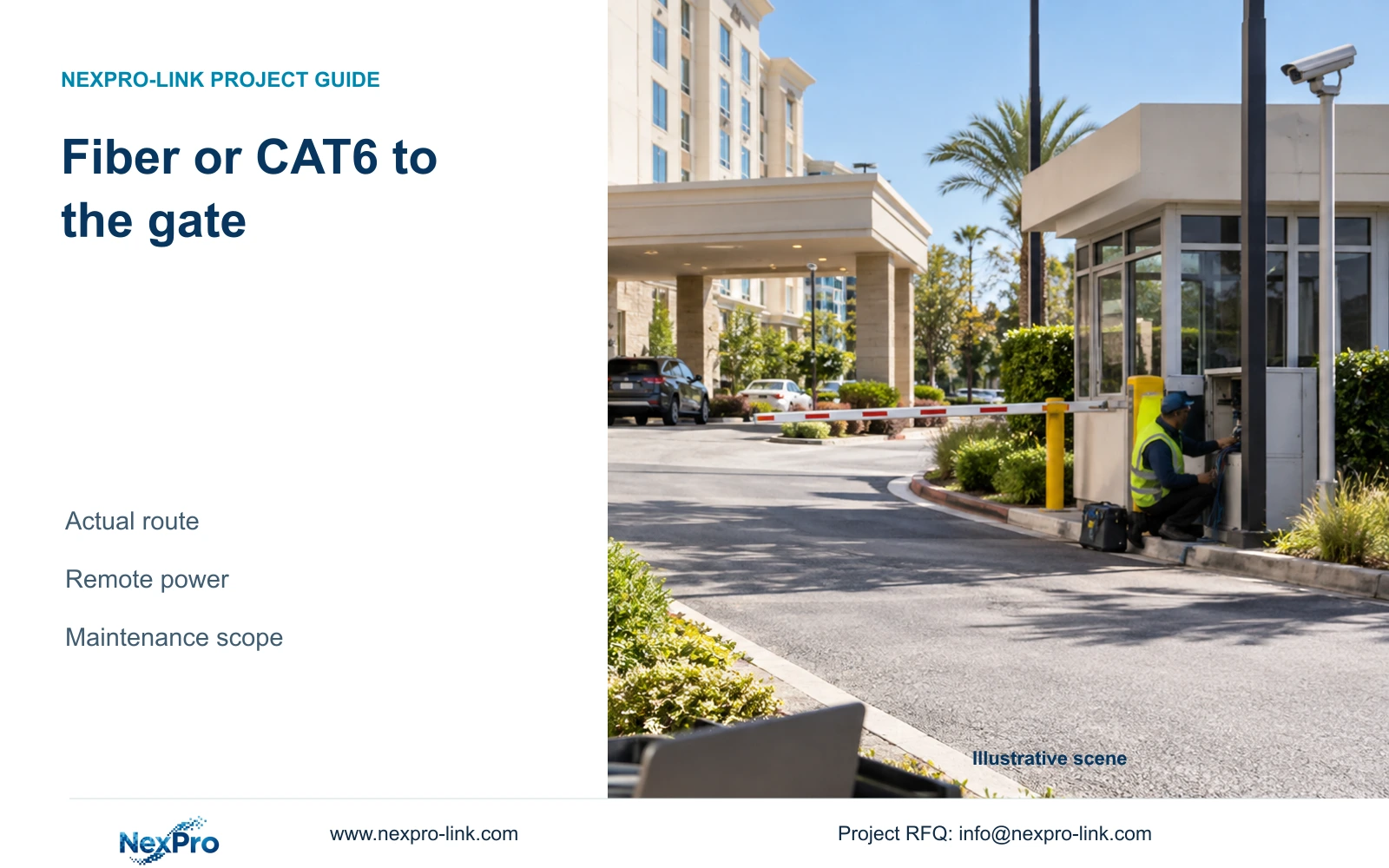
Measure each installable route, including risers, turns and termination allowances. The straight distance between buildings is insufficient for selecting a copper connection. The supplied Fluke source describes the typical 90 m permanent-link and 100 m channel distinction; the final category, connection arrangement and test basis remain project inputs.
A fibre backbone transports data and does not automatically power annex switches or cameras. Locate the required local power, equipment enclosure and maintenance access alongside the data route. If recording must continue during an outage, include each necessary remote node in a defined protection zone.
CASE09 assumes two access nodes with eight cameras each. Its hypothetical 12 W PD peak per camera gives 96 W per group, 106.67 W required PSE output at 90% cable delivery efficiency, and 133.33 W output budget with 20% spare. NexPro SW-POE1618G lists 16 PoE access ports and two uplinks, but its speed fields conflict and total PoE power is unstated. It cannot be declared compliant with this budget.
| Arrangement | Data dependency | Power requirement |
|---|---|---|
| Direct copper route | Actual link length and test basis | Source PoE capability checked |
| Fibre to local node | Backbone and endpoint equipment | Local switch power and protection |
| Local recorder | Local camera-to-recorder path | Recorder and required network protected |
Section 03
Budget storage separately from the hotel uplink
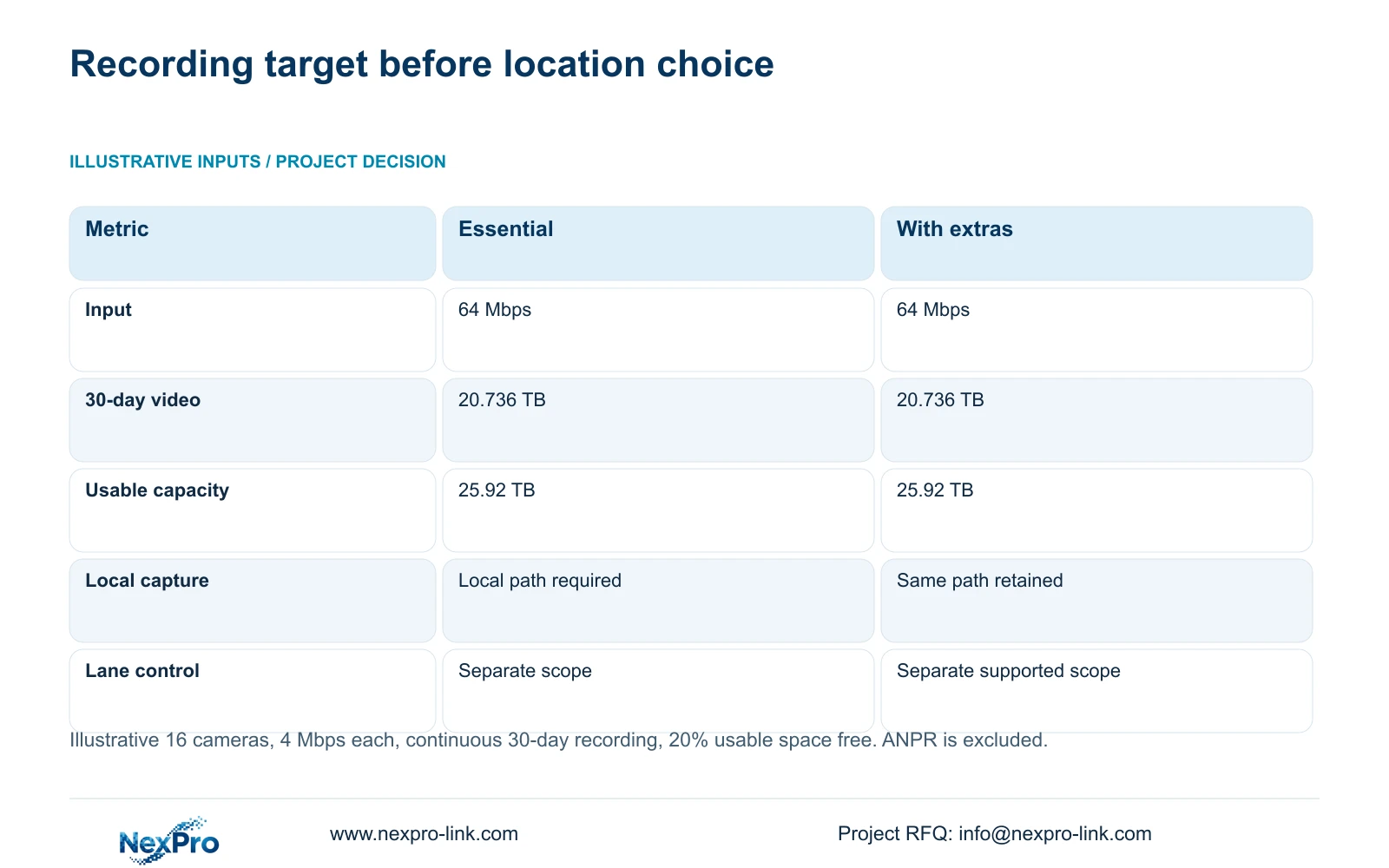
The independent 16-camera topic example assumes 4 Mbps average per camera, 24-hour daily recording and 30 days retention. Recording input is 16 × 4 = 64 Mbps. Decimal video TB equals 0.0108 × 16 × 4 × 30 = 20.736. Dividing by 0.80 gives 25.92 TB required usable capacity while leaving 20% free. These are teaching settings, not statutory retention or camera specifications.
CASE09 separately proposes NexPro-NVR4449-4K with four 8 TB disks. Its 32 TB raw capacity becomes 30.4 TB under an assumed 95% formatting allowance; 24.32 TB remains budgeted for video after reserve. This no-RAID-loss arrangement accommodates the stated video target. The recorder page lists four SATA positions and 320 Mbps input, but its recording-resolution and playback combination still needs confirmation.
Central recording sends the recording streams over the building link. Local recording keeps that traffic on the annex recording path, while authorized remote viewing and export use the uplink as required. CASE09's access links each carry 32 Mbps pure recording, or 35.2 Mbps with its illustrative 10% allowance. Count only flows that cross the path under review; a gigabit label is not an effective-throughput measurement.
| Metric | Essential recording-first | Same core with extras |
|---|---|---|
| Recording input | 64 Mbps | 64 Mbps |
| 30-day video data | 20.736 TB | 20.736 TB |
| Required usable capacity | 25.92 TB | 25.92 TB |
| Protected path | Cameras, network and recording | Same plus selected extras |
| Operator display | Task-sized monitor/workstation | Optional wall; recording independent |
| Cost basis | Complete scope quotation | Documented incremental scope |
Section 04
Keep lane control outside the ordinary CCTV assumption
Give dedicated identification and barrier-control equipment its own interface schedule. State the supported system and version, the required event or decision, and who owns operation during a link or power interruption. A camera that detects a vehicle does not by itself authorize a barrier movement.
Separate the data relationship from the electrical and control relationship. Ordinary footage can provide an overview of a lane event while the dedicated system manages entry. Any proposed event association, operator display or control interface needs actual support evidence. Coordinated procurement does not establish native integration between independently selected products.
The local specialist responsible for lane equipment must define safe operation and site installation requirements. Do not route an ordinary CCTV failure into an invented release or emergency-control rule. The annex recording baseline remains 20.736 TB even where a separate lane subsystem is added; recalculate only for additional recorded streams or changed policies.
Section 05
Compare recording locations under link loss
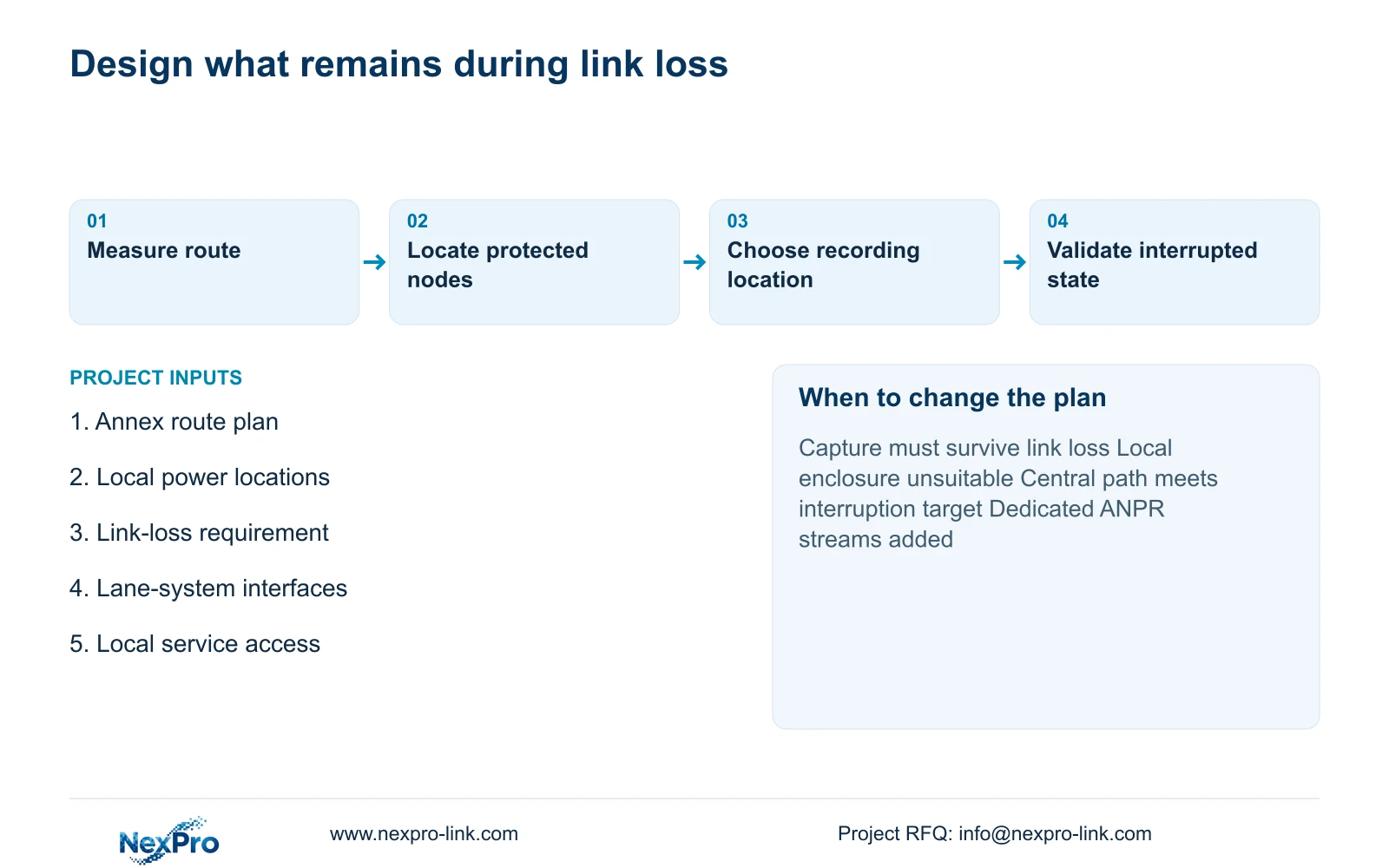
Local recording is the preferred starting point where footage must continue through a building-link interruption and a maintainable annex equipment location is available. It introduces local disk service and environmental responsibilities. Main-hotel staff may temporarily lose remote visibility while the supported local path continues recording.
Central recording places storage maintenance in the main property, but camera traffic depends on the interbuilding path. Compare that dependency against the owner's permitted recording interruption. Do not assume automatic edge buffering, failover or backfill where the selected devices have no confirmed support for those functions.
CASE09's base equipment power budget is an assumed 391.88 W, including access networking, recorder, core and ordinary monitor. SP1KR(S), rated 1 kVA/900 W, is its aggregate capacity candidate. Actual protection must follow installed zones and supported battery curves. A local NVR with an unprotected required switch does not satisfy the selected outage task.
| Outcome | Local recording | Central recording |
|---|---|---|
| Building link unavailable | Local capture depends on local path | Capture depends on an approved alternate path |
| Disk maintenance | Annex service access required | Main-property service location |
| Preferred condition | Local recording continuity required | Link dependency meets owner's requirement |
Section 06
List the whole annex operating package
Prepare the supply list by dependency: assigned cameras, access nodes, approved backbone endpoints, recording and disks, local protection, and any required operator station. Add mounting, enclosure and cable termination items where the selected routes need them. Keep dedicated ANPR and lane control as separate lines with their own acceptance responsibilities.
CASE09 includes an illustrative 908 m copper-route total and a feasible four-reel cutting plan for 305 m reels. Those quantities are not a survey of an actual annex. SP5648 is a Cat6 48-port patch panel and DT968MX a Cat6 module, neither an entire cable-reel SKU. Specify the actual conductor, category, sheath and destination requirements independently.
Recommend local recording unless the accepted link arrangement makes central dependence suitable. Change the proposal if local environment or service access cannot support the equipment, or a mandatory platform changes the recording architecture. Send the annex route plan, local power locations, permitted link-loss state and lane-system scope to info@nexpro-link.com. NexPro-Link can discuss a coordinated BOM and BOQ response with local-installation boundaries stated.
Section 07
Buyer questions
Can a fibre connection replace the annex UPS? No. Fibre addresses the data route. Annex active equipment still needs local power, and continued outage operation requires protection for the actual camera-to-recorder dependency path.
Should the parking recorder have a permanent local display? Include one when authorized annex staff need local incident viewing or operation. A maintenance-only requirement may justify a different arrangement. The display must not become an assumed recording dependency.
Is lane identification included in the 16-camera calculation? No. It covers ordinary overview tasks. Add dedicated identification streams and their supported operating system separately, then revise storage and traffic if those streams enter the recording scope.
Engineering references
These sources support the general planning principles. Always use the selected product's current datasheet and applicable project standards for final design.