Choose outdoor hotel cabling from its actual exposure and installation route. A Cat6 designation alone does not establish suitable jackets, connections or remote power.
Section 01
Define exposure before selecting the cable
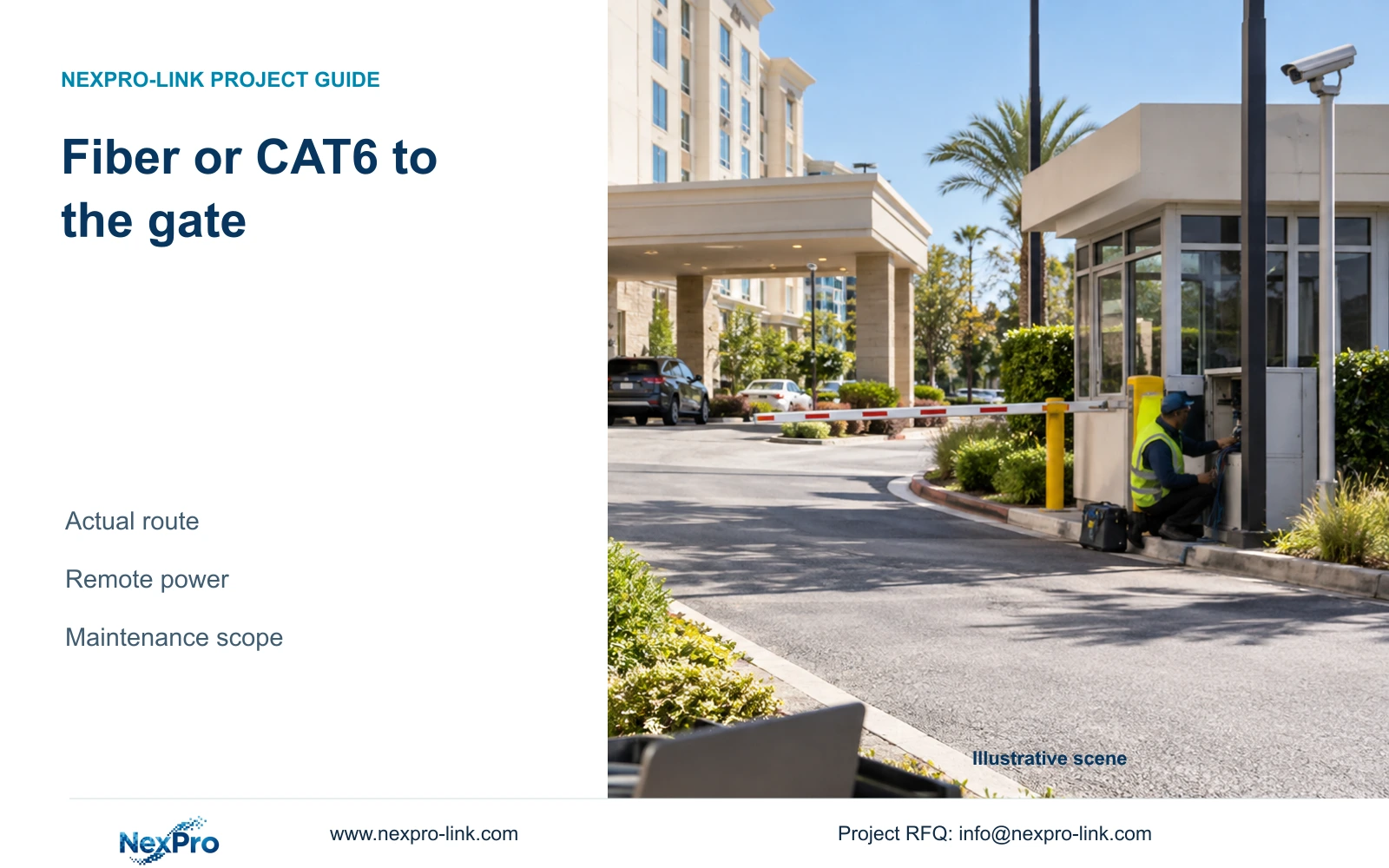
Specify transmission performance and outdoor suitability separately before ordering hotel CAT6. Retain direct copper where the complete installed link meets the project length basis and its cable, connections and protection suit the exposure. For a route crossing buildings or exceeding that basis, compare a qualified fiber backbone with local copper, including the remote node's power and maintenance requirements.
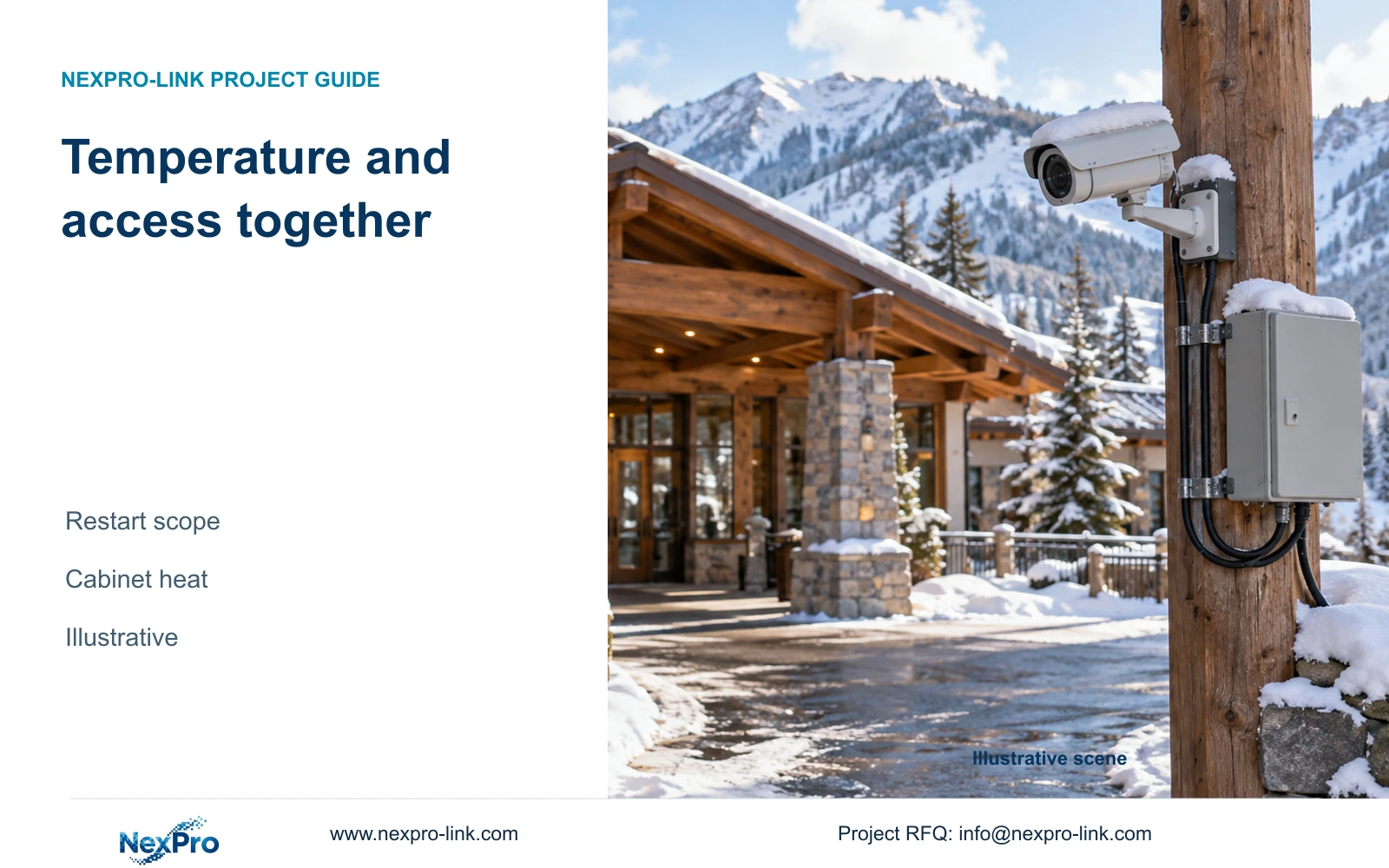
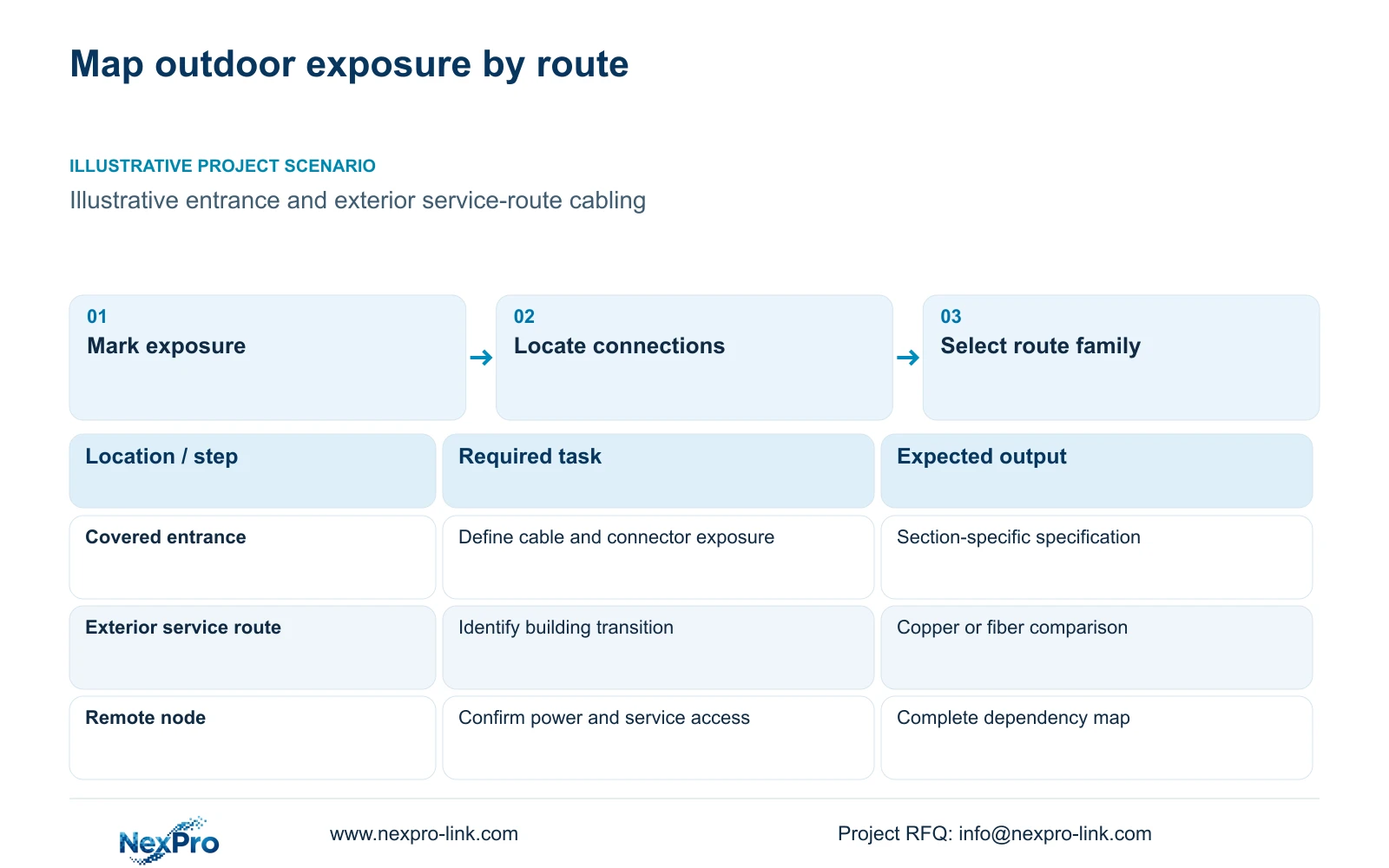
An exterior service-route camera and a camera beneath a covered entrance can require different installation provisions. Describe whether each cable section is exposed to sunlight, moisture or an outdoor connection point, and identify the proposed installation method. A covered location should not automatically inherit the specification used inside a dry equipment room.
Mark transitions on the route drawing, especially where a cable leaves an internal pathway or enters an exterior enclosure. The buyer can then request evidence for the conditions that apply to each section. Where exposure remains uncertain, keep the affected cable family provisional and resolve that section before purchasing the full quantity.
| Required task | Given information | Decision still needed |
|---|---|---|
| Entrance camera connection | Covered external mounting | Cable exposure and connection protection |
| Exterior service-route link | Route leaves the building | Installation method and backbone medium |
Section 02
Separate transmission performance from environmental suitability
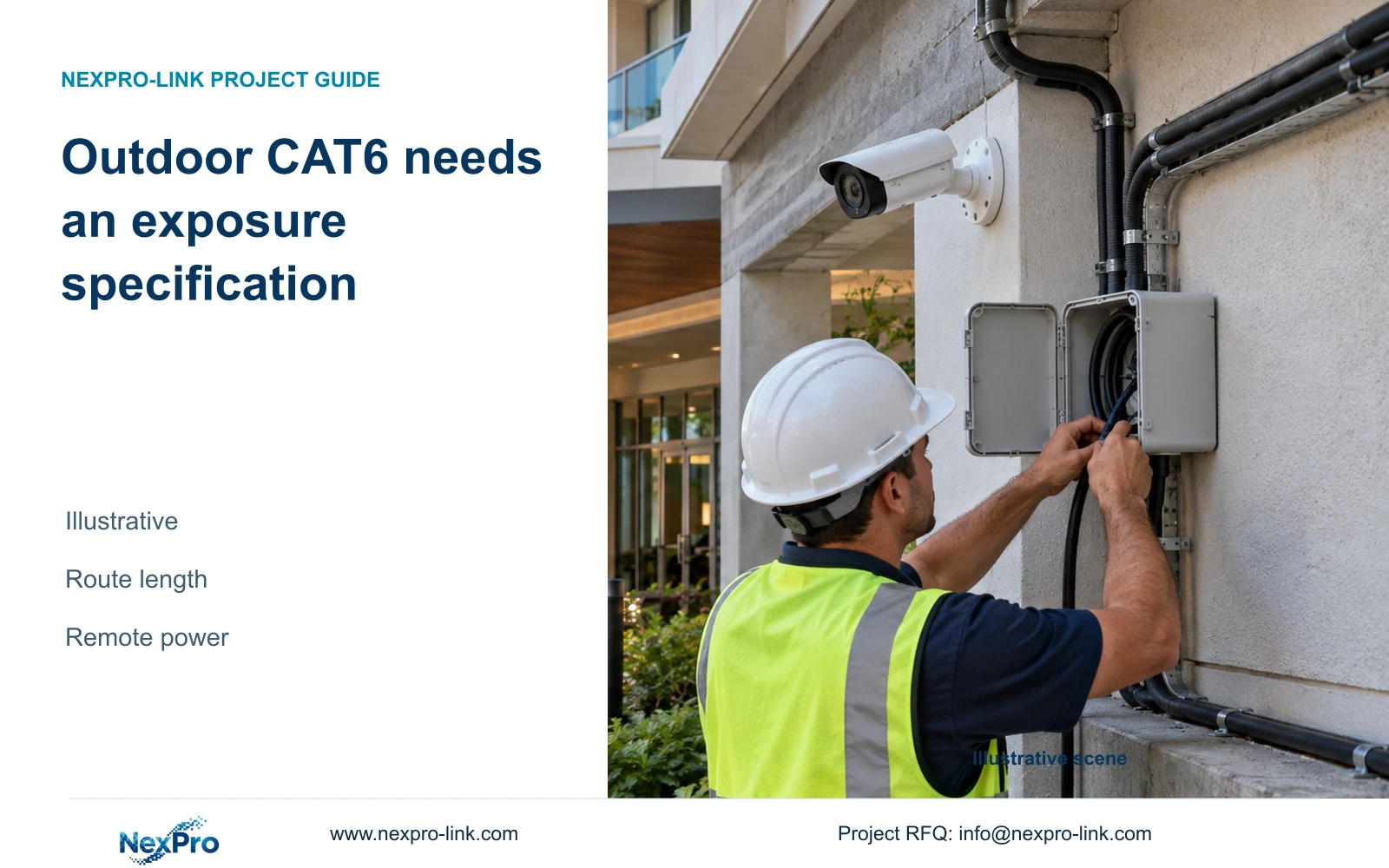
A Cat6 designation addresses a transmission category. The purchase description must also identify the conductor, jacket requirements and destination installation conditions. Treat ultraviolet exposure, moisture and the permitted laying method as separate selection inputs. Neither a network category nor a matching connector establishes every environmental property required along the route.
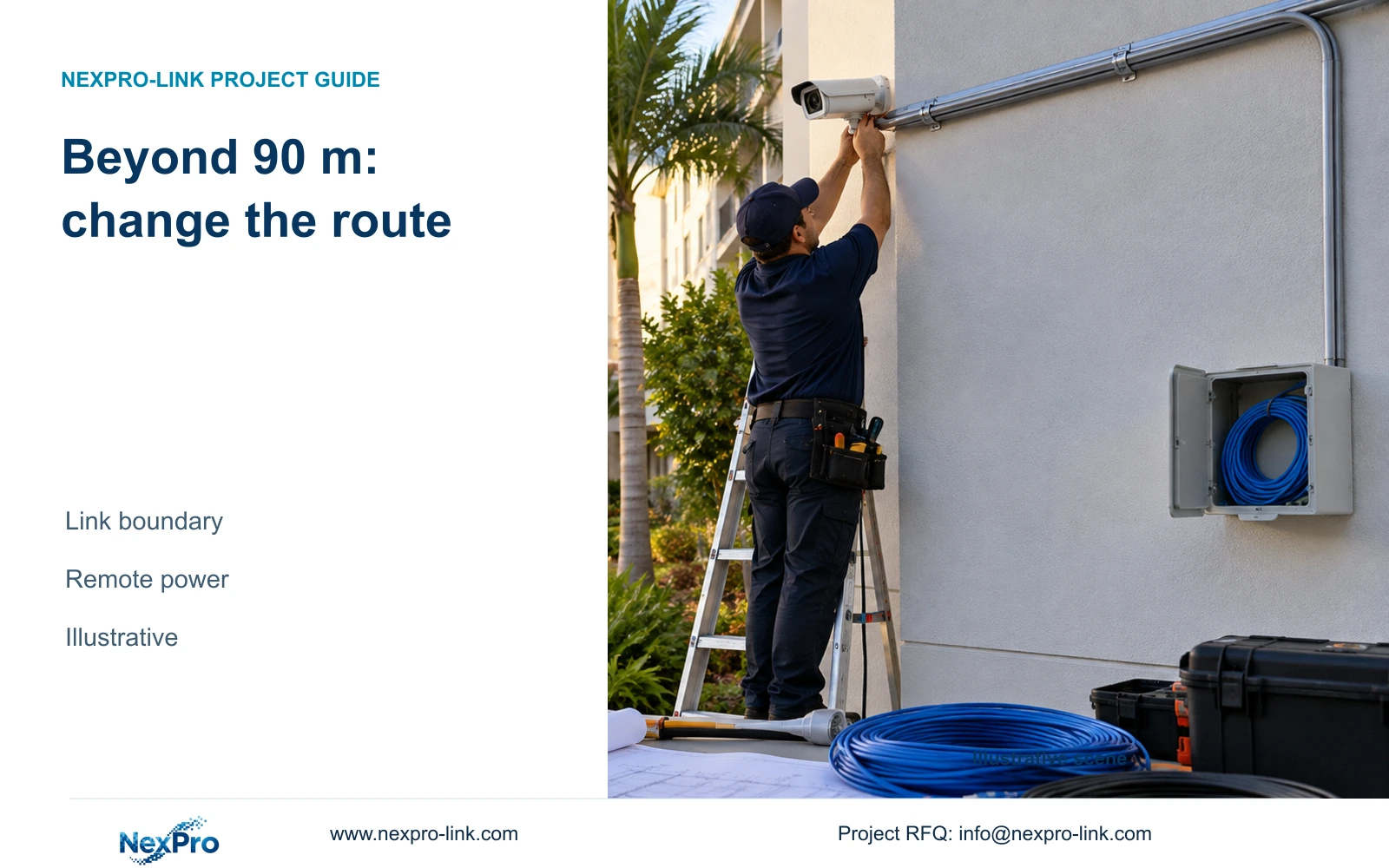
Measure the route through its actual horizontal pathway, riser and termination positions. Permanent-link length and the channel including patch cords have different boundaries. The supplied Fluke Networks record uses the typical 90 m permanent-link and 100 m channel distinction; the project must still define its test configuration, connections and applicable requirements.
Higher cable category, shielding or an outdoor jacket does not resolve an excessive permanent route length. If the route fails its length basis, examine a closer distribution point or different backbone arrangement. Conversely, a short route still needs suitable environmental provisions. These decisions should remain separate in the technical comparison so one accepted attribute cannot conceal an unresolved requirement.
Section 03
Review outdoor connections and enclosure access
Show every termination and intermediate device on the proposed route. The outdoor connection arrangement should describe the enclosure, cable entries and access needed for inspection or replacement. Procurement should establish which party supplies these items and which party installs them. A suitable cable cannot compensate for an unspecified exposed connection.
Adding an extender or switch introduces another active dependency. Its supported speed and output must match the intended service, while its enclosure and power source must suit the location. Include the device in the maintenance schedule, with a practical access position that remains reachable after landscaping or decorative work is complete.
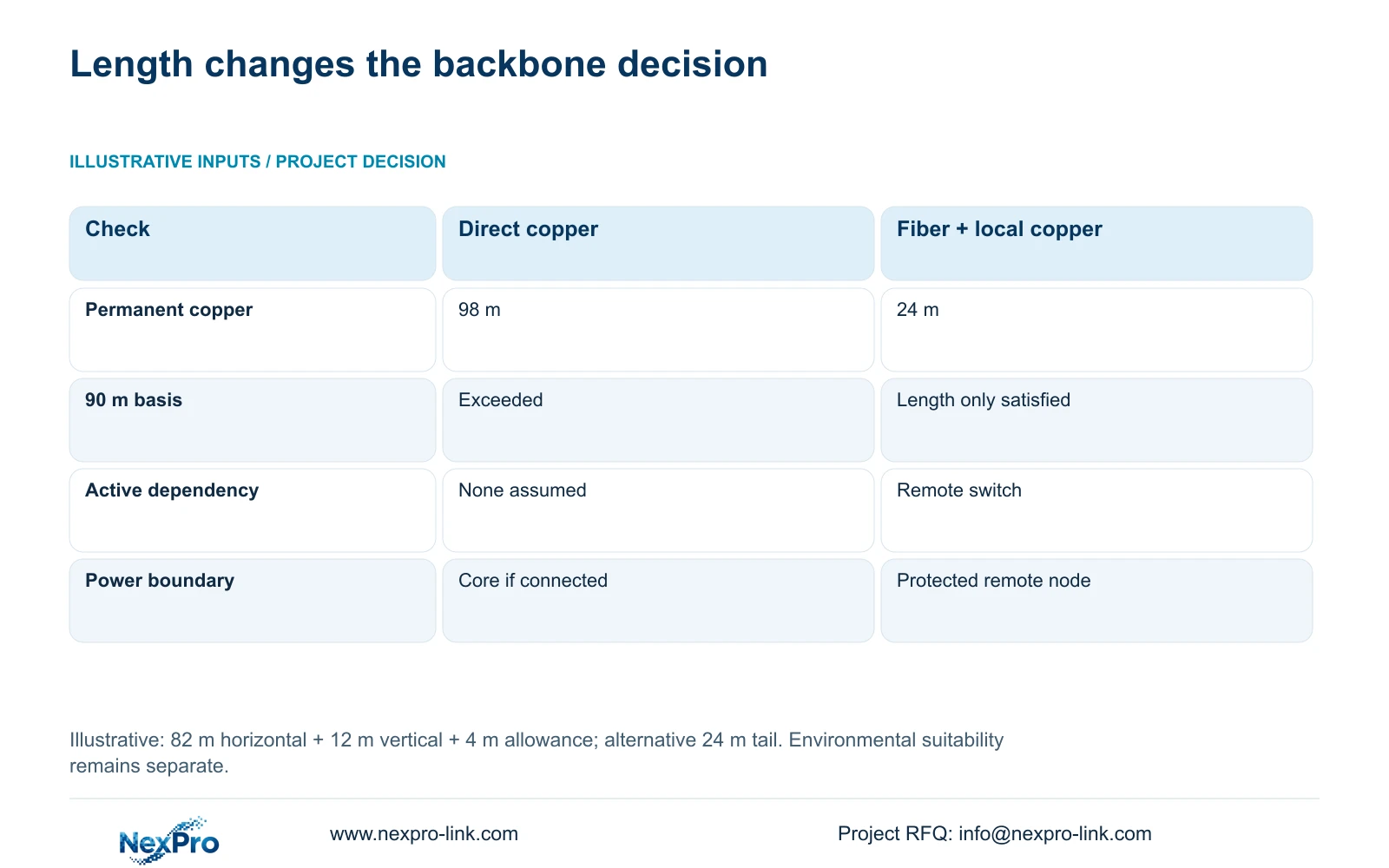
Use the independent route example below as an enclosure-planning input. Its direct route contains 82 m horizontally, 12 m vertically and 4 m of termination allowance, giving 98 m in total. Moving the data transition to a fiber node allows an illustrative 24 m local copper tail. That transition also creates a location where equipment protection, power and service access need explicit provision.
Section 04
Compare direct copper with a fiber-fed local node
Calculate permanent route length by adding horizontal distance, vertical distance and the stated termination allowances. All distances here are illustrative meters, with allowances already included. The comparison concerns one route; it must not be combined with the separate cable totals in the complete 32-camera hotel reference.
The 98 m copper route exceeds the stated typical 90 m permanent-link basis. The 24 m tail satisfies the length comparison only. It still requires the correct cable and installed-link verification. For this scenario, carry the fiber-fed local-node option forward, or investigate a revised closet position that brings direct copper within the approved basis.
Fiber carries the data across the backbone and does not automatically supply the remote switch or camera. Include local power and protection for the node when continued recording during an outage is required. Compare the complete alternative, including interfaces and installation, before accepting a lower cable-only allowance.
| Metric / condition | Direct copper route | Qualified fiber node + local copper |
|---|---|---|
| Planned copper permanent route | 98 m | 24 m |
| Typical 90 m permanent-link basis | Exceeds this basis | Within length basis only |
| Extra active dependency | None assumed | Remote switch and local power |
| Backup boundary | Core supply if fully connected | Remote node must also be protected |
Section 05
Assign local electrical and installation responsibilities
Keep the data topology separate from the protected-power arrangement. The network designer identifies the required communication path and interfaces. Appropriate local professionals address electrical protection, grounding, installation safety and the site's outdoor provisions. A supply proposal should name these interfaces without presenting a network sketch as an electrical installation design.
For a remote node, establish who provides its power source, who maintains the enclosure and who confirms its outage behavior. Protecting the central recorder alone leaves an incomplete recording path if the remote switch loses power. Distributed locations require protection decisions for their actual zones, even when an aggregate load appears modest.
The NexPro SW-POE1618G is a possible inquiry candidate with 16 PoE access ports, two uplinks and af/at descriptions. Its source title and detailed access-port speed fields conflict, and its total PoE wattage is not stated. Those limitations prevent treating it as an already qualified remote switch. The quotation must respond to the actual port-speed and power requirements.
Section 06
Issue a route-specific cable and equipment specification
Describe each cable family by its transmission category, conductor and required jacket conditions, together with the installation method and approved test basis. List connectors, enclosures and intermediate equipment separately. Procurement quantities should come from endpoint lengths and feasible continuous cuts; a total-meter estimate alone cannot establish how many reels will complete the routes.
SP5648 is a Cat6 48-port patch panel, and DT968MX is a Cat6 tool-free module. Their listed categories can support component selection, but neither is a bulk-cable SKU or proof of outdoor suitability for the assembled link. NexPro-Link's CCTV manufacturing core and coordinated supply support do not mean every supporting cabling item is manufactured in-house.
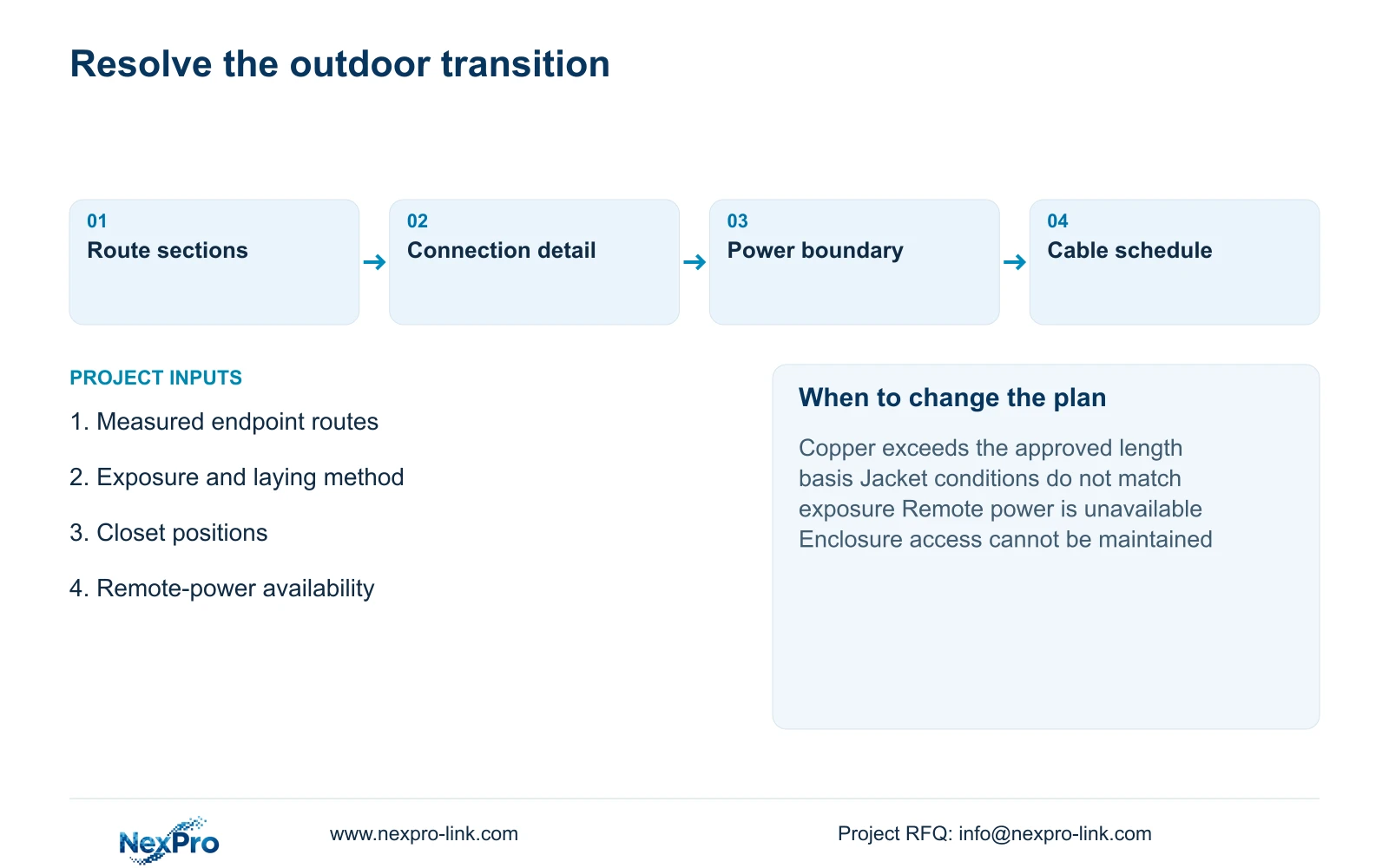
Send measured routes, closet positions, exposure notes and remote-power availability to info@nexpro-link.com, with the delivery destination. Hotel project equipment support and BOQ support can help organize a scoped proposal. Change the direct-copper recommendation if measured length, environmental conditions or building interfaces invalidate it; change the fiber-node proposal if suitable remote power or maintenance access cannot be provided.
Section 07
Buyer questions
Does a conduit make indoor CAT6 acceptable outside? Do not approve that substitution from the conduit description alone. Review the cable's intended conditions, the actual exposure along the route and the outdoor terminations. The installation specification must establish suitability for the complete arrangement.
Can an outdoor-rated cable solve the 98 m route? Outdoor suitability and installed length are separate checks. The illustrative 98 m permanent route exceeds the stated typical 90 m basis, so revise the route or compare a qualified backbone and local tail.
What should the first quotation include for a fiber-fed camera zone? Request the backbone interfaces, remote switch, local copper connections, enclosure and power boundary. State whether outage recording is required so remote-node protection is included in the evaluated scope.
Engineering references
These sources support the general planning principles. Always use the selected product's current datasheet and applicable project standards for final design.