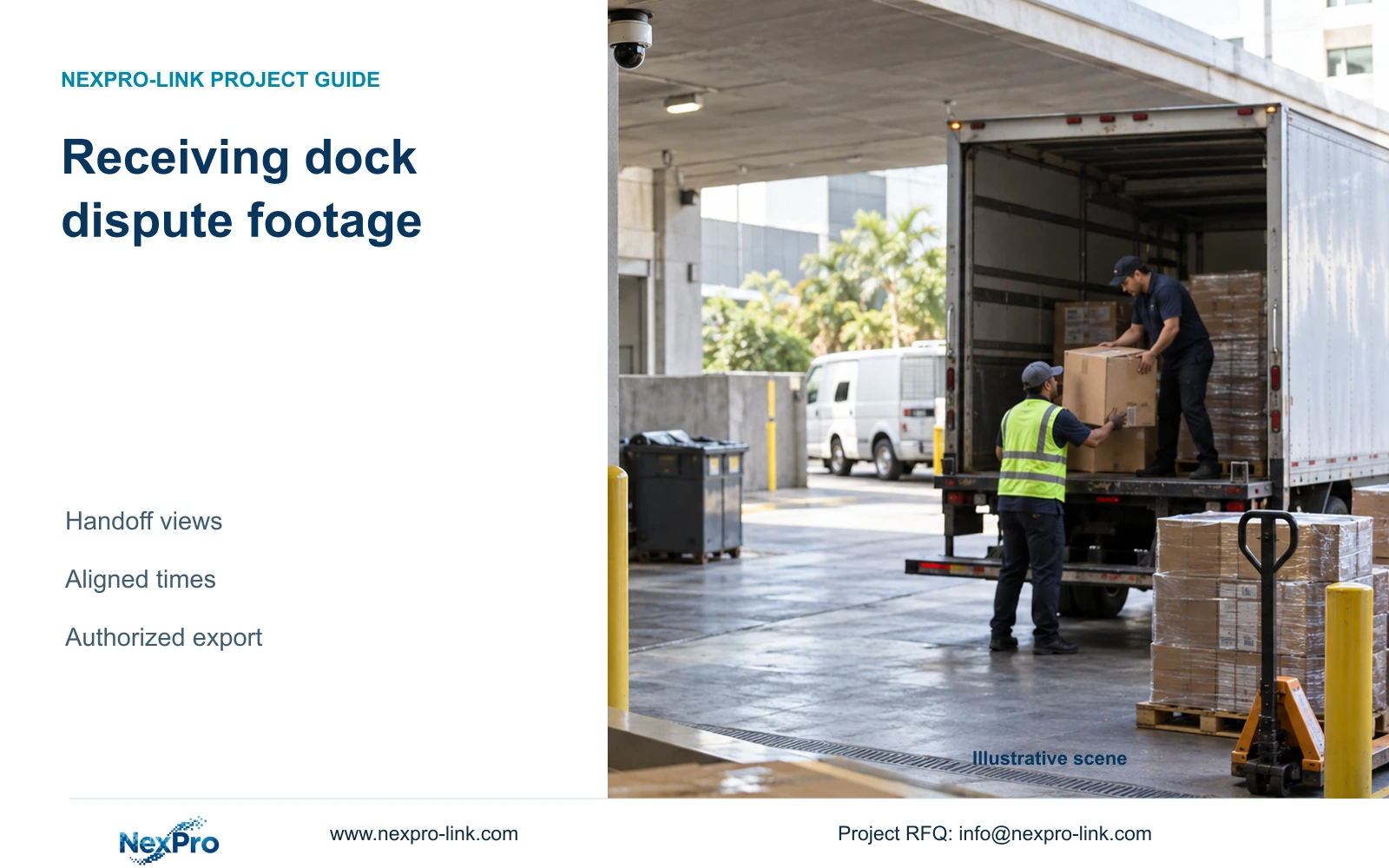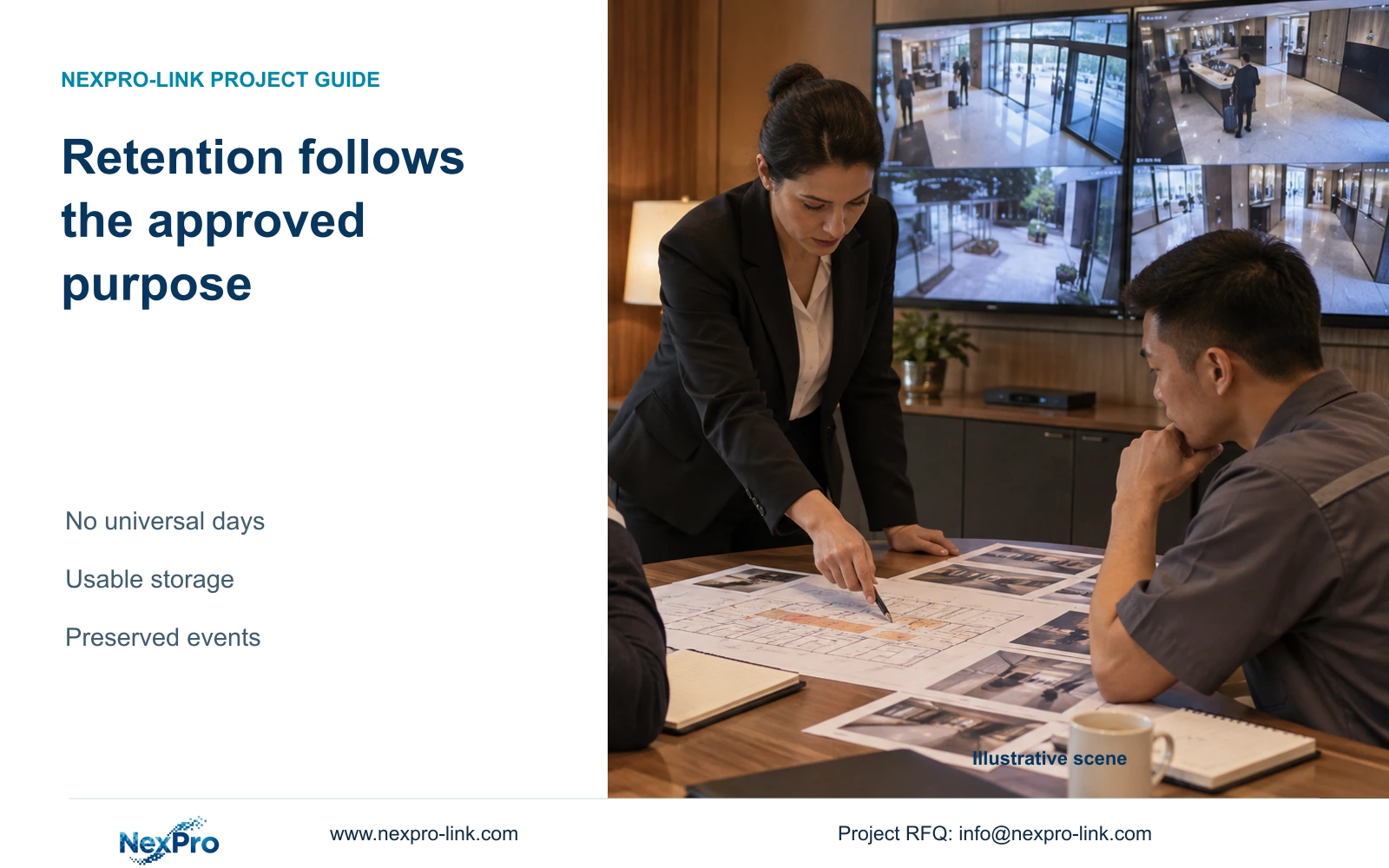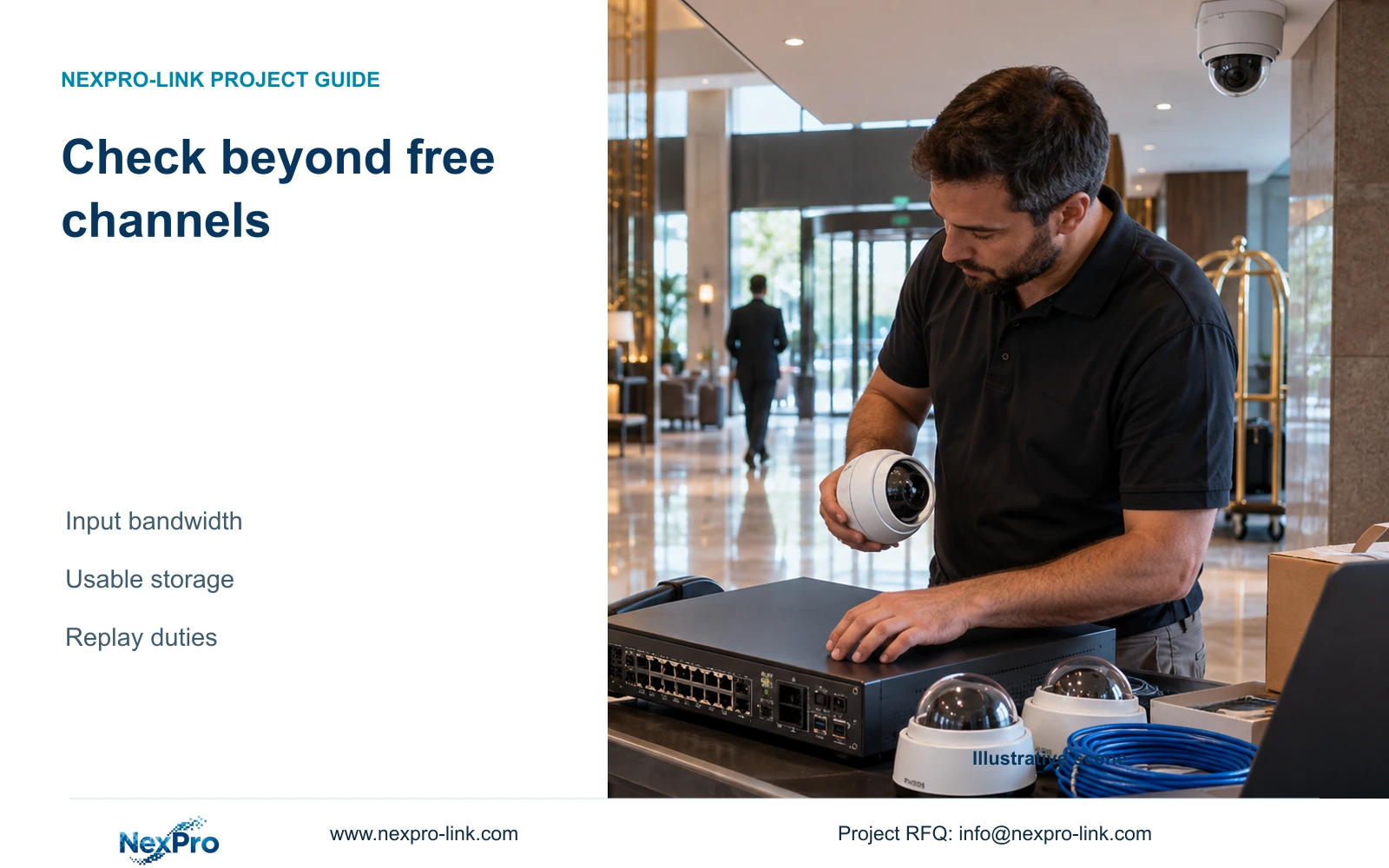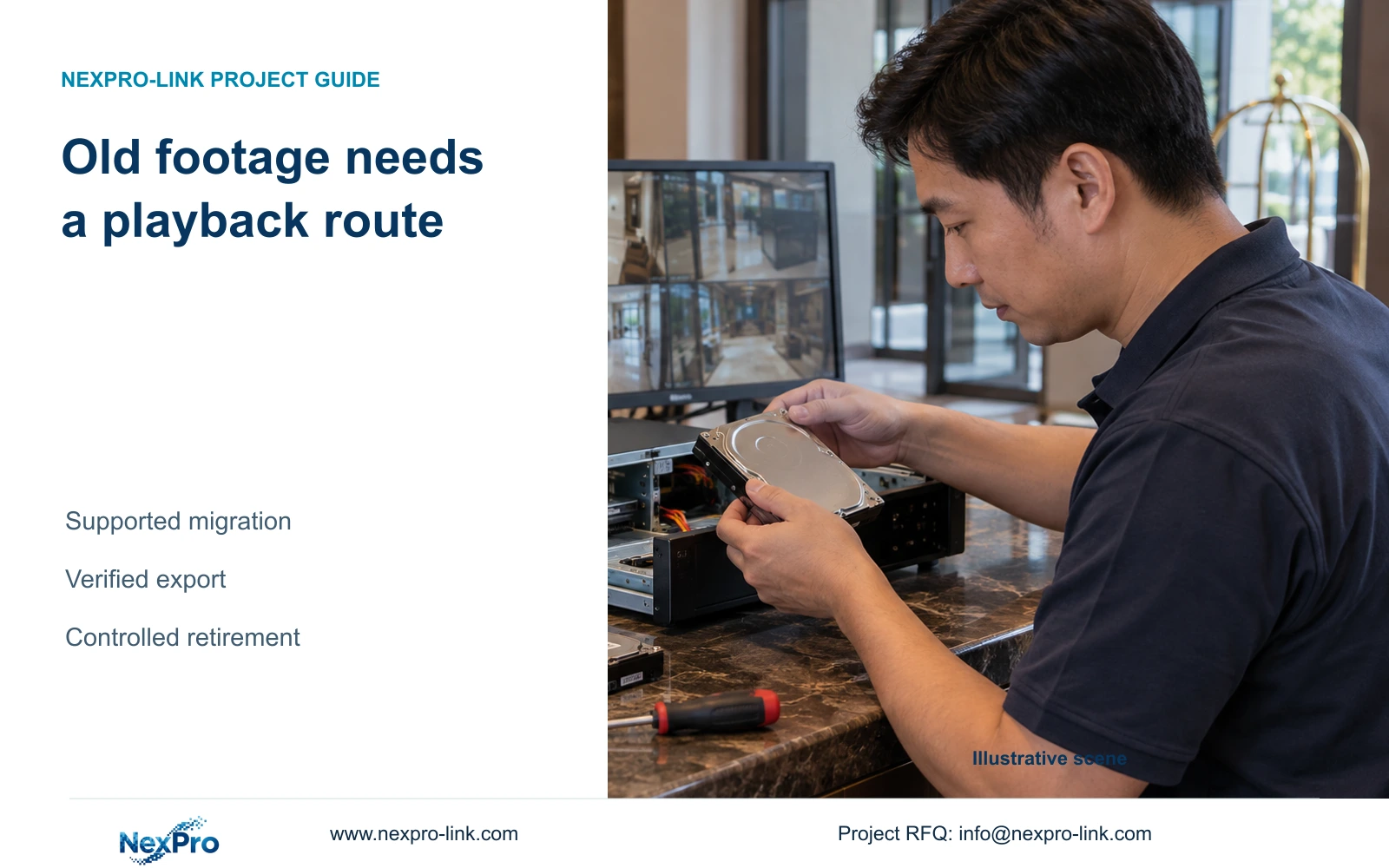
An old disk fitting a new NVR does not guarantee readable recordings. Preserve authorized footage through a supported migration or verified export, with enough overlap to check playback.
Section 01
Decide which old footage must remain accessible
Keep the original recorder available until required footage has a verified playback route. Use a supported migration process or authorized event export, and do not assume that inserting old disks into a new NVR preserves readable recordings. Extend parallel retention if playback or the required historical scope remains unresolved.
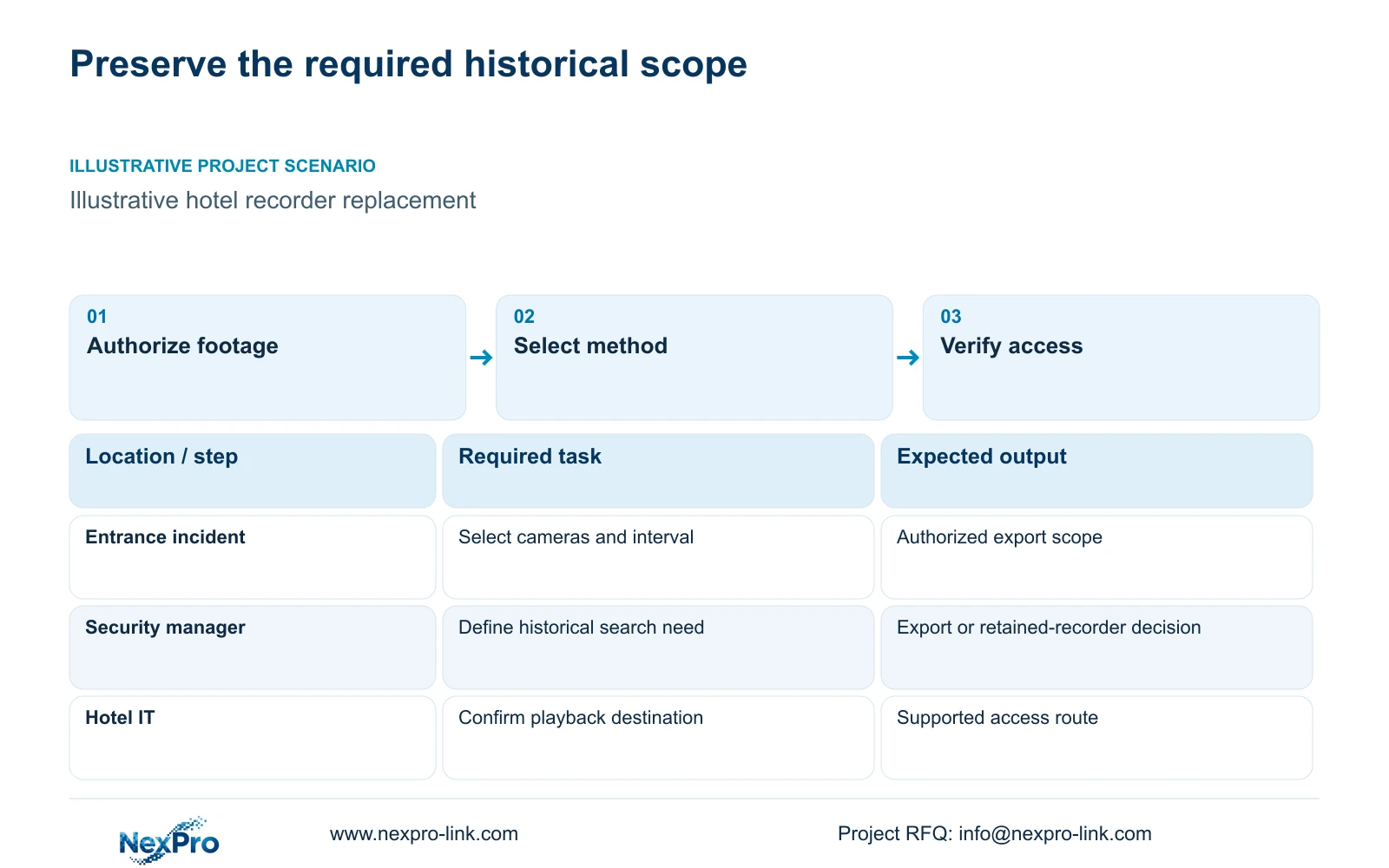
Identify the cameras and time intervals that the hotel needs to preserve. An entrance incident may require related public-route views for context, while unrelated footage should remain outside the export unless separately justified and authorized. Distinguish a selected incident from a requirement to search the full historical recording period.
Record camera identity, the relevant time basis, intended recipient and required playback method. A copied file can be unusable to its recipient if the necessary player or context is missing. The preservation decision therefore includes access and interpretation, alongside file transfer.
The illustrative CASE07 renovation combines retained and proposed cameras, but its new recording-capacity plan does not prove that old disks migrate. Historical access and the new recorder's future recording duty need separate acceptance decisions.
| Required task | Given information | Decision still needed |
|---|---|---|
| Preserve an entrance incident | Selected cameras and time window | Approved format and recipient |
| Search older public-area footage | Historical retention requirement | Keep old recorder or use supported migration |
| Retire existing disks | Replacement equipment proposed | Verify required footage before removal |
Section 02
Check the supported migration route
Obtain the migration procedure for the exact source recorder, destination recorder and software versions. Disk connectors and capacity labels do not establish recording-format compatibility. Treat any destination action that could initialize or alter the source media as a separate risk requiring an approved preservation plan.
Compare supported whole-system migration with clip export. A migration route may preserve a broader searchable history if the relevant equipment supports it. Export can preserve a defined event without claiming that the new recorder will index the old recording database. The hotel should choose according to the required historical task.
Published replacement-recorder capacity is useful for future recording selection. NexPro-NVR4449-4K lists 49 channels, 320 Mbps input and four SATA positions with 18 TB per drive. Those fields do not establish old-disk readability, all-resolution concurrency or a particular RAID mode.
The NexPro-NVR2232-4K source contains conflicting 2×8 TB and 2×18 TB capacity descriptions, together with recording or playback differences. Do not use the larger field as a settled purchase limit or as evidence of migration support.
| Item | Supported migration | Authorized export | Hotel effect |
|---|---|---|---|
| Historical scope | As supported by exact combination | Selected cameras and intervals | Full search and incident preservation differ |
| Playback route | Supported destination workflow | Delivered file and suitable player | Recipient must have a usable method |
| Original source | Retain through validation | Retain through export verification | Removal follows demonstrated access |
Section 03
Calculate the export payload and transfer window
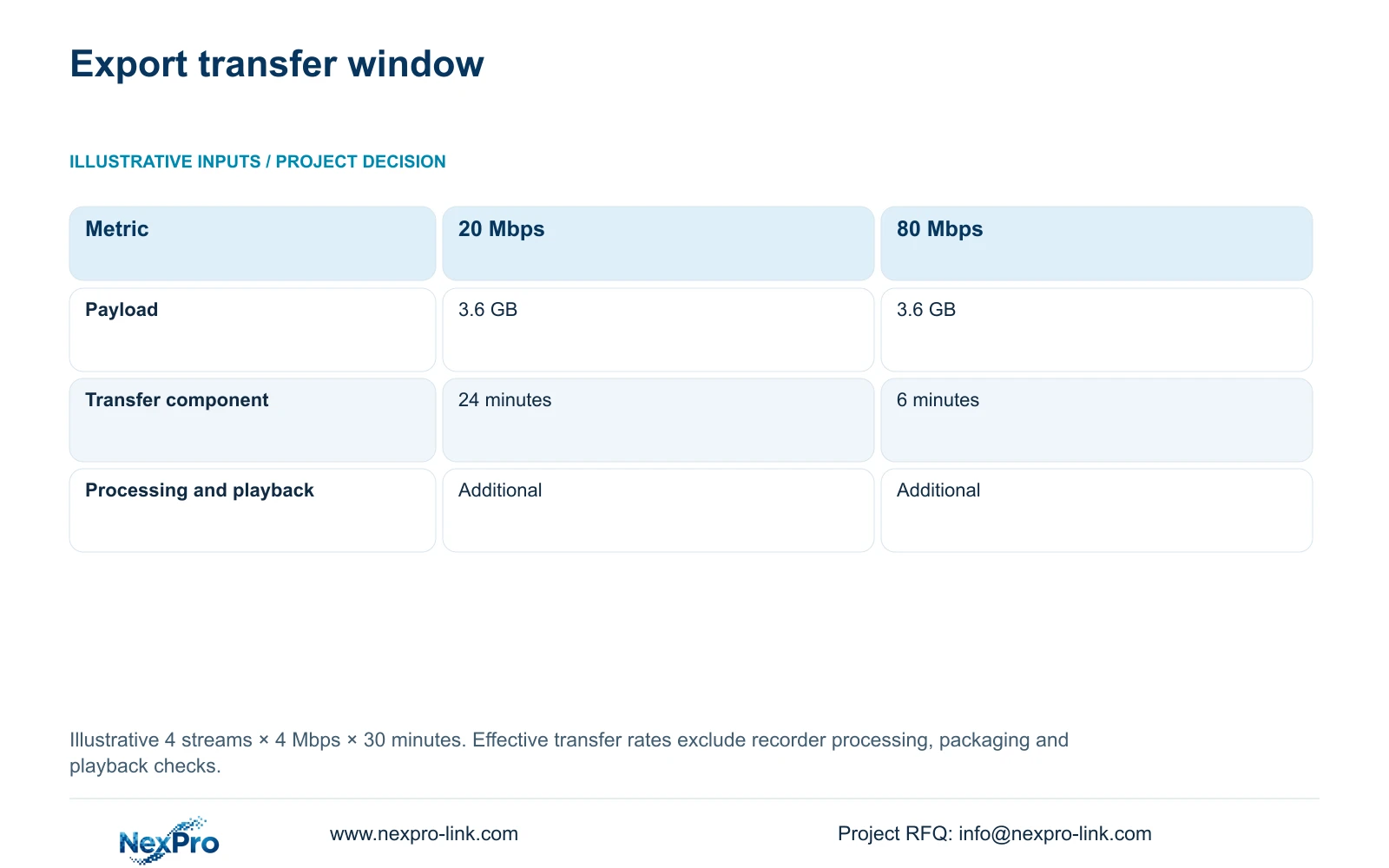
For the illustrative event, four streams average 4 Mbps each over 30 minutes. The duration is 1,800 seconds. These are teaching inputs, independent of CASE07's full-hotel storage totals and unrelated to a particular NVR's measured export speed.
Clip size in decimal GB equals streams × Mbps × seconds ÷ 8 ÷ 1,000. The calculation is 4 × 4 × 1,800 ÷ 8 ÷ 1,000 = 3.6 GB. The division by eight converts bits to bytes; the final divisor expresses the result in decimal gigabytes.
Transfer seconds equal GB × 8,000 ÷ effective Mbps. At 20 Mbps, the payload takes 1,440 seconds, or 24 minutes. At 80 Mbps, it takes 360 seconds, or six minutes. Effective throughput is the rate available to this transfer, not the interface label or advertised internet speed.
Recorder processing, file packaging and playback verification require additional time. Audio, metadata and container overhead can also change the delivered size. Use the comparison to reserve a realistic work window, and revise it when an actual export observation shows a slower controlling step.
| Metric / condition | Option A | Option B |
|---|---|---|
| Video data (GB) | 3.6 | 3.6 |
| Effective transfer (Mbps) | 20 | 80 |
| Ideal transfer time (minutes) | 24 | 6 |
| Processing / playback checks | Additional | Additional |
Section 04
Compare parallel retention methods
Keeping the old recorder available preserves its established retrieval route while the new system begins recording. This can suit a broad historical-search requirement, provided the hotel defines power, authorized access and the retirement event. Continued availability should not become an indefinite arrangement without responsibility or purpose.
Selected exports reduce the historical material carried into the replacement phase. They suit defined incidents whose files and playback method can be verified. They do not reproduce every search function of the source recorder. A supported migration should be evaluated separately where the owner needs a broader history.
Allow for overlap resources in the proposal: equipment space, protected power, network access and staff time. If cameras must record on both systems, verify that exact arrangement rather than assuming it is supported. Parallel retention of old footage and parallel new recording are different requirements.
Future capacity also needs its own calculation. Separate raw disks, array capacity, formatted usable space and the video budget. Do not count a hot spare as recording space or reduce bitrate merely to fit existing disks unless the recorded detail still meets the task.
Section 05
Control who receives transferred media
The hotel should approve the recipient, transfer path and access period before footage leaves the source system. Define any required encryption through the approved handling process. The export record should connect the authorized event scope with the person responsible for delivery and verification.
Keep the usable playback package together with its context. Camera names and timestamps should be understandable to the recipient; the approved player or supported viewing method should be available. Avoid sending an unexplained folder that requires privileged access to the hotel's live system.
Price the handling work explicitly where it falls outside equipment supply. Secure transfer provision, retained-recorder access and verification labor can have different responsible parties. A technical procedure does not establish legal admissibility; any evidence-preservation requirements must follow hotel authorization and applicable professional advice.
| Retained outcome | Extra scope | When useful | Counter-condition |
|---|---|---|---|
| Defined incident access | Export and playback package | Selected event scope is sufficient | Owner needs full historical search |
| Broader historical search | Old recorder availability | Migration remains unsupported | Source cannot remain safely operational |
| Destination history access | Supported migration and validation | Exact combination is supported | Disk readability is only assumed |
Section 06
Verify playback before retiring the recorder
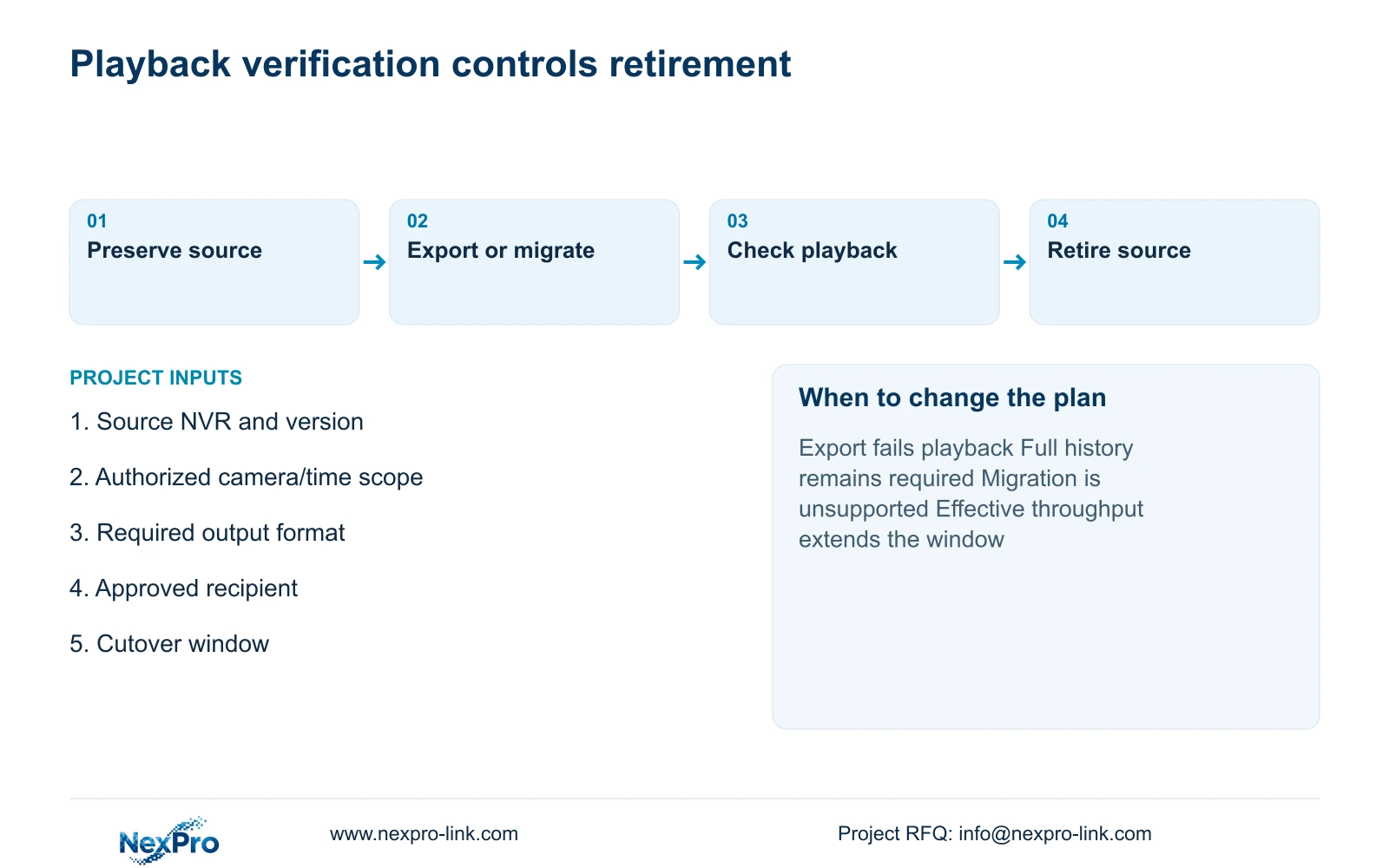
Have an authorized recipient open the delivered material through the intended playback method. Check the selected camera identity and time window, and review whether the required event context is present. A completed copy operation is insufficient evidence that the preservation task is complete.
Retire the old recorder only after the required historical scope is accessible and the new recording duty has been checked separately. If files fail to play or supported migration remains uncertain, retain the source and revise the handover arrangement. Do not promise a fixed overlap period without the actual preservation and cutover inputs.
NexPro-Link can discuss replacement model matching and the equipment boundaries through hotel project equipment support and BOQ and tender support. Send source and proposed NVR models and versions, the authorized camera/time scope, required output format and available cutover window to info@nexpro-link.com. State whether the owner requires selected incidents or full historical search; do not attach guest footage or credentials to the initial inquiry.
Section 07
Buyer questions
Can the new NVR read our old disks if the SATA connection fits? The connector does not establish recording-format compatibility. Obtain support for the exact migration combination and preserve the source until the required playback route is verified.
Does a faster network guarantee a six-minute export? No. Six minutes is the transfer component for the illustrative 3.6 GB payload at an effective 80 Mbps. Recorder processing, packaging and verification are additional, and actual throughput may differ.
Must we copy every recording before replacing the NVR? Define the authorized historical requirement first. Selected incident exports may be sufficient, while full historical search may require supported migration or continued access to the old recorder.
Engineering references
These sources support the general planning principles. Always use the selected product's current datasheet and applicable project standards for final design.