A stored spare reduces replacement delay but does not automatically resume recording. Select hotel redundancy by acceptable footage gaps, affected camera roles and a demonstrated recovery method.
Section 01
Set the acceptable recording gap and recovery task
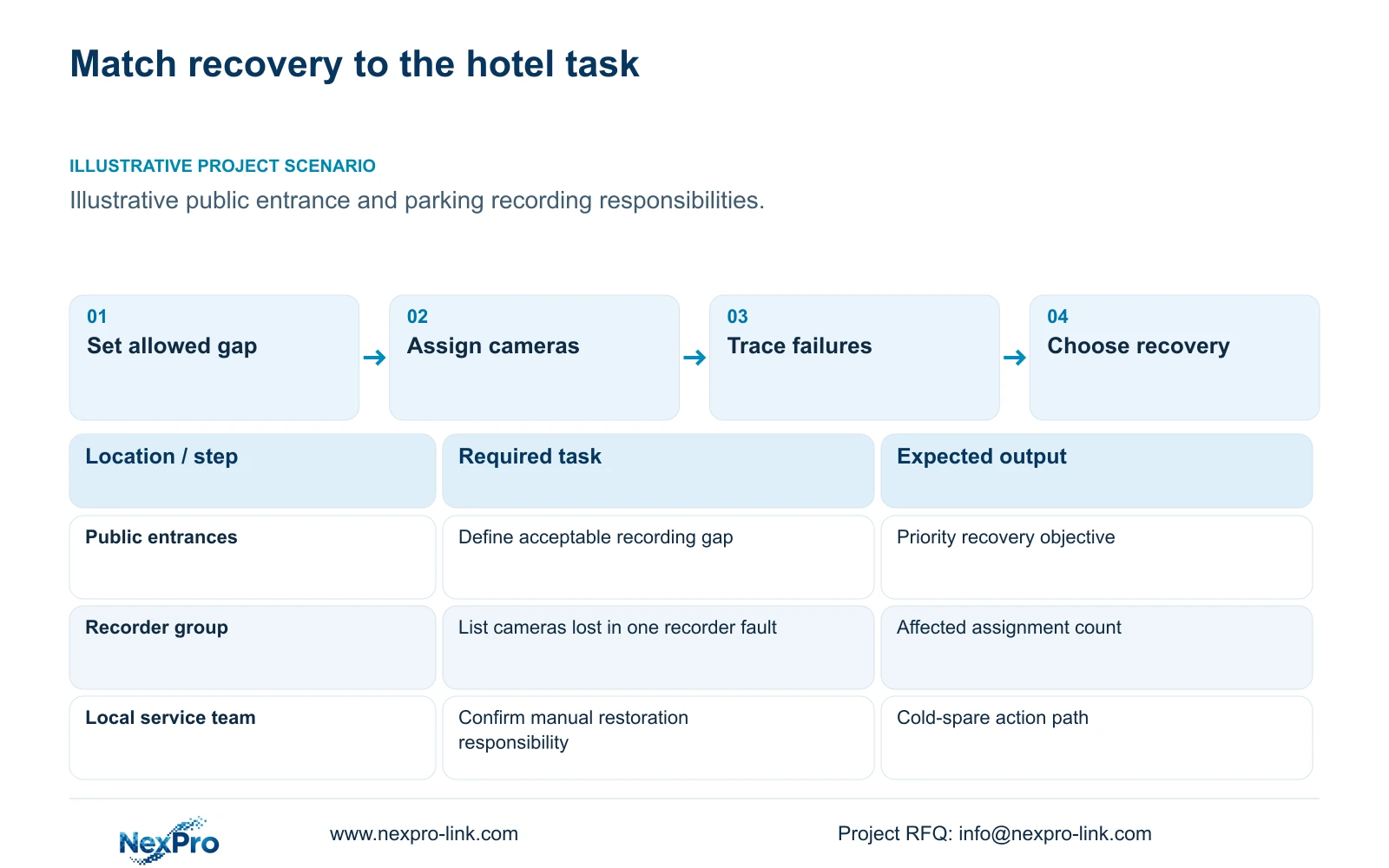
Choose a cold spare when the hotel can tolerate a manual restoration interval and has staff able to carry out the supported replacement procedure. Choose independent recorder groups when limiting the cameras affected by one recorder fault is useful. Specify automatic takeover only when the selected hardware and software explicitly support it and the demonstrated recovery meets the hotel's objectives.
Define the maximum acceptable recording gap for each public-area task, together with the required recovery action. Entrance continuity may have a different priority from a less critical exterior overview. The hotel should also distinguish loss of new recording from temporary inability to search older footage.
Recovery objectives need an actor. A spare in storage is useful only when an authorized person can identify the fault, reach the installation and restore the approved configuration. If that person is unavailable during the hotel's operating hours, a manual recovery assumption needs revision.
Keep the objective specific to a failure event. Recorder failure, access-switch failure and loss of an entire power zone can affect different cameras. A proposal that addresses one event should state the others that remain outside its recovery scope.
| Required task | Given information | Decision still needed |
|---|---|---|
| Continue entrance recording | High-priority public route | Acceptable gap and supported takeover |
| Restore failed recorder | Manual replacement is an option | Responsible person and restoration procedure |
| Retrieve earlier footage | Fault may affect stored recordings | Supported retrieval and preservation path |
Section 02
Separate spare hardware, grouping and automatic takeover
A cold spare is replacement hardware held for a service event. It does not capture missed footage while awaiting installation unless another separately supported recording path does so. Confirm its functional compatibility, firmware and configuration readiness; matching enclosure appearance is insufficient.
Independent recording groups divide the normal workload. A recorder failure can then affect its assigned group while other genuinely independent groups continue. This does not restore the failed group automatically. The benefit depends on the groups' actual network, storage and power dependencies.
Automatic failover requires a supported detection and takeover mechanism, enough receiving capacity and a defined return to normal operation. The supplied NexPro-Link recorder records do not establish that feature. A second recorder, dual network connections or unused channels cannot be presented as automatic takeover evidence.
Disk tolerance is another mechanism. A supported array may address certain drive failures, but it does not establish protection against recorder failure, deletion or every form of data loss. Use an explicitly supported storage mode and retain a separate incident-preservation workflow.
| Mechanism | Defined benefit | Remaining limitation |
|---|---|---|
| Cold spare | Replacement hardware is available | Manual restoration and recording gap |
| Independent groups | Limits one recorder's assigned scope | Shared failures can affect several groups |
| Supported automatic takeover | Transfers defined recording duties | Actual support, capacity and recovery need proof |
Section 04
Calculate the workload inside each failure boundary
Count affected cameras from the zone and dependency schedule. If the selected 32-camera arrangement has one recorder serving every camera, its recording service is a common dependency for all 32. Dividing the assignment only limits that fault's scope when the remaining groups have the resources needed to continue.
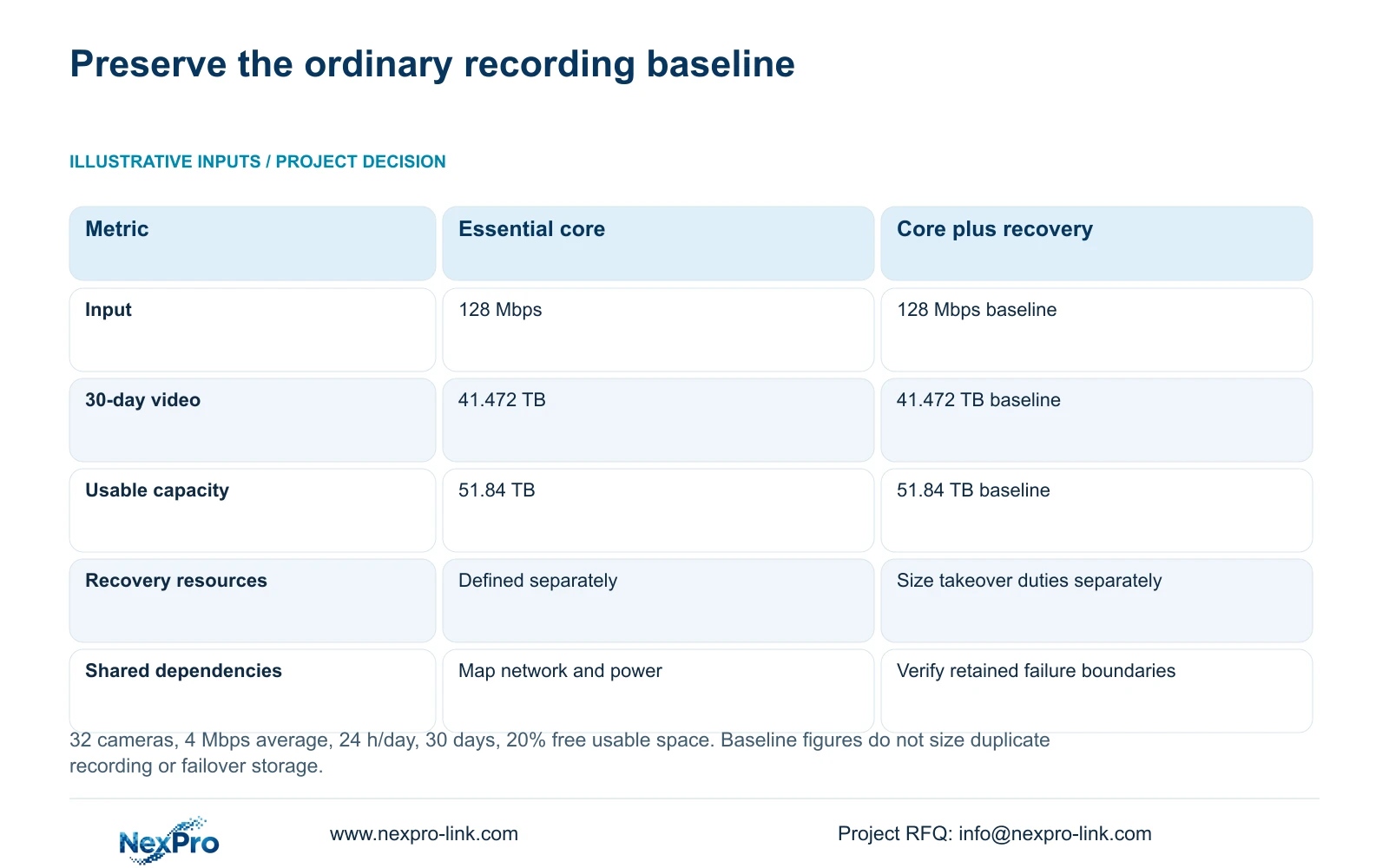
The illustrative baseline uses 32 cameras at an average 4 Mbps, recording 24 hours daily for 30 days. Input is 32×4 = 128 Mbps. Decimal video capacity is 0.0108×32×4×30 = 41.472 TB. Dividing by 0.80 retains the specified 20% free-space target and gives 51.84 TB required usable capacity.
Both comparison options preserve that ordinary recording requirement. Recovery additions need their own capacity analysis for the duties they may assume. The table does not size duplicate recording or a failover receiver, and it does not imply that a spare supplies another 30-day archive.
NexPro-NVR4449-4K lists 320 Mbps input and four SATA bays with up to 18 TB per drive, while its summary lists 49×5MP or 9×4K modes. Those fields identify a candidate for further configuration checks, not a failover capability or a guarantee for arbitrary camera formats.
| Metric / condition | Essential recording-first package | Same core plus optional display/recovery scope |
|---|---|---|
| Recording input (Mbps) | 128 | 128 |
| 30-day video data (TB) | 41.472 | 41.472 |
| Required usable capacity (TB) | 51.84 | 51.84 |
| Protected path | Cameras + network + recording | Same plus explicitly selected extras |
| Operator display | Task-sized monitor/workstation | Optional wall; independent recording |
| Cost comparison | Complete scope quotation required | Add only documented incremental scope |
Section 05
Compare capital cost with restoration effort
Compare complete proposals against the same accepted failure events. A cold spare adds hardware and preparation, while manual restoration adds labor and configuration work. Independent groups add equipment allocation and maintenance responsibilities. A supported failover arrangement may add software, network and receiving-storage scope.
Ask each proposal to state the retained recording outcome, additional equipment and the person responsible for recovery. No supplied failure rates or service prices justify an invented financial saving. A cheaper spare option is appropriate only when its restoration interval and footage gap are acceptable.
Reserve budget for the recovery dependency that addresses the hotel's priority. A larger monitoring wall does not resolve a recorder fault. If independent groups still share an unacceptable power or network failure point, compare the work required to separate that dependency before buying more recorder capacity.
Applicable main equipment has a 24-month limited hardware baseline from receipt in the supplied policy record, subject to written order terms. That does not define the restoration time. Storage, batteries, local labor and transport costs need explicit scope, and continuous technical support does not establish automatic recovery.
Section 06
Specify a failure test that measures the recovery objective
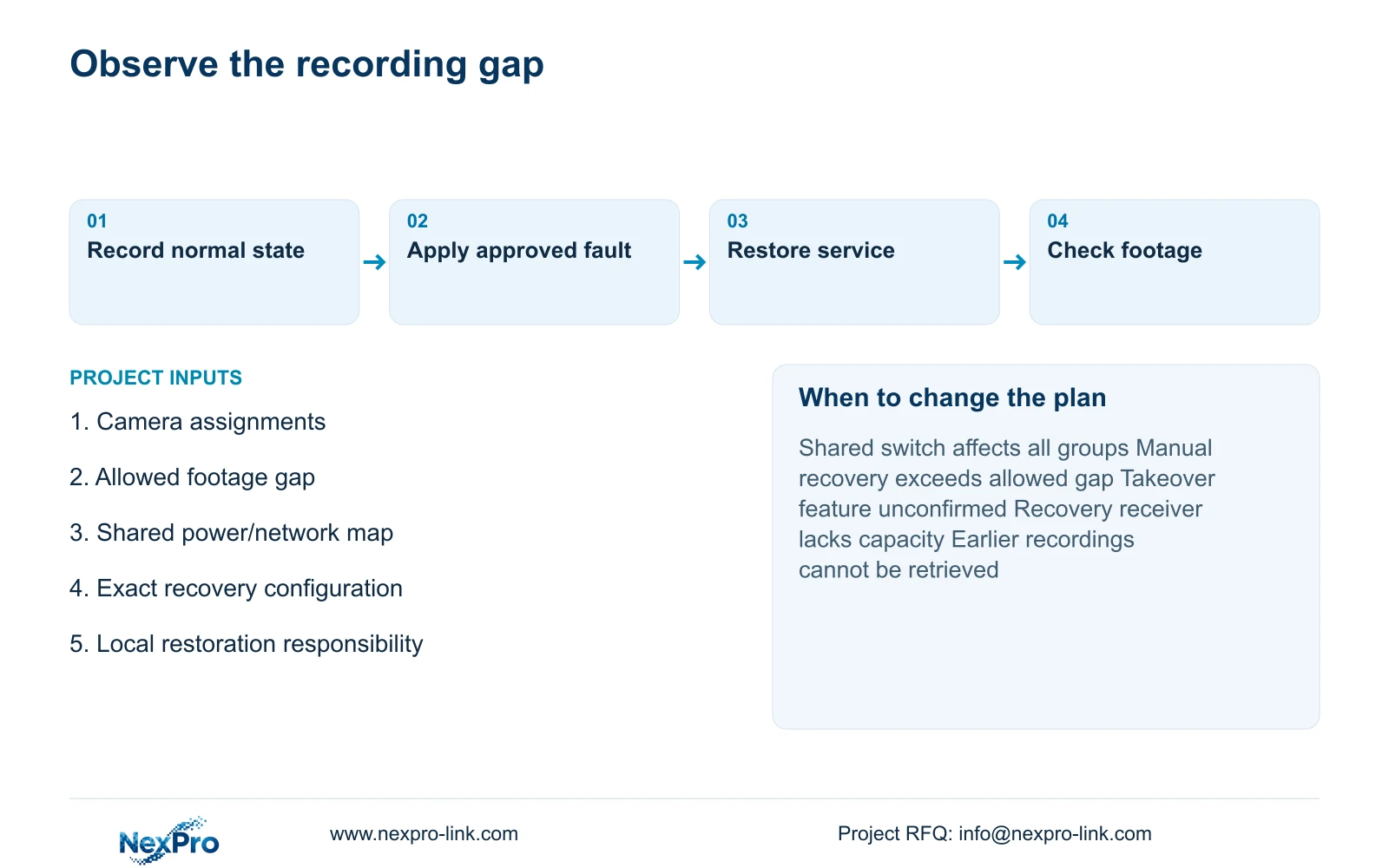
Define a controlled test for the approved failure event and configuration. Record the device models, firmware and camera assignments, then observe the last valid recording before the event and the first usable recording after restoration. Check unaffected groups and retrieve an authorized clip to verify the practical outcome.
Test takeover and return to normal separately where both are supported. A resumed live picture does not establish that recording, earlier retrieval and the intended retention policy remain correct. Leave expected results open until observed, and repeat the relevant conditions after correcting a problem.
Recommend a prepared cold spare for an acceptable manual-restoration task, independent groups for a defined recorder-fault boundary, or verified automatic takeover when the allowed gap requires it. Revise the choice if the test exposes a larger affected scope or slower recovery than the hotel accepts.
Send the camera-to-recorder schedule, shared network and power dependencies, and acceptable recording gap to info@nexpro-link.com. Identify who can perform local recovery. NexPro-Link can discuss a scoped equipment and BOQ response without treating unconfirmed redundancy features as included.
Section 07
Buyer questions
Will a spare recorder recover footage missed during replacement? A stored spare does not create that footage. Any gap-recovery claim requires a separately supported recording and retrieval mechanism identified in the design.
Do two network ports prove recorder failover? No. Port count does not establish failure detection, automatic transfer, receiving capacity or return-to-normal behavior. Request the supported mechanism for the exact configuration.
What should be recorded during the failure demonstration? Record the failure event, affected camera assignments, last and first valid recordings, restoration action and retrieval result. Compare the observed gap with the hotel's approved objective.
Engineering references
These sources support the general planning principles. Always use the selected product's current datasheet and applicable project standards for final design.