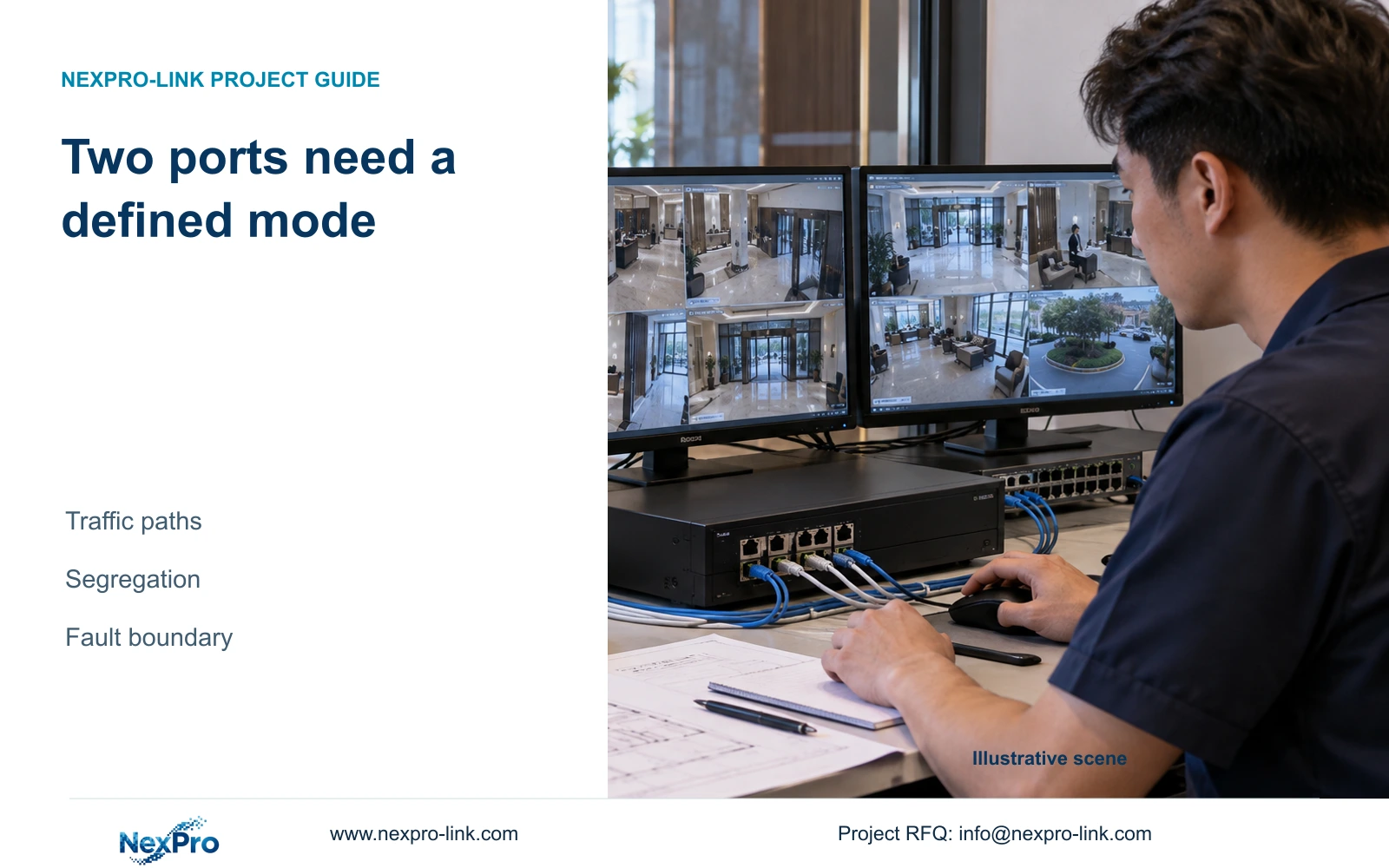
Two NVR network interfaces do not establish automatic failover or doubled bandwidth. Select the supported mode against the hotel's isolation, traffic and failure-state requirements.
Section 01
Choose the required network behavior before assigning ports
Configure hotel NVR dual LAN only after the exact firmware mode and routing design support the required behavior. Two interfaces do not automatically provide failover or twice the usable bandwidth. Use a documented segregation arrangement when separating camera traffic and authorized access is the task; require a separately supported and demonstrated recovery mode when operation must survive a network fault.
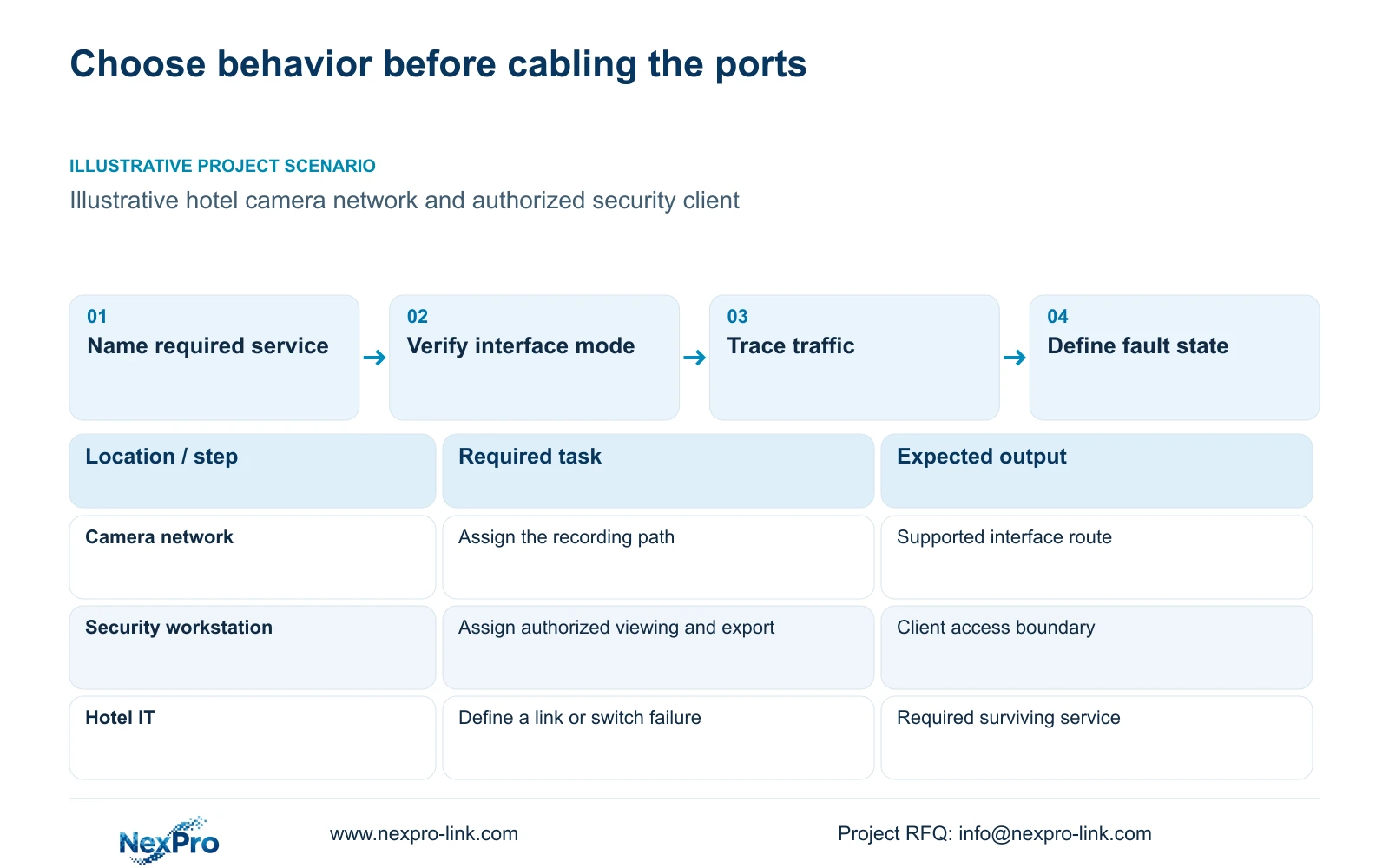
State the service in operational terms. Cameras must reach recording storage, authorized staff must retrieve the required footage, and any approved remote support must use a controlled path. Specify which of those services must remain available if a cable, switch or WAN connection becomes unavailable.
Create separate arrows for recording, viewing and export. The same video can cross different paths depending on whether the client receives it through the recorder or another supported route. Port assignments should follow that topology, with permissions and network access reviewed by hotel IT.
| Required task | Given information | Decision still needed |
|---|---|---|
| Keep camera traffic separated | Camera and authorized-client networks | Supported interface and routing mode |
| Maintain recording after a link fault | Two NVR ports proposed | Actual recovery behavior and surviving path |
| Permit limited remote support | Hotel IT controls access | Approved route and revocation responsibility |
Section 02
Verify the actual interface mode and version
NexPro-NVR4449-4K and NexPro-NVR8864-4K list dual gigabit interfaces. That physical specification does not establish independent routing, bonding, load sharing or automatic failover. Obtain the supported mode description for the exact proposed firmware and retain it with the equipment configuration.
If separate interfaces are proposed for camera and client networks, specify the address plan and permitted reachability. Do not assume that connecting both cables creates the intended segregation. If a combined or recovery mode is proposed, identify the required switch configuration and expected behavior under the relevant fault.
Translate the configuration into an operator outcome: recording remains available, the local client can search, or remote access is intentionally unavailable. Hotel security, IT and installation personnel need different responsibilities and permissions. A supplier can coordinate equipment requirements without taking unrestricted control of the hotel's network.
| Proposed behavior | Required evidence | Unresolved without it |
|---|---|---|
| Segregation | Supported addressing and routing arrangement | Which networks can reach each service |
| Failover | Supported mode and fault demonstration | Automatic recovery and recording continuity |
| Load sharing | Supported endpoint and switch arrangement | Usable traffic distribution |
| Two gigabit interfaces | Published physical field | No specific operating mode established |
Section 03
Calculate demand on the explicitly shared path
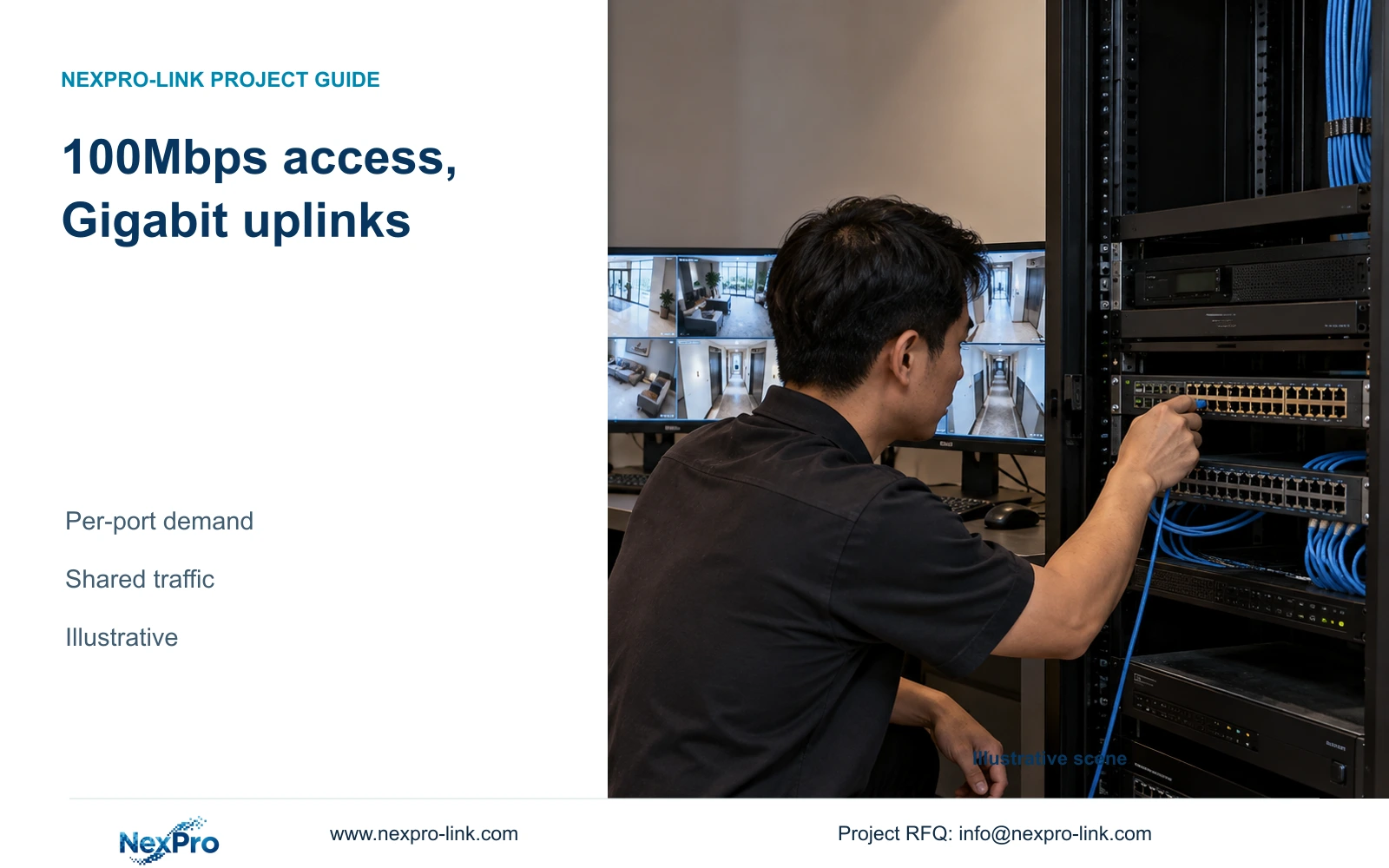
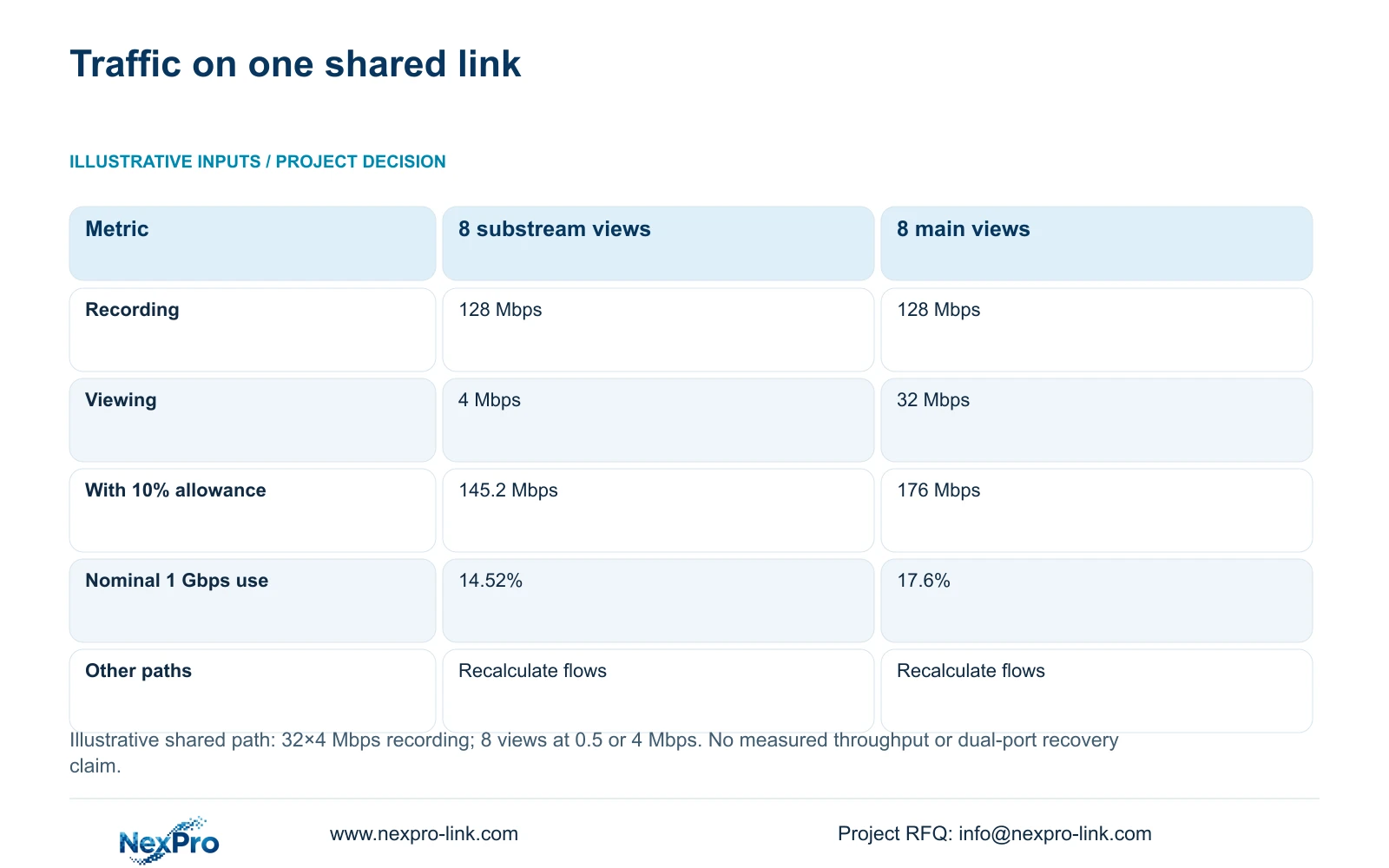
This topic's illustrative link carries 32 recording streams at 4 Mbps and eight simultaneous viewing streams. The recording component is 128 Mbps. At 0.5 Mbps per viewing stream, viewing adds 4 Mbps; at 4 Mbps each, it adds 32 Mbps. An illustrative 10% allowance gives (128+4)×1.10=145.2 Mbps or (128+32)×1.10=176 Mbps.
Against a nominal 1 Gbps link, those figures represent 14.52% and 17.6%. They do not establish measured throughput, supported NVR modes or switch performance. The calculation supplies no bandwidth reason by itself to promise a doubled link or select 10 Gbps.
The rates apply only where the named flows share the path. Inspect interface direction and the actual topology before using an aggregate figure for equipment sizing. Other segments need their own flow totals, and required exports or additional viewers must be added where they actually travel.
| Metric / condition | 8 substream views | 8 main-stream views |
|---|---|---|
| Recording traffic | 128 Mbps | 128 Mbps |
| Viewing traffic | 4 Mbps | 32 Mbps |
| Planned link traffic | 145.2 Mbps | 176 Mbps |
| 1 Gbps nominal utilization | 14.52% | 17.6% |
| Other links | Calculate their own flows | Do not copy this sum to every segment |
Section 04
Compare segregation and recovery as different designs
A segregation design assigns traffic and access boundaries. A recovery design preserves a required service after a defined failure. The hotel may need both, but each needs its own supported configuration. Two links carrying different traffic classes do not automatically substitute for one another when one disappears.
The 145.2 and 176 Mbps examples support a review of the stated shared-link load. They leave NVR ingestion, local decoding and disk retention as separate limits. NexPro-NVR4449-4K lists 320 Mbps input, but dual LAN does not establish that this internal recording limit doubles.
Compare the same recording and authorized viewing service across alternatives. If substream overview is sufficient, it can lower the viewing component without changing main recording. If the operator needs main-stream detail, keep that requirement and size its actual path. Do not reduce a required service merely to make a topology appear adequate.
Upgrade bandwidth when the approved concurrency or expansion demand justifies it on the limiting path. Select a recovery arrangement when the owner requires the service to survive a named fault and the equipment supports that behavior. A larger link alone does not provide an alternative path.
Section 05
Include the switches and protected power in the fault boundary
Two NVR cables terminating at one core switch retain that switch as a shared dependency. Separate switches can still depend on a common upstream path or power source. Draw the component removed in each failure scenario and mark the cameras and clients that retain a supported route.
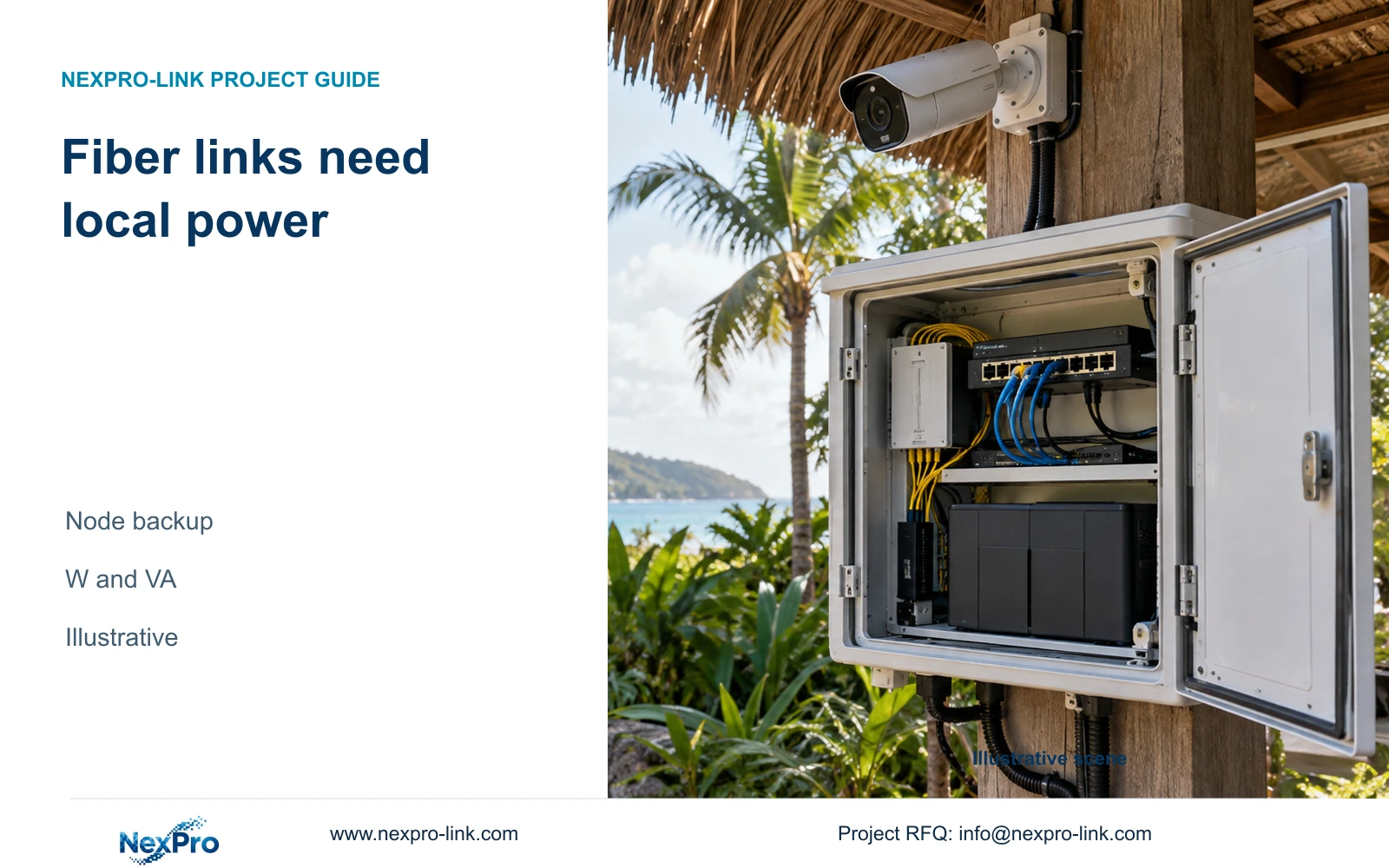
Data-path drawings and power drawings should remain distinct. A network path that survives cable failure can still stop when its essential access node loses power. Protect the required recorder, core and PoE nodes within their actual power zones. Fiber carries data and does not automatically supply a remote node.
NexPro SW-POE1618G is a 16-PoE-port, two-uplink candidate with af/at descriptions. Its title and detailed access-port speeds conflict, and its numeric total PoE budget is not stated. Do not use that candidate to assert that the complete path already satisfies throughput or peak power requirements.
CASE01 independently illustrates a protected 32-camera recording path. Its overall power budget does not prove this dual-LAN recovery design, and this article's shared-link traffic must not be copied to every case segment. Price additional switches, uplinks and protected power against the precise failure they address.
Section 06
Document the selected mode and its observed behavior
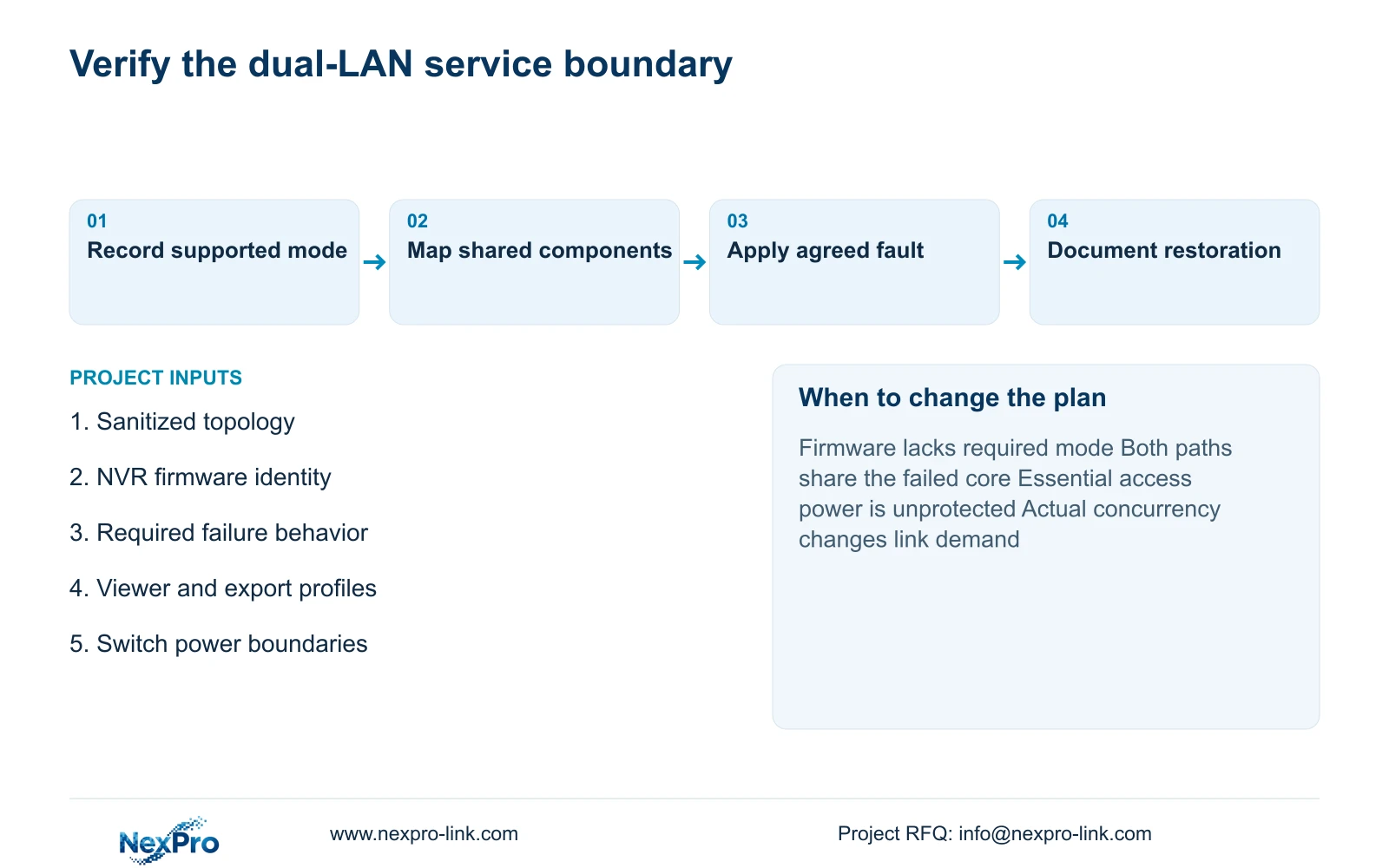
Record the NVR identity, firmware, interface mode and hotel-approved topology. Document switch identities, relevant port settings and the recording and viewing profiles used. Keep credentials outside public drawings and supplier-facing prose. These records let the responsible team repeat the intended checks after a configuration change.
Demonstrate normal recording and authorized retrieval, then apply the agreed fault under controlled project procedures. Inspect recording gaps and access behavior during failure and restoration. State observations for that tested configuration; no fault test has been performed by this article, and no recovery time is promised.
Recommend the simplest documented mode that meets the hotel task. Change the proposal if supported recovery is unavailable, a shared component defeats the requested resilience or actual traffic exceeds the selected path. Send a sanitized topology, required failure behavior, recorder firmware identity and concurrent viewing/export schedule to info@nexpro-link.com for hotel project or BOQ support.
Section 07
Buyer questions
Will two gigabit ports provide a 2 Gbps recording input? The listed port speeds do not establish that result. Verify the supported operating mode and traffic distribution, then keep the NVR's separate ingestion limit in the calculation. The cited recorder pages list 320 Mbps input.
Can the two cables connect to the same switch? That may be part of a supported arrangement, but it leaves the switch as a common dependency. If the requirement includes surviving that switch's failure, the proposal needs a different supported path and its associated power review.
What information can hotel IT share without exposing credentials? A sanitized topology, network-role labels, required reachability, recorder version and failure-state requirement are useful. Include concurrent viewer and export profiles. Initial design discussion does not require passwords or guest recordings.
Engineering references
These sources support the general planning principles. Always use the selected product's current datasheet and applicable project standards for final design.