100Mbps camera access can be sufficient when each port carries a qualifying workload and the uplinks handle aggregated traffic. Check the exact switch revision, PoE budget and concurrent viewing paths.
Section 01
Decide whether each camera needs faster access
Retain 100Mbps camera access where the actual traffic on each port fits its supported capacity with the project's chosen allowance, and use uplinks that accommodate the aggregated workload. Upgrade an individual port when its required peak traffic or another approved task exceeds that basis. Camera count across the hotel does not establish a need for Gigabit on every camera connection.
Start with the selected recording profile, then identify any additional streams that leave the camera simultaneously. The 4 Mbps recording rate used in this article is illustrative. It is not a constant associated with a resolution or codec. An average rate supports early budgeting, while final port selection needs the relevant configured limits or observed operating demand.
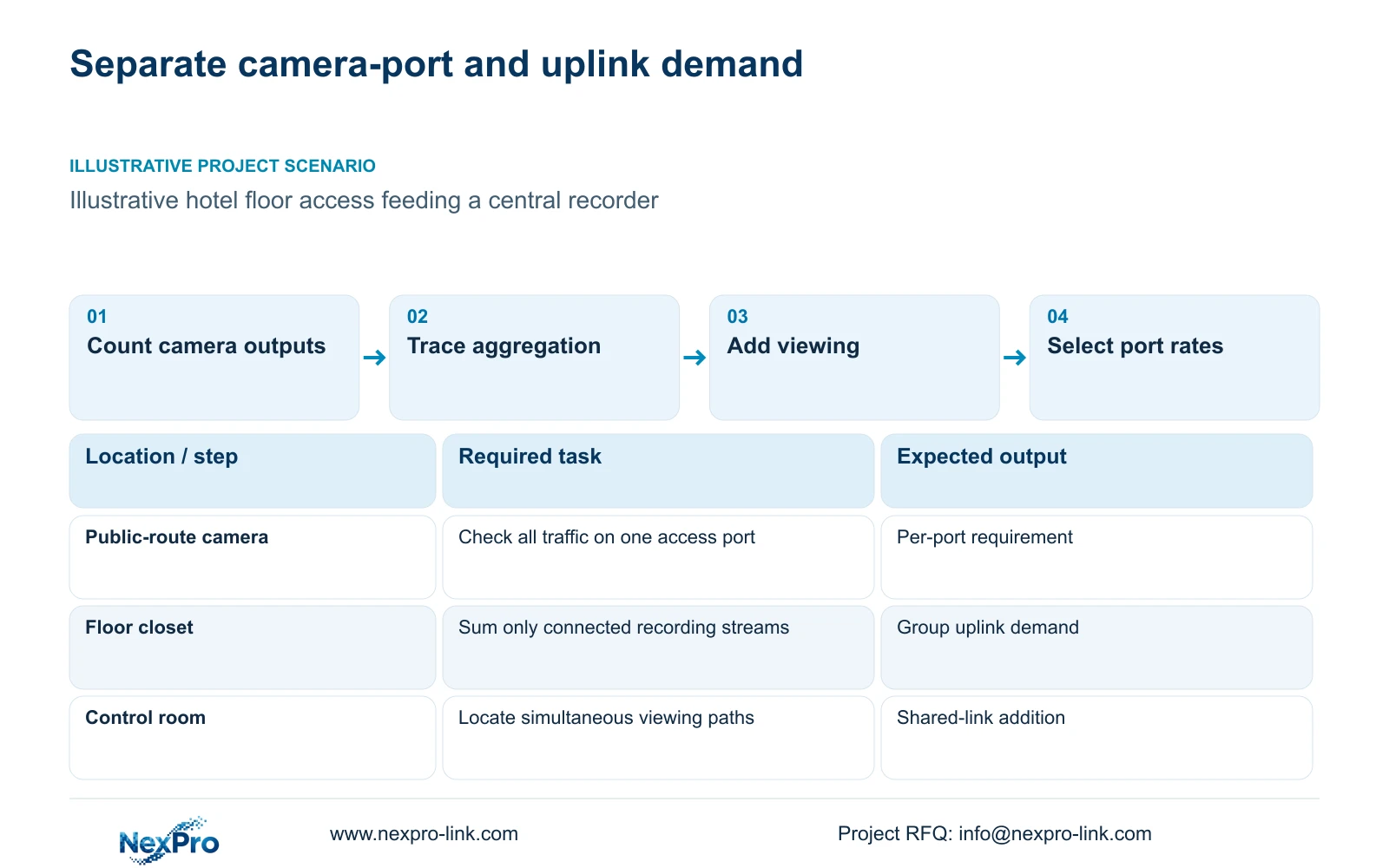
A camera port and an aggregation link carry different workloads. One camera's output passes through its access port; multiple camera streams may share the uplink. Keep these calculations separate so that a combined 32-camera demand is never assigned to every individual camera cable. Also check PoE capability independently, since adequate data capacity does not establish adequate power.
| Required task | Given information | Decision still needed |
|---|---|---|
| Record one camera | 4 Mbps average in this illustration | Peak and simultaneous output on its port |
| Carry aggregated recording | 32 streams total 128 Mbps | Which uplink carries which group |
| Support operator viewing | Eight viewing streams assumed | Stream profile and actual route |
Section 02
Trace where recording traffic accumulates
Draw a route from each camera to its recorder. Mark the access switch and every intervening link. Add a stream to a segment only when the proposed topology places it there. A floor uplink serving one camera group should receive that group's traffic, while a common recorder-facing link may receive several groups.
CASE01 provides a useful separate illustration: four groups of eight cameras, each at an assumed 4 Mbps, generate 32 Mbps recording traffic per access group. Its 10% teaching allowance gives 35.2 Mbps per recording-only group uplink. The central recording aggregate is 128 Mbps before viewing and export additions. Those case values are not a substitute for tracing the current hotel layout.
Viewing may come directly from cameras or through a recorder or platform. That choice changes which segments carry additional traffic. The deliberately shared link calculated below carries both all 32 recording streams and eight viewing streams. Do not copy its result to a floor uplink that carries fewer sources or to a path that the viewing streams never traverse.
Section 03
Compare access capacity with aggregation capacity
A nominal 100Mbps interface cannot accommodate the illustrated 128 Mbps recording aggregate. That observation concerns the shared aggregation path, not a single camera port. A nominal 1 Gbps uplink has a different capacity basis, but its suitability still depends on actual traffic, switch forwarding and the other services sharing it.
Keep nominal interface rate distinct from an equipment performance result. This article uses 1 Gbps as 1,000 Mbps when calculating nominal utilization. Its 10% allowance represents an explicit planning addition; it is not measured protocol overhead for every codec and network arrangement. Replace the assumptions when the project's actual profiles or operating policy differ.
NVR input bandwidth and client decoding remain separate checks. A faster uplink cannot increase an NVR's supported ingestion limit or make a workstation decode an unsupported layout. Likewise, the number of physical uplink sockets does not prove link aggregation, automatic failover or the effective capacity available to a particular connection.
Section 04
Include the viewing workload that shares the link
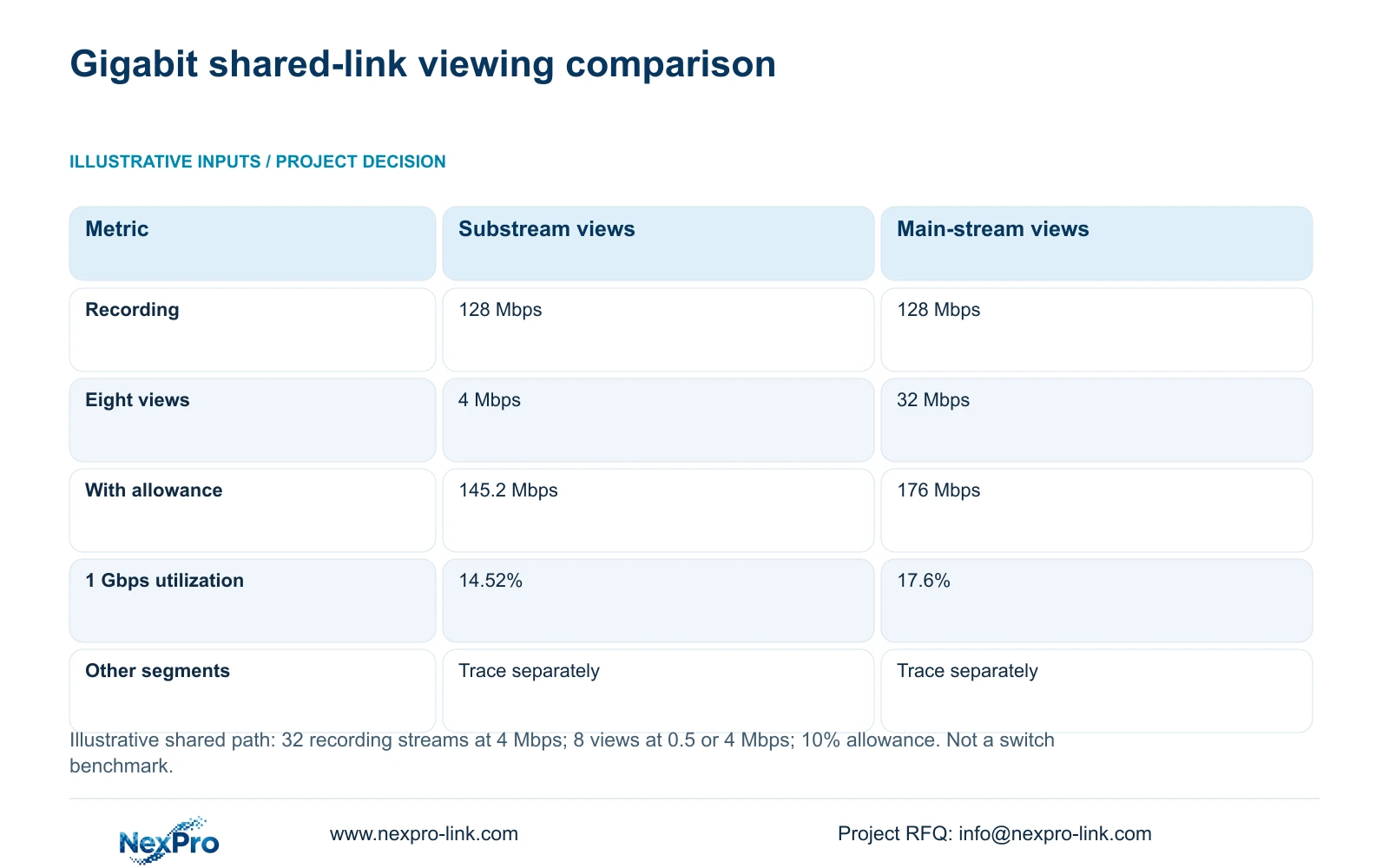
For this illustrative comparison, recording remains at 32 times 4 Mbps, or 128 Mbps. Eight substream views at 0.5 Mbps add 4 Mbps. Eight main-stream views at 4 Mbps add 32 Mbps. Planned demand equals the recording traffic plus simultaneous viewing traffic, multiplied by 1.10.
The two results are 145.2 Mbps and 176 Mbps on the explicitly shared path. Both are below the nominal 1,000 Mbps interface rate under these assumptions, so this calculation provides no reason to upgrade that link to 10 Gbps. It also provides no reason to change every camera access port to Gigabit.
Choose substreams for the routine grid only when they preserve the operator's required overview. Use the appropriate main stream for detail tasks. Retain the approved main recording profile regardless of the viewing choice. Additional viewers, replay sessions or exports require their own route and demand entries; the table does not silently include them.
| Metric / condition | Eight substream views | Eight main-stream views |
|---|---|---|
| Recording traffic (Mbps) | 128 | 128 |
| Viewing traffic (Mbps) | 4 | 32 |
| Planned link traffic (Mbps) | 145.2 | 176 |
| 1 Gbps nominal utilization | 14.52% | 17.6% |
| Other links | Calculate their own flows | Do not copy this sum to every segment |
Section 05
Resolve the exact switch port configuration
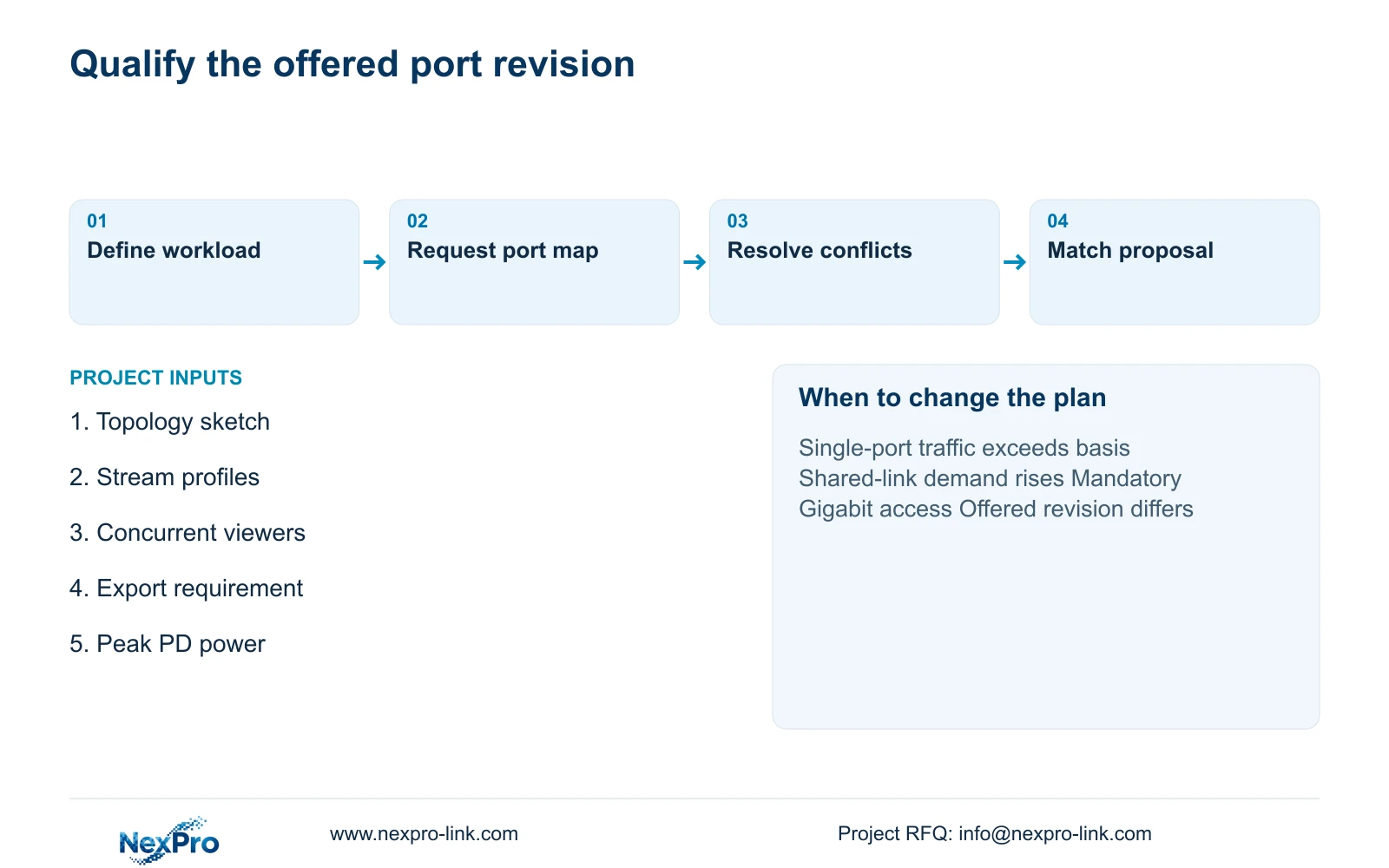
Request the port schedule for the exact offered hardware revision. It should distinguish access ports from uplinks and state each interface's rate. An order line containing only a family name or a Gigabit headline may leave the actual camera-facing interfaces unresolved.
The supplied record for NexPro SW-POE1618G lists 16 PoE access ports and two uplink ports, with af/at descriptions. Its title indicates Gigabit, while the detailed table describes 16 10/100M PoE ports with Gigabit uplinks. The total PoE output budget is also unstated. Preserve these differences in the inquiry and obtain a consistent configuration before treating the candidate as compliant.
Compare an access-port upgrade using the same recording and viewing service. Identify reusable cabling and equipment, replacement scope and any configuration work separately. SP5648 is a Cat6 48-port patch panel, not a cable reel or a throughput guarantee for the complete installed channel. A proposed equipment change should identify its actual network benefit and any cost or programme consequence.
Section 06
Select port rates for the agreed operating workload
Use 100Mbps camera access with Gigabit aggregation as a candidate arrangement when each camera port qualifies, the calculated aggregation paths fit and the operator's mandatory network requirements allow it. The present shared-link illustration supports that candidate at the bandwidth-planning level. It does not qualify an unspecified switch revision.
Change the proposal when individual camera demand requires faster access, shared traffic consumes the allowed uplink capacity or the hotel has a mandatory infrastructure standard. Evaluate a faster core link only where the affected segment needs it. Keep power reserve and access control in the equipment schedule even when the bandwidth figures look modest.
For a useful comparison, send info@nexpro-link.com a topology sketch, recording and viewing profiles, expected concurrent users and export requirements. Include the proposed port groups and peak device power inputs so network and PoE selections can be coordinated. NexPro-Link can support a scoped equipment and BOQ response; platform compatibility and local configuration responsibilities should remain explicit.
Section 07
Buyer questions
Will Gigabit camera ports improve recorded image detail? A faster port does not itself change the selected image profile. Its purchase value depends on whether the existing interface constrains the required streams. Keep image quality, camera output and port capacity as separate decisions.
Does the viewing allowance cover exports? No. The table includes recording and eight live views only. Add export demand on its actual route using the required concurrency and effective throughput, and account separately for recorder processing.
What should the quotation say about the switch revision? It should identify the offered revision, access-port rates, uplink configuration and usable PoE output. Any difference from the requested port schedule should appear as a stated deviation, not remain hidden behind the model name.
Engineering references
These sources support the general planning principles. Always use the selected product's current datasheet and applicable project standards for final design.