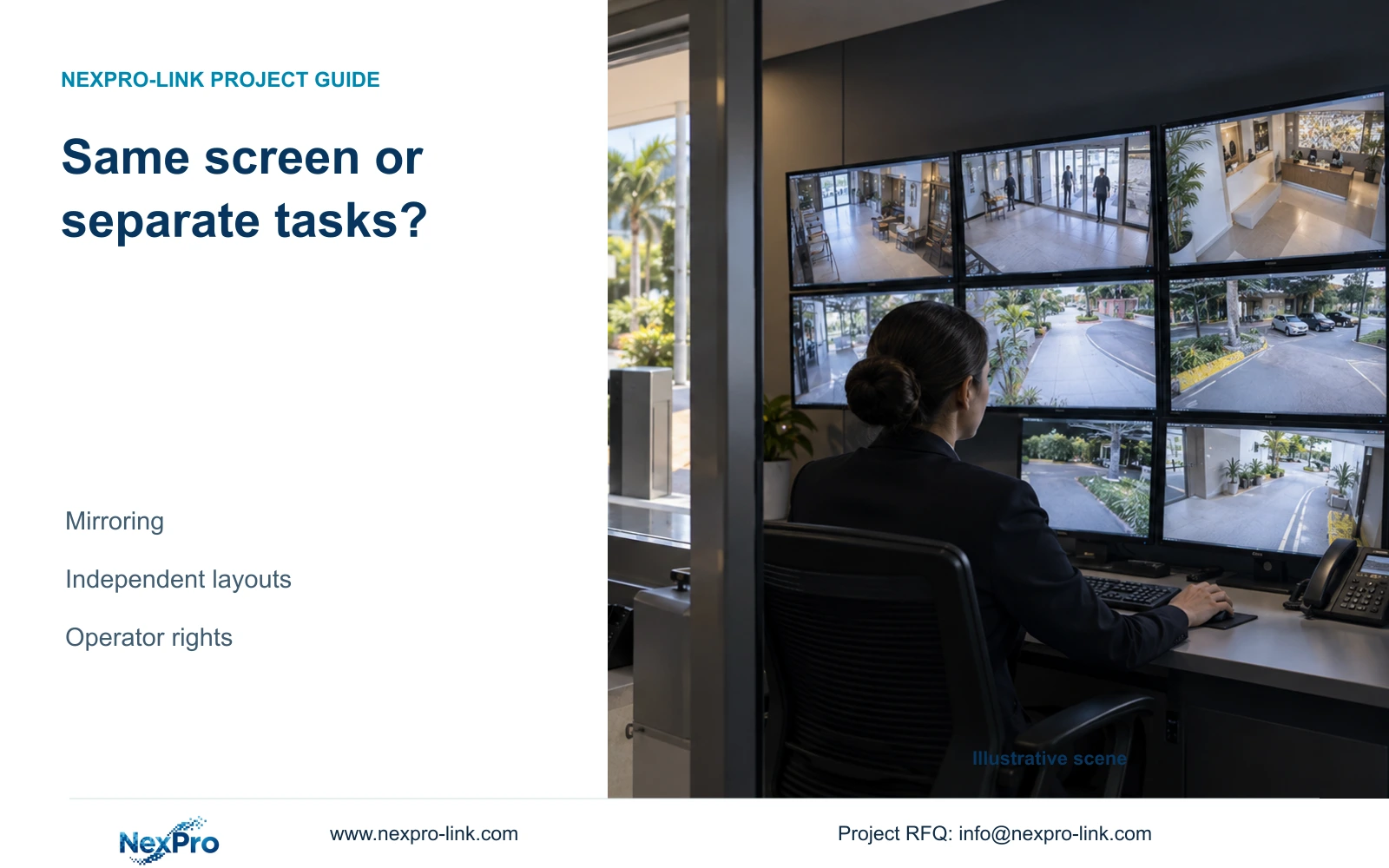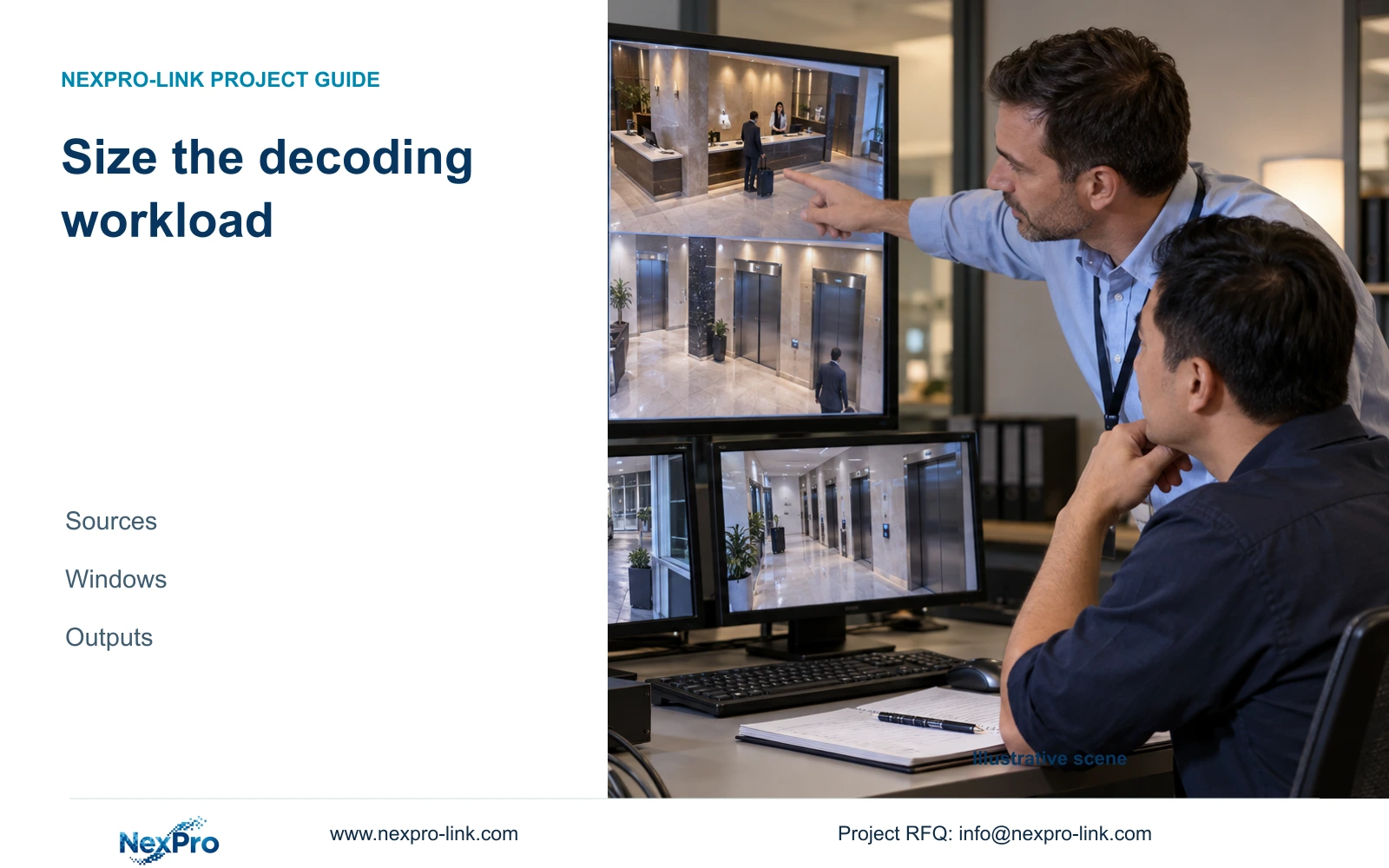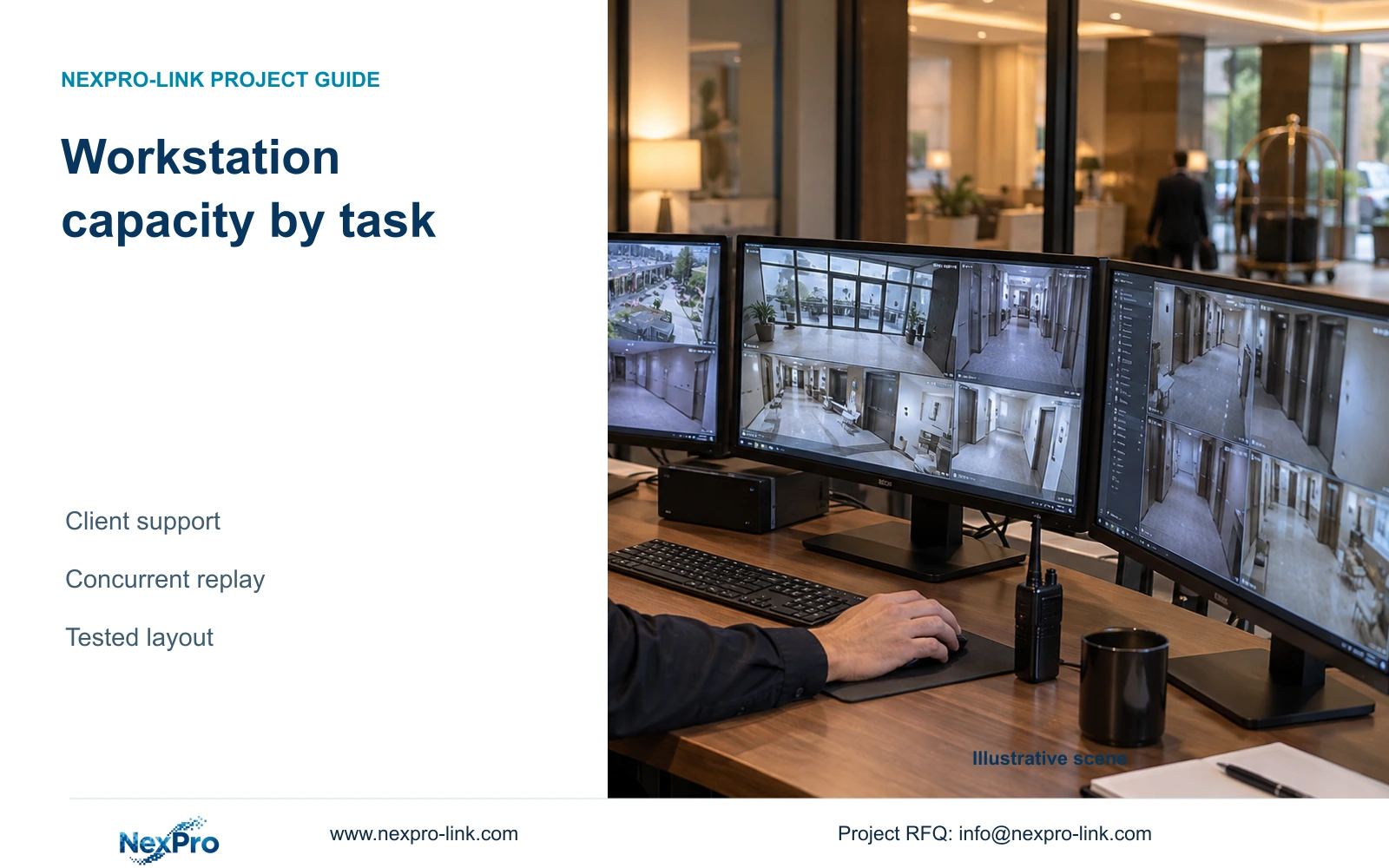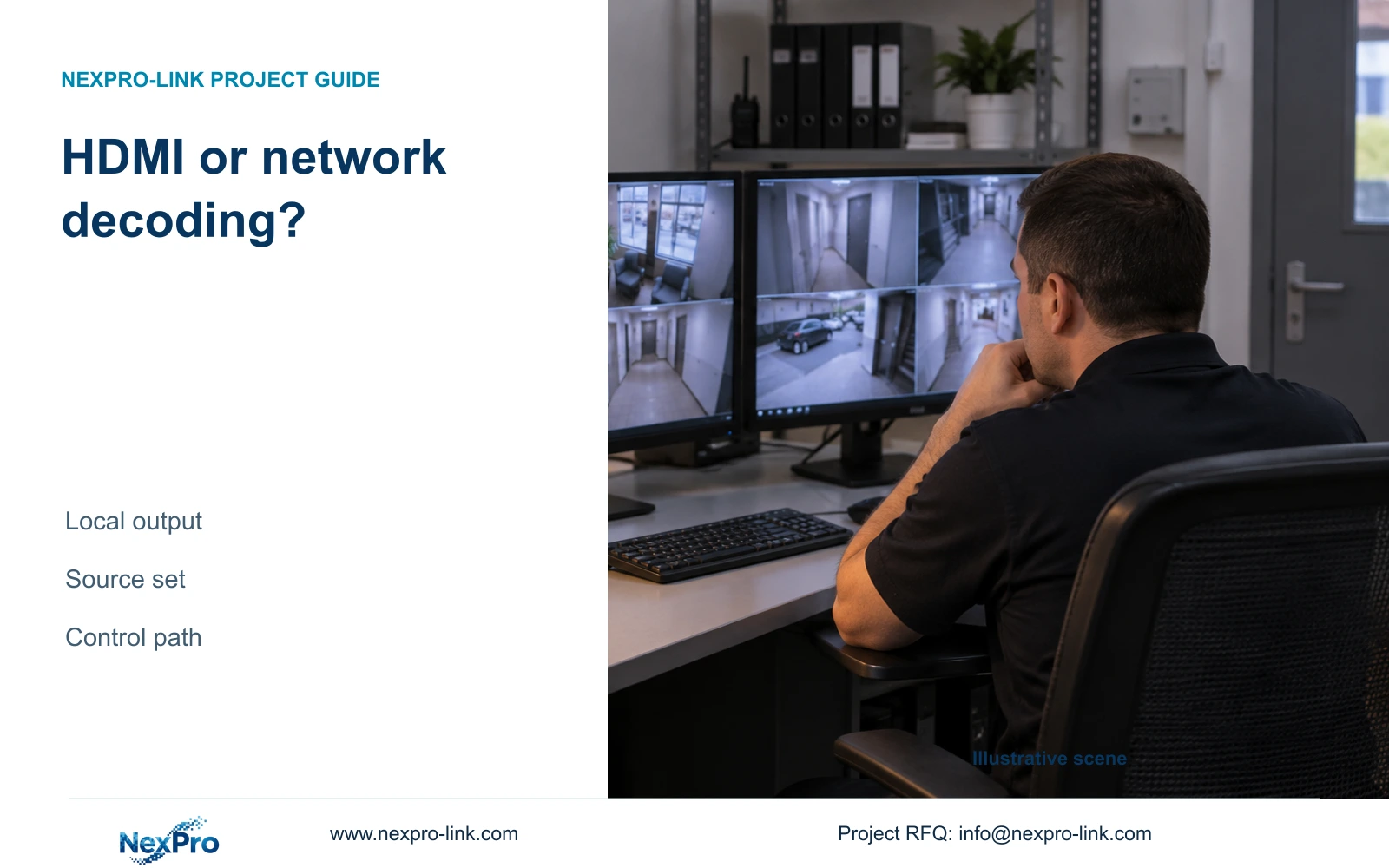
A small hotel security room may use the NVR's direct display output when the exact recorder supports its viewing and investigation tasks. A separate decoder needs a defined reason.
Section 01
Decide which sources the operator needs
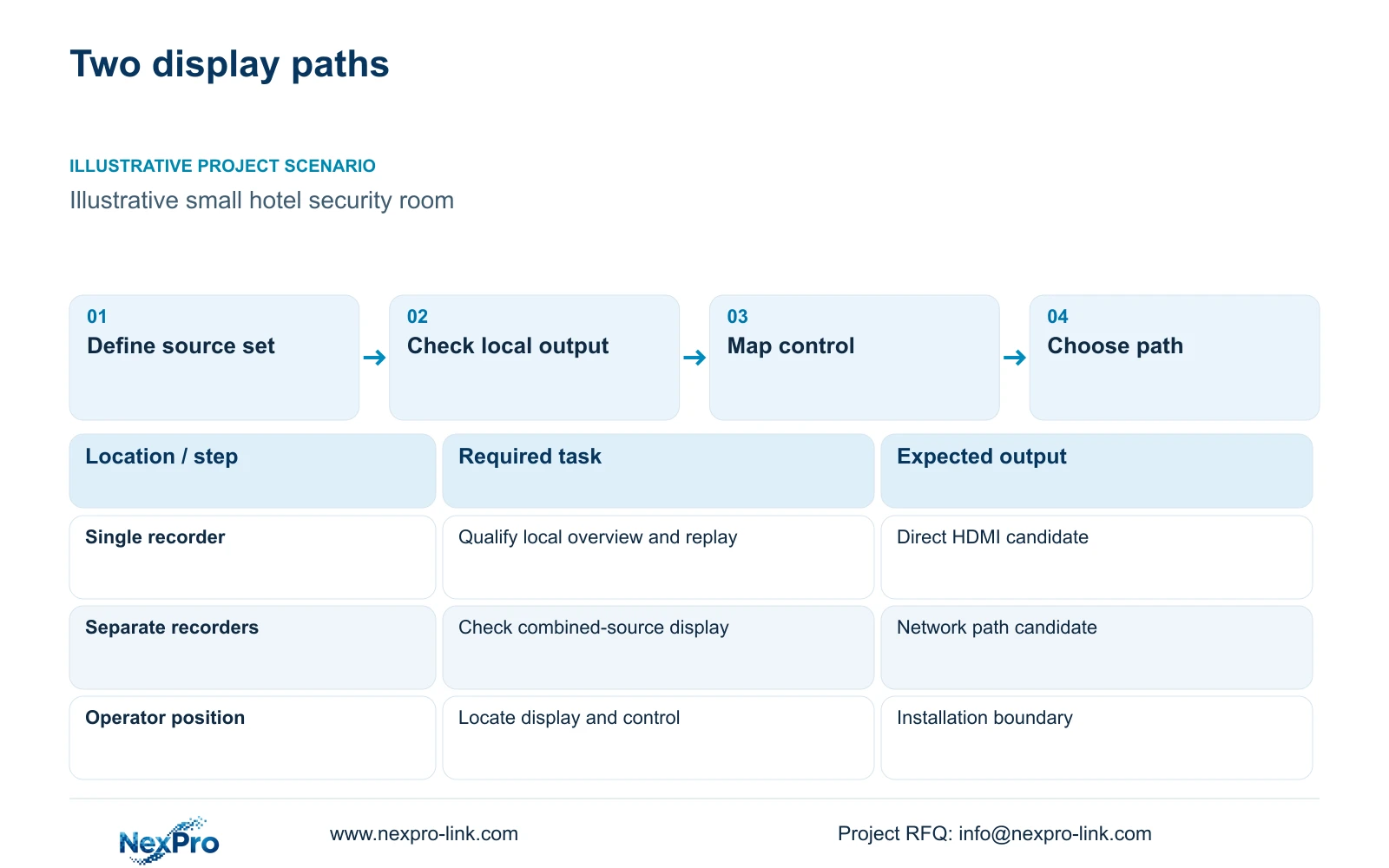
Use direct NVR HDMI as the first option for a small security room when the exact recorder supports the required source formats, operator layout and simultaneous investigation tasks. Compare network decoding when the display must combine separate sources, serve independent screens or support layouts beyond the recorder's qualified output functions. Room size alone does not determine the answer.
List the source set before selecting a display device. A single recorder holding the required entrance, reception and parking footage presents a different task from a display that must combine several recorders. Identify whether operators need live view, recorded playback or both at the same time, and whether an event view may replace the routine overview.
Keep recording, decoding and display duties visible in the schedule. The complete CASE01 reference uses 32 task-based camera positions and offers an ordinary operator display or an optional wall. Its camera count does not prove that every view must appear simultaneously. The following task questions establish the display scope without importing that case's storage or power totals.
| Required task | Given information | Decision still needed |
|---|---|---|
| Routine public-zone view | One local operator position | Required simultaneous views |
| Incident playback | Overview may remain active | Verified local-output concurrency |
| Combined source display | Separate source devices possible | Supported aggregation and control |
Section 02
Read the recorder's output functions separately
An HDMI connection describes part of the signal path. It does not state the recorder's local decoding limit, available layouts or behavior during playback. Obtain the exact output format and the supported source combination for the proposed firmware and configuration. Confirm how an authorized operator selects a camera and returns from playback to routine observation.
NexPro-NVR4449-4K has published fields for 49 channels and 320 Mbps incoming bandwidth. Its summary lists 49×5MP/9×4K, so the channel count cannot be read as permission for 49 arbitrary 8MP streams. Incoming bandwidth and local-display decoding answer different questions. A recorder can only be qualified for this display decision through the relevant output and operating-mode information.
NexPro-NVR2232-4K is listed with 32 channels and two SATA positions, but its source summary states 2×8TB while the detailed table states 2×18TB/36TB; playback fields also differ. Preserve those conflicts in the model response. Selecting the more favorable storage figure would not resolve its local-display capability.
| Item | Direct NVR HDMI | Network decoder | Effect on the hotel task |
|---|---|---|---|
| Image processing | Recorder's verified local mode | Decoder's verified source mode | Different capacity boundary |
| Control | Supported recorder workflow | Supported client/controller workflow | Operator method must be defined |
| Sources | Approved recorder source set | Qualified network source set | Aggregation needs explicit support |
Section 03
Map the direct HDMI route
Draw the direct route from camera recording to the recorder's local decoding and HDMI output, then to the selected monitor. Show the operator-control method separately. Record the actual installation route and any additional signal equipment proposed; the supplied evidence contains no universal HDMI cable-distance allowance.
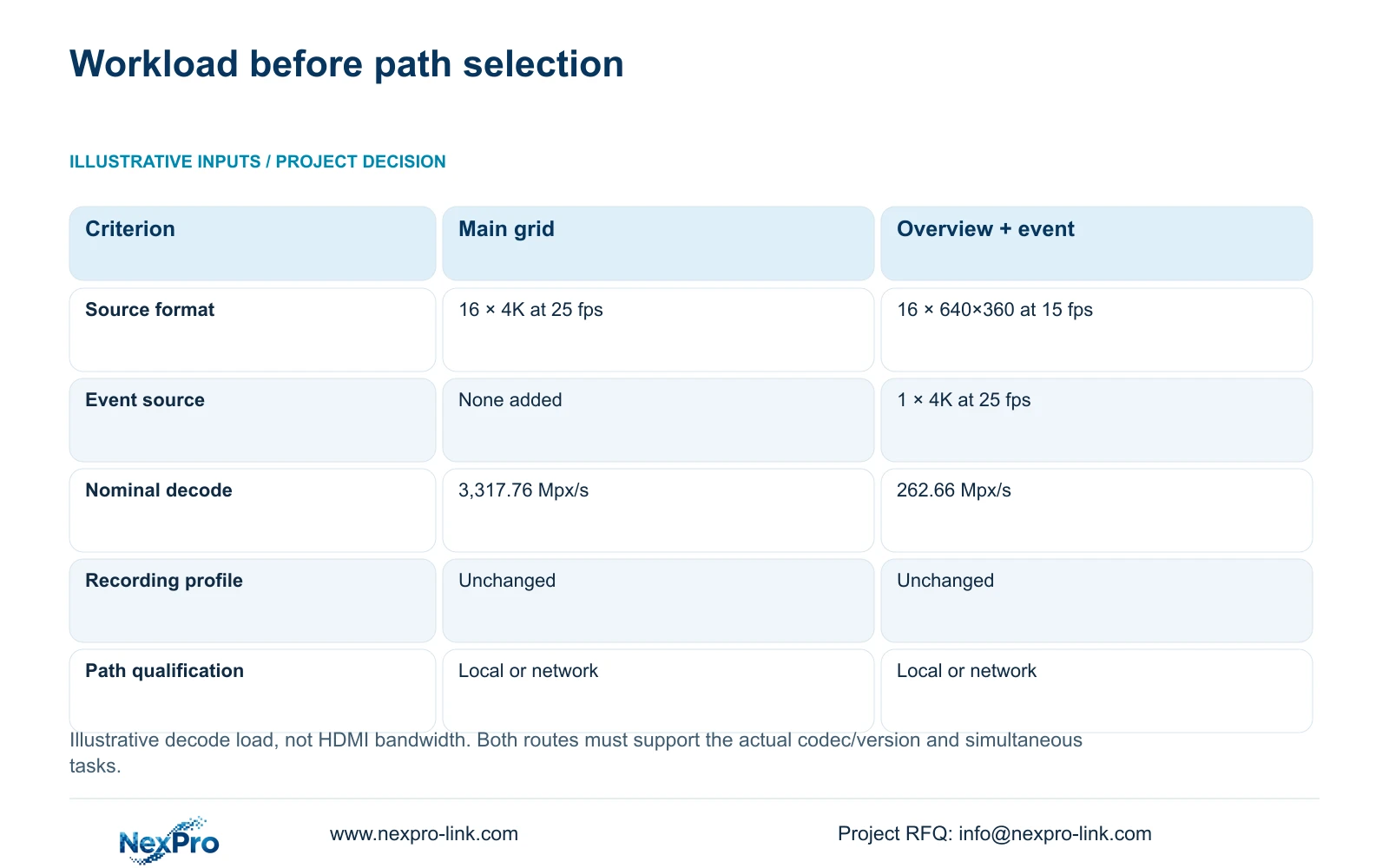
Use the same workload definition for both display paths. In the independent illustrative example, sixteen main streams at 3840×2160 and 25 fps demand 3,317.76 Mpx/s of nominal decoding. Sixteen 640×360 overview streams at 15 fps plus one 3840×2160 event stream at 25 fps demand 262.66 Mpx/s. The calculation is Σ(width × height × fps × concurrent streams), divided by 1,000,000.
These values describe source processing, not HDMI bandwidth or a guaranteed recorder capability. They justify checking whether the lighter overview layout lets the local output meet the operating requirement. The recording profiles remain unchanged. If the recorder cannot support the required simultaneous playback and live views, the simpler route has failed qualification even when the screen receives an image.
| Metric / condition | Option A | Option B |
|---|---|---|
| Viewing workload | 16 main streams for grid | 16 substreams for grid + 1 main event |
| Planning pixel load (Mpx/s) | 3,317.76 | 262.66 |
| Main recording | Unaffected by viewing choice | Unaffected by viewing choice |
| Hardware performance test | Required for actual codec/version | Required for actual codec/version |
Section 04
Compare a qualified network-decoding route
A network-decoding proposal receives selected sources over the approved data path and sends its composed image to the displays. Define where source selection and layout control occur. Record which links carry the viewing traffic; adding a decoder does not justify counting the same streams on every network segment.
NX-VD-4K16 is a modular network-decoder candidate with a 5U chassis description. Its name does not establish sixteen simultaneous 4K decodes. Request the source formats, concurrency, physical outputs and control arrangement for the actual configuration. ONVIF support also needs function-level checking for playback, audio and events.
Display choice remains independent. NX-VP-5535 is a 55-inch Full HD LCD panel, not direct-view LED. Four panels have a theoretical 3840×2160 canvas when appropriately addressed, while a single 4K monitor has the same nominal pixel count with a different physical layout. A wall's seams and operator viewing distance can affect the usefulness of event enlargement without changing the stored recording.
Section 05
Include operator control and maintenance scope
Compare the complete operating scope: display connections, control software, any required licenses, configuration and local maintenance. A decoder quotation that excludes the device used to select sources is incomplete for the operator task. Equally, a direct-output option needs a workable control position and a clear method for authorized investigation.
Define failure behavior. A display outage and a recording outage are different incidents; the hotel should know how recording continues when optional display equipment is unavailable. If viewing must remain available during a power interruption, include the selected display route and its required network nodes in the actual protection boundary.
The scoped public policy gives applicable main equipment a 24-month limited hardware baseline from receipt, subject to controlling written order terms. Batteries, storage and other categories require their own scope. Remote technical support does not establish free local labor, travel or replacement transport. These boundaries belong in the path comparison when an extra device adds service responsibility.
| Retained outcome | Extra scope | Worth buying when | Counter-condition |
|---|---|---|---|
| Required live and replay layout | Separate decoding/control | Local output cannot meet concurrency | Local mode already qualifies |
| Independent display layouts | Outputs and control resources | Different operators need different views | One shared layout is sufficient |
Section 06
Choose the simpler path after qualification
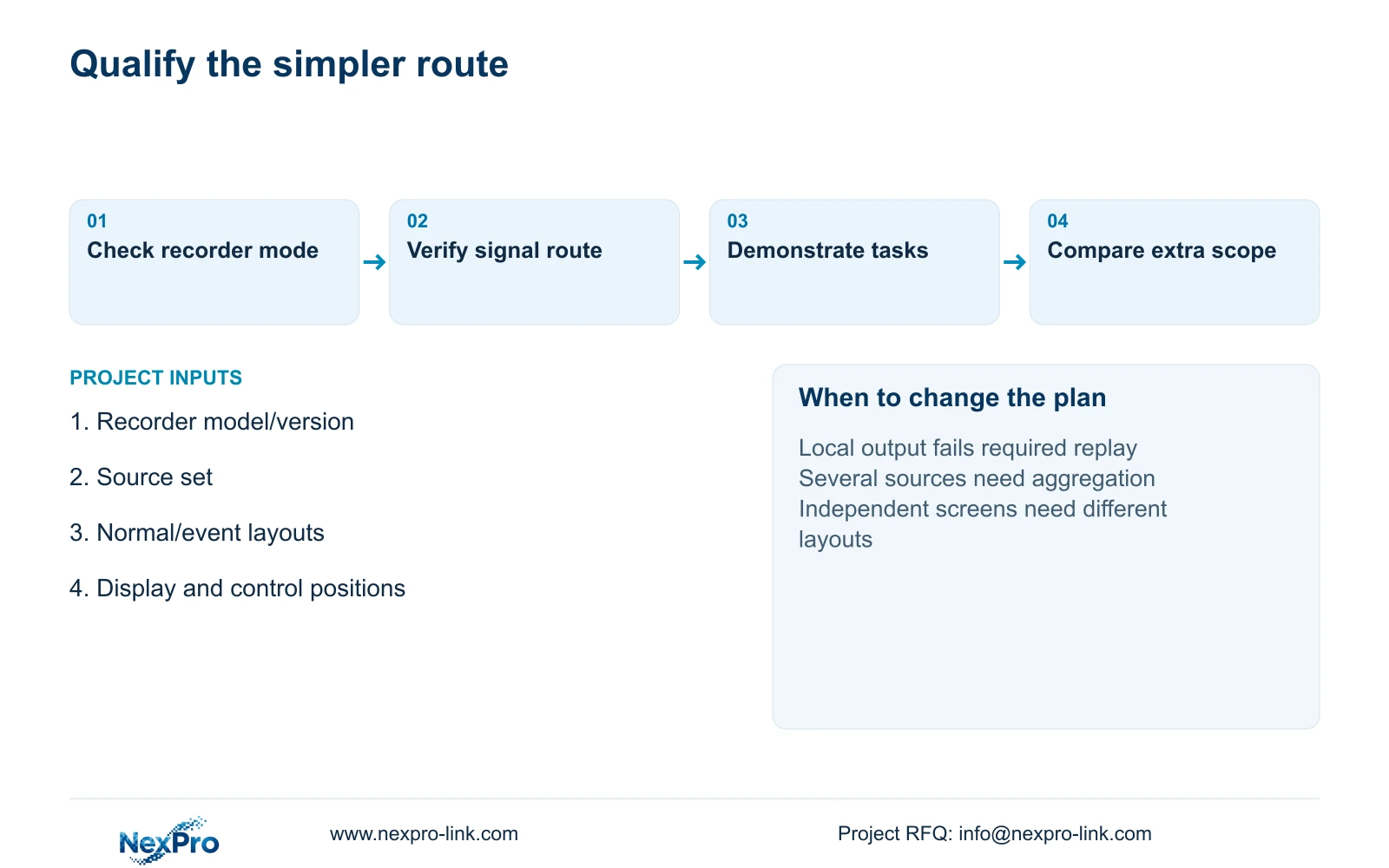
Recommend direct NVR HDMI when the selected recorder demonstrably supports the source set, screen format and operator tasks at the installed position. Change to a qualified network-decoding arrangement if cross-source aggregation, independent displays or event-time concurrency exceed that capability. A mandatory hotel platform may also determine the control path.
The comparison should retain the same recording policy and required investigation outcome. Demonstrate live overview, event enlargement, playback and export in the agreed simultaneous states. A clear still image or a connected HDMI port does not establish that the operator can complete the full sequence.
Send info@nexpro-link.com the recorder model and version, normal/event screen layouts, display positions and simultaneous playback needs. Include the destination and any mandatory platform requirement. NexPro-Link's hotel project support at /project-supply/hotel-security and BOQ support at /project-supply/boq-tender-support can help define model and supply boundaries without assuming that every interface or local installation service is included.
Section 07
Buyer questions
Does adding a decoder improve the recorded image? The display-path change alone does not improve the camera's recorded detail. Preserve the approved main recording profile and assess whether the new route improves the required viewing or investigation task.
Can the local HDMI display show sources from several recorders? Do not assume it. Identify the exact source set and request the selected recorder's supported aggregation functions. If unsupported, compare a qualified client or network-decoder arrangement.
Can we request a comparison without selecting the wall first? Yes. Provide the operator positions and candidate canvases as separate options. The proposal can identify how each changes outputs, control, decoding and installation scope.
Engineering references
These sources support the general planning principles. Always use the selected product's current datasheet and applicable project standards for final design.