Publish an expansion envelope containing accepted stream groups, retention, exact recorder modes and local power allocations. Mark which proposed additions fit and which trigger a specific remedy.
Section 01
Define the future views against a dated baseline
Publish an expansion envelope containing accepted stream groups, retention, exact recorder modes and local power allocations. Mark which proposed additions fit and which trigger a specific remedy. Recheck the envelope when settings change. Available channel count is only one entry; it cannot serve as a blanket approval for a later camera package.
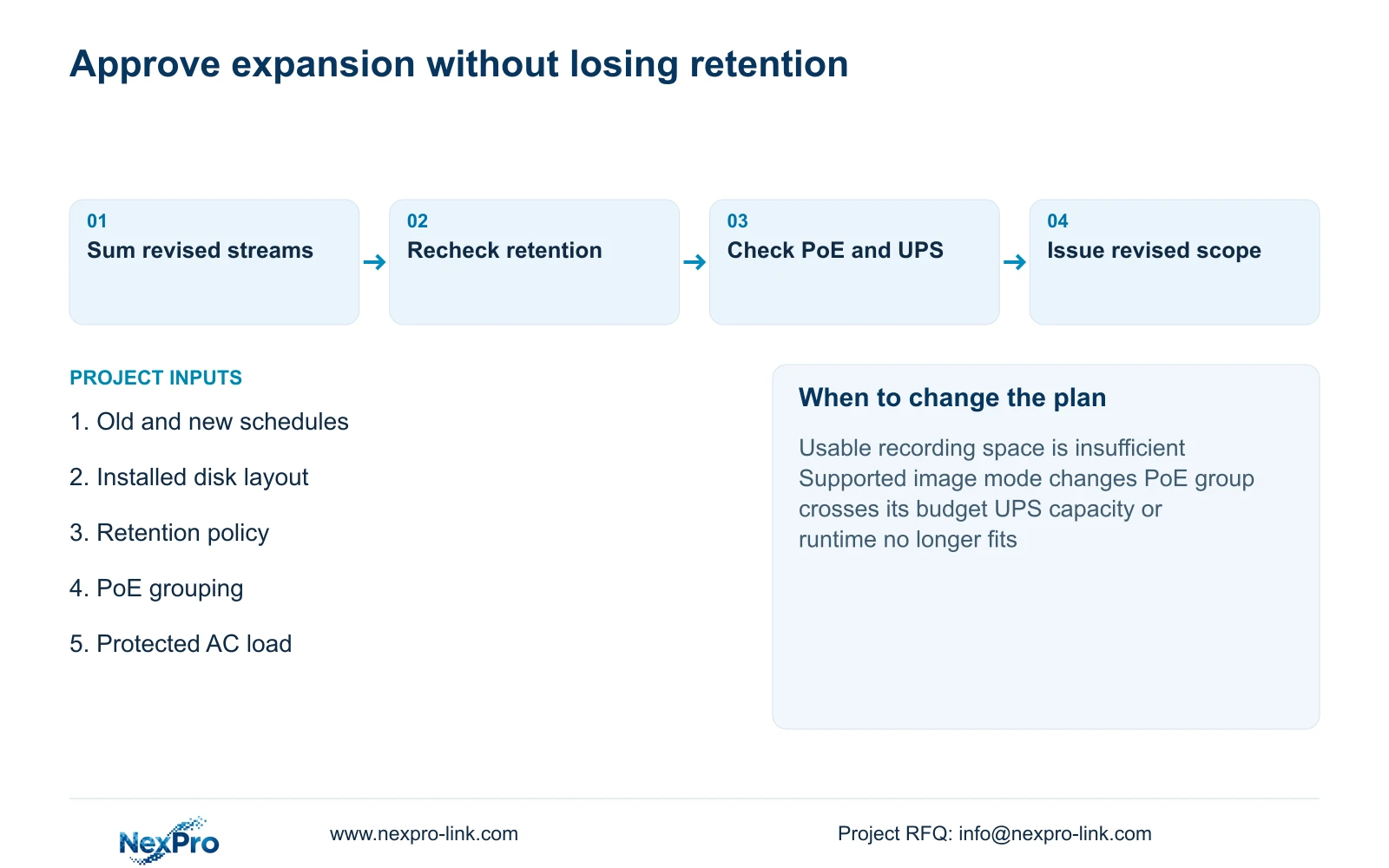
Approve hotel NVR expansion only after the revised schedule fits supported channels, incoming bitrate, usable storage and the affected PoE and UPS boundaries. Retain existing equipment when those checks preserve the required service. Add disks, change the recorder or revise the architecture when a specific limit is crossed; unused channels alone cannot establish expansion capacity.
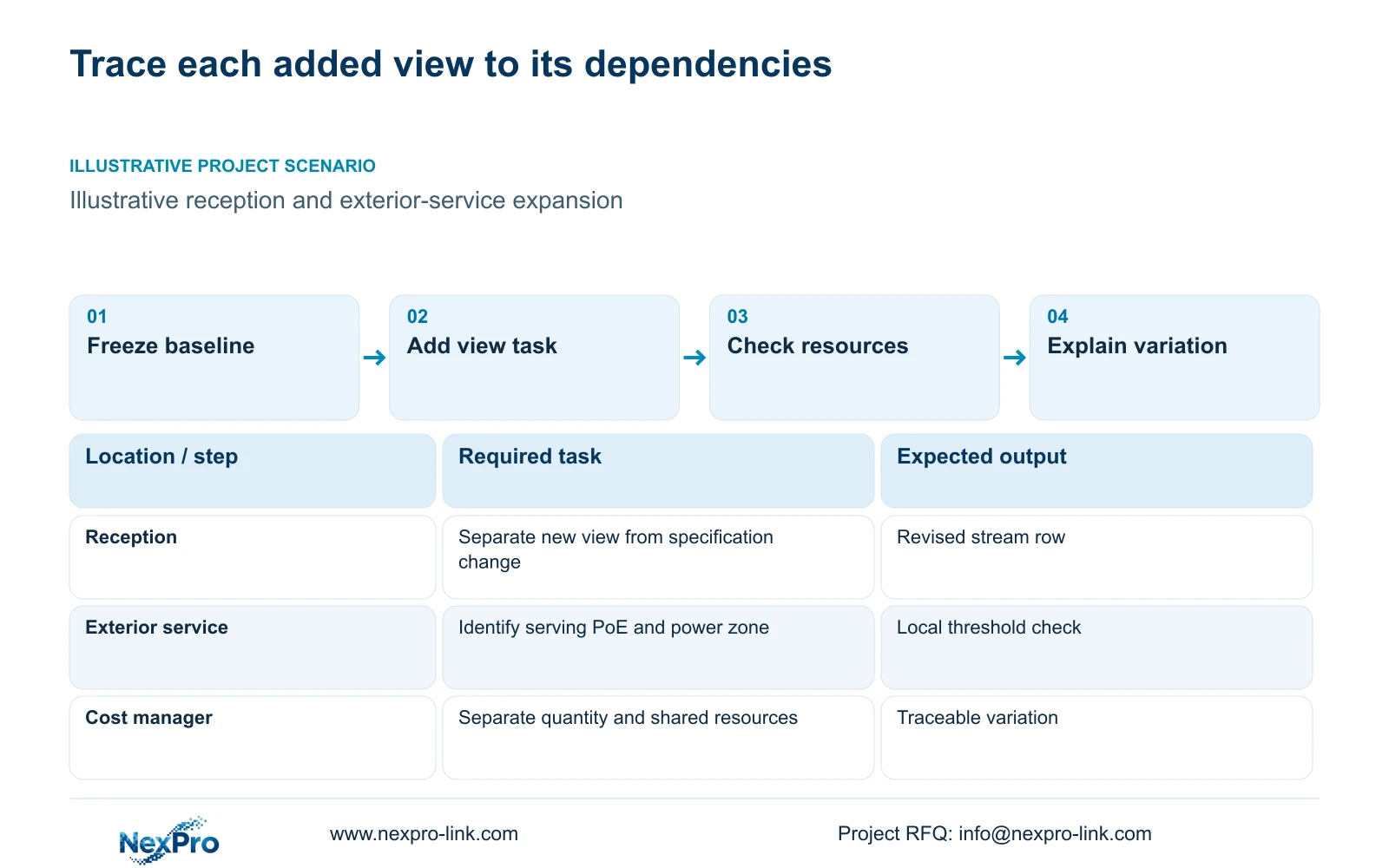
Keep a dated baseline showing installed cameras, recording profiles, disk arrangement and the quoted supply scope. Identify future public-area tasks separately from confirmed work. A proposed reception view or exterior-service position needs its own observation purpose, route and recording requirement before it becomes a priced addition.
Separate added quantities from changed specifications and newly identified accessories. If the revised design changes both camera count and unit specification, the cost manager needs both effects visible. This also prevents an existing disk or service already included in a package from being charged again as an expansion item.
| Required task | Given information | Decision still needed |
|---|---|---|
| New reception detail view | Existing camera baseline | Additional position or revised framing |
| Exterior-service extension | Proposed route | Stream profile and serving PoE node |
| Maintain approved retention | Existing disk arrangement | Revised usable-space requirement |
Section 02
Calculate additions and changed stream profiles separately
For each recorder, revised input equals retained streams at their revised rates plus the new assigned streams. Show the increase caused by extra cameras separately from any rate change to existing cameras. A megapixel upgrade does not supply a reliable fixed bitrate increment, so preserve the actual codec, frame rate and recording settings in the comparison.
The same allocation is needed for operator work. New cameras may add investigation windows or another recording location even when ingestion remains within its limit. Check the intended concurrent replay task instead of assuming that recording headroom provides decoding headroom.
Expansion costs can jump when a new position requires another supported recorder, switch group or protected-power zone. Keep those shared resources outside the ordinary camera unit rate unless the commercial scope expressly includes them. A four-camera addition therefore needs a dependency review before the buyer treats it as four identical unit-rate extensions.
Section 03
Recalculate retention using the revised video payload
Calculate each recording group using cameras×average Mbps×10^6×hours per day×3600×days÷8÷10^12 for decimal TB, then add the group results. Keep different rates or recording hours separate until that final sum. If the usable-space reserve is 20%, divide the payload by 0.80 to obtain required usable capacity.
An unchanged disk layout has a fixed recording budget after its applicable formatting, array and reserve allowances. Additional video consumes that budget faster. Preserve the approved retention target and compare it with the revised demand before deciding whether hardware can remain.
CASE01 independently illustrates 32 cameras at 4 Mbps, continuous recording for 30 days, producing 41.472 TB of video and 51.84 TB required usable capacity. Those are baseline teaching values, not a finished 36-camera expansion design. Its disk and power totals cannot be carried forward without recalculation. Retention periods are project policy inputs, not universal hotel legal requirements.
Section 04
Expose storage and power thresholds in the variation
Review the supported drive capacity and bay count, then the actual PoE group receiving each camera. Per-port capability and total PSE output budget must both remain sufficient under the relevant peak state. For UPS sizing, use one consistent AC boundary. A complete PoE-switch input already includes its downstream camera contribution.
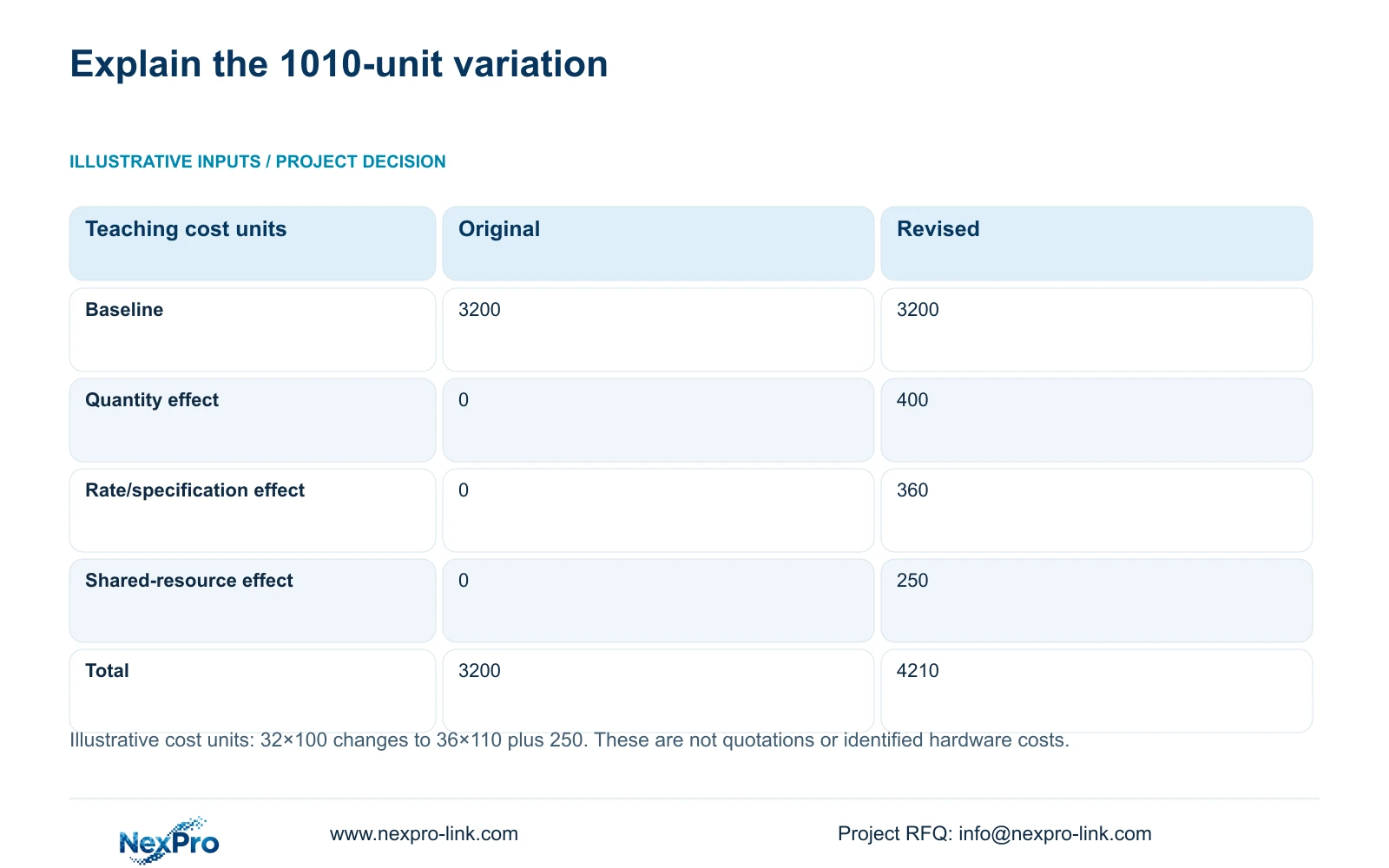
The following commercial bridge uses teaching cost units only. Original quantity is 32 at 100 units each. Revised quantity is 36 at 110 units each, with a separate shared-resource item of 250 units. Original cost is 32×100=3200; quantity effect is (36−32)×100=400; specification effect is 36×(110−100)=360.
Adding the shared item gives 3200+400+360+250=4210. The increase is 1010 units. This makes the reason for the variation inspectable, but the 250-unit item does not identify a real disk, UPS or switch. Technical threshold checks determine the actual item, and a scope-matched quotation determines its price.
| Metric / condition | Original: 32 at 100 | Revised: 36 at 110 |
|---|---|---|
| Original total | 3200 | 3200 |
| Quantity effect | 0 | 400 |
| Rate/specification effect | 0 | 360 |
| Shared-resource change | 0 | 250 |
| Final teaching total | 3200 | 4210 |
Section 05
Compare disk expansion with recorder replacement
A disk-only upgrade is appropriate when the recorder supports the revised streams and operating workload, and its supported storage arrangement can meet retention. Recorder replacement becomes relevant when ingestion, image combinations, bays or replay resources are insufficient. A separate recorder can serve a new group, but adds another search and maintenance boundary.
NexPro-NVR4449-4K lists four SATA bays, up to 18 TB per disk and 320 Mbps input. NexPro-NVR8864-4K lists eight bays and the same input figure. The larger bay count may address storage, while the unchanged listed input ceiling requires its own review. Neither channel headline proves every proposed 8MP recording combination or a particular RAID level.
Avoid basing reuse on favorable conflicting fields. NexPro-NVR2232-4K has 2×8 TB and 2×18 TB capacity information in different parts of its source page, with playback differences too. NexPro SW-POE1618G has conflicting access-speed descriptions and no stated numeric total PoE budget. Both require a clear proposal response before they can be declared adequate.
Compare migration work, reusable components, canceled items and remaining installation tasks alongside equipment cost. Preserving important footage requires a supported export and verification plan; an old disk should not be assumed readable in a replacement recorder. A lower incomplete equipment total can conceal a more expensive change.
Section 06
Record the expansion envelope in the approved scope
Define reserved expansion as a bounded schedule: intended future views, provisional stream rates, retention, serving network nodes and protected-power conditions. Distinguish a priced installed resource from an allowance for later work. Reserved channels without reserved storage or power describe only part of the future system.
Recommend reuse when the revised supported configuration preserves the approved recording and investigation tasks. Change that recommendation if measured bitrate, added night load, a different retention policy or a mandatory platform invalidates the assumptions. Lowering recorded detail to make the arithmetic fit requires confirmation that the observation task still succeeds.
Send the old and revised camera schedules, installed recorder and disk configuration, affected PoE grouping and required retention to info@nexpro-link.com. NexPro-Link can prepare model-matching and BOQ comparison inputs through its existing project support routes. Only the agreed revision should control procurement; a teaching calculation does not authorize an order change.
| Situation | Required record | Decision boundary |
|---|---|---|
| Addition fits current configuration | Exact stream groups, modes and local allocation | Record the unchanged growth envelope |
| One resource fails | Limiting resource and supported remedy | Hold that addition, not all existing service |
| Recording settings change | New rate/retention/mode basis | Reissue the envelope before approving more views |
Section 07
Buyer questions
Can we preserve retention by lowering the bitrate? Only if the revised recordings still retain the detail and motion needed for the hotel task. Compare relevant recorded scenes before approving that change. Do not apply an assumed intelligent-codec saving percentage as a guaranteed storage reduction.
Should we buy a larger recorder now for future cameras? Buy the resource that the defined expansion requires. Extra bays may be useful for retention, while extra channels alone may leave bandwidth or power unchanged. An undefined future camera count does not justify every upgrade.
Which records make an expansion quotation useful? Provide the baseline and revised schedules, disk layout and retention requirement, plus the serving PoE nodes. Identify reusable equipment and whether installation or migration is included. There is no need to send guest footage or passwords with the first inquiry.
Engineering references
These sources support the general planning principles. Always use the selected product's current datasheet and applicable project standards for final design.