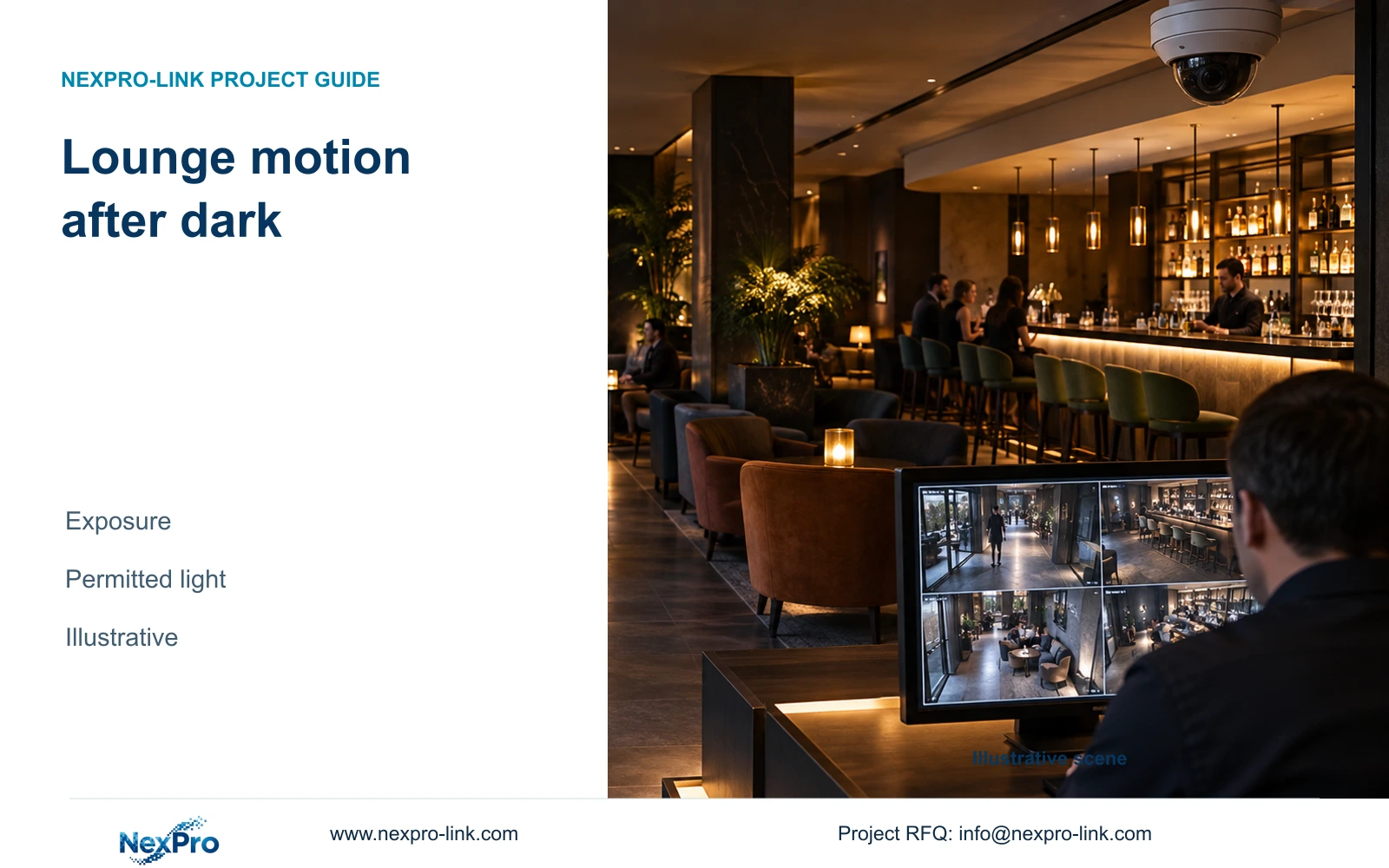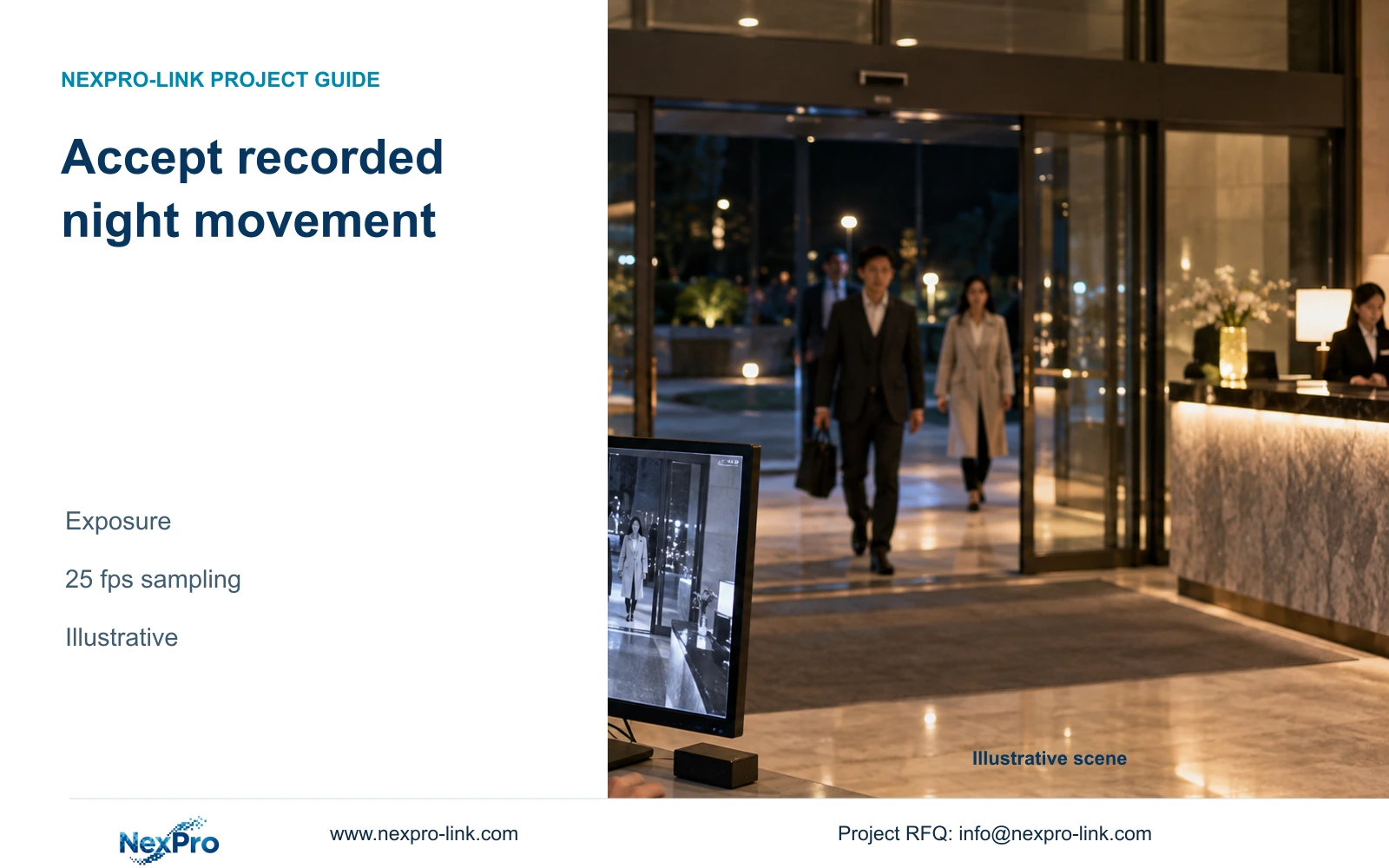
A clear night screenshot can hide movement blur. Define the target route and review recorded clips under matched lighting before accepting camera settings.
Section 01
Choose the movement the recording must preserve
Accept a night camera profile only after recorded movement preserves the hotel's agreed action and detail at the required observation point. If a shorter exposure improves movement detail but leaves the scene too dark or noisy, change the lighting, position or supported camera configuration and repeat the comparison. A static screenshot cannot resolve that trade-off.
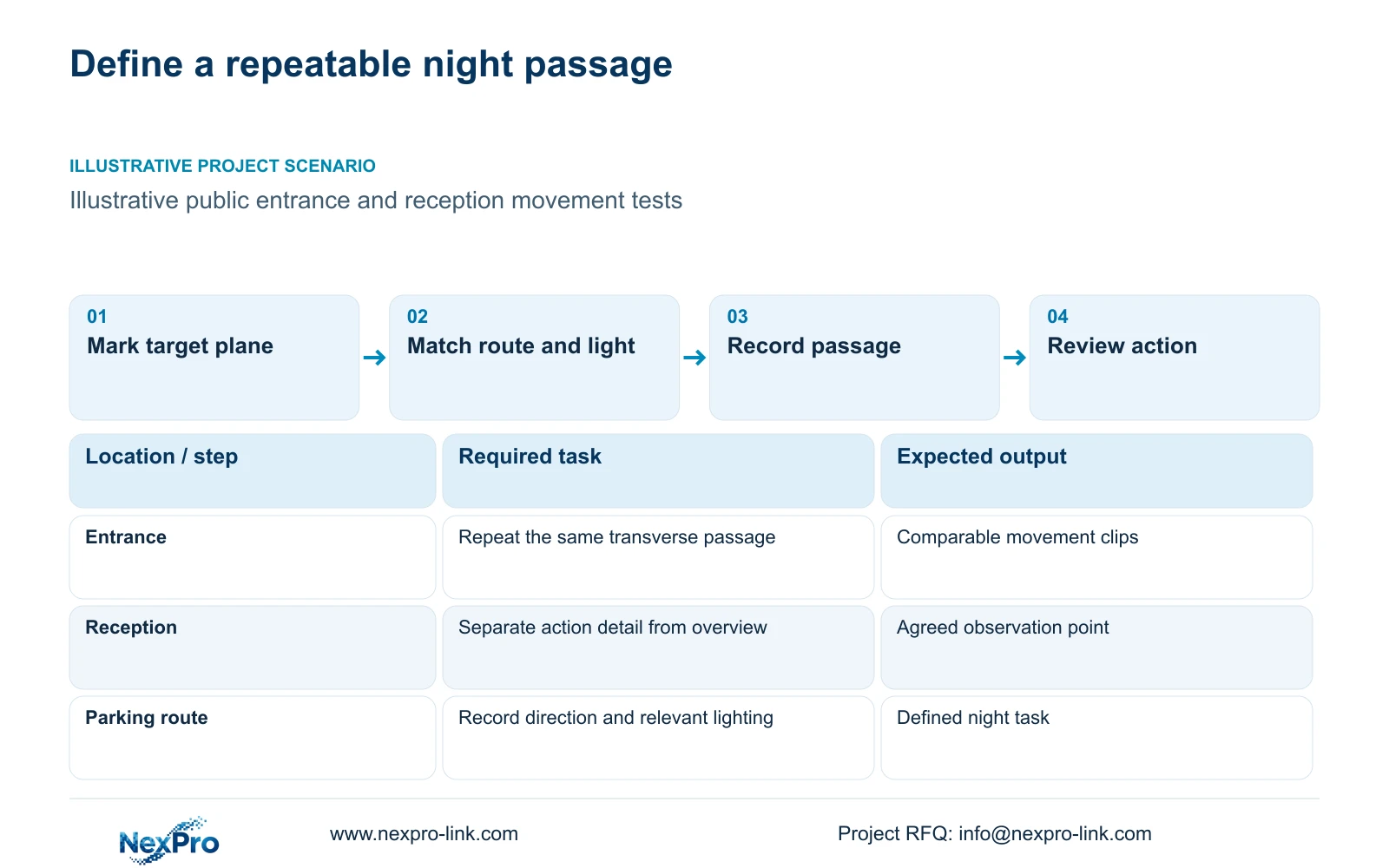
Define the target before choosing settings. An entrance passage, a reception interaction and movement across a parking route place different demands on the view. Record the direction of travel, approximate speed, target plane and the action that an authorized reviewer must interpret. Keep public-route coverage separate from guest-room interiors and other private spaces.
Frame rate controls how often positions are sampled. Exposure controls how far the target moves during a single image. A nominal 25 fps recording can therefore contain frequent blurred images. The acceptance task needs both a sampling requirement and useful detail within the recorded frames, with the actual lighting conditions retained in the test record.
| Required task | Given information | Decision still needed |
|---|---|---|
| Entrance passage | People cross a public observation point | Agree route, speed and required detail |
| Reception interaction | Overview and action detail may differ | Agree target plane and permitted framing |
Section 02
Set comparable scene conditions
Use the same route and observation point for each candidate profile. Keep installation position, target width and relevant lighting consistent wherever the comparison permits. If one option changes the illumination, identify that change as part of the proposed solution rather than attributing the whole result to the camera.
Record the selected illumination mode and its behavior. IR, visible light and event illumination address different requirements, and available controls depend on the exact model. Hotel glass and reflective surfaces can alter the useful image; light near occupied rooms can also constrain the proposal. These conditions may justify changing camera position before purchasing higher resolution.
The supplied DM2812M product PDF lists NexPro-DM2812M55-5MP-DIC-AI with a 2880×1620 main output and a 2.8-12 mm motorized lens. It lists NexPro-DM2812M88-8MP-DIC-AI with 3840×2160 at 25 fps. These are product fields, not night-test results. The lens range does not establish an exact field of view, and the Dome designation does not establish an impact rating.
| Item | Option A | Option B | Effect on the hotel task |
|---|---|---|---|
| Exposure | 1/50 s | 1/250 s | Changes travel within one image |
| Scene lighting | Existing agreed lighting | Revised lighting if needed | Changes the complete solution scope |
| Target route | Agreed public route | Same public route | Keeps movement comparison meaningful |
Section 03
Calculate motion and exposure effects
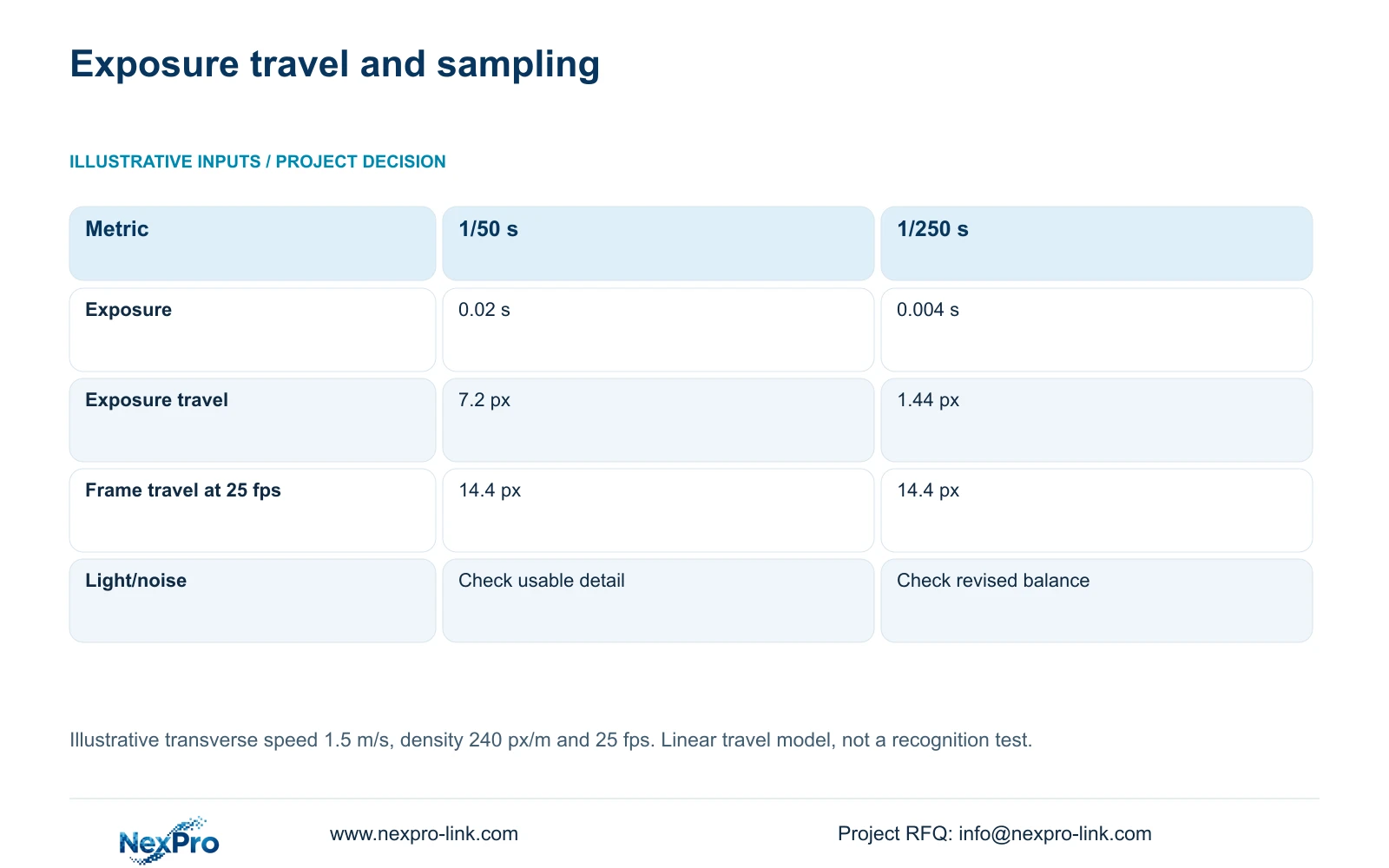
The illustrative calculation assumes transverse movement at 1.5 m/s, a planning image density of 240 pixels per metre and recording at 25 fps. Compare exposure times of 1/50 s and 1/250 s, equal to 0.02 s and 0.004 s. These are teaching inputs, not measured camera settings or recognition results.
Exposure travel in pixels equals speed in m/s multiplied by exposure seconds and pixels per metre. The two results are 1.5 × 0.02 × 240 = 7.2 pixels and 1.5 × 0.004 × 240 = 1.44 pixels. Frame-to-frame travel equals speed divided by frame rate, multiplied by image density: 1.5 ÷ 25 × 240 = 14.4 pixels in both cases.
The shorter exposure reduces the modelled travel within each image while leaving the sampling interval unchanged. This supports testing a shorter exposure when blur limits the task. It does not guarantee that a person or number plate becomes readable, because geometry, lighting, noise and the actual recording remain part of the result.
| Metric / condition | 1/50 s exposure | 1/250 s exposure |
|---|---|---|
| Exposure seconds | 0.02 | 0.004 |
| Transverse image travel during exposure (px) | 7.2 | 1.44 |
| Frame-to-frame travel at 25 fps (px) | 14.4 | 14.4 |
| Additional requirement | Suitable image quality at the light level | Usually needs a different light/noise balance |
Section 04
Review recorded footage under the agreed task
Review the clips retained by the intended recording system. Confirm the stream used for recording, then replay the relevant passage with the agreed client and display arrangement. A preview may use a different stream or show conditions that do not represent the stored material. Record the profile associated with each clip so the comparison remains reproducible.
Watch the complete movement through the observation point before extracting illustrative frames. A selected still can omit the blurred part of the passage or conceal a gap in useful detail. Compare clips with the same route and approximate speed, and note any variation in lighting or illumination triggering that affects interpretation.
Keep observed and predicted results separate. The 7.2 and 1.44 pixel values explain one motion mechanism; the recorded review establishes whether the hotel task works. If the clip cannot preserve the required action, document that outcome and the responsible correction. Repeat the same route after changing settings instead of declaring success from a new static image.
Section 05
Compare qualified camera settings
Compare profiles that retain the required framing and recording service. A shorter exposure can be useful where movement blur dominates, provided the available illumination supports usable detail. If noise or darkness becomes the limiting condition, evaluate a lighting adjustment or a different supported configuration. Raising frame rate alone does not shorten exposure.
Include the cost and operational consequences of the proposed correction. Additional visible lighting may require approval because of guest disturbance or reflections. Moving a camera may change cabling and maintenance access. A higher-resolution camera changes the recording profile that the NVR must support, even when the new image looks better in a single demonstration.
The supplied 32-camera reference case uses 4 Mbps per camera as a planning assumption. That value is independent of this motion calculation and is not a fixed bitrate for either PDF camera. After selecting a usable night profile, review its actual bitrate and recording mode before relying on the existing input-bandwidth or retention budget.
| Retained outcome | Extra scope | When it is worth buying | Counter-condition |
|---|---|---|---|
| Movement detail | Shorter exposure profile | Recorded detail remains usable at available light | Darkness or noise defeats the task |
| Required public view | Lighting or position change | Existing conditions prevent a useful recording | Light interference or coverage boundary is unacceptable |
Section 06
Record the usable operating profile
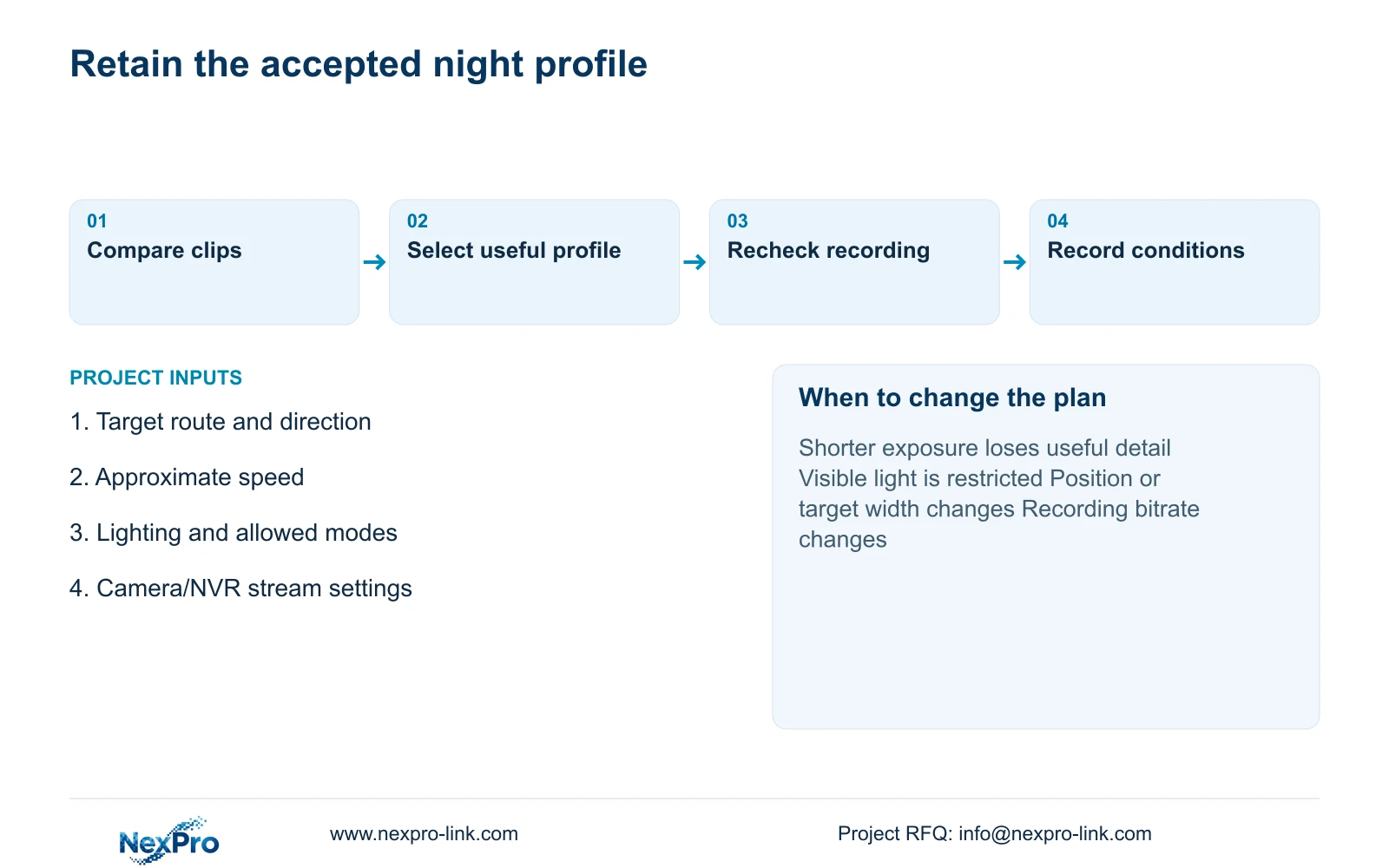
Retain the selected model, firmware, lens setting, exposure behavior, illumination mode and recording profile with the accepted route and conditions. The record should let the installer reproduce the setup and let the operator recognize which views require further attention after a lighting or layout change.
Recommend the shortest supported exposure that preserves the required movement detail under the permitted lighting conditions. Change that recommendation when the resulting recording becomes unusably dark or noisy, or when the hotel's illumination restrictions prevent the proposed mode. Repeat the task after correcting the limiting condition, then check NVR mode support and storage demand.
For a scoped proposal, send the public-zone target route, approximate speed and direction, representative lighting conditions, and intended camera/NVR profile to info@nexpro-link.com. NexPro-Link's hotel project and BOQ support can discuss equipment matching and the associated supply scope. This does not include an assumed night-performance guarantee or local installation service.
Section 07
Buyer questions
Should we replace a camera before testing its night profile? First establish whether framing, exposure or lighting limits the required task. Compare supported settings on the same route. Replace or reposition equipment when those adjustments cannot produce a usable recording within the hotel's permitted conditions.
Does an 8MP specification prove a better night result? No. More output pixels can increase the geometric detail budget at the same target width, but they do not establish movement clarity, noise or illumination behavior. Compare the exact models through recorded task clips.
What evidence is useful for an initial equipment inquiry? Send the route and observation requirement, lighting description and configured stream settings. Guest footage and account credentials are unnecessary for the first inquiry. Any later test material should follow the hotel's authorization process.
Engineering references
These sources support the general planning principles. Always use the selected product's current datasheet and applicable project standards for final design.