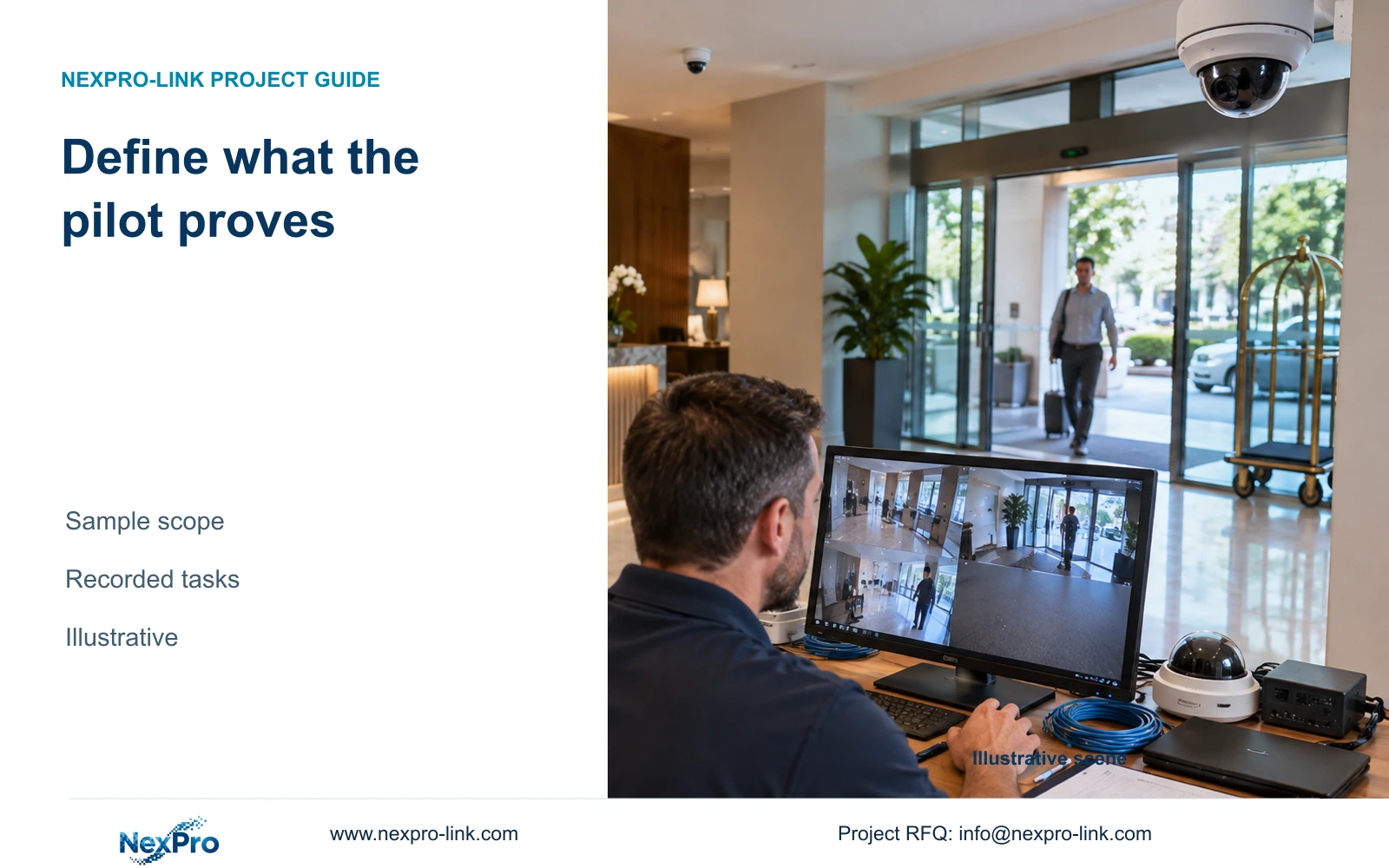
A small hotel CCTV pilot can support a configuration decision when it reproduces the required tasks. Three successful samples do not prove a zero-failure production batch.
Section 01
Select the tasks and models the pilot must represent
Use a small pilot to decide whether a defined camera and system configuration can complete representative hotel tasks. Three successful samples do not justify a claim that the production batch will have zero failures. Expand the pilot when an unrepresented model, environment or interface could change the purchase decision.
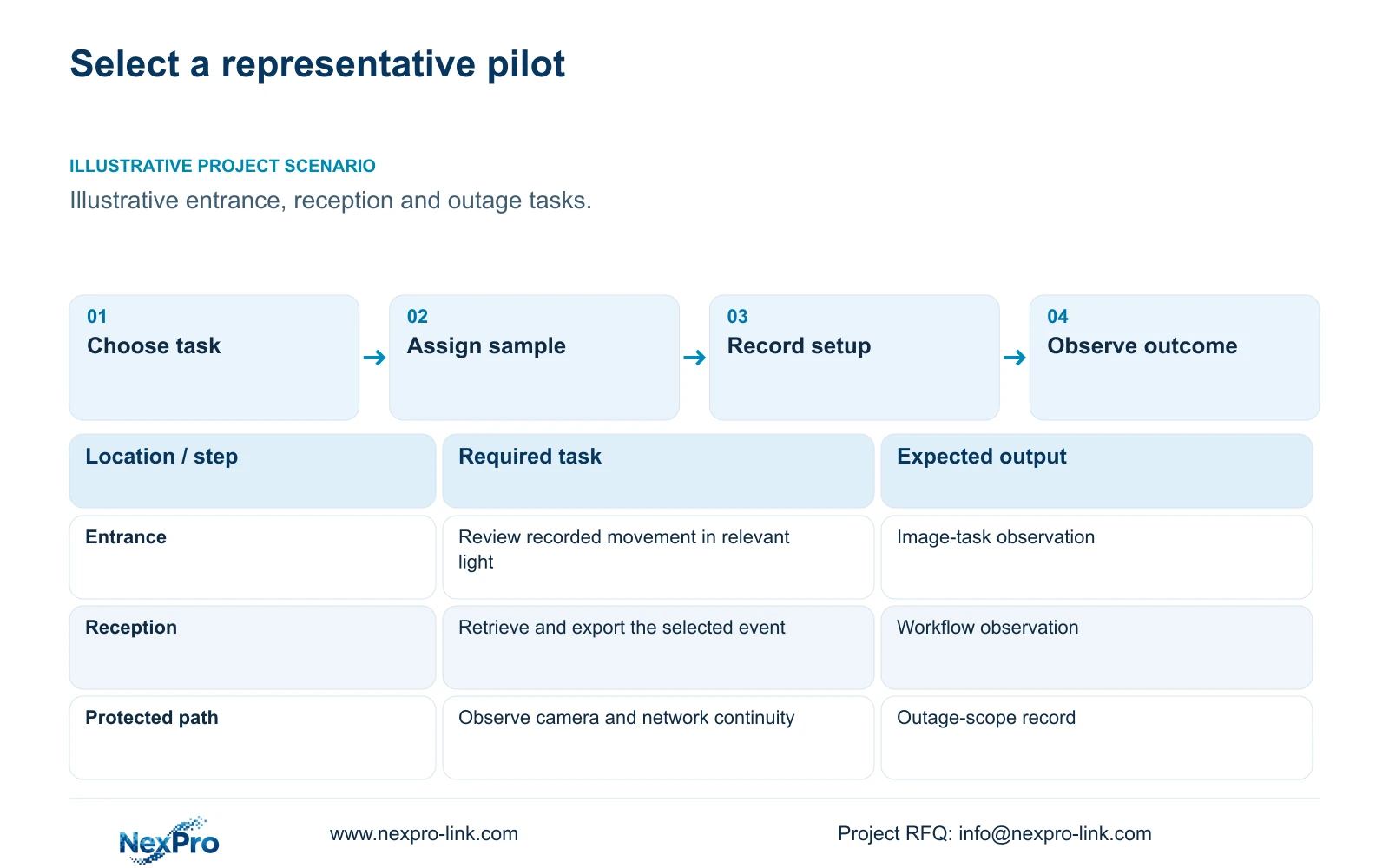
Choose tasks from the proposed camera schedule. An entrance may require useful recorded movement under relevant lighting, while reception may require straightforward incident retrieval. Include the recording and network equipment used for those tasks so the pilot can expose a dependency outside the camera itself.
Avoid choosing samples only because they are convenient to demonstrate. A clear static view from an easy location may leave the difficult entrance task unexamined. Identify which sample represents each proposed role and which project requirement remains outside the trial. The buyer can then distinguish a useful configuration observation from a broad quality statement.
| Required task | Given information | Decision still needed |
|---|---|---|
| Entrance incident review | Proposed view and camera model | Recorded movement and lighting conditions |
| Reception retrieval | Recorder and authorized client | Search and export workflow |
| Outage recording | Proposed camera/network path | Protected components and observation scope |
Section 02
Define exactly what the samples cover
List the individual sample identities and their exact model references. State whether the trial examines one model in several conditions or several models under one condition. These designs answer different questions. Repeating an easy scene with the same device does not establish suitability for every proposed public-zone task.
Describe the observations planned for each sample and the conditions deliberately excluded. A bench trial can support equipment setup and a selected recording workflow. It cannot reproduce every hotel's lighting, installed cabling or access arrangement. Factory observations and site observations should therefore remain separate entries in the project record.
Name the interfaces being examined: camera connection, recorded replay and event behavior are separate observations. For an ONVIF claim, check both device and client entries in ONVIF's Conformant Products database against the installed firmware or software version and required profile features. A matching profile does not prove every audio, event, search or account-binding function. Keep the specific camera-recorder-client trial in the pilot plan.
Select a narrow pilot when the unresolved decision is narrow. Add a representative combination when another lens arrangement, recording profile or client version enters the proposed schedule. The additional scope should answer a specified uncertainty, with its equipment and observation responsibilities made visible.
Section 03
Record configuration and observation conditions
Keep a configuration record beside each observation. Identify the camera, recorder and client versions, together with the selected image and recording settings. Describe the target route, relevant lighting and installed or bench connection. A buyer should be able to tell which setup produced an observed result without relying on a demonstration video alone.
Expected behavior belongs in the acceptance criteria; the result field remains open until the task is performed. If movement detail is the decision point, review the recorded movement at the agreed location. If export is required, record the actual retrieval and playback observations. Do not prefill successful outcomes from a specification sheet.
Separate published fields from trial assumptions. A selected product specification can establish its listed resolution or lens range. It cannot provide a missing peak-power value or prove performance under the trial lighting. If a required input is absent, request that input or narrow the conclusion instead of borrowing a value from another model.
Keep any supplied product-source conflict visible in the proposed configuration. For example, the NexPro-NVR2232-4K record contains differing disk-capacity and replay descriptions. A pilot using one specific configuration does not resolve those descriptions for every purchase option; the order configuration still needs an explicit supported scope.
Section 04
Compare functional observations with preview impressions
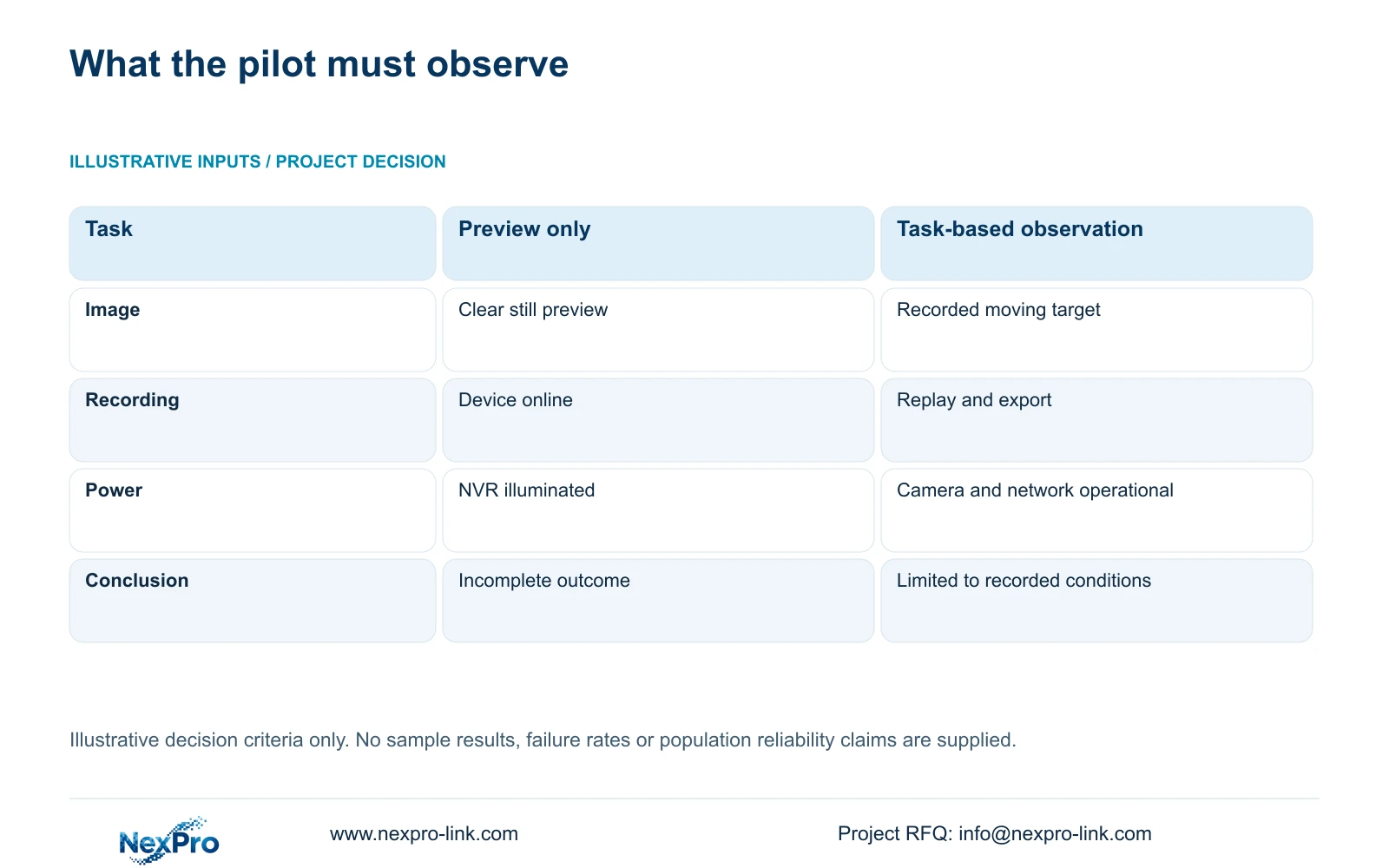
The following decision matrix compares preview-only acceptance with task-based acceptance. It contains illustrative criteria, not completed site observations. Choose the second approach when the purchase depends on useful recorded footage, retrieval or outage operation, because it defines the outcome that the trial must demonstrate.
Draw the data path separately from the power path. A recorder remaining illuminated can coexist with an unavailable camera or access switch. For an outage task, the observation must follow the required camera and network path into recording. An optional display can be evaluated separately without becoming a recording dependency.
Compare alternatives with the same essential task retained. A larger display or additional recovery feature should not hide reduced recording quality or an unprotected network node. Describe the result of each observed task and any remaining dependency, without turning the comparison into an unsupported brand ranking.
| Metric / condition | Preview-only acceptance | Task-based acceptance |
|---|---|---|
| Image | A still preview appears clear | Recorded moving target reviewed at the agreed point |
| Recording | Device online | Relevant footage can be replayed and exported |
| Power | NVR stays illuminated | Required camera and network path remains operational |
| Result status | Cannot prove complete outcome | Record actual observations; not pre-filled passes |
Section 05
Separate observed sample results from batch claims
Report the observations at their actual scope. If the three illustrative samples complete the defined tasks, the conclusion concerns those samples and configurations under the recorded conditions. It does not establish a population failure rate, service life or reliability across the entire product series.
Production consistency and site suitability require their own corresponding work. The buyer should preserve exact model and configuration identity between the trial and the proposed order, then define the receipt and site acceptance activities. A successful factory pilot does not complete installed acceptance for every camera route.
When a sample fails, describe the incomplete task and assign an action owner. Correct the configuration or equipment issue and repeat the same observation. A replacement sample that works in a different scene does not explain the original failure. Keep the original condition visible until the engineer can determine what changed.
Additional samples are useful when they cover missing roles or configurations. They should not be purchased merely to produce a larger-looking count. The reason for expanding the trial should be tied to an uncertainty that can affect the specification, supply scope or operating outcome.
Section 06
Use the findings to refine the project specification
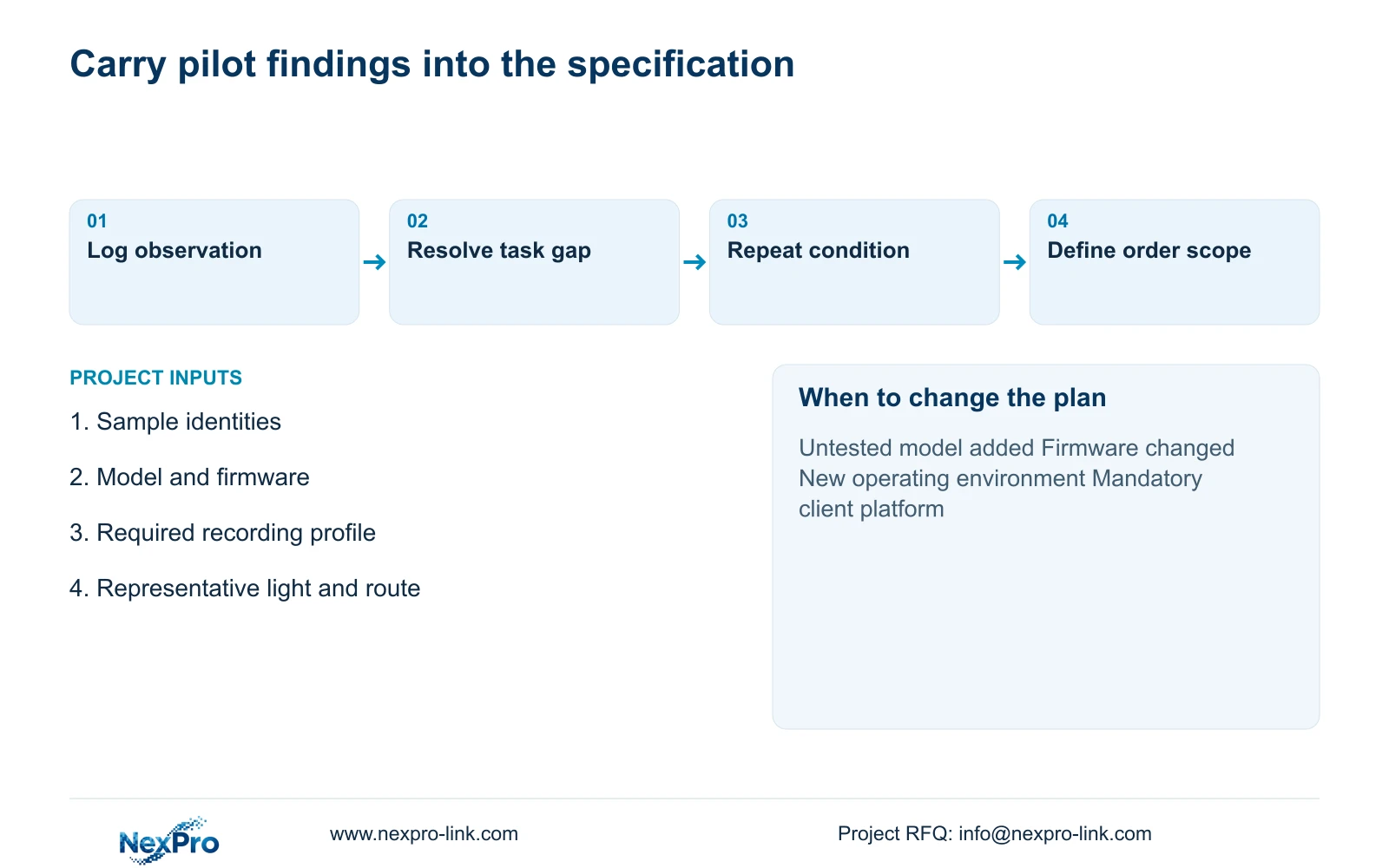
Translate findings into configuration requirements and repeatable acceptance tasks. Retain the tested image profile, relevant equipment identities and required workflow. Record limitations as unresolved requirements or explicit exclusions, so an unobserved function cannot enter the order as an assumed capability.
Proceed with the pilot-supported configuration when it completes the representative tasks and the proposed order preserves the relevant setup. Reopen the affected observations when a model, firmware, stream profile or operating environment changes materially. A mandatory hotel platform can also require a different trial combination even when the camera's basic image task remains unchanged.
Send the representative tasks, sample model list, firmware references and unresolved observation conditions to info@nexpro-link.com. NexPro-Link can discuss model matching, technical documents and coordinated equipment scope through its hotel project and BOQ support routes. Its CCTV manufacturing core and supporting equipment coordination should be identified separately; local observation responsibilities remain part of the agreed project scope.
Section 07
Buyer questions
Are three samples enough to select a camera? They may be enough for a narrowly defined configuration decision if they represent the relevant tasks. They are insufficient grounds for a zero-failure batch claim. Identify missing environments or interfaces before deciding whether more trial scope is needed.
Does a firmware change require another pilot? Review the tasks that depend on the changed configuration and repeat the affected observations. Keep the earlier result tied to its original version instead of transferring its acceptance automatically to the new setup.
What pilot evidence is useful for a quotation? Provide the equipment identities, tested profiles and a short list of observed and unresolved tasks. This allows the proposed order to preserve the relevant configuration while pricing additional interfaces or support separately.
Engineering references
These sources support the general planning principles. Always use the selected product's current datasheet and applicable project standards for final design.